St. Nicholas Day

St. Nicholas Day is December 6, the feast of St. Nicholas, the 4th-century bishop of Myra known for giving in secret. On the evening before, children in much of Europe and in parts of the United States set out shoes or stockings and wake to find sweets, fruit and small gifts. Churches on the Julian calendar keep it on December 19.
What is St. Nicholas Day?
St. Nicholas Day is the feast of St. Nicholas, bishop of Myra on the southern coast of present-day Turkey, who died on December 6 around the year 343. It is one of the oldest saints' days still kept as a family holiday. The Catholic, Anglican and Lutheran calendars keep it on December 6, as do most Orthodox churches. Churches that still follow the old Julian calendar, such as the Russian and Serbian Orthodox, keep it on December 19.
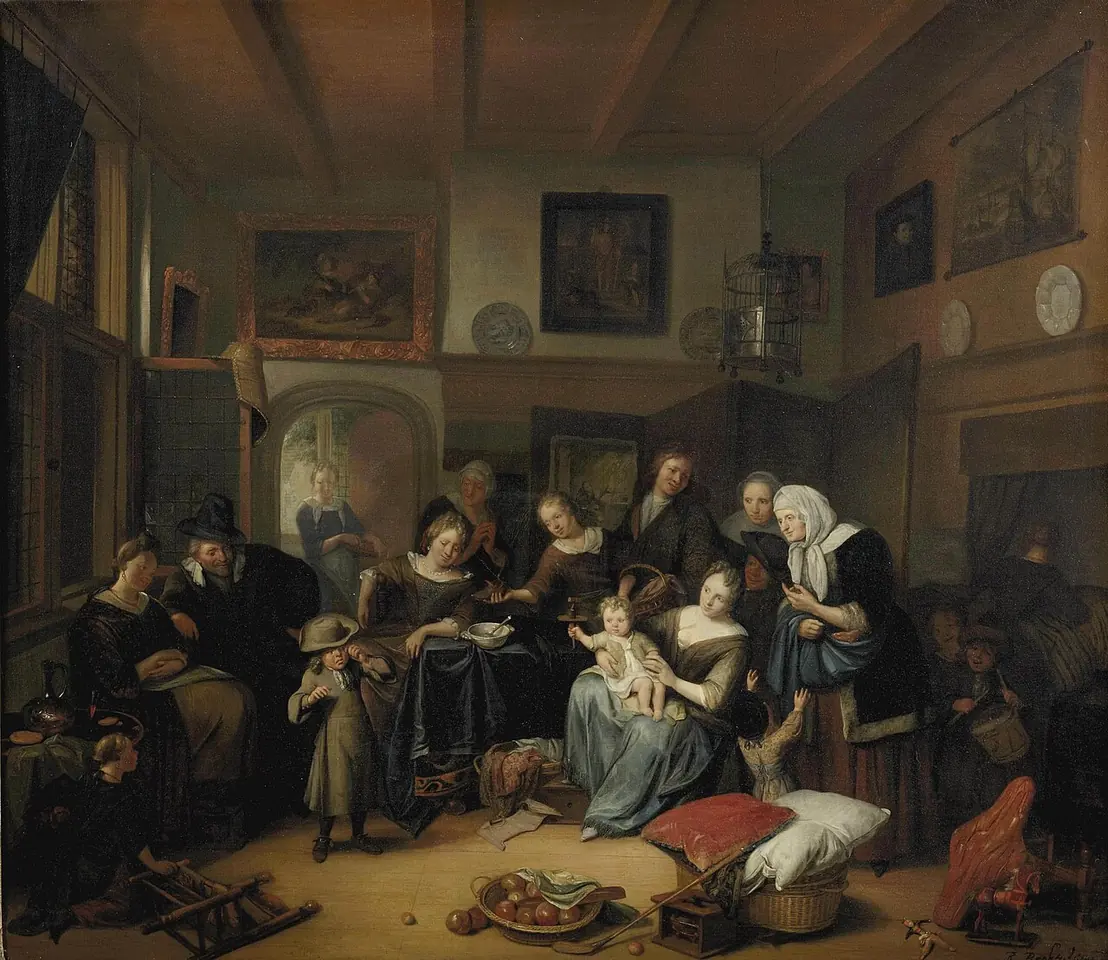
What makes the day different from most feasts is its hour. Much of the celebration happens the night before. On the evening of December 5, children across Europe set out a shoe or boot, and in the morning they find it filled with fruit, nuts, cookies and small gifts. In the Netherlands the main party is that evening. In parts of the American Midwest, children hang stockings.
This page is about the day and its customs. For the life of the saint himself, the miracles told about him and his relics, see our full entry on St. Nicholas of Myra.

When is St. Nicholas Day?
- December 6: the feast in the Western churches and most Orthodox churches. In 2026 it falls on a Sunday.
- December 5: St. Nicholas Eve, when shoes go out. The Dutch call it pakjesavond, "parcels evening," and give their gifts then.
- December 19: the feast for Orthodox churches on the Julian calendar.
- May 9: a second feast, for the arrival of his relics in Bari in 1087 (May 22 on the Julian calendar).
Because December 6 usually falls in the first or second week of Advent, many parishes hold a St. Nicholas breakfast or visit on the nearest Sunday. He belongs to a run of December saints that includes St. Barbara on December 4, Our Lady of Guadalupe on December 12 and St. Lucy on December 13. The full month is on our feast days page.
Why shoes and stockings? The three bags of gold
Almost every St. Nicholas Day custom goes back to one story, which this site labels traditional. A poor man had three daughters and no money for their dowries; without them, the girls could not marry and were in danger of being sold. On three nights Nicholas came in the dark and tossed a bag of gold through the window, one for each daughter. On the third night the father caught him, and Nicholas begged him to tell no one.
The story comes from the lives of Nicholas written centuries after his death, but it is the one tradition about him that some historians think may hold a memory of a real act. It shaped everything that followed. Gifts on his feast come at night, in secret, and are found in the morning. Later tellings have the gold land in stockings or shoes left by the fire to dry, which folk tradition gives as one origin of the Christmas stocking. The three gold balls in his pictures are those bags, and the oranges, mandarins and chocolate coins in children's shoes stand for the same gold.

St. Nicholas Day traditions around the world
The Netherlands: Sinterklaas
No country keeps the feast with more energy. In mid-November Sinterklaas "arrives from Spain" by steamboat, in red bishop's robes and a tall miter, and rides through town on a white horse. The official arrival is broadcast live on national television, and nearly every town holds its own parade. For the next three weeks children sing Sinterklaas songs and set a shoe by the fireplace or the heater with a drawing, a wish list and a carrot or hay for the horse.
Until the 1940s Dutch children found their presents on the morning of December 6, according to the St. Nicholas Center. The party then moved to the eve, December 5. Families exchange gifts signed only "from Sinterklaas," each with a teasing rhyme, and the more cleverly disguised the package, the better. Tangerines are part of the season too; the St. Nicholas Center reports that the grocer Albert Heijn sells around 18 million in the week of December 5.
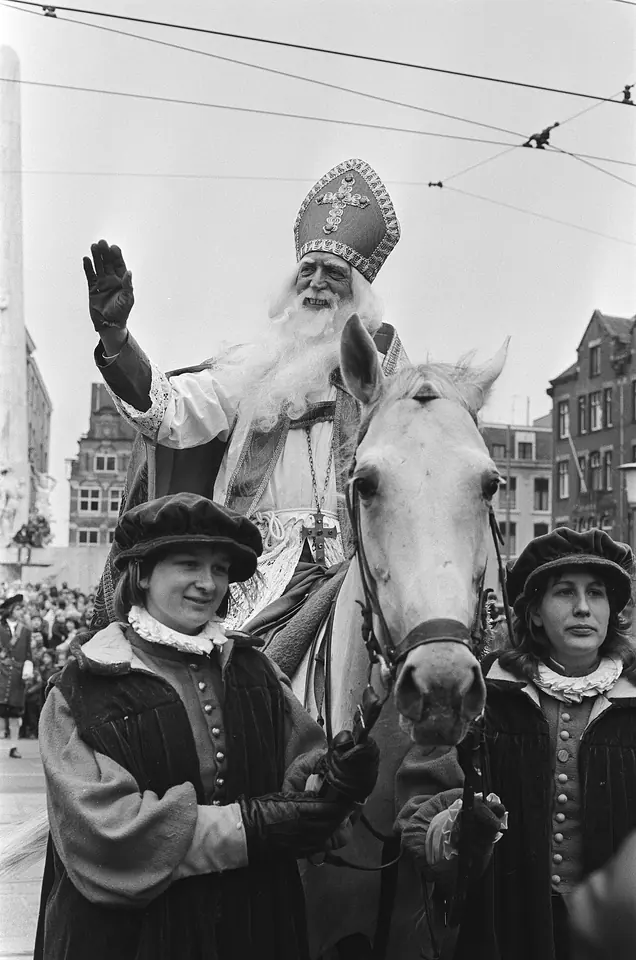

Zwarte Piet. The saint's helpers have been the center of a long national argument. The servant called Zwarte Piet ("Black Pete") first appears in an 1850 picture book by the Amsterdam schoolteacher Jan Schenkman, and for most of the 20th century he was played by people in blackface makeup, with red lips and gold earrings. Critics, many of them Black Dutch citizens, have called this a racist caricature; defenders saw a harmless children's character. The debate grew sharper after a United Nations human rights body raised concerns in 2013. Since then many organizers have switched to "sooty Piets," helpers with only a few smudges of chimney soot on their faces. Amsterdam made the change in 2017, and the national arrival used only sooty Piets from 2019. The St. Nicholas Center cites polls showing support for the traditional blackface figure falling from 89 percent in 2013 to 47 percent in 2020. Some smaller towns still keep the older figure.
Belgium
In Flanders Sinterklaas arrives in Antwerp by steamer in mid-November and greets the crowd from the town hall balcony; in French-speaking Belgium Saint Nicolas reaches the Grand Place in Brussels the weekend before his feast. Belgian children write him letters, and the postal service answers them. Hundreds of thousands arrive each year, addressed to Sinterklaas, Spanjestraat 1, 0612 Hemel ("Spain Street 1, Heaven"), or the French equivalent, and no stamp is needed. On the eve, children leave shoes or small baskets by the hearth with hay, carrots and a sugar lump for the horse.
Germany
In Catholic southern Germany, Sankt Nikolaus still comes as a bishop with miter and crozier. Children clean and polish their boots and put them outside the door or on a windowsill on December 5, with a letter and a carrot for his horse or donkey. In the morning the good ones find apples, nuts, oranges and chocolate. Some families arrange a home visit, in which Nikolaus arrives with a big book of the children's deeds and asks each child whether they have done their homework and helped their parents. His companion in much of Germany is Knecht Ruprecht, who carries switches and lumps of coal.
Austria and Krampus
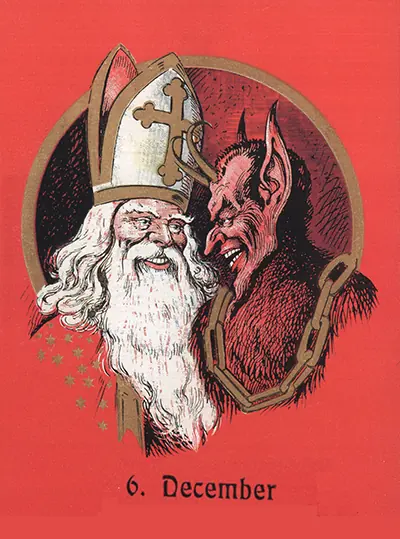
Austrian children also set out shoes, and Nikolaus visits most kindergartens and primary schools. Alongside him often comes the Krampus: a horned figure in fur and chains with a long red tongue, who threatens naughty children with a bundle of switches. The St. Nicholas Center says he appears in the 16th and 17th centuries as an anti-Nicholas, not as a leftover pagan god, as is often claimed. Today's Krampus parades are big, noisy events; Salzburg's draws 1,500 to 2,000 costumed Krampuses on the last Saturday in November.

France
In eastern France, above all Lorraine, which claims Nicholas as its patron, the feast is still a children's day with parades and gingerbread. The region's favorite story is a grim one: the traditional legend of three little boys killed by a butcher and hidden in his salting tub, whom Nicholas brings back to life. French children have sung it for generations in the song "Il était trois petits enfants."


Poland and Ukraine
In Poland, Święty Mikołaj comes as a dignified bishop with a crozier, sometimes with an angel. Children recite prayers before he hands out holy pictures, apples and pierniki, honey-spice cookies; if he doesn't come in person, treats appear under pillows or in polished shoes.
Ukrainians call him Sviatyi Mykolai. For centuries his day was December 19, but in 2023 the Ukrainian Greek Catholic Church and the Orthodox Church of Ukraine moved to the new calendar, so most Ukrainian families now celebrate on December 6. Children write to him on the eve and find gifts under their pillows in the morning. The day is also a time of organized charity: the Ukrainian Catholic University in Lviv has run a campaign called "St. Nicholas Travels Around Ukraine," collecting gifts for poor children, since 2000.
Lebanon
Lebanese Christians, Greek Orthodox, Armenian, Maronite and Melkite alike, honor Mar Nkoula. Beirut's Achrafieh district has the long public Stairs of Saint Nicholas, which run past the Greek Orthodox church of St. Nicholas and have hosted open-air art exhibitions since 1973, and a public St. Nicholas Garden across from the Greek Orthodox cathedral of the same name.
The United States
German, Dutch and Ukrainian immigrants brought the feast to America. Towns founded by the Dutch, such as Holland, Michigan, and Pella and Orange City, Iowa, hold Sinterklaas parades. German Sankt Nikolaus customs survive in New Ulm, Minnesota, in Pittsburgh, Cincinnati, Cleveland and St. Louis, and above all in Milwaukee. There, children hang a stocking on St. Nicholas Eve with their Christmas wish list; St. Nick collects the list and leaves candy and small toys, or coal as a warning with three weeks still to go before Christmas. Orthodox, Catholic and Episcopal parishes across the country hold St. Nicholas breakfasts and visits on the nearest Advent Sunday.
St. Nicholas Day foods
- Speculaas: thin, crisp spice cookies pressed into carved wooden molds, often in the shape of the saint on his horse. Dutch and Belgian bakeries fill their windows with them from November.
- Pepernoten and kruidnoten: small spiced cookies the Piets toss to children.
- Chocolate letters: a chocolate initial for each person, set at their place at the table on December 5.
- Mandarins and oranges: the gold of the three daughters. The St. Nicholas Center says tangerines reached the Netherlands from Spain in the early 1800s and came to stand for that gold.
- Chocolate coins: the same idea in foil.
- Pierniki, Lebkuchen and gingerbread bishops: across Central Europe, often decorated with icing.
- Bisschopswijn: "bishop's wine," a warm spiced wine for the adults.


The boy bishop
For several centuries the feast also turned the church upside down. The Catholic Encyclopedia explains that cathedrals, monasteries and schools across Catholic Europe, and especially England, chose a boy from the choir or school on St. Nicholas Day to be "bishop." Dressed in full vestments, he led his companions in procession, blessed the people and presided at the services until Holy Innocents' Day on December 28. The custom honored the young Nicholas, who tradition says was made a bishop while still a layman, and it was a lesson in humility for the adults who served the boys.
It also got out of hand. The Council of Basel suppressed it on the Continent in 1431, though it came back in places into the 18th century. In England Henry VIII abolished it, his Catholic daughter Mary restored it, and Elizabeth I ended it again. Salisbury Cathedral and a few other churches have revived the boy bishop in modern times. Our page on Holy Innocents tells the other end of the story.


How Sinterklaas became Santa Claus
The popular story says Dutch settlers brought Sinterklaas to New Amsterdam. The St. Nicholas Center, which has studied the question closely, finds little evidence for it. The American Santa Claus was mostly invented in New York in the half-century after the Revolution:
- 1809: Washington Irving's satirical Knickerbocker's History of New York, published on St. Nicholas Day, filled the city's Dutch past with a jolly, pipe-smoking Nicholas who came down chimneys. Most of the "old Dutch" St. Nicholas legends of New York start here.
- 1810: The New-York Historical Society held its first St. Nicholas dinner on December 6 and commissioned a print of Nicholas with stockings hung at a fireplace.
- 1821: A children's book, The Children's Friend, brought "Santeclaus" on a reindeer sleigh, on Christmas Eve instead of December 6.
- 1823: On December 23 the Troy Sentinel printed, anonymously, "A Visit from St. Nicholas," which begins "'Twas the night before Christmas." It gave the world the eight reindeer, the chimney and a "right jolly old elf." It is usually credited to Clement Clarke Moore, though a case has been made for Henry Livingston.
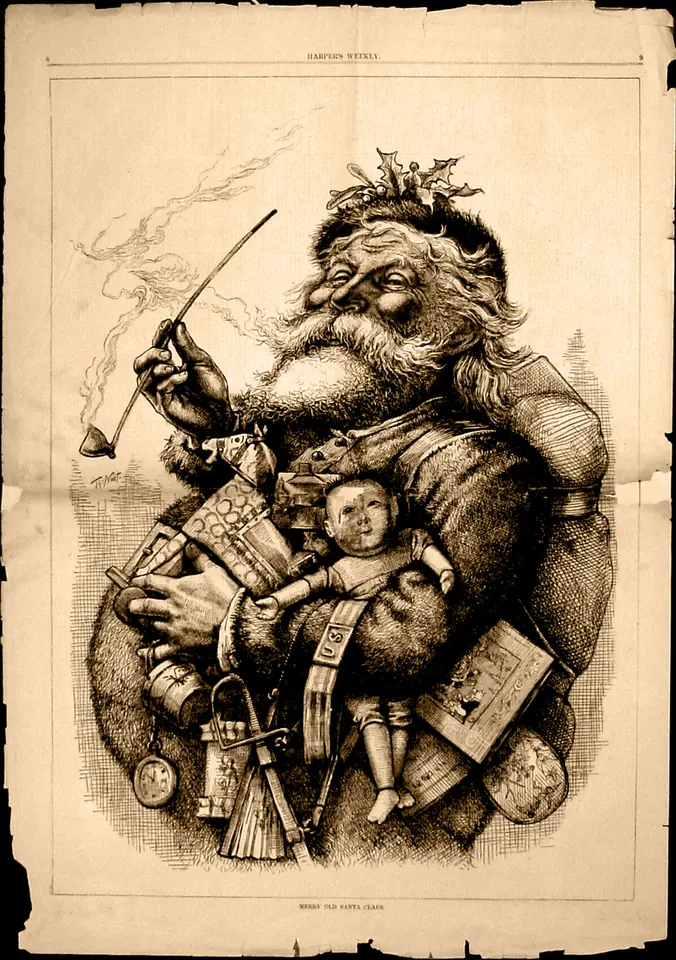
- 1863 to 1886: Thomas Nast's drawings for Harper's Weekly fixed the look: a fur-trimmed, white-bearded, round man with a workshop and a sack of toys.
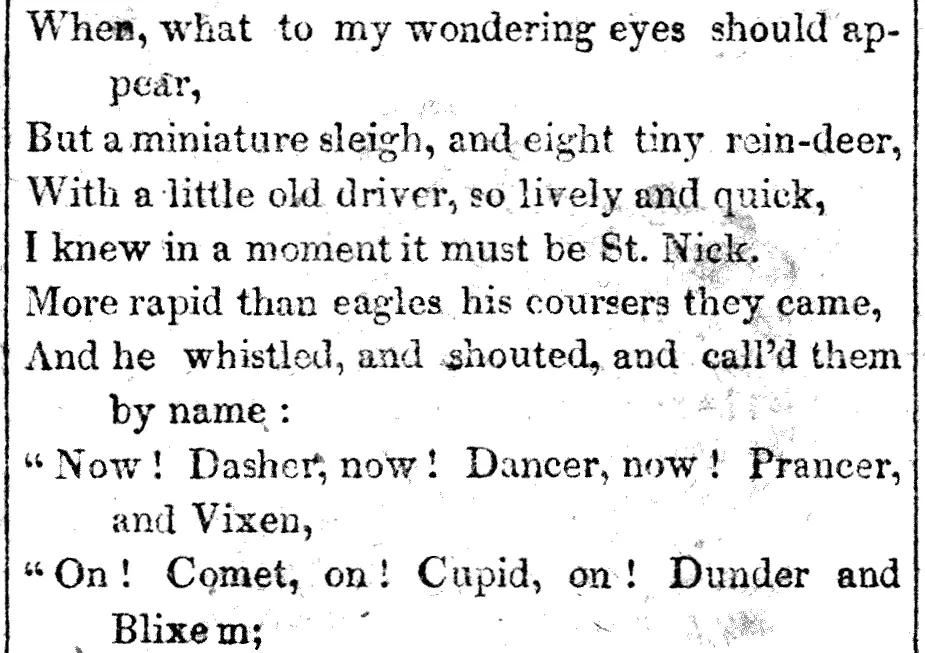

By the late 1800s Santa Claus had moved to Christmas Eve and lost his miter. Many families who keep St. Nicholas Day today do so partly to remember the bishop behind him.

St. Nicholas in Bari
Most of St. Nicholas's bones have rested since 1087 in the crypt of the Basilica di San Nicola in Bari, in southern Italy, after sailors from the city carried them from Myra. Venice keeps the smaller fragments left behind. The basilica is served by Dominican friars and draws both Catholic and Orthodox pilgrims, and its crypt has an Orthodox chapel. December 6 is kept there with the liturgy, but Bari's great festival is in May, for the arrival of the relics. The full story of the relics, the "manna" of St. Nicholas and the Bari–Venice question is in our St. Nicholas entry.
A prayer for St. Nicholas Day
This is the old Latin collect for St. Nicholas, as it appears in medieval Books of Hours and in the traditional Roman Missal (text from the St. Nicholas Center's edition of the Book of Hours suffrage):
Deus qui beatum Nicolaum pontificem tuum innumeris decorasti miraculis: tribue nobis quaesumus ut eius meritis et precibus a gehennae incendiis liberemur. Per dominum nostrum Iesum Christum filium tuum.
In plain English (our translation): "O God, who adorned your blessed bishop Nicholas with countless miracles, grant us, we pray, that by his merits and prayers we may be delivered from the fires of hell. Through our Lord Jesus Christ, your Son." Eastern Christians sing the troparion of St. Nicholas, printed on his saint page.
Ideas for keeping St. Nicholas Day at home
- Shoes on the eve. Have the children polish one shoe each and set it by the door on December 5. Fill it simply: a mandarin, a few chocolate coins, a cookie, perhaps a holy card of the saint.
- Tell the story. Read the three bags of gold aloud, and explain that the mandarin is the gold.
- Give in secret. Nicholas never wanted credit. Leave a bag of groceries at a neighbor's door, or pay a lunch-account balance at school, and tell no one.
- Bake. Speculaas or a simple gingerbread bishop are easy with children.
- Go to Mass or the Divine Liturgy if the feast falls on a weekday, or join a parish St. Nicholas breakfast.
- Keep Santa in his place. Many families explain that Santa Claus is a story that grew out of a real, holy man, and let December 6 belong to Nicholas.

The season goes on from here: the St. Andrew Christmas novena runs through these same weeks, Mexican families begin Las Posadas on December 16, and the Christmas season ends with the Magi and the Epiphany house blessing.
Frequently asked questions
When is St. Nicholas Day?
December 6 in the Catholic, Anglican, Lutheran and most Orthodox calendars. In 2026 it falls on a Sunday, so the eve is Saturday, December 5. Orthodox churches that still follow the Julian calendar, including the Russian and Serbian churches, keep it on December 19. The Dutch hold their main celebration on the eve, December 5.
What is St. Nicholas Day?
It is the feast day of St. Nicholas, bishop of Myra in present-day Turkey, who died around 343. Because of the legend that he secretly gave three bags of gold to a poor family, the day became a children's gift-giving feast. In most places children set out shoes, boots or stockings on the night of December 5.
Why do children put out shoes on St. Nicholas Eve?
The custom recalls Nicholas giving in secret. Children leave a shoe or boot by the door, hearth or window, often with a letter or drawing and a carrot or hay for the saint's horse, and find it filled the next morning. In Milwaukee and some other German-American communities, children hang stockings instead.
What do you eat on St. Nicholas Day?
Spiced speculaas cookies, pepernoten and chocolate initial letters in the Netherlands and Belgium; honey-spice pierniki in Poland; apples, nuts and chocolate in Germany and Austria. Mandarins and gold-wrapped chocolate coins appear almost everywhere, standing for the gold Nicholas gave away.
Is St. Nicholas the same as Santa Claus?
Santa Claus grew out of St. Nicholas. New York writers revived him after the American Revolution, starting with Washington Irving in 1809; the 1823 poem "A Visit from St. Nicholas" and Thomas Nast's drawings from the 1860s onward turned him into the Santa Claus Americans know and moved his visit to Christmas Eve.
Who is Krampus?
A horned, chained figure in fur who goes with St. Nicholas in Austria and nearby Alpine regions to frighten children who misbehave. The St. Nicholas Center notes that he appears in the 16th and 17th centuries as a counterpart to the saint, rather than as a survival of an older pagan figure. Krampus parades are held in late November and early December.
Sources
- St. Nicholas Center: Origin of Santa
- St. Nicholas Center: Netherlands
- St. Nicholas Center: Evolution of (Zwarte) Piet
- St. Nicholas Center: Piet, More Sooty Piets
- St. Nicholas Center: Germany
- St. Nicholas Center: Austria
- St. Nicholas Center: Belgium
- St. Nicholas Center: Poland
- St. Nicholas Center: Ukraine
- St. Nicholas Center: Lebanon
- St. Nicholas Center: United States
- St. Nicholas Center: Boy or Youth Bishops
- St. Nicholas Center: Suffrage to Saint Nicholas (Latin collect from a Book of Hours)
- Catholic Encyclopedia (1907): Boy-Bishop
- Catholic Encyclopedia (1911): St. Nicholas of Myra
- Troy Sentinel, December 23, 1823, page 3 (NYS Historic Newspapers)
- Poetry Foundation: A Visit from St. Nicholas
- Basilica di San Nicola, Bari (official site)