Las Posadas
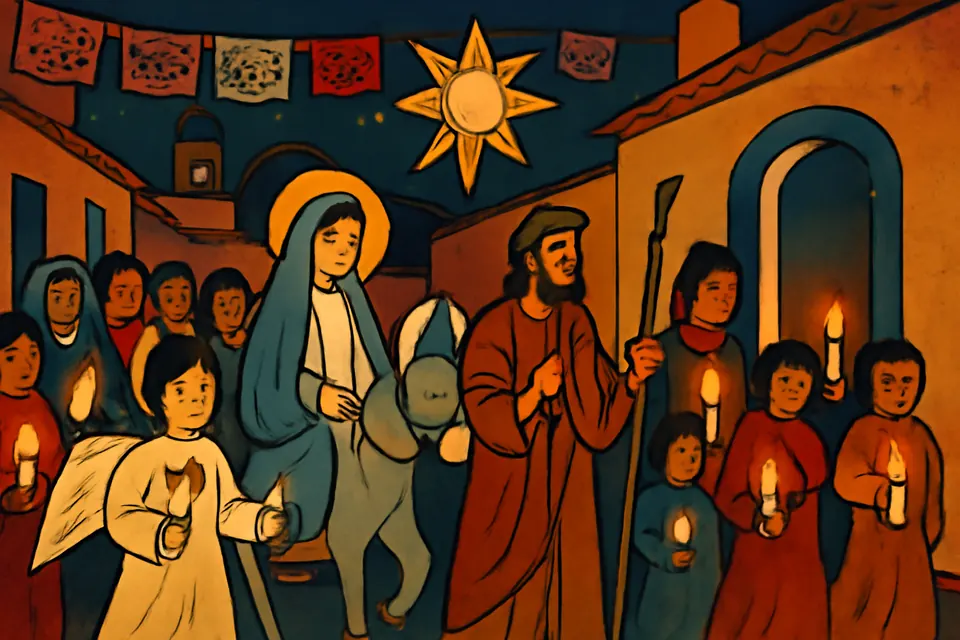
Las Posadas is a nine-night Christmas novena, held from December 16 to December 24, in which neighbors re-enact Mary and Joseph's search for lodging in Bethlehem. Each night a candlelit procession goes from door to door singing for shelter, is turned away, and is finally welcomed in for prayer, food and a piñata. It began in 16th-century Mexico.
What is Las Posadas?
Las Posadas is a nine-night Christmas devotion, kept from December 16 to December 24, in which a community walks with Mary and Joseph as they look for a place to stay in Bethlehem. Posada means "inn" or "lodging," and the plural names the nine nights. Each evening a procession, carrying small figures of the Holy Family or led by children dressed as Mary and Joseph, stops at the doors of several houses and asks for shelter in song. The people inside sing back that there is no room. At the last house the door opens, the pilgrims are welcomed, and the night turns into prayer, food and a piñata for the children.
It is Mexico's best-loved Advent custom. It is also kept in Guatemala, El Salvador and Honduras, and by Mexican-American families and parishes across the United States.
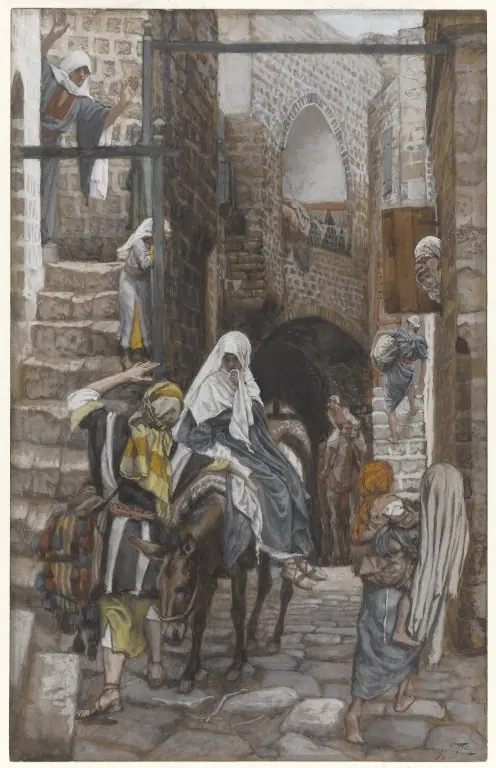
The whole devotion grows out of one verse of St. Luke's Gospel, given here in the Douay-Rheims translation:
And she brought forth her firstborn son, and wrapped him up in swaddling clothes, and laid him in a manger; because there was no room for them in the inn.

When is Las Posadas 2026?
Las Posadas does not move. It begins every year on December 16 and ends on Christmas Eve.
- First posada: Wednesday, December 16, 2026
- Last posada: Thursday, December 24, 2026, Christmas Eve
The nine nights make a novena, the Catholic custom of praying for nine days before a great feast. Mexican tradition adds two other meanings: the nine months Mary carried Jesus, and the days of the journey from Nazareth to Bethlehem. The Gospel gives no length for the journey; the nine days were fitted to the novena, as the Mexican writer José de Jesús Beaumont Galindo points out. The posadas follow closely on the feast of Our Lady of Guadalupe on December 12, so in Mexico the two run together into one long season of devotion.
Where Las Posadas came from
The Augustinians of Acolman
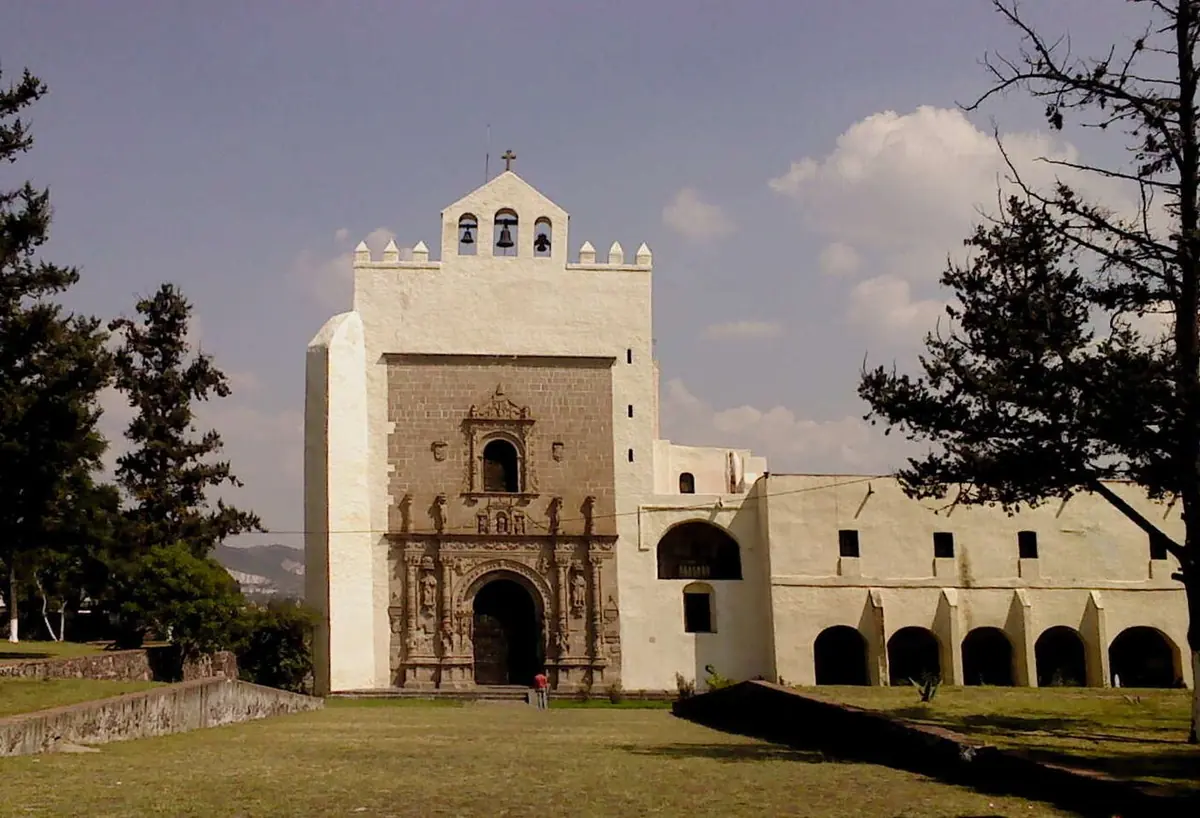
The posadas are traced to the Augustinian friars of San Agustín Acolman, a convent built in the 16th century near the pyramids of Teotihuacán, northeast of Mexico City. In a video for the Archdiocese of Mexico, Father José de Jesús Aguilar explained that the friars found the native peoples keeping night festivals with songs and lights around the winter solstice. The Mexica (Aztec) month of Panquetzaliztli, which fell in December, honored the war god Huitzilopochtli. The missionaries, he said, "took advantage of the nocturnal celebrations of pre-Hispanic origin and gave them a new meaning: accompanying Mary and Joseph on their pilgrimage to Bethlehem, looking for lodging."

The papal permission: 1586 or 1587?
The story always told is that an Acolman friar, Fray Diego de Soria, obtained permission from Pope Sixtus V to celebrate special Masses called misas de aguinaldo, "Christmas-gift Masses," on the nine days from December 16 to 24. They were said in the open courtyards (atrios) of the mission churches, where large crowds of native converts could gather. Most Mexican Catholic sources, including the Archdiocese of Mexico's account and Catholic.net, date the permission to 1587; others, including the English Wikipedia, give 1586. Sixtus V reigned from 1585 to 1590, so either year is possible. We could not find the text of the papal document itself in print, so this page treats the date as traditional: widely repeated, plausible and not yet verified from the original.
From Mass to neighborhood
Over time, devotions grew up around the Masses: a procession of the pilgrims, the singing of the Litany of Loreto, the sung request for lodging and, eventually, the piñata. According to Beaumont Galindo, by the end of the 18th century the posadas had become a custom of their own, separate from the Masses and held in the streets, courtyards and homes of New Spain. Families added food, music and the aguinaldo, a small gift for every guest.

How a posada works
A typical posada needs a few houses, two groups of people and a lot of candles.
- The pilgrims gather. Neighbors meet at dusk with candles, often in paper shades. Some carry the peregrinos, small statues of Mary on a donkey and Joseph, on a decorated litter; in other places children play Mary and Joseph, with an angel, shepherds and sometimes a real donkey.
- The rosary or litany. Many groups pray a decade or the whole rosary and sing the Litany of Loreto as they walk.
- Asking for lodging. At each chosen house, the group outside sings the verses of the pilgrims and the household inside answers with the innkeeper's verses, refusing.
- The door opens. At the last house the innkeepers recognize Mary and Joseph, the door opens, and everyone sings the welcome as the pilgrims come in and kneel at the Nativity scene.
- The party. Then come the ponche, the tamales, the aguinaldos and the piñata.

The song for asking lodging
The song, called pedir posada or the letanía para pedir posada, is a sung dialogue between the pilgrims outside and the innkeepers inside. It is an anonymous folk text handed down for generations, and its wording varies from town to town. These verses are as printed in a recent Mexican newspaper collection of the traditional text; the English is our own plain translation.
The pilgrims (outside):
En el nombre del cielo os pido posada,
pues no puede andar mi esposa amada.
In heaven's name I ask you for lodging, for my beloved wife can walk no farther.
The innkeepers (inside):
Aquí no es mesón, sigan adelante.
Yo no puedo abrir, no sea algún tunante.
This is no inn; keep going. I can't open up; you might be some rogue.
The exchange goes back and forth. Joseph says he is a carpenter from Nazareth, and the innkeeper grumbles that he doesn't care about names and wants to sleep. Then Joseph tells him that his wife is María, the Queen of Heaven, who will be the mother of the Divine Word, and everything changes:
¿Eres tú José? ¿Tu esposa es María?
Entren peregrinos, no los conocía.
Are you Joseph? Is your wife Mary? Come in, pilgrims, I didn't know you.
The door opens, and both groups sing together:
Entren santos peregrinos, reciban este rincón,
que aunque es pobre la morada, os la doy de corazón.
Enter, holy pilgrims, receive this corner; though the dwelling is poor, I give it to you with all my heart.

The piñata
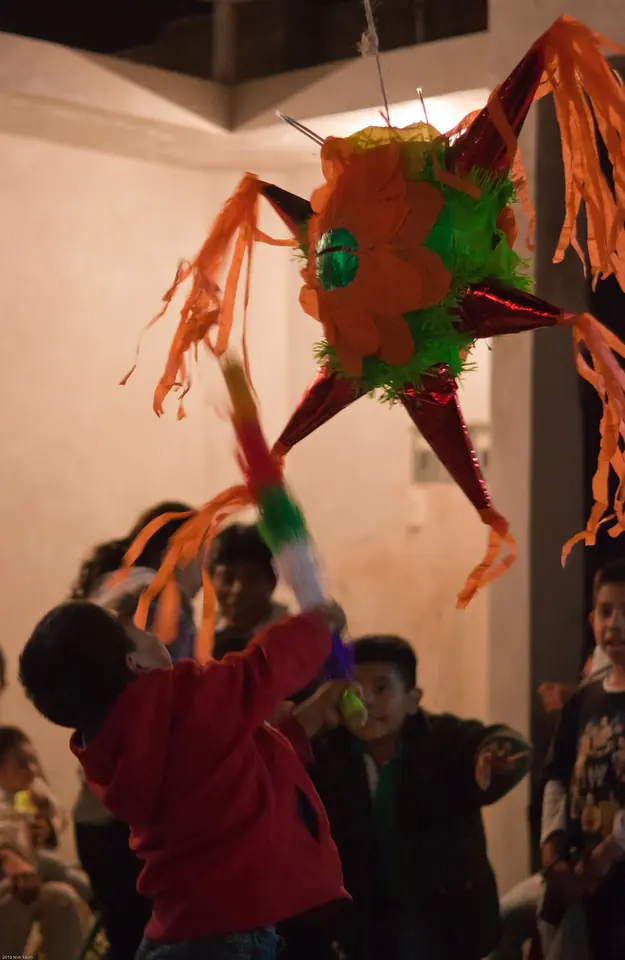
After the prayers the children get their turn. The traditional posada piñata is a star with seven cone-shaped points, built around a clay pot (now often cardboard) and filled with fruit and candy. A blindfolded child is spun around and swings a stick at it while everyone sings, until it breaks.
Mexican catechists have long used it to teach. In the explanation still given by Catholic sources, and labeled here as traditional catechesis rather than documented history:
- The seven points are the seven deadly sins: pride, envy, greed, lust, gluttony, sloth and wrath.
- The blindfold is faith, which trusts without seeing.
- The stick is virtue, the strength to strike down sin.
- The falling fruit and sweets are God's mercy and grace, which come to all.
A report from the Vatican news agency Fides gave the same idea more simply: breaking the piñata "symbolises the Birth of Christ which destroys sin." The piñata itself probably came to Mexico from Spain and Italy, and the missionaries may have joined it to a native custom of breaking a decorated clay pot; its exact origin is not well documented.

Food and aguinaldos
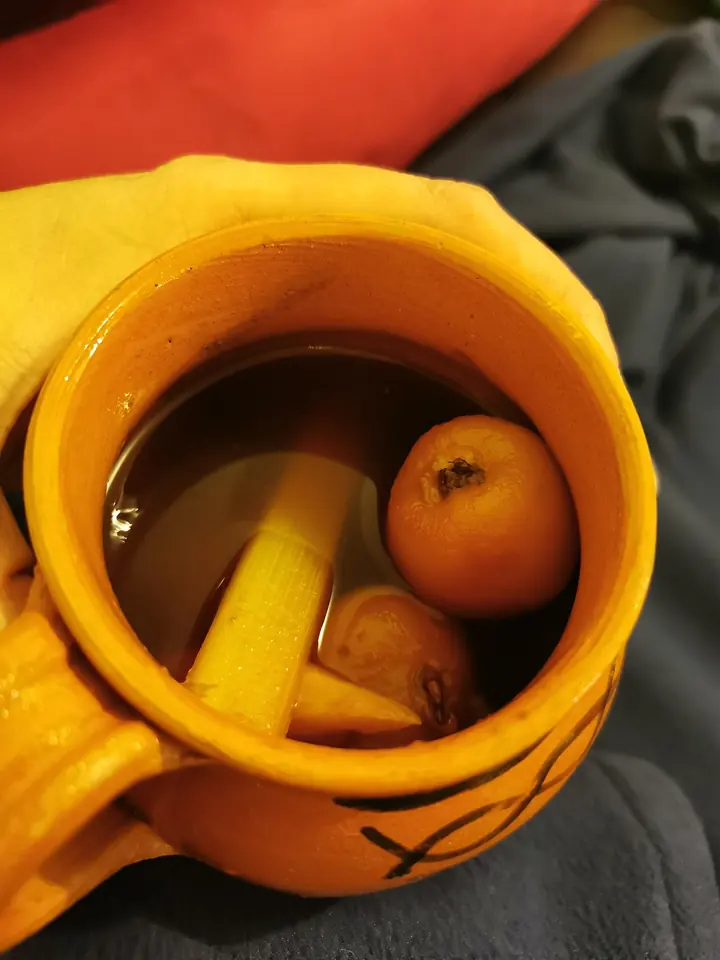
- Ponche navideño: hot fruit punch simmered with sugarcane, guavas, tejocotes (a small golden hawthorn fruit), apples, raisins, cinnamon and piloncillo brown sugar. Adults sometimes add a splash of rum, con piquete.
- Tamales: corn dough steamed in husks or banana leaves, the dish of the season from Mexico to Guatemala.
- Champurrado: thick hot chocolate made with corn masa. Olvera Street serves it every night with pan dulce.
- Buñuelos: thin fried dough rounds with syrup or sugar.
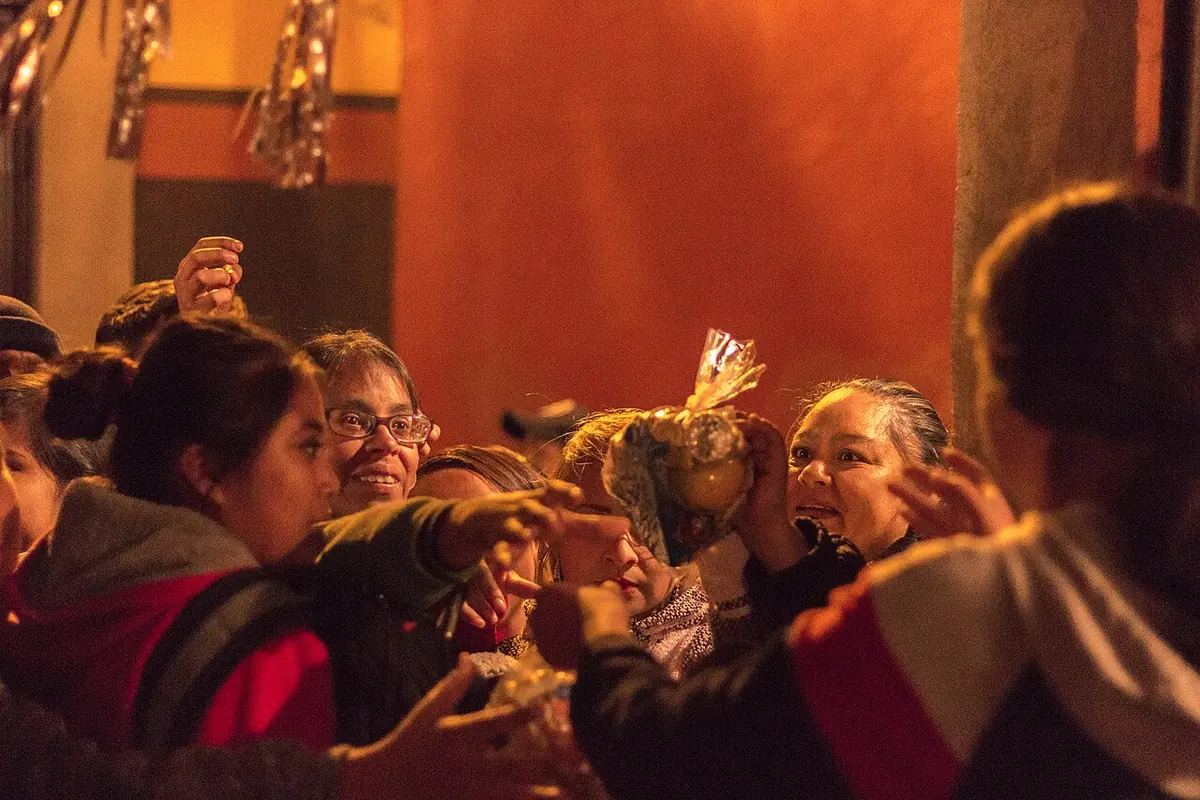
- Aguinaldos: small bags of candy, peanuts, oranges and guavas given to every guest, and especially to children. The word means a Christmas gift, the same word as the old misas de aguinaldo.

Christmas Eve and the Misa de Gallo
On the ninth night, December 24, the pilgrims are finally received, often at the parish church instead of a home. Many communities time the last posada to end with the Misa de Gallo, the "Rooster's Mass," as the midnight Mass of Christmas is called in Spanish. In many Mexican homes the figure of the Christ Child is laid in the manger that night, and the family sings lullabies as they rock him, a custom called arrullar al Niño Dios. The season goes on to the Day of the Kings on January 6 (see the Magi) and ends at Candlemas on February 2, when families gather again to "wake" the Christ Child with another song.

Las Posadas in the United States
Mexican families brought the posadas north, and today Mexican-American parishes from Texas to Chicago keep them, some going from house to house in the old way, others holding all nine nights in the church hall. A few public posadas have become landmarks of their cities.
Olvera Street, Los Angeles. The Olvera Street merchants' foundation, which organizes it, says Las Posadas has been part of Olvera Street since the street opened as a Mexican marketplace in 1930. Each night from December 16 to 24, costumed volunteers lead a candlelit procession of families from shop to shop, asking for shelter. It starts and ends at the Avila Adobe, the oldest house in Los Angeles, and closes with a children's piñata, champurrado and pan dulce. On Christmas Eve a live Mary and Joseph take part.


San Antonio. The San Antonio Conservation Society organizes a procession along the River Walk, held there since 1966. Mariachis lead the way past thousands of luminarias, candles set in paper bags. The writer Noëlle C. Collins described the singers asking for shelter from one bank of the river and the refusal coming back from the other, with Mary riding a donkey and the Franciscan friars of the old missions walking behind the band.
At home and in parishes. In much of the Southwest a posada is simply a neighborhood affair, organized by the parish or by a few families who take turns being the innkeepers.
In Latin America
In Mexico the posadas are kept everywhere, in villages and city neighborhoods alike, and "posada" has come to mean any Christmas party, which some Catholic groups protest, wanting the word kept for the devotion. Guatemala, El Salvador and Honduras keep their own posadas. In Colombia, Venezuela and Ecuador, families gather on the same nine nights for the Novena de Aguinaldos, a sister custom of prayers and carols around the crib. In the Philippines the Panunuluyan pageant re-enacts the same search for lodging, sometimes just before the Christmas midnight Mass.


Keeping a posada at home
- Choose three or more doors, in your own house or among neighbors. Put the Nativity scene, without the Christ Child, behind the last one.
- Split the group into pilgrims and innkeepers, and print the verses so everyone can sing.
- Carry Mary and Joseph. Use figures from your crib, or let two children play them.
- Pray a decade of the rosary on the walk, and read Luke 2:1-7 when the door opens.
- Feed everyone, hand out aguinaldos, and hang the piñata last.
Las Posadas fits with the season's other customs on this site: St. Nicholas Day earlier in Advent, the St. Andrew Christmas novena, Holy Innocents on December 28 and the Epiphany house blessing. For the saints at the heart of it, see St. Joseph, the Blessed Virgin Mary, Our Lady of Guadalupe and St. Juan Diego, and our feast days calendar.
Frequently asked questions
What is Las Posadas?
A Mexican Christmas custom, also kept in Central America and across the U.S. Southwest, in which a procession carrying Mary and Joseph (or children dressed as them) asks for lodging at a series of homes on each of the nine nights before Christmas. They are refused in song until the last house opens its door, and then everyone comes in to pray, eat and break a piñata.
When is Las Posadas 2026?
Las Posadas 2026 runs from Wednesday, December 16, to Thursday, December 24. The dates are the same every year. The last posada, on Christmas Eve, often ends at the parish church in time for the Misa de Gallo, the midnight Mass of Christmas.
Why does Las Posadas last nine days?
It is a novena, the old Catholic custom of praying for nine days before a feast. Mexican tradition also explains the nine nights as the nine months Mary carried Jesus, or as the stages of the journey from Nazareth to Bethlehem; the Gospel does not say how long that journey took.
What does the piñata mean at Las Posadas?
In traditional catechesis the seven points of the star piñata stand for the seven deadly sins, the blindfold for faith, the stick for virtue that overcomes sin, and the falling sweets for God's mercy and grace. These meanings are a teaching tradition, not a documented origin, but Mexican Catholic sources still give them.
What food is served at Las Posadas?
Hot ponche, a fruit punch with sugarcane, guavas, tejocotes and cinnamon; tamales; buñuelos; and champurrado, a thick chocolate corn drink. Guests, especially children, receive aguinaldos, small bags of candy, fruit and peanuts.
Where is Las Posadas celebrated in the United States?
Wherever there are Mexican-American parishes, from Texas and California to Chicago. Two of the best-known public posadas are the nightly procession on Olvera Street in Los Angeles, held since 1930, and the candlelit procession along the San Antonio River Walk organized by the San Antonio Conservation Society.
Sources
- Catholic World Report (ACI Prensa): How the 'Posadas' before Christmas in Mexico originated (2022)
- Catholic World Report (CNA): Piñatas, Posadas, and other Christ-centered Mexican Christmas traditions (2021)
- Catholic.net: La Novena de Navidad (las posadas), by José de Jesús Beaumont Galindo
- Agenzia Fides: Mexicans revive Las Posadas tradition (December 22, 2004)
- Vanguardia: Letanía para pedir posada, letra, origen y significado (traditional text of the song)
- Luke 2:1-7, Douay-Rheims (Bible Gateway)
- Olvera Street Merchants Association Foundation: Las Posadas on Olvera Street
- El Pueblo de Los Angeles Historical Monument: Las Posadas
- American Heritage: A Spanish Colonial Christmas in San Antonio, by Noëlle C. Collins
- Wikipedia: Las Posadas (used for leads on regional practice and the 1966 River Walk procession)
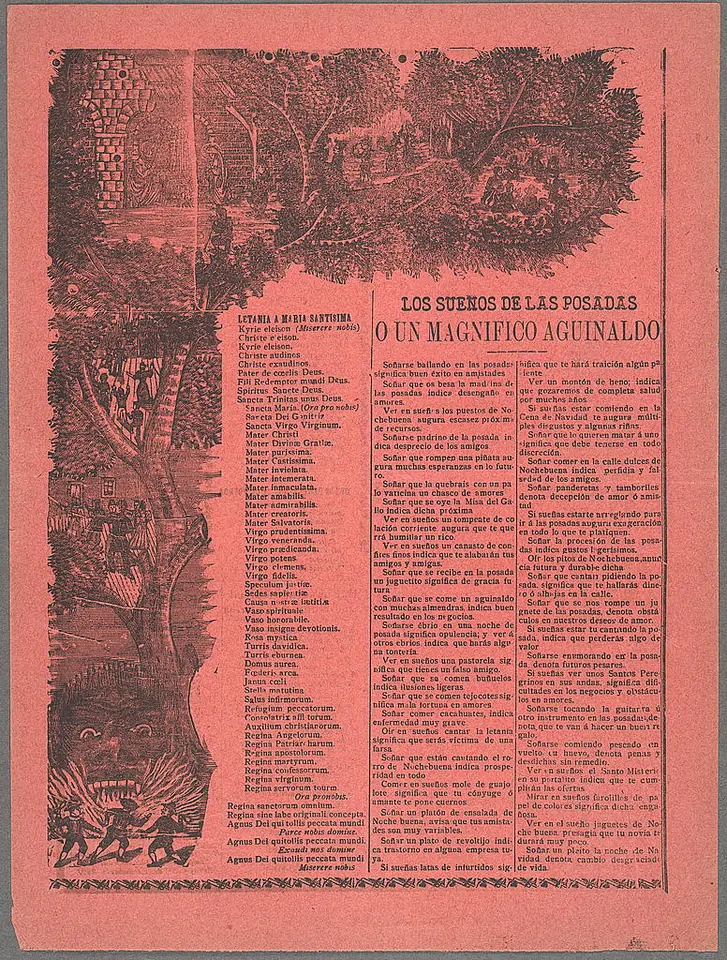
- Library of Congress: Los sueños de las posadas o un magnífico aguinaldo (broadside, 1903)