Stigmata
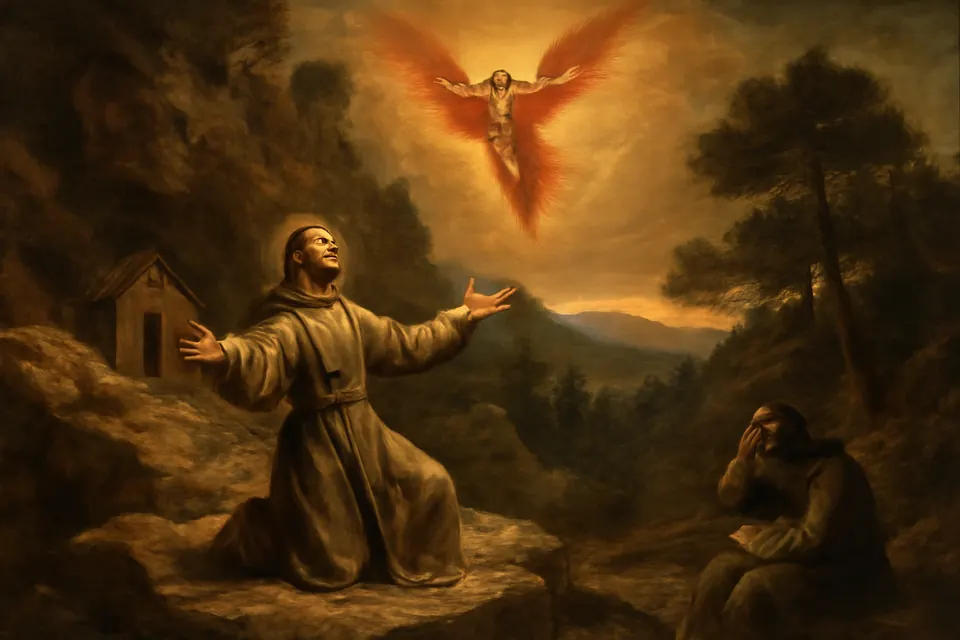
Stigmata are wounds, or the pain of wounds, matching the five wounds of the crucified Christ in the hands, feet and side, sometimes with the marks of the crown of thorns. St. Francis of Assisi is the first stigmatic known to history (1224). The Church judges stigmata with great caution: saints are canonized for heroic virtue, never for their wounds.
In September 1224, on a wooded mountain in Tuscany, St. Francis of Assisi was praying through a forty-day fast when he saw a seraph bearing the form of the crucified Christ. When the vision ended, his companions later said, his own body bore the wounds of the Crucified: in his hands and feet, and an open wound in his side. Nothing like it had ever been recorded. In the eight centuries since, a few hundred men and women have been reported to bear the same marks, and some of them are among the Church's best-loved saints. This page explains what stigmata are, the great cases, how the Church weighs them, and the saints with stigmata, each with an honest status.
What is stigmata?
The word is Greek: a stigma was a mark pricked or branded on the skin. St. Paul used it of himself at the close of his letter to the Galatians, which the Douay-Rheims renders: "From henceforth let no man be troublesome to me; for I bear the marks of the Lord Jesus in my body." Most interpreters take Paul to mean the scars of his beatings and stonings for the Gospel. The Church's spiritual writers borrowed his word for something new.
In Catholic usage, stigmata are wounds corresponding to the five wounds of Christ's Passion, in the hands, the feet and the side. Some stigmatics also bore marks of the crown of thorns on the head, of the scourging on the back, or of the cross on the shoulder. The Catholic Encyclopedia distinguishes visible stigmata, outward wounds with intense pain, from invisible stigmata, the pain without the marks. It insists that the suffering is the heart of the gift: the stigmatic's share in Christ's Passion, offered "for the expiation of the sins unceasingly committed in the world." Without that, it says bluntly, the wounds "would be but an empty symbol."
Two more of its observations are worth keeping. First, stigmata seem to occur only in people already living a life of deep prayer, usually with ecstasies. Second, there is no known case before the 13th century.

St. Francis of Assisi and La Verna (1224)
Early in August 1224, St. Francis withdrew with three companions to La Verna, a rugged height between the Tiber and the Arno, to keep a fast in preparation for the feast of St. Michael. Around the feast of the Exaltation of the Cross, September 14, he saw the seraph. The Catholic Encyclopedia describes the result from the early sources: the side bore "an open wound which looked as if made by a lance, while through his hands and feet were black nails of flesh, the points of which were bent backward."
Francis tried to hide the wounds, but his brothers saw them during his life and many saw them after his death in 1226; St. Clare and her sisters venerated them as his body was carried past San Damiano. Brother Leo, who was with him on La Verna, wrote a short note about the event on the parchment blessing that Francis wrote for him there; the parchment, in the saint's own hand, is kept in Assisi. The Catholic Encyclopedia calls the event "better attested than many another historical fact."

The popes affirmed the stigmata early. In 1237 Gregory IX, who had known Francis personally and canonized him in 1228, defended them in his bull Confessor Domini against those who doubted. The Church has long kept a feast of the Stigmata of St. Francis on September 17, still celebrated by the whole Franciscan family. A chapel stands on the spot at La Verna, and friars still walk there in procession every afternoon.
Status: reported, and affirmed by the popes. Of all the stigmata in history, these are the best attested and the only ones honored with a feast.
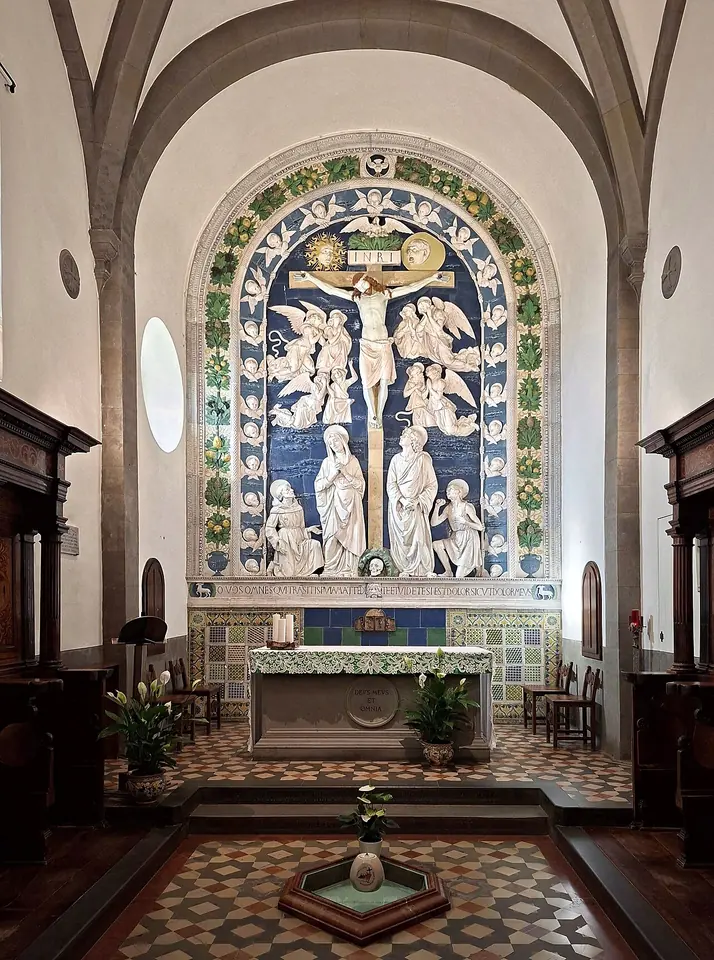
St. Catherine of Siena: the invisible stigmata
St. Catherine of Siena received the stigmata in Pisa on the fourth Sunday of Lent, 1375, after receiving Communion in the little church of Santa Cristina. Her confessor, Bl. Raymond of Capua, was present. She told him that rays came down from the wounds of the crucified Christ to her hands, feet and side, and that she begged the Lord to keep the marks hidden. They did not appear on her body while she lived, though she felt their pain until her death. The Catholic Encyclopedia gives the same pattern for St. Catherine de' Ricci, a Florentine Dominican of the 16th century.
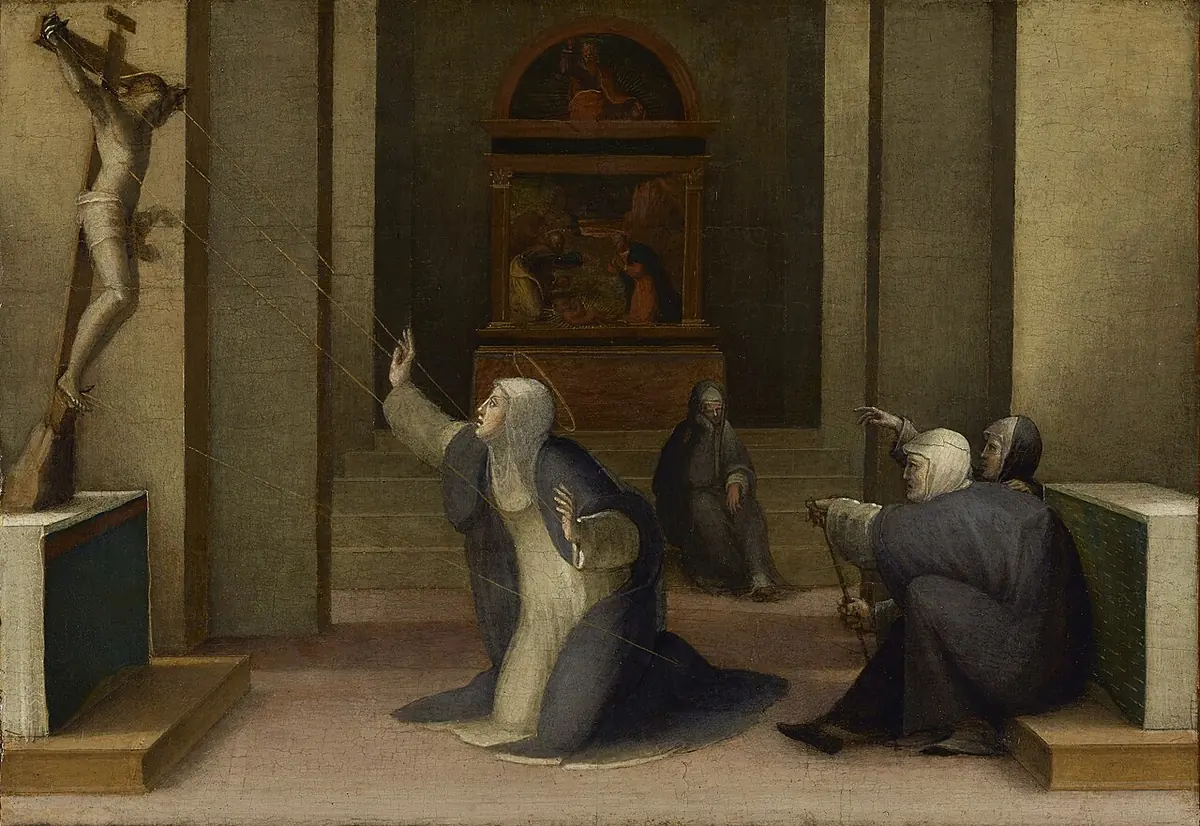
Status: reported. The witnesses saw her ecstasy, not wounds; the Church has never formally judged it.
St. Padre Pio (1918–1968)
On the morning of September 20, 1918, Padre Pio, a young Capuchin, was praying alone before a crucifix in the choir loft of the friary church at San Giovanni Rotondo. He wrote to his director a month later that he had seen a mysterious figure with bleeding hands, feet and side, and that afterward he found his own hands, feet and side pierced and bleeding. He bore the wounds for fifty years, wearing fingerless gloves and hiding his hands in his sleeves at the altar. They closed in the last days before his death on September 23, 1968.
His stigmata became the most examined in history, and the most argued over. Doctors who saw them in 1919 and 1920 disagreed. In 1921 Bishop Raffaele Rossi, sent by the Holy Office, judged that they were not a fraud. Yet on May 31, 1923, the Holy Office declared that the supernatural character of the facts had not been established, and for years Padre Pio bore restrictions with obedience. When St. John Paul II canonized him in 2002, it was for his heroic virtue and for two approved healings through his intercession.
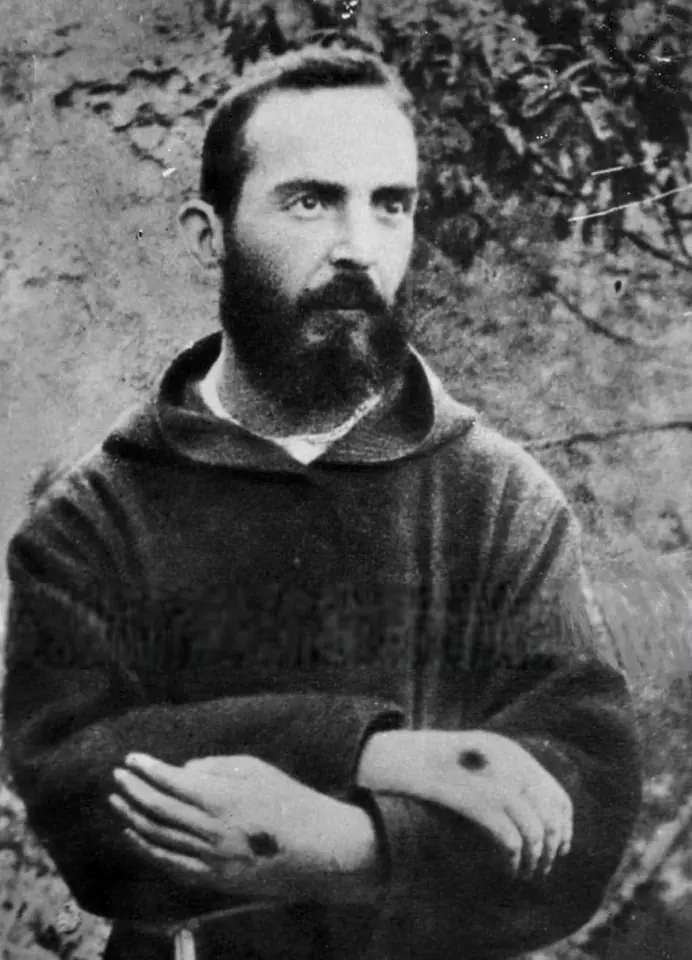
Status: reported. The Church honors his holiness and has never issued a formal judgment that the stigmata were supernatural.
How the Church judges stigmata
The Church's caution here is old and wise. A wound can come from God; it can also come from illness, from the power of a disturbed mind over the body, or from deception, and the history of mysticism has examples of all of these. So the Church looks first at the person, not the wound. Is she humble or does she seek attention? Does he obey his superiors and his confessor? Is the suffering borne with charity and offered for others? Does the person's life bear the fruits of the Holy Spirit?
The Catholic Encyclopedia states the principle plainly: "in processes of canonization stigmata do not count as incontestable miracles." Saints are raised to the altars for heroic virtue and for miracles worked through their intercession after death, examined as described in how the Church investigates miracles. When the Church examined the virtues of St. Gemma Galgani, whose spiritual director said she bore the stigmata from June 8, 1899, the 1931 decree said expressly that it gave no judgment on her "preternatural charisms." Padre Pio's long trial shows the same caution from another side.

The 2024 norms of the Dicastery for the Doctrine of the Faith on alleged supernatural phenomena name "psychophysical phenomena" among the things bishops must discern with care, recognizing their fruits and purifying them of anything negative. As a rule, the norms say, Church authorities will not declare such phenomena supernatural; at most they permit the faithful to accept them prudently. A stigmatic who is a saint is honored as a saint, and the wounds remain, as they were for Francis, a mystery between the soul and God.
Saints with stigmata: a list with statuses
Labels: reported means documented by witnesses but not formally judged by the Church; traditional means handed down in the saint's life and devotion without early documents to check; affirmed means honored by papal acts or the liturgy.
- St. Francis of Assisi (1224, La Verna): the five wounds, with "nails" of flesh. Reported; affirmed by the popes, with a feast on September 17.
- St. Catherine of Siena (1375, Pisa): invisible stigmata. Reported.
- St. Rita of Cascia (15th century, Cascia): a wound on the forehead like a thorn from Christ's crown. Traditional; the Catholic Encyclopedia includes her among the stigmatics. See St. Rita.
- St. Catherine de' Ricci (from 1542, Prato): weekly ecstasies of the Passion for twelve years, described in the bull of her canonization; stigmata made invisible at her request. Reported.
- St. Veronica Giuliani (Città di Castello): the crown of thorns from 1694, later the stigmata. Benedict XVI said in 2010 that "Crucified Love was impressed within her flesh as it was in that of St Francis of Assisi, with Jesus' stigmata." Reported.
- St. Gemma Galgani (1899, Lucca): wounds appearing from Thursday evening to Friday afternoon. Reported; expressly left unjudged.
- St. Padre Pio (1918 to 1968, San Giovanni Rotondo): the five wounds for fifty years. Reported; never formally judged.
- St. Faustina Kowalska: hidden stigmata, according to her congregation's account. Reported; never formally judged. See St. Faustina.
- Others in the Catholic Encyclopedia's list of saints and blessed: St. Lutgarde, St. Margaret of Cortona, St. Clare of Montefalco, St. Mary Magdalene de' Pazzi, St. Lidwine, St. Colette, St. John of God, Bl. Osanna of Mantua and Bl. Lucy of Narni, among others; it names St. Margaret Mary Alacoque as having "only the crown of thorns." Reported or traditional, case by case.
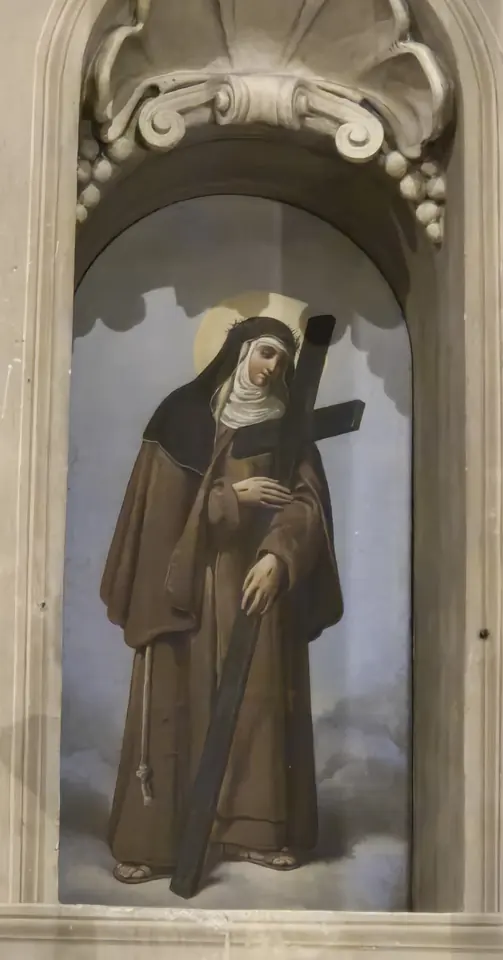
Some well-known stigmatics are not canonized. Bl. Anne Catherine Emmerich (1774–1824), whose stigmata were examined in her lifetime, was beatified by St. John Paul II in 2004 for her virtues; the books of visions written down by Clemens Brentano were set aside in her cause. Others, such as the French mystic Marthe Robin, are on the path to beatification, and their stigmata remain, like all the rest, unjudged.
Praying with the wounds of Christ
The stigmatized saints never pointed to themselves. They pointed to the Crucified. Francis, who carried the wounds, composed the Canticle of the Creatures in those last two years, praising God through his pain. Padre Pio hid his hands in gloves and spoke instead of the Mass and of confession.
So the right response to stigmata is not curiosity but prayer. Let us ask St. Francis and St. Catherine to obtain for us a real love of Christ's Passion, so that when suffering comes we can unite it to his. Many Catholics do this simply by praying before a crucifix on Fridays, or by praying the Stations of the Cross. We keep the feast of the Stigmata of St. Francis on September 17 and his feast day on October 4; see the feast days calendar for the others.
Frequently asked questions
What is stigmata?
Stigmata (the singular is stigma) are wounds that appear on a person's body matching the wounds of Christ's Passion, in the hands, feet and side, sometimes on the head as from the crown of thorns or on the shoulder and back. When there are no outward marks but the person feels the pain, the Catholic tradition speaks of invisible stigmata.
Who was the first saint with the stigmata?
St. Francis of Assisi, who received the stigmata on Mount La Verna in September 1224, two years before his death. The Catholic Encyclopedia notes that none are known before the 13th century. Brother Leo, who was with him, left a note about it on a parchment written by Francis himself, and Gregory IX defended the stigmata in 1237.
Which saints had the stigmata?
Among the best known are St. Francis of Assisi, St. Catherine of Siena (invisible stigmata), St. Rita of Cascia (a thorn wound on the forehead), St. Catherine de' Ricci, St. Veronica Giuliani, St. Gemma Galgani and St. Padre Pio. The list on this page gives each one's status.
Does the Church say stigmata are miracles?
Not as a rule. Saints are canonized for heroic virtue and for miracles worked through their intercession after death, not for their stigmata. The Holy Office declared in 1923 that the supernatural character of Padre Pio's phenomena had not been established, and the decree on St. Gemma Galgani's virtues said it gave no judgment on her "preternatural charisms." St. Francis's stigmata are the great exception, affirmed by popes and honored with a feast.
When is the feast of the Stigmata of St. Francis?
September 17. The Catholic Encyclopedia (1909) notes that "the impression of the stigmata on his body is celebrated on 17 September," and the Franciscan family still keeps the feast on that day.
Sources
- Catholic Encyclopedia (1912): Mystical Stigmata
- Catholic Encyclopedia (1909): St. Francis of Assisi
- Douay-Rheims Bible: Galatians 6
- Benedict XVI, General Audience of December 15, 2010: St. Veronica Giuliani
- Vatican: Padre Pio da Pietrelcina (1887–1968), biography
- Acta Apostolicae Sedis 24 (1932): decree on the heroic virtues of Gemma Galgani
- Dicastery for the Doctrine of the Faith, Norms for proceeding in the Discernment of alleged Supernatural Phenomena (May 17, 2024)