St. Rita of Cascia

St. Rita of Cascia (about 1381–1457) was an Italian wife, mother and widow who forgave her husband's killers, made peace between feuding families and spent her last forty years as an Augustinian nun in Cascia, where she bore a wound on her forehead like a thorn from Christ's crown. Her feast day is May 22, and she is the patron saint of impossible causes, difficult marriages and widows.
Who was St. Rita of Cascia?
St. Rita was born Margherita Lotti in Roccaporena, a hamlet in the mountains of Umbria about three miles from the town of Cascia. "Rita" is the short form of her name. She married young, raised two sons, lost her husband to a murder and her sons to illness, and then spent about forty years as a nun in the Augustinian monastery of St. Mary Magdalene in Cascia. She died there on May 22, 1457.
She left no writings. What is known of her comes from a handful of 15th-century objects and records in Cascia, from witnesses questioned in 1626 when the Church first examined her case, and from the lives written after that. The Augustinian nuns who keep her monastery today separate the documented core of the story from the legends that grew around it, and this article tries to do the same.
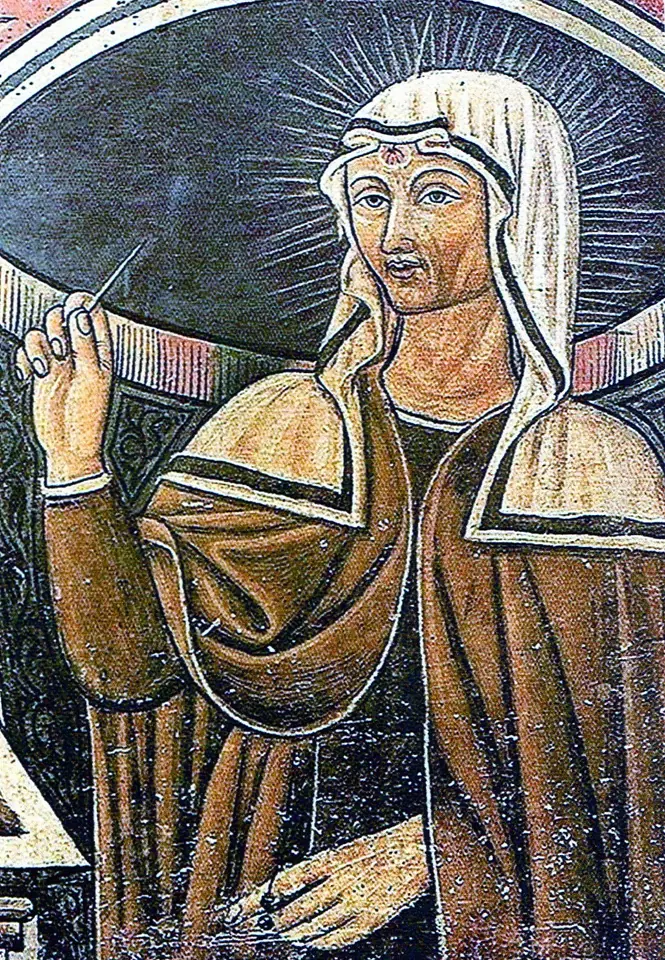

Her fame since then has been enormous. In Spain she became known as la santa de los imposibles, the saint of the impossible, according to the Catholic Encyclopedia. Pope John Paul II, on the hundredth anniversary of her canonization, called her "a woman who was small in stature but great in holiness," known throughout the world "for her heroic Christian life as a wife, mother, widow and nun."
The life of St. Rita
What the sources are
The earliest witnesses to Rita are physical. Her body was never buried, and within about ten years of her death it was laid in a painted wooden coffin, the cassa solenne, which carries her portrait and an epitaph. The epitaph says she suffered the thorn for fifteen years. The town of Cascia began recording cures at her tomb in a Codex miraculorum, a book of miracles, in 1457.
The first full biography came much later. The Augustinian friar Agostino Cavallucci published his Vita della B. Rita in Siena in 1610, more than 150 years after her death, drawing on oral tradition. His book already calls her "blessed," though she had not yet been beatified. Most of the colorful episodes below, the bees, the three saints, the withered vine, reach us through Cavallucci and the later lives built on him, so they are labeled here as traditional. Some of them, like the winter rose, were also told by witnesses at the 1626 inquiry.
A peacemaker's daughter
Rita's parents, Antonio Lotti and Amata Ferri, were known in Cascia as pacieri, official peacemakers. The town's statutes gave respected citizens the job of settling quarrels between families before they turned into killings, and the Catholic Encyclopedia says the couple were called the "Peacemakers of Jesus Christ." They were not nobles, the Cascia monastery says, but they were comfortable and well regarded. Rita was their only child, born late in their marriage, in 1381 by the reckoning the monastery and most writers follow. Another tradition puts her birth in 1371 and her death in 1447; both agree she lived to 76.
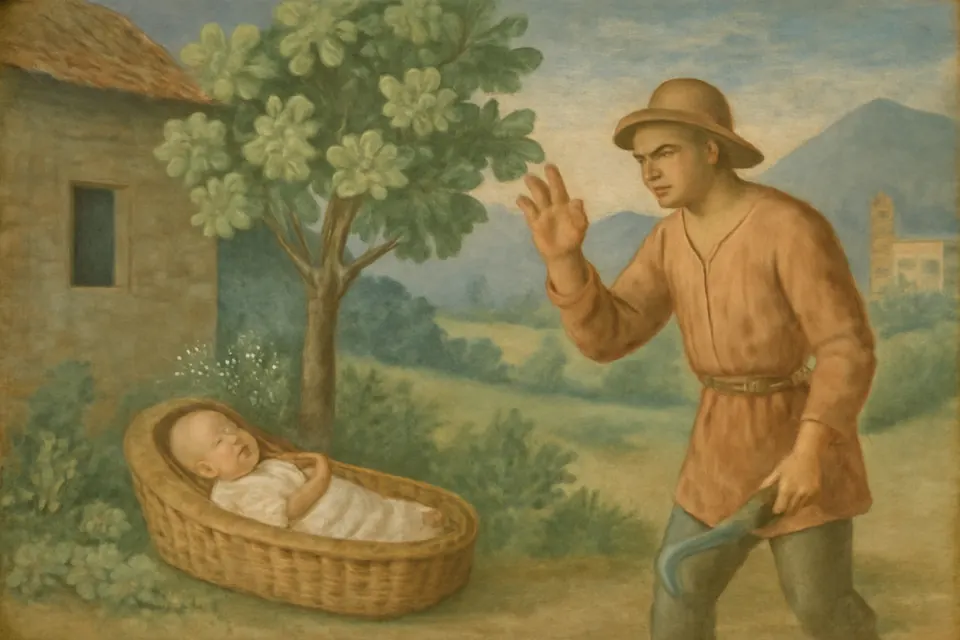
Tradition says that five days after her birth, while the baby slept in her cradle in the garden, a swarm of white bees flew in and out of her mouth without stinging her. A farmer who had just cut his hand with his sickle ran past, waved the bees away, and found his hand healed. The monastery itself calls this "a simple popular belief, full of symbolism": the bee was a medieval sign of hard work and sweetness, and the nuns still name their magazine Dalle Api alle Rose, "From the Bees to the Roses."
Wife and mother
Rita was baptized in the Augustinian church in Cascia and learned her faith from the Augustinian friars there. From them she took the three patron saints she kept all her life: St. Augustine, St. John the Baptist and the Augustinian friar St. Nicholas of Tolentino, who was not yet canonized in her day.
She married Paolo di Ferdinando di Mancino when she was about twelve or thirteen, according to the older lives. The older lives say she wanted to be a nun and married only to obey her parents, and they paint Paolo as violent and quarrelsome. The Roman Martyrology still says she "patiently endured mistreatment by her violent husband, finally reconciling him with God." The nuns of Cascia now tell it differently. In their account Paolo was a soldier, not a brute, the two loved each other, and Rita helped him live a more Christian life rather than taming a monster. The couple had two sons, Giangiacomo and Paolo Maria, and moved to a mill Paolo owned near Roccaporena.
Murder, forgiveness and loss
Around 1406, Paolo was ambushed and killed near the mill, a casualty of the feuds that tore through the towns of central Italy. Tradition says Rita reached him as he died and hid his bloodstained shirt so that her sons would not see it and swear revenge. She forgave the killers publicly and never named them, which turned her husband's family against her.
Her greater fear was for her boys. In that culture, sons were expected to avenge a father. Rita prayed that they would not commit murder, and within about a year both died of illness, one after the other. The 18th-century writer Carlo Massini says she had asked God to take them rather than let them kill. The nuns of Cascia describe her prayer more gently: that her sons would not stain themselves with blood.
"The three patron saints" and the monastery
Now alone, Rita asked to enter the monastery of St. Mary Magdalene in Cascia. The nuns refused her, more than once. According to the National Shrine in Philadelphia, they said that while she had forgiven her husband's killers, her husband's family had not, and relatives of the rival family lived in the convent. Peace had to come first.
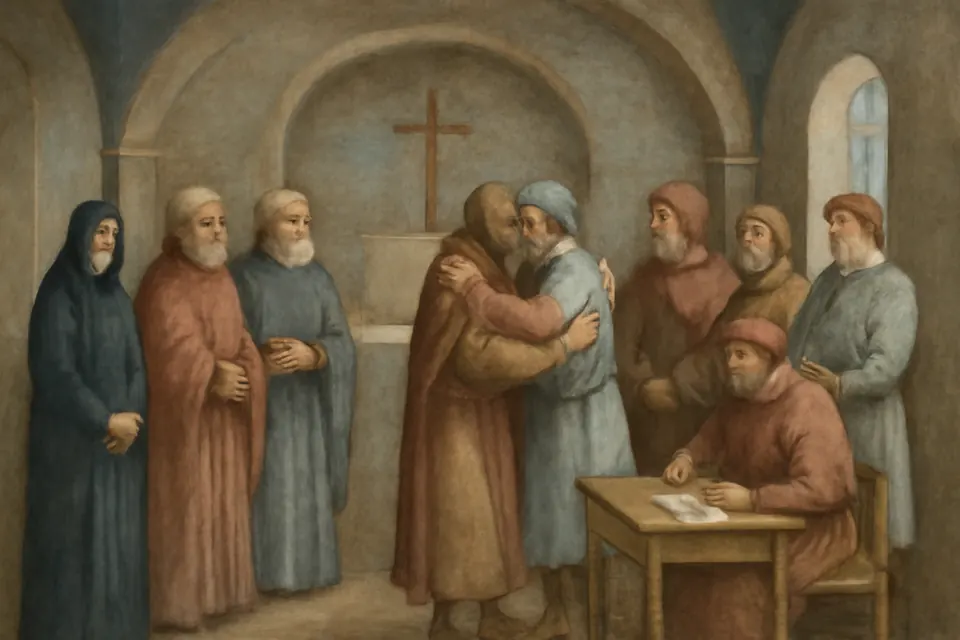
So Rita did what her parents had done for a living. She went to the Mancini family and persuaded them to give up the feud, and the other family agreed. The two sides embraced and signed a written peace, and a fresco of that embrace was later painted in the church of St. Francis in Cascia.
The most famous story of her life comes next. Cavallucci and the later lives say that one night Rita heard someone call her name. She went to the window and saw St. John the Baptist, who led her up the great rock above Roccaporena, the Scoglio, where St. Augustine and St. Nicholas of Tolentino joined them. From the top she was carried, the lives say, through the air to Cascia, and in the morning the nuns found her inside their locked monastery. They could not refuse her any longer.
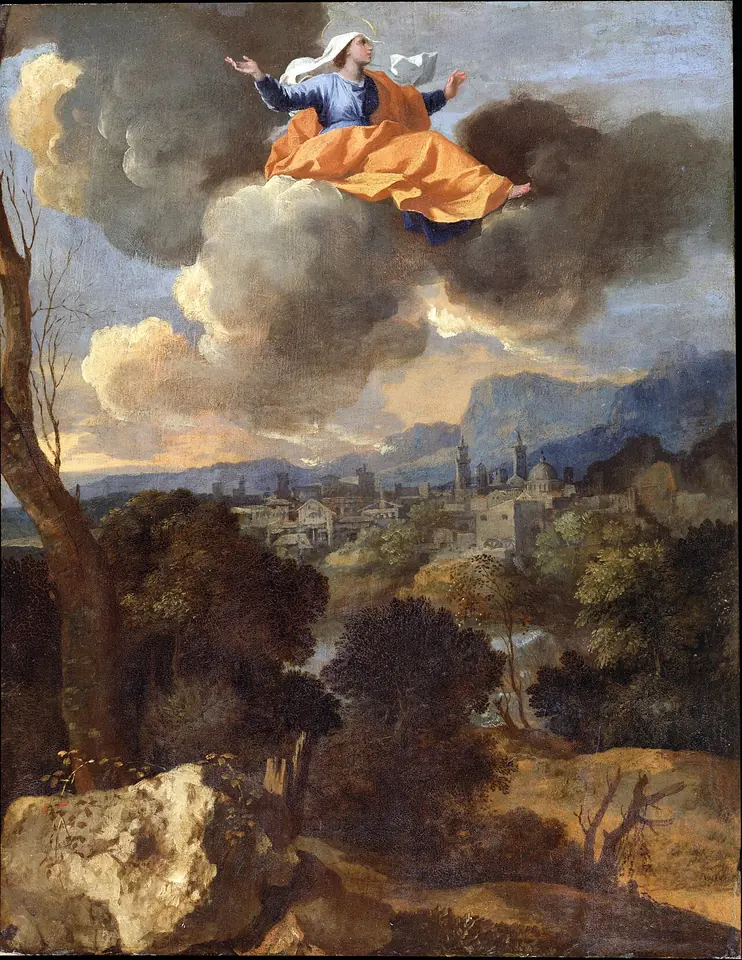

Connolly's 1903 life dates her entry to about 1413; the Cascia monastery says she was about 36. She received the habit and the Rule of St. Augustine and stayed for the rest of her life.
Forty years in the monastery
During her novitiate, tradition says, the abbess tested her obedience by ordering her to water a dry stick planted in the garden every day. Rita did, and the stick sprouted into a grapevine. A vine still grows in the cloister. The monastery notes that the present plant is over 200 years old, not the original, and that the stick was first identified as a vine in the 1700s.
Rita lived by prayer and penance, but she also went out to nurse the sick of Cascia, including plague victims. The town was still a place of violent faction. In 1426 a quarrel over the monogram of the name of Jesus, promoted by the Franciscan preacher St. Bernardine of Siena, set its supporters against the Dominican and Augustinian friars who opposed it, and the dispute ended in killings, and the nuns of Cascia believe Rita worked for peace in that conflict too. Both versions of the monogram appear on her coffin.
The thorn
In about 1442 or 1443, after hearing the Franciscan preacher St. James of the Marches give a sermon on the Passion, Rita knelt before a crucifix in the monastery and asked to share in Christ's suffering. A thorn from the crown on the crucifix, tradition says, came loose and struck her forehead. Connolly gives the year as 1443; the Philadelphia shrine says Good Friday 1442. Both agree that she carried the wound for the last fifteen years of her life, which matches the epitaph on her coffin.


The wound was not pretty. The lives describe it as festering and foul-smelling, so that she lived largely apart from the other sisters. It closed once, they say, so that she could travel to Rome, either for the canonization of Nicholas of Tolentino in 1446 or for the Jubilee of 1450, and opened again when she came home. Medical examinations of her remains, the monastery reports, found a lesion in the bone of her forehead.
The rose and the figs
In her last winter Rita was bedridden. A cousin from Roccaporena came to see her and asked if she wanted anything. Rita asked for a rose from the garden of her old home. It was January, and the cousin thought she was wandering in her mind, but when she got home she found a single red rose blooming in the snow. On a later visit Rita asked for two figs from the same garden, and the cousin found them ripe on a bare tree. The Cascia monastery says witnesses told this story at the beatification inquiry of 1626.

Rita took them, the nuns say, as a sign that God had received the souls of her husband and her sons. She died in the night between May 21 and 22, 1457. Tradition says the monastery bells began to ring by themselves.
The miracles of St. Rita
Rita is one of the few medieval saints for whom miracles were formally examined twice, in the 17th century and again for her canonization.
- Approved: for her canonization, the Congregation of Rites accepted three miracles in 1899. The first was the sweet fragrance noticed around her body. The second was the sudden cure in 1833 of Elisabetta Bergamini, a girl from Terni left nearly blind by smallpox, who was staying with the nuns of Cascia and could suddenly see while sorting grain in the courtyard. The third was the instant recovery of Cosimo Pellegrini, a tailor of Conversano near Bari, who was dying when the local nuns prayed to Rita for him and who said she appeared at his bedside.
- Reported: the cures written into Cascia's Codex miraculorum from 1457 on, including a blind man whose sight returned. The monastery also preserves a deposition from the 1626 inquiry about Cecco Barbari, a local carpenter with crippled hands, who said he would build her a coffin if only his hands worked, and was healed.
- Reported: the preservation of her body, described below.
- Traditional: the bees at her cradle, her entry into the monastery with her three patron saints, the vine that sprouted from a dry stick, the thorn, the rose and figs in winter, and the bells that rang at her death.


Why St. Rita is the patron saint of impossible causes
The title grew from the people who came to her tomb. Rita was invoked first, the nuns say, against plague, since she had nursed plague victims without catching it, and the long list of cures in Cascia's book of miracles did the rest. In Spain she was called la santa de los imposibles. She shares the title with St. Jude, the patron of hopeless causes, and with St. Philomena. See all the patron saints by cause.
Her other patronages follow her life closely:
- Difficult marriages and abuse victims: because of the long tradition, kept in the Roman Martyrology, that she suffered patiently under a harsh husband and won him back. Catholics who pray to her in an abusive marriage are asking for courage and help, and the Church does not ask anyone to stay in danger.
- Widows and mothers who have lost children: she was both.
- Peacemakers and families in conflict: she ended a blood feud.
- The sick and the wounded: because of the cures at her tomb and her own wound.
- Cascia and Roccaporena: her town and her birthplace.
Symbols of St. Rita in art
Look for an older nun in a black Augustinian habit with a white wimple and a black veil. The black is a later convention; the earliest images, like the coffin portrait, show her in the brown and white of her monastery in the 1400s. The clues that make her Rita:
- A wound or a thorn on the forehead: her most certain sign. Older images show a thorn still stuck in her brow or a red mark; some show rays coming from a crucifix to her head.
- A crucifix: often held against her chest, sometimes with a crown of thorns.
- Roses: her best-known emblem in modern statues and holy cards, from the winter rose. Sometimes two figs are added.
- Bees: less common, but found in some churches, from the story of her cradle.
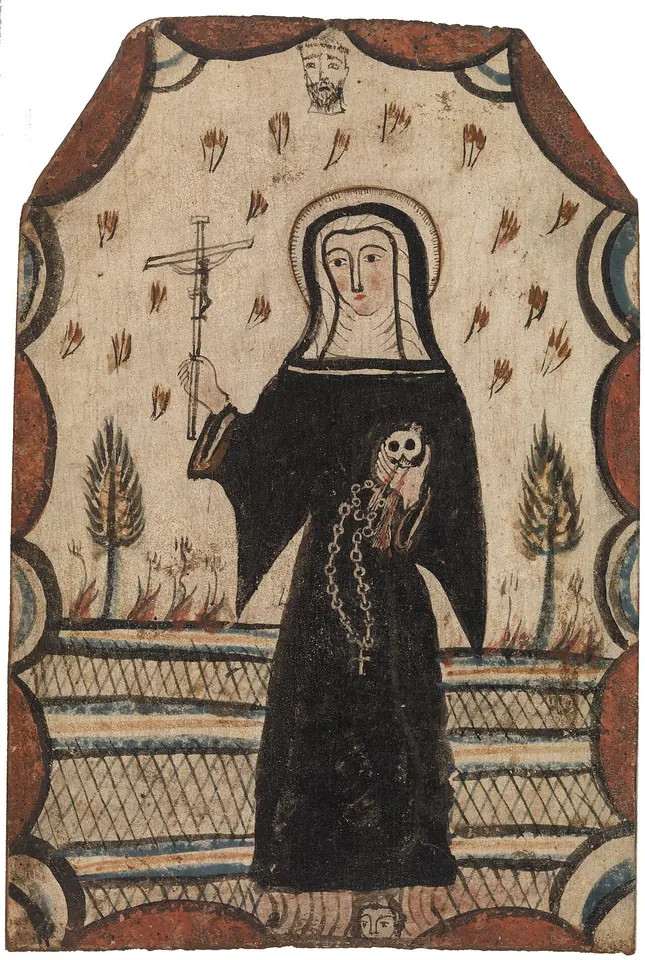
- A skull: a reminder of death and penance, common in Spanish and Latin American images.
- A grapevine: from the dry stick that sprouted.
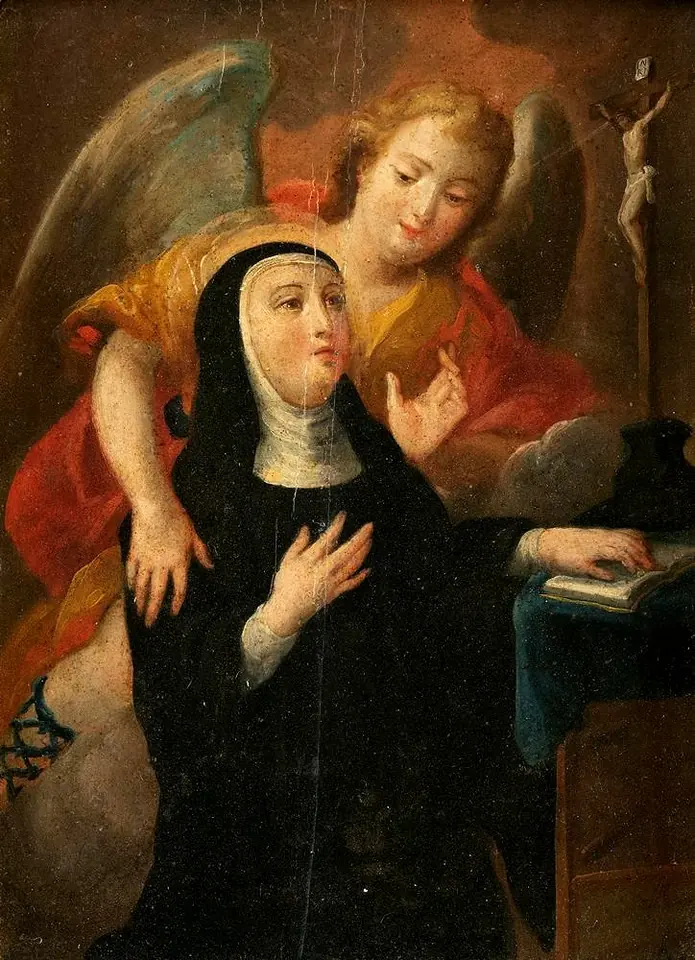

Spanish and Latin American artists painted her often, usually with a crucifix and a skull, as in the New Mexican panel below, where red sprigs that may be roses surround her.

Rita lived after the split between the Catholic and Orthodox churches, and she does not appear in Eastern icons.
Where St. Rita is honored
Roccaporena
Rita's birthplace sits in a narrow valley under steep cliffs. Pilgrims visit her parents' house, which Cardinal Fausto Poli, a native of the nearby village of Usigni, turned into a chapel in 1630; the "garden of miracles" where the rose was found; and the Scoglio, the great rock where she prayed and where, the lives say, her three saints led her. A chapel stands on top.


Cascia: the monastery and the basilica
The Augustinian nuns still live in the monastery where Rita died. Visitors can see her cell, her wedding ring and rosary, the vine in the cloister and the two old coffins, the plain first one inside the painted cassa solenne.
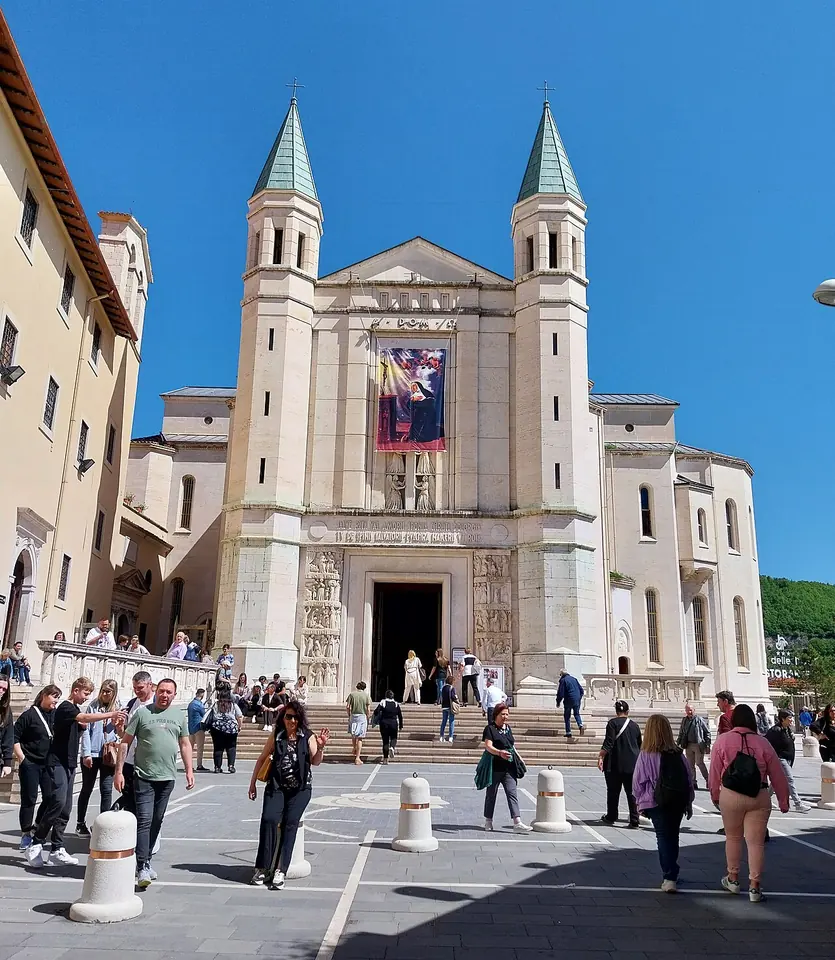
Her body was moved several times over the centuries. Since May 18, 1947, it has rested in a silver and crystal urn made in 1930, in the Basilica of Santa Rita, which Blessed Mother Maria Teresa Fasce, abbess of the monastery, had built with small donations from devotees. The first stone was laid in 1937, the church was consecrated in 1947, and Pope Pius XII made it a basilica in 1955. Ten reliefs around the main door show scenes from her life, from the bees to her death.

The nuns describe the body plainly: the face, hands and feet are mummified, and the skeleton is intact under the habit. She was 1.57 meters (about 5 feet 2 inches) tall. Connolly's 1903 life adds the traditional story that the body's eyes, always closed until then, opened during a brawl in the church in 1628.


Beatification and canonization
The road to the altar was slow. Pope Urban VIII, who had been bishop of Spoleto, the diocese that includes Cascia, ordered an inquiry, which opened in Cascia in October 1626. On October 2, 1627, he allowed the Augustinians and the Diocese of Spoleto to celebrate Mass and the Office in her honor, and on February 4, 1628, he extended the permission. Connolly says the solemn celebration of her beatification took place in the Augustinian church in Rome on July 16, 1628. Dates for her beatification vary between 1626 and 1628 depending on which of these steps a writer counts.
Her canonization cause began in 1737, stalled, was reopened in 1853 and restarted in 1887 after a new miracle. Pope Leo XIII declared her heroic virtue in 1896 and canonized her in St. Peter's on May 24, 1900, the same day as the French educator St. John Baptist de La Salle. In the year 2000 her body was flown to Rome, and Pope John Paul II welcomed it in St. Peter's Square.
Philadelphia and beyond
The National Shrine of St. Rita of Cascia in South Philadelphia, run by the Augustinians, was built in 1907. Churches and statues of St. Rita are everywhere in Italy, Spain, the Philippines and Latin America. The Philadelphia shrine also tells how she became the unofficial patron of baseball: in 1923 investors in a struggling Texas oil well were given a rose blessed in her name, the petals were scattered from the derrick, and the well, named Santa Rita No. 1, struck oil, while the idle crew had been playing baseball beside it.
St. Rita's feast day and the blessing of roses
St. Rita's feast is May 22, the day she died. The Roman Martyrology lists her that day, and she has an optional memorial in the Roman Missal. See her neighbors on the feast day calendar.
In Cascia, the celebrations fill the whole month. The Sunday before the feast brings the procession of the Standard, begun by the town in 1731 to thank Rita for protecting Cascia in the earthquake of 1730. The Transito, a ceremony recalling her death, fills the town with thousands of small flames. On May 22 a solemn pontifical Mass is celebrated in the basilica, and at the end the crowd lifts its roses into the air for the blessing and carries them home.
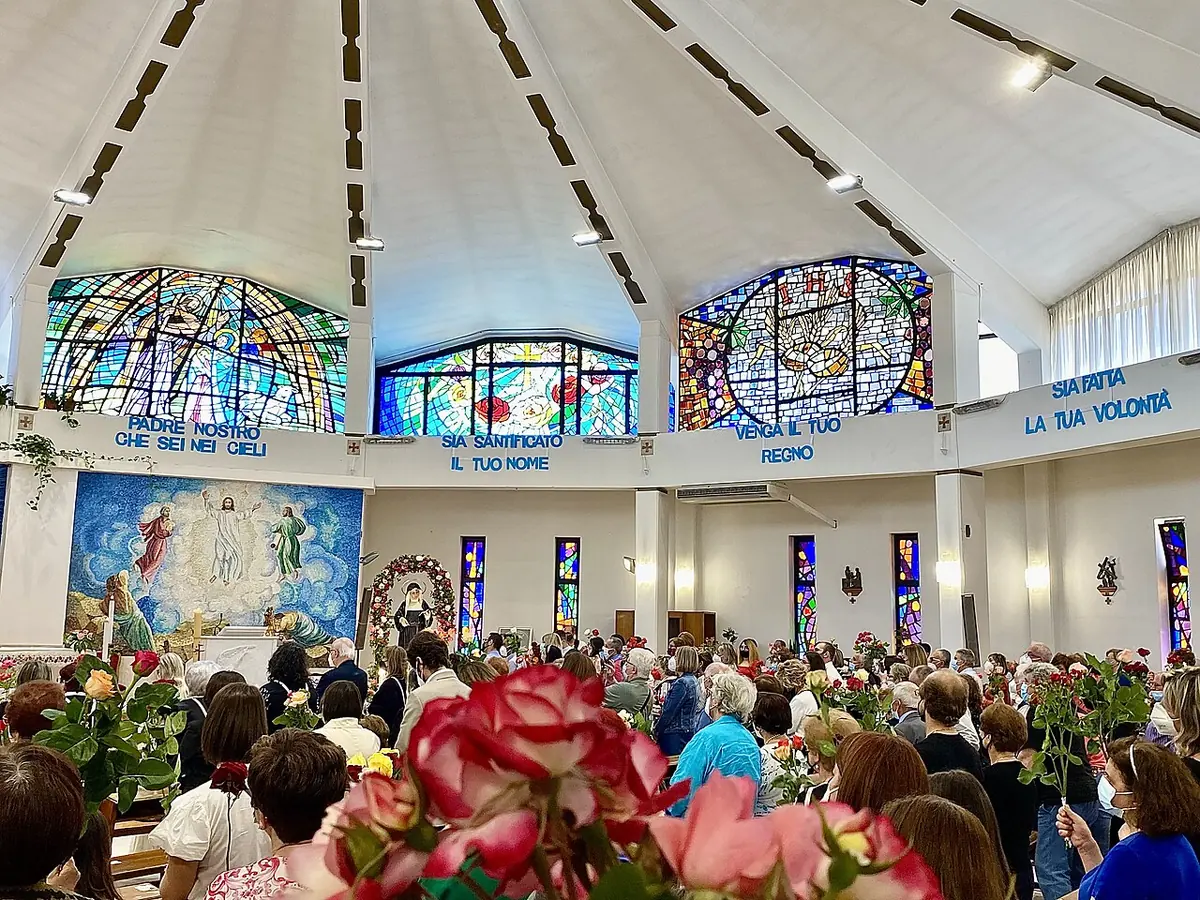

The blessing of roses is kept in every church of the Augustinian Order on May 22, according to Vatican News, and at many parishes besides. People take the blessed roses to the sick and homebound or press them in a prayer book. Devotees in Cascia also keep the Fifteen Thursdays, a series of weekly Masses and prayers before her feast, one for each year she bore the thorn.
Prayer to St. Rita
Catholics ask St. Rita to pray for them in situations that seem to have no way out: a failing marriage, a child in trouble, a diagnosis, a debt. The prayers below come from the National Shrine of St. Rita of Cascia in Philadelphia, which prints them in its novena. Rita left no prayers of her own.
Prayer of petition to St. Rita
This is the shrine's prayer of petition, which addresses her as "Advocate of hopeless and even impossible cases":
Glorious Saint Rita, patroness of those in need, your intercession with our Lord is most powerful. Through the favors obtained by your prayers you have been called "Advocate of hopeless and even impossible cases." Saint Rita, humble and pure; patient and compassionate lover of Christ Crucified! We have confidence that everyone who has recourse to you will find comfort and relief. Listen to our petitions and show your power with God on our behalf. Obtain our petitions for us if they are for the greater honor of God, and for our good. We promise, if our petitions are granted, to make known your favor, and to glorify God for His gift. Relying on your power with the merciful Savior, we ask of you... (mention your request in silence)
The closing prayer of the Litany of St. Rita
The shrine's novena includes a Litany of St. Rita, which ends with this prayer:
Let us pray. O God, Who bestowed on Saint Rita such grace that she loved her enemies, and bore in her heart and on her forehead the mark of Your love and Passion, grant us, we beseech You, through her merits and intercession, a love for our enemies. Through our contemplation of Your sufferings and Passion, may we merit the reward promised to the meek and the suffering. You live and reign forever. Amen.
How to pray a St. Rita novena
- Choose one intention. The traditional time is May 13 to 21, ending the day before her feast, but a novena can be prayed at any time of year.
- Each day, pray the Litany of St. Rita and the prayer of petition above, naming your request.
- Many people add an Our Father, a Hail Mary and a Glory Be.
- Finish on the ninth day with thanks to God, whatever the answer. On May 22, if you can, bring a rose to Mass to be blessed.
The Philadelphia shrine celebrates its solemn novena publicly each May and accepts prayer intentions all year. The monastery in Cascia also receives prayer intentions from around the world.
Frequently asked questions
What is St. Rita the patron saint of?
Impossible causes, above all. Catholics also ask her help with difficult marriages, abuse, widowhood, loneliness and sickness, all of which touch some part of her life. In Spain she has long been called "the saint of the impossible."
When is St. Rita's feast day?
May 22, the day she died in 1457. The Roman Martyrology lists her on that day, and the current Roman Missal gives her an optional memorial. Churches of the Augustinian Order bless roses at Mass on May 22, and the shrines in Cascia and Philadelphia hold a novena on the nine days before.
Why is St. Rita shown with roses?
Tradition says that in January, a few months before she died, Rita asked a cousin to bring her a rose from the garden of her old home in Roccaporena, and the cousin found one blooming in the snow, followed by two ripe figs. The story is traditional, though the Cascia monastery notes that witnesses at her 1626 beatification inquiry told it.
What is the wound on St. Rita's forehead?
Tradition says that while she prayed before a crucifix, a thorn from Christ's crown struck her forehead and left a wound she carried for the last fifteen years of her life, from about 1442 or 1443 until she died. The Church treats it as a partial stigma. Medical examinations of her remains, the Cascia monastery reports, found a lesion in the bone of the forehead.
Is St. Rita's body incorrupt?
Her body was never buried, and it is shown today in a silver and crystal urn made in 1930 in the Basilica of Santa Rita in Cascia. The monastery describes the face, hands and feet as mummified, with the skeleton intact under the habit. Its preservation is a reported wonder; a sweet scent from the body was one of the miracles approved for her canonization.
Was St. Rita's husband abusive?
The older lives and the Roman Martyrology say so: the Martyrology says she "patiently endured mistreatment by her violent husband" and brought him back to God. The Augustinian nuns of Cascia now read the evidence differently and say Paolo was a soldier who grew more Christian through her love, not a brute she tamed. Both readings agree that he was murdered in a feud and that she forgave the killers.
How do you pray the St. Rita novena?
A novena is nine days of prayer for one intention. The National Shrine in Philadelphia prays its solemn novena from May 13 to 21, with the Litany of St. Rita and a prayer of petition each day. In Cascia, devotees also keep the Fifteen Thursdays before her feast, one for each year she bore the thorn.
Why is St. Rita called the saint of the impossible?
Because of the number of cures and answered prayers reported at her tomb from the day she died. Cascia's town council began recording them in a book of miracles in 1457. Her own life also looked impossible at several turns: a widow refused three times by a convent who got in anyway, and a peacemaker who ended a blood feud.
Sources
- Catholic Encyclopedia (1912): St. Rita of Cascia
- Monastero Santa Rita da Cascia: Vita di Santa Rita da Cascia
- Monastery of Saint Rita of Cascia: Ritian Symbology
- Monastero Santa Rita da Cascia: La festa di Santa Rita
- Monastery of Saint Rita of Cascia: Basilica of Saint Rita
- Monastery of Saint Rita of Cascia: Fifteen Thursdays of Saint Rita
- Agostino Cavallucci, Vita della B. Rita da Cassia (Siena, 1610), Internet Archive
- Richard Connolly, Life of St. Rita of Cascia, O.S.A. (1903), Project Gutenberg
- John Paul II: To the pilgrims gathered to venerate Saint Rita of Cascia (May 20, 2000)
- Vatican News: Saint Rita: Despite bitter suffering, always full of joy, working countless miracles (2023)
- Vatican News: Cascia célèbre les 125 ans de la canonisation de sainte Rita (2025)
- National Shrine of Saint Rita of Cascia, Philadelphia: Saint Rita of Cascia
- National Shrine of Saint Rita of Cascia, Philadelphia: Novena Prayers
- The Augustinians: Augustinians Celebrate the Feast of Saint Rita of Cascia at the National Shrine
- Roman Martyrology 2004, May 22 (GCatholic)