St. Gemma Galgani

St. Gemma Galgani (1878–1903) was a young laywoman of Lucca, Italy, whose short life of illness, poverty and prayer was marked by reported mystical experiences, including the stigmata. The Church canonized her in 1940 for her heroic virtue, while stating that it made no judgment on those phenomena. Her feast day is April 11, and she is popularly called the patron saint of pharmacists, students and those who have lost their parents.
Who was St. Gemma Galgani?
Gemma Galgani was a young woman of Lucca, in Tuscany, who never married, never entered a convent and died of tuberculosis at twenty-five. She is one of the most widely loved and most debated saints of the modern era. Her spiritual director said she received the stigmata, saw and spoke with her guardian angel, and fell into ecstasies in which she spoke aloud to Christ. Others in Lucca thought she was ill or deceived.
The Church's judgment was careful. When Pope Pius XI declared her virtues heroic in 1931, the decree added that it made no judgment "on the preternatural charisms of the Servant of God," noting that such decrees never do. She was canonized in 1940 for the way she lived, and for cures reported after her death, and not for her visions.


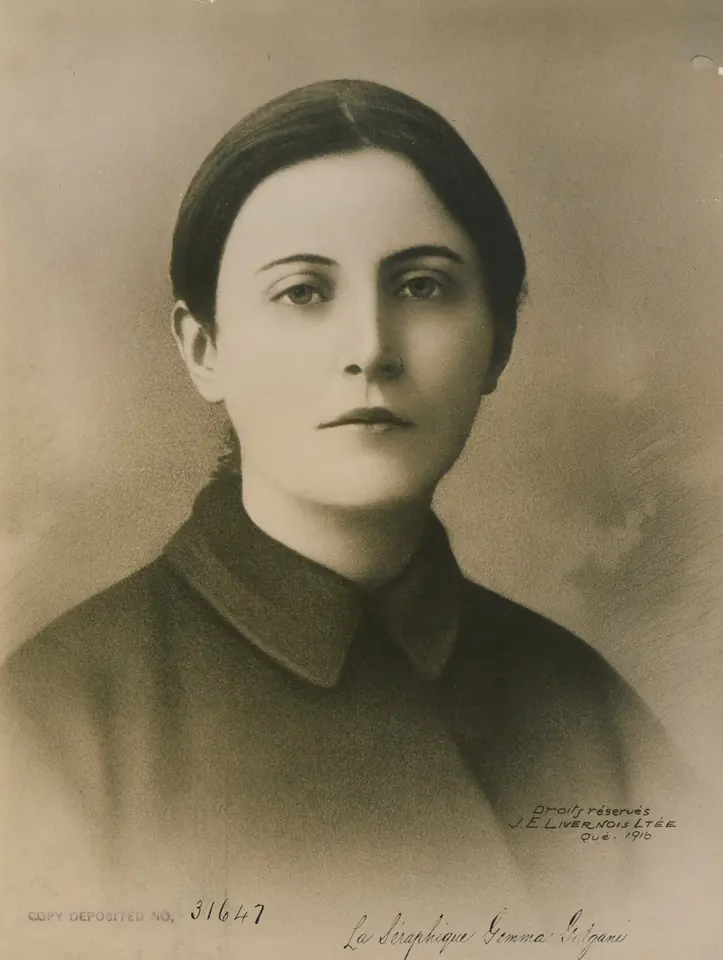
Several photographs of her survive, which is rare for a saint of her time. They are the best guide to what she looked like; the portraits on holy cards are based on them.
The life of St. Gemma Galgani
The main sources are her own letters, diary and autobiography, written at her directors' request, and the Life by her spiritual director, the Passionist priest Germanus of St. Stanislaus (Germano Ruoppolo), published in Italian in 1907 and in English in 1913. The decrees of her cause, printed in the Vatican's Acta Apostolicae Sedis, confirm the main dates.
Childhood and early losses
Gemma was born on March 12, 1878, in the hamlet of Borgonuovo near Camigliano, a few miles from Lucca. Her father, Enrico Galgani, was a pharmacist; her mother was Aurelia Landi. The family soon moved into Lucca. Gemma was confirmed in 1885, and her mother died of tuberculosis the following year, when Gemma was eight. The girl was sent to a school run by the Oblates of the Holy Spirit and taught by their founder, Elena Guerra. She made her First Communion on June 17, 1887, the feast of the Sacred Heart.
More deaths followed. Her brother Gino, who was preparing for the priesthood, died young, and in 1897 her father died after a long illness, leaving the family in poverty. Gemma was nineteen. She turned down at least one offer of marriage, saying she wanted to belong wholly to Jesus.
Illness and cure
In 1899 she fell gravely ill. The sanctuary in Lucca says she was comforted in her sickness by visions of the young Passionist St. Gabriel of Our Lady of Sorrows. At the end of a novena to St. Margaret Mary Alacoque, she recovered. The 1931 decree says only that she got better "apparently not in a natural way." This cure is reported; it wasn't one of the miracles examined for her cause.
The stigmata, June 8, 1899
On the evening of June 8, 1899, the eve of the feast of the Sacred Heart, Gemma described an intense sorrow for her sins, followed by a vision of Mary and her guardian angel. Then, she wrote, "Jesus appeared with all His Wounds open; but from those Wounds there no longer came forth blood, but flames of fire," which touched her hands, feet and heart. When she came to herself she was kneeling, in pain, and bleeding from those places. The sanctuary says the marks returned each week from Thursday evening to Friday afternoon.
Lucca's clergy were divided. Some believed the wounds were genuine; others spoke of fraud, hysteria or self-suggestion. Her confessor, Monsignor Volpi, would not call her deluded, but Germanus writes that he would not "too readily recognize in her the work of God" either. He ordered her to pray that the marks stop. Germanus reports that they did stop for a time and then returned.

Life with the Giannini family
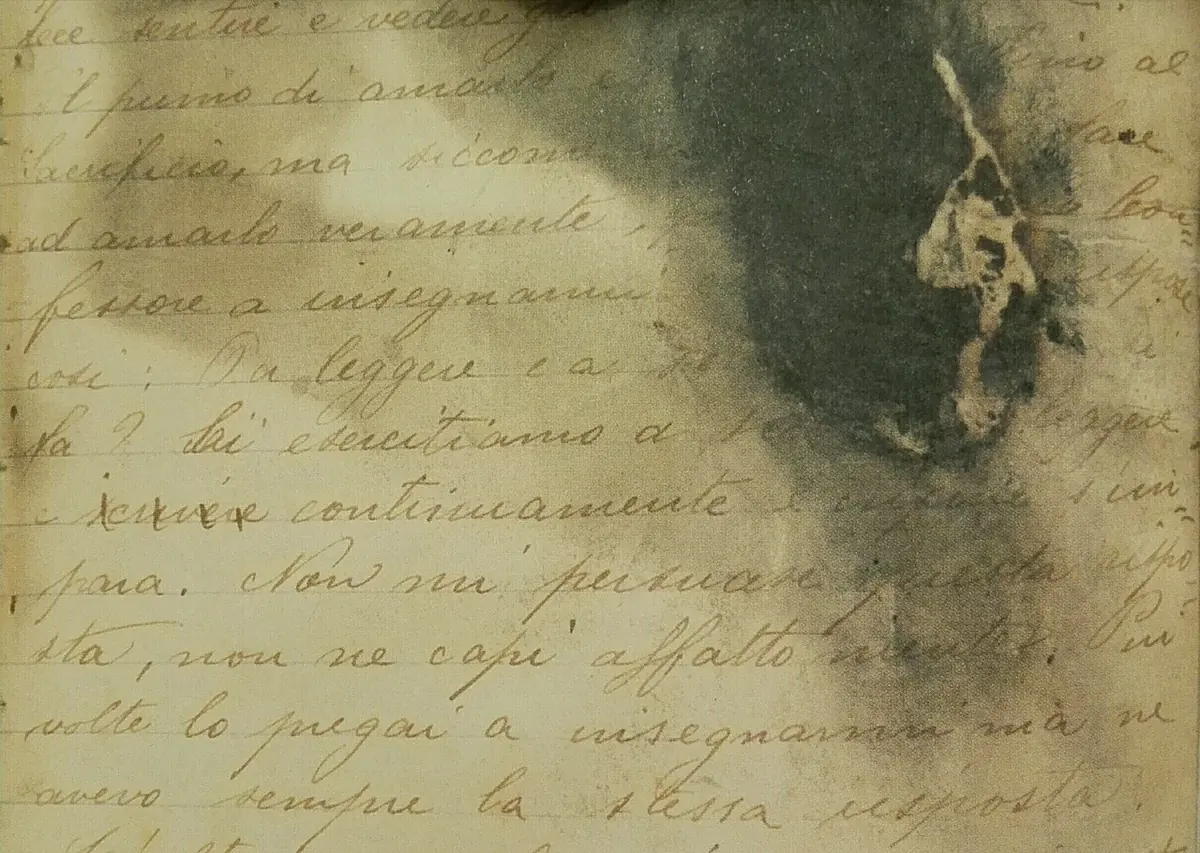
In 1900 a devout family of Lucca, the Gianninis, took her into their house, more as a daughter than a guest. Cecilia Giannini, whom Gemma called aunt, watched over her at the request of Volpi and of Father Germanus, who directed her at first by letter and only later met her. Gemma helped the younger children with their homework, went to Mass each morning and wrote long letters to Germanus. Witnesses in that house described her ecstasies, her conversations with her guardian angel and what she believed were violent attacks by the devil.

Gemma wanted to become a Passionist nun, but every community she approached refused her because of her health and her lack of a dowry. The sanctuary records that she told an aunt, "They don't want me alive, but they will look for me when I'm dead" (our translation). A Passionist convent was founded in Lucca in March 1905, two years after her death, and its nuns keep her body today.
Death on Holy Saturday
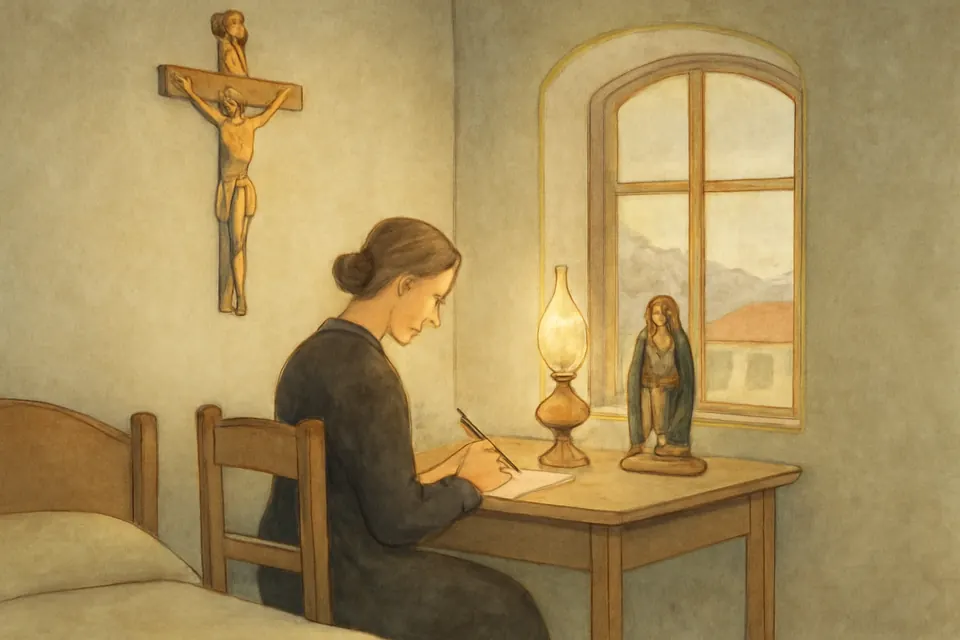
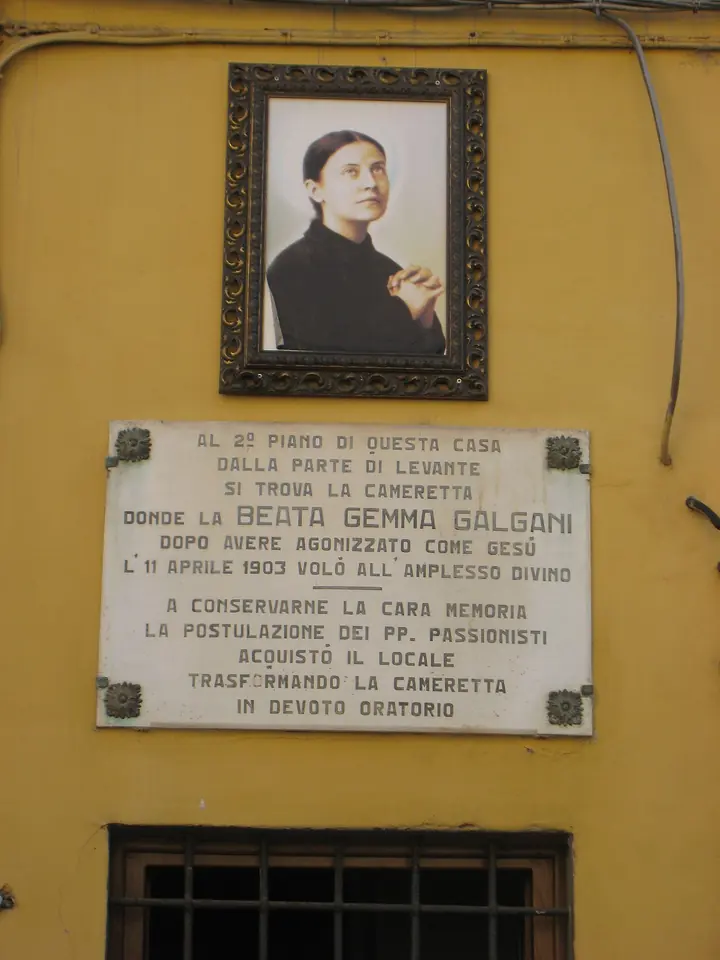
In September 1902 she began coughing blood, and in January 1903 she was moved to a house facing the Giannini courtyard for fear of contagion. She died there on April 11, 1903, Holy Saturday, as the church bells of Lucca rang for Easter. According to the sanctuary, her last words were to Jesus: "See, O Jesus, I can't go on any longer; if it is your will, take me" (our translation). Then she laid her head on the shoulder of Giustina Giannini and died.

The miracles of St. Gemma Galgani
The Church approved four cures through her intercession, all described in the decrees of her cause:
- Maria Menicucci: approved for beatification (decree of February 5, 1933). Her right knee, diseased for years and judged incurable, healed suddenly on the ninth day of a novena, after she touched a relic of Gemma to it.
- Father Ulisse Fabrizi: approved for beatification. A large varicose ulcer on the leg of this seventy-five-year-old priest closed overnight on November 26–27, 1919.
- Elisa Scarpelli of Lappano: approved for canonization (decree of March 26, 1939). Lupus on her left cheek healed at about eleven in the morning of May 14, 1933, while Gemma's beatification Mass was under way in St. Peter's.
- Natale Scarpelli of Lappano: approved for canonization. A leg ulcer was found healed the morning after his family laid a relic on it, on May 30–31, 1935.
- The stigmata, ecstasies and angelic visits: reported. They are documented by eyewitnesses, but the Church expressly left them unjudged.
Why St. Gemma is the patron saint of pharmacists and students
None of her patronages comes from a papal decree. Devotees link them to her life: her father was a pharmacist, she was a gifted pupil of the Oblates' school, she lost both parents young, and she suffered from headaches and spinal illness (the iron back brace she had to wear is kept in Lucca). The devotional site stgemmagalgani.com, which collects these customs, lists her as patron of pharmacists, students, the loss of parents, back pain, headaches and those seeking purity of heart. More are on our patron saints page.
Symbols of St. Gemma Galgani in art
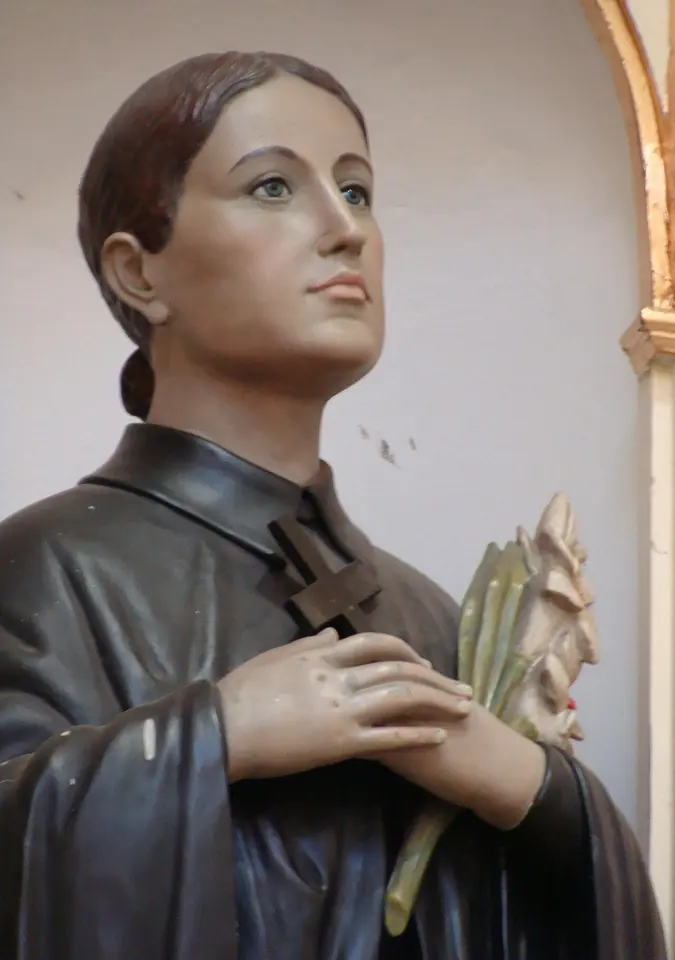
Because photographs of her exist, images of Gemma look much alike: a slender young woman with dark hair parted in the middle and drawn back, in the plain black dress she wore in her photos. Look for these details:
- A black, high-collared dress: her everyday clothes, not a nun's habit.
- A crucifix: for her lifelong devotion to the Passion of Christ.
- Lilies: her purity; her guardian angel, the sanctuary says, once offered her a crown of lilies or a crown of thorns, and she chose thorns.
- A crown of thorns or the Passionist emblem: a heart topped with a cross, worn by the Passionists she longed to join.
- Eyes raised to heaven: taken from the 1900 photograph.
Pius XII said in his canonization homily that she is rightly called the "flower of the Lord's Passion." Statues often join several of these attributes, like this one in São Paulo.

Prints made soon after her death stayed close to the photographs. This one, published in Quebec in 1916, copies her face almost exactly.

Feast day and the sanctuary in Lucca
Her feast is April 11. Pius XII canonized her in St. Peter's Basilica on May 2, 1940, Ascension Thursday, together with St. Mary Euphrasia Pelletier, and set her feast on the anniversary of her death. Because she isn't on the General Roman Calendar, the day is kept mainly in Lucca, among the Passionists and by her devotees. See other saints of the season on our feast days page.


Pilgrims in Lucca visit three places: the sanctuary of the Passionist nuns on Via di Tiglio, where her body rests; the house where she received the stigmata, now an oratory with her family's crucifix and belongings; and the Giannini house and the room where she died, both now chapels.
Prayer of St. Gemma Galgani
A prayer that circulates widely on holy cards is called "a prayer composed by St. Gemma to obtain a desired grace." It is adapted from a prayer she wrote for Father Germanus, recorded in his Life. In the English text reprinted with that Life, it begins:
Behold me at Your most holy feet, O dear Jesus, to manifest to you my gratitude for the continual favours which You have bestowed upon me, and still wish to bestow upon me.
As many times as I have invoked You, O Jesus, You have made me content; I have often had recourse to You and You have always consoled me.
It ends with the petition, then: "If you were not omnipotent, I would not make this request. O Jesus, have pity on me. May your most holy will be done in all things." Catholics also ask her intercession in novenas and a litany that devotees have compiled, especially for the sick and for those struggling with temptation.


Frequently asked questions
Did St. Gemma Galgani really have the stigmata?
Her confessors and the family she lived with said that marks like Christ's wounds appeared on her hands, feet and side from June 8, 1899, usually from Thursday evening to Friday afternoon. Others in Lucca, including some of the clergy, doubted them. The Church never ruled on it. The 1931 decree on her heroic virtue says plainly that it gave no judgment on her "preternatural charisms."
What is St. Gemma Galgani the patron saint of?
Popular devotion calls her the patron of pharmacists (her father was one), students, people who have lost their parents, people with back pain or headaches, and those seeking purity. These patronages come from her life and from custom, not from a papal declaration.
When is St. Gemma Galgani's feast day?
April 11, the day she died in 1903, as set at her canonization. She is not on the General Roman Calendar, so it is kept in Lucca, by the Passionists (who celebrate on May 16) and by her devotees.
What miracles were approved for St. Gemma?
Four cures. For her beatification the Church approved the healing of Maria Menicucci's knee and of a priest, Ulisse Fabrizi, whose leg ulcer closed overnight in 1919. For her canonization it approved two cures in Lappano, near Cosenza, of Elisa Scarpelli (a facial lupus, healed during the beatification Mass in 1933) and Natale Scarpelli (a leg ulcer, 1935).
Where is St. Gemma Galgani buried?
Her body lies in the Sanctuary of St. Gemma, the church of the Passionist nuns' monastery in Lucca. She had tried to join the Passionist nuns and was refused; the community founded in Lucca in 1905, two years after her death, now keeps her remains.
Sources
- Acta Apostolicae Sedis 24 (1932): Decree on the heroic virtues of Gemma Galgani, November 29, 1931
- Acta Apostolicae Sedis 25 (1933): Decree on two miracles for the beatification of Gemma Galgani
- Acta Apostolicae Sedis 31 (1939): Decree on two miracles for the canonization of Gemma Galgani
- Acta Apostolicae Sedis 32 (1940): Canonization of Gemma Galgani and homily of Pius XII, May 2, 1940
- Germanus of St. Stanislaus, C.P., The Life of Saint Gemma Galgani, translated by A. M. O'Sullivan (B. Herder, 1913)
- Santuario Santa Gemma, Lucca: La vita
- St Gemma Galgani (devotional site with patronages and prayers)