St. Faustina Kowalska
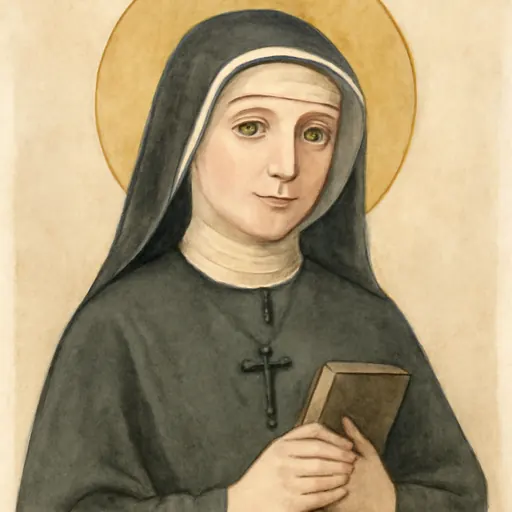
St. Faustina Kowalska (1905–1938) was a Polish nun of the Congregation of the Sisters of Our Lady of Mercy who wrote that Jesus appeared to her and asked her to spread devotion to his mercy. Her Diary gave the Church the Divine Mercy image with the words "Jesus, I trust in You," the Chaplet of Divine Mercy, the three o'clock Hour of Mercy and Divine Mercy Sunday. Her feast day is October 5, and she is honored as the apostle of Divine Mercy.
Who was St. Faustina?
St. Faustina Kowalska was a Polish nun who lived only 33 years and spent most of them cooking, gardening, baking bread and minding the convent door. She had three years of schooling. Yet the notebooks she filled between 1934 and 1938, published as the Diary of Saint Maria Faustina Kowalska: Divine Mercy in My Soul, became one of the most widely read Catholic books of the 20th century, and the devotion she described is now practiced in parishes around the world.
She wrote that from 1931 on, Jesus appeared to her and asked her to make his mercy known. He asked, she wrote, for a painted image of himself with the words "Jesus, I trust in You," for a Feast of Mercy on the Sunday after Easter, for a short prayer on rosary beads now called the Chaplet of Divine Mercy, and for prayer at three o'clock in the afternoon, the hour of his death. Together these make up what Catholics call the Divine Mercy devotion.

Her path to the altar was not smooth. Twenty years after her death, the Holy See banned the spread of the devotion in the forms she proposed. Twenty years after that, the ban was lifted, largely through the efforts of the archbishop of Kraków, Karol Wojtyła. As Pope John Paul II he beatified her in 1993 and canonized her on April 30, 2000, calling her "a gift of God for our time."
The life of St. Faustina
A farm girl from Głogowiec
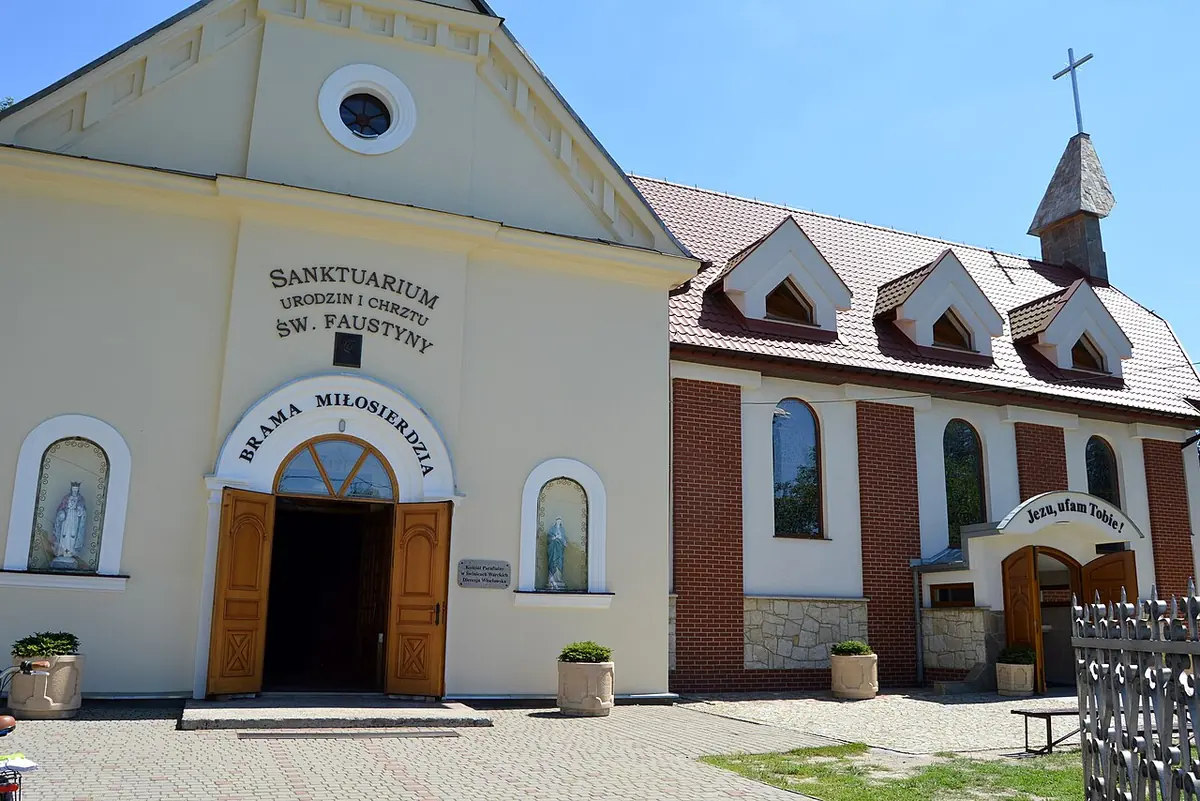
Helena Kowalska was born on August 25, 1905, in the village of Głogowiec in central Poland, the third of ten children of Stanisław and Marianna Kowalski. Her father farmed a few acres and worked as a carpenter. Two days after her birth she was baptized in the parish church of St. Casimir at Świnice Warckie, which is now a shrine of her birth and baptism. Her congregation's biography records that she felt drawn to religious life from the age of seven, and that her mother found her getting up at night to pray.

School came late, when the region was freed from Russian rule, and she left after three years to make room for younger children. At sixteen she went into domestic service, first in a bakery household in Aleksandrów Łódzki, then in Łódź. Her parents twice refused to let her enter a convent.
The dance in Łódź
The turning point came in 1924, at a dance in a park in Łódź. In the congregation's English translation of the Diary, she wrote: "As I started to dance, I suddenly saw Jesus next to me, Jesus crushed with suffering, stripped of His apparel and all covered with wounds" (Diary, 9). She remembered him asking how long he would have to wait for her. She left the dance, went to the cathedral nearby, and understood that she was to go to Warsaw and enter a convent. She went without telling her parents.

Several convents turned the poor, uneducated girl away. The Congregation of the Sisters of Our Lady of Mercy, which ran homes for young women in trouble, finally accepted her, on condition that she first save money for her trousseau. She entered on August 1, 1925, and received the habit in Kraków on April 30, 1926, with the name Sister Maria Faustina. She made her first vows in 1928 and her perpetual vows on May 1, 1933.
Płock, 1931: "Paint an image"
On the evening of Sunday, February 22, 1931, in her cell at the convent in Płock, Faustina had the vision that started everything. In the Marian Fathers' translation of the Diary, she saw Jesus "clothed in a white garment," his right hand raised in blessing and his left touching his garment at the breast, from which came two large rays, one red and one pale. Jesus said:
Paint an image according to the pattern you see, with the signature: Jesus, I trust in You. I desire that this image be venerated, first in your chapel, and [then] throughout the world. (Diary, 47)
The next entry adds a promise: "I promise that the soul that will venerate this image will not perish" (Diary, 48). Faustina could not paint, and her superiors were cautious. Her confessor told her to paint God's image in her soul. For three years nothing happened on canvas.

Vilnius and Fr. Sopoćko
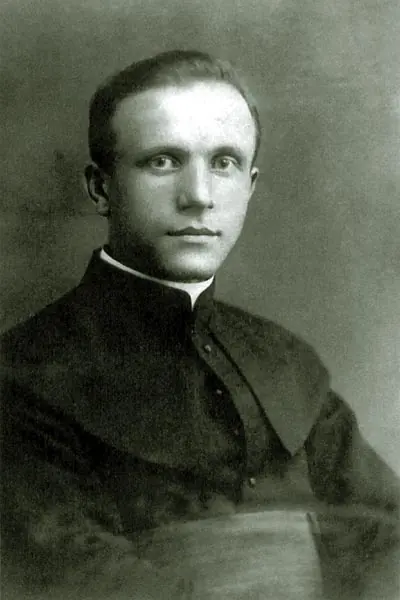
In 1933 she was sent to the convent in Vilnius, then a Polish city, to work in the garden. There she met the priest she said she had already seen in a vision: Fr. Michał Sopoćko, a professor of pastoral theology at the university and confessor to the sisters. He was skeptical. He asked for a psychiatric examination, which found her healthy, and later admitted that he had the image painted "more out of curiosity rather than conviction." He also told her to keep a diary. Sopoćko was himself beatified in 2008.

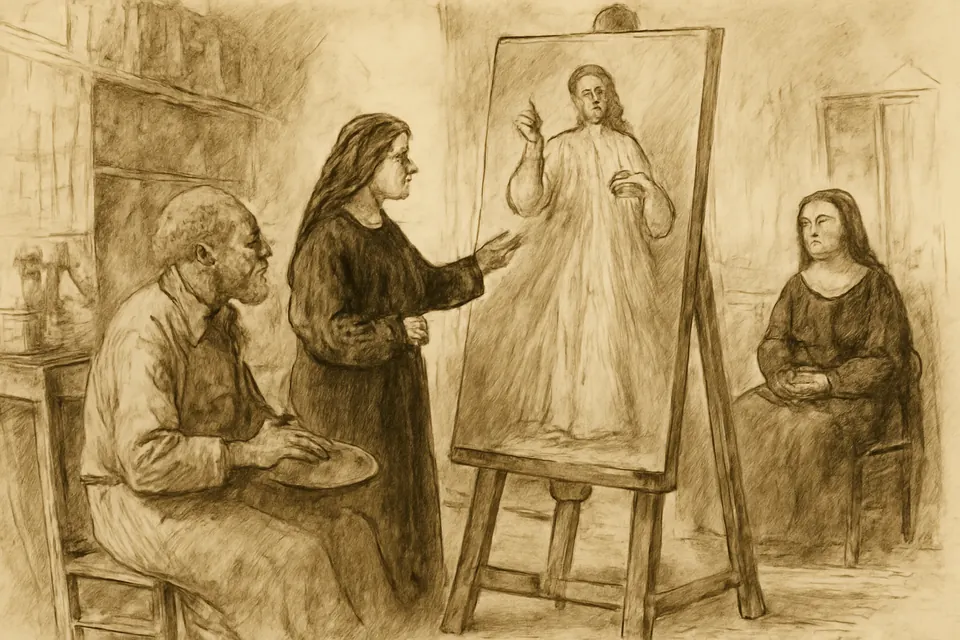
In January 1934 Sopoćko hired Eugeniusz Kazimirowski, a painter who lived in his building. Accompanied by her superior, Faustina visited the studio and told the artist how the picture should look. When it was finished in June 1934, she was disappointed. She wrote that she wept in the chapel and asked, "Who will paint You as beautiful as You are?" and heard the answer: "Not in the beauty of the color, nor of the brush lies the greatness of this image, but in My grace" (Diary, 313).
On April 26 to 28, 1935, the painting was displayed in a window of the Gate of Dawn, the city gate of Vilnius that holds a famous icon of Our Lady of Mercy, during the celebrations closing the Jubilee of the Redemption. April 28 was the Sunday after Easter. In the congregation's translation, Faustina wrote that "it was on the first Sunday after Easter [April, 1935] that the image was publicly honoured by crowds of people for the first time" (Diary, 89).


The chaplet, September 1935
On Friday, September 13, 1935, in her cell in Vilnius, Faustina saw an angel sent to strike the earth for its sins. She began to plead with words she said she heard within her, which became the core of the Chaplet of Divine Mercy (Diary, 474–476). The next day Jesus told her how to pray them on rosary beads. The text of the chaplet is given below.
Kraków and the last years
From 1936 Faustina lived in the convent at Łagiewniki on the edge of Kraków. She had tuberculosis of the lungs and digestive tract and spent long months in the hospital at Prądnik. Her Jesuit confessor in Kraków, Fr. Józef Andrasz, guided her during these years, and she kept writing. By the end the Diary filled six notebooks.

She struggled for years with the sense that Jesus wanted a new religious community devoted to mercy, and her superiors and confessors urged patience. In 1937 and 1938 she recorded the requests about the hour of three o'clock. Fr. Sopoćko visited her for the last time in September 1938. She died in the convent at Łagiewniki on the night of October 5, 1938, and was buried in the community cemetery two days later. One line from the Diary is often quoted about what followed: "I feel certain that my mission will not come to an end upon my death, but will begin" (Diary, 281).
The ban of 1959 and its lifting
During the Second World War the devotion spread fast through Poland and Lithuania. Fr. Sopoćko had thousands of small prints made, and soldiers sewed them into their uniforms. In 1941 a Marian priest, Fr. Józef Jarzębowski, brought it to the United States, and the Marians at Stockbridge, Massachusetts, became its center in English.
Rome grew uneasy. Bishops complained about a new image entering churches from a source the Church had never examined. In November 1958 the Holy Office (now the Dicastery for the Doctrine of the Faith) judged that the supernatural character of the revelations was not evident. A Notification published in 1959 forbade spreading images and writings promoting the devotion "in the form proposed by Sister Faustina" and left it to bishops whether to remove images already displayed. Many were taken down. The decree gave no reasons.
Both of Faustina's spiritual families give the same explanation. Her congregation says the Notification "had been issued owing to an erroneous translation of her diary," and the Marian Fathers say Rome had "erroneous and confusing translations" it could not check against the Polish original while Poland was under Communist rule. Some traditionalist critics still read the ban as a judgment on the devotion's theology, and a Polish theologian, Fr. Wincenty Granat, once argued that the chaplet's words were theologically flawed. Fr. Ignacy Różycki answered him that the phrase "Body and Blood, Soul and Divinity" follows the Council of Trent's language about the Eucharist.
In 1965 Archbishop Karol Wojtyła opened the diocesan inquiry into Faustina's life, and her cause went to Rome in 1968. On April 15, 1978, the Congregation for the Doctrine of the Faith, "having examined many original documents unknown in 1959," declared that the 1959 prohibitions "are no longer binding." Six months later Wojtyła was elected pope. In 1979 the same Congregation told the Marians there was no longer "any impediment" to spreading the devotion "in the authentic forms" Faustina proposed.
The miracles of St. Faustina
The Church examined two healings and approved both as miracles through her intercession. The Diary also describes extraordinary gifts in her own life, which her congregation's biography lists as visions, ecstasies, bilocation and hidden stigmata. Those were never the subject of a formal Church judgment.
- Approved (for beatification): Maureen Digan of Massachusetts had suffered from lymphedema since she was 15. She had about fifty operations and one leg amputated, and doctors expected to amputate the other. In March 1981 her husband, Bob, took her to Faustina's tomb at Łagiewniki with Fr. Seraphim Michalenko of the Marians. According to the Marians' account, she prayed, "Okay, Faustina, I came a long way, now do something," and heard within her, "If you ask for my help, I will give it to you." The swelling in her leg went down. Five doctors in the United States found her cured, and after review by the Congregation for the Causes of Saints the healing was accepted as a miracle. Faustina was beatified on April 18, 1993, the Sunday after Easter.
- Approved (for canonization): Fr. Ron Pytel, a priest of the Archdiocese of Baltimore, had a seriously damaged heart. On October 5, 1995, Faustina's feast, he prayed for healing at Holy Rosary Church in Baltimore, the archdiocese's Divine Mercy shrine, and venerated a relic of Faustina. He collapsed and lay on the floor, unable to move but at peace. His cardiologist then found his heart had healed. After almost three years of study, John Paul II ordered the decree on the miracle published on December 20, 1999. "I know in my heart that Faustina put in a word with Jesus, and His Heart touched mine," Pytel said.
- Reported: the many graces devotees attribute to the image, the chaplet and her intercession. The shrines at Łagiewniki and Stockbridge collect testimonies, but these have not been examined by the Church.
St. Faustina's canonization and Divine Mercy Sunday
John Paul II canonized Faustina in St. Peter's Square on April 30, 2000, the Sunday after Easter in the Great Jubilee year, and the Marian Fathers call her the "Saint for the Third Millennium." In the same homily he announced that the Second Sunday of Easter, "from now on throughout the Church will be called 'Divine Mercy Sunday'." This was the feast Faustina had asked for. In her Diary, as the Marians quote it, Jesus said: "The Feast of Mercy emerged from my very depths of tenderness. It is my desire that it solemnly be celebrated on the first Sunday after Easter. Mankind will not have peace until it turns to the fount of My Mercy" (Diary, 699).
On August 17, 2002, John Paul II dedicated the new Basilica of the Divine Mercy at Łagiewniki and there solemnly entrusted the world to Divine Mercy. He quoted Faustina's Diary: from this place "the spark which will prepare the world for his final coming" must go forth (Diary, 1732). He died on April 2, 2005, on the evening before Divine Mercy Sunday. Faustina and John Paul II were the patrons of World Youth Day in Kraków in 2016.


Why St. Faustina is the apostle of Divine Mercy
St. Faustina has no long list of patronages. She is not formally the patron of a trade or an illness. Catholics call her the apostle or secretary of Divine Mercy because, in the Diary, Jesus gives her that task: to tell the world about his mercy. In 2020 Pope Francis added her feast to the General Roman Calendar, citing her influence around the world. People ask her prayers above all for the conversion of sinners, for the dying, for trust in God in fear or illness, and for those who think they are beyond forgiveness. See all the patron saints.
Symbols of St. Faustina in art
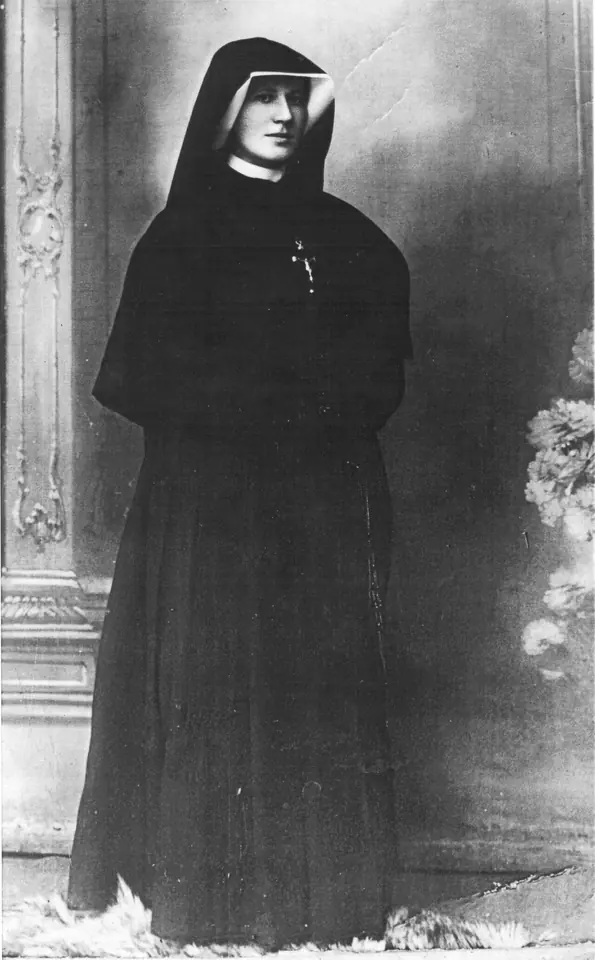
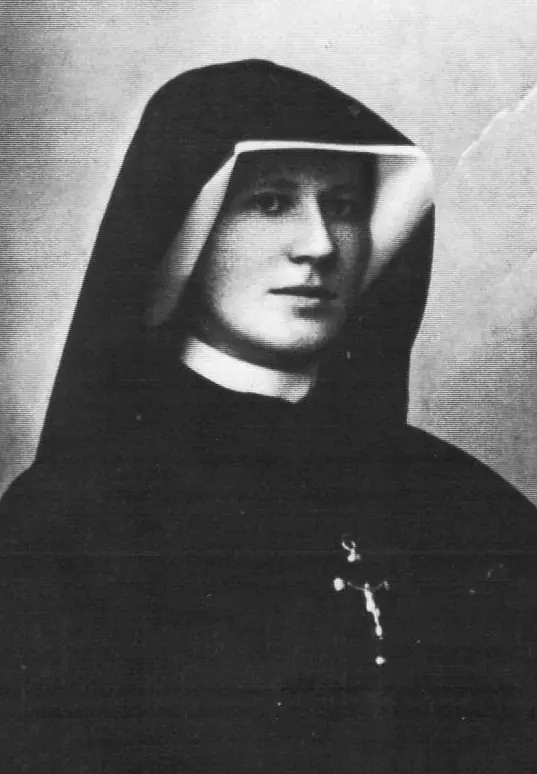
Because she lived in the age of photography, the real St. Faustina is easy to recognize. Statues and holy cards copy her photographs closely.
- Black habit and white coif: the habit of the Sisters of Our Lady of Mercy, a black veil over a stiff white band that frames the face. Her photographs on this page show it.
- The image of the Merciful Jesus: she is almost always shown beside it or looking up at it, often kneeling. When you see a nun in black kneeling before Christ in white with red and pale rays, it is Faustina.
- "Jesus, I trust in You": the signature on the image, in Polish Jezu, ufam Tobie. It often runs below her picture too.
- The Diary or a pen: for her role as the "secretary" of mercy. Some statues show her holding an open book.
- Rosary beads: for the chaplet, which is prayed on an ordinary rosary.
The Divine Mercy image: Vilnius and Kraków
There are two famous versions of the image, and it helps to know them apart.
The Kazimirowski image (1934) is the only one Faustina saw. Christ walks forward on a dark ground, and his right hand is raised only to the shoulder, because, the congregation explains, Sopoćko posed for it and that was how priests blessed then. The rays fall from his chest, which shows no heart. The painting hung in St. Michael's Church in Vilnius from 1937 until the Soviets closed it in 1948. It was hidden for decades, much of the time in a village church at Nowa Ruda in today's Belarus, smuggled back to Vilnius in 1986 and moved in 2005 to the Holy Trinity Church, now the Divine Mercy Sanctuary.
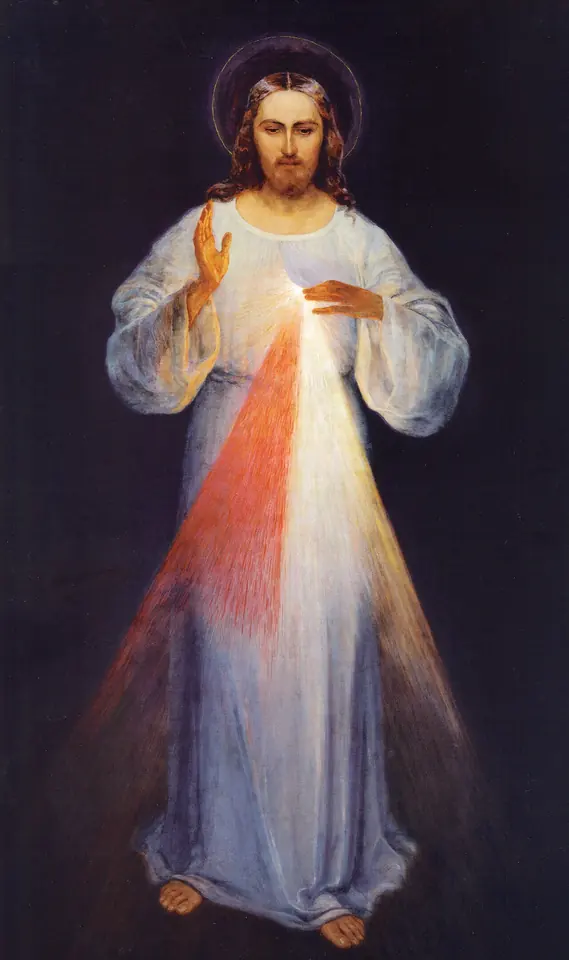

The Hyła image at Łagiewniki is the one most people know. Adolf Hyła, a Kraków painter, made it as a votive offering, working from Faustina's description and a print of the Kazimirowski picture. Fr. Andrasz blessed the version that hangs in the convent chapel on April 16, 1944, the Sunday after Easter. Christ's face is softer and his hand is raised higher. Copies of it fill churches on every continent.
The meaning is the same in both. In the Diary Jesus explains the rays this way: "The two rays denote Blood and Water. The pale ray stands for the Water which makes souls righteous. The red ray stands for the Blood which is the life of souls" (Diary, 299). The Marians explain them as the graces of Baptism and the Eucharist, flowing from the side of Christ pierced on the cross (John 19:34).


Feast day and where St. Faustina is honored
St. Faustina's feast is October 5, an optional memorial in the General Roman Calendar. Divine Mercy Sunday, the Sunday after Easter, is the larger celebration of the devotion she spread; many parishes pray the chaplet as a novena on the nine days from Good Friday to that Sunday. See the feast day calendar.
Kraków-Łagiewniki
Her relics rest in the convent chapel of the Sisters of Our Lady of Mercy at Łagiewniki, beneath Hyła's image. Her remains were later moved there from the convent cemetery. The modern basilica next door, with its tall tower, draws pilgrims from all over the world.


Other places
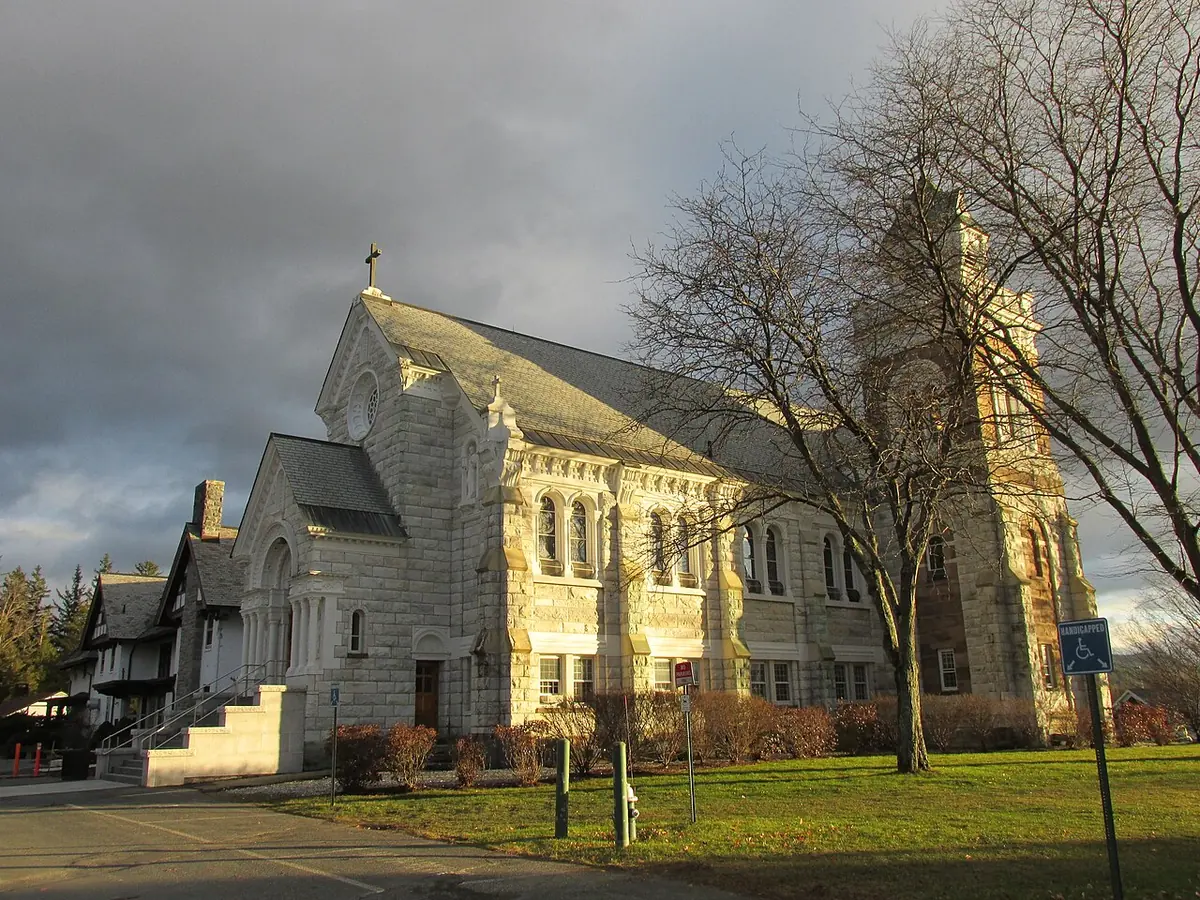
Vilnius keeps the first image at the Divine Mercy Sanctuary and the Gate of Dawn where it was first shown. Płock, where the first vision took place, and Świnice Warckie, where she was baptized, are shrines. In the United States, the Marian Fathers run the National Shrine of The Divine Mercy on Eden Hill in Stockbridge, Massachusetts, whose Divine Mercy Sunday draws thousands. Relics of St. Faustina have been given to many churches around the world.

The Chaplet of Divine Mercy and the three o'clock hour
How to pray the Divine Mercy Chaplet
Faustina wrote that Jesus told her how to pray the chaplet the day after her vision of the angel. In the English translation published by her congregation:
"First, say one Our Father, one Hail Mary, and the Apostles' Creed; next, on the Our Father beads you will say «Eternal Father, I offer You the Body and Blood, Soul and Divinity of Your Dearly Beloved Son, Our Lord, Jesus Christ, in atonement for our sins and those of the whole world;» and on the Hail Mary beads you will say these words, «For the sake of His sorrowful Passion, have mercy on us and on the whole world.» At the end, you will say these words three times, «Holy God, Holy Mighty One, Holy Immortal One, have mercy on us and on the whole world»" (Diary 476).
Using ordinary rosary beads, the steps are:
- Our Father, Hail Mary and the Apostles' Creed.
- On each large bead: "Eternal Father, I offer You the Body and Blood, Soul and Divinity of Your Dearly Beloved Son, Our Lord, Jesus Christ, in atonement for our sins and those of the whole world."
- On each of the ten small beads: "For the sake of His sorrowful Passion, have mercy on us and on the whole world."
- After five decades, three times: "Holy God, Holy Mighty One, Holy Immortal One, have mercy on us and on the whole world."
The congregation asks that the words not be changed, for example by saying "my sins" for "our sins," and the text carries the imprimatur of Cardinal Franciszek Macharski (1994). The Marian Fathers suggest an optional opening prayer from the Diary, said three times:
O Blood and Water, which gushed forth from the Heart of Jesus as a fount of mercy for us, I trust in You!
In the Diary the chaplet carries promises, especially for the dying. In the Marians' translation: "When they say this Chaplet in the presence of the dying, I will stand between My Father and the dying person, not as the just Judge but as the Merciful Savior" (Diary, 1541), and "Through the Chaplet you will obtain everything, if what you ask for is compatible with My will" (Diary, 1731).


The Hour of Mercy
Three o'clock in the afternoon is the hour Jesus died. In the Marian translation of the Diary:
At three o'clock, implore My mercy, especially for sinners; and, if only for a brief moment, immerse yourself in My Passion, particularly in My abandonment at the moment of agony. This is the hour of great mercy. (Diary, 1320)
Faustina recorded that Jesus suggested the Stations of the Cross at that hour, or a visit to the Blessed Sacrament, or simply a moment of prayer wherever one is (Diary, 1572). Many people pray the chaplet at three o'clock, though the congregation points out that the Diary never ties the chaplet to that hour; the two are separate practices.
Prayer to St. Faustina
Her congregation publishes a prayer for graces through her intercession, with the imprimatur of Cardinal Franciszek Macharski, archbishop of Kraków, dated January 20, 2000:
O Jesus, You inspired Saint Faustina with profound veneration for Your boundless Mercy. Grant me through her intercession, if it be Your holy will, the grace ...for which I fervently pray. My sins render me unworthy of Your Mercy, but be mindful of Saint Faustina's spirit of sacrifice and self-denial, and reward her virtue by granting the petition which, with childlike confidence, I present to You through her intercession.
Our Father..., Hail Mary..., Glory...
Saint Faustina, pray for us.
John Paul II ended his canonization homily with a prayer to her, which the congregation also prints:
And you, Faustina, a gift of God to our time, a gift from the land of Poland to the whole Church, obtain for us an awareness of the depth of divine mercy; help us to have a living experience of it and to bear witness to it among our brothers and sisters.
Words from the Diary
A few lines that are often quoted, from the Marian Fathers' English translation unless noted:
- "My sanctity and perfection consist in the close union of my will with the will of God" (Diary, 1107, quoted in the Vatican's biography).
- "I do not want to punish aching mankind, but I desire to heal it" (Diary, 1588, quoted in the Vatican's biography).
- "By means of this image I shall grant many graces to souls. It is to be a reminder of the demands of My mercy, because even the strongest faith is of no avail without works" (Diary, 742).
The Marian Fathers' English translation, published by Marian Press in Stockbridge, is the standard English edition. Her congregation publishes its own translation, quoted on this page where noted.
Frequently asked questions
When is St. Faustina's feast day?
October 5, the day she died in 1938. Pope Francis added it to the General Roman Calendar as an optional memorial in 2020. Divine Mercy Sunday, the Sunday after Easter, is a separate celebration that she said Jesus asked for.
What is St. Faustina known for?
For the Divine Mercy devotion. In her Diary she recorded words she believed came from Jesus asking for an image of the Merciful Jesus signed "Jesus, I trust in You," a feast of mercy on the Sunday after Easter, the Chaplet of Divine Mercy and prayer at three o'clock in the afternoon.
What miracles were approved for St. Faustina?
Two healings. For her beatification the Church approved the 1981 cure of Maureen Digan of Massachusetts from lymphedema after she prayed at Faustina's tomb. For her canonization it approved the 1995 healing of Fr. Ron Pytel of Baltimore, whose damaged heart was found healed after he prayed for her intercession on October 5, 1995.
How do you pray the Divine Mercy Chaplet?
On ordinary rosary beads. Begin with an Our Father, a Hail Mary and the Apostles' Creed. On each large bead say "Eternal Father, I offer You the Body and Blood, Soul and Divinity of Your dearly beloved Son, Our Lord Jesus Christ, in atonement for our sins and those of the whole world." On the ten small beads say "For the sake of His sorrowful Passion, have mercy on us and on the whole world." End with "Holy God, Holy Mighty One, Holy Immortal One, have mercy on us and on the whole world" three times.
Why was the Divine Mercy devotion banned?
In 1959 the Holy Office forbade spreading the devotion "in the form proposed by Sister Faustina" and left it to bishops whether to remove the images. Her congregation and the Marian Fathers say Rome was working from a faulty Italian translation of the Diary and could not check the Polish original under Communism. In 1978 the Congregation for the Doctrine of the Faith declared the prohibitions "no longer binding."
Where is St. Faustina buried?
Her relics rest in the convent chapel of the Sisters of Our Lady of Mercy at the Shrine of Divine Mercy in Kraków-Łagiewniki, beneath the famous Divine Mercy image by Adolf Hyła. She was first buried in the convent cemetery in 1938.
What is the difference between the Divine Mercy image in Vilnius and the one in Kraków?
The Vilnius image is the first, painted by Eugeniusz Kazimirowski in 1934 while Faustina watched and gave directions. The Kraków image was painted by Adolf Hyła in 1943–1944, after her death, as a votive offering. Hyła's version is the one reproduced around the world.
Did St. Faustina write the Divine Mercy prayers herself?
She wrote that she heard the chaplet's words interiorly in Vilnius in September 1935 and recorded them in her Diary (475–476). The opening prayer "O Blood and Water" is also from the Diary. Some popular additions, like the "Eternal God" closing prayer, are passages from her Diary that publishers attached to the chaplet later.
Sources
- Vatican: Mary Faustina Kowalska (1905–1938), biography
- John Paul II, Homily for the Canonization of Sr. Mary Faustina Kowalska, April 30, 2000
- John Paul II, Homily at the Dedication of the Shrine of Divine Mercy, Kraków-Łagiewniki, August 17, 2002
- Sacred Congregation for the Doctrine of the Faith: Notification regarding the devotion to Divine Mercy in the form proposed by Sr. Faustina Kowalska, April 15, 1978
- Diary of Saint Maria Faustina Kowalska: Divine Mercy in My Soul (Marian Press, Stockbridge, Massachusetts)
- Congregation of the Sisters of Our Lady of Mercy: Biography of St. Faustina
- Congregation of the Sisters of Our Lady of Mercy: The Divine Mercy Image (history of the Kazimirowski and Hyła images)
- Congregation of the Sisters of Our Lady of Mercy: Chaplet of the Divine Mercy
- Congregation of the Sisters of Our Lady of Mercy: Hour of Mercy
- Congregation of the Sisters of Our Lady of Mercy: Prayer through the Intercession of St. Faustina
- Marian Fathers: How to Recite the Chaplet of The Divine Mercy
- Marian Fathers: The History of the Chaplet of The Divine Mercy
- Marian Fathers: The Image of The Divine Mercy
- Marian Fathers: The Hour of Great Mercy
- Marian Fathers: St. Faustina, the Marians, and the Spread of the Devotion
- Marian Fathers: Graces and Miracles Received (Maureen Digan and Fr. Ron Pytel)
- Vatican News: Pope adds St. Faustina Kowalska to the General Roman Calendar (May 2020)