St. Jerome
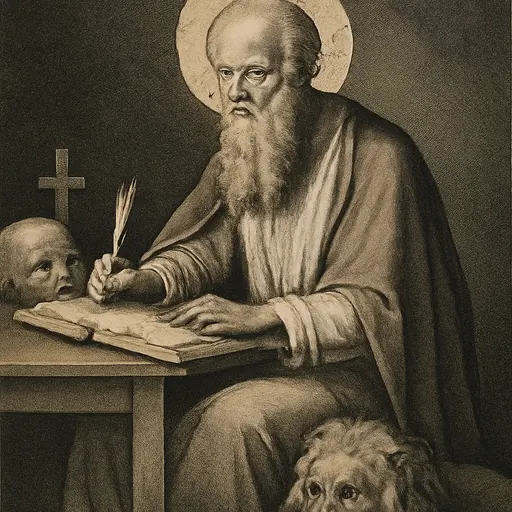
St. Jerome (about 345–420) was a priest and scholar from Stridon, on the border of present-day Croatia and Slovenia, who translated most of the Bible into Latin. His translation, the Vulgate, was the Bible of the Western Church for over a thousand years. He spent his last 34 years in Bethlehem. His feast day is September 30, and he is the patron saint of translators and librarians.
Who was St. Jerome?
St. Jerome gave the Latin-speaking Church its Bible. Working first in Rome and then for more than thirty years in a cell at Bethlehem, he revised the Latin Gospels and translated most of the Old Testament directly from Hebrew. The result, later called the Vulgate, was read, prayed and copied across Europe for more than a thousand years. Pope Francis wrote in 2020 that "Medieval Europe learned to read, pray and think from the pages of the Bible translated by Jerome."
He was also a monk, a spiritual guide to a circle of Roman women, a tireless letter writer and a fierce controversialist. Pope Benedict XVI, opening two talks on him in 2007, mentioned his "well-known difficult, hot-tempered character." The Church honors him as one of the four great Latin Doctors, with St. Ambrose, St. Augustine and St. Gregory the Great.
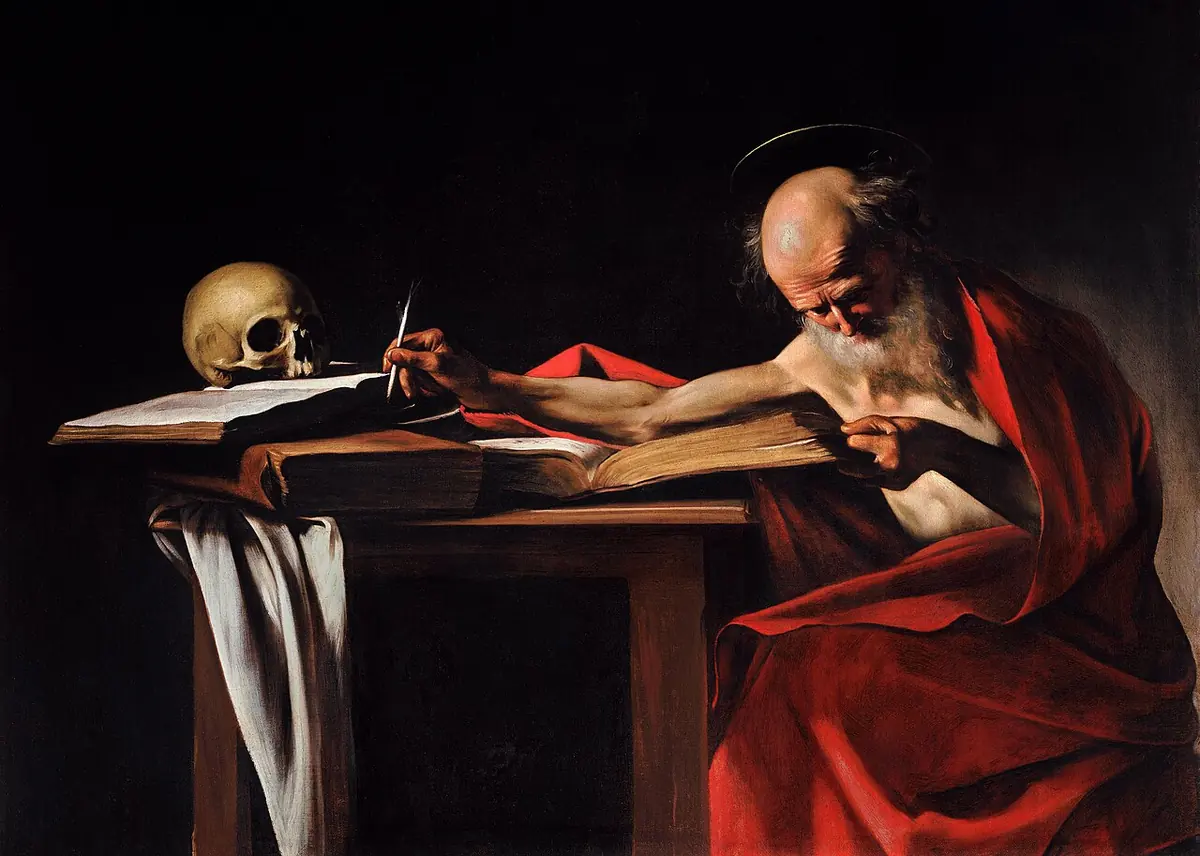

The life of St. Jerome
Stridon and Rome
Jerome was born in Stridon, a small town on the border between Dalmatia and Pannonia, in present-day Croatia or Slovenia. The Catholic Encyclopedia dates his birth to about 340–342; Benedict XVI gives about 347, and Pope Francis about 345. His Christian parents sent him to Rome to study rhetoric, and he fell in love with the Latin classics. He later admitted the "indiscretions of his youth." He was baptized in Rome as a young adult, sometime between 358 and 366.
The desert and the dream
After studying at Trier and living with a group of ascetics at Aquileia, he went east around 373. From about 374 to 379 he lived as a hermit in the desert of Chalcis, southwest of Antioch, where a converted Jew taught him Hebrew. He found its sounds "harsh and aspirate."
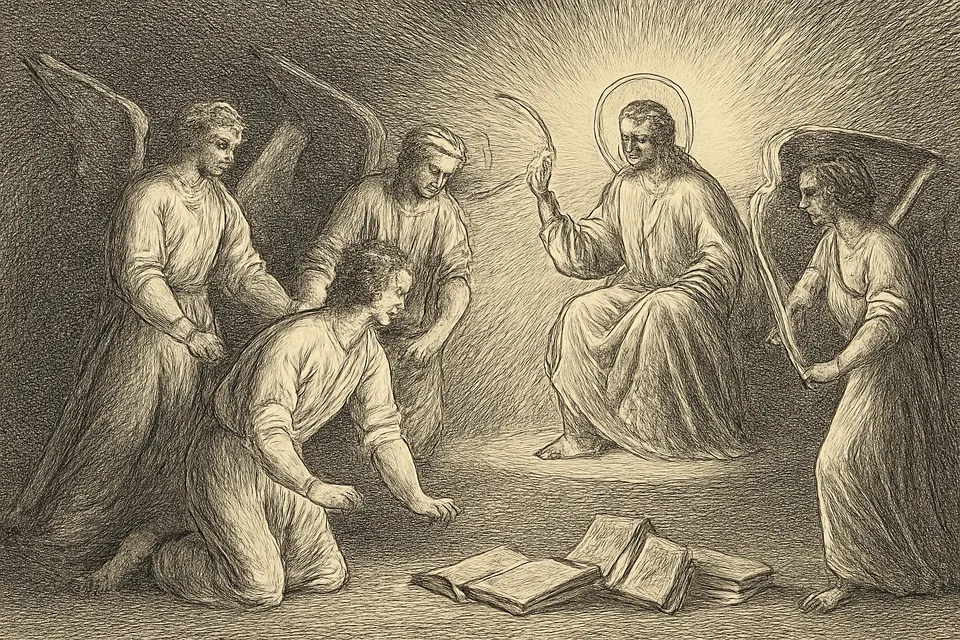
During a Lenten fever, probably in 375, he had the dream that changed his life. He described it in a letter to Eustochium:
Asked who and what I was I replied: I am a Christian. But He who presided said: You lie. You are a follower of Cicero and not of Christ. For 'where your treasure is, there will your heart be also.' (Letter 22, 30)
He swore never again to read worldly books. Jerome insisted it was no idle dream: "my shoulders were black and blue," he wrote, and "thenceforth I read the books of God with a zeal greater than I had previously given to the books of men."
Ordained a priest at Antioch, he went on to Constantinople around 380, where he studied with St. Gregory of Nazianzus.
Pope Damasus and the Aventine circle
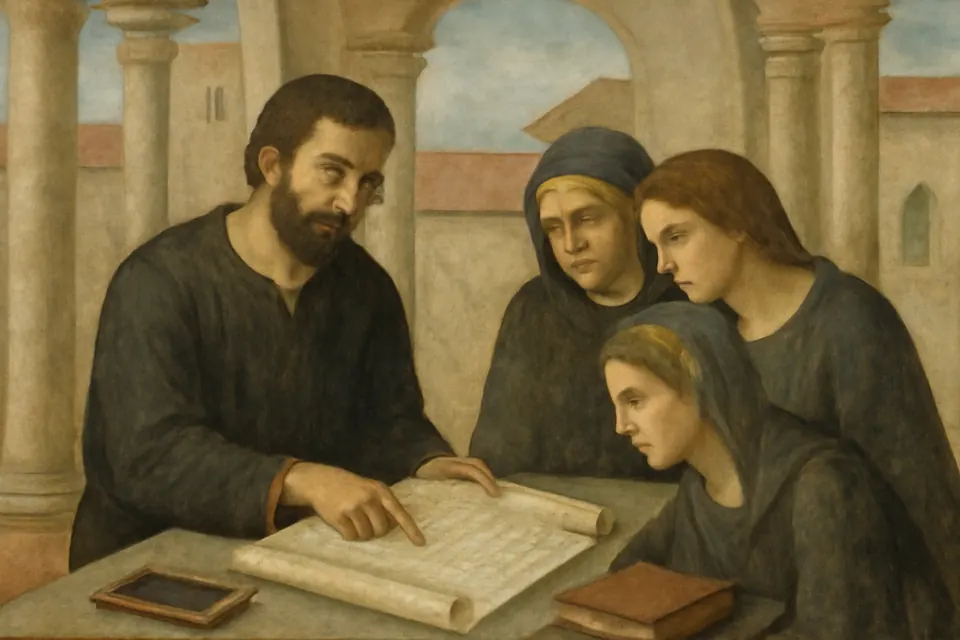
In 382 Jerome came back to Rome, and Pope Damasus made him his secretary and adviser. Damasus asked him to revise the old Latin translations of the Gospels, which differed from manuscript to manuscript. In Rome he also became the teacher of a group of noble Christian women on the Aventine Hill, among them Marcella, the widow Paula and her daughter Eustochium. Benedict XVI noted that "these noblewomen also learned Greek and Hebrew."
Damasus died in December 384. Jerome's harsh criticisms of the Roman clergy had made him bitter enemies, the Catholic Encyclopedia says, and in August 385 he left Rome for good.
Bethlehem, Paula and Eustochium
After a pilgrimage through the Holy Land and a visit to the monks of Egypt, Jerome settled in Bethlehem in 386. Paula paid for a monastery for men, a convent for women and a hospice for pilgrims, "remembering Mary and Joseph who had found no room there." He lived there for the rest of his life, close to the grotto of the Nativity.


When Paula died in 404, Jerome wrote Eustochium one of his longest letters, a full life of her mother. He closed it: "In this letter I have built to your memory a monument more lasting than bronze, which no lapse of time will be able to destroy."
His last years were hard. He lived through the news of the Gothic sack of Rome in 410, and in 411 raiders overran the country around Bethlehem. He died in his cell on September 30, 420, and was buried near the cave of the Nativity.


The Vulgate
Jerome's Bible came in stages. In Rome he revised the Gospels (384) and made a first revision of the Psalms from the Greek. In Bethlehem he made a second Psalter from Origen's Hexapla, the Gallican Psalter that became part of the Vulgate. Then, between about 390 and 405, he did what no Latin Christian had done before: he translated the Old Testament directly from Hebrew.
The Catholic Encyclopedia says he came to hold that only the original text was inspired, and that in reaction he did not value the Greek Septuagint enough, but it concludes: "we must admit the excellence of the translation made by St. Jerome." His rule of thumb was to go back to the source: "if there are divergences between the Greek and Latin texts we should have recourse to the original Hebrew text."
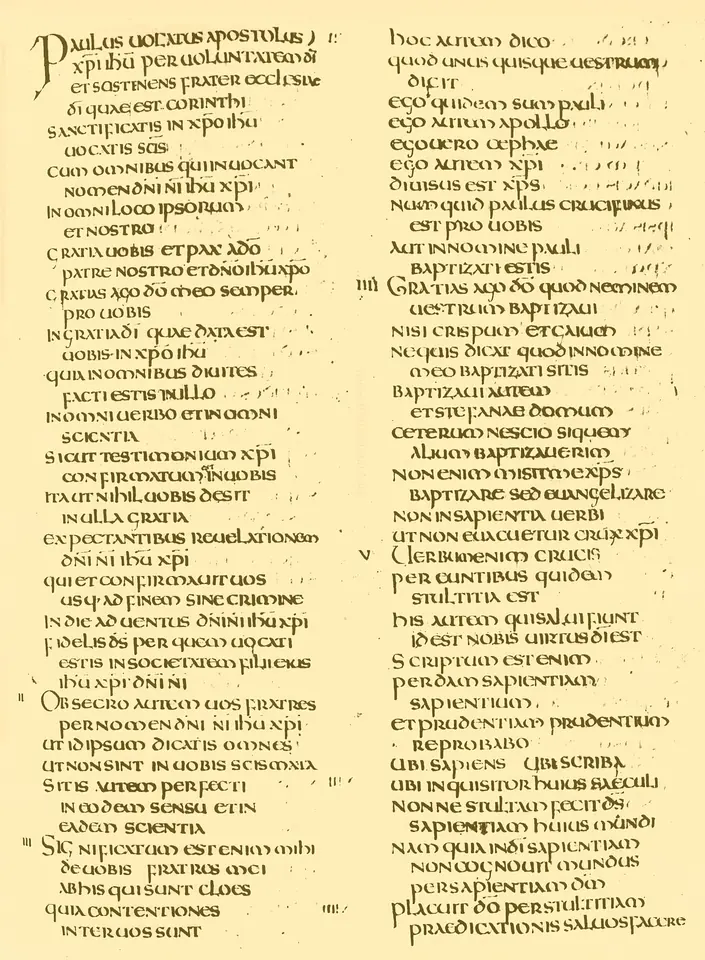

The new translation met some resistance at first, but it became the common Bible of the West; the name "Vulgate" means the version in common use. The Council of Trent declared it "authentic" for study, preaching and public disputation, and in 1979 St. John Paul II promulgated a revised edition, the Neo-Vulgate.
"Ignorance of Scripture is ignorance of Christ"
Jerome's most quoted sentence comes from the prologue of his Commentary on Isaiah. The Second Vatican Council placed it in Dei Verbum (no. 25): "For ignorance of the Scriptures is ignorance of Christ." Benedict XVI quoted it in 2007 and drew the lesson for every Christian: "to love the Word of God in Sacred Scripture."
A difficult saint
Jerome was not an easy man. The Catholic Encyclopedia lists "his waywardness, his love of extremes, his exceeding sensitiveness," and says his letters could be "bitterly satirical, unsparingly outspoken concerning others and equally frank about himself." He quarreled bitterly with his old friend Rufinus over Origen and attacked Helvidius, Jovinian, Vigilantius and Pelagius with sarcasm. Pope Francis called him a "Lion of Bethlehem" who "could be violent in his language," but always in the service of the truth.
The lion and other legends
The best-known story about Jerome is not in his writings. The Golden Legend, compiled in the 13th century, says that one evening a limping lion walked into the monastery at Bethlehem. The monks fled, but Jerome had them wash its paw, found a thorn, and healed it. The lion stayed and was given a job, guarding the donkey that carried firewood. When merchants stole the donkey, the monks accused the lion of eating it and made it carry the wood instead, until it found the donkey with a caravan and drove the whole train back to the monastery.


The story is traditional, and it was almost certainly borrowed. A very similar tale, of a lion healed of a thorn that went on to serve the monks, was told earlier in the East about St. Gerasimus, who founded a monastery by the Jordan around 450. The Orthodox Church still paints Gerasimus with the lion at his feet. The historian Eugene Rice argued that the story moved to Jerome because in late Latin his name, Geronimus, sounded almost like Gerasimus.


No miracles of Jerome have been approved in the modern sense. Other stories of his death and last Communion come from a letter that claimed to be by one of his 5th-century companions but was written in the late 13th century; they too are traditional.
Why St. Jerome is the patron saint of translators
He is the model translator: a man who learned Greek and Hebrew as an adult to bring the Bible into his readers' language. In 2017 the United Nations made September 30 International Translation Day because it is "the feast of St. Jerome, the Bible translator, who is considered the patron saint of translators." Pope Francis wrote that "a translator is a bridge builder."
Librarians and scholars claim him because of his learning; Francis called him "the library of Christ." See all the patron saints by cause.
Symbols of St. Jerome in art
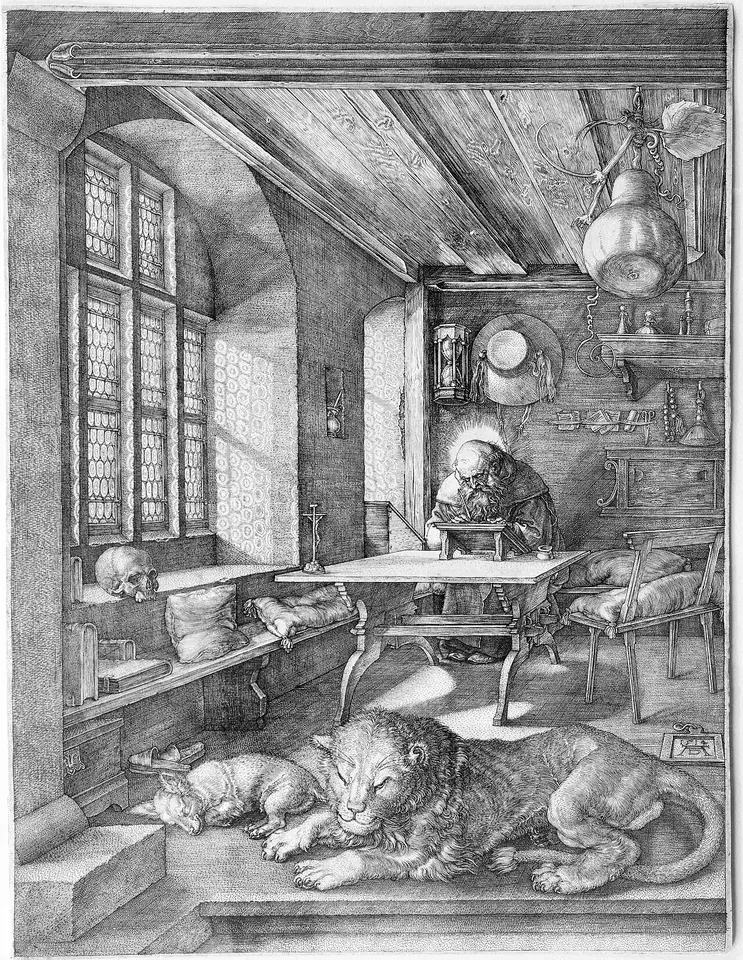
Jerome usually appears in one of two settings: the study or the desert.
- The lion: his most common companion, from the Golden Legend.
- A red cardinal's hat and robe: from the legend that he was a cardinal; Pope Francis explains it as a sign of his service to Damasus.
- A book, pen and inkwell: the scholar and translator.
- A skull: a reminder of death, common in his study.
- A stone: in desert scenes he beats his breast with a rock in penance.
- A trumpet: an angel sounding the Last Judgment, from a line long attributed to him.


In the study he is an old man at a desk, sometimes wearing spectacles; in the desert he is half-naked before a crucifix. Dalmatian art sometimes gives him a model church, a sign of local pride in a son of the region.

Feast day and where he is honored
The Catholic Church keeps his memorial on September 30; the Orthodox Church remembers him on June 15. See the feast day calendar. According to the Roman Martyrology, his body was later taken from Bethlehem to Rome and placed in the Basilica of St. Mary Major, where tradition holds it still lies. Pilgrims in Bethlehem visit his cave and tomb beneath the Church of the Nativity, beside the Franciscan church of St. Catherine.
Prayer to St. Jerome
No traditional prayer to St. Jerome has a widely documented origin. The Church's prayer for his feast, the Collect of September 30, thanks God for giving him "a living and tender love" for Sacred Scripture; Pope Francis took those words from the opening prayer of the memorial to begin his 2020 letter on Jerome. Catholics ask St. Jerome's intercession when studying, translating or reading the Bible, and many pray his own line: "Seek to learn on earth those truths which will remain ever valid in Heaven."
Frequently asked questions
What is St. Jerome the patron saint of?
Translators, librarians, Bible scholars and students. The United Nations chose his feast, September 30, as International Translation Day in 2017 because he is "considered the patron saint of translators."
What did St. Jerome say about Scripture?
His best-known line is "Ignorance of the Scriptures is ignorance of Christ," from the prologue of his Commentary on Isaiah. The Second Vatican Council quoted it in Dei Verbum, and Pope Benedict XVI repeated it in 2007.
Why is St. Jerome shown with a lion?
The Golden Legend tells how a limping lion walked into his monastery in Bethlehem; Jerome pulled a thorn from its paw, and it stayed to guard the monks' donkey. Jerome himself never mentions a lion. The same story was told earlier about St. Gerasimus, a monk of the Jordan, and was probably transferred to Jerome because their names sounded alike.
Why is St. Jerome dressed as a cardinal?
The Golden Legend wrongly says he was made a cardinal-priest in Rome. Cardinals did not exist in his day. Pope Francis explained the red robes as a sign of his service to Pope Damasus as a priest of Rome.
Where is St. Jerome buried?
He was buried in Bethlehem, near the grotto of the Nativity, where the cave tomb can still be visited. The Roman Martyrology says his body was later taken to Rome and laid in the Basilica of St. Mary Major. The Orthodox Church in America says the relics went to Rome in 642 but that their present location is unknown.
Sources
- Catholic Encyclopedia (1910): St. Jerome
- Benedict XVI, General Audience of 7 November 2007: Saint Jerome (1)
- Benedict XVI, General Audience of 14 November 2007: Saint Jerome (2)
- Pope Francis, Apostolic Letter Scripturae Sacrae Affectus on the 1600th anniversary of the death of Saint Jerome (2020)
- Second Vatican Council, Dei Verbum (1965), no. 25
- Jerome, Letter 22 to Eustochium
- Jerome, Letter 108 to Eustochium (on the death of Paula)
- Catholic Encyclopedia (1909): Doctors of the Church
- The Golden Legend (Caxton translation): Life of Saint Jerome
- Christian Iconography: St. Jerome in Art
- Orthodox Church in America: Saint Jerome (Hieronymus) of Stridon
- Orthodox Church in America: Venerable Gerasimus of the Jordan
- United Nations: International Translation Day
- Eugene F. Rice Jr., Saint Jerome in the Renaissance (Johns Hopkins University Press, 1985)
- Roman Martyrology, September 30