St. Basil the Great

St. Basil the Great (about 330–379) was the bishop of Caesarea in Cappadocia, in present-day Turkey, a defender of the Nicene faith against the Arian emperor Valens, and the father of Eastern monasticism. He built a complex of hospitals and hostels for the poor that Pope Benedict XVI called the origin of the modern hospital. His feast is January 2 in the Catholic Church, shared with St. Gregory Nazianzen, and January 1 in the Orthodox Church, when Greek families cut the Vasilopita in his name.
Who was St. Basil the Great?
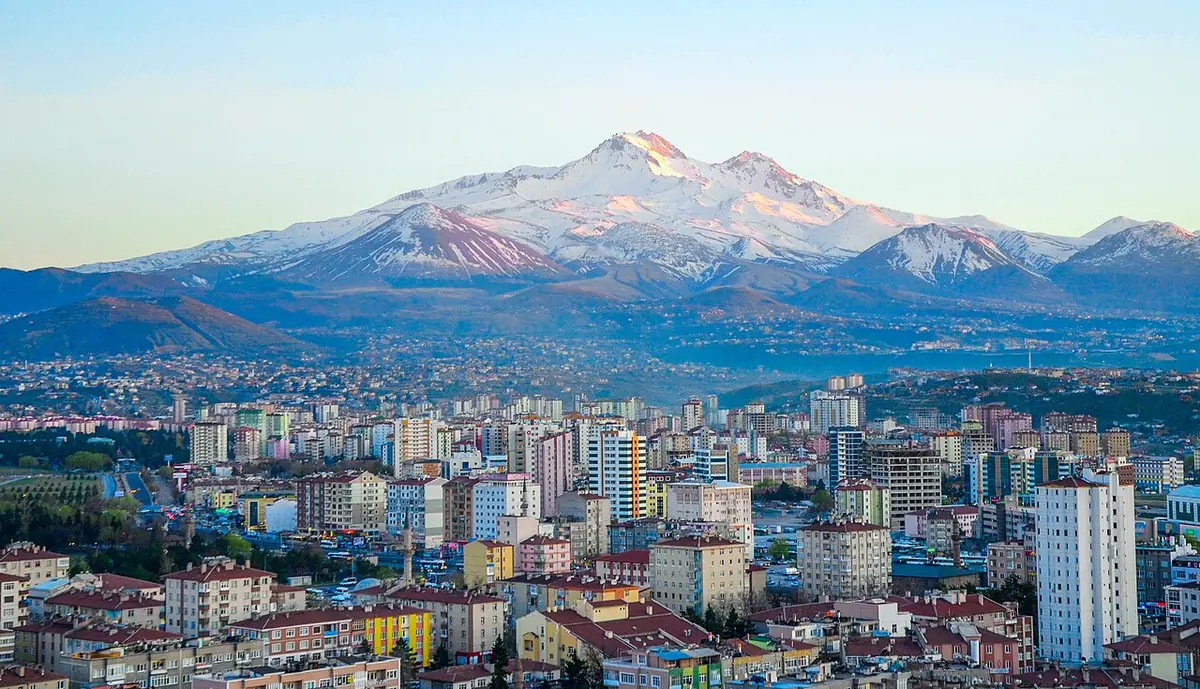
Basil was a 4th-century bishop of Caesarea, the capital of Cappadocia, now Kayseri in central Turkey. He lived about forty-nine years and was a bishop for nine. In that time he defended the faith of the Council of Nicaea against an Arian emperor, wrote the rules that still shape Eastern monastic life, gave the Byzantine rite one of its two liturgies and built a quarter of hospitals and hostels outside his city.
The Catholic Encyclopedia ranks him just after St. Athanasius as a defender of the Eastern Church. With his friend St. Gregory of Nazianzus and his younger brother Gregory of Nyssa, he is one of the three "Cappadocian Fathers." Catholics count him a Doctor of the Church, and the Orthodox honor him with Gregory and St. John Chrysostom as one of the Three Holy Hierarchs.

The life of St. Basil
A family of saints
Basil was born about 330 into a wealthy Christian family of Caesarea. His father, Basil the Elder, was a well-known teacher of rhetoric. His mother, Emmelia, was the daughter of a martyr. His father's parents had hidden for years in the forests of Pontus during the last great persecution, and his grandmother, Macrina the Elder, passed on to the children what she remembered of the teaching of St. Gregory the Wonderworker, the apostle of the region.
Emmelia and Basil the Elder had ten children. The Catholic Encyclopedia names three as saints: Basil, his older sister Macrina and his brother Gregory, later bishop of Nyssa. The Orthodox Church honors five, adding Peter, bishop of Sebaste, and Theosebia. Benedict XVI called the household "a true domestic Church."
Athens and a change of heart
Basil studied at Caesarea, Constantinople and Athens, where his friendship with Gregory of Nazianzus grew so close that, in Gregory's words, "we seemed to have one soul, inhabiting two bodies." He came home about 357 a brilliant young rhetorician, and for a while he taught in Caesarea.
His sister Macrina had turned the family estate at Annesi in Pontus into a religious community, and her brother Gregory of Nyssa, in his life of her, gives her the credit for turning Basil from a worldly career. Basil described the change in a letter written years later:
Much time had I spent in vanity, and had wasted nearly all my youth in the vain labour which I underwent in acquiring the wisdom made foolish by God. Then once upon a time, like a man roused from deep sleep, I turned my eyes to the marvellous light of the truth of the Gospel, and I perceived the uselessness of the wisdom of the princes of this world, that come to naught. (Letter 223)
He was baptized, traveled to see the monks of Egypt, Palestine, Syria and Mesopotamia, gave away his wealth and settled on the river Iris across from his mother's and sister's community. Gregory joined him for a time. Together they compiled the Philocalia, a collection of passages from Origen.
Father of Eastern monasticism
Asia Minor already had hermits. Basil added the common life: monks praying, working and eating together under a superior. His Longer Rules and Shorter Rules, written as answers to his monks' questions, remain the basis of monastic life in the Orthodox Church. St. Benedict, the father of Western monasticism, recommended Basil's rule to his own monks in the last chapter of his Rule, and Benedict XVI said he "considered Basil his teacher."
Priest and bishop
Basil was ordained a priest about 364 and soon ran most of the diocese for his bishop, Eusebius. During a famine he collected food from those who had it, set out "basins of soup" for the hungry and, Gregory says, served them himself. When Eusebius died in 370, Basil was elected bishop of Caesarea and metropolitan of Cappadocia, with authority over fifty country bishops.

Standing up to Valens
The emperor Valens favored the Arians, who denied that the Son of God was fully divine, and exiled bishops who resisted. In 372 his prefect Modestus summoned Basil and threatened him with confiscation, banishment, torture and death. Gregory Nazianzen preserved the exchange in his funeral oration. Basil answered that "a man who has nothing, is beyond the reach of confiscation; unless you demand my tattered rags, and the few books, which are my only possessions," and that exile meant nothing to a man who counted all lands as God's.
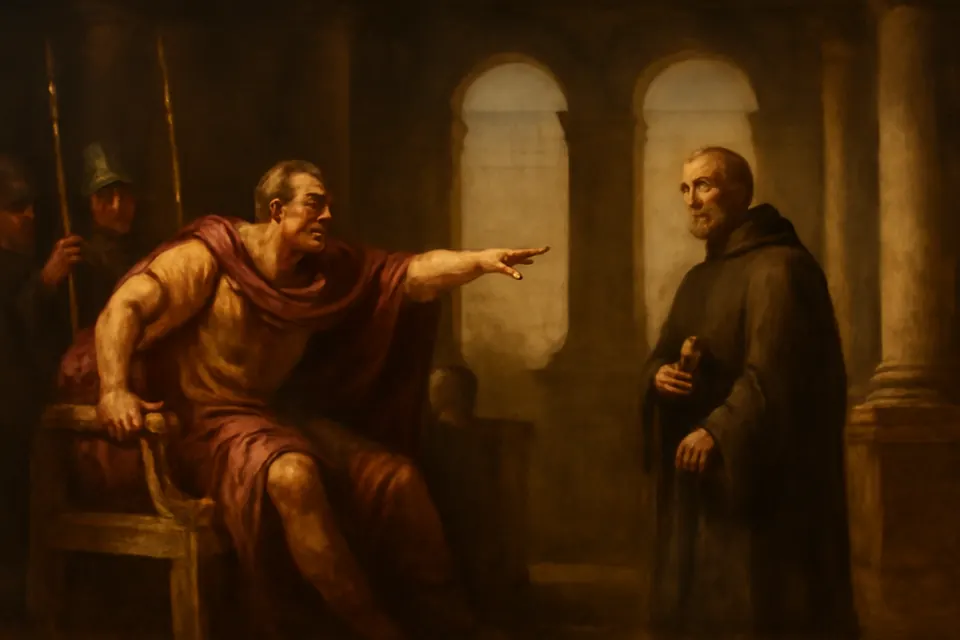
Amazed at this language, the prefect said, No one has ever yet spoken thus, and with such boldness, to Modestus. Why, perhaps, said Basil, you have not met with a Bishop, or in his defense of such interests he would have used precisely the same language. (Gregory Nazianzen, Oration 43)
Modestus reported to the emperor, "We have been worsted, Sire, by the prelate of this Church." When Valens himself came to Basil's church on the Epiphany, Gregory says, the thunder of the psalms and the sight of Basil motionless at the altar so shook him that he staggered with his offering and had to be caught. He never exiled Basil.


The new city
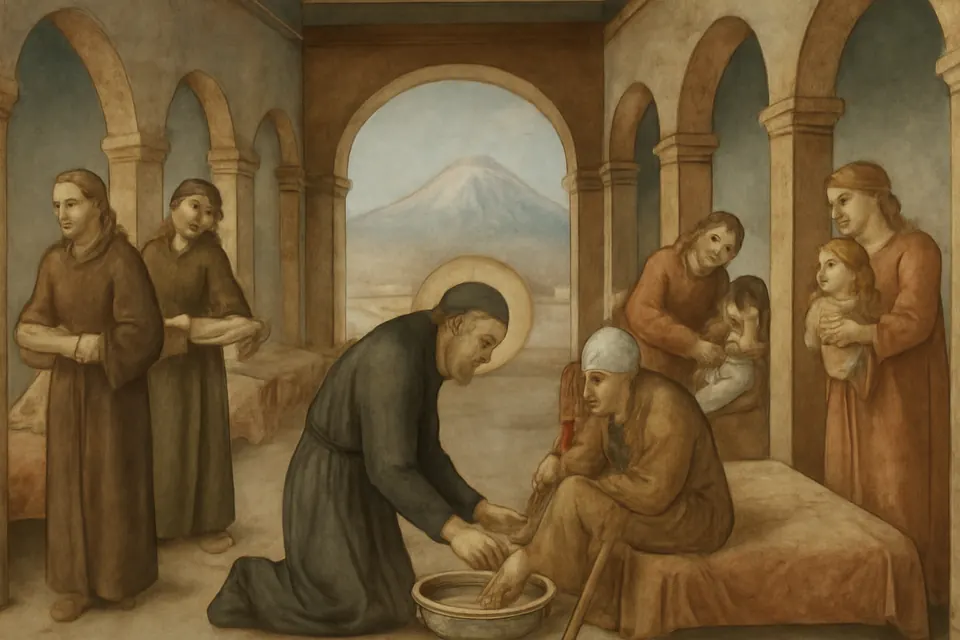
Outside Caesarea Basil built a complex for the sick, travelers and the poor, with a church and quarters for physicians and workers. Writing to a suspicious governor, he called it "a place of entertainment for strangers, both for those who are on a journey and for those who require medical treatment on account of sickness" (Letter 94). It came to be called the Basiliad. Gregory urged his listeners:
Go forth a little way from the city, and behold the new city, the storehouse of piety, the common treasury of the wealthy, in which the superfluities of their wealth, aye, and even their necessaries, are stored, in consequence of his exhortations. (Oration 43)
Gregory adds that Basil "kissed the lepers." Benedict XVI called the Basiliad "the origin of the modern hospital structures where the sick are admitted for treatment."
On the Holy Spirit and his death
Critics objected when Basil prayed the doxology both ways, "with the Son together with the Holy Ghost" as well as "through the Son in the Holy Ghost." His answer was the treatise On the Holy Spirit (about 375), written for his friend Amphilochius of Iconium, which defends the full divinity of the Spirit.
Worn out by illness and fasting, Basil died on January 1, 379. Gregory describes a funeral so crowded that people trampled one another, with Jews and pagans mourning alongside Christians.
Miracles and legends of St. Basil
No miracle of Basil's has been approved in the modern sense; his cult is older than any formal process. Gregory's oration says plainly that Basil could not rain bread from heaven like Moses, but fed the hungry by persuading the rich.
- Traditional: Valens faltering at the Epiphany liturgy, which Gregory tells as a sign of Basil's holiness, not a miracle.
- Traditional: the legend behind the Vasilopita, described below.
- Traditional: the miracles of later lives. The Catholic Encyclopedia calls the best known, the Life ascribed to Amphilochius, a forgery of about the 9th century.
Why St. Basil is the patron saint of monks and hospitals
Eastern monks call Basil their lawgiver because his rules still govern their life. Catholic Online names him patron of hospital administrators because of the Basiliad. See all patron saints.
Symbols of St. Basil in art
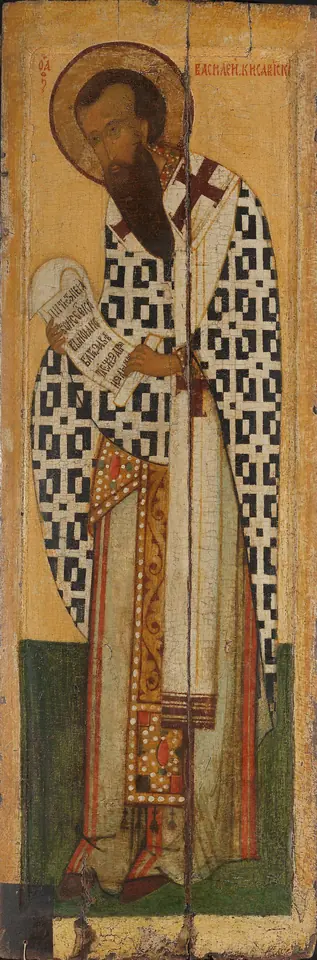
In Byzantine and Russian icons Basil is easy to spot once you know the type:
- A long, dark, pointed beard and a thin, ascetic face. Gregory, by contrast, is shown balding, with a bushy white beard.
- The omophorion, the long white stole of a bishop marked with large black crosses, worn over a phelonion.
- A Gospel book or scroll, often with words from his liturgy.
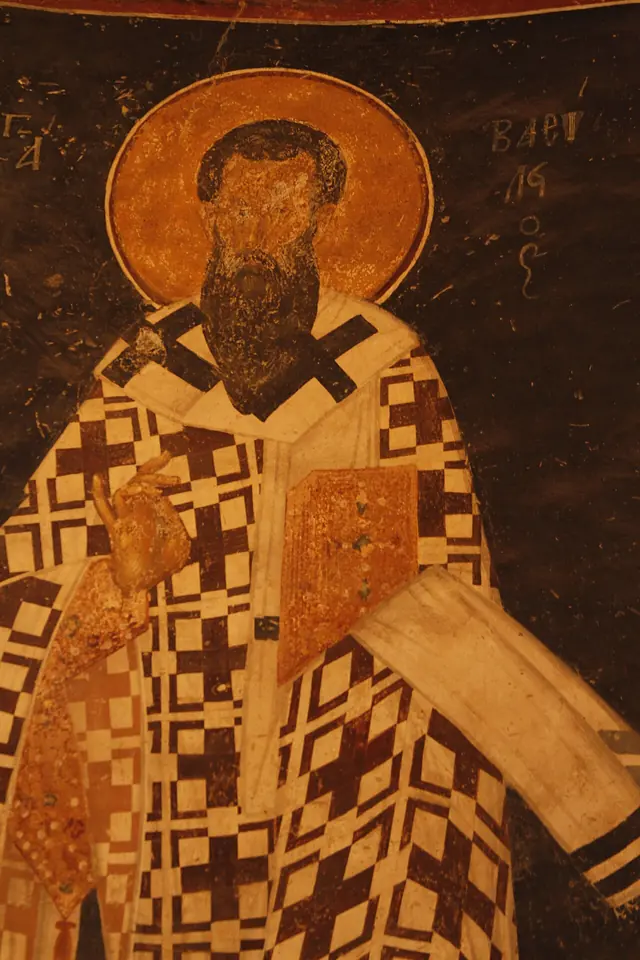

The Chora fresco and the Novgorod icon on this page both show these features, and the Cefalù mosaic sets him beside his two fellow hierarchs.


Western painters gave him a Latin miter and a dove, the Holy Spirit inspiring his writing, which Catholic Culture lists among his symbols.
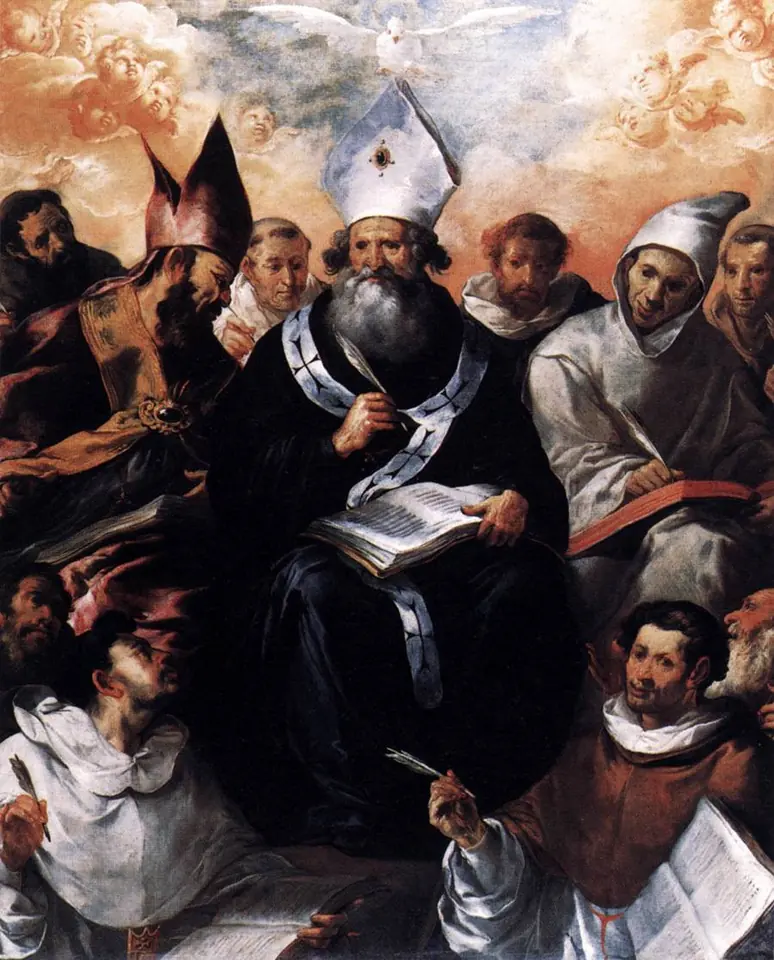

Feast days, the Liturgy of St. Basil and the Vasilopita
The Roman calendar honors Basil and Gregory together on January 2; older Western martyrologies kept Basil on June 14. In the East his day is January 1, the day he died. The Synaxis of the Three Holy Hierarchs on January 30 was set in 1081 by John, patriarch of Constantinople, after a vision, according to the Catholic Encyclopedia. See the feast day calendar.
The Divine Liturgy of St. Basil
The Byzantine rite has two Eucharistic liturgies, and the tradition of Constantinople ascribes the older to Basil. The Catholic Encyclopedia calls it certain that he reformed the liturgy of his church, while noting that parts of the present text are later. Orthodox and Byzantine Catholic churches celebrate it on the Sundays of Lent except Palm Sunday, on Holy Thursday and Holy Saturday, on the eves of Christmas and Theophany, and on his own feast of January 1. Other days use the Liturgy of St. John Chrysostom.
The Vasilopita and St. Basil the gift-bringer
In Greece and Greek communities abroad, January 1 is St. Basil's day, and Agios Vasilis, not St. Nicholas, is the saint of the season's gifts. The Orthodox Church in America describes carols in his honor, a place set for him at the table because he is believed to visit the homes of the faithful, small gifts for the children, and the Vasilopita, a bread with a silver coin baked into it, blessed and shared after the Liturgy. Whoever finds the coin is said to have St. Basil's blessing for the year.


The story families tell with it is traditional: Basil had to return gold and jewels his people had collected to buy off an enemy, could not tell whose was whose, and baked them into loaves, so that each family found its own treasure. No early life of Basil records the story.
Relics
His head is kept at the Great Lavra on Mount Athos, according to the Orthodox Church in America. The Catholic Encyclopedia notes that relics of Basil are first mentioned in the 12th century, when a crusader was said to have brought some to Bruges.
Prayer to St. Basil
The Catholic Church prays this collect from the Roman Missal on January 2:
O God, who were pleased to give light to your Church by the example and teaching of the Bishops Saints Basil and Gregory, grant, we pray, that in humility we may learn your truth and practice it faithfully in charity. Through our Lord Jesus Christ, your Son, who lives and reigns with you in the unity of the Holy Spirit, God, for ever and ever.
Orthodox Christians sing the troparion of his feast, in the translation of the Orthodox Church in America:
Your proclamation has gone out into all the earth / which was divinely taught by hearing your voice / expounding the nature of creatures, / ennobling the manners of men. / O holy father of a royal priesthood, / entreat Christ God that our souls may be saved.
In his second catechesis on Basil, Benedict XVI quoted a sentence that sums up the saint's social teaching: "All the destitute look to our hands just as we look to those of God when we are in need."
Frequently asked questions
When is St. Basil's feast day?
January 2 in the Roman Catholic calendar, a memorial he shares with his friend St. Gregory Nazianzen. The Orthodox Church celebrates him on January 1, the day he died in 379, and again on January 30 with Gregory and St. John Chrysostom as the Three Holy Hierarchs.
Why is St. Basil called "the Great"?
For the size of his work in a short life. In about nine years as bishop he defended the divinity of the Son and the Holy Spirit, wrote the monastic rules still followed in the East, reformed the liturgy, and built a city of care for the sick and poor. Gregory Nazianzen's funeral oration for him already treats him as without equal.
What is the Vasilopita?
A sweet bread or cake with a coin baked inside, cut in Greek homes and churches at the New Year in honor of St. Basil. The Orthodox Church in America describes it being blessed after the Liturgy on January 1, with the coin bringing St. Basil's blessing for the year to whoever finds it.
What is the Divine Liturgy of St. Basil?
The older of the two Eucharistic liturgies of the Byzantine rite, traditionally ascribed to Basil, who is known to have reformed the liturgy of Caesarea. Orthodox and Byzantine Catholic churches celebrate it ten times a year, including the Sundays of Lent and January 1. The Coptic Church also has a Liturgy of St. Basil.
What is St. Basil the patron saint of?
He is the father of Eastern monasticism, so monks of the Byzantine tradition look to him as their founder and lawgiver. Catholic Online lists him as patron of hospital administrators, because of the Basiliad, the hospital and hostel he built outside Caesarea.
Sources
- Catholic Encyclopedia (1907): St. Basil the Great
- Catholic Encyclopedia (1910): St. Macrina the Younger
- Catholic Encyclopedia (1908): The Rite of Constantinople (Byzantine Rite)
- Gregory Nazianzen, Oration 43, Funeral Oration on the Great St. Basil (NPNF translation)
- Basil, Letter 223 (NPNF translation)
- Basil, Letter 94 (NPNF translation)
- Basil, De Spiritu Sancto (On the Holy Spirit), NPNF translation
- Benedict XVI, General Audience of 4 July 2007: Saint Basil (1)
- Benedict XVI, General Audience of 1 August 2007: Saint Basil (2)
- Orthodox Church in America: Saint Basil the Great, Archbishop of Caesarea in Cappadocia
- Orthodox Church in America: Saint Basil the Great, Troparion and Kontakion
- Orthodox Church in America: Synaxis of the Ecumenical Teachers and Hierarchs
- Catholic Culture: Memorial of St. Basil the Great and St. Gregory Nazianzen (collect of the Roman Missal)
- Catholic Online: St. Basil the Great
- Roman Martyrology, January 2