Archangel Chamuel
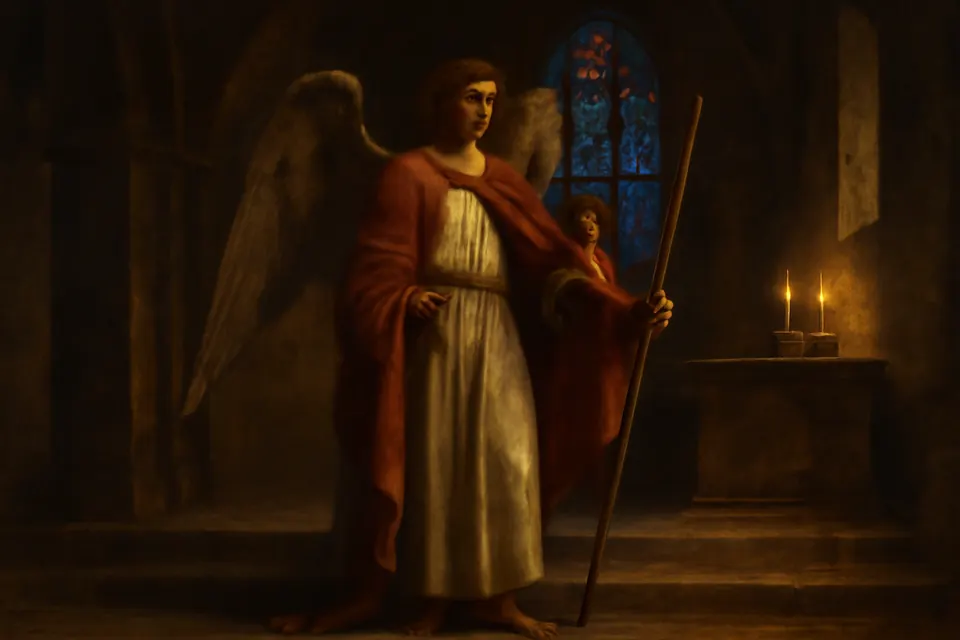
Archangel Chamuel (also Camael or Kemuel) is not named in the Bible. Kemuel appears in Scripture only as the name of men. Chamuel the angel comes from later Jewish legend, Renaissance occult lists and modern New Age books, which gave him his "angel of love" role. The Church names only Michael, Gabriel and Raphael and asks us not to use other angel names.
Archangel Chamuel is searched for thousands of times a month, usually as "the angel of love," the angel who helps you find lost things or the right relationship. It is worth knowing where that picture comes from, because most of it is very new. The name has a long and tangled history: a man in Genesis, a gatekeeper of heaven in Jewish legend, an angel of the planet Mars in a Renaissance book of magic, a saint in Victorian glass, and finally a pink-robed "archangel of love" in 20th-century spiritualist teaching. Let us follow that trail honestly, and then turn to the angels God has truly made known to us.
Who is Archangel Chamuel?
Chamuel, also spelled Camael, Kamael or Kemuel, is the name given to an archangel in various lists outside the Bible. He is usually counted among seven archangels, together with Michael, Gabriel, Raphael, Uriel, Jophiel and Zadkiel. Modern books and websites call him the angel of love, of peace in relationships and of finding what has been lost, and often give him a pink color.
None of this comes from Scripture or from the teaching of the Church. The Catholic Bible names three angels: St. Michael in Daniel, Jude and Revelation, St. Gabriel in Daniel and Luke, and St. Raphael in Tobit. These three we honor by name on September 29. Chamuel has no feast in the Roman calendar, and he is not among the archangels the Orthodox churches honor at their Synaxis of the Bodiless Powers on November 8 either.
That does not mean the angels are a small matter. The Church believes firmly in them; their existence, the Catechism says, "is a truth of faith" (no. 328). What the Church is careful about is giving them names God has not revealed. To see why, it helps to know where this name came from.
Is Chamuel in the Bible?
No angel by any of these names appears in Scripture. The Hebrew name Kemuel (Qemuel) does occur, but only for men, three of them.
The first is a nephew of Abraham. When Abraham comes home from Mount Moriah, word reaches him that his brother Nachor has had sons: "Hus the firstborn, and Buz his brother, and Camuel the father of the Syrians" (Genesis 22:21, Douay-Rheims). Kemuel's brother Bathuel was the father of Rebecca, so this Kemuel was Rebecca's uncle, and his story ends there. The second is a leader of the tribe of Ephraim, chosen to help divide the Promised Land: "Of the tribe of Ephraim, Camuel the son of Sephtan" (Numbers 34:24). The third is the father of a Levite chief under King David: "Over the Levites, Hasabias the son of Camuel" (1 Paralipomenon 27:17).
Strong's Concordance explains the Hebrew as "raised of God," from the verb "to rise" and El, God. The meaning so often given online, "he who seeks God," does not come from the lexicons. It appears in modern spiritualist writings, as we will see below.

Kemuel in Jewish legend
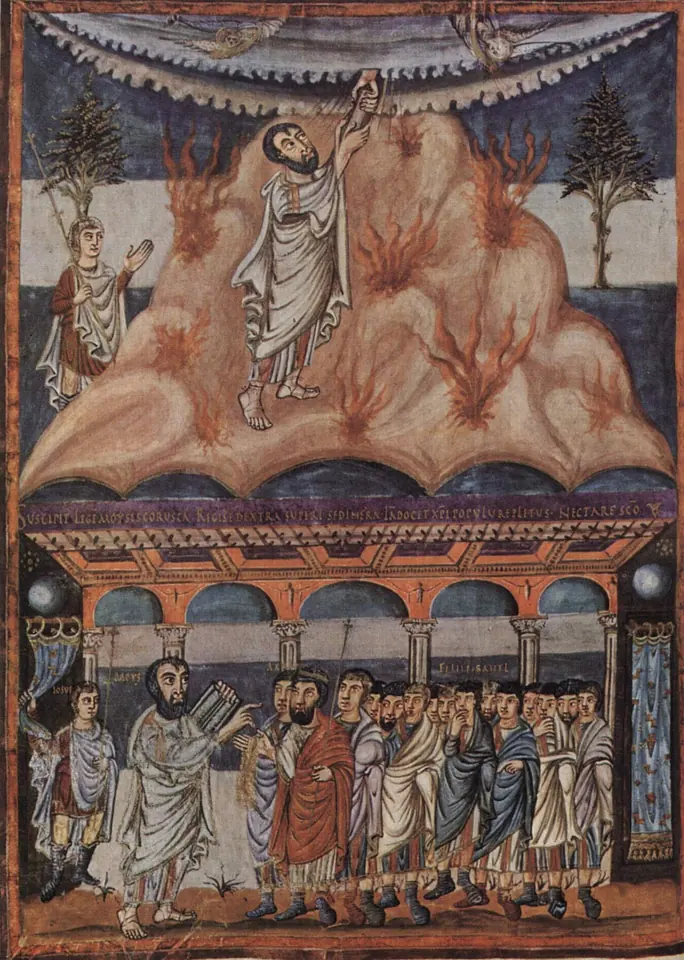
The name first becomes an angel's name in Jewish writings of the centuries after Christ. The best-known story is in the Pesikta Rabbati, a collection of sermons for the feasts. The Jewish Encyclopedia (1906) translates the passage: "When Moses went up in the cloud to heaven, Ḳemuel, the janitor of the first gate, with 12,000 angels of destruction under him, went to strike him, but succumbed." Moses goes on past other fearsome angels until he holds fast to the throne of glory and receives the Law "despite the protesting angels" (Pesikta Rabbati 20).
So in his oldest appearance, Kemuel is not a gentle angel of love at all. He is a stern doorkeeper who tries to keep Moses out and is overcome. Later Jewish mystical writing gave him a higher post. The Jewish Encyclopedia notes that a treatise called Maseket Atzilut puts "Shemuel [Ḳemuel] or Jehoel" at the head of the seraphim.
These are legends, told by teachers who used them to praise the greatness of the Law and of Moses. They were never part of Christian teaching, and they have nothing to say about love or relationships.
Camael in Renaissance lists
Not from Dionysius
Many websites say that Chamuel belongs to a list of seven archangels drawn up by Pseudo-Dionysius, the Syrian writer of around A.D. 500 who described the nine choirs of angels. His book The Celestial Hierarchy does not contain that list. In John Parker's English translation, the only angels named are those Scripture names: Michael, "Ruler of the Jewish people," and "the most divine Gabriel," who spoke to Zachary. Dionysius wrote at length about the choirs (seraphim, cherubim, thrones and the rest) without giving their members personal names. For the choirs themselves, see our page on the nine choirs of angels.
Agrippa and the angel of Mars
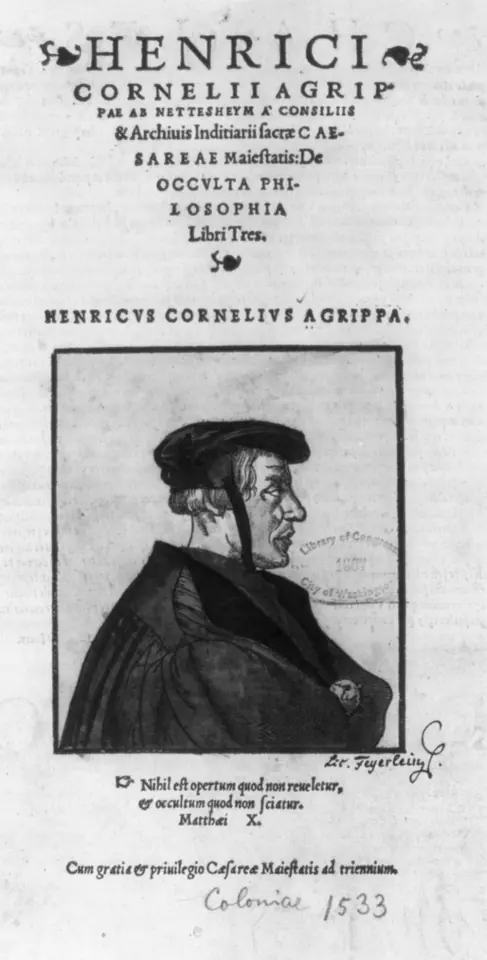
The clearest early source for Camael is a book of magic. In 1533 the German scholar Heinrich Cornelius Agrippa published De occulta philosophia (Three Books of Occult Philosophy). In Book II, chapter 10, he sets out a "Scale of the Number seven," pairing seven names with the seven planets: Zaphkiel with Saturn, Zadkiel with Jupiter, Camael with Mars, Raphael with the Sun, Haniel with Venus, Michael with Mercury and Gabriel with the Moon. He calls them the "Seven Angels which stand in the presence of God," borrowing the phrase from Tobit. Another of his tables puts Camael over the choir of Powers and the sphere of Mars.
Agrippa's Hebrew spelling for Camael is not the Kemuel of Genesis; it is a different word. Mars was the planet of war and of iron, and in these tables Camael is a martial figure, the very opposite of the soft "angel of love" of later books. Agrippa's work was meant for practitioners of ceremonial magic, and the Church has always warned the faithful away from it. The Catechism is plain that all practices of magic, "by which one attempts to tame occult powers," are "gravely contrary to the virtue of religion" (no. 2117).
The engravers' Camael
Devout artists also borrowed the name. Around 1575 the Dutch engraver Crispijn van de Passe the Elder published Angelorum Icones, a series of prints of angels, many with names from these extra lists. His plate "Principatus Camael" shows the angel striding through the clouds with a chalice and a staff. The Latin verse beneath it makes Camael the angel who wrestled with Jacob ("Israel") and the angel who comforted Christ "in the garden" when he shrank from the cup.
That is the root of the chalice that Chamuel holds in so many windows. It is a pious thought, but it is not something Scripture tells us. Genesis says only that "a man wrestled with him till morning" (Genesis 32:24), and St. Luke, writing of the agony in the garden, gives the angel no name: "And there appeared to him an angel from heaven, strengthening him" (Luke 22:43).
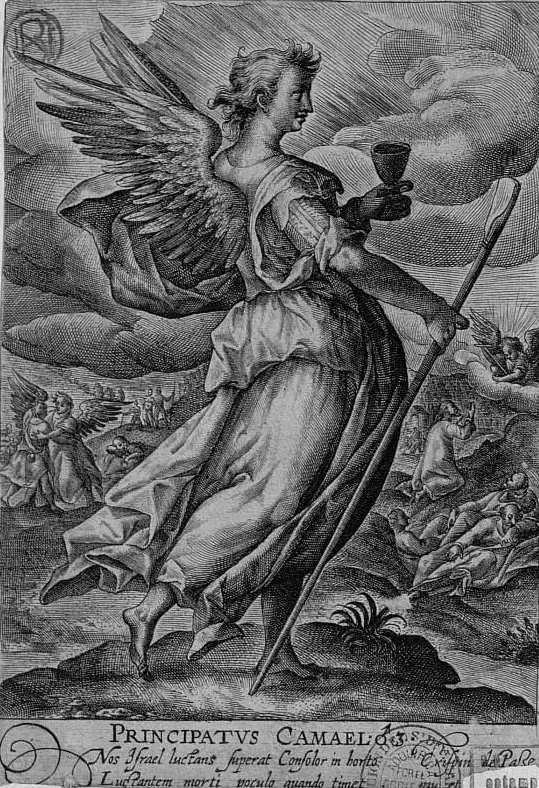
Let us keep the true mystery in view. Our Lord, in his agony, accepted the strength his Father sent him through an angel, and then he rose and went to his Passion. We do not need to know that angel's name to thank God for him.

Chamuel in Victorian windows
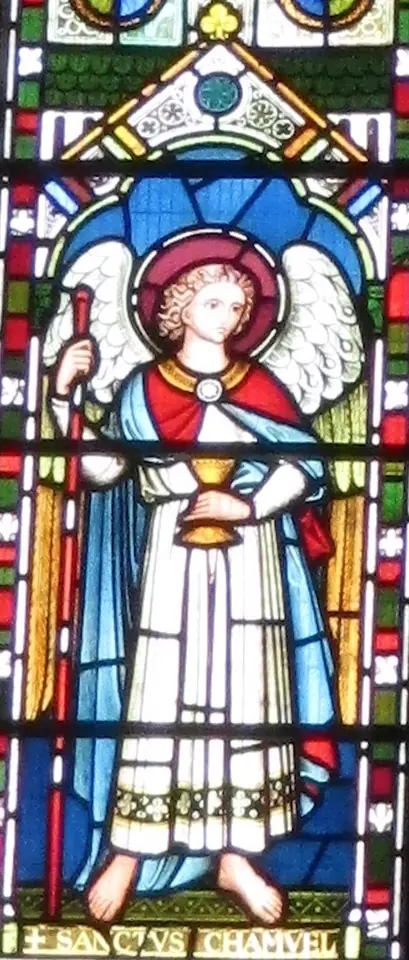
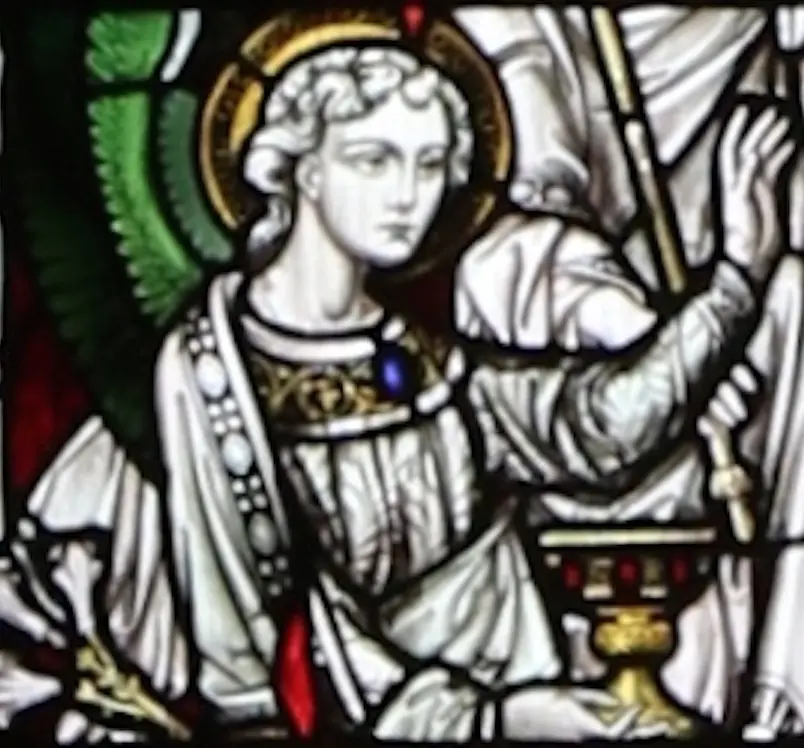
In the 19th century the seven names Michael, Gabriel, Uriel, Chamuel, Raphael, Jophiel and Zadkiel began to appear in English church glass. In 1862 the firm of Clayton and Bell made a great east window for St. Michael and All Angels in Brighton, an Anglican church, with these seven archangels in a row, each named on a banner; the panel shown above calls him "Sanctus Chamuel." Other windows followed, and in the 1950s a new west window for St. Martin in the Bull Ring, Birmingham, replacing glass lost in the wartime bombing, also included Camael with his chalice.
These windows are beautiful, and the people who made them meant to honor God's angels. But a window is not a decree. The Victorian list was gathered from later Jewish mysticism and Renaissance tables, the same thin sources described above, and the Holy See never adopted it. Our page on the seven archangels tells the longer story, including the Palermo devotion of the 1500s, whose four extra names did not include Chamuel at all.
Where the "angel of love" comes from
The Chamuel most people meet online is newer still. In 1958 Mark L. Prophet founded the Summit Lighthouse in Washington, D.C., a movement that teaches messages it says come from "Ascended Masters." Its teaching assigns each of the seven archangels from the Victorian list to a colored "ray." Its page on Chamuel reads: "Archangel Chamuel, whose name means 'he who seeks God,' and his divine complement, Archeia Charity, serve on the third ray of divine love." It places their "etheric retreat, the Temple of the Crystal-Pink Flame," over St. Louis, Missouri.
That is where Chamuel's pink color, his female partner and his work for love come from. Later angel books, oracle cards and websites repeated these ideas and added more, such as finding lost objects or a new job. Nothing in Jewish legend, in Agrippa or in the Victorian windows supports them.
We should speak gently here. Many people who search for Chamuel are lonely, or hurting in a marriage, or longing for peace in a family, and they are reaching for help from heaven. That longing is good. But the Church cannot recommend calling on a spirit by a name invented in the last century, with instructions that come from a channeled message. Our hearts deserve a surer path.
What the Catholic Church teaches about Chamuel
The Roman synod of 745
The Church faced this question long ago. In the eighth century a Frankish preacher named Aldebert drew crowds by claiming special powers and composed a prayer calling on eight angels by name. On October 25, 745, Pope St. Zachary held a synod in Rome to judge him. When the prayer was read, the bishops answered, in Ephraim Emerton's translation: "The names of the eight angels whom Aldebert invokes in his prayer are, with the exception of Michael, not angels but demons whom he has called to his aid. As we know from the teaching of the Apostolic See and divine authority, there are only three angels, Michael, Gabriel and Raphael."
Chamuel was not on Aldebert's list. But the synod's principle covers him: we do not invent names for the holy angels and then call on them, because we cannot know what answers to a name God has not given.
The Directory on Popular Piety (2001)
The Holy See said the same thing in our own time. The Directory on Popular Piety and the Liturgy, issued in 2001, praises devotion to the holy angels as "legitimate and good" and warns against a few ways it can go wrong. Then it says:
The practice of assigning names to the Holy Angels should be discouraged, except in the cases of Gabriel, Raphael and Michael whose names are contained in Holy Scripture. (Directory on Popular Piety and the Liturgy, no. 217)
That is the Church's guidance, and it is a gift, not a restriction. It keeps our devotion tied to what God has actually revealed. The angels themselves want nothing else; they are servants who point away from themselves to God.
Where to turn instead
None of this leaves us without help. God has given us angels by the thousands, and he has told us the names of three of them so that we can call on them with confidence.
The three archangels
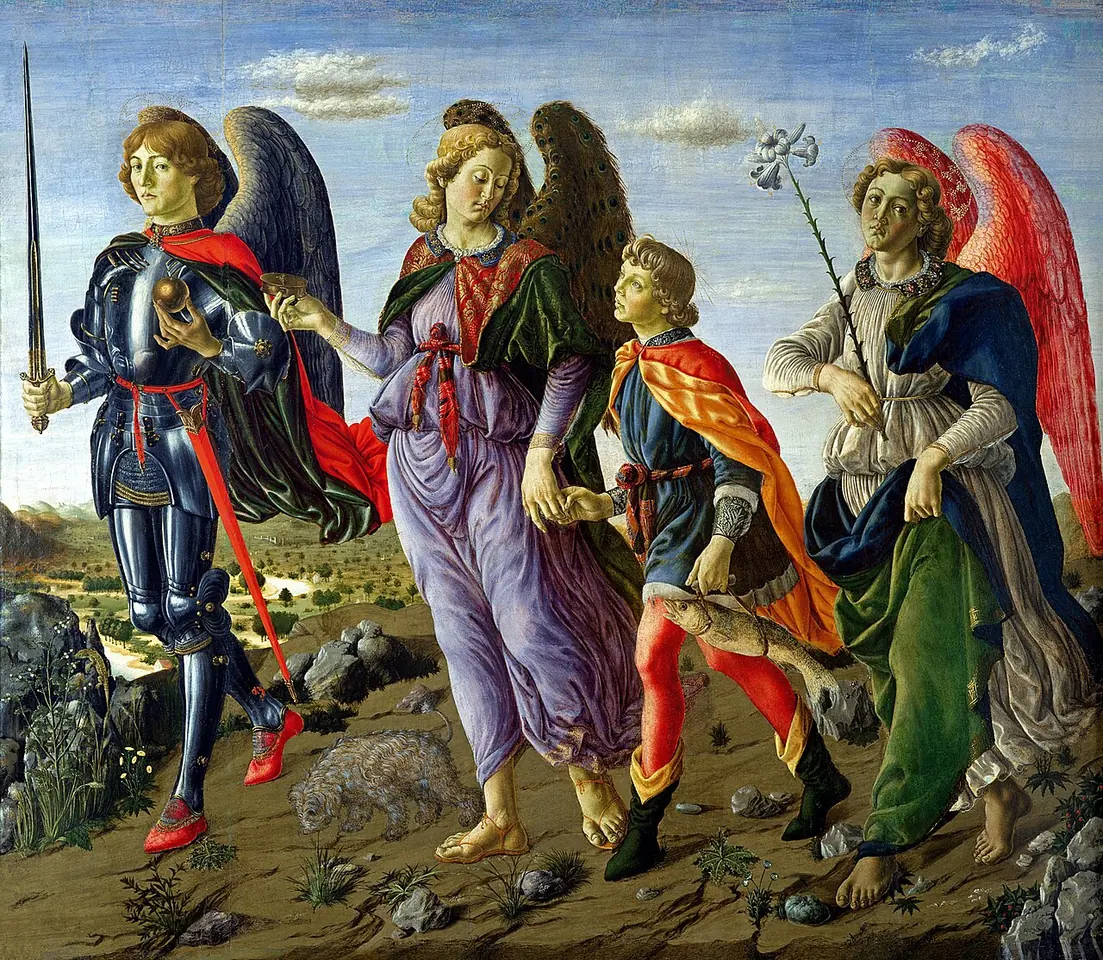
If you came here looking for an angel of love and relationships, turn to St. Raphael. In the Book of Tobit he guided young Tobias on his journey, brought him to Sara, freed her from the evil spirit that troubled her and blessed their marriage. The faithful have asked his help for generations when they hope to meet a husband or wife, and when a marriage needs healing; the prayers are on our St. Raphael prayer page. St. Gabriel brought the message of the Incarnation to Our Lady, and we can ask him to help us hear and accept God's word. St. Michael defends us in every spiritual battle, including the quiet ones fought inside a home.
Let us pray to him in the words the Church has used since Pope Leo XIII:
St. Michael the Archangel, defend us in battle. Be our defense against the wickedness and snares of the Devil. May God rebuke him, we humbly pray, and do thou, O Prince of the heavenly hosts, by the power of God, thrust into hell Satan, and all the evil spirits, who prowl about the world seeking the ruin of souls. Amen.
The history of this prayer, its Latin text and the longer form are on our page for the St. Michael prayer.
Your guardian angel
God has also given each of us an angel of our own. "From infancy to death human life is surrounded by their watchful care and intercession," the Catechism teaches, and it quotes St. Basil: "Beside each believer stands an angel as protector and shepherd leading him to life" (no. 336). We don't know our guardian angel's name, and we don't need to. He knows ours. The Church keeps the feast of the guardian angels on October 2.
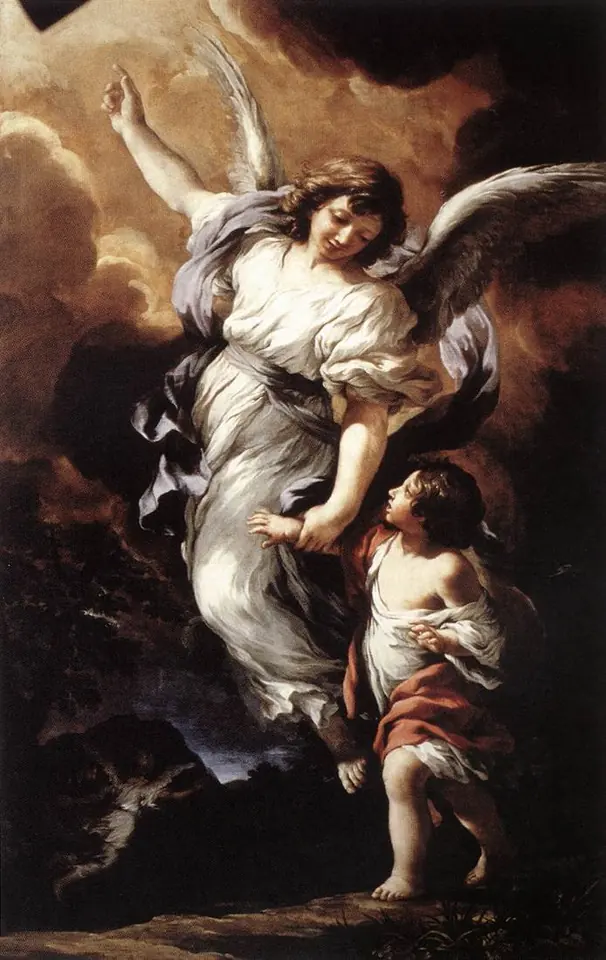
The simplest prayer of all is the one many of us learned as children:
Angel of God, my guardian dear, To whom His love commits me here, Ever this day be at my side, To light and guard, to rule and guide. Amen.
Pray it morning and night, for yourself and for those you love. If you are worried about a husband, a wife or a child who has drifted away, ask your guardian angel to pray for them, and ask their guardian angels too. It costs nothing but a moment's faith.
Other angels with names that are not revealed
Chamuel is one of several popular angel names with the same story. Our pages on Archangel Uriel, Metatron and the names of angels trace the others. The pattern is the same each time: the name may be old, the art may be lovely, but the Church asks us to pray to the angels by the names God has given.
Let us close by asking the whole company of heaven to pray for us, as we do at every Mass when we join "the Angels and Archangels" in singing Holy, Holy, Holy. All the love the angels have, they receive from God, and they will gladly carry our prayers for love and peace to him.
Frequently asked questions
Is Archangel Chamuel in the Bible?
No. No angel named Chamuel, Camael or Kemuel appears anywhere in the Catholic Bible. Kemuel (Camuel in the Douay-Rheims) is the name of three men in the Old Testament, a nephew of Abraham in Genesis 22:21, a prince of Ephraim in Numbers 34:24 and a Levite's father in 1 Chronicles 27:17. The only angels Scripture names are Michael, Gabriel and Raphael.
What does the name Chamuel mean?
The Hebrew name Kemuel in Genesis is usually explained as "raised of God" (Strong's Concordance). The meaning "he who seeks God," repeated on many websites, comes from modern spiritualist writings, not from the Hebrew. The occult spelling Camael is a different Hebrew word again, so the "meaning" depends on which name a writer has in mind.
Is Chamuel a saint or an archangel in the Catholic Church?
No. The Church honors three archangels by name, Michael, Gabriel and Raphael, on September 29. Chamuel has no feast in the Roman calendar or in the Orthodox calendar, and the Directory on Popular Piety and the Liturgy (2001) says the practice of giving names to angels other than those three "should be discouraged."
Can Catholics pray to Archangel Chamuel?
The Church asks us not to call on angels by names that God has not revealed. We should pray to the holy angels, and we have every reason to, but by the names Scripture gives, Michael, Gabriel and Raphael, and through our own guardian angel. A Roman synod in 745 condemned a prayer that invoked angels by unrevealed names, and the Holy See repeated the caution in 2001.
Is Chamuel the angel of love and relationships?
That idea is modern. It was taught by 20th-century Ascended Master groups such as the Summit Lighthouse, founded in 1958, which places "Archangel Chamuel and Archeia Charity" on a pink "third ray of divine love." Older sources say nothing like it; Agrippa in 1533 put Camael over the planet Mars. For help in love and marriage, the Church points us to St. Raphael, who led Tobias to Sara.
Was Chamuel the angel who comforted Jesus in Gethsemane?
Scripture does not name that angel. St. Luke says only that "there appeared to him an angel from heaven, strengthening him" (Luke 22:43). Some 16th-century prints gave the name Camael to the angel of the agony, which is why he is often shown with a chalice, but that was an artist's or devotional writer's choice, not a teaching of the Church.
Are Chamuel, Camael and Kemuel the same angel?
Modern books treat them as one, but they come from different places. Kemuel is a gatekeeper of heaven in a Jewish legend about Moses; Camael is the angel of Mars in Renaissance occult tables; Chamuel is a later spelling that Victorian glass and New Age books used for the same figure. None of them is a revealed name.
Sources
- Directory on Popular Piety and the Liturgy (2001), no. 217
- Catechism of the Catholic Church, nos. 328–336 (the angels). No. 2117, on magic, is at https://www.vatican.va/archive/ENG0015/__P7E.HTM
- Acts of the Roman Synod of October 25, 745, condemning Aldebert (The Letters of St. Boniface, tr. Emerton)
- Jewish Encyclopedia (1906): Angelology. Kemuel as gatekeeper of heaven in Pesikta Rabbati 20, and as chief of the seraphim in Maseket Atzilut
- Strong's Hebrew Concordance 7055: Qemuel. The meaning "raised of God"
- Dionysius the Areopagite, The Celestial Hierarchy (tr. John Parker, 1899). Names no angels besides Michael and Gabriel
- Heinrich Cornelius Agrippa, Three Books of Occult Philosophy, Book II (English translation of 1651). Chapter 10, the scale of the number seven, with Camael set over Mars
- The Summit Lighthouse: Archangel Chamuel and Charity. Cited as evidence of the modern Ascended Master teaching, not as an authority