Guardian angels

Guardian angels are the angels God assigns to watch over each person, to protect us, guide us and pray for us on the way to heaven. Jesus said of the little ones that "their angels in heaven always see the face of my Father" (Matthew 18:10), and the Catechism teaches that "beside each believer stands an angel as protector and shepherd" (336). The Church keeps their feast on October 2.
Most of us learned it as children, kneeling by the bed: "Angel of God, my guardian dear." It is one of the first truths of the faith a child can grasp, and one of the most consoling we keep as adults. You are never alone. From the day you were born, God has given you an angel to watch over you, and that angel is with you now, reading these words with you.
Do we have guardian angels?
Yes. The clearest word comes from Jesus himself. When his disciples asked who was greatest in the kingdom, he set a little child in front of them and warned: "See that you despise not one of these little ones: for I say to you, that their angels in heaven always see the face of my Father who is in heaven" (Matthew 18:10, Douay-Rheims).
The Catholic Encyclopedia notes the two things this verse teaches. Even little children have their own angels, and those angels never lose the sight of God while they care for us on earth. Their work for us takes nothing from their joy in heaven.
The Catechism gathers the Church's faith in a few lines: "From infancy to death human life is surrounded by their watchful care and intercession. 'Beside each believer stands an angel as protector and shepherd leading him to life.' Already here on earth the Christian life shares by faith in the blessed company of angels and men united in God" (336). The quotation inside comes from St. Basil the Great, writing in the 4th century.

What Scripture says
The Old Testament prepares the way. God promised Moses, "Behold I will send my angel, who shall go before thee, and keep thee in thy journey, and bring thee into the place that I have prepared" (Exodus 23:20). The old patriarch Jacob, blessing his grandsons, called on "the angel that delivereth me from all evils" (Genesis 48:16). Judith, home safe from the enemy camp, said, "his angel hath been my keeper" (Judith 13:20). The psalms sing it: "The angel of the Lord shall encamp round about them that fear him: and shall deliver them" (Psalm 33:8), and "he hath given his angels charge over thee; to keep thee in all thy ways. In their hands they shall bear thee up: lest thou dash thy foot against a stone" (Psalm 90:11-12).
The whole Book of Tobias is the story of a guardian angel. The archangel St. Raphael walks beside young Tobias on a long journey disguised as a fellow traveler, protects him, finds him a wife and heals his father. At the end he says, "I offered thy prayer to the Lord" (Tobias 12:12).
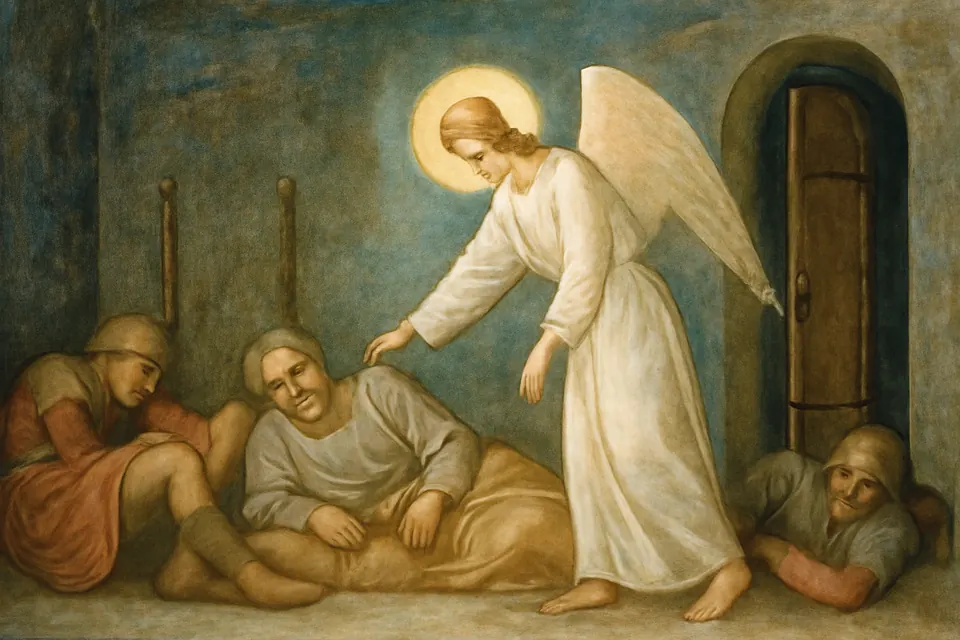
In the New Testament, an angel strengthened Jesus in his agony and another freed St. Peter from prison. When Peter knocked at the door afterward, the disciples inside could not believe it and said, "It is his angel" (Acts 12:15). They took it for granted that Peter had an angel of his own. The Letter to the Hebrews sums it up: "Are they not all ministering spirits, sent to minister for them, who shall receive the inheritance of salvation?" (Hebrews 1:14).
What the Fathers and Doctors teach
The early Church took guardian angels to heart. St. Jerome, commenting on Matthew 18:10, wrote: "how great the dignity of the soul, since each one has from his birth an angel commissioned to guard it." St. Basil taught that each believer has an angel at his side as protector and shepherd. St. Ambrose urged, "We should pray to the angels who are given to us as guardians." The Fathers discussed only the details: Origen reports that some thought the angel was given at baptism and others at birth.
St. Bernard of Clairvaux preached on Psalm 90 and became, in the words of the Vatican's Directory on Popular Piety, "a great master and a notable promoter of devotion to the Guardian Angels." For him the angels were proof "that heaven denies us nothing that assists us," for "these celestial spirits have been placed at our sides to protect us, instruct us and to guide us." He urged his monks to show their angels reverence for their presence, devotion for their kindness and trust in their protection.

St. Thomas Aquinas on guardian angels
St. Thomas Aquinas gathered this teaching into a clear set of answers in the Summa Theologiae (I, q. 113):
- Everyone has one. "Each man has an angel guardian appointed to him." Because human beings are on a road to heaven threatened by many dangers, "as guardians are appointed for men who have to pass by an unsafe road, so an angel guardian is assigned to each man as long as he is a wayfarer."
- From birth. St. Thomas sided with St. Jerome: the guardian is a gift to us as human beings, so "from the very moment of his birth man has an angel guardian appointed to him," not only from baptism.
- From the lowest choir. Caring for one person is the humblest angelic task, so Aquinas thought our guardians come from the ninth choir, the angels. Bl. John Duns Scotus held that God may send an angel from any choir. See the nine choirs of angels.
- Never abandoning us. "The angel guardian never forsakes a man entirely," though he may allow us to suffer some trouble for our good.
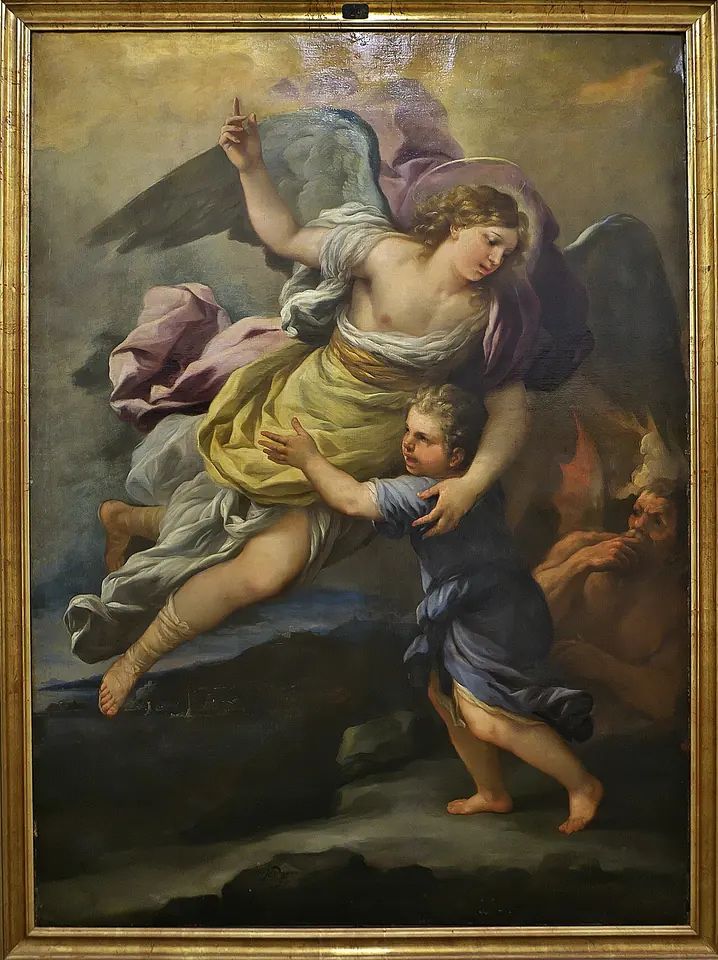
How does our angel help us? He cannot force our free will. But, the Catholic Encyclopedia explains, following St. Thomas, our angels can act on our senses and imagination, and so on our minds, putting good thoughts before us, warning us, consoling us. Many people can remember a sudden inner nudge that kept them from danger or brought them back to God. The angel also carries our prayers to God, as Raphael did for Tobit.
Is it Church teaching?
The Church teaches as part of the faith that God gives the angels as guardians to his people. That each individual person has his own guardian angel has never been solemnly defined. But the Catholic Encyclopedia calls it "the mind of the Church," and says the view has such strong support from the Doctors of the Church "that it would be rash to deny it." The Catechism, the liturgy and the feast of October 2 all express it.
The feast of the Guardian Angels, October 2
For many centuries the guardian angels were honored together with St. Michael and all the angels on September 29. A separate feast began in Spain. The Catholic Encyclopedia records that Córdoba asked Rome in 1579 for permission to keep a feast of the guardian angels, and that Valencia received approval for an office of the guardian angels in 1582.
Pope Paul V placed the feast in the general calendar on September 27, 1608, as an optional feast for the whole Church, obligatory in the lands of the Holy Roman Empire. Pope Clement X (reigned 1670 to 1676) made it obligatory for the universal Church and fixed it on October 2, "the first unoccupied day after the feast of St. Michael." Leo XIII raised its rank in 1883. Today the Church keeps the Holy Guardian Angels as a memorial on October 2.
The Gospel of the feast is Matthew 18:10. The old Breviary's antiphon at Lauds captured the spirit of the day: "Let us praise the Lord whom the Angels praise, whom the Cherubim and Seraphim proclaim Holy, Holy, Holy."

Praying to your guardian angel
The simplest prayer is the one we learned first. The full text, its Latin original Angele Dei and its history are on our page about the guardian angel prayer:
Angel of God, my guardian dear, to whom His love commits me here, ever this day be at my side, to light and guard, to rule and guide. Amen.
A few ways to live with your angel:
- Greet your angel in the morning and at night with the Angel of God prayer. Families often add it to the Angelus or night prayers.
- Thank your angel when you have been kept from harm or helped through a hard day.
- Ask your angel's help before a journey, a difficult conversation, an exam or a temptation.
- Greet the angels of others. Silently greeting the guardian angel of each person you meet is a good way to remember that every one of them is loved and watched over by God.
The Directory on Popular Piety adds two cautions. We should not name our angels, since the Church uses only the names Scripture gives, Michael, Gabriel and Raphael. And we should not treat life childishly, crediting every setback to the devil and every success to our angel. Devotion to the guardian angels is meant to make us grateful, aware that we live in God's presence, and calm in trouble.
Saints and their guardian angels
Many saints lived close to their guardian angels. St. Gemma Galgani wrote of seeing and speaking with hers, a reported grace described by her spiritual director, and she is often painted with her angel beside her. The Church canonized her in 1940 for her heroic virtue, while making no judgment on these mystical experiences. Most of us will never see our angel, and we do not need to. Faith is enough to know he is there.
For more on the holy angels, see our angels hub, the archangels St. Michael, St. Gabriel and St. Raphael, and the St. Michael prayer.
Holy guardian angel, to whom God has entrusted me, light and guard, rule and guide me today and always.
Frequently asked questions
Does everyone have a guardian angel?
Yes. St. Thomas Aquinas taught that "each man has an angel guardian appointed to him," from birth, baptized or not, as long as he lives on earth. St. Jerome said each soul "has from his birth an angel commissioned to guard it." The Church has not solemnly defined this, but it is the constant teaching of the Fathers and Doctors.
What does the Bible say about guardian angels?
Jesus said, "See that you despise not one of these little ones: for I say to you, that their angels in heaven always see the face of my Father who is in heaven" (Matthew 18:10). Psalm 90 promises, "he hath given his angels charge over thee; to keep thee in all thy ways," and Hebrews 1:14 calls angels "ministering spirits, sent to minister" to those who will be saved.
When is the feast of the Guardian Angels?
October 2, the first free day after the feast of the archangels on September 29. Pope Paul V allowed the feast for the whole Church in 1608, and Pope Clement X made it obligatory for the universal Church on October 2.
Can I name my guardian angel?
The Church advises against it. The Directory on Popular Piety and the Liturgy (2001) says "the practice of assigning names to the Holy Angels should be discouraged, except in the cases of Gabriel, Raphael and Michael whose names are contained in Holy Scripture." You can simply speak to your angel as "my guardian angel."
Do animals have guardian angels?
Not in the same way. St. Thomas Aquinas explains that individual guardian angels are given to human beings because each person has an immortal soul and is on a journey to God. Animals are cared for by God's providence and by the angels' care for creation as a whole.
Does my guardian angel ever leave me?
St. Thomas taught that "the angel guardian never forsakes a man entirely," even when he allows us to suffer some trouble. After death the guardian's work is done, but Aquinas held that the saved will have the angels as companions in heaven.
Sources
- Catholic Encyclopedia (1910): Guardian Angel
- Catholic Encyclopedia (1910): Feast of Guardian Angels
- St. Thomas Aquinas, Summa Theologiae I, q. 113 (The guardianship of the good angels)
- Catechism of the Catholic Church, nos. 325-354
- Congregation for Divine Worship, Directory on Popular Piety and the Liturgy (2001), nos. 213-217
- Catholic Encyclopedia (1907): Angels