St. Bernard of Clairvaux
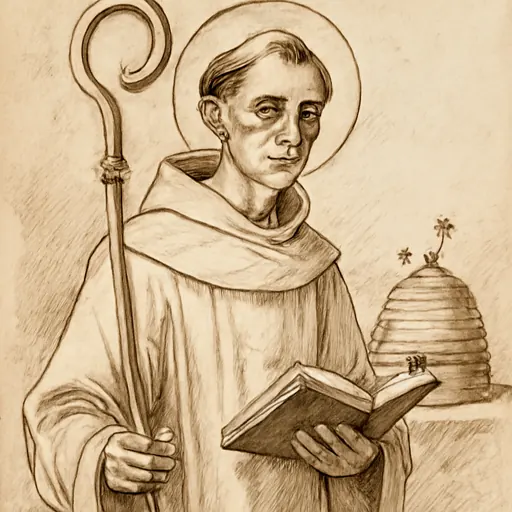
St. Bernard of Clairvaux (1090–1153) was a French monk who founded the abbey of Clairvaux in 1115 and made the Cistercians the fastest-growing order of his age. Adviser to popes and kings, preacher of the Second Crusade and a great writer on Christ and the Virgin Mary, he is a Doctor of the Church, called the Doctor Mellifluus, "honey-sweet teacher." His feast day is August 20.
Who was St. Bernard of Clairvaux?
Bernard was a Burgundian nobleman's son who became a monk, an abbot, and for a quarter of a century the most influential churchman in Western Europe. He settled a papal schism, advised kings, preached a crusade and corrected theologians, all while insisting he wanted nothing but his cloister. Pope Benedict XVI called him "the last of the Fathers" of the Church, because he wrote theology in the manner of the early Fathers, from Scripture and prayer rather than from logic.
He is also one of the great Christian writers on love: God's love, the soul's love, and the love of the Virgin Mary. Dante put the last great prayer of the Paradiso on his lips. The Church honors him as a Doctor of the Church, and tradition calls him the Doctor Mellifluus, the "honey-sweet teacher."

The life of St. Bernard
A Burgundian family
Bernard was born in 1090 at Fontaines, near Dijon, the third of seven children of Tescelin, lord of Fontaines, and Aleth of Montbard. The Catholic Encyclopedia says he studied with the canons of Saint-Vorles at Châtillon-sur-Seine and loved literature, especially poetry. His mother died when he was about nineteen.
Cîteaux and Clairvaux
In 1098 St. Robert of Molesme had founded a new monastery at Cîteaux to keep the Rule of St. Benedict "in all its rigour." It was struggling when, in 1113, Bernard arrived asking to join, bringing about thirty young Burgundian noblemen with him, many of them his relatives. The abbot, St. Stephen Harding, sent him out three years later at the head of a band of monks to found a new house in a valley in the diocese of Langres. Bernard named it Claire Vallée, the bright valley: Clairvaux. The foundation date was June 25, 1115. He was twenty-five.
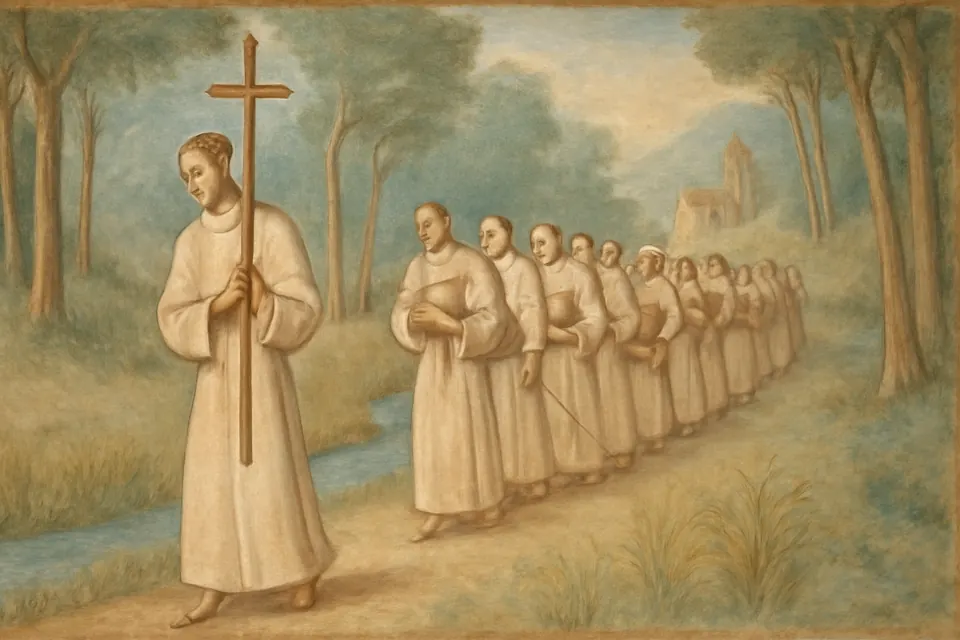
The early years were hard. The diet was so poor that Bernard's health broke, and his friend William of Champeaux, bishop of Châlons, had to persuade him to ease his fasting. But men poured in. His father and all his brothers eventually became monks of Clairvaux. Daughter houses followed: Trois-Fontaines in 1118, Fontenay in 1119, Foigny in 1121. By his death, the Catholic Encyclopedia reports, Bernard had founded 163 monasteries, and the order counted 343.


Adviser to popes and kings
From 1130 Bernard was drawn into the affairs of the whole Church. When rival popes, Innocent II and Anacletus II, were elected that year, a French council chose Bernard to judge between them. He backed Innocent and spent much of the next eight years winning kings and cities to his side. He helped draft the rule of the Knights Templar at the Council of Troyes in 1128 and wrote them a treatise, In Praise of the New Knighthood.
In 1140 he confronted Peter Abelard, the most brilliant logician of the age, whose teaching on the Trinity he judged dangerous. A council at Sens condemned Abelard, who submitted and spent his last two years at Cluny under Peter the Venerable. Benedict XVI noted that Bernard also opposed the Cathars.
In 1145 one of his own monks was elected pope as Eugene III. Bernard wrote him On Consideration, a book on how a pope should live and pray, which, the Catholic Encyclopedia says, many later popes kept as regular reading.
The Second Crusade
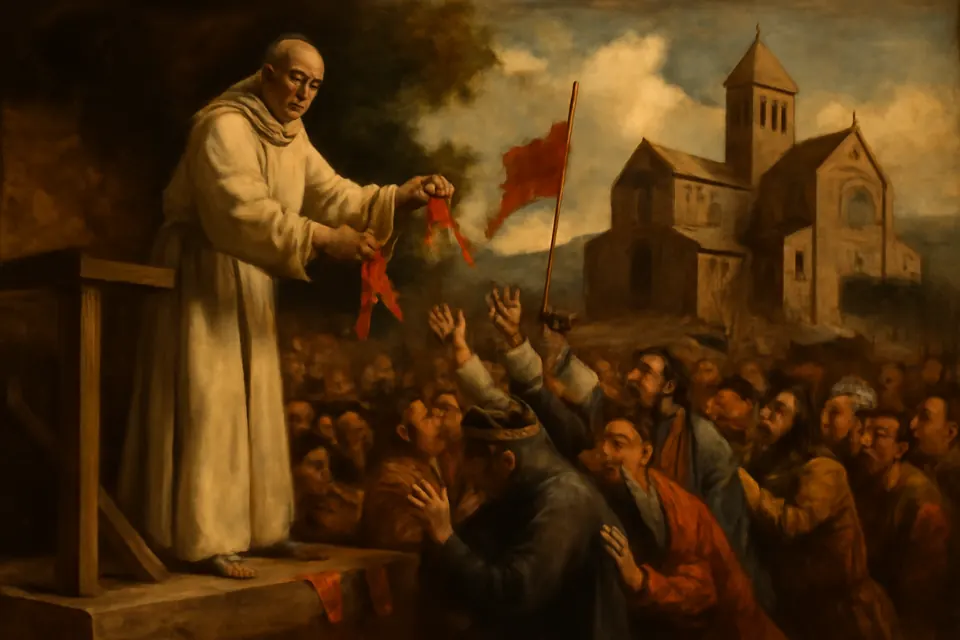
After Edessa fell to the Turks in 1144, Eugene III commissioned Bernard to preach a new crusade. At Vézelay in Burgundy in 1146, King Louis VII, Queen Eleanor and many nobles took the cross from him; the Catholic Encyclopedia says he tore up his own habit to make enough cloth crosses for the crowd. He then preached in Germany, where Emperor Conrad III and his nephew Frederick Barbarossa took the cross.
Crusade preaching in these years was shadowed by violence against Jews. Benedict XVI recalled that Bernard "condemned the ever more widespread outbursts of anti-Semitism," and that Rabbi Ephraim of Bonn later paid tribute to him for defending the Jews. The crusade itself failed when the army could not take Damascus, and much of the blame fell on Bernard. He answered in On Consideration that the crusaders' sins, not God's faithfulness, explained the defeat.


Death and canonization
Bernard died at Clairvaux on August 20, 1153, in his sixty-third year, after forty years as a monk. Pope Alexander III canonized him on January 18, 1174, the first Cistercian on the calendar of saints. Pope Pius VIII declared him a Doctor of the Church, and in 1953, for the 800th anniversary of his death, Pope Pius XII devoted an encyclical to him, Doctor Mellifluus.
Bernard's writings and Marian devotion
His best known works are eighty-six Sermons on the Song of Songs (which, the Catholic Encyclopedia notes, get only as far as the start of chapter three), On Consideration, The Steps of Humility and Pride, Grace and Free Will and 530 letters. Benedict XVI summed up his teaching on Christ with Bernard's own words: Jesus is "honey in the mouth, song to the ear, jubilation in the heart."
Bernard wrote his homilies In Praise of Mary (De Laudibus Mariae) around 1120, early in his career, and his sermons for Marian feasts were read for centuries. Benedict XVI quoted one of his best known passages, from the second homily on the Annunciation (Missus est):
In danger, in distress, in uncertainty, think of Mary, call upon Mary. She never leaves your lips, she never departs from your heart; and so that you may obtain the help of her prayers, never forget the example of her life.
Dante gave Bernard the last great prayer of the Divine Comedy, which begins "Virgin Mother, daughter of your own Son" (Paradiso XXXIII).
Did St. Bernard write the Memorare?
The Memorare ("Remember, O most gracious Virgin Mary") is often printed with his name, but he very likely did not write it. The New Catholic Encyclopedia says passages in his sermons "echo the theme" but "none comes close to the actual wording," and that the text can be traced only to the 15th century, as part of a longer prayer. A French priest named Claude Bernard (1588–1641), known as the "Poor Priest," taught it in hospitals and prisons and made it famous. Bishop Hefele, writing in 1882, suggested that the two Bernards were simply confused.
The miracles of St. Bernard
- Healings during his preaching tour in Germany, 1146 to 1147: reported. The Catholic Encyclopedia says "miracles ... multiplied almost at his every step." No modern Church process has examined them.
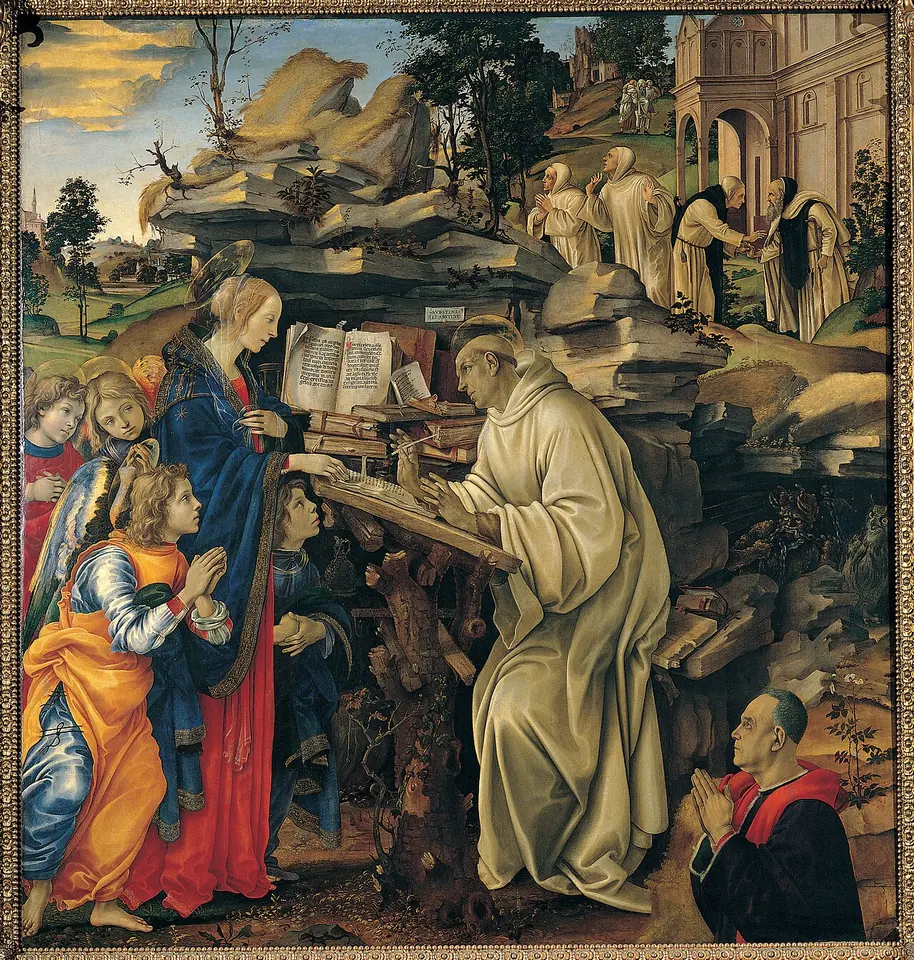
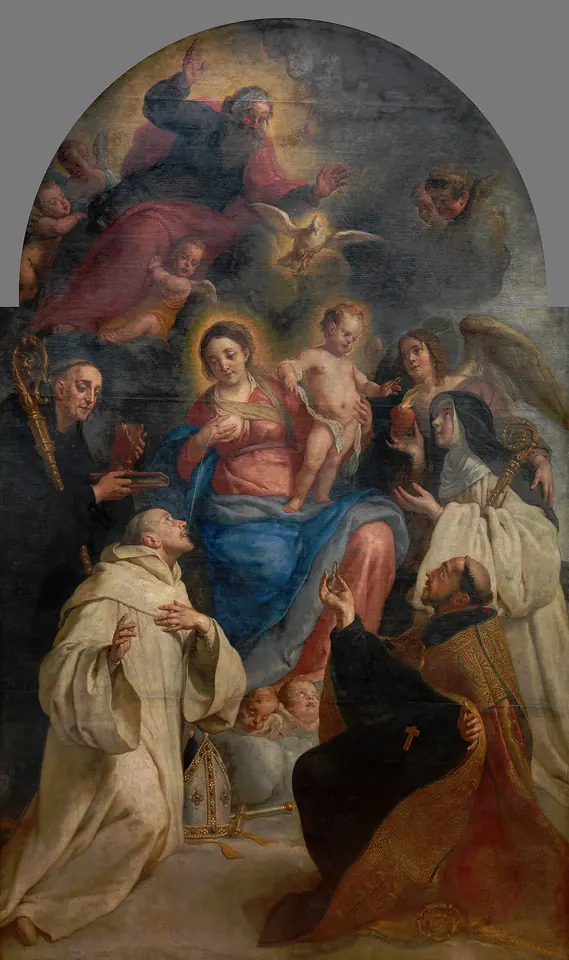
- The Virgin appearing to him while he wrote: traditional. Filippino Lippi's painting near the top of this page shows it.
- The lactation: traditional. A later medieval legend says the Virgin Mary, as Bernard prayed before her image, gave him drops of her milk. Painters often showed it, usually with great restraint, as a sign of his gift for speaking about her.

Why St. Bernard is a patron saint
Catholic Culture lists him as patron of beekeepers, candle makers, wax workers, the Cistercians, Burgundy, Gibraltar and the Knights Templar, among others. Beekeepers and chandlers come from his "honeyed" title and the beehive that goes with it. Burgundy was his homeland, and the Templars owed their first rule partly to him. See our patron saints page for other saints of beekeepers, such as St. Ambrose.
Symbols of St. Bernard in art
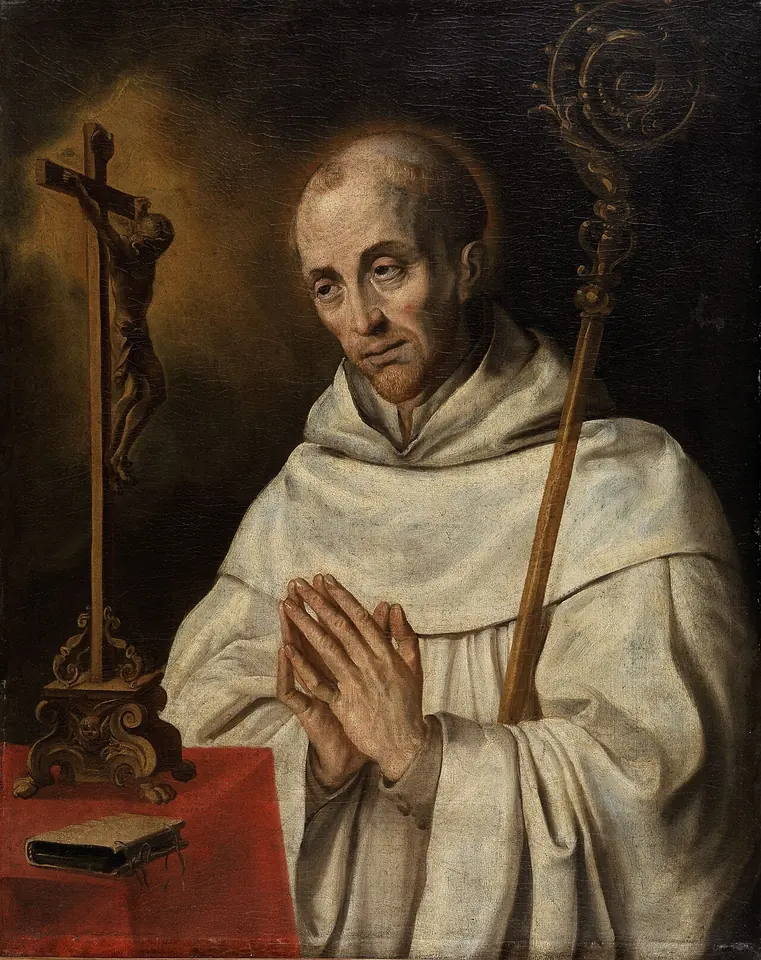
Bernard is easy to spot once you know the Cistercian habit: white or undyed wool with a wide cowl, never the black of the Benedictines. Then look for:
- A beehive or bees, for the Doctor Mellifluus.
- Three miters on a book or at his feet, for the bishoprics he turned down. The Catholic Encyclopedia mentions that he refused the archbishopric of Milan.
- A chained demon, for his victories over temptation and heresy.
- The instruments of the Passion, or Christ reaching down from the cross to embrace him.
- A white dog at his feet, in some medieval images.
- The Virgin Mary appearing to him, as in Lippi's painting.
The 17th-century portrait in Ghent shows the plainer type: a thin, tonsured monk at prayer, with crozier and crucifix.

Feast day, relics and places
Bernard's feast is August 20, a memorial on the General Roman Calendar; see the feast days page for his neighbors. He was buried at Clairvaux. The abbey was suppressed in the French Revolution, and his remaining relics are kept in the treasury of Troyes Cathedral, in a reliquary shrine. His birthplace, Fontaine-lès-Dijon, has a basilica in his honor.
Prayer to St. Bernard
The Mass of his memorial uses this collect from the Roman Missal, as published by Catholic Culture:
O God, who made the Abbot Saint Bernard a man consumed with zeal for your house and a light shining and burning in your Church, grant, through his intercession, that we may be on fire with the same spirit and walk always as children of light.
Many Catholics also pray the Memorare in his memory, though he did not write it. The standard English text, as given in the Catholic Culture dictionary:
Remember, O most gracious virgin Mary, that never was it known that anyone who fled to your protection, implored your help, or sought your intercession, was left unaided. Inspired with this confidence, I fly unto you, O virgin of Virgins, my Mother. To you I come, before you I stand, sinful and sorrowful. O Mother of the Word Incarnate, despise not my petitions, but in your mercy hear and answer me. Amen.
Frequently asked questions
Did St. Bernard write the Memorare?
Probably not, though it is often printed under his name. The New Catholic Encyclopedia says the author is unknown and the text can be traced only to the 15th century. A French priest, Claude Bernard (1588–1641), the "Poor Priest" of Paris, spread it widely, and his name was likely confused with the saint's. St. Bernard's sermons do echo its trust in Mary.
Why is St. Bernard the patron saint of beekeepers?
Because of his title Doctor Mellifluus, "flowing with honey." Benedict XVI explained that his praise of Christ "flowed like honey," as in his line that Jesus is "honey in the mouth, song to the ear, jubilation in the heart." The beehive became his emblem, and with it came patronage of beekeepers and candle makers, who work with beeswax.
What did St. Bernard have to do with the Second Crusade?
Pope Eugene III, his former monk, asked him to preach it. He did so at Vézelay in 1146 before King Louis VII, then in Germany. The crusade failed, and Bernard was blamed. Benedict XVI noted that in these years Bernard "condemned the ever more widespread outbursts of anti-Semitism," and that a rabbi, Ephraim of Bonn, later paid tribute to him.
When is St. Bernard's feast day?
August 20, the day he died at Clairvaux in 1153. It is a memorial on the General Roman Calendar.
Is St. Bernard of Clairvaux the same as the St. Bernard of the dogs?
No. The St. Bernard dogs are named for the Great St. Bernard Pass and its hospice in the Alps, founded by St. Bernard of Menthon, a different and earlier saint. The Catholic Encyclopedia notes the monks there went out with "their well-trained dogs" to find travelers lost in the snow.
Sources
- Catholic Encyclopedia (1907): St. Bernard of Clairvaux
- Benedict XVI: General Audience of 21 October 2009, Saint Bernard of Clairvaux
- Pius XII: Doctor Mellifluus (May 24, 1953)
- New Catholic Encyclopedia: Memorare (Encyclopedia.com)
- Catholic Culture Dictionary: Memorare
- Catholic Culture: Memorial of St. Bernard, August 20
- Catholic Encyclopedia (1907): St. Bernard of Menthon