St. Teresa of Calcutta (Mother Teresa)

St. Teresa of Calcutta, known worldwide as Mother Teresa, was an Albanian Catholic nun born in Skopje in 1910 who founded the Missionaries of Charity in Calcutta, India, to serve "the poorest of the poor." She won the Nobel Peace Prize in 1979, died in 1997 and was canonized by Pope Francis in 2016. Her feast day is September 5, and she is honored as a patron of the poor and the dying.
Who was St. Teresa of Calcutta?
Mother Teresa was a small Albanian nun who spent almost seventy years in India and became, for much of the late 20th century, the best-known Catholic in the world after the pope. She left a teaching convent in 1948 to live among the poor of Calcutta, founded the Missionaries of Charity in 1950, and by her death in 1997 her sisters ran homes for the dying, orphanages, leprosy clinics and shelters on every continent. She received the Nobel Peace Prize in 1979. The Church declared her a saint, St. Teresa of Calcutta, on September 4, 2016, though as Pope Francis admitted that day, most people still call her Mother Teresa.
She described herself in a sentence the Vatican put at the top of its official biography:
By blood, I am Albanian. By citizenship, an Indian. By faith, I am a Catholic nun. As to my calling, I belong to the world. As to my heart, I belong entirely to the Heart of Jesus.


Two facts about her became known only after her death. For close to fifty years she lived with an inner sense of God's absence, which she called "the darkness." And her life's work, praised around the world, also drew sharp criticism for the standard of care in her homes and the handling of donations. This article tells both sides.
The life of Mother Teresa
Skopje and the call to be a missionary
Gonxha Agnes Bojaxhiu was born on August 26, 1910, in Skopje, then a city of the Ottoman Empire and now the capital of North Macedonia. She was the youngest child of Nikola and Drana Bojaxhiu, an Albanian Catholic family. According to the Vatican biography, she made her First Communion at five and a half and was confirmed in November 1916. Her father died suddenly when she was about eight, leaving the family short of money. Her mother raised the children "firmly and lovingly," and the Jesuit parish of the Sacred Heart shaped her faith.
The biography she prepared for the Nobel Foundation says that at twelve she first "felt strongly the call of God" to be a missionary. At eighteen, in September 1928, she left Skopje for good to join the Sisters of Loreto, an Irish order with missions in India. In Ireland she took the name Sister Mary Teresa, after St. Thérèse of Lisieux, the young Carmelite patron of missions. She arrived in Calcutta on January 6, 1929.


Twenty years with the Loreto sisters
Sister Teresa made her first vows in May 1931 and was sent to the Loreto community at Entally in Calcutta, where she taught at St. Mary's School for girls. She made her final vows on May 24, 1937, and from then on was called Mother Teresa, as Loreto nuns were. In 1944 she became the school's principal. The Vatican biography calls her twenty years with Loreto years of "profound happiness."
The "call within a call"
On September 10, 1946, she was on the train from Calcutta to Darjeeling for her yearly retreat. On that journey, the biography says, "in a way she would never explain, Jesus' thirst for love and for souls took hold of her heart." She called it her "inspiration," her "call within a call." In the following weeks and months, through what she described as interior words and visions, she understood Jesus to be asking her to found a community to serve the poorest of the poor. "Come be My light," she heard him say. "I cannot go alone." The Missionaries of Charity keep September 10 as "Inspiration Day."
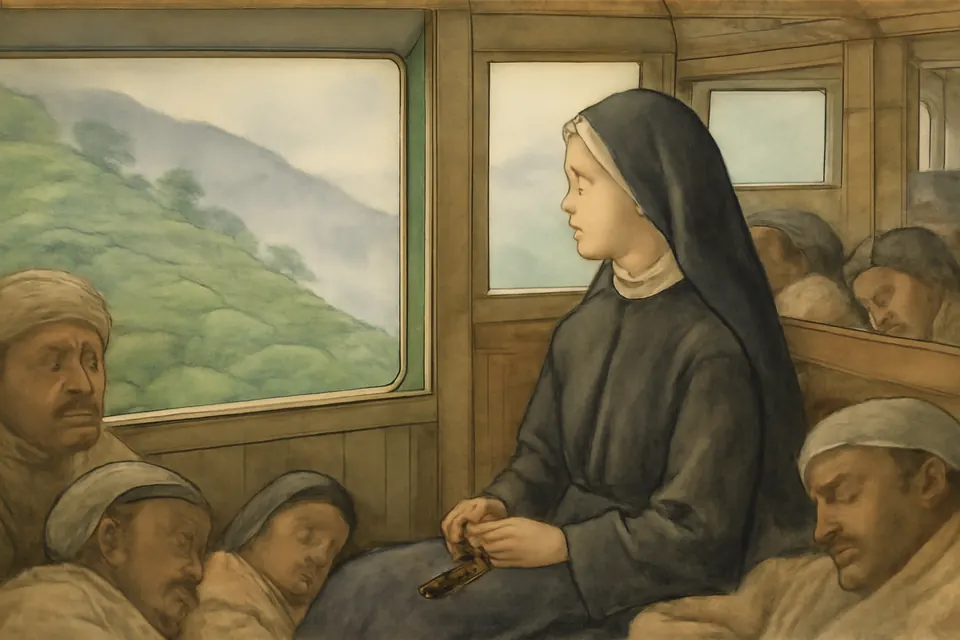
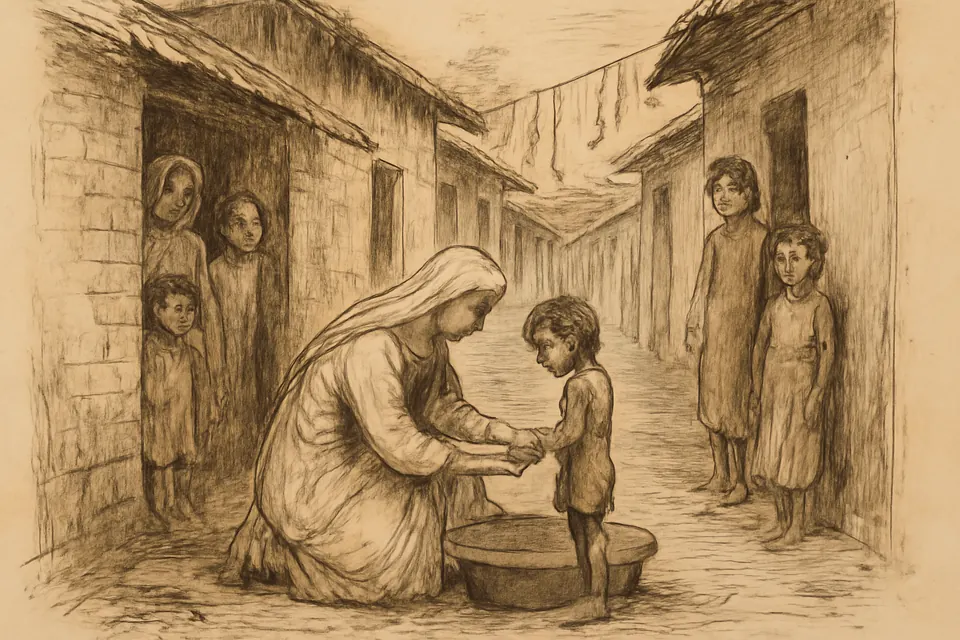
Her superiors and the archbishop of Calcutta took nearly two years to test the call. On August 17, 1948, she put on a white cotton sari with a blue border, the dress of poor Bengali women, and walked out of the Loreto convent. After a short nursing course with the Medical Mission Sisters in Patna, she came back to Calcutta. On December 21, 1948, she went into the slums for the first time. That day, the Vatican biography records, she "visited families, washed the sores of some children, cared for an old man lying sick on the road and nursed a woman dying of hunger and TB."
The Missionaries of Charity
Some of her former students joined her one by one. On October 7, 1950, the Missionaries of Charity were established as a congregation in the Archdiocese of Calcutta. Besides the usual vows of poverty, chastity and obedience, the sisters take a fourth vow of "wholehearted and free service to the poorest of the poor."
In 1952 she opened her first home for the dying, Nirmal Hriday ("Pure Heart"), in a building beside the Kali temple at Kalighat that city officials gave her. A children's home, Nirmala Shishu Bhavan, followed in 1955, and later a settlement for people with leprosy, Shanti Nagar ("City of Peace"). In her Nobel lecture she told the story of a man brought in from a drain: "I have lived like an animal in the street, but I am going to die like an angel, loved and cared for."


In February 1965 Pope Paul VI gave the congregation a Decree of Praise, making it a congregation of pontifical right, and the sisters began to open houses outside India: Venezuela first, then Rome and Tanzania. She founded the Missionaries of Charity Brothers in 1963, a contemplative branch of the sisters in 1976, contemplative brothers in 1979 and the Missionaries of Charity Fathers in 1984. Lay Co-Workers, of many faiths, shared the work.

From 1980 she opened houses in almost every communist country, including the Soviet Union, Albania and Cuba.
The Nobel Peace Prize
Honors came from 1962, when India gave her the Padma Shri, and they kept coming. On December 10, 1979, she received the Nobel Peace Prize in Oslo "for her work for bringing help to suffering humanity." In her Nobel lecture the next day she told the audience that she did not want gifts "from your abundance": "I want that you give me until it hurts." She also called abortion "the greatest destroyer of peace today," a line that drew criticism then and is still quoted by both her admirers and her critics.
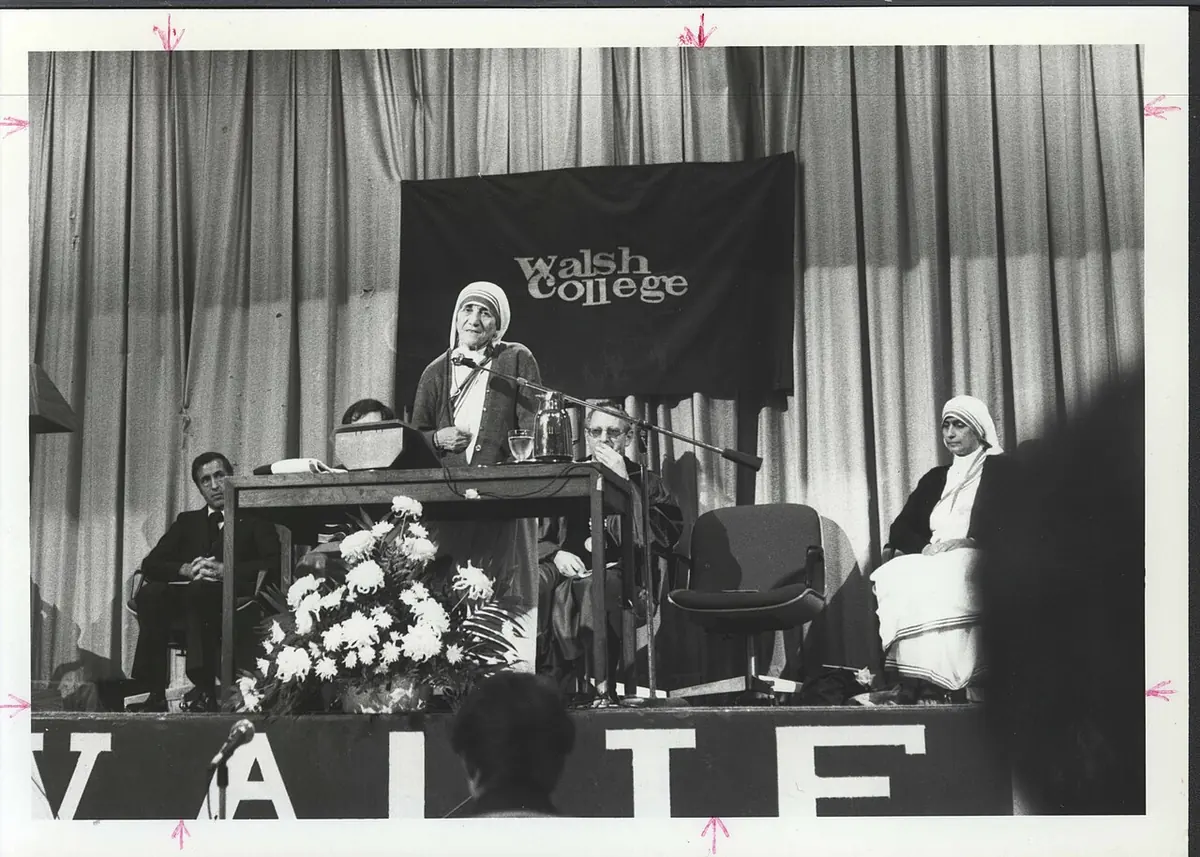

She traveled constantly in the 1980s and 1990s, to famines, war zones and AIDS wards, and used her fame to ask for help for the poor. She received honorary citizenship of the United States in 1996. In Oslo she joked that "if I don’t go to Heaven for anything else I will be going to Heaven for all the publicity because it has purified me."
Death in Calcutta
Her health failed through the 1990s. In March 1997 the sisters elected her successor, Sister Nirmala Joshi. After a last meeting with Pope John Paul II in Rome, she went home to Calcutta, where she died on the evening of September 5, 1997, at eighty-seven. The Government of India gave her a state funeral, and she was buried in the Mother House of the Missionaries of Charity. By then, according to the Mother Teresa Center, the congregation numbered 3,842 sisters in 594 houses in 120 countries.


Her long darkness
The Mother Teresa Center calls her interior suffering "another heroic side of this great woman that was revealed only after her death." From about the time she began her work among the poor until the end of her life, she felt "separated from God, even rejected by Him," while longing for his love. She asked that her letters to her confessors be destroyed. They were kept, and in 2007 Fr. Brian Kolodiejchuk, the postulator of her cause, published them as Mother Teresa: Come Be My Light.
The letters are startling. In 1956 she wrote: "Such deep longing for God and … repulsed empty no faith no love no zeal. … Heaven means nothing pray for me please that I keep smiling at Him in spite of everything." In an undated letter: "I have no Faith — I dare not utter the words & thoughts that crowd in my heart — & make me suffer untold agony." She described her famous smile as "a mask."
Some readers took the letters as proof that she had lost her faith. Fr. Kolodiejchuk argued the opposite: she lamented the loss of any felt sense of God, he said, but never stopped believing he was working through her. Catholic writers compared her trial to the "dark night of the soul" taught by St. John of the Cross and to the "night of nothingness" of her own namesake, St. Thérèse. In a 1962 letter she seemed to accept it as her vocation:
If I ever become a Saint– I will surely be one of “darkness.” I will continually be absent from Heaven– to light the light of those in darkness on earth.
John Paul II spoke of it openly at her beatification: she shared in Christ's Passion "during long years of 'inner darkness,'" which she accepted as a rare "gift and privilege." In the darkest hours, he said, "she clung even more tenaciously to prayer before the Blessed Sacrament."
The miracles of St. Teresa of Calcutta
John Paul II allowed her cause to open in 1999, less than two years after her death, waiving the usual five-year wait. Two healings were investigated and approved by the Church: one for her beatification, one for her canonization. Both were also disputed by others, and the accounts below give both.
Monica Besra, 1998 (approved)
Monica Besra was a young tribal woman from the village of Nakur in the South Dinajpur district of West Bengal. In 1998 she was being cared for by the Missionaries of Charity, with fever, vomiting and a large mass growing in her abdomen. She had been treated the year before for tuberculous meningitis. On September 5, 1998, the first anniversary of Mother Teresa's death, the sisters placed on her abdomen a medallion that had touched Mother Teresa's body and prayed for her. Besra said she had seen a light coming from a picture of Mother Teresa in the chapel. The next morning, she said, the mass was gone. John Paul II approved the healing as a miracle on December 20, 2002, and Mother Teresa was beatified in St. Peter's Square on October 19, 2003.
The case was contested. Time reported in 2002 that Dr. Ranjan Mustafi, who had treated Besra, said the lump "was not a full-grown tumor" and that "she responded to our treatment steadily." Christopher Hitchens called the miracle fakery. The Church's medical consultants concluded that the speed and completeness of the cure had no natural explanation.
Marcilio Haddad Andrino, 2008 (approved)
Marcilio Haddad Andrino, a young man from Santos, Brazil, fell ill soon after his marriage. In October 2008, after two years without a diagnosis, doctors found eight abscesses in his brain, with a dangerous build-up of fluid. His wife, Fernanda, had a relic of Mother Teresa from their parish priest. "I put the relic on Marcilio's head, where he had the abscesses," she told reporters in 2016, and "recited the prayer of beatification." On December 9, 2008, in great pain and close to death, he was taken to the operating room for emergency surgery. He woke there, he said, with "a great peace" and no headache, and the surgery was called off. Within days, scans showed the abscesses shrinking and the fluid gone. Doctors had told the couple that his treatment would leave them unable to have children; within a year Fernanda was pregnant, and they now have children.
Pope Francis approved the healing as a miracle on December 17, 2015, and canonized her on September 4, 2016, in St. Peter's Square, before a crowd of volunteers gathered for the Jubilee of Mercy.
Other reported favors
The Missionaries of Charity receive many accounts of favors attributed to her prayers. These are reported, not formally examined. Petitions sent to the Mother Teresa Center are placed on her tomb.
Criticism of Mother Teresa
Mother Teresa was admired as few people of her time were, and she was also criticized, in her lifetime and after. The criticisms fall into a few groups.
The standard of care. In 1994 Dr. Robin Fox, editor of the British medical journal The Lancet, visited Nirmal Hriday and wrote that patients were seldom properly diagnosed and that strong painkillers were lacking. The Nobel Foundation's own summary notes the allegation that "dying people in the hospices were refused pain relief, whereas Mother Teresa herself accepted hospital treatment." A 2013 study by Serge Larivée, Geneviève Chénard and Carole Sénéchal of the University of Montreal and the University of Ottawa, reported by The Guardian, criticized the homes for unhygienic conditions, poor food, a shortage of care and "her rather dubious way of caring for the sick."
Money and patrons. The same researchers questioned her "suspicious management of the enormous sums of money she received." The journalist Christopher Hitchens, in a 1994 documentary and the 1995 book The Missionary Position, attacked her for accepting money and honors from people such as the Haitian dictator Jean-Claude Duvalier and the American financier Charles Keating, a central figure in the savings-and-loan scandal of the late 1980s. The Calcutta-born physician Aroup Chatterjee published a book-length critique of her work, Mother Teresa: The Final Verdict, in 2003.
Her teaching. Her opposition to abortion, contraception and divorce, which she voiced even in her Nobel lecture, angered many. Hitchens attacked her stand against birth control and abortion as harmful to the poor women she served.
Her defenders reply that she never meant to run hospitals. Her homes, she said, were for people who would otherwise die alone in the street, to be loved at the end. The Missionaries of Charity took a vow of poverty and refused many comforts for their patients and for themselves. During her cause, the Vatican invited critics to testify, and Hitchens gave evidence to the inquiry. As the Vatican journalist John Allen wrote when her canonization was announced, declaring someone a saint "is not tantamount to a claim of moral perfection. It doesn't mean they never made mistakes or were utterly free of blind spots."
Why she is honored as a patron of the poor and the dying
She has no long traditional list of patronages; she died too recently. Catholics invoke her for the poor, the sick and the dying, for the lonely and unwanted, and for those who care for them, because these were her life's work. In her Nobel lecture she said the home for the dying had taken in "more than 36,000 people only from the streets of Calcutta," and that more than 18,000 of them "have died a beautiful death."
Her own idea of poverty was wide. At her beatification John Paul II recalled that she "was fond of repeating that the greatest poverty is to be unwanted, to have no one to take care of you." In 2017, on the first anniversary of her canonization, the Archdiocese of Calcutta declared her its co-patron, beside St. Francis Xavier. Pope Francis, canonizing her during the Jubilee for Workers of Mercy, offered her to volunteers everywhere: "may she be your model of holiness!" See all the patron saints.
How to recognize Mother Teresa in art
Because she lived in the age of photography, most images of her are photographs, and painted images follow them closely. Look for:
- The white sari with blue border: plain cotton with three blue stripes, one wide and two narrow, the dress of the Missionaries of Charity. She chose a poor woman's sari in 1948.
- A small crucifix pinned at the left shoulder of the sari.
- A rosary, often in her joined hands. John Paul II recalled a favorite image of her "clasping a child's hand in one hand while moving her Rosary beads with the other."
- Joined hands and a bowed head, the Indian greeting of namaste that she gave to everyone she met.
- A child or a dying person in her arms or at her side.
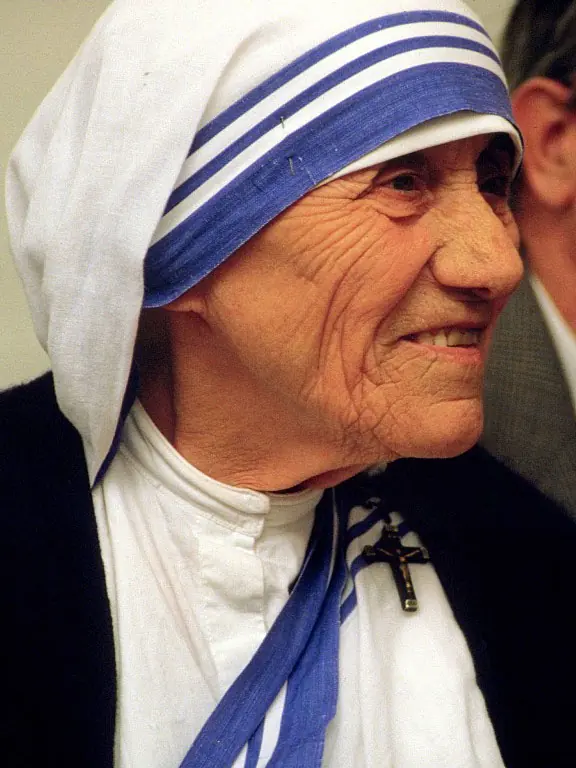

Since her canonization, statues, mosaics and stained glass of her have appeared in churches from India to the Balkans and the Americas. In some she has a halo; in many, she is simply the familiar small figure in the sari.
Feast day and where she is honored
Her feast is September 5, the day she died. The Mother Teresa Center describes it as an optional memorial. The United Nations General Assembly made September 5 the International Day of Charity in her honor. See the feast day calendar.
The Mother House, Kolkata
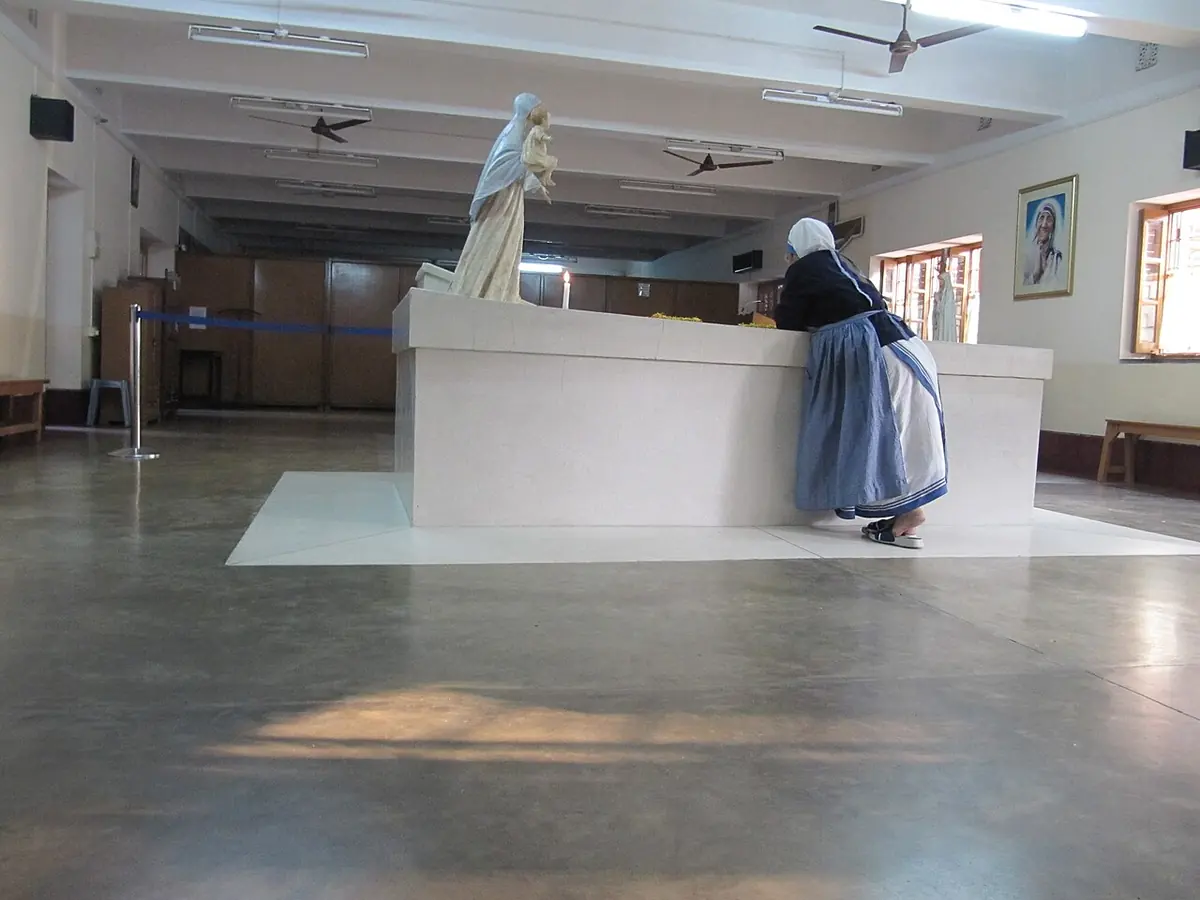
The Mother House of the Missionaries of Charity, at 54A A.J.C. Bose Road, is still the order's headquarters. Her plain white tomb stands in a ground-floor hall where the sisters pray. The Mother Teresa Center says the tomb "quickly became a place of pilgrimage and prayer for people of all faiths, rich and poor alike." Upstairs, her small room has been kept as it was.

Skopje and the Albanian lands
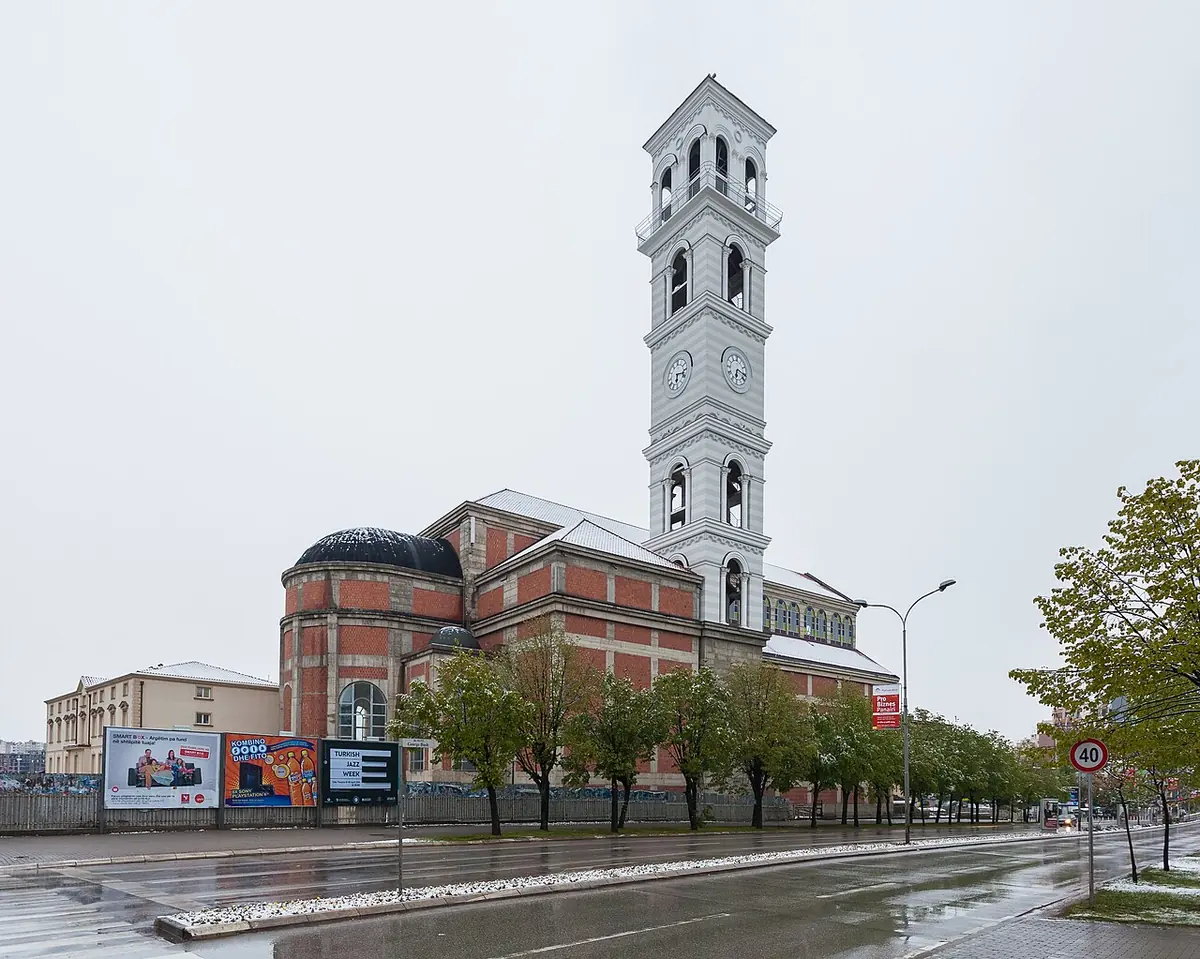
In Skopje, the Memorial House of Mother Teresa opened in 2009 on the site of the Sacred Heart church where she was baptized. Albanians in Albania, Kosovo and North Macedonia honor her as their most famous daughter, Nënë Tereza. In Pristina, the capital of Kosovo, the Catholic cathedral consecrated in 2017 is dedicated to her.

Prayer to St. Teresa of Calcutta
The official prayer
The Mother Teresa Center of the Missionaries of Charity publishes this prayer to her:
Saint Teresa of Calcutta, Jesus called you to bring the light of His love to those who live in darkness. By tender, loving care for the poorest and the neediest, you became the sign of God's presence, His love and compassion in the midst of suffering and pain. Following your example, help us to recognize the face of Jesus in our suffering brothers and sisters and to serve Him with humility and joy. Teach us to be carriers of God's tender love and mercy and so bear witness that God still loves the world through each one of us. Amen.
The Center also publishes a nine-day novena, with a passage from her writings for each day, to be followed by this prayer. Petitions sent to the Center are placed on her tomb.
A prayer she prayed
Among the prayers Mother Teresa wrote and taught her sisters is this one to the Virgin Mary, also published by the Mother Teresa Center:
Mary, Mother of Jesus, give me your heart so beautiful, so pure, so immaculate, so full of love and humility that I may be able to receive Jesus in the Bread of Life, love Him as you loved Him, and serve Him as you served Him in the distressing disguise of the poorest of the poor. Amen.
Her sisters also pray each day after Communion the prayer for peace attributed to St. Francis of Assisi, which she led the audience in praying when she received the Nobel Prize in Oslo.
In her own words
Her sayings circulate widely, and many attributed to her are not hers; the Mother Teresa Center keeps a list of quotes falsely attributed to her. These are from documented sources:
- "My secret is very simple, I pray." (quoted by the Mother Teresa Center)
- "The fruit of silence is prayer; the fruit of prayer is faith; the fruit of faith is love; the fruit of love is service; the fruit of service is peace." (quoted by John Paul II, October 20, 2003)
- "It is not how much we do, but how much love we put in the action that we do." (Nobel lecture, 1979)
- "Perhaps I don't speak their language, but I can smile." (quoted by Pope Francis at her canonization, 2016)
Frequently asked questions
When is St. Mother Teresa's feast day?
September 5, the anniversary of her death in Calcutta in 1997. The Mother Teresa Center of the Missionaries of Charity describes it as an optional memorial. The United Nations General Assembly made September 5 the International Day of Charity in her honor.
What miracles made Mother Teresa a saint?
Two healings were formally approved. The first was the cure of Monica Besra, a tribal woman in West Bengal, from an abdominal mass in 1998, approved in 2002 for her beatification. The second was the cure of Marcilio Haddad Andrino, a young man in Santos, Brazil, from multiple brain abscesses in 2008, approved in December 2015 for her canonization.
What is Mother Teresa the patron saint of?
She has no long official list, but Catholics turn to her for the poor, the sick, the dying and the abandoned, and for the Missionaries of Charity she founded. In 2017 the Archdiocese of Calcutta declared her its co-patron, alongside St. Francis Xavier.
What was Mother Teresa's real name?
She was baptized Gonxha (Anjezë) Agnes Bojaxhiu, the youngest child of Nikola and Drana Bojaxhiu, an Albanian Catholic family in Skopje. She took the name Teresa, after St. Thérèse of Lisieux, when she joined the Sisters of Loreto in 1928.
Did Mother Teresa doubt God?
Her private letters, published in 2007 in Mother Teresa: Come Be My Light, show that for nearly fifty years she felt separated from God and called this experience "the darkness." The editor of the letters, Fr. Brian Kolodiejchuk, says she never stopped believing. Catholic writers compare her experience to the "dark night" described by St. John of the Cross.
Why was Mother Teresa criticized?
Visitors and researchers questioned the medical standard of her homes, especially the lack of diagnosis and strong pain relief in Calcutta's home for the dying, and how donations were used. Critics also objected to her outspoken opposition to abortion and contraception and to some of the donors she accepted. Her defenders answer that her homes were meant as places of love for the dying, not hospitals.
Where is Mother Teresa buried?
In the Mother House of the Missionaries of Charity at 54A A.J.C. Bose Road in Kolkata. Her plain white tomb stands in a ground-floor hall, and visitors of every religion come to pray there.
Is there a prayer to St. Teresa of Calcutta?
Yes. The Mother Teresa Center of the Missionaries of Charity publishes an official prayer that begins "Saint Teresa of Calcutta, Jesus called you to bring the light of His love to those who live in darkness." It is printed in full below.
Sources
- Vatican: Mother Teresa of Calcutta (1910–1997), biography
- John Paul II, Homily for the Beatification of Mother Teresa of Calcutta, 19 October 2003
- John Paul II, Address to the pilgrims who had come to Rome for the beatification of Mother Teresa, 20 October 2003
- Pope Francis, Homily at the Canonization of Blessed Mother Teresa of Calcutta, 4 September 2016
- Mother Teresa, Nobel Lecture, 11 December 1979 (NobelPrize.org)
- NobelPrize.org: Mother Teresa, Facts
- NobelPrize.org: Mother Teresa, Biographical
- Mother Teresa Center of the Missionaries of Charity: Biography
- Mother Teresa Center: Mother Teresa's Cause
- Mother Teresa Center: Prayers
- Mother Teresa Center: Prayers by Mother Teresa
- Catholic World Report (CNA): 'I was sure that it was Mother Teresa who healed me' (2017)
- Biography.com: The Miracles That Made Mother Teresa a Saint
- Time: What's Mother Teresa Got to Do with It? (2002)
- The Guardian: Mother Teresa to become saint after pope recognises 'miracle' (2015)
- Mail & Guardian (AP): New book shows Mother Teresa's faith struggle (2007)
- Penguin Random House: Mother Teresa, Come Be My Light, ed. Brian Kolodiejchuk
- Robin Fox, Mother Theresa's care for the dying, The Lancet 344 (1994): 807–808 (PubMed record)
- Vatican Radio: Mother Teresa to be co-patron of Calcutta Archdiocese (2017)