St. Elizabeth Ann Seton
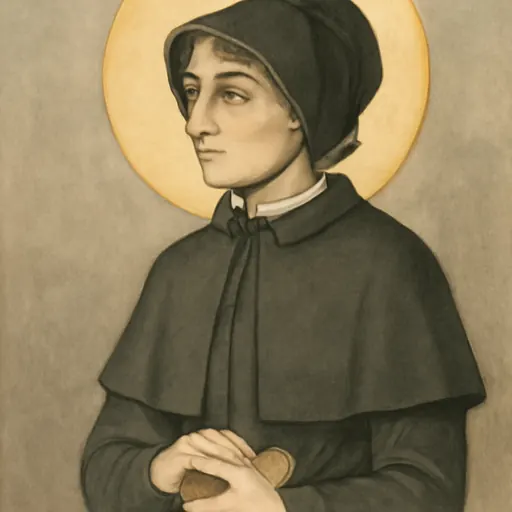
St. Elizabeth Ann Seton (1774–1821) was a New York wife and mother who was widowed at 29, became a Catholic in 1805 and founded the Sisters of Charity of St. Joseph's in Emmitsburg, Maryland, the first community of religious sisters started in the United States. Her schools there are counted as the beginning of Catholic parochial education in America. Canonized in 1975, she was the first native-born citizen of the United States to be declared a saint. Her feast day is January 4.
Who was St. Elizabeth Ann Seton?
Elizabeth Ann Seton was born a New York Episcopalian, married a merchant, raised five children and was widowed at 29. Two years later she became a Catholic, at a cost that left her poor and shunned by much of her family. In 1809, at Emmitsburg in the Maryland hills, she founded the Sisters of Charity of St. Joseph's, the first community of religious sisters begun in the United States, and opened a free school for the girls of the valley. She died there in 1821, at 46.
On September 14, 1975, Pope Paul VI declared her a saint. She was the first person born in the United States to be canonized. "Elizabeth Ann Seton is a Saint!" the pope said in his homily. "She is the first daughter of the United States of America to be glorified with this incomparable attribute!"


The National Shrine in Emmitsburg sums her up as "a wife, mother, widow, convert, educator, and foundress." Catholics know her as Mother Seton, the title Archbishop John Carroll gave her in 1809.
The life of St. Elizabeth Ann Seton
A New York childhood
Elizabeth Ann Bayley was born in New York City on August 28, 1774, two years before the Declaration of Independence. Her father, Dr. Richard Bayley, was a surgeon who became the first professor of anatomy at Columbia College and the health officer of the Port of New York. Her mother, Catherine Charlton, the daughter of an Anglican rector on Staten Island, died in 1777, when Elizabeth was three.
Her father remarried, and the marriage later broke apart. Elizabeth and her older sister were left in the care of relatives in New Rochelle while their father studied abroad. Sr. Betty Ann McNeil, D.C., archivist of the Daughters of Charity, writes that she went through a period of darkness in those years, which she later recalled in a memoir called Dear Remembrances. The Catholic Encyclopedia says she was a religious girl who wore a small crucifix and loved to read the Scriptures, especially the Psalms. McNeil adds that Psalm 23 stayed her favorite for life.
Wife, mother and "Protestant Sister of Charity"
On January 25, 1794, at 19, she married William Magee Seton, a young partner in his family's import-export firm. Samuel Provoost, the first Episcopal bishop of New York, witnessed the vows. The couple had five children: Anna Maria, William, Richard, Catherine and Rebecca.
The Setons worshiped at Trinity Church, where the young Rev. John Henry Hobart became Elizabeth's spiritual director. With her sister-in-law Rebecca Seton, "the friend of her soul," she nursed sick neighbors and visited the poor, and the two were nicknamed the "Protestant Sisters of Charity." In 1797 she was among the founders of the Society for the Relief of Poor Widows with Small Children and served as its treasurer.
Then the family's fortunes collapsed. William's father died in 1798, leaving him the business and the care of his younger half-siblings, whom Elizabeth taught at home. Piracy at sea and hard times at home ruined the firm, which went bankrupt in 1801, and the Setons lost their house at 61 Stone Street. Elizabeth's father died the same year. William had begun to show signs of tuberculosis.
Italy, 1803
In 1803 the doctors sent William to the warm climate of Tuscany. Elizabeth and their eldest daughter, Anna Maria, went with him, and the four younger children stayed with Rebecca. William's business friends in Livorno were the Filicchi brothers, Filippo and Antonio.
Yellow fever was then raging in New York, so the Italian port officials held the Setons in quarantine for a month in the cold stone lazaretto of San Jacopo. Elizabeth kept a journal for Rebecca of those weeks, nursing her husband and trying to keep up his spirits. William was released, but he died in Pisa on December 27, 1803, and was buried in the English cemetery at Livorno. Elizabeth was a widow at 29.
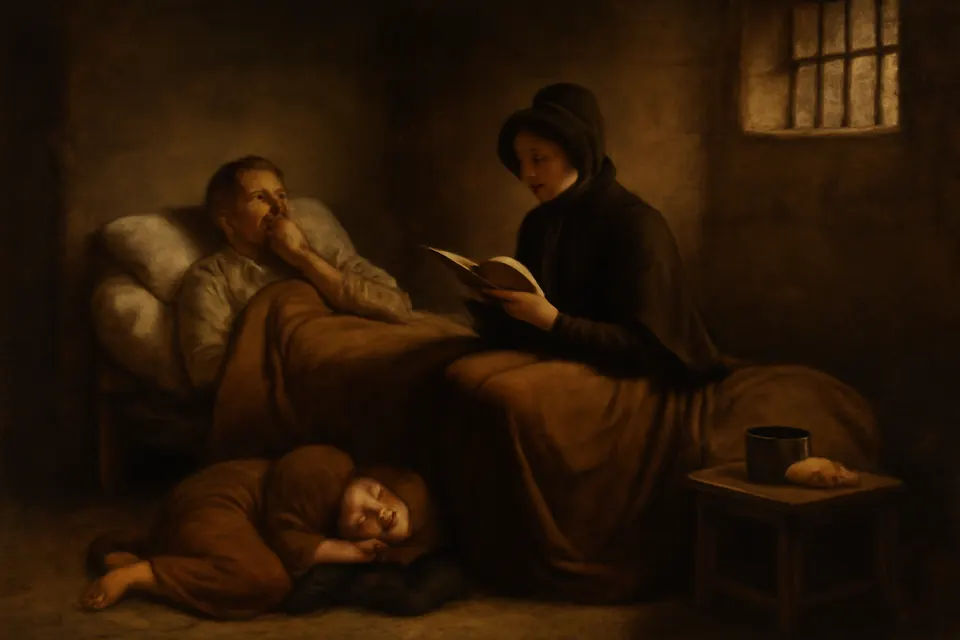
She and Anna Maria stayed with Antonio Filicchi and his wife, Amabilia, until spring. There, McNeil writes, Elizabeth came upon the Memorare, the old prayer to the Virgin Mary, and began to ask questions about the Mass, the real presence of Christ in the Eucharist and the Church's unbroken link to the apostles. Her long Italian Journal, written for Rebecca, records the struggle. Antonio Filicchi sailed home with her, and they reached New York on June 3, 1804. Rebecca died the next month.
Conversion, 1805
Back in New York, Elizabeth was torn. Hobart did all he could to keep her in the Episcopal Church. Antonio Filicchi argued for Catholicism and put her in touch by letter with Fr. John Cheverus of Boston, later the first bishop of Boston, and with Bishop John Carroll of Baltimore. The Catholic Encyclopedia gives the prayer she said in those months, a stanza from Alexander Pope's Universal Prayer: "If I am right Thy grace impart still in the right to stay. If I am wrong Oh, teach my heart to find the better way."
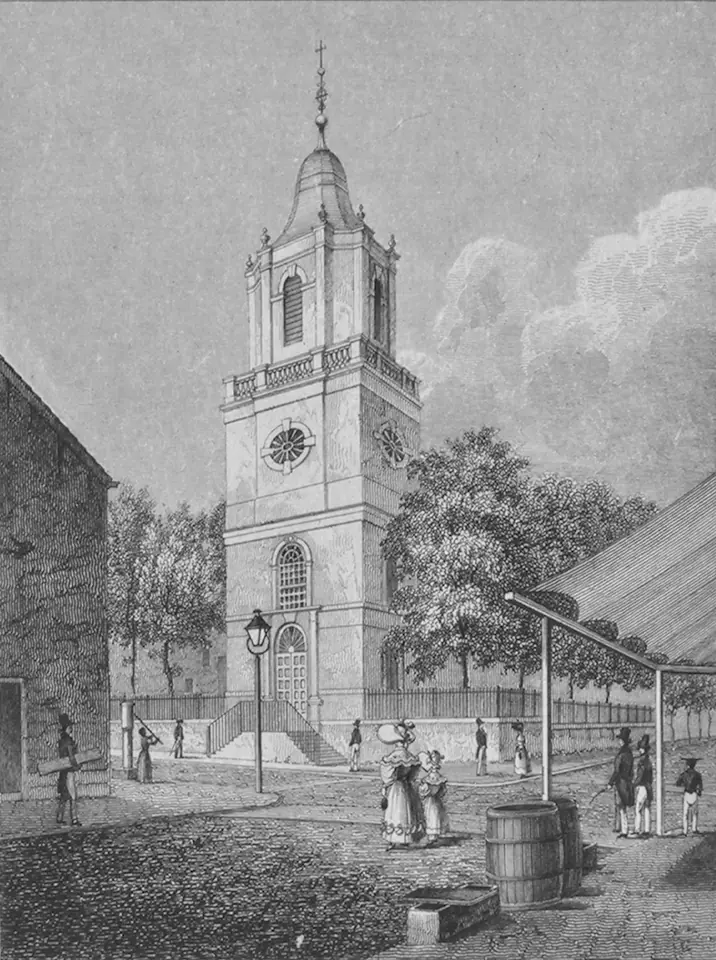
On Ash Wednesday, March 14, 1805, Fr. Matthew O'Brien received her into the Catholic Church at St. Peter's Church on Barclay Street. She made her First Communion there on March 25. "AT LAST, God is mine and I am His," she wrote afterward. When Bishop Carroll confirmed her the next year, she added the name Mary to her own and often signed herself MEAS, for Mary Elizabeth Ann Seton.

The cost was high. Relatives who would have supported her and the children turned away. A school she helped run lost its pupils when parents heard it was linked to a Catholic, and a boarding house she kept for schoolboys failed for the same reason. When her young sister-in-law Cecilia Seton asked to become a Catholic in 1806, the Catholic Encyclopedia says there were threats to have Elizabeth driven from the state. She considered moving to a convent in Canada. McNeil writes that all her life she held to the conviction she put in a letter: "God will provide, that is all my Comfort never did that providence fail me."

Baltimore, 1808
The way out came through Fr. Louis William Dubourg, a French Sulpician priest who was president of St. Mary's College in Baltimore. With Bishop Carroll's approval he invited her to open a school for girls beside the Sulpicians' seminary. She arrived on June 16, 1808, the day the seminary's new chapel was dedicated, and moved into a small brick house on Paca Street with her daughters.
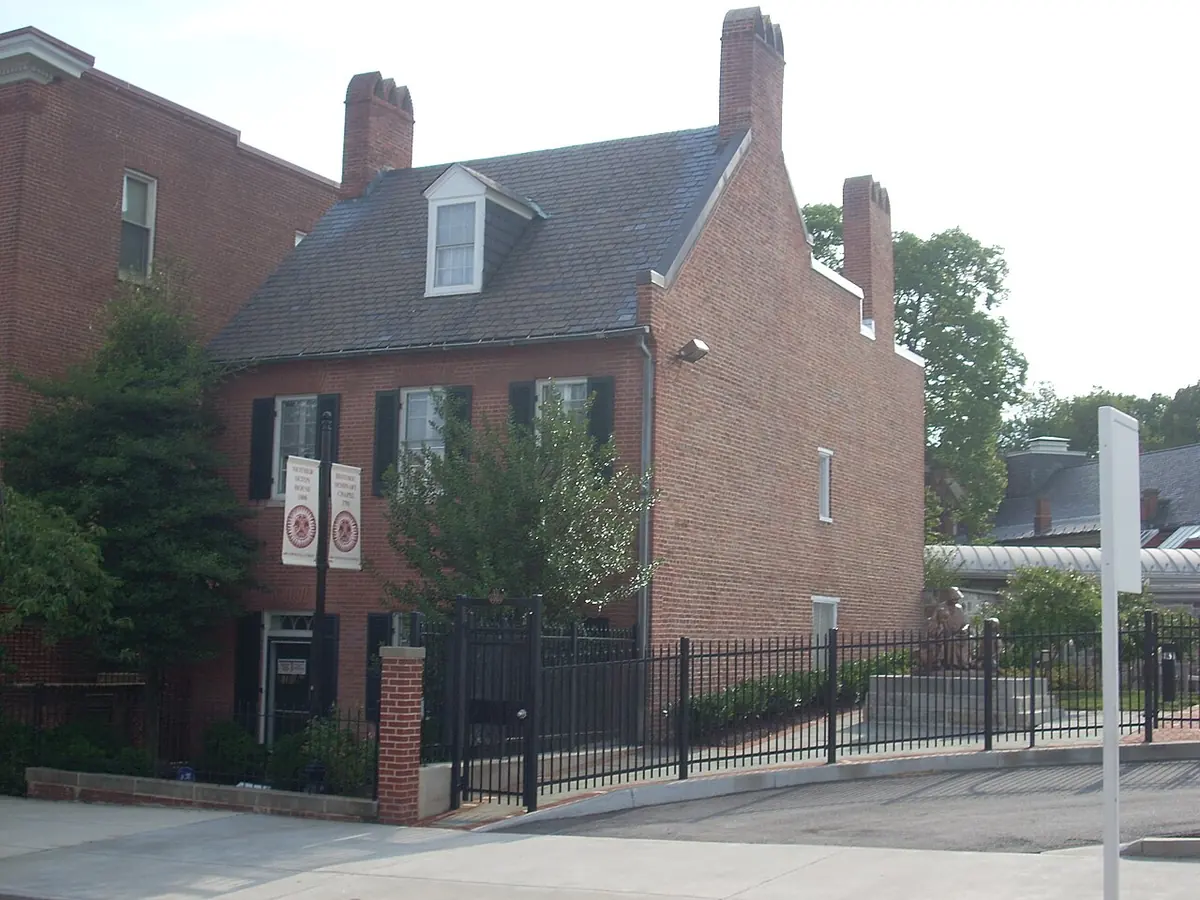

Other women soon came to join her. The first was Cecilia O'Conway of Philadelphia, on December 7, 1808. On March 25, 1809, in the lower chapel of St. Mary's Seminary, Elizabeth made vows of chastity and obedience to Archbishop Carroll for one year, and he gave her the title "Mother Seton." From June 16, 1809, the little community dressed alike in a black dress and cape with a bonnet, modeled on the widows' dress Elizabeth had seen in Italy.
Emmitsburg and the Sisters of Charity
A wealthy seminarian and convert, Samuel Sutherland Cooper, bought 269 acres near the village of Emmitsburg, in Frederick County, for a school and a house of charity. In June 1809 Elizabeth and her companions made the journey north. The Sisters of Charity of St. Joseph's began on July 31, 1809, in a stone farmhouse in what Elizabeth named St. Joseph's Valley. The shrine says sixteen people crowded into its four rooms.
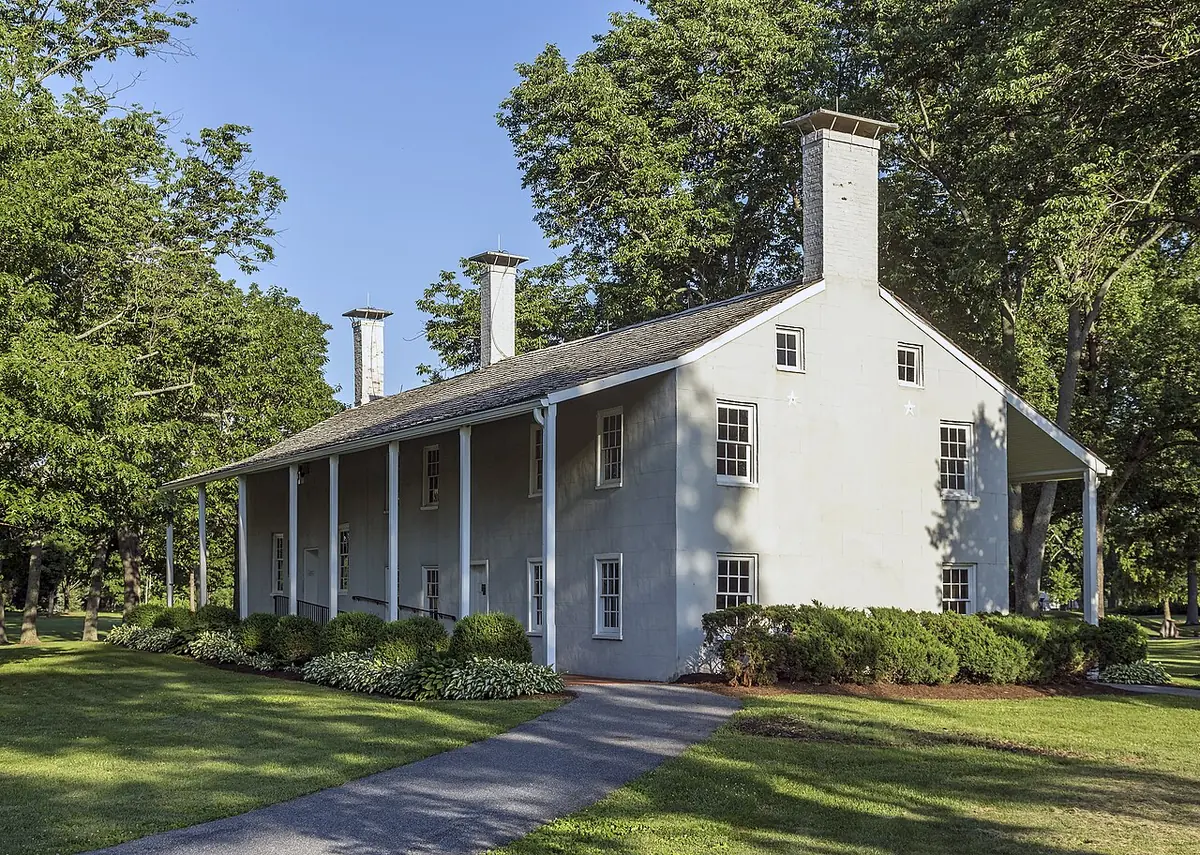

Early in 1810 the community moved into a new house, St. Joseph's House. On February 22, 1810, they opened St. Joseph's Free School for the poor girls of the area, and on May 14 they added St. Joseph's Academy for boarding pupils whose tuition paid for the free school. McNeil calls it the first free Catholic school for girls staffed by sisters in the country.
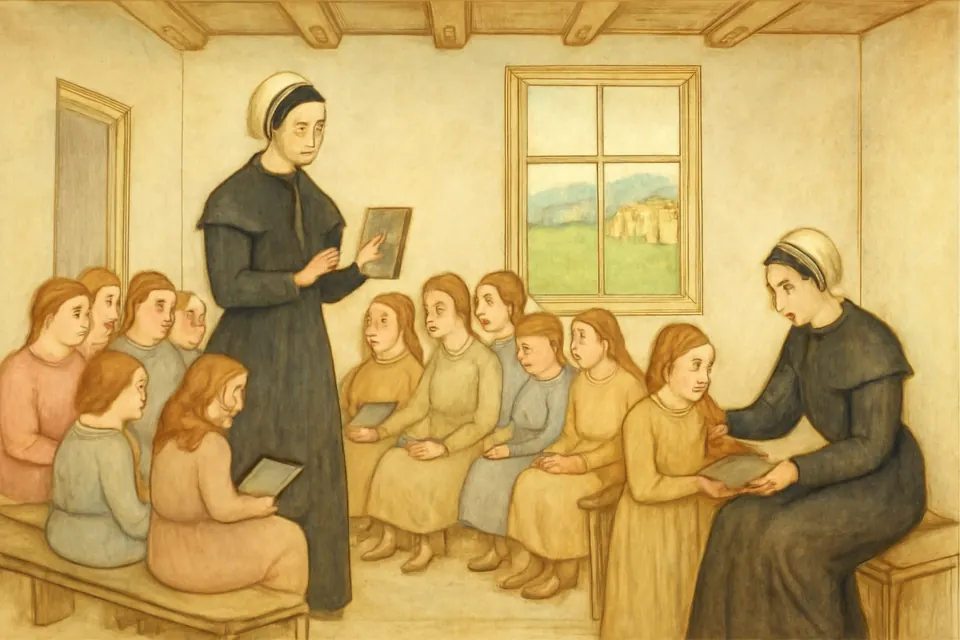
The Sulpicians helped the sisters adapt the rule of the Daughters of Charity of St. Vincent de Paul, and Archbishop Carroll approved it in January 1812. Elizabeth was elected the community's first Mother, against her own wishes, and was reelected until her death. On July 19, 1813, eighteen Sisters of Charity, Elizabeth among them, made their first vows of poverty, chastity, obedience and service of the poor. In 1814 she sent sisters to run an orphanage in Philadelphia, and in 1817 to New York.


Sorrows and death
Illness was always close. Her sisters-in-law Harriet and Cecilia Seton, who came to Emmitsburg with her, died in 1809 and 1810. Her eldest daughter, Anna Maria, made her vows as a Sister of Charity on her deathbed and died on March 12, 1812. Her youngest, Rebecca, lamed by a fall on the ice, died in 1816. McNeil counts eighteen sisters Elizabeth buried at Emmitsburg besides her own family.
The Sulpician Fr. Simon Bruté, later the first bishop of Vincennes, was her spiritual director in her last years. Elizabeth herself had tuberculosis. On January 2, 1821, she spoke her last counsel to the sisters around her bed: "Be children of the Church." She died in St. Joseph's House on January 4, 1821. Her daughter Catherine was the only one of her children with her.
The first Catholic schools in America
Popular histories call Mother Seton the founder of the Catholic school system. The claim needs a little care. There were Catholic schools in the colonies before her, and the parish school system grew in the decades after her death. What she started was the model: a community of trained sisters running a free school for the poor alongside a tuition academy that paid for it. McNeil calls St. Joseph's Academy and Free School "the cradle of Catholic education in the United States." Pope Paul VI put it this way at her canonization: "The apostolate of helping the poor and the running of parochial schools in America had this humble, poor, courageous and glorious beginning."


Her sisters spread fast. In 1850 the Emmitsburg community joined the Daughters of Charity of St. Vincent de Paul in Paris. Other branches became independent congregations: the Sisters of Charity of New York (1846), of Cincinnati (1852), of Halifax (1856), of St. Elizabeth at Convent Station, New Jersey (1859), and of Seton Hill in Greensburg, Pennsylvania (1870). Together they ran schools, orphanages and hospitals across North America.
The miracles of St. Elizabeth Ann Seton
Three cures through her intercession were approved by the Holy See after medical and theological investigation. Two were required for her beatification and were approved in 1961. The third opened the way to her canonization.
- Sister Gertrude Korzendorfer, D.C. (approved), a Daughter of Charity in New Orleans, was cured of pancreatic cancer.
- Ann Teresa O'Neill (approved) of Baltimore was diagnosed with acute lymphatic leukemia, then incurable, at four years old. A Daughter of Charity told her mother about Mother Seton. Her father drove her to Emmitsburg on a crib mattress in the back of a station wagon, and the family laid her on Mother Seton's tomb and took her to the room where she died. Within days she began to improve, and bone marrow tests over the following years found her free of cancer. The Catholic Review dates the cure to 1952. Ann O'Neill lived to 78, died on July 17, 2026, and was buried on the shrine grounds.
- Carl Kalin (approved), an engineer from Yonkers, New York, was admitted to St. Joseph's Hospital there in October 1963 with an extremely rare brain disease. The Sisters of Charity of New York write that only five cases had been documented and none had survived. The sisters at the hospital prayed for Mother Seton's intercession. After five days in a coma he woke, and five days later he went home cured. He lived until 1976.
Many other cures have been reported. The Sisters of Charity of Cincinnati tell of Jim Porter, a 21-year-old whose family prayed to the soon-to-be saint after a motorcycle accident in July 1975 left him in a coma with no hope of recovery. Such accounts are personal testimonies, not cases examined by the Church.
The road to canonization
Her cause took almost a century. On August 22, 1882, after saying Mass at St. Joseph's in Emmitsburg, Archbishop James Gibbons of Baltimore turned to the sisters and said, "I have been inspired this morning to begin the Cause of Mother Seton's canonization." Pope Pius XII signed the decree introducing the cause on February 28, 1940. The Sisters of Charity of Cincinnati note that it was the first official document the Holy See ever issued in English.
Pope John XXIII declared her Venerable on December 18, 1959, and beatified her on March 17, 1963. Pope Paul VI canonized her on September 14, 1975, during a Holy Year that the United Nations had also named International Women's Year. Sister Hildegard Marie Mahoney, S.C., who read at the Mass, was the first woman to serve as a lector at a papal Eucharist, and President Gerald Ford named the day National Saint Elizabeth Seton Day.
In his homily Paul VI repeated Cardinal Spellman's phrase, "Elizabeth Ann Seton was wholly American!" and spoke to her country directly: "Rejoice for your glorious daughter. Be proud of her. And know how to preserve her fruitful heritage." He also honored the Episcopal Church in which she was raised, saying it had "the merit of having awakened and fostered the religious sense and Christian sentiment" in the young Elizabeth.
Why St. Elizabeth Ann Seton is a patron saint
- Catholic schools: McNeil writes that popular devotion acclaims her patron of Catholic schools because of her pioneering role in Catholic education.
- Widows and converts: she was both, and both cost her dearly. Women raising children alone often ask her prayers.
- The United States Sea Services: she is officially their patron. Her son William was a U.S. Navy officer, and her son Richard died at sea off Liberia. The Emmitsburg shrine holds an annual pilgrimage and Mass for the Sea Services.
- Maryland: the state where she founded her community and where she is buried.
See all the patron saints by cause.
Symbols of St. Elizabeth Ann Seton in art
Mother Seton died in 1821, before photography, so every picture of her goes back to a few portraits made in her lifetime or copied from them. Here is how to recognize her:
- A close cap tied under the chin, a black dress and a short cape: the habit of the first Sisters of Charity, modeled on the dress of Italian widows. Most portraits, statues and holy cards show her in it, usually with a black cap.
- A profile view: the oldest likeness is a 1797 profile drawing by the French artist Charles de Saint-Mémin, made before her conversion. Later portraits, including the one linked to her friend Amabilia Filicchi, keep the same profile.
- A rosary: her love for Mary, which began in Italy with the Memorare.
- A book: the Scriptures she read all her life, and her work as a teacher.
- Children: usually schoolgirls, for her free school and academy.
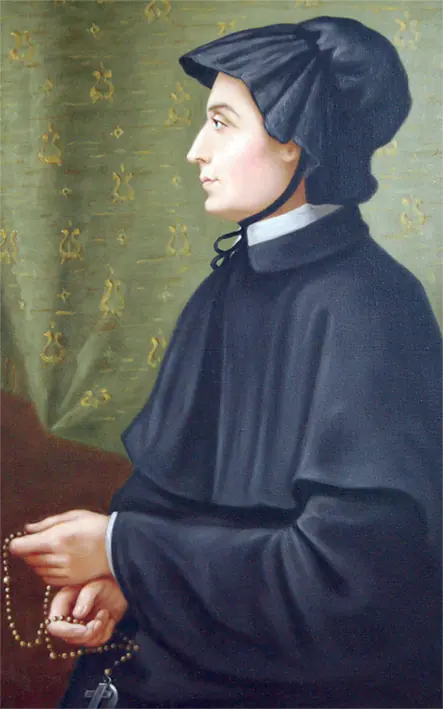

Modern statues stand in many American churches and schools named for her, and the altar of her basilica in Emmitsburg has a statue of her in the habit, carved in Italy.
Feast day and where St. Elizabeth Ann Seton is honored
Her feast is January 4, the anniversary of her death, a memorial in the United States and Canada. It falls on the eleventh day of the Christmas season. See the feast day calendar.
The National Shrine, Emmitsburg
The Basilica of the National Shrine of St. Elizabeth Ann Seton was completed in 1965 as the chapel of the Daughters of Charity and became her national shrine after her beatification. Her remains were moved there in 1968 and rest in a small copper casket beneath the marble Altar of Relics. Visitors can also tour the Stone House and the White House, where her schoolroom is set up as it was, and the cemetery where she was first buried. On September 23, 2015, President Barack Obama gave Pope Francis one of the original keys to the Stone House as a gift from the nation.


New York and Baltimore
In Lower Manhattan, the Shrine of St. Elizabeth Ann Seton stands on State Street facing the harbor, a small Georgian-style church of the 1960s beside the James Watson House, a Federal mansion of 1793 that serves as its rectory. In Baltimore, the Mother Seton House on Paca Street, where she lived from 1808 to 1809, stands next to the old seminary chapel of 1808 and is open to visitors as part of St. Mary's Historic Site.


Prayer to St. Elizabeth Ann Seton
The Church's own prayer for her day is the collect of the Mass of her memorial in the Roman Missal for the United States:
O God, who crowned with the gift of true faith Saint Elizabeth Ann Seton's burning zeal to find you, grant by her intercession and example that we may always seek you with diligent love and find you in daily service with sincere faith. Through our Lord Jesus Christ, your Son, who lives and reigns with you in the unity of the Holy Spirit, God, for ever and ever.
Catholics also pray in her own words. In a conference to her sisters she described the rule of her life:
What was the first rule of our dear Savior's life? You know it was to do His Father's will. Well, then, the first end I propose in our daily work is to do the will of God; secondly to do it in the manner He wills...
Catholic Culture prints a short prayer drawn from this passage, asking that "His Will of the present moment be the first rule of our daily life and work." The Emmitsburg shrine also offers novenas of Masses in the basilica, with each intention placed at the foot of her altar.
In her own words
Mother Seton wrote constantly: letters, journals, meditations, instructions for the sisters and translations, including the first English lives of St. Vincent de Paul and St. Louise de Marillac and portions of the writings of St. Teresa of Avila and St. Francis de Sales. Her papers are published in the three-volume Collected Writings. A few lines that are often quoted:
AT LAST, God is mine and I am His.
She wrote that after her First Communion in 1805. To her lifelong friend Julia Scott she summed up her way of life:
Faith lifts the staggering soul on one side, hope supports it on the other, experience says it must be and love says let it be.
And to her sisters, two days before she died:
Be children of the Church.
Frequently asked questions
Why is St. Elizabeth Ann Seton famous?
She was the first person born in what became the United States to be canonized, in 1975. She founded the first American congregation of religious sisters, the Sisters of Charity of St. Joseph's, in 1809, and her free school for girls in Emmitsburg, opened in 1810, is called the cradle of Catholic education in the United States.
When is St. Elizabeth Ann Seton's feast day?
January 4, the anniversary of her death in 1821. It is a memorial in the Catholic calendar of the United States and is also kept in Canada. It falls in the Christmas season, between St. Genevieve on January 3 and St. John Neumann on January 5.
What is St. Elizabeth Ann Seton the patron saint of?
Catholic schools, by popular devotion, because of her pioneering schools in Baltimore and Emmitsburg. She is officially the patroness of the United States Sea Services and of the state of Maryland, and widows and converts often ask her prayers.
What miracles were approved for St. Elizabeth Ann Seton?
The Holy See accepted three cures through her intercession. Sister Gertrude Korzendorfer, a Daughter of Charity in New Orleans, was cured of pancreatic cancer. Ann Teresa O'Neill of Baltimore was cured of acute lymphatic leukemia in 1952, at four years old. Carl Kalin of Yonkers, New York, recovered from a fatal brain disease in 1963.
Was Elizabeth Ann Seton the first American saint?
She was the first saint born in the United States. St. Frances Xavier Cabrini, canonized in 1946, was the first United States citizen to be canonized, but she was born in Italy and became a citizen in 1909.
Why did Elizabeth Ann Seton become Catholic?
In Italy, after her husband's death in 1803, she lived with the Catholic Filicchi family and was drawn above all by the Catholic belief in the real presence of Christ in the Eucharist. After months of struggle back in New York she was received into the Catholic Church on March 14, 1805, though it cost her friends, students and family support.
Where is St. Elizabeth Ann Seton buried?
In the Basilica of the National Shrine of St. Elizabeth Ann Seton in Emmitsburg, Maryland. Her remains were moved there in 1968 and rest in a small copper casket in the marble Altar of Relics.
Did Elizabeth Ann Seton have children?
Yes, five, with her husband William Magee Seton: Anna Maria, William, Richard, Catherine and Rebecca. Anna Maria and Rebecca died young of tuberculosis at Emmitsburg. Catherine became a Sister of Mercy in New York and lived to 90.
Sources
- National Shrine of Saint Elizabeth Ann Seton: The Life of Saint Elizabeth Ann Seton
- National Shrine of Saint Elizabeth Ann Seton: The Basilica
- National Shrine of Saint Elizabeth Ann Seton: The Stone House
- National Shrine of Saint Elizabeth Ann Seton: Historic St. Joseph's House (the White House)
- Sr. Betty Ann McNeil, D.C., St. Elizabeth Ann Seton (Archdiocese of Baltimore)
- Catholic Encyclopedia (1912): Elizabeth Ann Seton
- Paul VI, Homily for the Canonization of Elizabeth Ann Seton, 14 September 1975
- Sisters of Charity of Cincinnati: The Canonization of Elizabeth Seton
- Sisters of Charity of New York: Elizabeth Seton, A Saint for Our Times
- Catholic Review (2026): Ann Teresa O'Neill, whose confirmed miracle led to the canonization of St. Elizabeth Ann Seton, dies at 78
- Catholic Culture: Memorial of St. Elizabeth Ann Seton, January 4 (collect and readings)
- St. Mary's Historic Site, Paca Street: Mother Seton House
- Regina Bechtle, S.C., and Judith Metz, S.C., eds., Elizabeth Bayley Seton: Collected Writings, 3 vols. (New City Press, 2000–2006)