Prayer before an exam
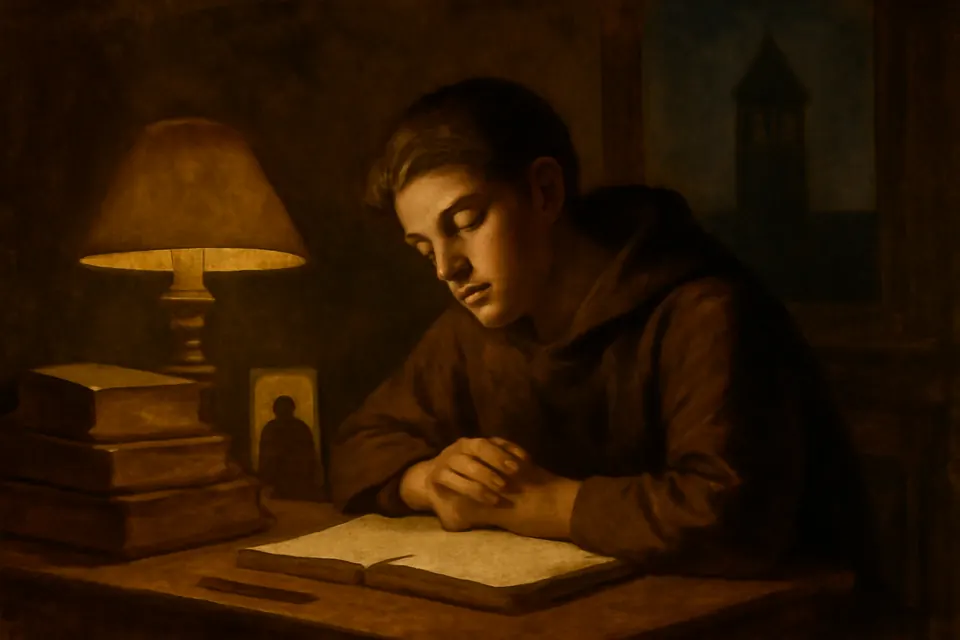
The best-known Catholic prayer before an exam is St. Thomas Aquinas's prayer before study, Creator ineffabilis, which asks God for "acuteness in understanding," memory and ease in expressing what you know. Students also ask the help of St. Joseph of Cupertino, the patron saint of exams, who passed his own examination for the diaconate when he was asked the one passage he knew, and pray to the Holy Spirit.
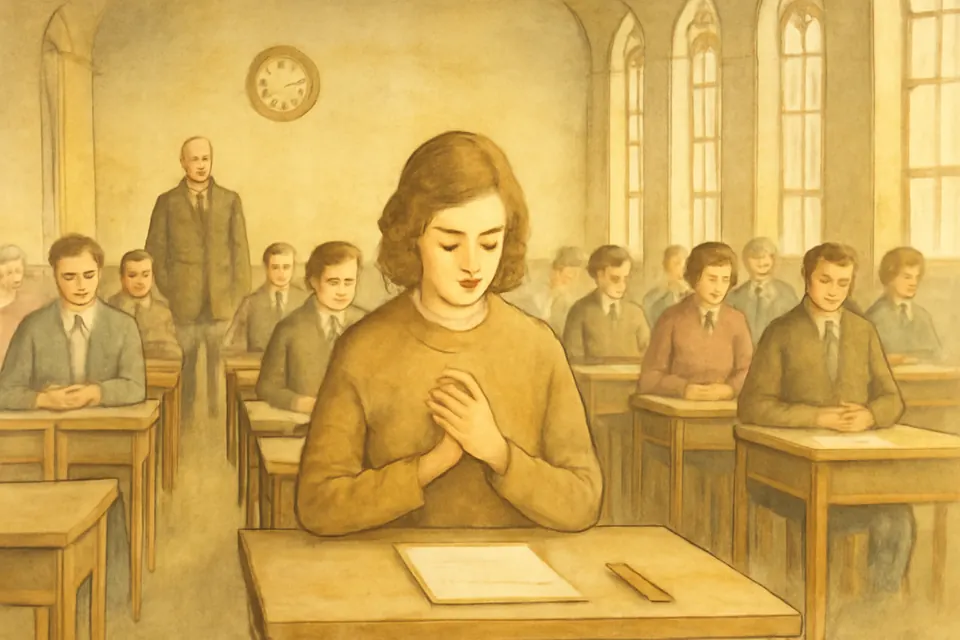
Exam rooms have always been full of quiet prayers. Some are no more than "Please, God," muttered while the papers are handed out. Catholic tradition offers a few with more behind them: a 13th-century prayer from the greatest scholar of the Middle Ages, the story of a friar who could barely read and still passed his exams, and a one-line prayer to the Holy Spirit that fits in the seconds before you turn the page over.
The prayer before an exam of St. Thomas Aquinas
This is the prayer most Catholic schools hand out before exams. It is the Oratio ante studium, "prayer before study," attributed to St. Thomas Aquinas. The English is the translation printed in the 1910 English Raccolta, the official collection of indulgenced prayers:
Ineffable Creator, who, of the treasures of thy wisdom hast formed the nine choirs of Angels, and set them on high above the heavens in a wonderful order, and hast exquisitely fashioned and knit together all parts of the universe; do Thou, who art the true fountain and one principle of light and wisdom, deign to shed the brightness of thy light upon the darkness of my understanding, and thus to disperse the twofold darkness of sin and ignorance wherein I was born. O Thou, who makest eloquent the tongues of babes, instruct my tongue, and pour forth on my lips the grace of thy blessing. Grant me acuteness in understanding what I read, power to retain it, subtlety to discern its true meaning, and clearness and ease in expressing it. Do Thou order my beginnings, direct and further my progress, complete and bless my ending; Thou who art true God and true Man, who livest and reignest world without end. Amen.
The Latin: Creator ineffabilis
Pope Pius XI printed the Latin at the end of his encyclical Studiorum Ducem on June 29, 1923:
Creator ineffabilis, qui de thesauris sapientiae tuae tres Angelorum hierarchias designasti, et eas super caelum empyreum miro ordine collocasti, atque universi partes elegantissime distribuisti: Tu, inquam, qui verus Fons Luminis et Sapientiae diceris, ac supereminens Principium, infundere digneris super intellectus mei tenebras, tuae radium claritatis, duplices, in quibus natus sum, a me removens tenebras, peccatum scilicet, et ignorantiam. Tu, qui linguas infantium facis disertas, linguam meam erudias atque in labiis meis gratiam tuae benedictionis infundas. Da mihi intelligendi acumen, retinendi capacitatem, addiscendi modum et facilitatem, interpretandi subtilitatem, loquendi gratiam copiosam. Ingressum instruas, progressum dirigas, egressum compleas: Tu qui es verus Deus et homo, qui vivis et regnas in saecula saeculorum. Amen.
(The Raccolta's Latin has disposuisti, "arranged," where Pius XI has distribuisti, "distributed." The meaning is the same.)

What it asks for
Read the fourth line slowly and it is a student's whole wish list. In the Latin, Thomas asks for five things: intelligendi acumen, sharpness in understanding; retinendi capacitatem, the capacity to remember; addiscendi modum et facilitatem, a method and ease in learning; interpretandi subtilitatem, subtlety in interpreting; and loquendi gratiam copiosam, an abundant gift for speaking, or in an exam, for writing out an answer. The prayer opens with the angels and the order of the universe, which is Thomas's way of saying that every true thing a student learns is part of what God made. It ends with the three words every test-taker understands: ingressum, progressum, egressum, the beginning, the middle and the end.
The "twofold darkness" is sin and ignorance. Thomas treats both as obstacles to knowing the truth, which is why many Catholics like to go to confession before a major exam.
Where it comes from
The prayer is attributed to Thomas (1225–1274) and has been printed under his name for centuries. The 1903 New Raccolta describes it as a "prayer which S. Thomas Aquinas composed and frequently recited before dictating, writing or preaching," and the 1910 Raccolta heads it "before writing, preaching, etc." Leo XIII indulgenced it on February 21, 1880, the same year he named Thomas patron of Catholic schools.
It became the classic student's prayer through Pius XI. In Studiorum Ducem, his encyclical for the sixth centenary of Thomas's canonization, he attached "the form of prayer which he himself used" (precandi formulam, qua ipse utebatur), asked bishops to spread it, and granted an indulgence of seven years to anyone who said it devoutly.

A shorter prayer of St. Thomas before study
The Raccolta actually gives a different, shorter prayer of Thomas as the one "to be said before study or class." Leo XIII indulgenced it in 1879 for anyone "who, before studying or reading," said it. It is short enough to say in the hallway:
O merciful God, grant that I may eagerly desire, carefully search out, truthfully acknowledge, and ever perfectly fulfil all things which are pleasing to Thee, to the praise and glory of thy Name. Amen.
The Latin begins Concede mihi, misericors Deus.
Prayer to St. Joseph of Cupertino, patron saint of exams
The story of his examinations
St. Joseph of Cupertino (1603–1663) was a Franciscan friar from Copertino in southern Italy. His biographers agree he was no scholar. Angelo Pastrovicchi, whose life of Joseph appeared in 1753, says his novice master often scolded him for his "poor progress in learning."
Joseph received minor orders without an examination in January 1627. For the diaconate that March, he had to be examined. Pastrovicchi says he passed "in a providential manner; for the passage of the Gospel beginning with the words, 'Blessed is the womb that bore thee,' which the Bishop of Nardo gave him to explain, was the only one he had learned by long study and could well interpret." A year later, at the examination for the priesthood, the Bishop of Castro "was so pleased with the learning of the friars whom he had examined first, that he considered the others, among whom was Joseph, to be equally well prepared, and ordained them without examination." Joseph was ordained a priest on March 28, 1628.
These events are reported by his biographer. Nothing about them was examined as a miracle, and Pastrovicchi himself calls the first one simply providential. But students noticed. The 1918 English translation of Pastrovicchi notes that "because of this occurrence St. Joseph is invoked as patron of examinations by students in Italy and France." He is far better known for his reported levitations, which earned him the nickname "the flying saint."

The prayer from his feast-day Mass
The official prayer of the Church for St. Joseph of Cupertino is the collect of his feast on September 18. This is the English given in the 1916 missal The Mass Every Day of the Year:
O God, who didst ordain to draw all things after thine only begotten Son lifted up from the earth, graciously so dispose that, by the merits and example of thy seraphic Confessor Joseph, we may be lifted up above all earthly cravings and deserve to come nigh to Him. Who liveth and reigneth with thee in the unity of the Holy Ghost, God world without end. Amen.
The prayer plays on Christ's words in John 12:32, "I, if I be lifted up from the earth, will draw all things to myself," and on Joseph's flights. It asks to be lifted above "earthly cravings," which is no bad request on the night before a test.
The holy-card prayer
The prayer students use most often is a different one. It begins, in most versions, "O great St. Joseph of Cupertino, who while on earth did obtain from God the grace to be asked at your examinations only the questions you knew," and asks him to win "a like favor" for the one praying. It appears on holy cards and on school and parish websites in several slightly different forms. It is modern, and we could not find its author or the date it first appeared. Many students simply speak to Joseph in their own words: "St. Joseph of Cupertino, pray for me."
A short prayer to the Holy Spirit before a test
For the moment the papers come around, a single line is enough. This is the traditional prayer to the Holy Spirit, as the 1910 Raccolta gives it, with the versicle and prayer that usually follow:
Come, O Holy Ghost, fill the hearts of thy faithful, and kindle in them the fire of thy love. V. Send forth thy Spirit, and they shall be created. R. And Thou shalt renew the face of the earth. Let us pray. O God, who didst instruct the hearts of the faithful by the light of the Holy Spirit, grant us in the same Spirit to be truly wise and ever to rejoice in His consolation, through Jesus Christ our Lord. Amen.
The closing prayer asks "to be truly wise," and in the Latin of the old Mass, recta sapere, to have a right judgment. The Raccolta also has an even shorter invocation that fits on a sticky note inside a pencil case: "Holy Spirit, Spirit of Truth, come into our hearts."
Encouragement for students
Catholic tradition has always put study and prayer together. The old Breviary lessons for Thomas's feast, as the Catholic Encyclopedia reports, say "he never began to study without first invoking the assistance of God in prayer," and when a passage of Scripture defeated him, he added fasting. Here is how students have put that into practice for generations.
- Pray before you study, not only before the exam. Thomas's prayer is a prayer before study. Say it when you open the textbook, weeks ahead.
- Do the work. God answers prayers through ordinary means, and the most ordinary means of passing a test is preparation. Joseph of Cupertino's story is about a man who studied one passage until he knew it well.
- Ask for the right things. Clear thinking, a good memory, calm nerves, and honesty. Nothing in the tradition supports praying for help to cheat, and plenty warns against it.
- Sleep. The prayer asks for "acuteness in understanding," and tired minds lose it.
- Make the sign of the cross at your desk before you start. It is short, silent and allowed in any exam room.
- Accept the result. Thomas's prayer ends by asking God to "complete and bless my ending," which leaves the ending in God's hands.
Other patron saints of students
Besides Thomas and Joseph, students turn to several saints. St. Albert the Great was Thomas's own teacher. St. Catherine of Alexandria, by tradition, out-argued fifty philosophers. St. Isidore of Seville wrote an encyclopedia and is now a patron of the internet. St. Gabriel of Our Lady of Sorrows and St. Aloysius Gonzaga are patrons of young people and students, and St. John Bosco spent his life teaching poor boys. Students also often pray to their guardian angel. For the full list, see our patron saints page.
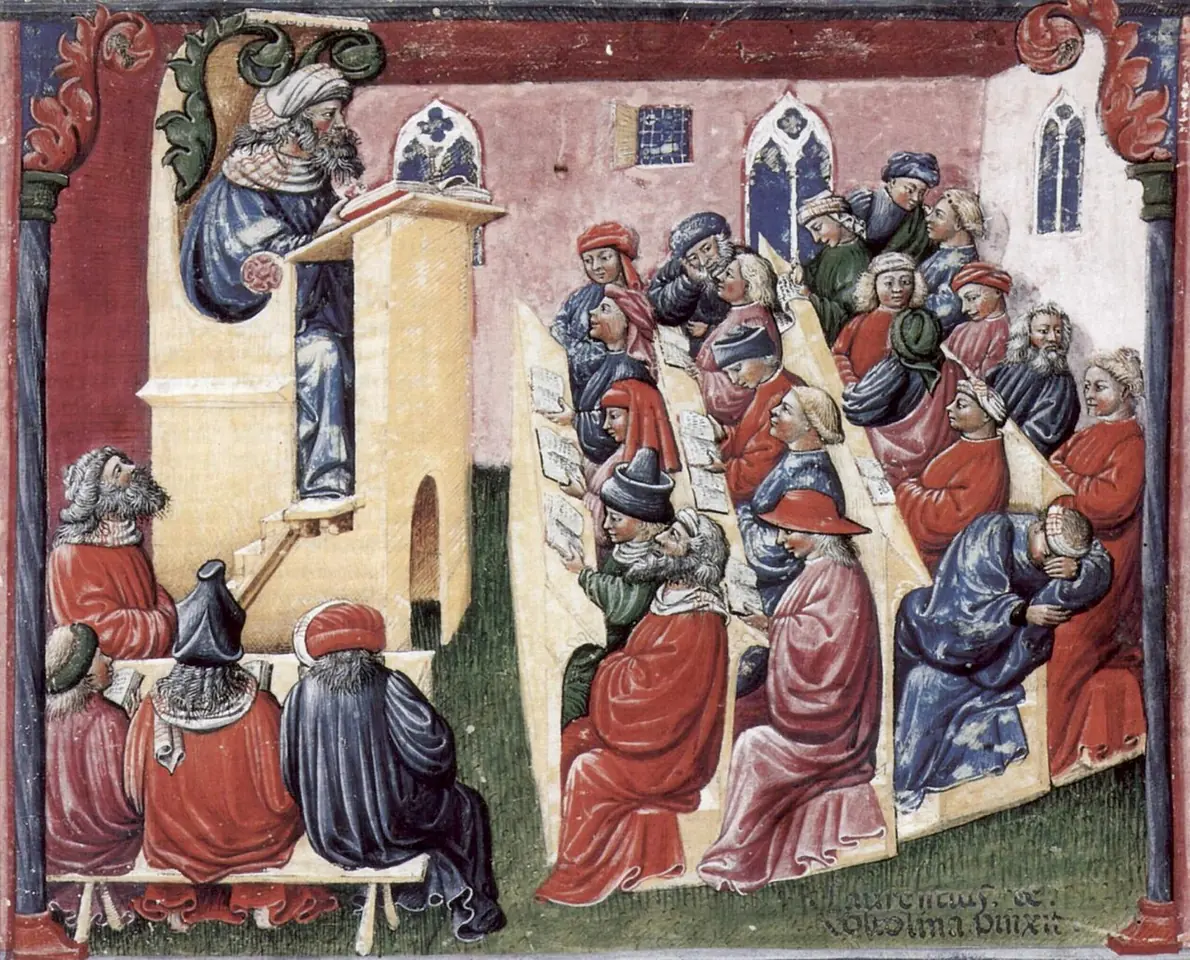
Thomas told his secretary, Reginald of Piperno, that he had learned more in prayer and contemplation than from men or books, according to the Catholic Encyclopedia. Coming from the greatest scholar of his age, that is a strong argument for a prayer before an exam.
Frequently asked questions
What is a good Catholic prayer before an exam?
St. Thomas Aquinas's prayer before study, which begins "Ineffable Creator" (Creator ineffabilis). It asks for understanding, memory, the ability to interpret and to express what you know, and ends, "Do Thou order my beginnings, direct and further my progress, complete and bless my ending." A quicker option is the short prayer "Come, O Holy Ghost, fill the hearts of thy faithful, and kindle in them the fire of thy love."
Who is the patron saint of exams?
St. Joseph of Cupertino (1603–1663), an Italian Franciscan friar. He was a poor student, but at his examination for the diaconate in 1627 the bishop asked him to explain the one Gospel passage he had studied well, and at his priestly ordination the next year the candidates were passed without being questioned. His feast is September 18. St. Thomas Aquinas is the patron of students and Catholic schools.
Is there a prayer to St. Joseph of Cupertino for exams?
Yes. The most common one, found on holy cards and school websites, asks him to obtain the same favor he received, to be asked only what you know. It is modern, and its author is unknown. The older, official prayer is the collect from his feast-day Mass, printed in full on this page.
Did St. Thomas Aquinas really write the prayer before study?
It has been attributed to him for centuries. When Pope Pius XI attached it to his 1923 encyclical Studiorum Ducem for students to say, he called it the prayer "which he himself used." Earlier prayer books described it as a prayer St. Thomas said before dictating, writing or preaching.
Is it wrong to pray to pass a test I didn't study for?
Catholic writers generally say prayer is not a substitute for work. Thomas Aquinas's prayer asks for help to understand, remember and express what you have learned, which assumes you have done the learning. Praying for calm, clear thinking and the grace to do your honest best is always appropriate, and so is accepting the result.
Sources
- Pius XI, Encyclical Studiorum Ducem (1923), Latin text with the Oratio before study (Vatican)
- The Raccolta, or Collection of Indulgenced Prayers and Good Works (Burns & Oates, 1910), nos. 39-41, 51-52, Internet Archive
- The New Raccolta (Philadelphia, 1903), prayers of St. Thomas Aquinas before study and before writing, Internet Archive
- Angelo Pastrovicchi, St. Joseph of Copertino (1753), translated by Francis S. Laing (St. Louis: Herder, 1918)
- The Mass Every Day of the Year: The Roman Missal (New York: Home Press, 1916), September 18, St. Joseph of Cupertino
- Catholic Encyclopedia (1912): St. Thomas Aquinas