St. Aloysius Gonzaga
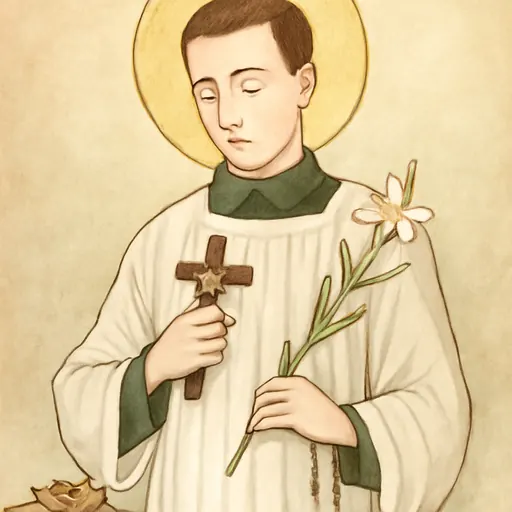
St. Aloysius Gonzaga (1568–1591) was the eldest son of an Italian prince who gave up his inheritance to become a Jesuit. While studying in Rome he nursed victims of the plague of 1591, caught the disease and died at 23. He is the patron saint of young people and students, and his feast day is June 21.
Who was St. Aloysius Gonzaga?
Aloysius (in Italian, Luigi) Gonzaga was born on March 9, 1568, in the family castle at Castiglione delle Stiviere, near Mantua in northern Italy. He was the eldest son of Ferrante Gonzaga, Marquis of Castiglione, and was raised to inherit the title. Instead he gave it up, joined the Society of Jesus, and died in Rome at 23 after caring for the sick during an epidemic.
The Catholic Encyclopedia (1907) gives the outline of his life in a single paragraph, and most of what follows comes from it. The details are well documented, since witnesses who knew him gave testimony for his beatification within a few decades of his death.

The life of St. Aloysius
A boy at court
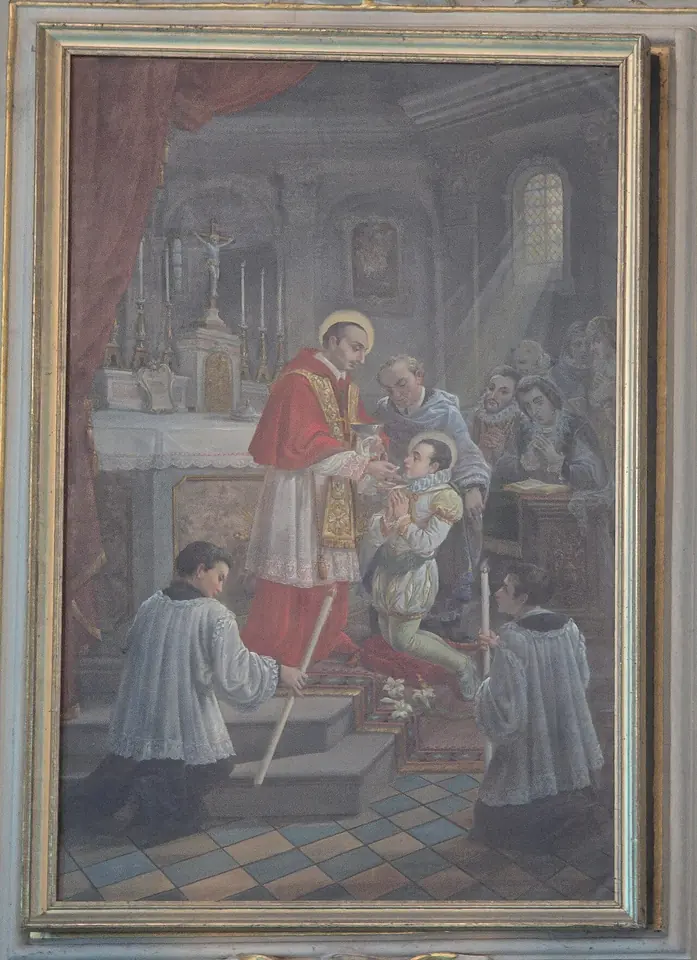
At eight he was sent to the court of Francesco de' Medici in Florence, and two years later to Mantua. When he was twelve, at Brescia, he came under the spiritual guidance of St. Charles Borromeo, the archbishop of Milan, who gave him his First Communion.

In 1581 he went with his father to Spain, where he and his brother served as pages to James (Diego), the young son of King Philip II. There he decided to become a Jesuit. The Catholic Encyclopedia says he first thought of the Discalced Carmelites, and that while in Spain he passed a public examination in philosophy and theology at the University of Alcalá.
Giving up the title
His father opposed the plan for years. Aloysius came back to Italy in 1584, and only after "much difficulty" got his consent. On November 2, 1585, he renounced his inheritance in favor of his brother. Because Castiglione was a fief of the Holy Roman Empire, the renunciation needed the emperor's approval.
On November 25, 1585, he presented himself in Rome to Claudio Acquaviva, the Jesuit superior general. He made his vows on November 25, 1587, and began theology at the Roman College.


The plague of 1591
In 1591, in his fourth year of theology, famine and an epidemic struck Rome. Although his health was delicate, Aloysius volunteered to care for the sick. Aleteia notes that the Jesuits opened a hospital for the victims that year and that Aloysius was among those who went out to help victims dying in the streets. He fell ill on March 3.

He lingered for more than three months. His confessor in his last illness was the Jesuit cardinal St. Robert Bellarmine. Speaking at Castiglione on the 400th anniversary, Pope John Paul II described his death on June 21, 1591, "invoking the name of Jesus, clasping the Crucifix in one hand and in the other a burning candle," with the blessing of Pope Gregory XIV (our translation from the Italian).
Beatification, canonization and miracles
The Catholic Encyclopedia says Gregory XV beatified him in 1621; other sources date his beatification to 1605 under Paul V. Benedict XIII canonized him on December 31, 1726, on the same day as another young Jesuit, St. Stanislaus Kostka.
Cures were reported at his tomb, as at the tombs of most saints of the period, and his canonization process examined miracles. We could not find the specific approved cases in a source we could check, so we don't list them here. Healings attributed to him in popular devotion are reported.
Why St. Aloysius is the patron saint of youth
He died young, and he chose his path young. Benedict XIII named him patron of young students in 1729, three years after canonizing him. Pius XI named him patron of Christian youth in 1926. In 1991 John Paul II, praying at his hometown basilica, called him the "celeste patrono dei giovani," the heavenly patron of the young. Schools and universities named for him include Gonzaga University in Spokane, Washington. See the full list on our patron saints page.
His death after nursing the sick made him a patron against plague, like St. Roch. In the late 20th century the same story made him a patron of people with AIDS and those who care for them. Aleteia reports that the Jesuits proposed this patronage to John Paul II in 1991; the Pope's homily at Castiglione that June greeted young people "malati di Aids," those sick with AIDS, among the suffering young. The patronage is widely used, but we found no decree making it official.
Symbols of St. Aloysius in art
Aloysius is almost always shown as a slim, pale young man in a black Jesuit cassock with a white surplice over it. Look for:
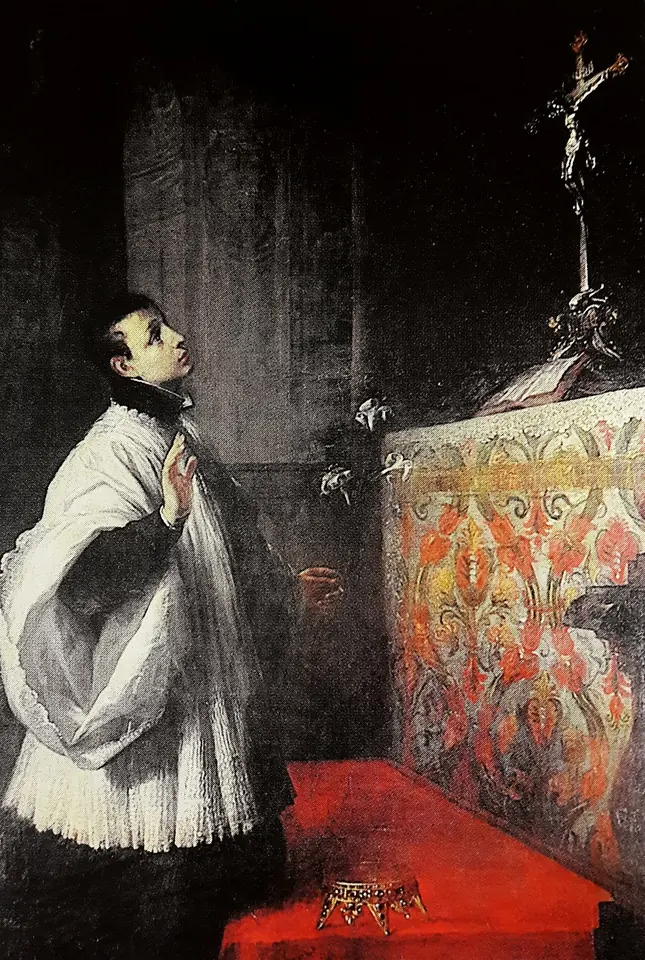
- A lily: purity and innocence. It lies at his feet in Guercino's painting above.
- A crucifix: his meditation on the Passion. He often holds it or gazes at it.
- A skull: his early death and the thought of death that marked his prayer.
- A crown, sometimes on a cushion: the title he gave up. Schultz's painting at the top of the page places it on the floor.
- A rosary or a scourge: his devotion and his penances.
He is often paired with Stanislaus Kostka and John Berchmans, the young Jesuit saints, in church windows and altarpieces.


Where St. Aloysius is honored
His feast is June 21, an obligatory memorial on the Church's calendar. See his neighbors on our feast days calendar.
His body rests in Rome's Church of Sant'Ignazio, the great Jesuit church near the Pantheon, in what the Catholic Encyclopedia calls "a magnificent urn of lapis lazuli wreathed with festoons of silver." Above it is a large marble relief of the saint by the French sculptor Pierre Le Gros.


His skull is kept in the basilica named for him in Castiglione delle Stiviere, which Paul VI made a minor basilica in 1964. John Paul II prayed there in 1991.
Prayer to St. Aloysius Gonzaga
There is no single traditional prayer to St. Aloysius in universal use. One citable prayer is the one Pope John Paul II prayed at the basilica in Castiglione on June 22, 1991. It is published in Italian on the Vatican's website and begins:
San Luigi, povero in spirito, a te con fiducia ci rivolgiamo, benedicendo il Padre celeste, perché in te ci hai offerto una prova eloquente del suo amore misericordioso.
In English: "St. Aloysius, poor in spirit, we turn to you with confidence, blessing the heavenly Father, because in you he has given us an eloquent proof of his merciful love" (our translation). The prayer goes on to ask him to protect the young from hatred and violence and to keep them free.
Catholics also ask his prayers for students before exams, for young people discerning a vocation, and for the sick and their caregivers.
Frequently asked questions
When is the feast day of St. Aloysius Gonzaga?
June 21, the day he died in 1591. It is an obligatory memorial in the General Roman Calendar.
What is St. Aloysius Gonzaga the patron saint of?
Young people and students. Pope Benedict XIII named him patron of young students in 1729, and Pope Pius XI patron of Christian youth in 1926. In 1991 Pope John Paul II called him the "heavenly patron of the young." Because he died after nursing plague victims, he is also invoked against plague, and many Catholics today regard him as a patron of people with AIDS and those who care for them.
Is St. Aloysius the official patron saint of AIDS patients?
The patronage is popular rather than formally decreed. Aleteia reports that in 1991, the 400th anniversary of his death, Jesuits proposed him to Pope John Paul II as patron of people with AIDS and their caregivers. We found no papal document making it official.
Where is St. Aloysius Gonzaga buried?
His body lies in an urn of lapis lazuli under the altar of the Lancellotti Chapel in the Church of Sant'Ignazio in Rome. His skull is kept in the basilica named for him in his hometown, Castiglione delle Stiviere.
Sources
- Catholic Encyclopedia (1907): St. Aloysius Gonzaga
- John Paul II, Celebration of the Word with young people at Castiglione delle Stiviere, 22 June 1991 (Italian)
- John Paul II, Prayer to St. Aloysius Gonzaga, Castiglione delle Stiviere, 22 June 1991 (Italian)
- Aleteia: St. Aloysius Gonzaga, the patron saint of AIDS patients, died helping plague victims (2017)
- Catholic News Herald: St. Aloysius Gonzaga, patron of AIDS patients, remembered June 21
- Wikipedia (Italian): Santuario basilica di San Luigi Gonzaga