St. Albert the Great, the Universal Doctor
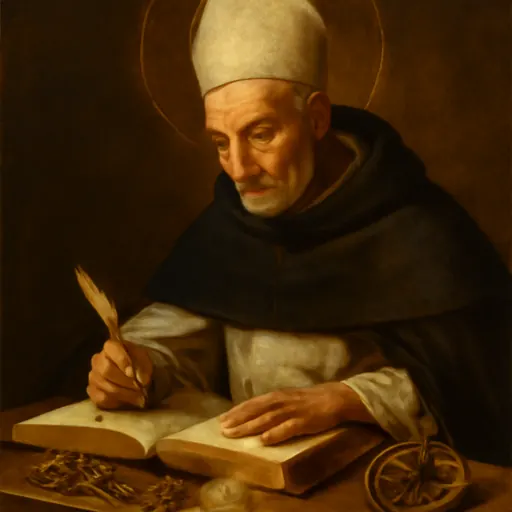
St. Albert the Great (Albertus Magnus, about 1200 to 1280) was a German Dominican friar, teacher and briefly bishop of Regensburg who wrote on almost every subject known in his day, from theology to plants, animals and minerals. He taught St. Thomas Aquinas and is the patron saint of scientists, named so by Pope Pius XII in 1941. His feast day is November 15.
Who was St. Albert the Great?
Albert the Great, in Latin Albertus Magnus, was a German Dominican friar of the 13th century who taught theology, wrote on nearly every branch of knowledge then known, served for two years as bishop of Regensburg and spent most of his long life in Cologne. He is best known today for two things: he was the teacher of St. Thomas Aquinas, and he studied the natural world with a seriousness that led Pope Pius XII to name him the patron of scientists.
His own age was already in awe of him. Ulrich of Strasbourg, one of his students, called him "the wonder and miracle of our epoch," a phrase both the Catholic Encyclopedia and Pope Benedict XVI quote. He was given the title Doctor universalis, the Universal Doctor, because he wrote on logic, physics, astronomy, minerals, plants, animals, ethics, metaphysics, Scripture and theology. The Lyons edition of his works, printed in 1651, filled twenty-one folio volumes.

Unlike many early saints, Albert's life is well documented. The facts below come from the Catholic Encyclopedia, from Benedict XVI's general audience on Albert in 2010 and from papal documents. Where later legend adds color, this article says so.
The life of St. Albert the Great
A count's son at Padua
Albert was the eldest son of a noble family of Lauingen, a small town on the Danube in Swabia. His birth year is uncertain: the Catholic Encyclopedia gives 1205 or 1206 and notes that many historians prefer 1193. As a young man he went to study the liberal arts at the University of Padua in northern Italy.
There he heard the preaching of Blessed Jordan of Saxony, the successor of St. Dominic as head of the Order of Preachers. Benedict XVI says Albert came to his decision gradually and had to overcome his family's resistance. He received the Dominican habit from Jordan himself, about 1223.
Teacher of Thomas Aquinas
After his studies Albert taught theology in Dominican houses at Hildesheim, Freiburg, Regensburg, Strasbourg and Cologne. In 1245 he was sent to the University of Paris, the leading school of theology in Europe, where he became a master. Among his students in these years was a large, silent young Italian named Thomas of Aquino.
The Catholic Encyclopedia's article on Thomas tells the story. Thomas's classmates took his humility and silence for dullness and called him the dumb ox. When Albert heard him defend a difficult thesis, he answered them: "We call this young man a dumb ox, but his bellowing in doctrine will one day resound throughout the world."
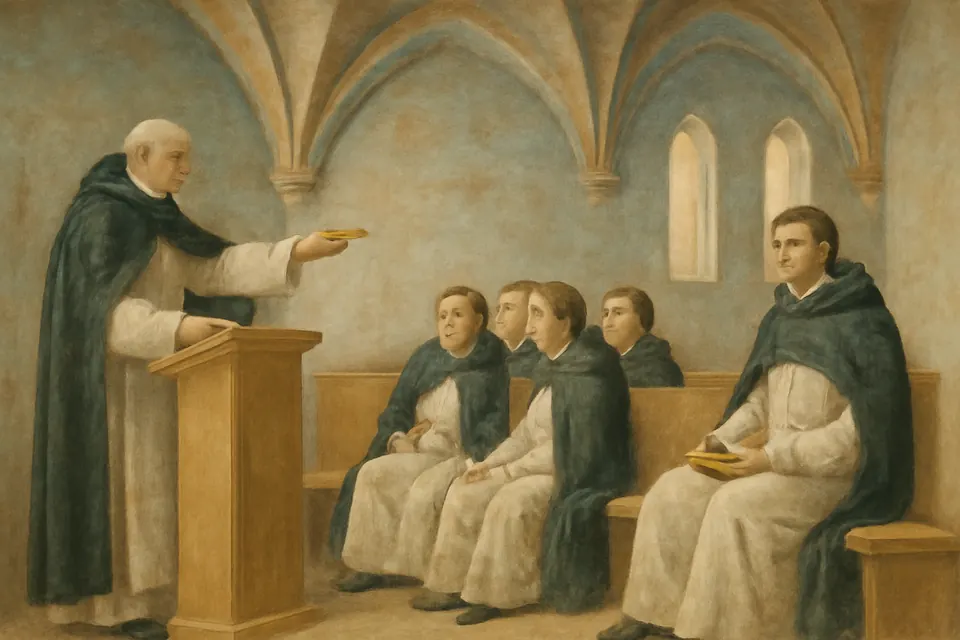
In 1248 Albert went back to Cologne to open a new studium generale, a house of higher studies for the order, and Thomas came with him. Benedict XVI calls their bond a relationship "of mutual esteem and friendship."
Provincial, bishop and peacemaker
In 1254 Albert was elected provincial of the Dominicans in Germany, a territory that stretched across central and northern Europe. Benedict XVI says he visited its communities and called his brothers back to the example of St. Dominic. In 1256 he went to Rome to defend the mendicant orders against attacks from the Paris master William of St. Amour.
In 1260 Pope Alexander IV made him bishop of Regensburg, a large diocese in trouble. The Dominican master general tried to stop the appointment and failed. Benedict XVI says Albert restored peace in the city, reorganized parishes and convents and gave new life to its charities. In 1262 his resignation was accepted and he went back to teaching in Cologne, where he also mediated between the archbishop and the citizens.

The last years
Pope Gregory X called Albert to the Second Council of Lyons in 1274, where he worked for reunion with the Greek Church. On the way, the council received news that Thomas Aquinas had died. The Catholic Encyclopedia says Albert declared that "the Light of the Church" had gone out, and that for the rest of his life he could not hear Thomas's name without tears.
In 1277 the bishop of Paris, Stephen Tempier, moved to condemn propositions that touched Thomas's teaching. Albert, by then in his seventies, traveled to Paris to defend his student's memory. After 1278, when he drew up his will, his memory began to fail. He died in his cell at the Dominican priory of the Holy Cross in Cologne on November 15, 1280.
Albert and the study of nature
Albert read Aristotle, who was only then becoming fully known in Latin Europe, and he commented on almost all of Aristotle's works. Many Christian teachers feared Aristotle because Arab commentators had read him in ways that seemed to deny the faith; for some years before 1225, his books on physics and metaphysics were banned from lectures at Paris. Albert's answer was to study them closely, keep what was true and correct what was not. "Whoever believes that Aristotle was a god, must also believe that he never erred," he wrote in his commentary on the Physics. "But if one believe that Aristotle was a man, then doubtless he was liable to error just as we are."
He also looked for himself. His treatise on minerals says: "The aim of natural science is not simply to accept the statements of others, but to investigate the causes that are at work in nature." In his work on plants he wrote, Experimentum solum certificat in talibus, "experiment is the only safe guide in such investigations." The Catholic Encyclopedia quotes the 19th-century historian of botany Ernst Meyer, who judged that no botanist after Albert equaled him for three hundred years.
Albert rejected magic and doubted that alchemy could turn lead into gold. In Benedict XVI's words, his method "consisted simply in the observation, description and classification of the phenomena he had studied, but it was in this way that he opened the door for future research." The pope's conclusion was that Albert "shows that there is no opposition between faith and science."

The miracles and legends of St. Albert
Albert's fame as a scientist produced a crop of legends. The Catholic Encyclopedia says many stories "attribute to him the power of a magician or sorcerer," and that they grew out of his real skill in the physical sciences. His 19th-century biographer Joachim Sighart collected them and tried to sort fact from fable.
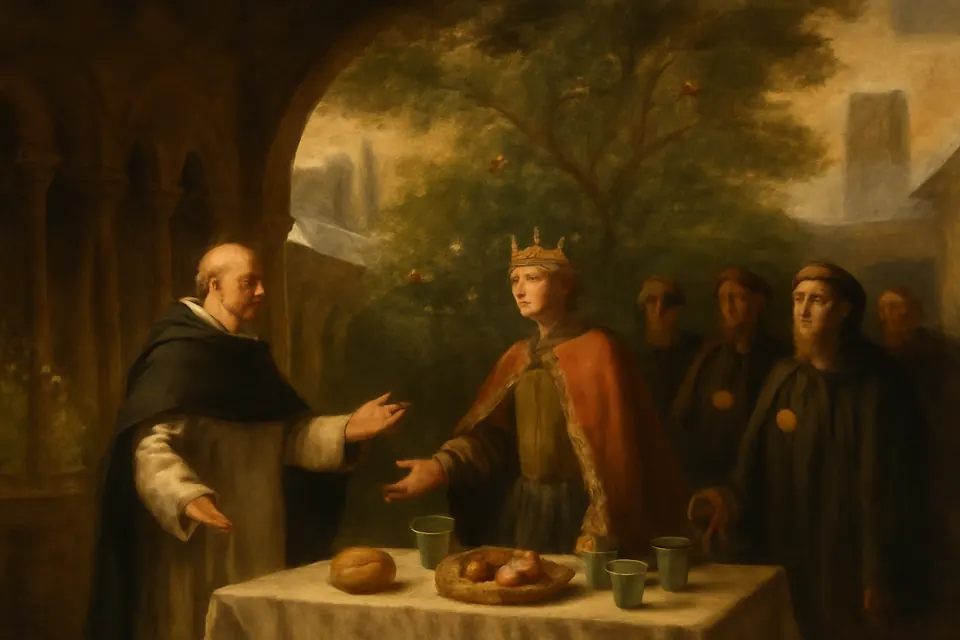
- The winter garden: traditional. In January 1249, the story goes, Albert received William of Holland, King of the Romans, in the Dominican garden at Cologne. Though snow covered the city, the garden was green and in bloom for the banquet. Sighart notes that the Utrecht chronicler William Heda already treated it as a tale people told, and suggests Albert may simply have shown the king something like a greenhouse.
- The talking head: traditional. A later legend says Albert built a mechanical figure that could speak, and that Thomas Aquinas, thinking it the work of the devil, smashed it with a stick. Sighart points out that the old historians don't mention it, though Albert's books do describe mechanical figures moved by air or mercury.
- Cologne Cathedral: traditional. Legend credits Albert with drawing the plans of Cologne's Gothic cathedral, begun in 1248. No document supports it.
- Miracles for his canonization: Benedict XVI says Albert was "very soon venerated by his confreres" after his death, and Pope Gregory XV beatified him in 1622. This encyclopedia has not found a published record of specific miracles approved for his canonization in 1931, so none is listed here as approved.
Why St. Albert is the patron saint of scientists
Pope Pius XI canonized Albert on December 16, 1931, and in the same decree declared him a Doctor of the Church, adding him to the small group of saints honored for their teaching. Ten years later to the day, on December 16, 1941, Pius XII issued the apostolic letter Ad Deum, which declared him the heavenly patron of all who study the natural sciences (Cultorum Scientiarum naturalium coelestis Patronus).
The letter, printed in the Vatican's Acta Apostolicae Sedis, says Catholic universities and scientists in Italy, Germany, France, Hungary, Belgium, Holland, Spain, America and the Philippines had asked for it. It was written in the middle of the Second World War, and Pius XII gave a reason that belonged to its moment: science, he wrote, was being used to bring war to cities instead of serving the praise of God and the good of humanity, and he asked Albert to turn scientists' hearts toward a peaceful use of nature.
Because he taught at Paris and Cologne for most of his life, Albert is also a patron of students and philosophers. Many Catholic colleges, schools and parishes bear his name. See all the patron saints by cause.
Symbols of St. Albert the Great in art
Albert is easy to confuse with other Dominican scholars, especially Thomas Aquinas. Look for these signs:
- The Dominican habit: a white tunic and scapular under a black cloak with a hood.
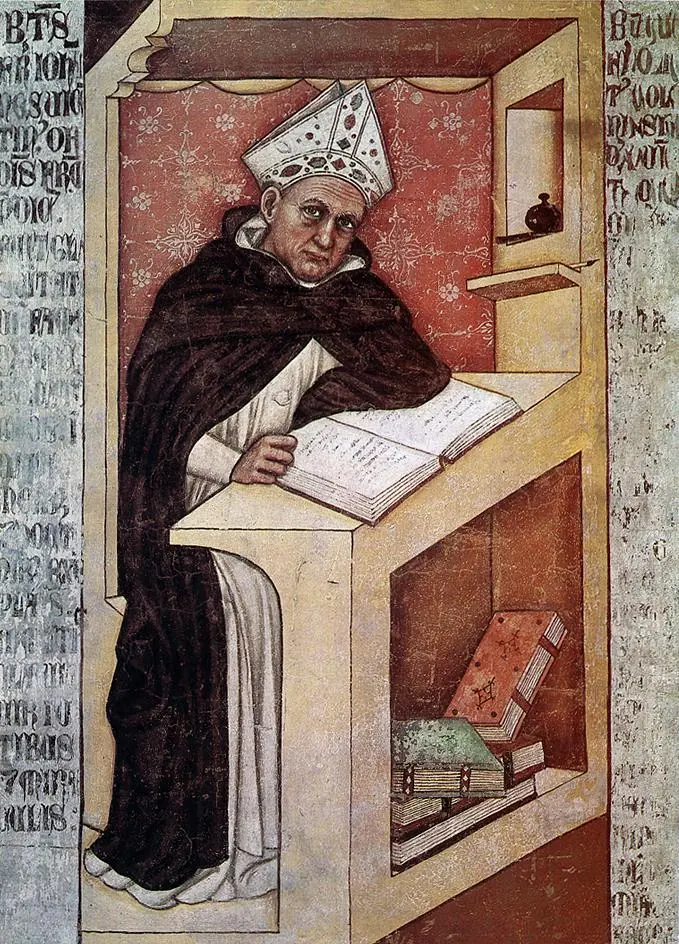
- A bishop's miter or crozier: he was bishop of Regensburg, so he often wears a miter over the habit, as in Tommaso da Modena's fresco near the top of this page. Thomas never does.
- A book and pen: for his vast writings. He is often seated at a desk or lectern.
- A teacher's cap and raised hand: the gesture of a lecturer, as in the portrait painted for the Duke of Urbino's study below.
- An older man: Albert is usually shown elderly and lean; Thomas is young and heavy and often has a sun on his breast.
- Young Thomas at his side: in group scenes, the pair appear together as master and student.


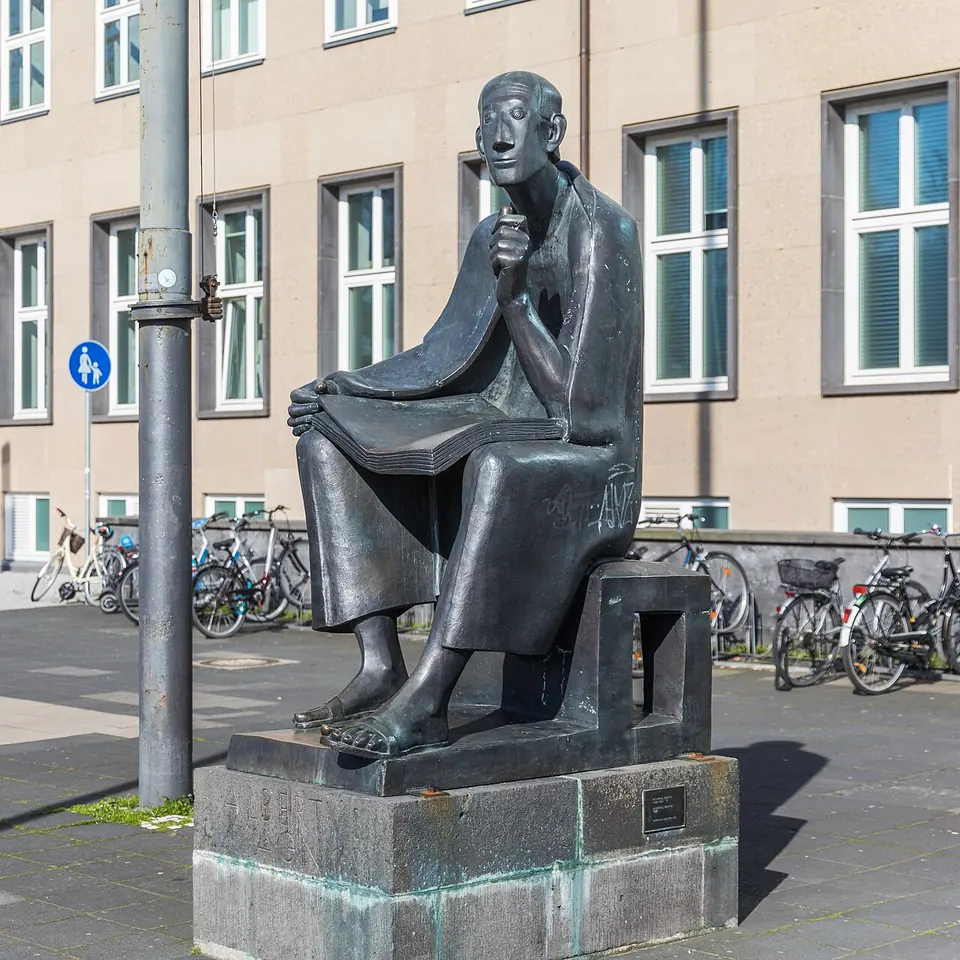
Modern statues, like Gerhard Marcks's bronze in Cologne, often show him reading or thinking rather than wearing a miter.
Feast day and where St. Albert is honored
Albert's feast is November 15, the day of his death, and it is an optional memorial in the General Roman Calendar. Its neighbors on the feast days calendar include St. Margaret of Scotland and St. Gertrude the Great on November 16.
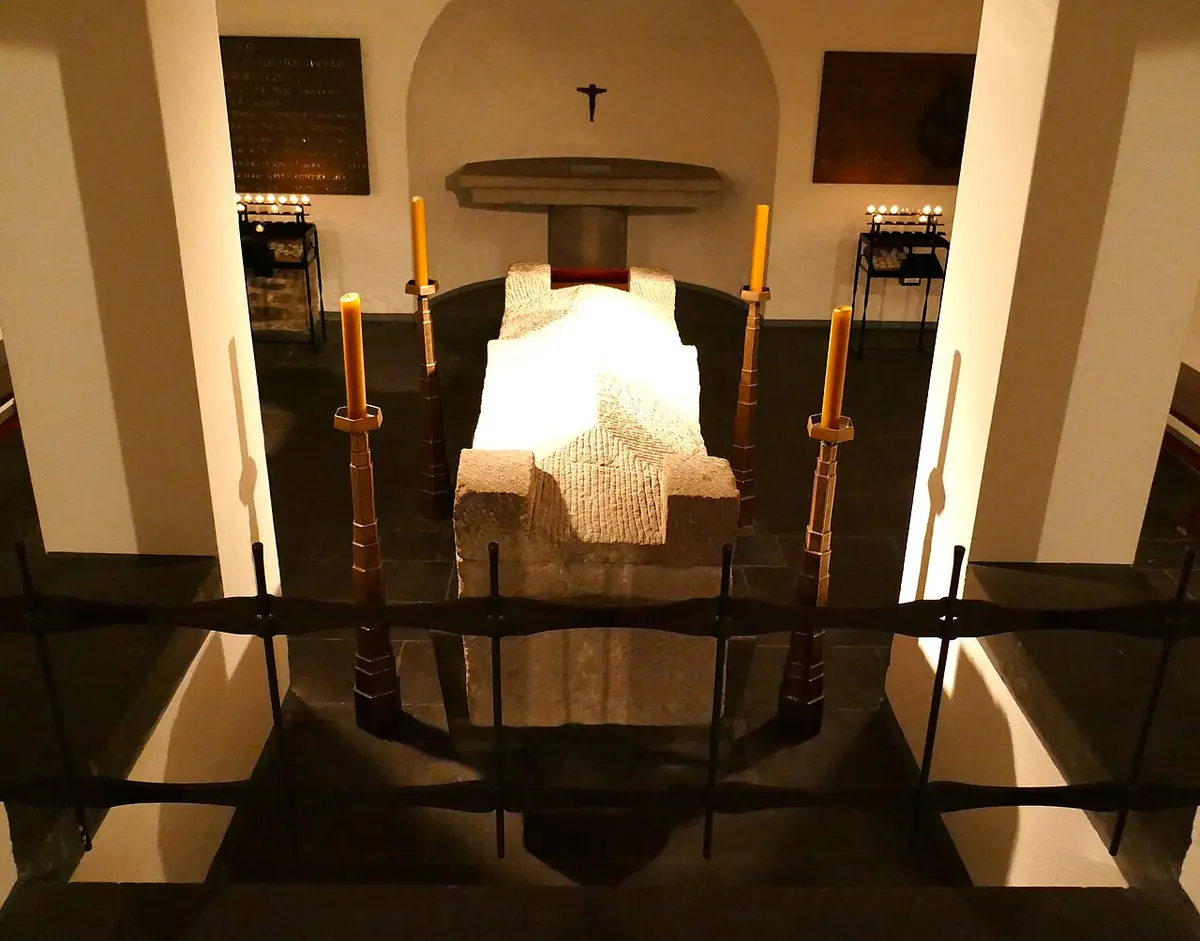
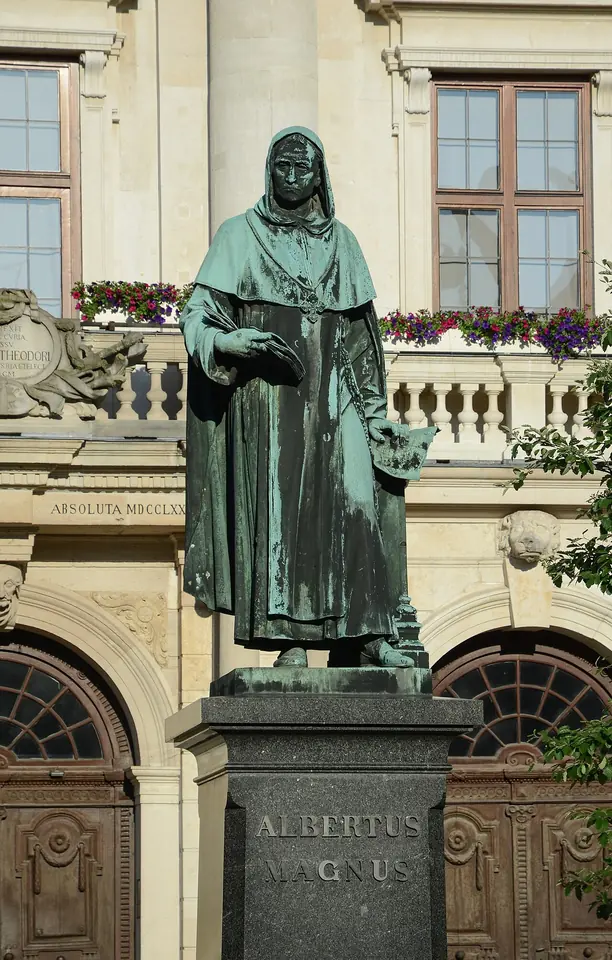
His body lies in the crypt of St. Andreas, a Romanesque church in the old town of Cologne, in a stone sarcophagus from the Roman period. The Dominicans have ministered there since 1947. Lauingen, his birthplace, raised a bronze monument to him in 1881.


Prayer to St. Albert the Great
Benedict XVI ended his 2010 audience by asking Christians to take up Albert's own "formula of holiness":
to desire all that I desire for the glory of God, as God desires for his glory all that he desires
There is also a traditional litany of St. Albert, which Catholic Culture says was written in the 16th century; it appears in Benjamin Francis Musser's collection Kyrie Eleison: Two Hundred Litanies (1944). It closes with this prayer:
O God, Who didst richly adorn Saint Albert with Thy heavenly gifts and didst decorate him with all virtues: grant us, Thy servants, that we may follow in his footsteps, may persevere in Thy service until death and securely obtain an everlasting reward. Through Jesus Christ, Thy Son, Our Lord. R. Amen.
Catholic students often ask Albert's prayers before exams, and scientists and science teachers ask him to help them study creation honestly and with gratitude to its Maker.
Frequently asked questions
Why is St. Albert the Great the patron saint of scientists?
Because he studied nature himself and wrote long treatises on plants, animals, minerals, weather and the heavens, insisting that the student of nature must investigate causes, not just repeat what others said. On December 16, 1941, Pope Pius XII declared him the heavenly patron of those who study the natural sciences, in the apostolic letter Ad Deum.
When is the feast of St. Albert the Great?
November 15, the day he died in Cologne in 1280. It is an optional memorial in the General Roman Calendar.
Was St. Albert the Great the teacher of St. Thomas Aquinas?
Yes. Thomas studied under Albert in Paris and then followed him to Cologne in 1248, where Albert opened the Dominicans' new house of studies. According to the Catholic Encyclopedia, Albert defended the silent young student by saying, "We call this young man a dumb ox, but his bellowing in doctrine will one day resound throughout the world."
Why is he called "the Great" and the "Universal Doctor"?
His contemporaries were already amazed at how much he knew. His student Ulrich of Strasbourg called him "the wonder and miracle of our epoch," and he was given the title Doctor universalis, the universal teacher, because his writing covered every field of learning in the 13th century.
Where is St. Albert the Great buried?
In the crypt of St. Andreas (St. Andrew's Church) in Cologne, Germany, in a Roman stone sarcophagus. The Dominicans have served the church since 1947.
Sources
- Catholic Encyclopedia (1907): St. Albertus Magnus
- Pope Benedict XVI, General Audience of 24 March 2010: Saint Albert the Great
- Acta Apostolicae Sedis 34 (1942): Pius XII, apostolic letter Ad Deum (December 16, 1941), declaring St. Albert patron of students of the natural sciences
- Catholic Encyclopedia (1912): St. Thomas Aquinas
- Catholic Culture: Optional Memorial of St. Albert the Great, November 15
- Catholic Culture: Litany of Saint Albert the Great
- Joachim Sighart, Albert the Great: His Life and Scholastic Labours (English translation, 1876), Internet Archive
- St. Andreas, Cologne (Wikipedia, for the location of his tomb)