St. Joseph of Cupertino
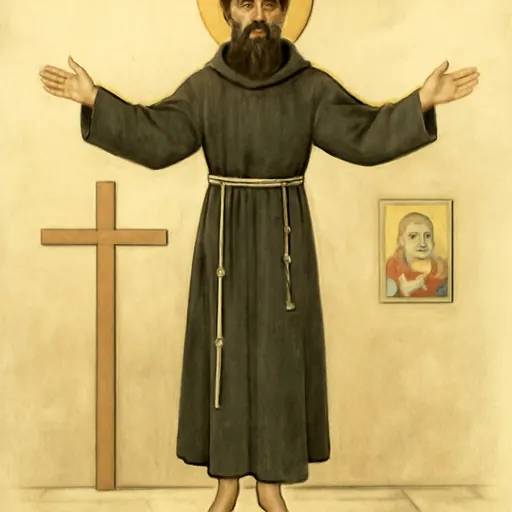
St. Joseph of Cupertino (1603–1663) was an Italian Franciscan friar from Copertino, in Apulia, known as "the flying saint" because dozens of eyewitnesses reported seeing him rise into the air in ecstasy. Slow at his studies, he passed his examination for the diaconate when the bishop happened to ask the one Gospel passage he knew, so he is the patron saint of students taking exams, and also of aviators. His feast day is September 18.
Who was St. Joseph of Cupertino?
Joseph of Cupertino was a Franciscan priest from the small town of Copertino, near Lecce in the heel of Italy. He was slow, clumsy and barely literate, turned away by two religious orders before the friars of his home town took him in to work in their stable. Yet in his lifetime he became one of the most famous holy men in Europe. Cardinals, princes and a pope came to see him, because people said that when he prayed he rose off the ground.
He is the saint of the reported levitations, and the evidence for them is unusual. The Catholic Encyclopedia (1910) states plainly that he "would be raised from his feet and remain suspended in the air," and his first full biography, written by the Conventual Franciscan Angelo Pastrovicchi for his beatification in 1753, ties each event to sworn testimony in the official processes. That doesn't settle every question a modern reader will ask, but these aren't legends written centuries later. They come from people who said they were there.


The name is spelled two ways. Italians write Copertino, the town's real name; English books have long used Cupertino. The city of Cupertino, California, takes its name from a creek that a cartographer of Juan Bautista de Anza's Spanish expedition named for him.
The life of St. Joseph of Cupertino
Born in a stable
Giuseppe Maria Desa was born on June 17, 1603. His father, Felice Desa, a carpenter, died in debt, and his creditors drove the family from their house. His mother, Francesca, gave birth to him in a stable. The sanctuary in Copertino still keeps that stable, the "Stalletta," inside the church built over it.
As a boy he suffered long illnesses and fell into trances at school, staring open-mouthed at nothing. The other children called him "Bocca Aperta," open mouth. The Catholic Encyclopedia adds that he also had "a hot and irascible temper," which his strict mother worked hard to break.


Rejected, then taken in
He was apprenticed to a shoemaker. At seventeen he asked to join the Conventual Franciscans and was refused for lack of schooling. The Capuchins accepted him as a lay brother in 1620, but he kept dropping dishes and forgetting tasks in his ecstasies, and they sent him away. His family treated him as a good-for-nothing. At last the Franciscans of the Grottella, a small friary outside Copertino, let him work in their stable. There his humility and prayer changed their minds, and in 1625 he was admitted as a cleric.
The examination
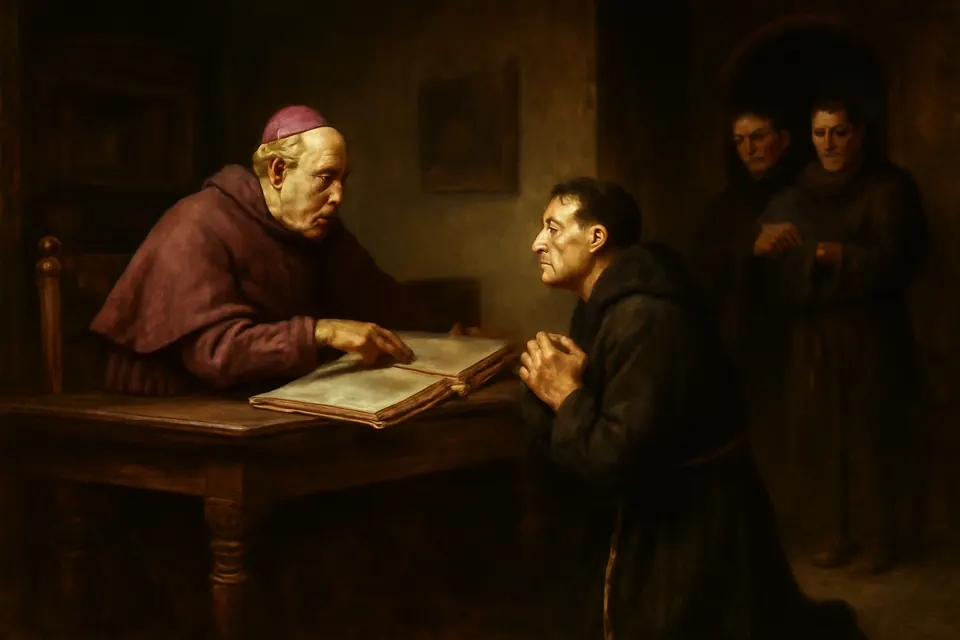
Joseph could hardly read, and theology was beyond him. Pastrovicchi tells how he passed anyway. At his examination for the diaconate in 1627, the Bishop of Nardò opened the Gospel at "Blessed is the womb that bore thee," the one passage Joseph had studied until he could explain it well. In March 1628, at the examination for the priesthood, the Bishop of Castro questioned the first candidates, found them so well prepared that he assumed the rest were too, and ordained them all without further questions. Joseph was among them.
Before the Inquisition
Once he was a priest, his ecstasies became constant. The sound of a bell, the name of Jesus or Mary, a holy picture could send him into a trance. The Catholic Encyclopedia says that neither "piercing with needles, nor even burning his flesh with candles" would rouse him; only his superior's voice could. Crowds followed him, and a vicar general reported him to the Inquisition at Naples for drawing people after him "as to another Messias." In October 1638 he went to Naples, was examined three times, and was cleared.
The Church still thought the crowds were a danger. For the next twenty-five years Joseph was moved from friary to friary and kept out of sight. He was sent to Rome and then, in April 1639, to the Sacro Convento at Assisi, beside the tomb of St. Francis. In 1653 the Inquisition moved him to the remote Capuchin hermitage at Pietrarubbia, where crowds tore openings in the church walls to see him say Mass, and then to the Capuchins at Fossombrone. For thirty-five years, the Catholic Encyclopedia says, he was not allowed to sing in choir, eat with the community or say Mass in public.
Last years at Osimo
In July 1657 Pope Alexander VII sent him back to his own order, at Osimo near Ancona, with orders that he see no one but the bishop, his vicar general, the friars and the doctor. He lived there in one room with a private chapel for six years. He died just after midnight following September 18, 1663, at sixty, asking to be buried somewhere no one could find him. He was buried in the church at Osimo instead.

The miracles of St. Joseph of Cupertino
The levitations: reported
The flights that made him famous are reported. They were investigated, under oath, but the Church did not declare them miracles. Pastrovicchi writes that the acts of his beatification recorded "more than seventy such flights" at Copertino alone, not counting those during Mass. A few of the accounts:
- The Calvary at the Grottella. Ten men could not raise a heavy cross for a shrine on the hill. Pastrovicchi writes that Joseph "flew about eighty paces" from the friary door to the cross, lifted it "as easily as if it were a straw," and set it in its hole.
- The olive tree. When a priest said to him, "Father Joseph, oh, how beautiful God has made heaven," he flew up into an olive tree and knelt on a branch for half an hour, the branch swaying "as lightly as if a small bird rested on it."
- Before the pope. On his first visit to Rome, kneeling to kiss the feet of Urban VIII, he was "raised aloft" until his superior called him back. His biographers say the pope told the Minister General that he would testify to it himself if Joseph died during his reign.
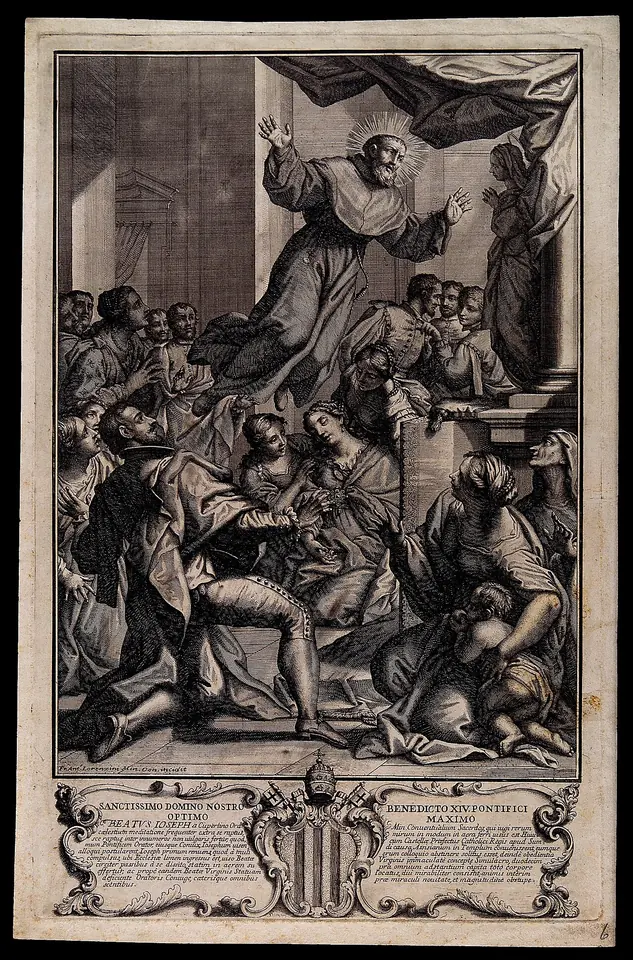
- The Spanish ambassador. In 1645 the High Admiral of Castile visited him at Assisi with his wife. Joseph saw a statue of the Immaculate Conception in the church and, according to the account, flew about twelve paces over the heads of the visitors to its feet.
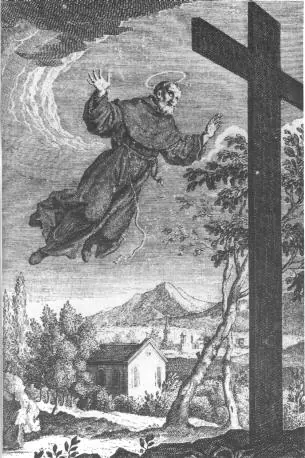

The witnesses were not only simple country people, a point the 1918 translator stresses, and Joseph's fame helped bring the Lutheran Duke John Frederick of Brunswick into the Catholic Church. Skeptics, then and now, have looked for natural explanations. This encyclopedia records what the witnesses said and labels it for what it is. Pastrovicchi's translator quotes a Catholic handbook of medical ethics to the effect that the Church "has certainly not based canonization on the single fact of levitation."

Healings: approved
The miracles the Church formally approved were cures. For his beatification, Benedict XIV approved two in 1752, both at Osimo: Victor Mattei's hard swelling on the knee and his son's blind eye, healed at Joseph's tomb. For his canonization, the Congregation of Rites approved three healings from the 1750s: Magdalen Panzironi's abdominal tumor, Benedicta Pierangelini's heart disease, and a poor muleteer's ulcerated sores. Clement XIII canonized Joseph on July 16, 1767.
Other gifts: reported
His biographers also describe him reading hearts, foretelling events, and appearing at his mother's deathbed in Copertino in 1645 while he was shut away at Assisi. These are reported.
Why St. Joseph of Cupertino is the patron of students and aviators
Pastrovicchi's translator notes that because of the examination story, Joseph "is invoked as patron of examinations by students in Italy and France." Today students all over the world pray to him before tests, and the sanctuary at Copertino receives intentions from thousands of students sitting school-leaving and university exams. The sanctuary also calls him the patron of aviators, for his reported flights. See more on our patron saints page, where he shares students with St. Thomas Aquinas.
Symbols of St. Joseph of Cupertino in art
Joseph is easy to spot. Look for:
- A friar in the air. He is almost always shown off the ground, arms spread, face turned up. No other saint is painted flying this often.
- The black habit of the Conventual Franciscans, with a white knotted cord. In 18th-century paintings the habit is often dark gray or brown.
- A large wooden cross, usually the Calvary at the Grottella that he is said to have flown to.
- The Virgin Mary, often as an image or statue he flies toward, whom he called his mother.
- A watching crowd of friars, nobles and townspeople, there to show that what follows had witnesses.


Most images date from after his beatification in 1753, when churches of the Franciscan order commissioned altarpieces of him. Giuseppe Nogari's altarpiece in the Frari in Venice sends him up toward the cross and the Virgin in glory.


Where St. Joseph of Cupertino is honored
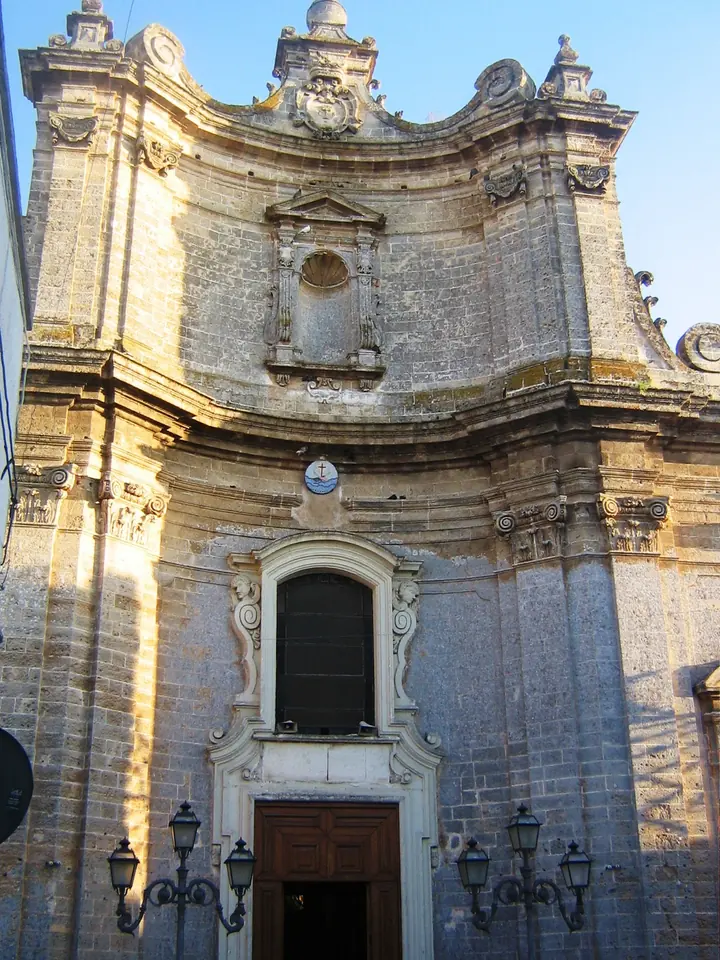
In Copertino, the town built a sanctuary over his birthplace stable beginning in 1754, the year after his beatification, and finished it in 1758. His heart was brought there from Osimo on April 7, 1953, and is kept in the Stalletta. The Grottella friary outside town, where he first found a home, is a sanctuary too.

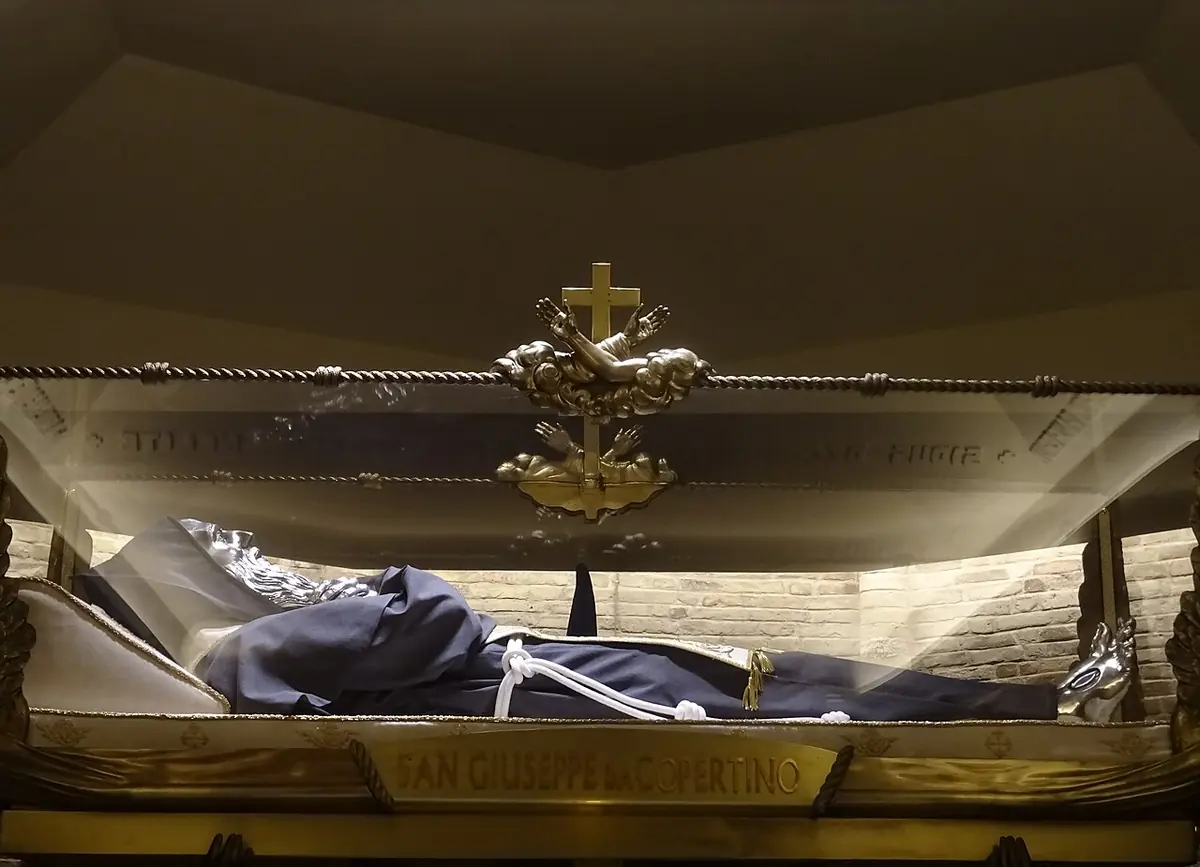
In Osimo, his body lies in a glass urn in the crypt of the Basilica of St. Joseph of Cupertino, the old Conventual church where he died.


His feast is September 18. Benedict XIV set the date in the brief of beatification, and Clement XIV extended his office to the whole Church. He is no longer on the General Roman Calendar, but the Roman Martyrology names him on September 18 and the Franciscans celebrate his feast. See the feast days calendar.

Prayer to St. Joseph of Cupertino
The old collect for his feast, as Catholic Culture gives it, plays on his flights and on Christ's words in John 12:32:
O God, You ordained that Your only-begotten Son should be lifted up above the earth and draw all things to Himself; mercifully grant that, through the merits and example of Your seraphic confessor Joseph, we may be lifted up above all earthly desires and be found worthy to come to Him, who being God, lives and reigns with You in the unity of the Holy Spirit, for ever and ever. Amen.
Joseph's own last prayers, as Pastrovicchi records them, were short: "Take this heart, burn and rive this heart, my Jesus." Students usually ask his help in their own words before an exam, or use one of the popular prayers for students printed on holy cards in his name. Those prayers are modern and their authors unknown.
Frequently asked questions
Why is St. Joseph of Cupertino the patron of students and exams?
Joseph was a poor student who could barely read. According to his 18th-century biographer Angelo Pastrovicchi, when he was examined for the diaconate in 1627, the Bishop of Nardò asked him to explain "Blessed is the womb that bore thee," the only passage he had mastered. At his ordination to the priesthood the next year, the bishop was so pleased with the first candidates that he passed the rest, Joseph among them, without examination. Students in Italy and France began asking his help before exams, and the custom spread.
Did St. Joseph of Cupertino really levitate?
The Church records the levitations as reported, not as approved miracles. They are described in sworn testimony gathered for his beatification, which, Pastrovicchi says, recorded more than seventy flights at Copertino alone. Witnesses included friars, townspeople, cardinals and, by his biographers' account, Pope Urban VIII. The miracles formally approved for his beatification and canonization were all healings.
When is St. Joseph of Cupertino's feast day?
September 18, the day of his death in 1663. Benedict XIV fixed the date when he beatified Joseph in 1753. Joseph is commemorated that day in the Roman Martyrology, and Franciscans and the towns of Copertino and Osimo keep it as his feast.
Why is he the patron saint of aviators?
Because of his reported flights. The sanctuary at Copertino calls him the patron of students and of aviators, and pilots and air passengers ask his protection.
Where is St. Joseph of Cupertino buried?
His body is in the crypt of the Basilica of St. Joseph of Cupertino in Osimo, in the Marche region of Italy, where he died. His heart was taken to his birthplace, Copertino, in 1953 and is kept in the restored stable where he was born.
Sources
- Catholic Encyclopedia (1910): St. Joseph of Cupertino
- Angelo Pastrovicchi, St. Joseph of Copertino (1753), translated by Francis S. Laing (St. Louis: Herder, 1918)
- Santuario San Giuseppe da Copertino: La Vita di San Giuseppe (Italian)
- Santuario San Giuseppe da Copertino: Il Santuario e la Stalletta (Italian)
- Catholic Culture: Collect for Saint Joseph of Cupertino
- Catholic Culture: September 18, St. Joseph of Cupertino, Priest (Roman Martyrology)
- Roman Martyrology, September 18