St. Isidore of Seville
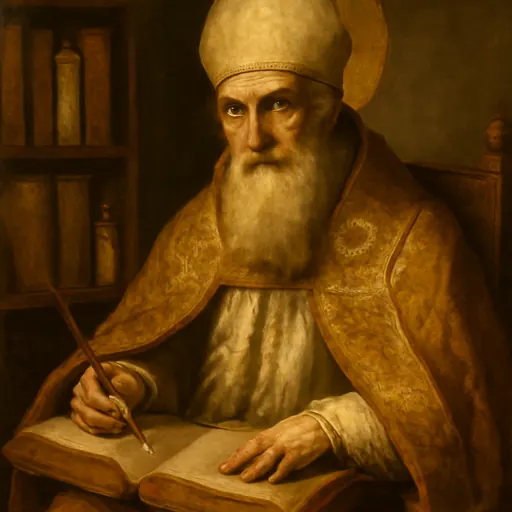
St. Isidore of Seville (about 560–636) was archbishop of Seville in Visigothic Spain and the most learned man of his age. His Etymologies, an encyclopedia of everything known in his day, was a standard textbook for the Middle Ages. He is a Doctor of the Church, his feast day is April 4, and he is often suggested, unofficially, as patron saint of the internet.
Who was St. Isidore of Seville?
Isidore was archbishop of Seville from about 600 until his death in 636, in the Visigothic kingdom that ruled Spain after the fall of Rome. He belonged to a family of saints: his elder brother Leander was archbishop before him, his younger brother Fulgentius was bishop of Astigi (Écija), and his sister Florentina was a nun. Pope Benedict XVI introduced him as Leander's younger brother "and a great friend of Pope Gregory the Great."
Isidore was a pastor and a reformer, but he is remembered above all as a collector of knowledge. The Catholic Encyclopedia calls him "the last of the great Latin Fathers" and "undoubtedly the most learned man of his age." His encyclopedia, the Etymologies, carried a great deal of ancient learning into medieval Europe. Pope Innocent XIII declared him a Doctor of the Church in 1722.


The life of St. Isidore of Seville
A family of bishops
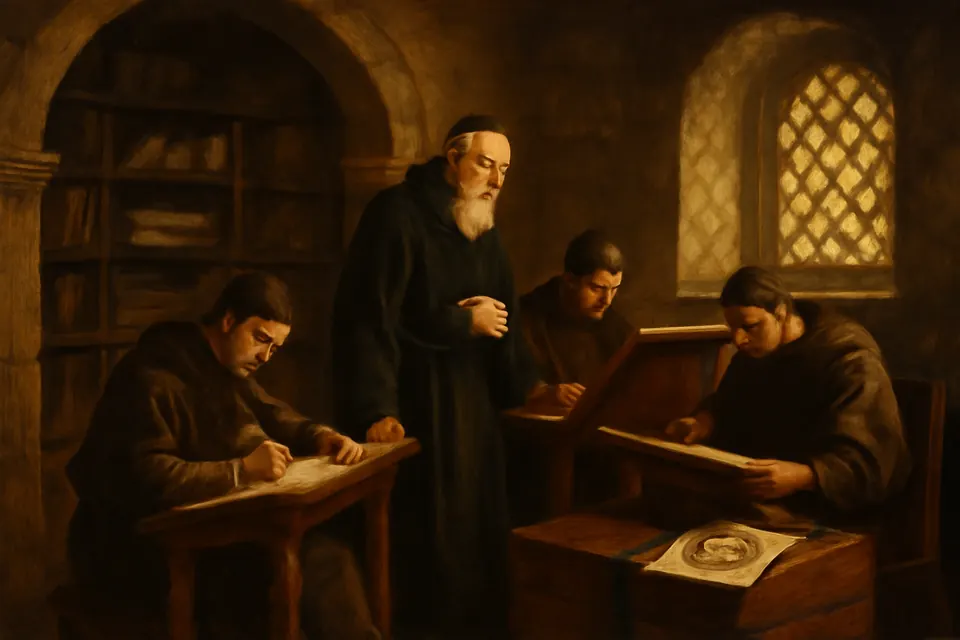
Isidore was born about 560, probably at Cartagena, the son of Severianus and Theodora. Benedict XVI says he was taught "under the responsibility of his elder brother" Leander, in a house with a library "richly endowed with classical, pagan and Christian works," and learned "a very strong discipline" of study. Isidore studied at the cathedral school of Seville, and the Catholic Encyclopedia says he mastered Latin, Greek and Hebrew there.
When Leander died, Isidore succeeded him; Benedict XVI gives the year as 599. The Visigoths who ruled Spain had long been Arian Christians, and the brothers worked to bring them into the Catholic Church. The Catholic Encyclopedia says that under Isidore, Arianism "was eradicated" and church discipline was strengthened everywhere.
Bishop, reformer, teacher
He protected monks, presided over the Second Council of Seville in 619 and, already old, over the Fourth Council of Toledo in 633, which gathered all the bishops of Spain. Through his influence, the Catholic Encyclopedia says, that council ordered every bishop to found a school in his cathedral city on the model of Seville's, where Greek, Hebrew, the liberal arts, law and medicine were taught.
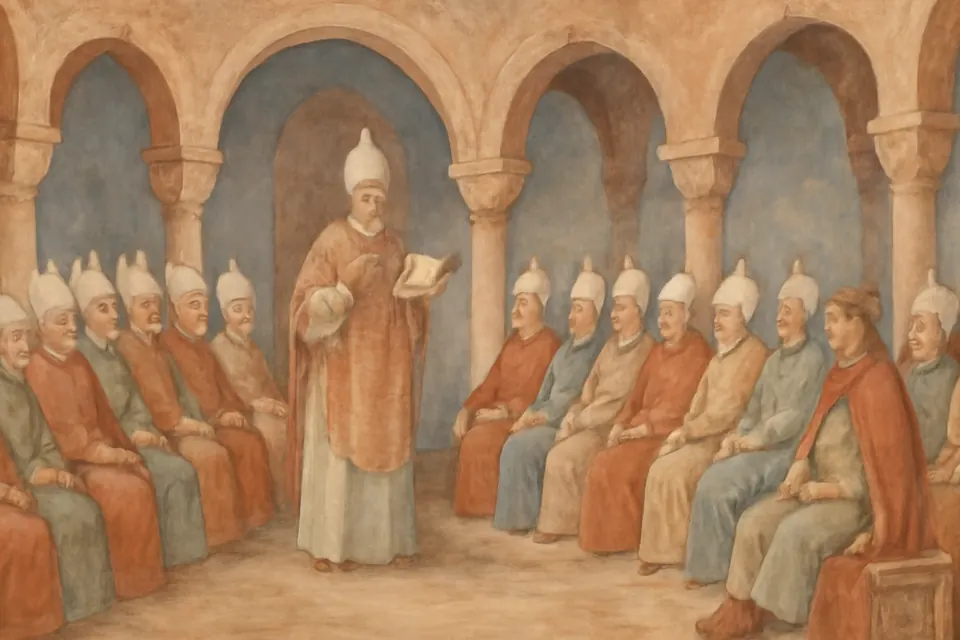
Benedict XVI saw in him a man torn between the wish for quiet study and the duty to govern. He quoted Isidore's own advice: "just as we must love God in contemplation, so we must love our neighbour with action."
He died at Seville on April 4, 636. Seventeen years later the Eighth Council of Toledo called him "the extraordinary doctor, the latest ornament of the Catholic Church, the most learned man of the latter ages."
The Etymologies and other writings
Isidore wrote on history, theology, Scripture, nature, monastic life and the liturgy of the old Spanish church. His History of the Goths is a main source for Visigothic Spain. But his great work is the Etymologiae, compiled at the request of his friend Braulio, bishop of Saragossa, who divided it into twenty books.


It runs from grammar and rhetoric through medicine, law, God and the angels, languages, animals, geography, buildings, stones and metals, farming, war, ships, clothing and food. Isidore often explains a thing by the origin of its name, sometimes correctly, sometimes fancifully. The Catholic Encyclopedia counts quotations from 154 authors, Christian and pagan, and says the book "superseded the use of the individual works of the classics themselves" in many medieval schools. It was printed ten times between 1470 and 1529. A simple diagram in it, the T-and-O map dividing the world into Asia, Europe and Africa, became the oldest map printed in the West.


Why St. Isidore is called the patron saint of the internet
He is honored as a patron of students and scholars because of his learning and the schools he founded. The internet is another matter. No pope has named Isidore patron of the internet, and there is no Vatican decree. The idea spread among Catholics online, on the reasoning that the Etymologies was a kind of early database. It is a popular devotion, not an official title, and many Catholics now suggest St. Carlo Acutis instead. See our patron saints page.
Miracles of St. Isidore of Seville
None is formally approved; his cult is far older than modern canonization. Healings at his tomb in León are reported. Later Spanish legend made him a heavenly helper in the wars of the Reconquista, which is why some sculptures show him on horseback; those stories are traditional.
Symbols of St. Isidore of Seville in art
Isidore is an elderly, bearded bishop with miter and crozier, nearly always with a book or a pen, as in Murillo's painting. Manuscripts of the Etymologies often show him writing at a desk. In Spain he is sometimes shown with his brother Leander, as in the pair of paintings Murillo made for Seville Cathedral. Modern Spain made him an emblem of learning: his seated statue by José Alcoverro, from 1892, guards the steps of the National Library in Madrid.


Feast day and relics
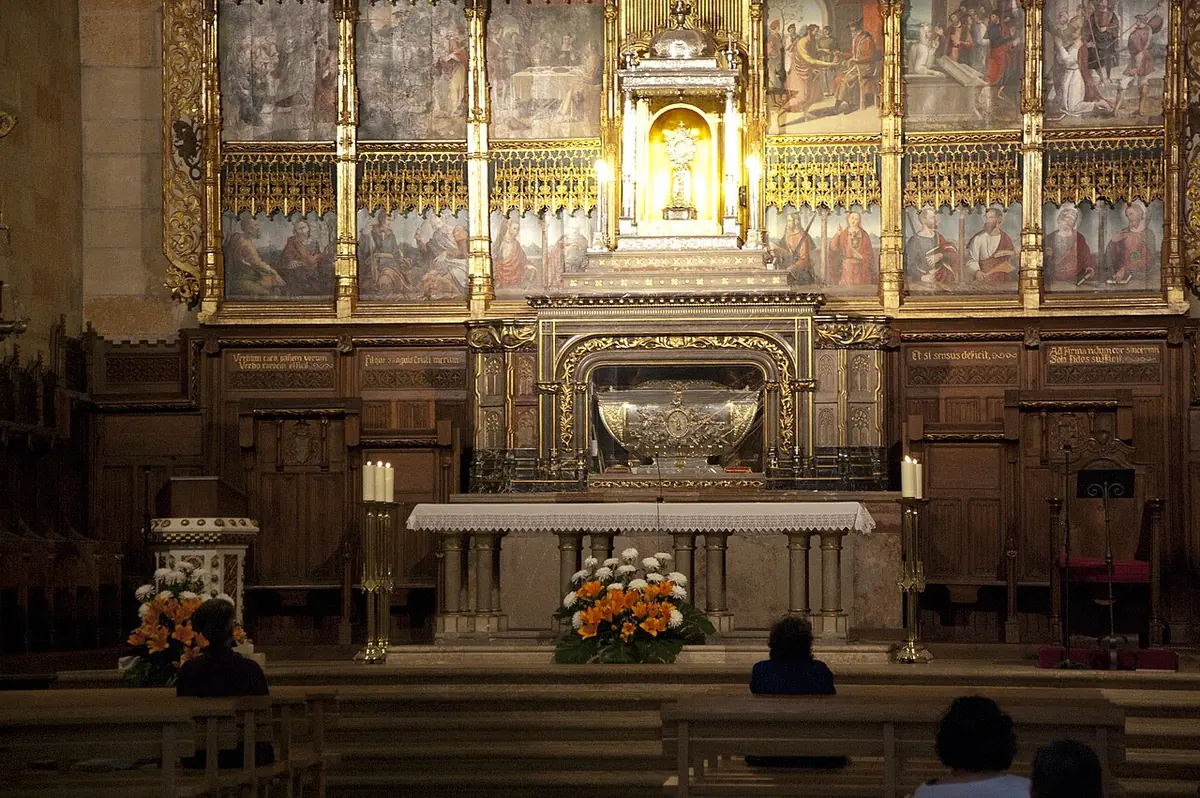
His feast is April 4, an optional memorial in the General Roman Calendar (see our feast days page). On December 21, 1063, according to the Museo de San Isidoro, King Ferdinand I and Queen Sancha of León brought his relics from Seville, then under Muslim rule, to León. They rest today on the high altar of the Basilica of San Isidoro.

Prayer to St. Isidore of Seville
Prayers to Isidore before using the internet circulate widely, but they are modern and of unknown authorship, so this encyclopedia does not reproduce them. The Church honors him in the Mass and Liturgy of the Hours of April 4, and students and teachers ask his intercession for their studies.
Frequently asked questions
Is St. Isidore of Seville the patron saint of the internet?
Not officially. No pope has named him patron of the internet, and the Vatican has issued no decree. The idea spread among Catholics online because he compiled the first great Christian encyclopedia, a kind of database of all knowledge. Many still call on him that way, and St. Carlo Acutis is now often suggested for the same role.
What are the Etymologies of St. Isidore?
The Etymologiae (also called Origines) is an encyclopedia in twenty books, written near the end of his life at the request of his friend Braulio, bishop of Saragossa. It covers grammar, rhetoric, medicine, law, theology, animals, geography, buildings, ships, food and much more, often explaining things through the origin of their names. The Catholic Encyclopedia says it was "the textbook most in use" in schools for most of the Middle Ages.
When is St. Isidore of Seville's feast day?
April 4, the day he died in 636. It is an optional memorial in the General Roman Calendar.
Is St. Isidore of Seville the same as St. Isidore the Farmer?
No. St. Isidore the Farmer was a 12th-century farm laborer from Madrid, named after the bishop of Seville, whose feast is May 15. The two are often confused.