St. Matthew the Apostle
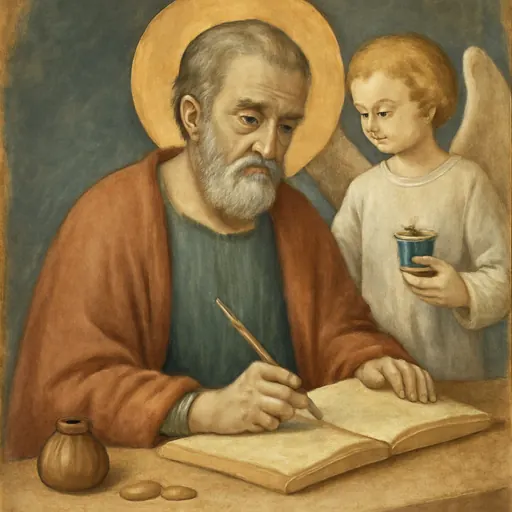
St. Matthew was a tax collector at Capernaum whom Jesus called with the words "Follow me," and who became one of the twelve apostles. Since the 2nd century the Church has named him as the writer of the first Gospel. His feast day is September 21 (November 16 in the Orthodox Church), and he is the patron saint of accountants, bankers and tax collectors.
Who was St. Matthew?
St. Matthew was a tax collector in the lakeside town of Capernaum who left his table of coins the moment Jesus told him to follow, and became one of the twelve apostles. He is named in all four lists of the Twelve. The Gospel that stands first in the New Testament bears his name, and from the early 2nd century on, Christian writers said he wrote it.
The Gospels tell us very little else. Pope Benedict XVI, in his 2006 catechesis on Matthew, admitted that "it is almost impossible to paint a complete picture of him because the information we have of him is scarce and fragmentary." What the Gospels give instead is one scene, told three times: a man despised by his neighbors, sitting at the tax office, who gets up and walks away from his money.


Everything after Pentecost comes from later tradition. Early writers say Matthew preached first to his own people and then went to distant lands, most often named as "Ethiopia," Persia or Parthia, and that he died there. Since the 10th century his relics have been honored in Salerno, in southern Italy.
St. Matthew in the Gospels
The tax collector at Capernaum
Matthew tells his own call in one verse:
As Jesus passed on from there, he saw a man called Matthew sitting at the tax office; and he said to him, "Follow me." And he rose and followed him. (Matthew 9:9, RSV)
Benedict XVI pointed out that the verses just before it place Jesus at Capernaum, on the Sea of Galilee, and concluded that Matthew collected taxes there. The Catholic Encyclopedia says he collected customs duties for Herod Antipas, the ruler of Galilee. Capernaum sat on a trade road, and the duty on goods passing through was a living for men willing to take it.
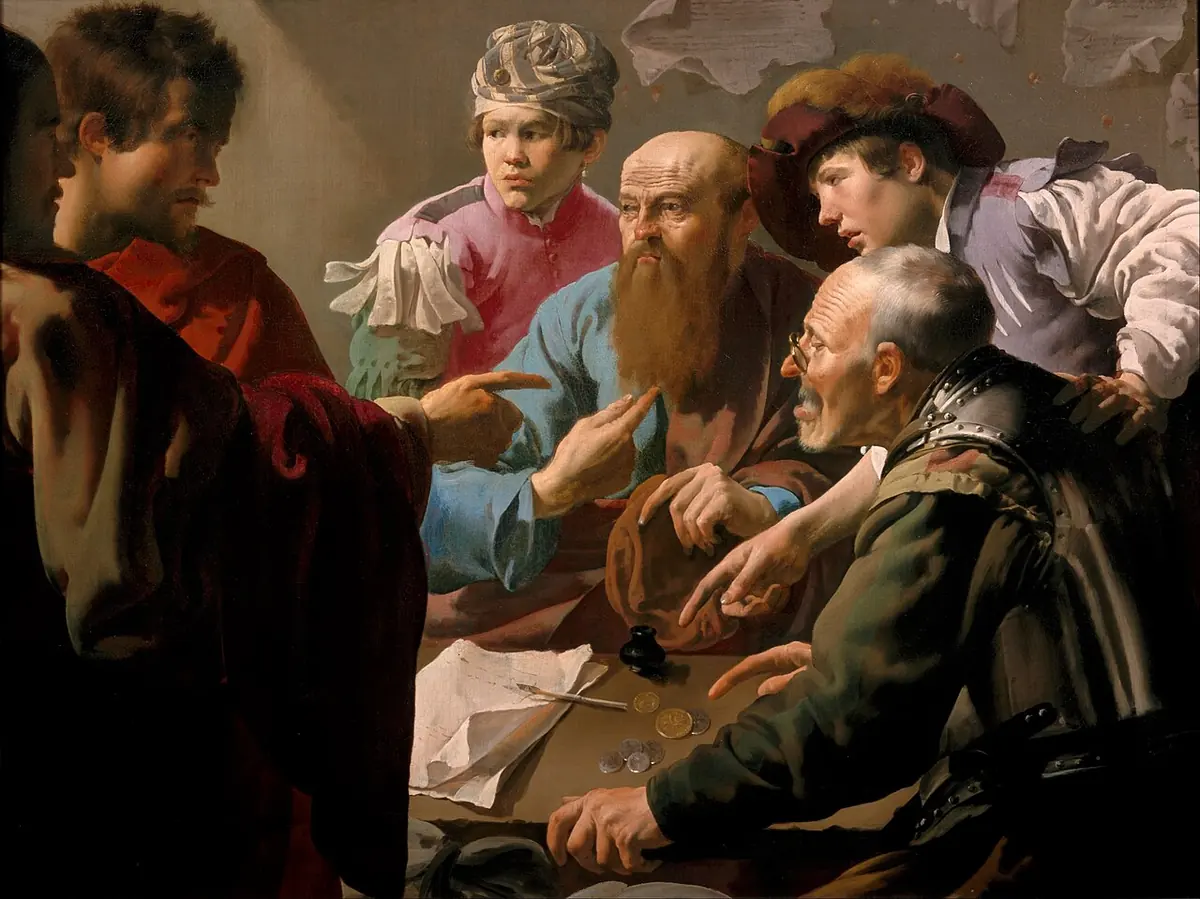
It was not a respectable living. Tax collectors, or publicans, bid for the right to collect and kept what they could squeeze out beyond the amount owed. They worked for a foreign power and handled Gentile money. The Gospels pair them with "sinners" and "prostitutes," and the Pharisees treated them as public sinners. Benedict XVI quoted St. John Chrysostom on the point: Peter and Andrew were called while fishing and Matthew while collecting taxes, "because there is nothing more despicable than the tax collector, and nothing more common than fishing."
Levi and Matthew
Mark and Luke tell the same story with a different name. Mark has "Levi the son of Alphaeus sitting at the tax office" (Mark 2:14), and Luke adds that "he left everything, and rose and followed him" (Luke 5:28). Matthew's own Gospel, listing the Twelve, calls him "Matthew the tax collector" (Matthew 10:3).
The Catholic Encyclopedia treats Levi and Matthew as one man and suggests that Levi was his birth name and that Matthew, from the Hebrew Mattija, "gift of Yahweh," was the name he was known by among Christians. Jews of the time often had two names, as with Simon Peter and Joseph Caiaphas.

Mark's "son of Alphaeus" raises a question no one has settled. James the Less is also called the son of Alphaeus, and the Orthodox life of Matthew calls the two apostles brothers. The Gospels themselves never say so.
Dinner with tax collectors and sinners
Matthew's first act as a disciple was to throw a party. Luke says "Levi made him a great feast in his house" (Luke 5:29), and Matthew records that "many tax collectors and sinners came and sat down with Jesus and his disciples." The Pharisees asked the disciples why their teacher ate with such people. Jesus answered:
"Those who are well have no need of a physician, but those who are sick. Go and learn what this means, 'I desire mercy, and not sacrifice.' For I came not to call the righteous, but sinners." (Matthew 9:12–13, RSV)

The Orthodox life of St. Matthew adds that he repaid fourfold anyone he had cheated, as Zacchaeus promised to do in Luke 19:8, and gave the rest of his goods to the poor. The Gospels do not say this of Matthew; it is the Orthodox tradition.
Among the Twelve
After his call, Matthew appears only in the lists of the apostles. He was with Jesus through the public ministry, saw the risen Lord, and was among the eleven who waited in prayer with Mary in the upper room after the Ascension (Acts 1:13–14). The Catholic Encyclopedia says no more than that, and neither does anyone who sticks to the New Testament.
The Gospel of Matthew
What the early Church said
The oldest testimony comes from Papias, bishop of Hierapolis in Asia Minor, who wrote around 130. His words survive because the historian Eusebius copied them: "So then Matthew wrote the oracles in the Hebrew language, and every one interpreted them as he was able." Scholars have argued for centuries about what Papias meant by "oracles" and by "Hebrew," which could mean Aramaic, the language Jews in Galilee spoke.


Later writers say the same thing in more detail. St. Irenaeus, around 180, wrote that "Matthew published his Gospel among the Hebrews in their own language, while Peter and Paul were preaching and founding the church in Rome." Origen, in the 3rd century, said the first Gospel "was written by Matthew, who was once a publican, but afterwards an apostle of Jesus Christ, and it was prepared for the converts from Judaism." Eusebius explained why Matthew wrote at all: he "had at first preached to the Hebrews, when he was about to go to other peoples, committed his Gospel to writing in his native tongue, and thus compensated those whom he was obliged to leave for the loss of his presence."
St. Jerome, around 392, added that the Greek translator was unknown and that a copy of the Hebrew Gospel was still kept in the library at Caesarea. Eusebius tells a stranger story: the teacher Pantaenus, traveling to India late in the 2nd century, found Christians there who already had Matthew's Gospel "in the Hebrew language," left with them by the apostle St. Bartholomew.
What modern scholars think
No Hebrew or Aramaic Gospel of Matthew survives. The Gospel the Church reads is in Greek, and it closely follows Mark's Gospel. For that reason the introduction to Matthew in the New American Bible, the translation used at Mass in the United States, calls the ancient tradition that the apostle wrote it "untenable." It describes the author as an unknown Jewish Christian, writing after the fall of Jerusalem in 70 and probably around 80 to 90, who drew on Mark and on a collection of Jesus' sayings that Luke also used. The same introduction allows that the apostle may have stood behind some of the traditions in the book.
The Catholic and Orthodox churches still call Matthew the evangelist, and Benedict XVI said in 2006 that in the Greek Gospel "we still continue to hear, in a certain way, the persuasive voice of the publican Matthew." The Gospel opens with the genealogy of Jesus and the visit of the Magi. It contains the Sermon on the Mount, the Beatitudes, the Lord's Prayer in the form Christians pray it, Jesus' words to Peter about the Church built on rock, and the parable of the sheep and the goats. The Church placed it first in the New Testament.


Mission and martyrdom traditions
The Bible says nothing about where Matthew went after Pentecost. The stories below are traditional.
Preaching to the Hebrews
The Catholic Encyclopedia gathers the early witnesses: Irenaeus says Matthew preached among the Hebrews, and Clement of Alexandria says he did so for fifteen years before leaving Palestine.
Ethiopia, Persia and Parthia
Ancient writers do not agree about where he went next. Almost all of them name "Ethiopia," but the Catholic Encyclopedia notes that they meant a land south of the Caspian Sea, not Ethiopia in Africa. Others name Persia, Parthia, Macedonia and Syria. The Orthodox Church in America says he preached in Syria, Media, Persia and Parthia and ended his work in Ethiopia.
The Golden Legend, the 13th-century book of saints' lives by Jacobus de Voragine, tells the Western version. In Ethiopia Matthew defeats two magicians, Zaroes and Arphaxat, who come against him with two fire-breathing dragons; he sends the dragons away and raises the king's dead son. King Egippus and his people are baptized, and the king's daughter Iphigenia consecrates herself to God and leads a community of more than two hundred virgins. The magicians flee to Persia, where, the same book says, St. Simon and St. Jude later defeated them.
How he died
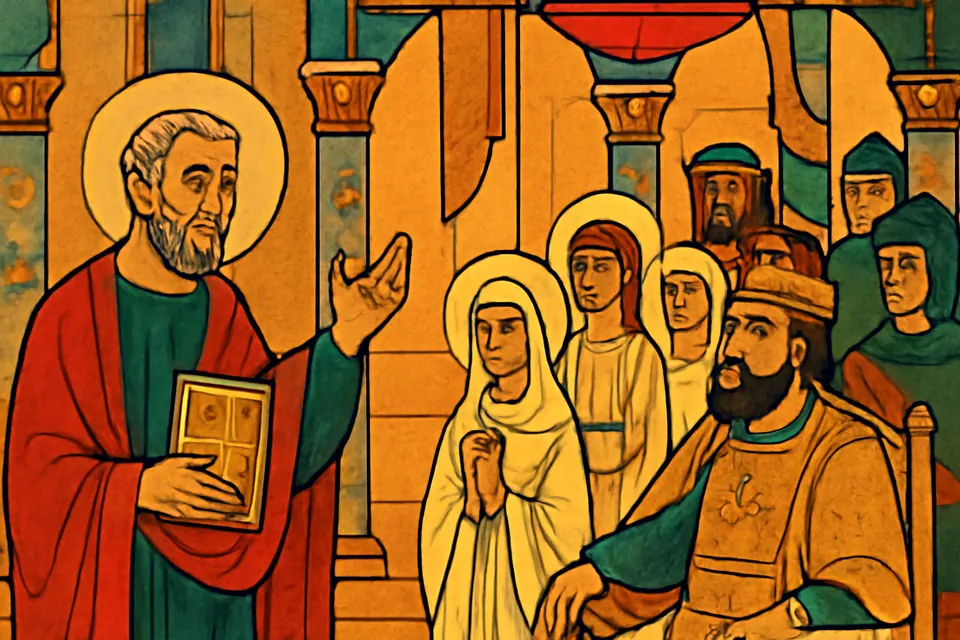
The Golden Legend goes on: after Egippus died, his successor Hirtacus wanted to marry Iphigenia. Matthew preached that she was already promised to the King of heaven, and after Mass, as he stood at the altar with his hands raised, the king's man killed him "with a sword behind him." The Cathedral of Salerno tells the same story of King Egippus, Iphigenia and Hirtacus on its page about the saint.


The Orthodox account is different. There, Matthew founds a church in the city of Myrmena and makes his companion Platon its bishop. The ruler Fulvian has him placed head downward on a pyre, but the fire does not touch him, melts the idols set around it and turns toward Fulvian, who begs for mercy. Matthew dies in peace, his body is thrown into the sea in an iron coffin and comes back to shore, and Fulvian is baptized with the name Matthew and later becomes a bishop.
The Catholic Encyclopedia states plainly that no one knows whether Matthew was burned, stoned or beheaded. It records that Heracleon, a 2nd-century writer quoted by Clement of Alexandria, said Matthew did not die a martyr at all, though every other ancient witness says he did, and it calls a Greek Martyrdom of St. Matthew "absolutely devoid of historic value." The Roman Martyrology says simply that he "suffered martyrdom while preaching in Ethiopia."

The miracles of St. Matthew
Matthew lived long before the Church began formally investigating miracles, so none of his is approved in the modern sense.
- Traditional: the defeat of the magicians and their dragons, the raising of King Egippus's son, and the conversion of Ethiopia, from the Golden Legend.
- Traditional: in the Golden Legend, after his death Matthew appears at the house where Iphigenia and her companions are threatened with fire, and the fire turns on the king's palace instead.
- Traditional: the fire that would not burn him, the coffin that returned from the sea and the conversion of Fulvian, from the Orthodox life.
- Traditional: Salerno's own story that St. Matthew raised a storm that sank much of an enemy fleet besieging the city. A fresco in the crypt of Salerno Cathedral shows the siege and the storm.
- Reported: favors attributed to his intercession by the people of Salerno and other devotees. These have not been examined by the Church.
Why St. Matthew is the patron saint of accountants, bankers and tax collectors
The reason is his old job. Matthew spent his days counting money, keeping records of duties paid and owed, and dealing with merchants. People who do that work now, accountants, bookkeepers, bankers, tax collectors and customs officers, took him as their patron. Catholic Culture's list of his patronages also includes security guards and stockbrokers. See our list of patron saints by occupation.
The patronage is not a compliment to the profession as Matthew practiced it. It rests on the turn he made. Benedict XVI put it this way: in the figure of Matthew, "those who seem to be the farthest from holiness can even become a model of the acceptance of God's mercy." Christians who handle other people's money ask St. Matthew to pray that they will do it honestly.
He is also the patron of Salerno, which has kept his relics for more than a thousand years.
Symbols of St. Matthew in art
The early Church matched the four evangelists with the four living creatures of Ezekiel 1:10 and Revelation 4:7: a man, a lion, an ox and an eagle. St. Jerome already used the arrangement familiar in the West, which gives Matthew the man, because his Gospel begins with the human genealogy of Jesus. Catholic Culture explains the symbol this way. Here is how to recognize him:
- A winged man or an angel: his evangelist symbol. In the oldest art, such as the 5th-century mosaics of Ravenna, the winged man alone stands for Matthew. Later artists turned the symbol into an angel standing beside him, holding his inkwell or dictating to him.
- A book, pen and inkwell: his Gospel. Matthew is often shown writing.
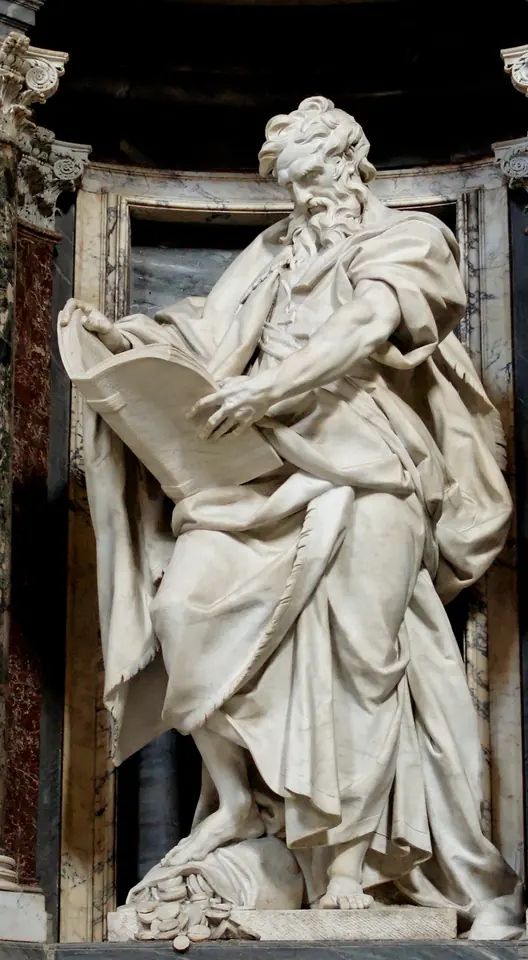
- A money bag, coins or a money box: the life he gave up. When a bag of coins lies at an apostle's feet, it is almost always Matthew.
- A sword: the weapon of his death in the Golden Legend.
- A halberd or spear: common in sets of the twelve apostles. The Catholic Encyclopedia gives him a lance. The Christian Iconography site notes that the halberd has no basis in the texts and may come from confusion with St. Matthias, whose axe can look like one.


Eastern icons show Matthew as an older man with a full gray or white beard, usually seated and writing, and often with an angel. On the royal doors of an Orthodox iconostasis the four evangelists appear in small panels around the Annunciation, and Matthew's is the one with the angel.
In Western churches, look for the bag of coins. Camillo Rusconi's giant marble Matthew in the Lateran Basilica in Rome, one of twelve apostle statues carved in the early 1700s, holds his open Gospel with a money bag at his feet.

Caravaggio's St. Matthew paintings
The best-known pictures of St. Matthew hang together in one small chapel in Rome. The Contarelli Chapel in the church of San Luigi dei Francesi, the French national church, was founded by the French cardinal Matthieu Cointrel, called Contarelli in Italian, and dedicated to his name saint. Caravaggio painted three canvases for it.
- The Calling of St. Matthew (1599–1600) shows the tax office as a dim room in Rome, with young men in feathered hats at a table. Jesus and Peter stand in the shadows at the right, and a beam of light follows Jesus' pointing hand. Benedict XVI told his audience that to picture Matthew 9:9 "it suffices to recall Caravaggio's magnificent canvas." Viewers still argue about which figure is Matthew. Most take him to be the bearded man pointing to himself; the Christian Iconography site reads him as the young man at the end of the table, still bent over the coins.
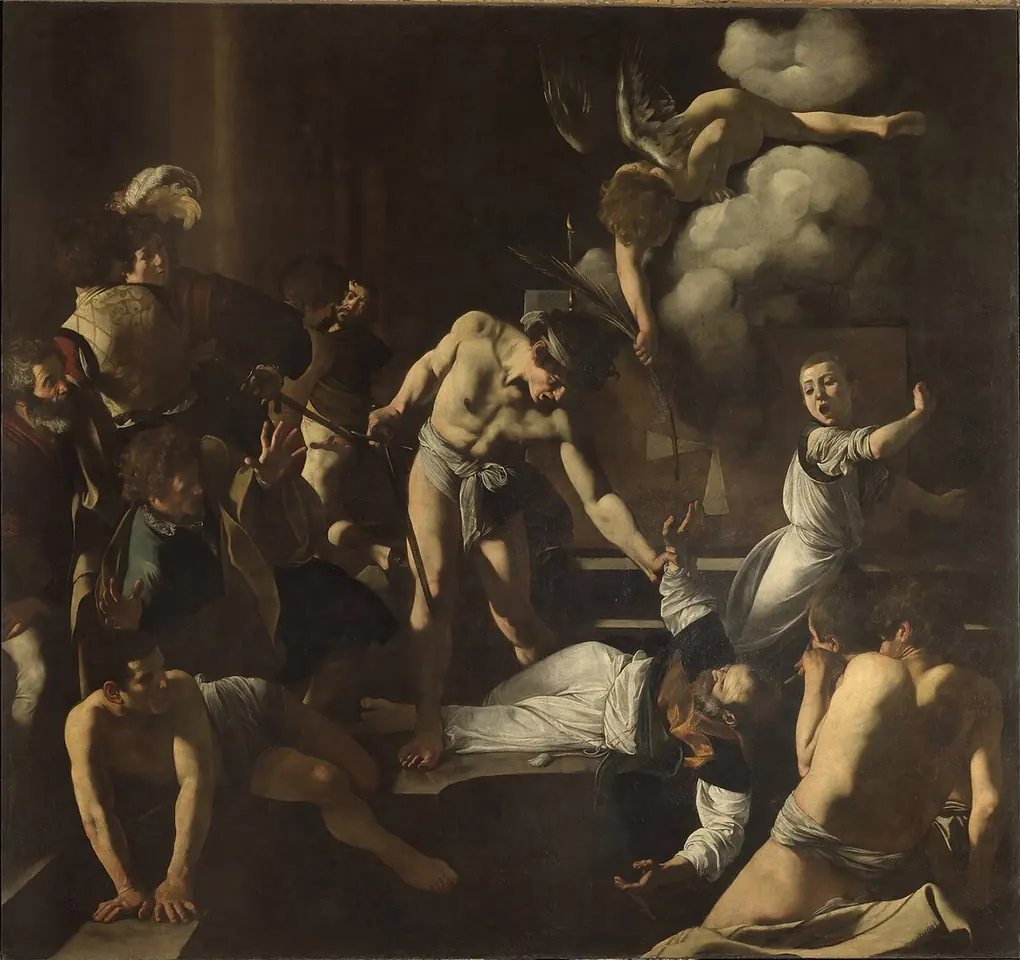
- The Martyrdom of St. Matthew (1599–1600), on the opposite wall, follows the Golden Legend: the saint has fallen beside the altar where he said Mass, and an angel hands down the palm of martyrdom.
- The Inspiration of St. Matthew (1602), above the altar, shows the evangelist at his desk, turning to an angel who counts off points on his fingers.


Feast day and where St. Matthew is honored
The Catholic Church celebrates St. Matthew, Apostle and Evangelist, on September 21 as a feast. The Gospel at Mass is his own call, Matthew 9:9–13. The Orthodox Church keeps his feast on November 16. See the feast day calendar for the saints around him.
Salerno Cathedral
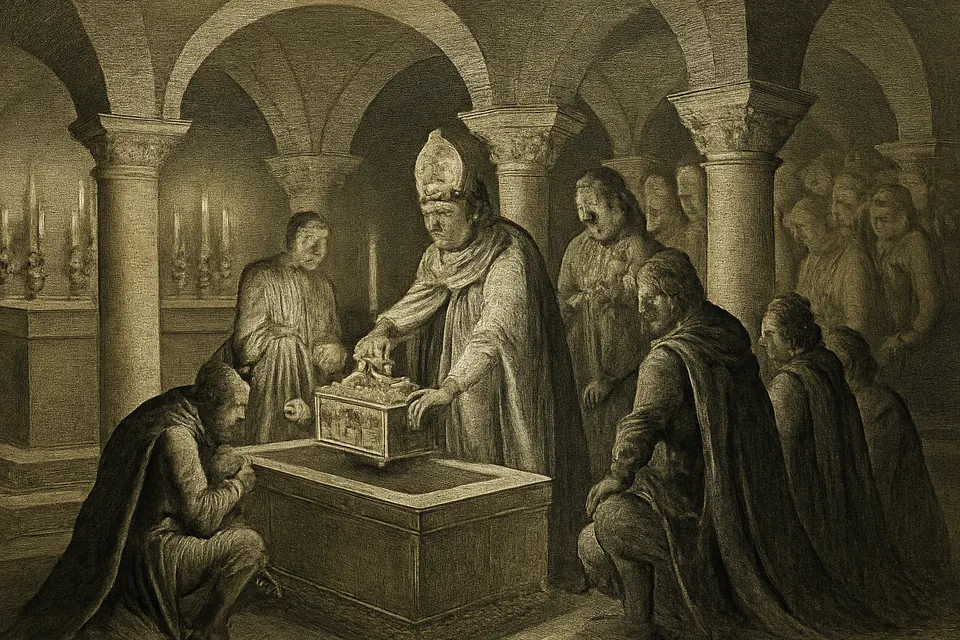
The Cathedral of Salerno keeps the relics of St. Matthew in its crypt. According to the cathedral, the Roman Martyrology records on May 6 the translation of his body from Ethiopia to Salerno by way of Paestum. Salerno already had the body in 954, but it was hidden during troubled times and its place forgotten. It was found again around 1080, and on September 18, 1080, Pope Gregory VII wrote to Archbishop Alfanus I to congratulate him on the discovery. The cathedral calls that letter a reliable historical document.


The Norman duke Robert Guiscard was then building a new cathedral, and its crypt was finished first. In March 1081, in the presence of Robert Guiscard, Alfanus placed the apostle's relics there with those of local martyrs. Gregory VII, who consecrated the church, died in exile in Salerno and is buried in the cathedral.
The crypt as it looks today was redesigned in the early 1600s by the architect Domenico Fontana and his son Giulio Cesare. At its center is a double statue of St. Matthew by Michelangelo Naccherino (1606), two figures back to back, each writing the Gospel on his knee while an angel holds out an inkwell. Through a small opening in the altar, visitors can see the tomb itself.
Pope Francis and the call of Matthew
On the feast of St. Matthew in 1953, a 17-year-old Jorge Bergoglio went to confession in Buenos Aires and felt, in the Vatican's words, "the descent of the Mercy of God" calling him to religious life. As a bishop and then as Pope Francis, he took his motto from a homily of St. Bede the Venerable on the call of Matthew, which the Church reads in the Liturgy of the Hours on this feast:
Vidit ergo Jesus publicanum, et quia miserando atque eligendo vidit, ait illi, 'Sequere me'. [Jesus therefore sees the tax collector, and since he sees by having mercy and by choosing, he says to him, 'follow me'.]
The motto on his coat of arms is the phrase miserando atque eligendo, "by having mercy and by choosing."
Prayer to St. Matthew
There is no widely known traditional novena to St. Matthew, and no prayer that he wrote. The prayer most Catholics hear on his day is the collect of the feast in the Roman Missal:
O God, who with untold mercy were pleased to choose as an Apostle Saint Matthew, the tax collector, grant that, sustained by his example and intercession, we may merit to hold firm in following you. Through our Lord Jesus Christ, your Son, who lives and reigns with you in the unity of the Holy Spirit, God, for ever and ever.
Catholics and Orthodox also ask St. Matthew to pray for them in their own words, especially those who work with money and those who are trying to leave an old way of life behind. Many read his call in Matthew 9:9–13 on his feast. The Orthodox Church sings his troparion and kontakion on November 16.
Frequently asked questions
What is St. Matthew the patron saint of?
Accountants, bankers, bookkeepers, tax collectors and customs officers, because he was a tax collector before Jesus called him. He is also the patron of the city of Salerno in southern Italy, where his relics lie in the cathedral crypt.
When is St. Matthew's feast day?
September 21 in the Catholic Church and in many Anglican and Lutheran calendars. The Orthodox Church honors him on November 16.
Are Matthew and Levi the same person?
Yes, in the traditional reading. Matthew's Gospel calls the tax collector Jesus called "Matthew," while Mark and Luke tell the same story about "Levi." The Catholic Encyclopedia concludes that Levi was his original name and Matthew, meaning "gift of God," the name he was known by among Christians.
Did St. Matthew write the Gospel of Matthew?
The early Church said so, starting with Papias around 130, and Catholic and Orthodox tradition still calls him the evangelist. Many modern scholars think the Greek Gospel was written by an unknown Jewish Christian around 80 to 90, using Mark's Gospel. The introduction in the US bishops' New American Bible takes that view.
How did St. Matthew die?
No one knows for certain. The Roman Martyrology says he suffered martyrdom while preaching in Ethiopia. The Golden Legend says a king's man killed him with a sword at the altar after Mass; the Orthodox life says he was put in a fire that did not harm him and then died in peace. An early writer, Heracleon, said he was not martyred at all.
Why is St. Matthew's symbol a winged man?
Early Christians matched the four evangelists with the four living creatures of Ezekiel 1:10 and Revelation 4:7. Matthew received the man because his Gospel begins with the human ancestry of Jesus.
Where are St. Matthew's relics?
In the crypt of Salerno Cathedral in southern Italy. Salerno had his body by 954, and Archbishop Alfanus I placed it in the new crypt in 1081. Visitors can see the tomb through a small opening in the altar.
Is there a prayer to St. Matthew?
The best-known prayer is the collect of his feast in the Roman Missal, which asks God, who chose "Saint Matthew, the tax collector," to help us "hold firm in following you." There is no widely used traditional novena to St. Matthew.
Sources
- Catholic Encyclopedia (1911): St. Matthew
- Catholic Encyclopedia (1911): Gospel of St. Matthew
- Benedict XVI, General Audience of 30 August 2006: Matthew, the tax collector
- Eusebius, Church History, Book III (Papias on Matthew, chapter 39; Matthew's Gospel, chapter 24)
- Eusebius, Church History, Book V (Irenaeus, chapter 8; Pantaenus, chapter 10)
- Eusebius, Church History, Book VI (Origen on the Gospels, chapter 25)
- Jerome, De Viris Illustribus (Lives of Illustrious Men), chapter 3
- New American Bible (Revised Edition), Introduction to the Gospel according to Matthew (USCCB)
- Orthodox Church in America: Apostle and Evangelist Matthew
- Jacobus de Voragine, The Golden Legend (Caxton translation): Life of Saint Matthew
- Christian Iconography: St. Matthew in Art
- Christian Iconography: The Four Evangelists in Art
- Cattedrale di Salerno: San Matteo Apostolo ed Evangelista
- Cattedrale di Salerno: La Cripta
- The Holy See: The Coat of Arms of Pope Francis (miserando atque eligendo)
- Catholic Culture: Feast of St. Matthew, Apostle and Evangelist
- Roman Martyrology, September 21