St. Edith Stein (Teresa Benedicta of the Cross)
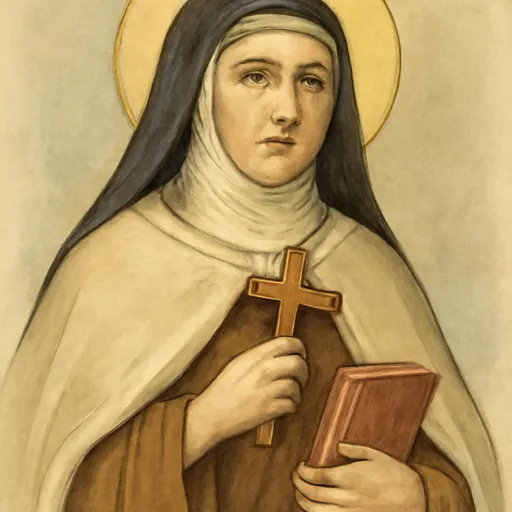
St. Teresa Benedicta of the Cross (1891–1942), born Edith Stein, was a German Jewish philosopher who became a Catholic in 1922 and a Discalced Carmelite nun in 1933. The Nazis deported her from a Dutch convent to Auschwitz, where she was murdered with her sister Rosa. She is a co-patron of Europe, and her feast day is August 9.
Who was St. Edith Stein?
Edith Stein was born on October 12, 1891, in Breslau, then in Germany and now Wrocław in Poland. The youngest of eleven children in a devout Jewish family, she was born on Yom Kippur. Her father, who ran a timber business, died when she had just turned two, and her mother ran the business and raised the children.
She became one of the leading philosophers of her generation, a Catholic, and a Carmelite nun. In August 1942 the Nazis took her from a convent in the Netherlands to Auschwitz, where she was murdered with her sister Rosa. The Catholic Church honors her as Saint Teresa Benedicta of the Cross, virgin and martyr.
Her own memoir and letters document her life well. The quotations below come from the Vatican's biography, published for her canonization in 1998.


The life of Edith Stein
The philosopher
As a teenager she stopped believing. "I consciously decided, of my own volition, to give up praying," she later wrote. She studied German and history at Breslau, then in 1913 moved to Göttingen to study philosophy under Edmund Husserl, the founder of phenomenology. She earned her doctorate summa cum laude at Freiburg in 1917 with a thesis on empathy and worked as Husserl's assistant. During the First World War she volunteered as a nurse in an Austrian field hospital.
Universities would not give a professorship to a woman, and later, under the Nazis, to a Jew. Husserl wrote that if academic careers were opened to women, he would recommend her "as my first choice."
The road to faith
Several moments moved her. In Frankfurt Cathedral she saw a woman with a shopping basket come in to pray. "This was something totally new to me," she wrote. "In the synagogues and Protestant churches I had visited people simply went to the services. Here, however, I saw someone coming straight from the busy marketplace into this empty church, as if she was going to have an intimate conversation."
In 1917 she visited the widow of her friend Adolf Reinach, who had been killed in the war, and was struck by the young widow's faith. She later called it "my first encounter with the Cross."
In the summer of 1921, staying with friends at Bergzabern, she picked up the autobiography of St. Teresa of Ávila and read it through the night. "When I had finished the book, I said to myself: This is the truth."
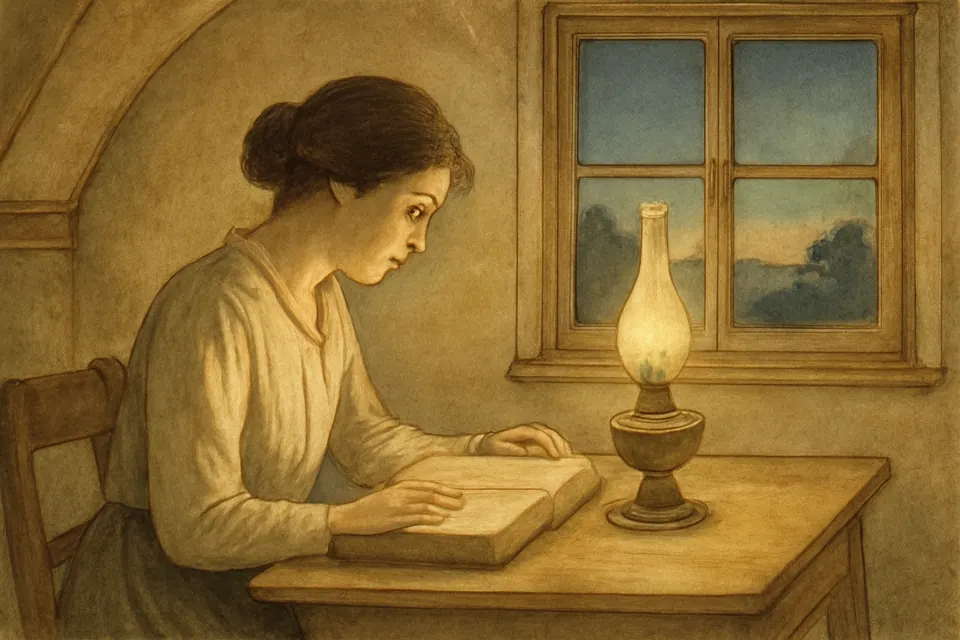
She was baptized on January 1, 1922. When she told her mother, the Vatican biography says, both women cried. She taught for years at a Dominican sisters' school in Speyer, lectured widely on women's issues, and translated Thomas Aquinas and the letters of John Henry Newman into German.

Carmel
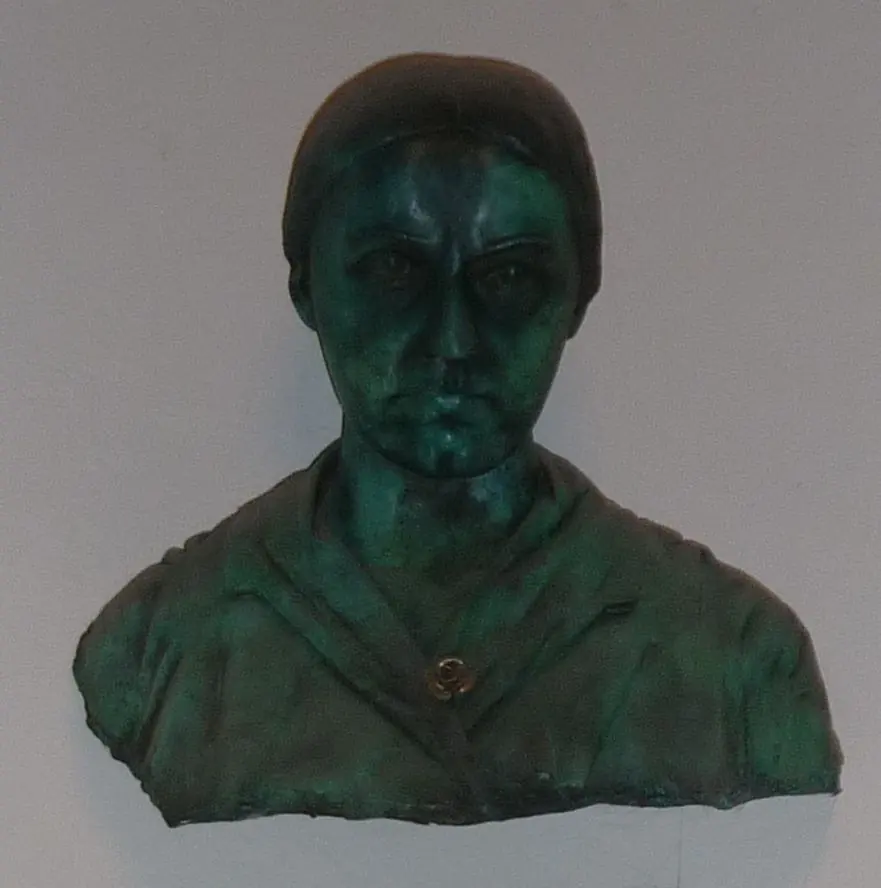
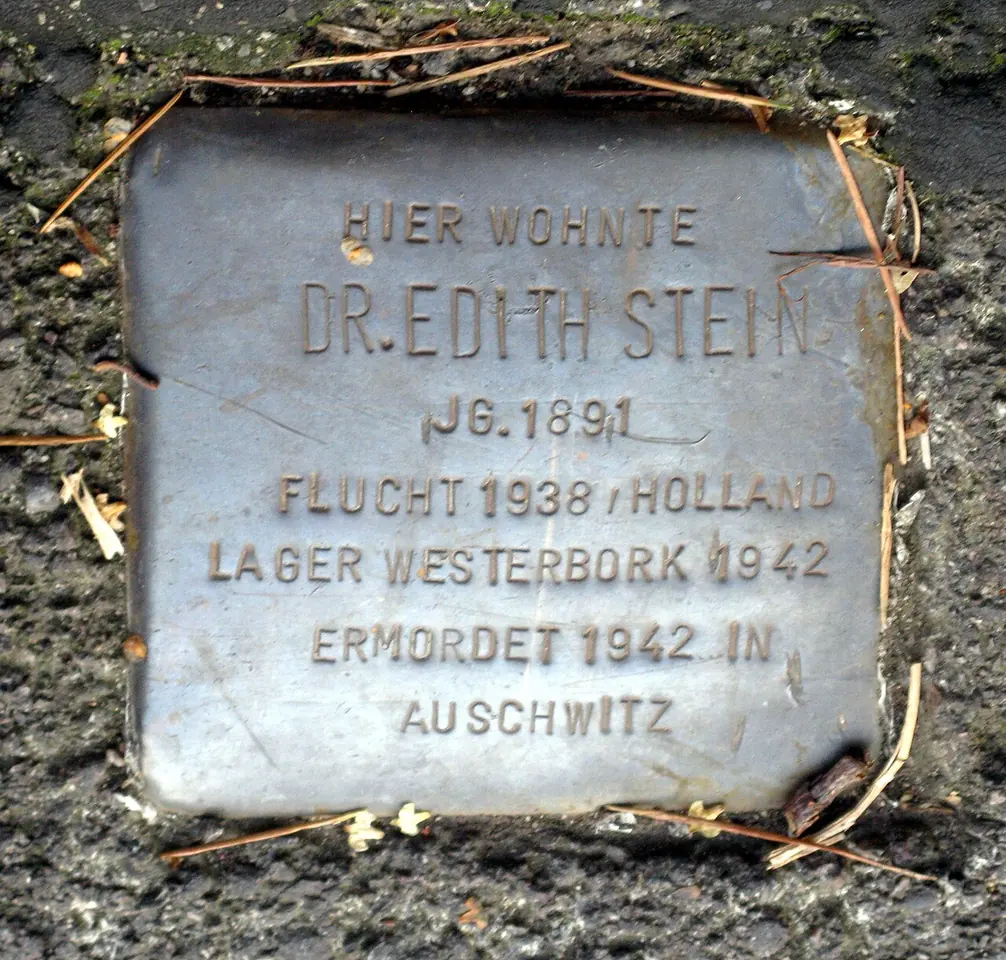
In 1933 the Nazi racial laws ended her teaching post in Münster. She entered the Discalced Carmelite convent in Cologne that October, taking the name Teresia Benedicta a Cruce, Teresa Benedicta of the Cross. Her last day at home was her birthday, and she went to the synagogue with her mother. Her mother, the Vatican biography says, cried.
In Carmel she kept writing, including her major philosophical work, Finite and Eternal Being. After the pogrom of November 1938 the prioress arranged for her to be taken across the border on New Year's Eve to the Carmel at Echt in the Netherlands. Her sister Rosa, also a convert, followed her there. In October 1938 she had written: "I am a very poor and powerless little Esther, but the King who has chosen me is infinitely great and merciful."

Arrest and death
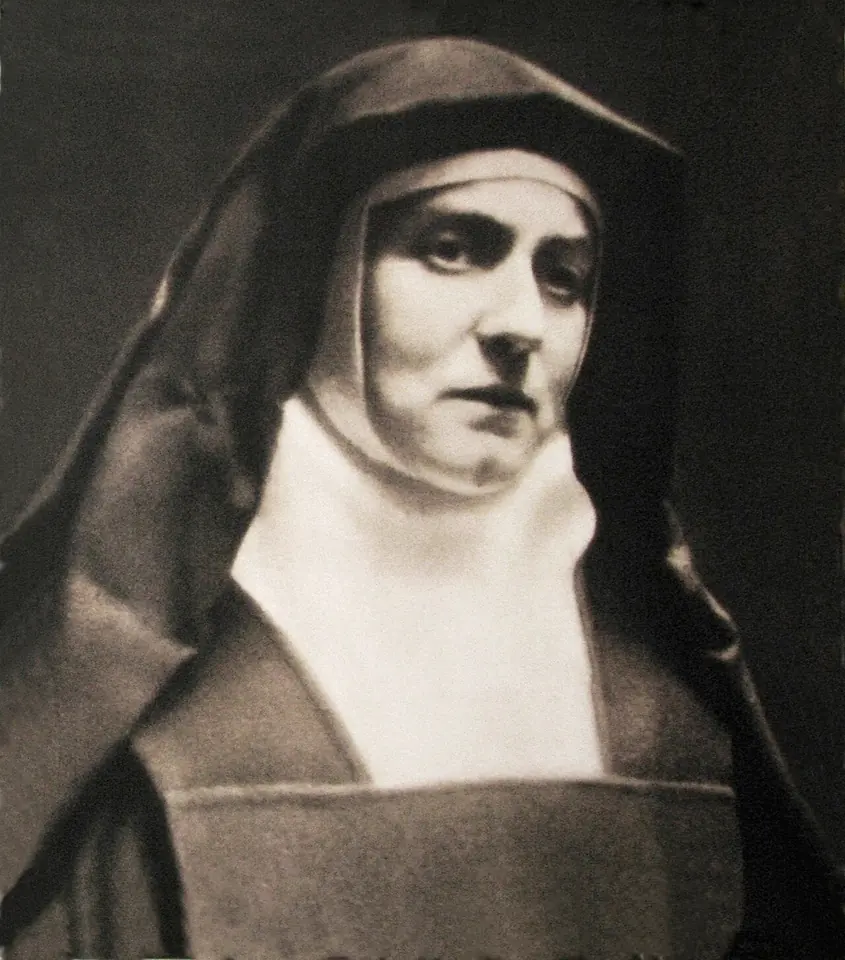
In July 1942 the Dutch Catholic bishops issued a letter protesting the pogroms and deportations of Jews. In reprisal, the Nazis arrested Catholics of Jewish descent. The Gestapo came for Edith and Rosa at Echt on August 2, 1942. Her last words heard at the convent were to Rosa: "Come, we are going for our people."
They were taken to the camps at Amersfoort and Westerbork. On August 7, 987 Jews were deported from Westerbork to Auschwitz. Edith, Rosa and many others were probably murdered in the gas chambers on August 9. Her body was never recovered, so there are no relics.

Beatification, canonization and the approved miracle
John Paul II beatified her as a martyr in Cologne on May 1, 1987, calling her "an outstanding daughter of Israel and at the same time a daughter of the Carmelite Order." A martyr needs no miracle for beatification.
For canonization the Church accepted one approved miracle. In 1987 Teresa Benedicta McCarthy, the two-year-old daughter of a Melkite Catholic priest in Brockton, Massachusetts, swallowed a large amount of Tylenol. Her liver and kidneys began to fail, and doctors at Massachusetts General Hospital prepared for a transplant. The family, who had named her after Edith Stein, asked for Stein's prayers. The child recovered. Her doctor told the Seattle Times, "I thought it was miraculous that she recovered," and later testified before a Vatican tribunal of doctors and clergy. The miracle was approved in 1997, and John Paul II canonized Edith Stein in St. Peter's Square on October 11, 1998.
Why St. Edith Stein is co-patron of Europe
On October 1, 1999, in his letter Spes Aedificandi, John Paul II named her a co-patron of Europe, along with St. Bridget of Sweden and St. Catherine of Siena. He wrote that her martyrdom proclaimed "the ways of God and man in the horrendous atrocity of the Shoah," and that she had "become the symbol of a human, cultural and religious pilgrimage which embodies the deepest tragedy and the deepest hopes of Europe." See our patron saints page.
Symbols of St. Edith Stein in art
Most images follow her photographs: a woman in the brown habit, white wimple and black veil of a Discalced Carmelite. Look for:
- The cross: from her religious name and her last book, The Science of the Cross. In 1941 she wrote to a friend that she had said with all her heart, "Ave, Crux, Spes unica" ("I welcome you, Cross, our only hope").
- A book or pen: her work as a philosopher.
- The Star of David, added in some modern images beside the cross: her Jewish people, whom she never stopped calling her own.

Feast day and prayer
Her feast is August 9, an optional memorial in the Church's calendar and a feast in Europe. See our feast days calendar. John Paul II asked that her feast also be a day to remember the Shoah, "that cruel plan to exterminate a people."
There is no traditional prayer to her. At her canonization John Paul II summed up her teaching in two sentences:
Do not accept anything as the truth if it lacks love. And do not accept anything as love which lacks truth!
He ended the homily with the invocation Catholics use to ask her intercession: "St Teresa Benedicta of the Cross, pray for us!"
Frequently asked questions
When is St. Edith Stein's feast day?
August 9, the day she is believed to have died at Auschwitz in 1942. It is an optional memorial in the General Roman Calendar and a feast in Europe.
Why is Edith Stein a patron saint of Europe?
On October 1, 1999, John Paul II named her co-patron of Europe with Sts. Bridget of Sweden and Catherine of Siena. In his letter Spes Aedificandi he said she had built "a kind of bridge between her Jewish roots and her commitment to Christ," and called her a symbol of "the deepest tragedy and the deepest hopes of Europe."
What miracle led to Edith Stein's canonization?
The recovery of Teresa Benedicta McCarthy, a two-and-a-half-year-old in Brockton, Massachusetts, who in 1987 swallowed a large amount of Tylenol and suffered liver failure. Her family, who had named her after Edith Stein, asked for Stein's prayers, and the child recovered. The Vatican accepted the cure as a miracle in 1997. It is an approved miracle.
Was Edith Stein killed because she was Jewish or because she was Catholic?
She was arrested on August 2, 1942, with other Catholics of Jewish descent in the Netherlands, in reprisal for a pastoral letter of the Dutch bishops protesting the deportation of Jews. John Paul II said at her canonization, "Because she was Jewish, Edith Stein was taken with her sister Rosa and many other Catholic Jews from the Netherlands to the concentration camp in Auschwitz." The Church honors her as a martyr and asked that her feast also be a day to remember the Shoah.
Sources
- Vatican: Teresa Benedict of the Cross Edith Stein (1891-1942), biography
- John Paul II, Homily for the Canonization of Edith Stein, 11 October 1998
- John Paul II, Spes Aedificandi: Proclamation of the Co-Patronesses of Europe (October 1, 1999)
- The Seattle Times: Patron Saint of the Holocaust: A Prayer to Edith Stein Is Answered (May 31, 1997)
- Liturgy Office of England and Wales: Roman Missal, additions to the Universal Calendar