St. John of the Cross
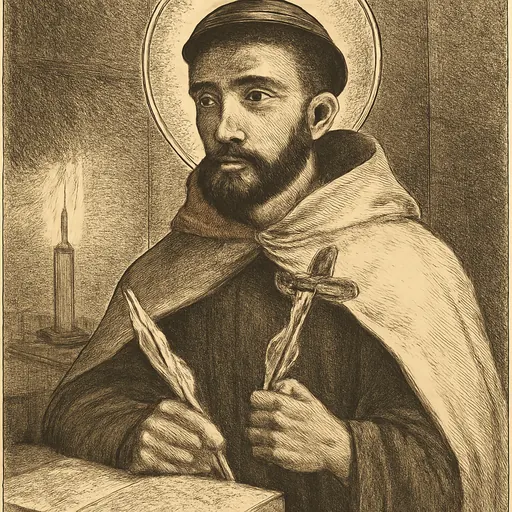
St. John of the Cross (1542–1591) was a Spanish Carmelite friar who worked with St. Teresa of Ávila to reform the Carmelite order and wrote some of the greatest poems in the Spanish language, among them The Dark Night. His feast day is December 14. A Doctor of the Church since 1926, he is the patron saint of mystics, contemplatives and Spanish poets.
Who was St. John of the Cross?
John of the Cross was a Spanish friar, priest and poet who helped St. Teresa of Ávila reform the Carmelite order in the 16th century. He was a small man (Teresa joked about his size), born poor, and he spent much of his life in conflict inside his own order. His brothers in religion once locked him in a cell for nine months. Out of that prison came poems that Spanish readers still count among the finest in their language.
He wrote four great prose works to explain his poems: The Ascent of Mount Carmel, The Dark Night, The Spiritual Canticle and The Living Flame of Love. Pope Pius XI declared him a Doctor of the Church in 1926, and he is known as the Mystical Doctor. Benedict XVI, in a 2011 catechesis, said his life "did not 'float on mystical clouds'" but was "very hard," and that it was in prison that "he wrote one of his most beautiful works."


The life of St. John of the Cross
A poor boy in Castile
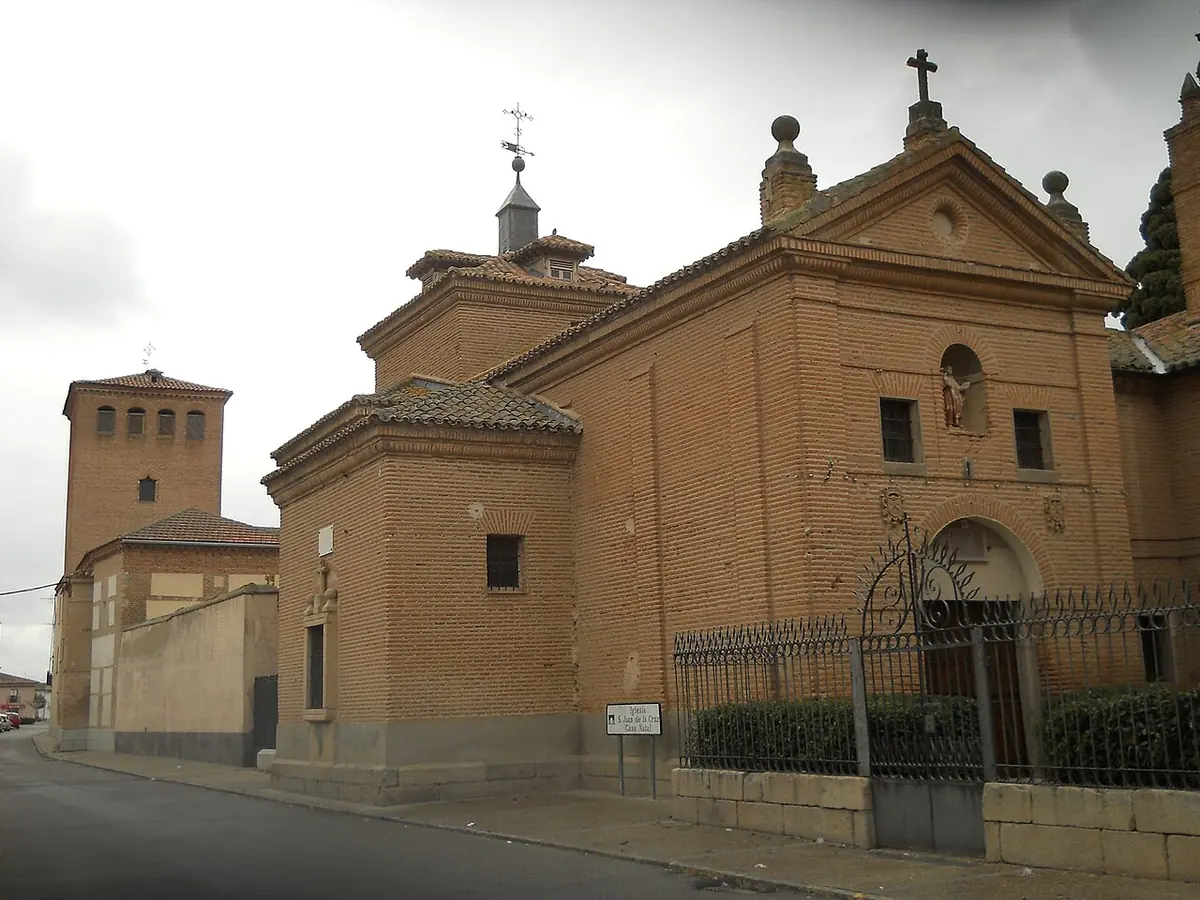
Juan de Yepes Álvarez was born in 1542 in Fontiveros, a village near Ávila, the youngest of three sons. His father, Gonzalo, came from a well-off family of Toledo silk merchants who disowned him for marrying Catalina Álvarez, a poor weaver. Gonzalo died when Juan was small, and Catalina moved her sons from town to town looking for work before settling in Medina del Campo.
There Juan went to a school for poor children and worked as an orderly at a hospital for people with contagious diseases, while studying with the Jesuits. In 1563 he entered the Carmelite friary of Santa Ana in Medina and took the name John of St. Matthias. He studied at the University of Salamanca and was ordained a priest in 1567.

Teresa and the first Discalced friars
The young priest was thinking of leaving for the stricter Carthusians when he met Teresa of Ávila in Medina in 1567. She was 52 and had begun founding convents of nuns who lived the original, stricter Carmelite rule. She wanted friars to do the same. According to the Catholic Encyclopedia, she "persuaded him to remain in the Carmelite Order" and help her.

On November 28, 1568, in a tiny farmhouse at Duruelo, John and two companions began the first community of Discalced (barefoot) Carmelite friars. At this time he took the name John of the Cross. From 1572 he spent about five years in Ávila as confessor to the nuns of the Monastery of the Incarnation, where Teresa was prioress. Benedict XVI called these "years of close collaboration and spiritual friendship which enriched both." Read more in our entry on St. Teresa of Ávila.
Nine months in a Toledo cell
The reform caused bitter conflict. Superiors of the older, "Calced" Carmelites ordered John to leave Ávila, and he refused, since his post came from the papal nuncio. On the night of December 3, 1577, they seized him and took him to their friary in Toledo. The Catholic Encyclopedia says he spent "more than nine months close imprisonment in a narrow, stifling cell." Benedict XVI speaks of "unbelievable insults and physical abuse."
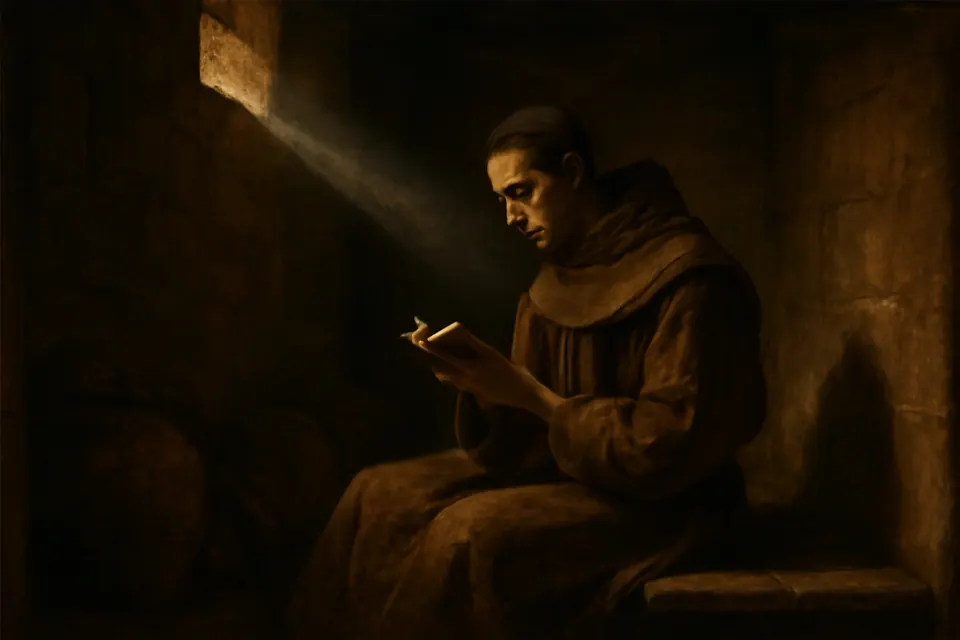
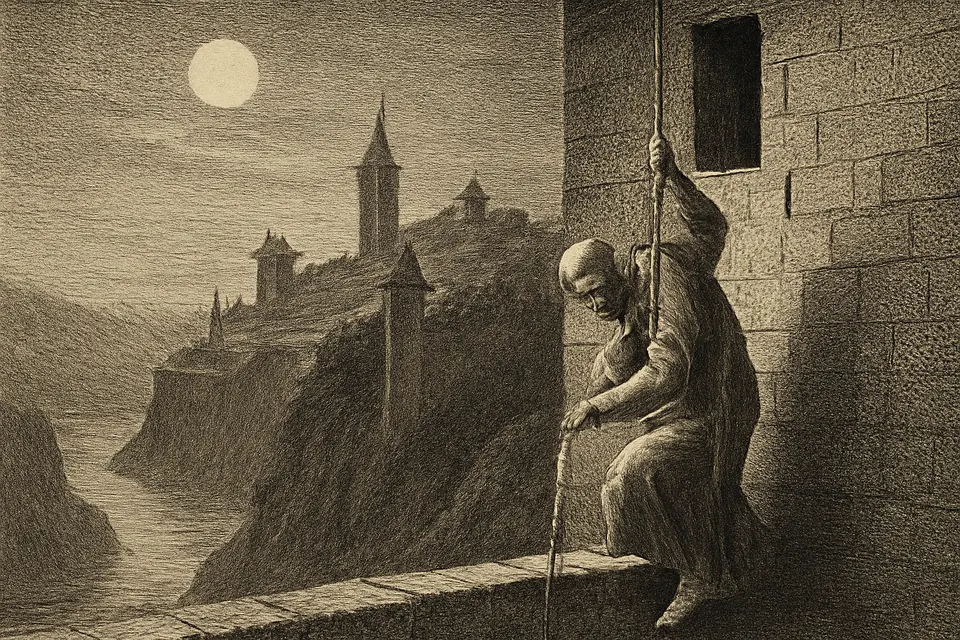
In that cell he composed several poems, among them the first part of the Spiritual Canticle. In the night between August 16 and 17, 1578, by Benedict XVI's dating, he escaped and took shelter with Teresa's nuns in Toledo.
Andalusia, Segovia and Úbeda
He spent most of the next ten years in Andalusia, as superior at El Calvario, rector of a college in Baeza and prior of Los Mártires in Granada, where he wrote much of his prose. In 1588 he became a member of the order's governing council and moved to Segovia.
The quarrels did not end. When John opposed Nicolás Doria, the vicar general, over the government of the order and the nuns' constitutions, he lost all his offices in 1591. He went to the remote friary of La Peñuela, fell ill and was moved to Úbeda for treatment, where, the Discalced Carmelites record, he "suffered considerably under the prior." He died there on the night of December 13 to 14, 1591, at 49. Benedict XVI records his last words to the friars praying Matins: "Today I am going to sing the Office in Heaven."

The poems and the dark night of the soul
John wrote fewer than thirty poems. Three of them, with his prose commentaries, are the heart of his work.
The Dark Night
"Noche oscura" tells, in eight short stanzas, of a woman who slips out of her sleeping house at night to meet her lover. John read it as the soul going out to God. It begins:
En una noche oscura, / con ansias en amores inflamada, / (¡oh dichosa ventura!) / salí sin ser notada, / estando ya mi casa sosegada.
In David Lewis's translation, published as The Dark Night of the Soul in 1908:
In a dark night, / With anxious love inflamed, / O, happy lot! / Forth unobserved I went, / My house being now at rest.
In his commentary, the dark night is the way God purifies a person who seeks him. In the "night of sense," prayer loses its sweetness. In the deeper "night of the spirit," God seems to have gone. John teaches that this darkness comes from God's light being too bright for the soul, and that it leads to union with him. English editions titled the commentary The Dark Night of the Soul, and the phrase passed into everyday English for any time of spiritual desolation.


The Spiritual Canticle
The Spiritual Canticle is a long dialogue between the Bride and her Beloved, modeled on the Song of Songs. It opens, in the spelling of the old manuscripts, "¿Adónde te escondiste, / Amado, y me dexaste con gemido?" In the translation by Kieran Kavanaugh and Otilio Rodriguez: "Where have you hidden, / Beloved, and left me moaning?"
The Living Flame of Love
He wrote the commentary on this short poem around 1584 at the request of Doña Ana de Peñalosa, a laywoman in Granada. It describes a soul already united with God:
¡O llama de amor viva / que tiernamente hieres / de mi alma en el más profundo centro!
The English poet Arthur Symons translated it: "O flame of living love, / That dost eternally / Pierce through my soul with so consuming heat."
The best-known line from his short sayings is quoted in the Catechism of the Catholic Church (1022): "At the evening of life, we shall be judged on our love."
The miracles of St. John of the Cross
- Approved: the miracles the Church accepted in the processes for his beatification in 1675 and canonization in 1726. The sources used here don't describe them individually.
- Traditional: the Catholic Encyclopedia reports that as a boy "twice he was saved from certain death by the intervention of the Blessed Virgin," and calls his escape from Toledo miraculous.
- Reported: after his death, his brother Francisco and many others said they saw images of Christ crucified, the Virgin and saints in his relics. In 1615 the bishop of Valladolid authenticated one such case, and Cornelis Boel engraved it.
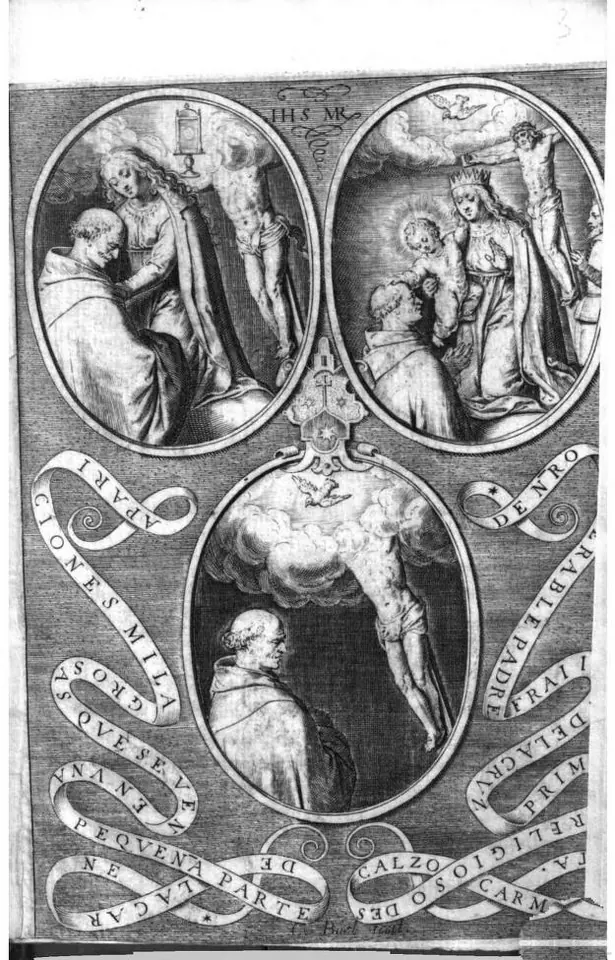

Why St. John of the Cross is the patron saint of mystics and poets
He is the patron of mystics and contemplatives because his books are the Church's classic map of contemplative prayer. Catholic Culture also lists him as patron of mystical theology. He is the patron of Spanish poets because his handful of poems are among the finest of Spain's Golden Age. Segovia, where his body lies, counts him as a patron too. See all the patron saints by cause.
Symbols of St. John of the Cross in art
Look for a small, thin friar with a short beard in the Carmelite habit: brown tunic and scapular, often with a white cloak. Common attributes:
- A crucifix, held or contemplated, for his name and his love of the cross.
- A pen and book, as a Doctor of the Church.
- An eagle, for the height of his mystical writing.
- Christ carrying the cross, in scenes of a vision that tradition places at Segovia, in which Christ asked what reward he wanted. Tradition gives his answer as the prayer the Catholic Encyclopedia records as constant with him, "to suffer and to be despised."
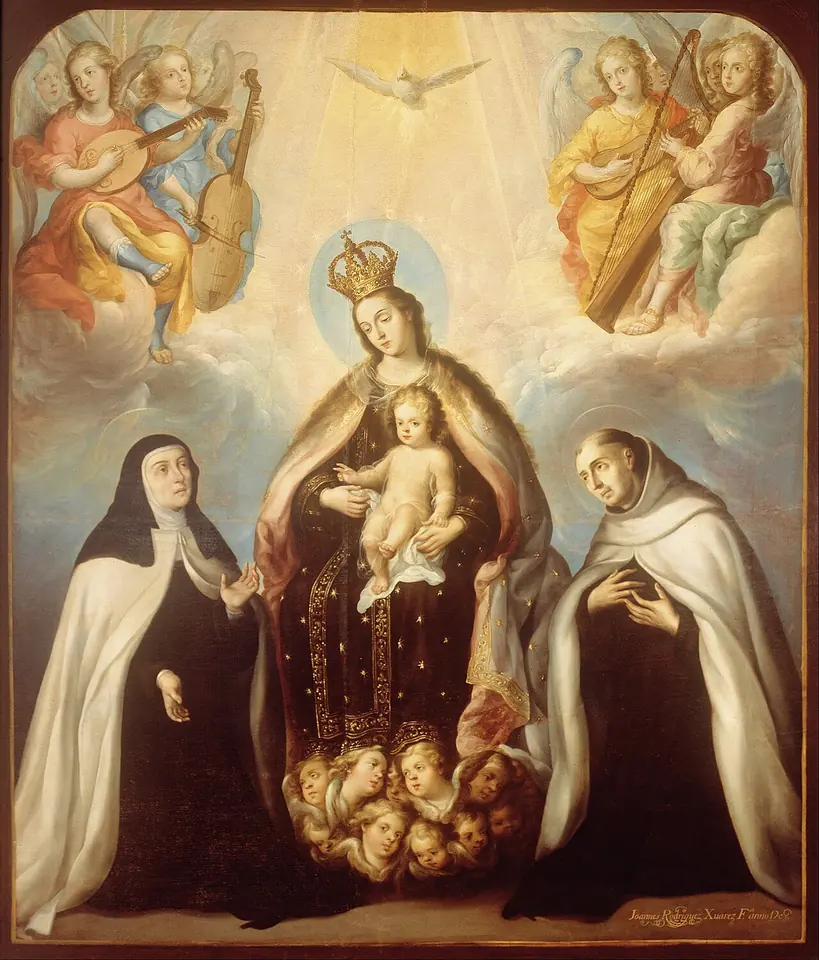
- With St. Teresa, usually kneeling on either side of Our Lady of Mount Carmel, as in Juan Rodríguez Juárez's painting.

The drawing of Christ crucified
Between about 1574 and 1577, at the Monastery of the Incarnation in Ávila, John made a small pen drawing of Christ on the cross, seen from above as if from the Father's point of view. The nuns kept it, and it is still in Ávila. In 1951 Salvador Dalí painted Christ of Saint John of the Cross, now in the Kelvingrove Art Gallery and Museum in Glasgow, inspired by it. The sketch at the top of this page is John's own.
Feast day, tomb and relics
The Church celebrates St. John of the Cross on December 14, the day he died. From 1738 until 1969 the feast was kept on November 24. See the feast day calendar.
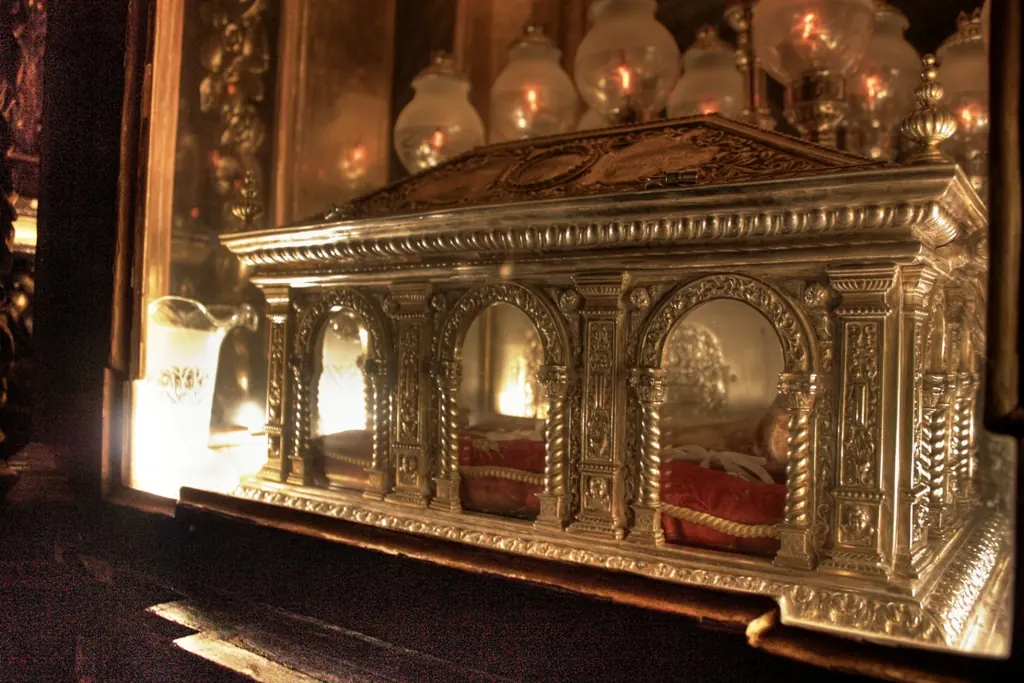
His body was moved in secret from Úbeda to Segovia in 1593, and Úbeda went to court to get it back. In the end each city kept part of the relics. Most of the body rests in a marble tomb in the chapel of St. John of the Cross at the Discalced Carmelite friary in Segovia, the house he built.


In Úbeda, the Oratory of San Juan de la Cruz, built in 1627, keeps a reliquary with some of his bones.

Prayer to St. John of the Cross
The Church prays this collect at Mass on his memorial, in the English translation of the Roman Missal:
O God, who gave the Priest Saint John an outstanding dedication to perfect self-denial and love of the Cross, grant that, by imitating him closely at all times, we may come to contemplate eternally your glory. Through our Lord Jesus Christ, your Son, who lives and reigns with you in the unity of the Holy Spirit, God, for ever and ever.
Catholics who ask his prayers often do so in times of spiritual dryness, and many pray with his own poems.
Frequently asked questions
When is the feast of St. John of the Cross?
December 14, the day he died in 1591. It is a memorial in the General Roman Calendar. Before the calendar reform of 1969 his feast was kept on November 24.
What does "dark night of the soul" mean?
In St. John's writings the dark night is the stage of the spiritual life in which God purifies a person who seeks him, first in the senses and then in the spirit. Prayer feels dry and God seems absent, though John teaches that he is closer than ever. The phrase comes from the English title of his commentary on his poem "Noche oscura," and today it is often used for any time of deep spiritual or emotional desolation.
What is St. John of the Cross the patron saint of?
Mystics, contemplatives and those who study mystical theology, and Spanish poets. He is also a patron of the city of Segovia, where he is buried.
Why was St. John of the Cross imprisoned?
Friars of the older, unreformed Carmelite observance opposed the reform he led with St. Teresa. On the night of December 2 to 3, 1577, they seized him in Ávila and held him for about nine months in a tiny cell in their friary in Toledo. He escaped in August 1578.
Did Salvador Dalí paint St. John of the Cross?
Dalí's 1951 painting Christ of Saint John of the Cross, now in Glasgow, was inspired by the small drawing of the crucified Christ that John made at Ávila. The painting shows Christ, not John, seen from above as in John's sketch.
Sources
- Catholic Encyclopedia (1910): St. John of the Cross
- Benedict XVI, General Audience of 16 February 2011: Saint John of the Cross
- Discalced Carmelites (OCD General Curia): St. John of the Cross
- Catechism of the Catholic Church, 1022
- Catholic Culture: Memorial of St. John of the Cross (collect and patronages)
- San Juan de la Cruz, Noche oscura (Spanish text, Biblioteca Antológica)
- San Juan de la Cruz, Llama de amor viva (Spanish text, Biblioteca Antológica)
- Poetry Foundation: The Dark Night of the Soul (trans. David Lewis, 1908)
- Poesi.as: Cántico (Spanish text)
- Poesi.as: Spiritual Canticle (trans. Kieran Kavanaugh and Otilio Rodriguez)
- Poesi.as: Flame of Living Love (trans. Arthur Symons)
- The Collected Works of St. John of the Cross, trans. Kieran Kavanaugh and Otilio Rodriguez (ICS Publications, 1991)