St. Roch
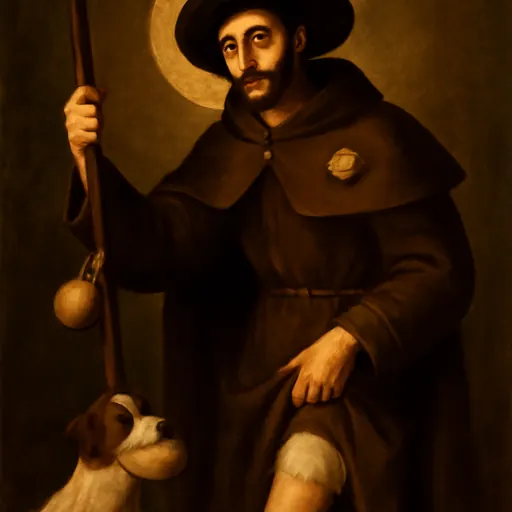
St. Roch (in Italian San Rocco, in Spanish San Roque) was a pilgrim from Montpellier in southern France who, according to tradition, nursed plague victims in Italy, caught the plague himself, was fed in the forest by a dog that brought him bread, and died in prison after being arrested as a spy. He probably lived in the 1300s, but his Lives were written a century after his death and disagree on the details. His feast day is August 16, and he is the patron saint of dogs and of people sick with plague and epidemics.
Who was St. Roch?
Roch was a pilgrim from Montpellier, in the south of France, who gave away his inheritance, walked to Italy, and nursed the sick through outbreaks of plague. He caught the disease himself, recovered in a forest hut where a dog brought him bread, and died in prison after soldiers took him for a spy. Within a century of his death, Christians across Europe were calling on him whenever plague came, and they still do in Italy, Spain, France and the Philippines.
That is the story as his Lives tell it. Very little of it can be checked. The Catholic Encyclopedia (1912) repeats the traditional dates, born about 1295 and died 1327, which come from the Vita Sancti Rochi written in 1478 or 1479 by Francesco Diedo, the Venetian governor of Brescia. The Scuola Grande di San Rocco in Venice, which keeps his body, says plainly that historical information about his life "is limited and uncertain" and mixed with popular legend.

The Lives of St. Roch, and why they disagree
Roch's story reached print in three main versions within a few years of each other, all about a century after his death:
- Francesco Diedo's Vita Sancti Rochi (1478 or 1479), written in Latin at Salò while plague raged in Brescia. Diedo has Roch die in his home town of Montpellier, imprisoned by his own uncle.
- The Acta Breviora, an anonymous Latin life first printed at Cologne in 1483. Some scholars think it translates an older Italian text from the 1420s; most now date it after Diedo. It places Roch's death in "Angleria" in Lombardy.
- A German life printed at Vienna in 1482 and Nuremberg in 1484.
William Caxton's English Golden Legend of 1483 follows the Lombard version, so English readers met a Roch who died in "a province of Lombardy called Angleria," a lord's nephew arrested while that lord "made war with his enemy." Even small details shift. The Catholic Encyclopedia says the cross-shaped birthmark was on his breast; Caxton puts it "in the shoulder on his left side."
Modern research has moved the story to Voghera, a town south of Pavia. Pierre Bolle and Paolo Ascagni, writing for the Italian San Rocco association, point to two facts: Voghera's statutes record a feast of San Rocco by 1391, and Roch's body is documented there by 1469. Montpellier's first recorded procession in his honor dates only from 1505. On this reading Roch was born between 1345 and 1350, reached Rome while Pope Urban V was briefly there (1367–1370), and died a prisoner at Voghera, then a stronghold of the Visconti of Milan, between 1376 and 1379. Bolle and Ascagni admit the uncertainty remains, but they report that most scholars now lean toward the later dates.
The life of St. Roch, as tradition tells it
What follows is traditional, drawn from the Golden Legend and Diedo.
A wealthy young man gives everything away
Roch's parents, John and Libera in the Golden Legend, were the lord of Montpellier and his wife, who had long prayed for a child. When both died before he turned twenty, Roch spent the family fortune on the poor, widows, orphans and the sick. Then he dressed as a pilgrim, "a scrip on his shoulder, and a pilgrim's staff in his right hand," and set out for Rome.


Nursing the plague-stricken
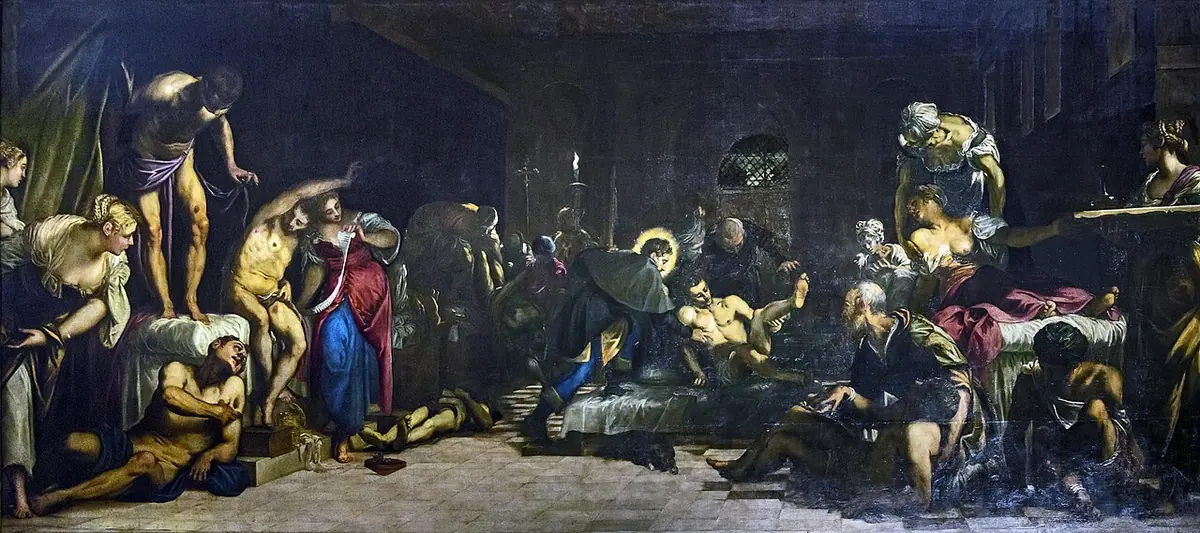
At Acquapendente, north of Rome, he found the town in the grip of plague and talked the hospital master into letting him nurse the sick day and night. The legend says he healed them with the sign of the cross. He did the same at Cesena, in Rome, where he cured a cardinal by tracing a cross on his forehead, and at Rimini and other towns, before reaching Piacenza.

The forest, the spring and the dog
At Piacenza, after a year in the hospital, he woke one night with the plague on him. The citizens drove him out, and he crawled into a wooded valley and made "a lodge of boughs and leaves." A spring rose beside the hut. Nearby lived a nobleman named Gothard who kept hunting dogs, and one of them began stealing bread from his table and carrying it off. Gothard set out a fine loaf, watched the dog take it, and followed it to the hut. Roch warned him away for fear of infection, but Gothard came back to care for him and in time became his disciple.

The Golden Legend adds that wild animals came to Roch to be healed, and that they "would incline their heads reverently and go their way" afterward. An angel finally told him he was cured and should go home.


Prisoner and stranger
On the road home he crossed a war zone, was arrested as a spy and thrown into prison. He refused to say who he was. He spent five years there in prayer. When he was dying he asked for a priest, and after his death the jailers found a light filling the cell and a tablet under his head, written in gold, promising that "who that calleth meekly to S. Rocke he shall not be hurt with any hurt of pestilence." The lord's mother recognized the cross-shaped birthmark: the prisoner was the lord's own nephew.

The miracles of St. Roch
None of Roch's miracles has been formally examined by the Church. His cult is older than the modern canonization process.
- Healing the plague-stricken with the sign of the cross; the cardinal's forehead; the spring; the dog and the bread; the healed animals; the golden tablet: all traditional, from the 15th-century Lives.
- The end of the plague at the Council of Constance in 1414, after the bishops held processions in Roch's honor: traditional. It first appears in Diedo's Vita, and Bolle and Ascagni note that what is known about the spread of his cult contradicts it.
- Protection and cures during later plagues, especially in Venice: reported. According to the National Gallery in London, Venice kept his feast every year to celebrate his part in ending the plague of 1576.
Why St. Roch is the patron saint of plague and of dogs
His patronage against plague follows straight from his story: a man who nursed plague victims, survived the disease, and died, says the legend, asking God to spare everyone who called on him. The plague in northern Italy in the late 1470s, when Diedo wrote, spread his cult further, and confraternities in his name sprang up across Europe.


The dog that fed him made him the patron of dogs. His other patronages come from details of the legend. He is patron of invalids and surgeons because he tended the sick and suffered the plague himself, of the falsely accused because he died in prison as an innocent man taken for a spy, and of bachelors because he never married. He is also patron of Venice, which holds his body, and of many towns where he is said to have stopped a plague. See all of them on our patron saints page.
Roch is often painted with St. Sebastian, the older plague saint; the two flank the Virgin on countless altarpieces from plague years. Later Christians who cared for plague victims, such as St. Charles Borromeo and St. Aloysius Gonzaga, are honored for the same kind of courage.
Symbols of St. Roch in art
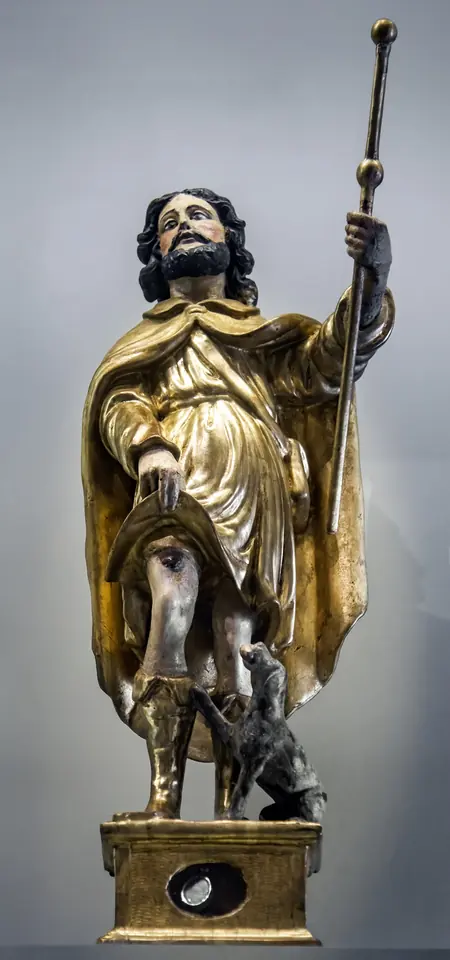
Roch is one of the easiest saints to recognize. Look for:
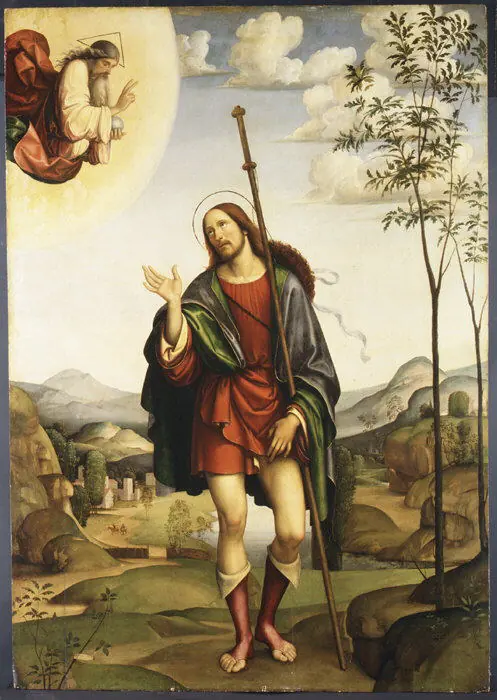
- Pilgrim's clothes: a broad-brimmed hat, a short cape, a staff, often a gourd for water and a pouch. The hat may carry a scallop shell, the badge of Compostela and St. James, or the crossed keys of Rome.
- A sore on his thigh: he lifts his tunic and points to it. The Golden Legend puts the swellings under his arms, but artists chose the thigh, and the gesture became his signature.
- A dog with a loaf of bread in its mouth, usually at his feet. Few images leave it out.
- An angel who points to heaven, brings a jar of ointment or kneels to dress his wound. This is the angel who told him he was cured.


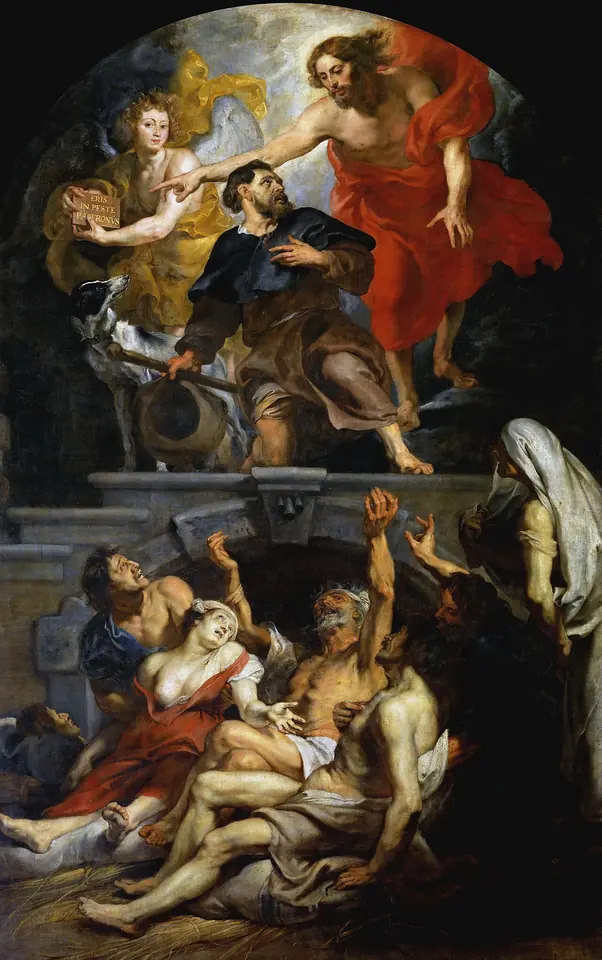
Italian Renaissance painters like Francia and Parmigianino made him a young, beardless or lightly bearded pilgrim. Northern and Spanish statues tend to give him a full beard and a scallop-covered cape. In Rubens's altarpiece for St. Martin's Church in Aalst, Christ himself appears to appoint Roch patron of the plague-stricken, who reach up from a prison below.

St. Roch in Venice and his relics
According to the Scuola Grande di San Rocco, Roch's body arrived in Venice from Voghera in 1485. On March 13 of that year the Patriarch informed the Council of Ten of the translation and certified the relics. The Scuola's own records tell of a Camaldolese monk named Mauro who brought the body from the castle of Count Pietro dal Verme, by theft in one account and by purchase in another. Voghera kept two small fragments of the arm, which its church of San Rocco still holds in a silver reliquary, along with the walnut box in which the body is said to have lain.
The body was placed in the new church of San Rocco in 1490 and moved in 1520 into a "reliquary-altar" designed by the Bergamo stonemason Venturino Fantoni, where it still lies. In 1549 the confraternity commissioned Jacopo Tintoretto to paint canvases of Roch's life for the chapel, and Tintoretto went on to fill the halls of the Scuola next door with his paintings.


The feast of St. Roch, August 16
Roch's feast is August 16, the day after the Assumption; the Golden Legend already says it "is always holden on the morn after the day of the Assumption of our Lady." Pope Gregory XIV (1590–1591) entered him in the Roman Martyrology, and Urban VIII confirmed his long-standing cult. The Roman Martyrology entry, as quoted by Christian Iconography, reads: "In Montpellier, in Occitanie, the burial of blessed Confessor Roch, who saved many cities of Italy from the plague by means of the sign of the Cross. Later his body was translated to Venice and placed with great honors in the church that is consecrated in his name." He is not on the General Roman Calendar. Find his neighbors on our feast days calendar.
In Venice, after the plague of 1576, the doge went every August 16 to Mass at San Rocco. The National Gallery in London notes that the men in the procession carried nosegays in memory of the plague, and that old and new paintings were hung on the Scuola's facade for the day.


Small reliquary statues and shrines at crossroads and town gates spread his protection across Europe. The Scuola counts some three thousand churches and chapels dedicated to him in Italy alone.

Prayer to St. Roch
The oldest prayer to St. Roch in English closes William Caxton's Golden Legend of 1483:
Then let us reverently with devotion pray unto this glorious saint S. Rocke, that by his intercession and prayer we may be delivered from the hard death of pestilence and epidemic, and that we may so live in this life and be penitent for our sins, that after this short life we may come unto everlasting life in heaven. Amen.
Catholics today ask St. Roch to pray for them in epidemics and illness, for sick animals, and for anyone wrongly accused. In Rome, Paul III founded a confraternity of St. Roch to run the church and hospital built in his honor, and Paul IV raised it to an archconfraternity. The Catholic Encyclopedia reported in 1912 that it "still flourishes."
Frequently asked questions
Why is St. Roch the patron saint of dogs?
Because of the best-known story in his legend. When Roch fell sick with plague near Piacenza and hid in the woods, a nobleman's hunting dog stole bread from its master's table every day and carried it to him. The master, Gothard, followed the dog and found him. The story is traditional, but the dog with a loaf in its mouth is in almost every picture of the saint.
When is St. Roch's feast day?
August 16, the day after the Assumption, which is the date his Lives give for his death. It is in the Roman Martyrology rather than the General Roman Calendar, and it is kept with Masses, processions and festivals wherever he is a local patron, in Italy, France, Spain, Portugal, Latin America and the Philippines.
What is the dog's name in the St. Roch story?
The old Lives don't name the dog. They name only its master, Gothard (Gottardo in Italian), whom later Italian tradition calls Gottardo Pollastrelli of Piacenza. Names given to the dog in modern books and holy cards come from later popular tradition.
Is St. Roch a real person?
Most historians accept that he was. A feast of San Rocco was already kept at Voghera, in Lombardy, by 1391, and his relics are documented there by 1469, long before his first Lives were written. But almost every detail of his story, including his dates, depends on Lives written about a hundred years after he died, and they disagree with each other.
Why is St. Roch shown pointing to his leg?
He is showing the plague sore he caught while nursing the sick. The Golden Legend actually places the swellings "under his both arms," but painters from the 1400s onward put the sore on his thigh, where it could be shown modestly, and that became the rule.
Sources
- Catholic Encyclopedia (1912): St. Roch
- The Golden Legend, The Life of S. Rocke (Caxton translation, 1483), vol. 5, Internet Medieval Sourcebook
- Scuola Grande di San Rocco: St. Roch
- Scuola Grande di San Rocco: Devotion and following
- Scuola Grande di San Rocco: Church
- Pierre Bolle and Paolo Ascagni, Rocco di Montpellier: Voghera e il suo santo (Associazione Italiana San Rocco di Montpellier, rev. 2010; archived PDF)
- Christian Iconography: St. Roch in Art
- National Gallery, London: Canaletto, Venice: The Feast Day of Saint Roch
- CatholicSaints.Info: Saint Roch (patronages)
- Roman Martyrology, August 16