St. Helena, Mother of Constantine
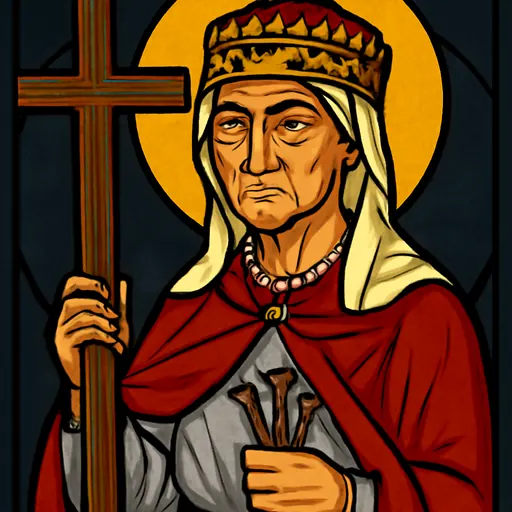
St. Helena was the mother of Constantine the Great, the first Christian Roman emperor. A woman of humble birth who became empress (Augusta) and a Christian late in life, she made a famous pilgrimage to the Holy Land around 327, built churches at Bethlehem and on the Mount of Olives, and is credited by tradition with finding the True Cross. Her feast day is August 18 (May 21 in the Orthodox Church), and she is the patron saint of archaeologists, converts and difficult marriages.
Who was St. Helena?
St. Helena was the mother of Constantine the Great, the Roman emperor who ended the persecution of Christians and became a Christian himself. She was born in humble circumstances around 248, rose to become Augusta, the highest title a Roman woman could hold, and in her late seventies traveled to the Holy Land to pray where Jesus had lived and died. There she built churches at Bethlehem and on the Mount of Olives. Within a few generations, Christians across the empire told how she had found the Cross on which Christ was crucified.
This page is about the saint. Many searches for "St. Helena" are for the island in the South Atlantic, which the Portuguese named after her.

Her life is better documented than that of most early saints. Eusebius of Caesarea, a bishop who knew Constantine, described her pilgrimage and death in his Life of Constantine, written soon after 337. Coins and inscriptions record her titles. The story of the True Cross is another matter. It appears in writing only decades after her death and grew in the telling, and this article separates what the early sources say from what tradition added.
The life of St. Helena
An innkeeper's daughter
Helena was probably born at Drepanum, a town in Bithynia on the Gulf of Nicomedia in northwest Turkey. Constantine later renamed it Helenopolis in her honor, and the 6th-century historian Procopius says he did so because his mother was born there. Since Eusebius says she died at about eighty, the historian Jan Willem Drijvers places her birth around 248 or 249.
Her family was poor. St. Ambrose, in his funeral oration for the emperor Theodosius in 395, called her a stabularia, a stable-maid or innkeeper. Other ancient writers were less kind; the church historian Philostorgius compared her to a prostitute. She met Constantius, a rising Roman officer, perhaps around 270, and their son Constantine was born at Naissus (today Niš in Serbia) in 272 or 273.
Whether Helena and Constantius were legally married is still debated. Drijvers thinks they probably lived in concubinage, a recognized arrangement for couples of unequal rank. The Catholic Encyclopedia calls her his lawful wife. Either way, when Constantius was made Caesar, one of the empire's junior emperors, he left Helena to marry Theodora, the stepdaughter of the senior emperor Maximian. Drijvers dates the separation to 289; the Orthodox life of the saint gives 294. Helena then disappears from the record for many years.
A medieval legend: Helena of Britain
English chroniclers of the Middle Ages, and especially Geoffrey of Monmouth, told a different story: that Helena was a British princess, the daughter of "Old King Cole" of Colchester. The tale was loved in England, and Colchester still claims her. Some older Catholic lives repeated it. The Catholic Encyclopedia says the British birth is "entirely without historical foundation" and suggests it arose from a misread phrase in a Roman speech about the start of Constantine's reign in Britain.
Mother of the emperor
In 306 the army at York proclaimed Constantine emperor after his father's death, and Helena seems to have joined her son's court. Constantine lived at Trier, on the Moselle in today's Germany, and then in Rome, where Helena owned a large estate in the southeast of the city, including the Sessorian palace. Eusebius says Constantine "rendered her through his influence so devout a worshiper of God, (though she had not previously been such,) that she seemed to have been instructed from the first by the Saviour of mankind." Drijvers concludes that she probably became a Christian after 312, when her son defeated Maxentius at the Milvian Bridge.
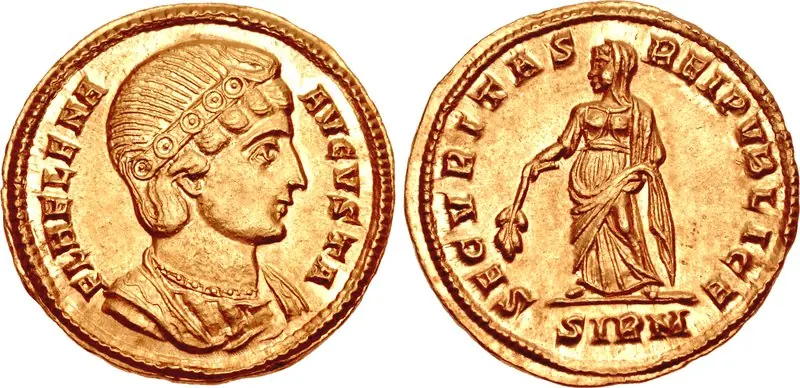
In 324, after Constantine became sole ruler of the empire, he named her Augusta. Gold coins carried her portrait, and Eusebius says Constantine gave her authority over the imperial treasury "to use and dispense them according to her own will and discretion in every case."

The pilgrimage to the Holy Land
Helena set out for Palestine and the eastern provinces around 326–328, when she was nearly eighty. Eusebius says she went to give thanks to God for her son and grandsons and "hastened with youthful alacrity to survey this venerable land." Drijvers adds that the journey may also have been an act of political reconciliation. In 326 Constantine had put to death his eldest son Crispus and his wife Fausta, and the empire was shaken.


Bethlehem and the Mount of Olives
Eusebius credits Helena with two churches. "She dedicated two churches to the God whom she adored, one at the grotto which had been the scene of the Saviour's birth; the other on the mount of his ascension." The first was the Church of the Nativity in Bethlehem, over the cave where Christians remembered the birth of Christ. The second, called the Eleona, stood on the summit of the Mount of Olives over a cave where, Eusebius says, Jesus taught his disciples. Its ruins lie under the modern Church of the Pater Noster. Constantine added gifts of silver, gold and embroidered hangings.


The great church over the tomb of Christ in Jerusalem, the Holy Sepulchre, was Constantine's own project. Eusebius quotes his letter ordering Bishop Macarius of Jerusalem to build it after workers removed a temple of Venus and found the tomb. Later writers gave Helena a part in this too.
Charity on the road
Eusebius remembered Helena's generosity more than her buildings. On her journey she gave to whole cities and to individuals, to soldiers and above all to the poor. "To some she gave money, to others an ample supply of clothing: she liberated some from imprisonment, or from the bitter servitude of the mines; others she delivered from unjust oppression, and others again, she restored from exile." Though she was empress, he adds, she could be seen "in simple and modest attire, mingling with the crowd of worshipers."
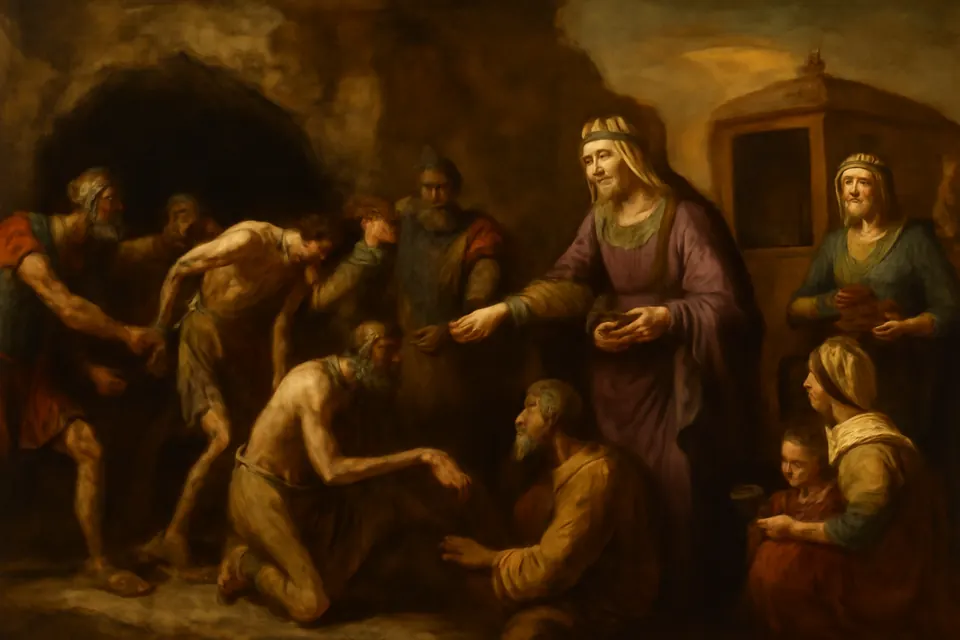
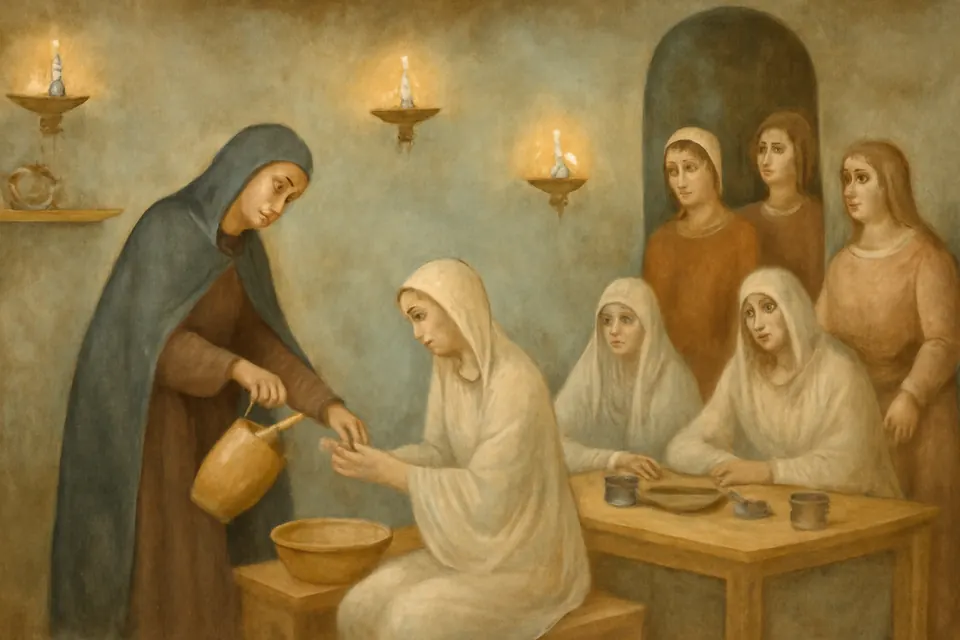
The 5th-century historians tell one more story. In Jerusalem she invited the women who had vowed their lives to God to a meal and waited on them herself. Theodoret says she "fulfilled the duties of a handmaid, serving them with food and handing them cups and pouring out wine, and bringing a basin and pitcher, and pouring out water to wash their hands."
Her death
Soon after returning, Helena died at about eighty with Constantine beside her. Eusebius writes that he "was in attendance at her side, caring for her and held her hands." The coins issued in her name stop in the spring of 329, so Drijvers dates her death to late 328 or early 329. She was buried in Rome in a round mausoleum on the Via Labicana, beside the basilica of Sts. Marcellinus and Peter, which still stands in ruins at Tor Pignattara. The Roman Martyrology remembers her "in Rome on the Via Lavicana." Socrates, writing in Constantinople a century later, believed her remains had been taken to the new capital.
The finding of the True Cross
No part of Helena's story is better known, and no part is harder to pin down. Here are the sources in the order they were written.
- Eusebius (soon after 337) describes the uncovering of Christ's tomb and Helena's pilgrimage at length. He never mentions the Cross being found.
- St. Cyril of Jerusalem (about 348), preaching at Golgotha, says "the whole world has since been filled with pieces of the wood of the Cross." Relics of the Cross were already being venerated in Jerusalem. In a letter of 351 to the emperor Constantius II, Cyril says the Cross was found in Constantine's reign, but he doesn't say by whom.
- St. Ambrose (395) is the first known writer to credit Helena. In his funeral sermon for Theodosius, he says she searched Golgotha, found three crosses and recognized Christ's by the title Pilate had fixed above it. Ambrose insists that she worshiped the King, not the wood.
- Rufinus (about 402) tells the story most later writers follow. Helena and Bishop Macarius found three crosses and could not tell which was Christ's. Macarius had each one touched to a dying woman. At the third, she recovered and, in Thomas Head's translation, "began to run about all over the house magnifying the power of the Lord."
- Socrates, Sozomen and Theodoret (about 440–450) repeat Rufinus's account with additions. Sozomen says some credited a Jew who had inherited old documents, but he preferred to believe God revealed the place "by means of signs and dreams." He also reports that a dead person was restored to life by the Cross.


All three historians say Helena left part of the Cross in Jerusalem in a silver case and sent part to Constantine with the nails. Socrates says the emperor sealed a piece in his own statue on a porphyry column in Constantinople, and that he had the nails made "into bridle-bits and a helmet." Theodoret explains the bridle by the prophet Zechariah: "There shall be upon the bridles of the horses Holiness unto the Lord Almighty."
A further version, the legend of Judas Cyriacus, spread from the 5th century. In it a Jew named Judas reveals where the Cross is buried and later becomes a bishop. Drijvers notes it became the most popular version, "probably because of its anti-Judaism." Through the Golden Legend it reached medieval Europe, together with older tales that traced the wood back to a tree planted on Adam's grave. The Catholic Encyclopedia calls the beliefs drawn from the Cyriacus story "universally held to be apocryphal," while defending the core tradition that the Cross was found in Jerusalem in Helena's time.
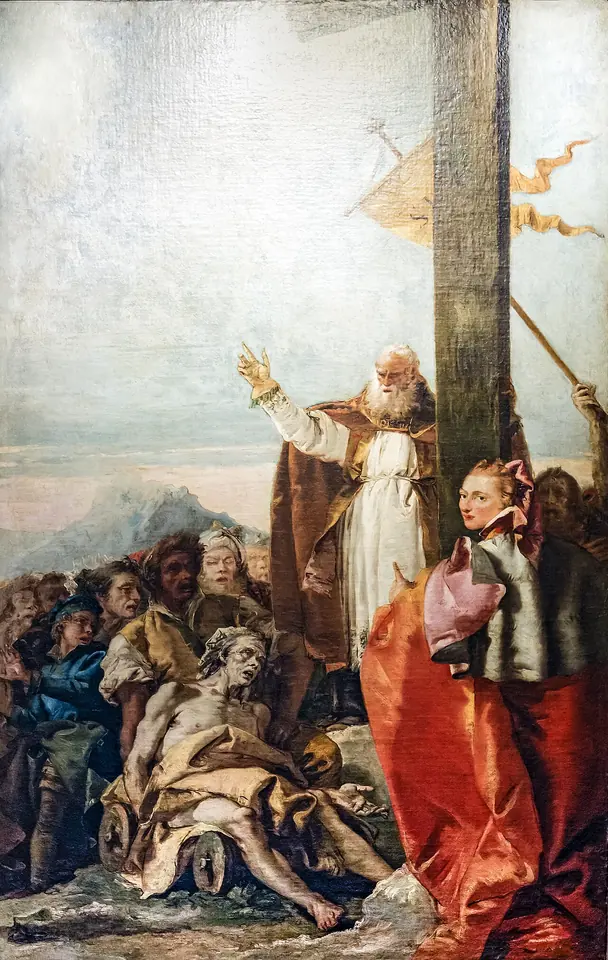

What can be said with confidence? A wooden relic believed to be the Cross was venerated in Jerusalem by the 340s. Around 380 the pilgrim Egeria watched the faithful file past it on Good Friday, kissing it while deacons stood guard. Helena was in Jerusalem in the late 320s, when the tomb of Christ had just been uncovered. Drijvers, a leading scholar of her life, concludes that her fame for finding the Cross rests on an act "for which she was probably not responsible." Catholic and Orthodox Christians honor her as its finder by long tradition.
The miracles of St. Helena
None of the miracles connected with Helena has been formally investigated by the Church. Sorted by this encyclopedia's labels:
- The healing of the dying woman by the Cross: traditional. It is found in Rufinus, Socrates, Sozomen and Theodoret, and the Orthodox and Catholic traditions of the Cross both accept it.
- The raising of a dead man by the Cross: traditional. Sozomen reports it as hearsay; the Judas Cyriacus legend makes it the main proof.
- A dream or vision guiding her search: traditional. Socrates says she went to Jerusalem "divinely directed by dreams."
- Answered prayers through her intercession: reported, by Christians who ask her help in family troubles, searches and conversions, but not examined by the Church.
Eusebius, the one writer who knew her son, records no miracles at all. He remembers her for prayer, churches and charity.
Why St. Helena is the patron saint of archaeologists, converts and difficult marriages
- Archaeologists: the tradition that she directed the digging at Calvary makes her, in a loose sense, the first Christian excavator.
- Converts: she came to Christian faith late in life. Eusebius says she was not a believer before her son influenced her.
- Difficult marriages and divorced people: Constantius left her to marry an emperor's stepdaughter when she was about forty. She is one of several saints, with St. Rita of Cascia, whom Catholics ask to pray for troubled marriages.
- Empresses: for obvious reasons. In the Orthodox world she and Constantine became the model of a Christian ruler.
Older lists also name her against fire, storms and thunder, and as patron of nail makers and needle makers, from the nails of the Cross. See all the patron saints by cause.
Symbols of St. Helena in art
Once you know her attributes, Helena is easy to find in churches and museums.
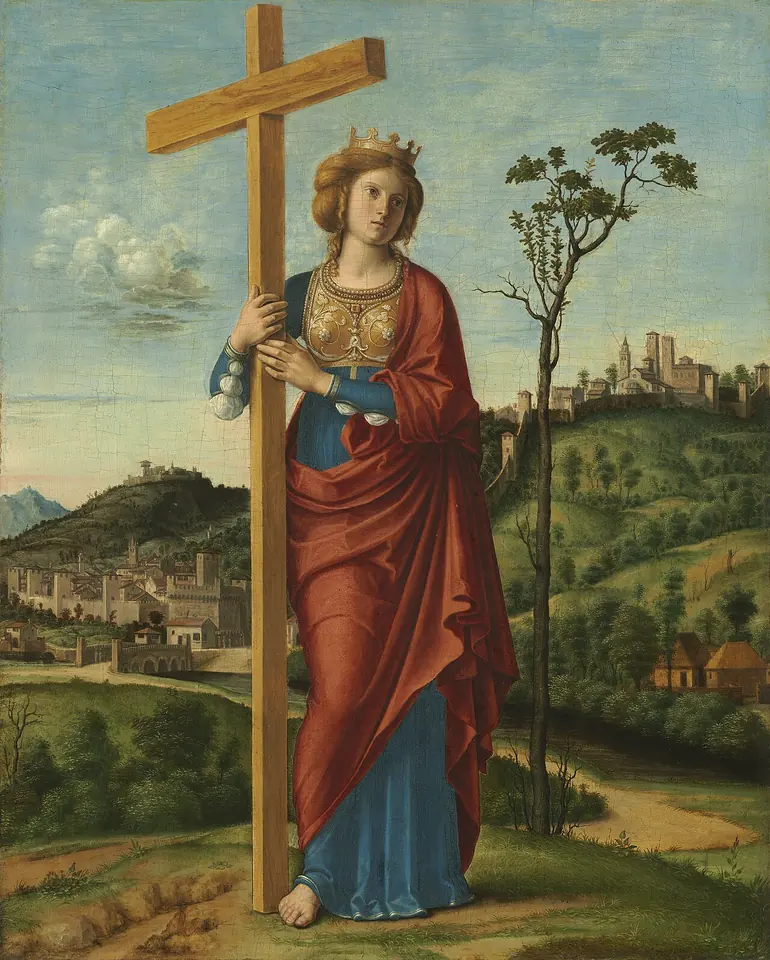
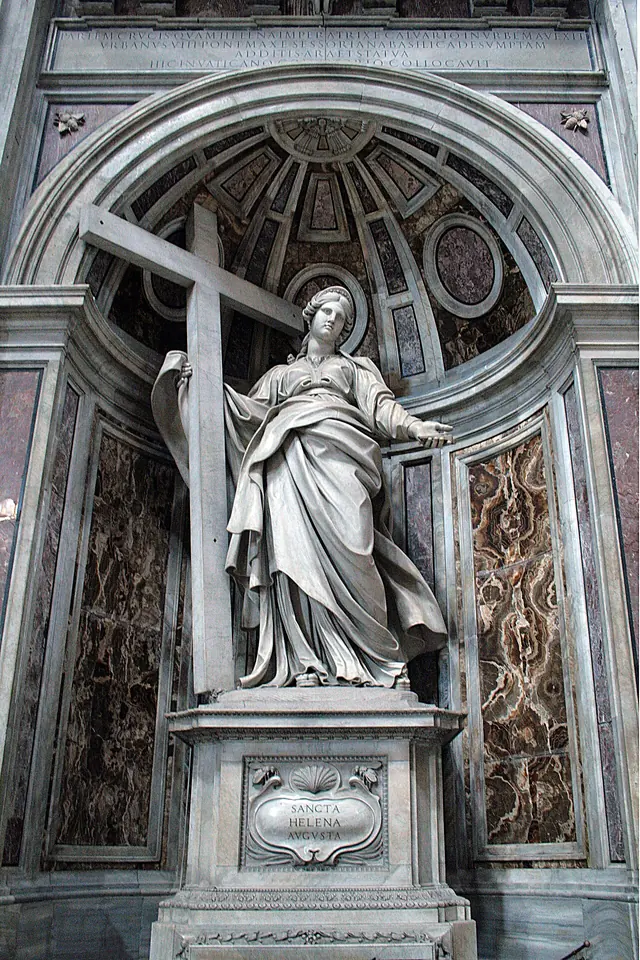
- A large wooden cross: her main attribute, usually taller than she is. Christian Iconography notes that it is rarely tall enough for a real crucifixion; it's a sign more than a likeness.
- A crown and imperial robes: she was Augusta. Western painters often make her a young queen, as Cima da Conegliano did; Eastern icons show a crowned Byzantine empress.
- Nails: sometimes three, the nails of the Crucifixion.
- Workers digging, or a man rising from a bier: scenes from the finding of the Cross, as in Piero della Francesca's frescoes.
- Asleep with a vision of the Cross: Veronese's painting shows the legend that a dream guided her.
- Standing with Constantine: in Eastern icons the two almost always stand on either side of the Cross, both crowned, holding it between them.
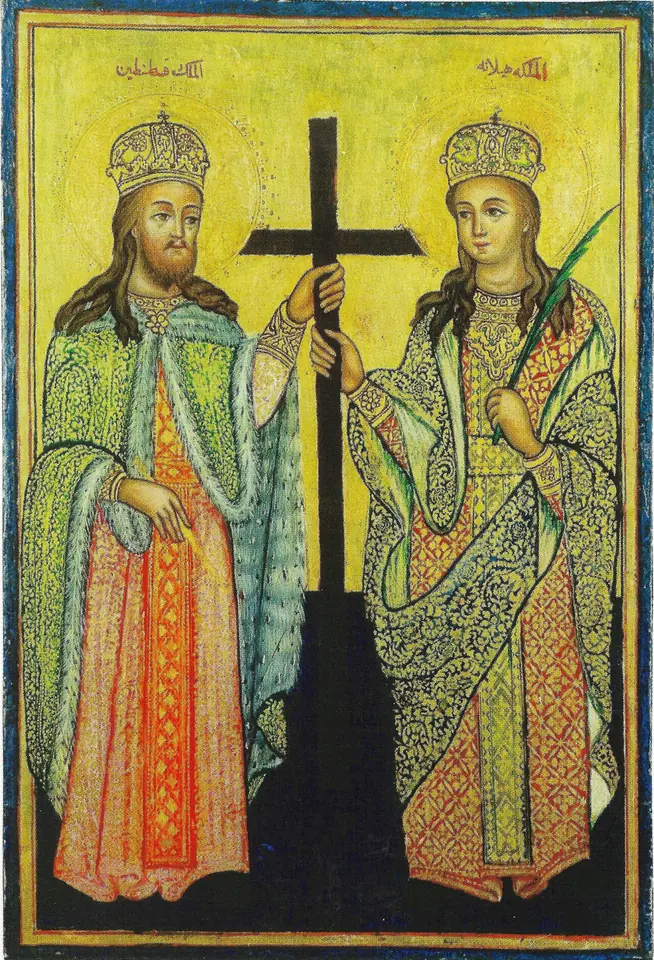

The pairing with Constantine is the easiest way to recognize her in an Orthodox church. In the West, look for a crowned woman with a cross and no martyr's palm.
Feast day and where St. Helena is honored
The Catholic Church remembers St. Helena on August 18, the date given in the Roman Martyrology. She is not on the General Roman Calendar, so most parishes don't celebrate her at Mass, though churches dedicated to her do. The Orthodox Church keeps May 21, the feast of Saints Constantine and Helen, "Equal to the Apostles," and also remembers the uncovering of the Cross and Nails by Helena on March 6. The Feast of the Exaltation of the Holy Cross on September 14 is tied to her story in both East and West. See the feast day calendar.
In Ethiopia, the great festival of Maskel on September 26 commemorates the unearthing of the True Cross with a huge bonfire in Addis Ababa. UNESCO has listed it as part of the Intangible Cultural Heritage of Humanity.
Santa Croce in Gerusalemme, Rome
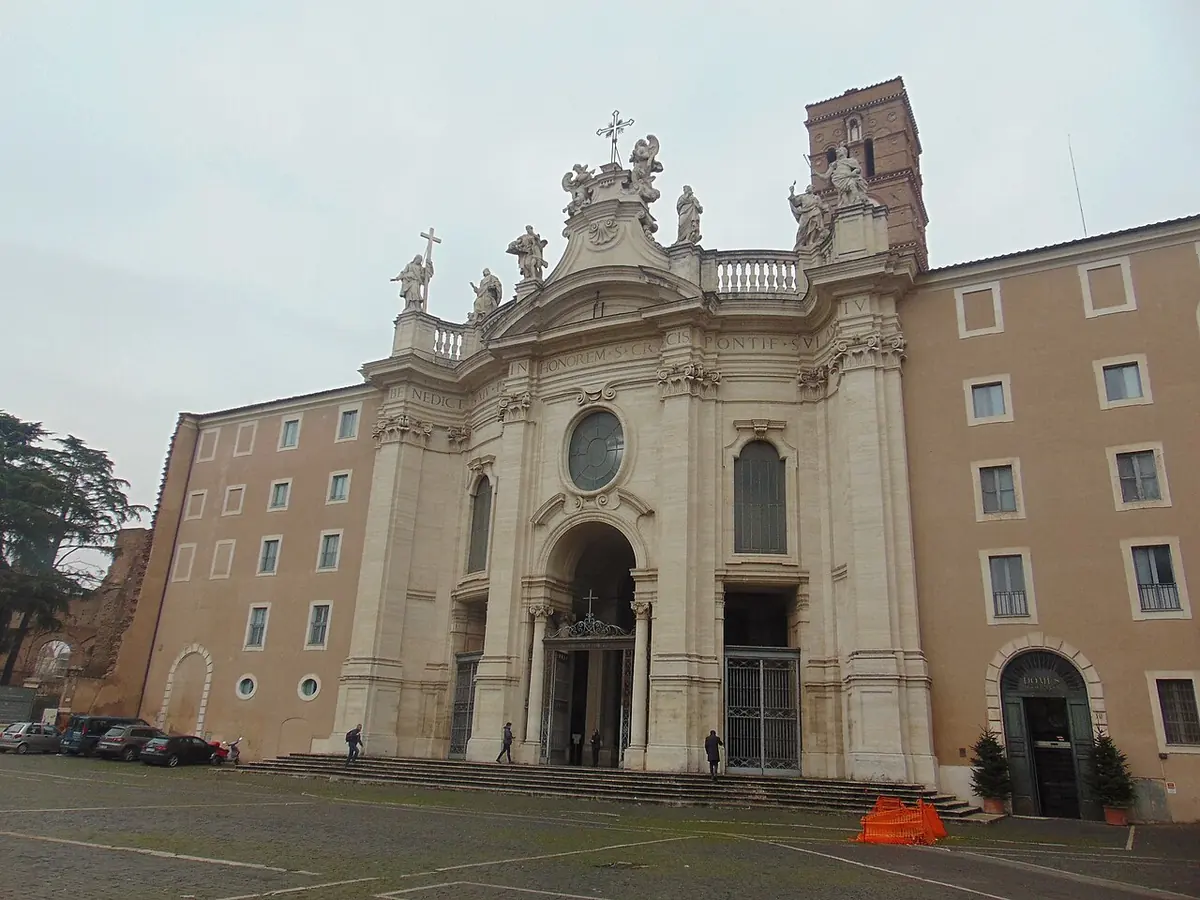
Helena's Roman residence, the Sessorian palace, became the church of Santa Croce in Gerusalemme, "Holy Cross in Jerusalem." The Catholic Encyclopedia thinks it quite possible that Constantine built a basilica there at her suggestion in honor of the True Cross. Its chapel of relics keeps fragments of the Cross and other relics of the Passion that tradition says she brought from Jerusalem.

St. Peter's Basilica
One of the four great piers that hold up Michelangelo's dome in St. Peter's is dedicated to Helena. Andrea Bolgi's colossal marble statue of her stands in its niche, embracing a huge cross, and the chapel above it keeps relics of the True Cross.

Trier
Trier honors Helena as the city's own saint. Its cathedral says that, according to tradition, she brought the Holy Robe of Christ, the seamless tunic of John 19:23, from the Holy Land to Trier, and that she gave the Trier church a Holy Nail, now kept in a 10th-century reliquary in the cathedral treasury. The cathedral itself admits that the robe's authenticity can be proved neither by historical nor by scientific methods. A skull venerated as hers is kept in the cathedral's east crypt.
Her tomb and relics
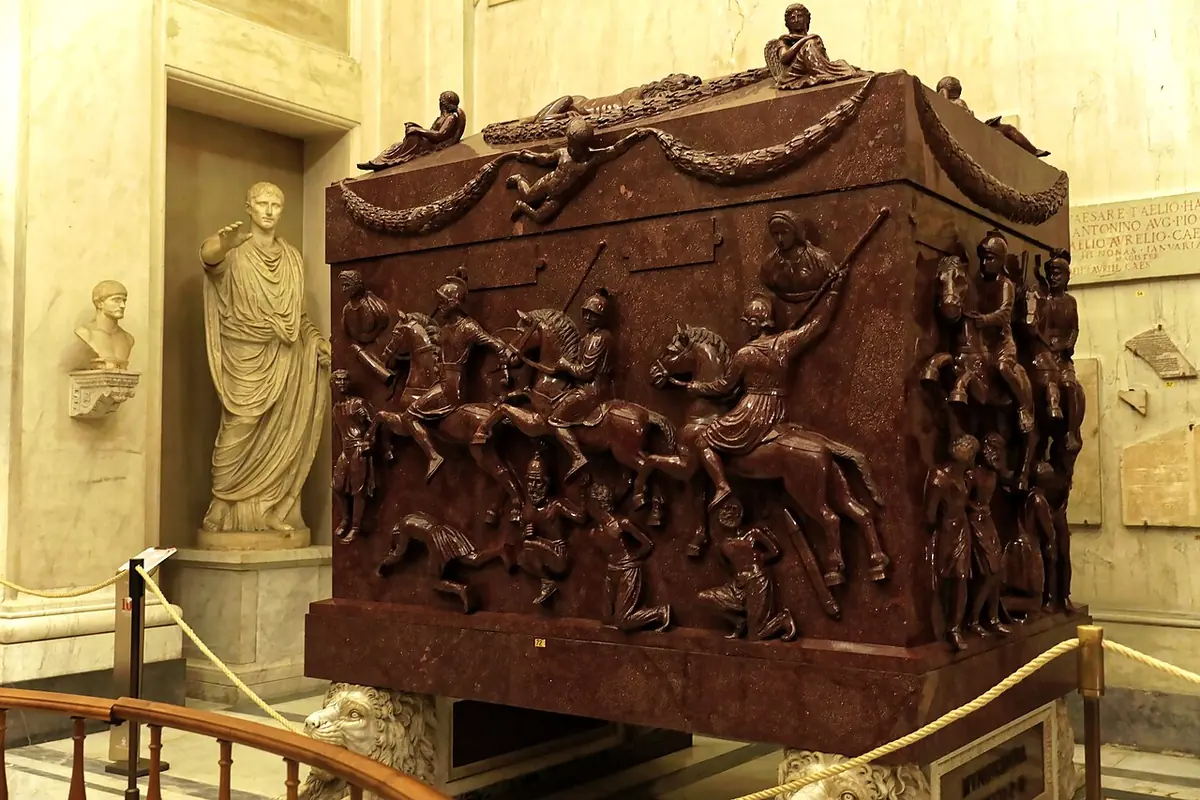
Her porphyry sarcophagus, carved with Roman cavalry riding over captives, came from her mausoleum on the Via Labicana and was brought into the Vatican in 1777. The Vatican Museums note that its military scenes suit a man better than a woman and that it may first have been made for her husband or for Constantine himself.

Her body itself has a complicated history. According to the 9th-century monk Altmann, it was taken to the Abbey of Hautvillers in the Archdiocese of Reims; the Catholic Encyclopedia dates the move to 849. Those relics survived the French Revolution and since 1819 have been in the Paris church of Saint-Leu-Saint-Gilles, brought there by the Knights of the Holy Sepulchre. The basilica of Santa Maria in Aracoeli in Rome and the church of Sant'Elena in Venice also claim her body or relics. These claims overlap and can't all be right.
Prayer to St. Helena
There is no single traditional Catholic prayer to St. Helena in common use, and she has no proper prayer in the Roman Missal. Catholics ask her to pray for them in their own words, especially in family troubles, searches for something lost and the conversion of loved ones, often with an Our Father, a Hail Mary and a Glory Be.
The Orthodox Church sings this kontakion on May 21, in the translation of the Orthodox Church in America:
Today Constantine and his mother Helen / reveal the precious Cross, / the weapon of the faithful / against their enemies. / For our sakes, it has been shown to be a great sign, and fearsome in battle.
Since her story is the story of the Cross, many Christians remember her on September 14, when the Church sings of the Cross Helena is said to have found.
Frequently asked questions
What is St. Helena the patron saint of?
Archaeologists, because of the tradition that she excavated the site of Calvary and found the Cross. Converts, since she became a Christian late in life. Difficult marriages and divorced people, because her husband Constantius left her for a politically useful marriage. She is also a patron of empresses and of Colchester in England.
When is St. Helena's feast day?
August 18 in the Roman Catholic Church, where the Roman Martyrology names her on that day. The Orthodox Church celebrates her with her son on May 21 as Saints Constantine and Helen, Equal to the Apostles, and the Church of England also keeps May 21.
Did St. Helena really find the True Cross?
The oldest sources disagree. Eusebius, who described her pilgrimage in detail, never mentions the Cross. St. Cyril of Jerusalem spoke of relics of the Cross by about 348 and later wrote that it was found in Constantine's reign, without naming Helena. St. Ambrose in 395 is the first known writer to credit her. Catholic and Orthodox tradition holds that she found it; many historians think the finding happened in her time but without her. This encyclopedia labels it traditional.
Where are St. Helena's relics?
Several places claim them. She was buried in a mausoleum on the Via Labicana outside Rome, and her empty porphyry sarcophagus is now in the Vatican Museums. Relics kept at Hautvillers Abbey in France since the 9th century have been in the Paris church of Saint-Leu-Saint-Gilles since 1819. Santa Maria in Aracoeli in Rome, Trier Cathedral (a skull) and the church of Sant'Elena in Venice also claim relics.
Was St. Helena British?
Almost certainly not. Medieval English writers, especially Geoffrey of Monmouth, made her the daughter of "Old King Cole" of Colchester, but the Catholic Encyclopedia calls that story "entirely without historical foundation." Ancient sources point to Drepanum in Bithynia, in northwest Turkey, which Constantine renamed Helenopolis in her honor.
Why is St. Helena shown with a cross and nails?
The cross is the True Cross that tradition says she found in Jerusalem. The nails are the nails of the Crucifixion, which the 5th-century historians Socrates, Sozomen and Theodoret say she also found and sent to Constantine, to be set in his helmet and his horse's bridle.
Is the island of St. Helena named after her?
Yes. The island in the South Atlantic was named for her by the Portuguese sailors who found it in the 1500s. Many searches for "St. Helena" are about the island; this page is about the saint.
Sources
- Catholic Encyclopedia (1910): St. Helena
- Catholic Encyclopedia (1908): The True Cross
- Catholic Encyclopedia (1908): Archaeology of the Cross and Crucifix
- Eusebius, Life of Constantine, Book III, chapters 25–47
- Socrates Scholasticus, Church History, Book I, chapter 17
- Sozomen, Ecclesiastical History, Book II, chapters 1–2
- Theodoret, Ecclesiastical History, Book I, chapter 17
- Cyril of Jerusalem, Catechetical Lecture 4
- Jan Willem Drijvers, Helena Augusta (248/249–328/329 A.D.), De Imperatoribus Romanis
- Vatican Museums: Sarcophagus of St. Helena
- Orthodox Church in America: Equal of the Apostles and Emperor Constantine with his Mother Helen
- Orthodox Church in America: Troparion and Kontakion of Saints Constantine and Helen
- Trier Cathedral: Bau- und Kunstgeschichte (the Holy Robe tradition)
- Trier Cathedral: Heiliger Nagel (the Holy Nail reliquary)
- Saint-Leu-Saint-Gilles parish, Paris: Histoire de l'église
- UNESCO: Commemoration feast of the finding of the True Holy Cross of Christ (Maskel, Ethiopia)
- Christian Iconography: St. Helena in Art
- Jacobus de Voragine, The Golden Legend (Caxton translation): The Invention of the Holy Cross
- Catholic Culture: Liturgical calendar, August 18 (St. Helena in the Roman Martyrology; patronages; Butler's Lives)
- Roman Martyrology, August 18