St. Bridget of Sweden

St. Bridget of Sweden (1303–1373) was a Swedish noblewoman, wife and mother of eight who, after her husband's death, recorded the visions published as her Revelations and founded the Order of the Most Holy Savior, the Bridgettines. She spent her last 24 years in Rome. Pope John Paul II named her a co-patron of Europe in 1999, and her feast day is July 23.
Who was St. Bridget of Sweden?
Bridget (Birgitta in Swedish) was born in 1303 at Finsta, in the Swedish province of Uppland, to one of the richest noble families in the kingdom. Her father, Birger Persson, was lawman of Uppland, and her mother, Ingeborg Bengtsdotter, was known for her piety. She lived two lives. For 28 years she was a wife, a mother of eight and a lady of the royal court. After her husband died she became a visionary, the founder of a religious order and, from 1349 until her death in 1373, a pilgrim living in Rome who wrote to popes and kings.
Benedict XVI noted that her life is well documented because "her spiritual fathers compiled her biography in order to further the process of her canonization immediately after her death."
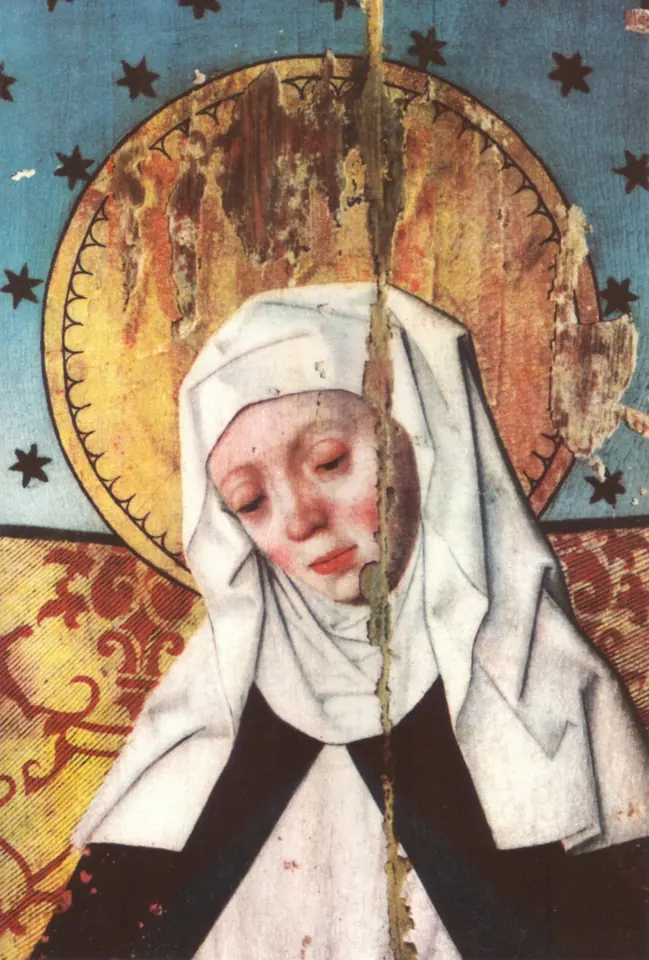

The life of St. Bridget of Sweden
Wife, mother and courtier
The Catholic Encyclopedia says Bridget showed "extraordinary religious impressions" from the age of seven. Her mother died around 1315, and an aunt raised her. In 1316, at thirteen, she married Ulf Gudmarsson, who was eighteen. It was a happy marriage, and the couple lived by the rule of the Franciscan tertiaries, served the poor and founded a hospital. Of their eight children, the second, Karin, is venerated as St. Catherine of Sweden.
King Magnus Eriksson called Bridget to court to help his young queen, Blanche of Namur, learn Swedish ways. Around 1341 she and Ulf made the long pilgrimage to the shrine of St. James at Santiago de Compostela. On the way back Ulf fell ill, and he died in 1344 at the Cistercian monastery of Alvastra.
The revelations
As a widow Bridget gave away her possessions and settled near Alvastra. There, Benedict XVI says, "began the divine revelations that were to accompany her for the rest of her life." She believed that Christ himself spoke to her. She dictated what she received in Swedish to her confessors, Prior Peter of Alvastra and Master Mathias, a canon of Linköping, who put it into Latin. The Revelationes fill eight books with a supplement.
They are full of the Passion of Christ and the sorrows of Mary, and of sharp warnings to kings, bishops and popes. In one passage Christ tells her: "O my friends, I love my sheep so tenderly that were it possible I would die many other times for each one of them that same death I suffered for the redemption of all" (Book I, chapter 59).
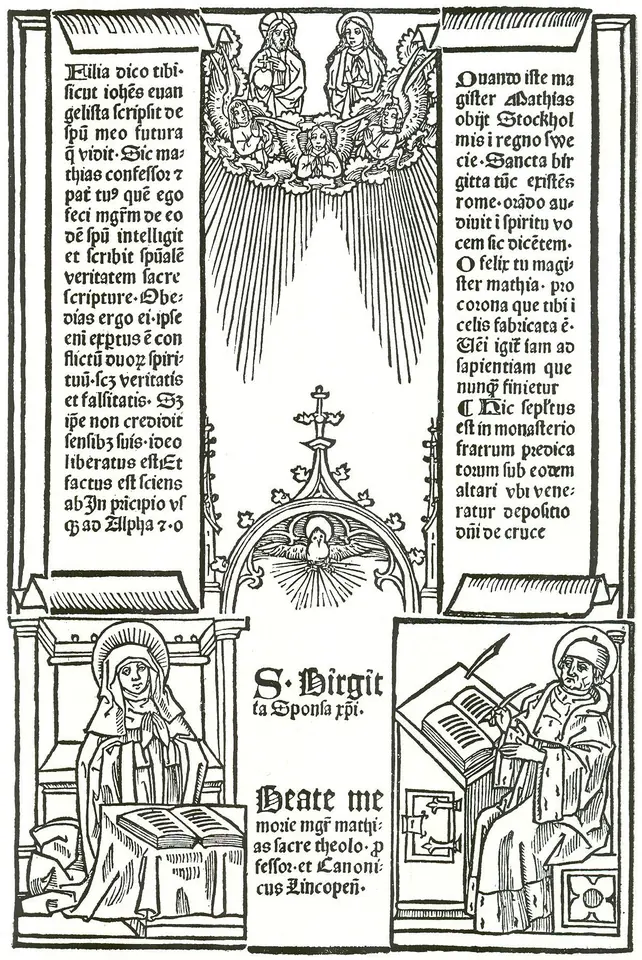

The Bridgettines
In 1346 Bridget founded the Order of the Most Holy Savior, the Bridgettines. King Magnus and his queen gave land at Vadstena for its first monastery, planned as a double house of nuns and monks under the authority of an abbess.
Rome, Avignon and Jerusalem
In 1349 she left Sweden for good to seek papal approval for her order and to keep the Jubilee of 1350 in Rome. She never went home. With her daughter Karin she gave herself to prayer and charity in Rome and made pilgrimages to Italian shrines, especially Assisi, home of St. Francis, whom she loved. The popes were then living at Avignon, and she pleaded with them to return to Rome. Pope Urban V approved her rule in 1370.

In 1371 she set out for the Holy Land with a group of companions she called "the friends of God." She died in Rome on July 23, 1373, a few years before Pope Gregory XI returned for good. Her body rested briefly in San Lorenzo in Panisperna; in 1374 her son Birger and daughter Karin carried it home to Vadstena. Pope Boniface IX canonized her on October 7, 1391.
Bridget's visions and miracles
The Church treats Bridget's visions as private revelations. John Paul II wrote that it "recognized Bridget's holiness without ever pronouncing on her individual revelations," while accepting "the overall authenticity of her interior experience." Her early biographers recorded prophecies and healings during her life and after her death; this encyclopedia lists them as reported.
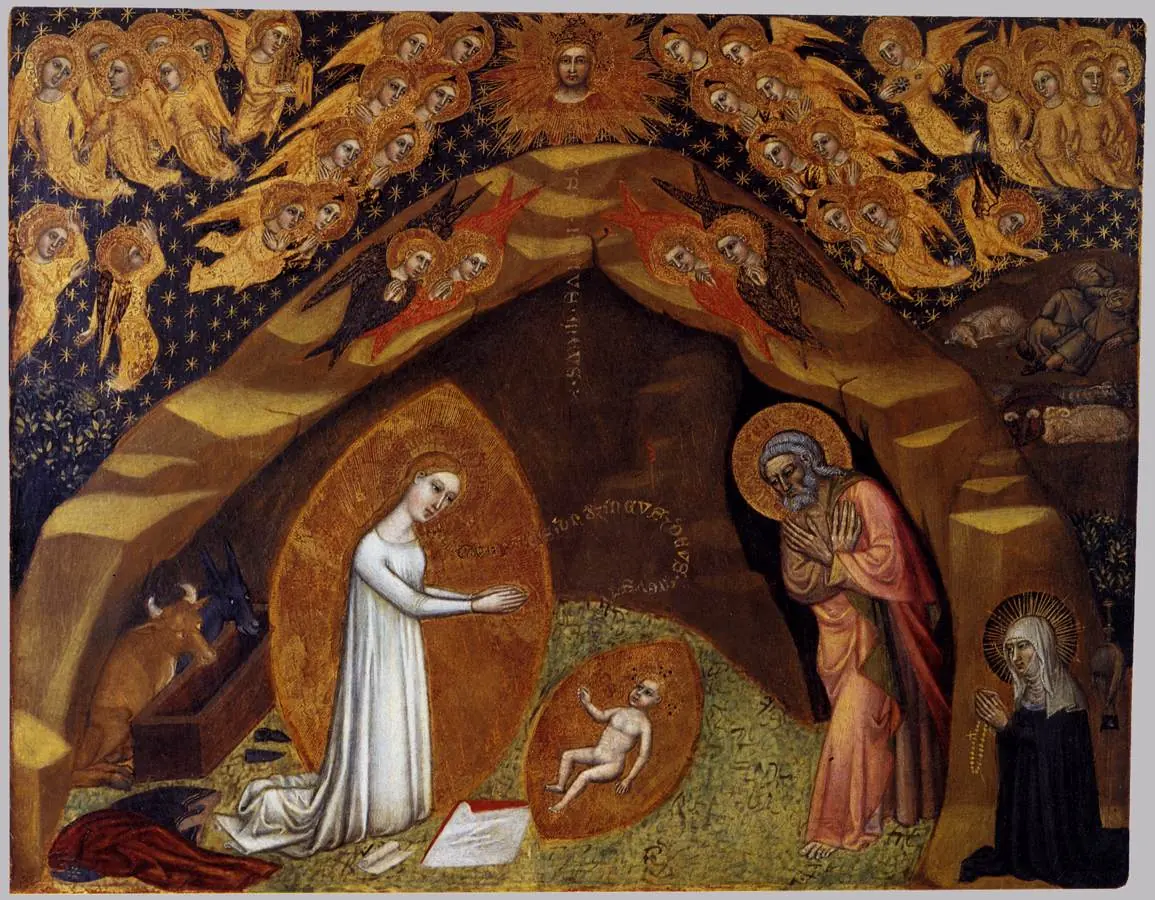
Her vision of the Nativity, received at Bethlehem during her pilgrimage, changed Christian art. In the Revelations she says she saw the newborn Christ "lying on the earth, naked and glowing," with Mary kneeling to adore him. After her, painters across Europe began to show Mary and Joseph kneeling before a radiant child on the ground.

Why St. Bridget is a patron saint of Europe
On October 1, 1999, in the letter Spes Aedificandi, John Paul II named Bridget, St. Catherine of Siena and St. Teresa Benedicta of the Cross co-patrons of Europe, joining St. Benedict and Sts. Cyril and Methodius. He chose Bridget as a woman from the far north who made Rome her goal, and as an ecumenical "bridge," since the Scandinavian churches separated from Rome in the 16th century. She is also a patron of Sweden. See all patron saints.
Symbols of St. Bridget of Sweden in art
Bridget almost always appears as a widow in a white veil and wimple, often older. Look for:
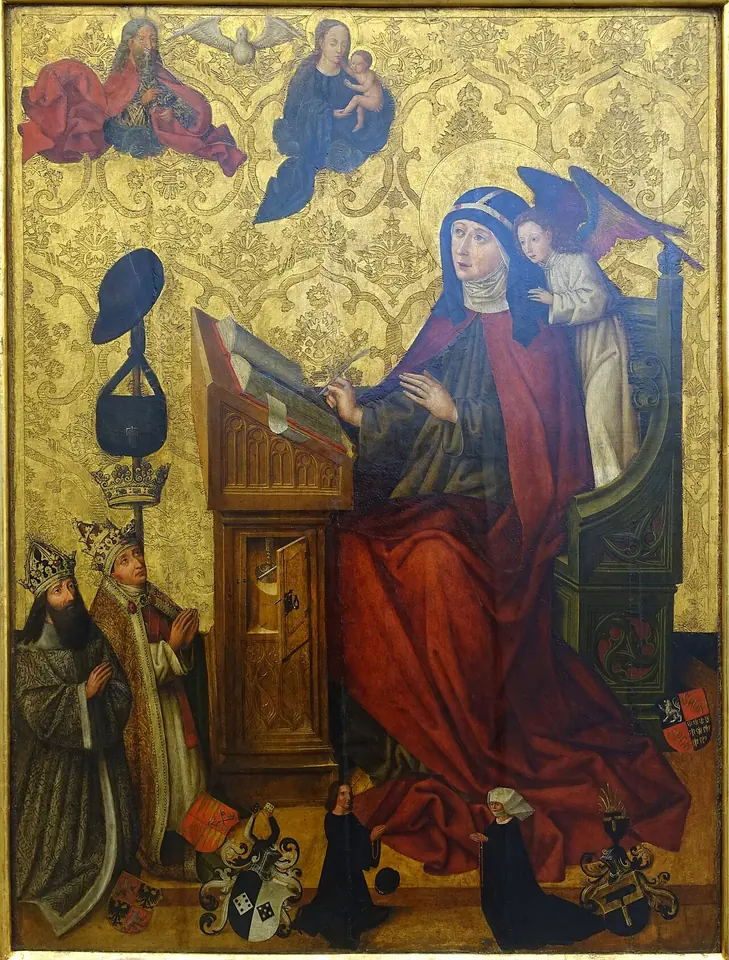
- A writing desk, book and pen, for her revelations and letters.
- A pilgrim's staff, hat and bag, for Santiago, Rome and Jerusalem; the hat may carry a Veronica badge.
- An angel, or the dove of the Holy Spirit, near her as she writes.
- The Nativity, when she kneels beside Mary and Joseph.
- A heart, sometimes flaming or marked with a cross, for her devotion to the Passion.
Her nuns wear a crown of metal bands set with five red stones for the five wounds of Christ. The Nuremberg epitaph on this page brings several attributes together: desk, angel, pilgrim's hat and staff.

Feast day and where St. Bridget is honored
Her feast is July 23, an optional memorial on the General Roman Calendar and a feast in Europe. See the feast days calendar.
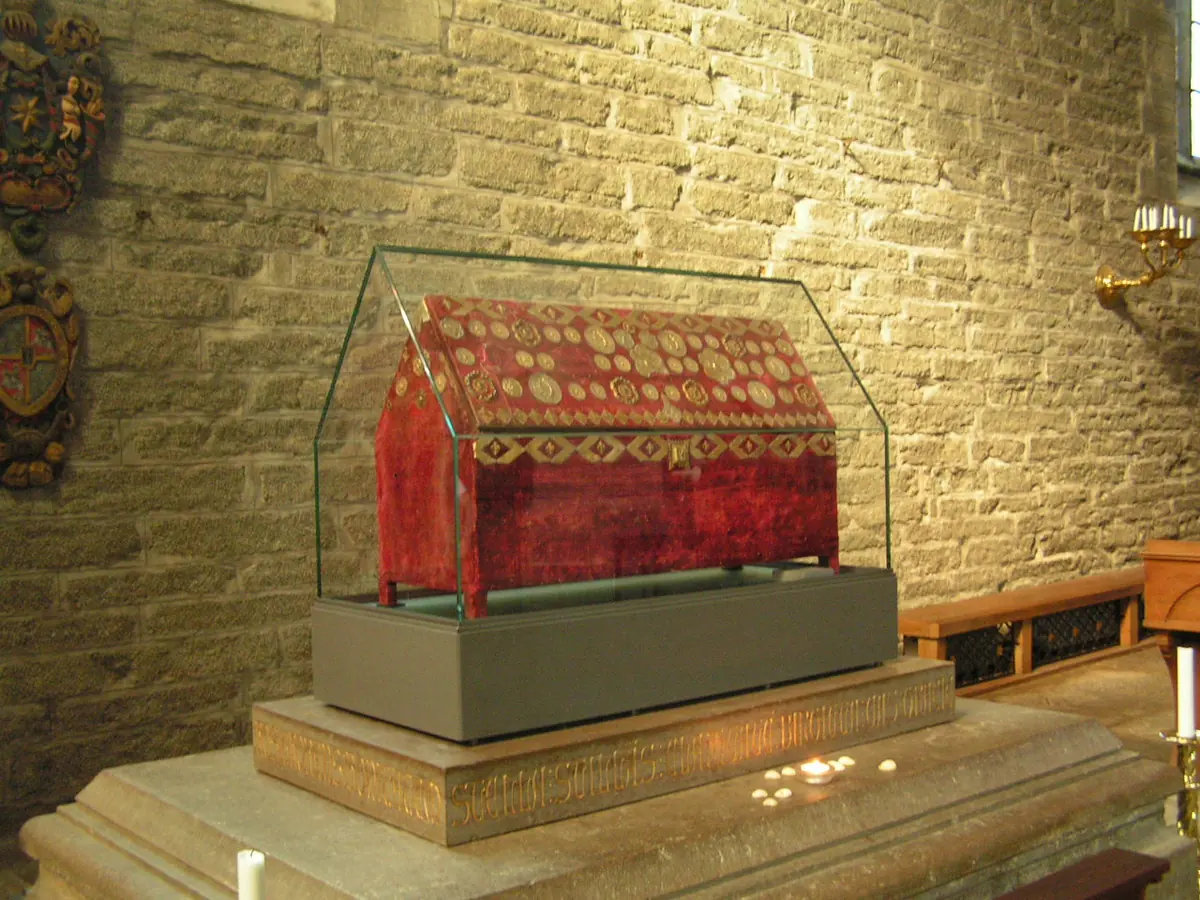
Her relics lie in a reliquary shrine in Vadstena Abbey Church, beside the site of the first Bridgettine monastery, which her children made her resting place in 1374.

Prayer to St. Bridget
The Church's prayer for her memorial, the collect of the Roman Missal (English text as given by Catholic Culture), reads:
O God, who guided Saint Bridget of Sweden along different paths of life and wondrously taught her the wisdom of the Cross as she contemplated the Passion of your Son, grant us, we pray, that, walking worthily in our vocation, we may seek you in all things.
Outside the liturgy, Catholics ask St. Bridget's prayers for Europe, for Christian unity and for widows, and many read her Revelations on the Passion as meditations. Devotional books also print a set of "Fifteen Prayers" on the Passion under her name; we don't reproduce them here because we haven't been able to confirm their origin.


Frequently asked questions
Why is St. Bridget of Sweden a patron saint of Europe?
On October 1, 1999, Pope John Paul II named her, St. Catherine of Siena and St. Teresa Benedicta of the Cross (Edith Stein) co-patrons of Europe, alongside St. Benedict and Sts. Cyril and Methodius. He called Bridget a figure of the "extreme north" of Europe who made Rome her goal, and an ecumenical "bridge" to the Scandinavian countries separated from Rome in the 16th century.
What are the Revelations of St. Bridget?
The accounts of her visions, which she dictated in Swedish to her confessors, who translated them into Latin. They fill eight books plus a supplement. John Paul II wrote that the Church "recognized Bridget's holiness without ever pronouncing on her individual revelations."
When is St. Bridget's feast day?
July 23, the day she died in Rome in 1373. It is an optional memorial on the General Roman Calendar and a feast in Europe.
Who are the Bridgettines?
The Order of the Most Holy Savior, which Bridget founded in 1346 with its first monastery at Vadstena. It was planned as a double community of nuns and monks under an abbess, and Pope Urban V approved its rule in 1370.
Sources
- Catholic Encyclopedia (1907): St. Bridget of Sweden
- John Paul II, Spes Aedificandi: Proclamation of the Co-Patronesses of Europe (October 1, 1999)
- Benedict XVI, General Audience of October 27, 2010: Saint Bridget of Sweden
- Christian Iconography: St. Bridget of Sweden
- Catholic Culture: St. Bridget, July 23