Our Lady of Mount Carmel
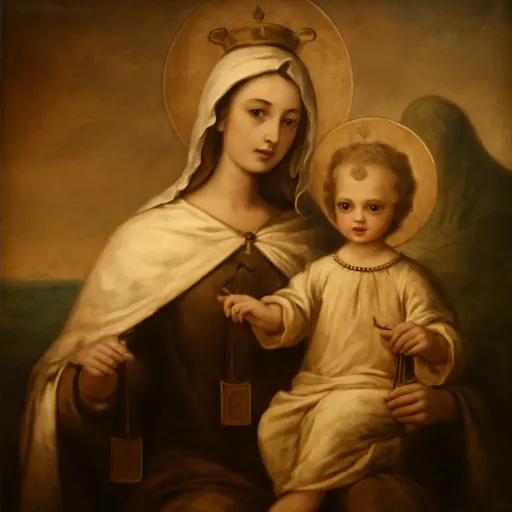
Our Lady of Mount Carmel is the title the Carmelite order gives to the Virgin Mary as its patroness, named for Mount Carmel in the Holy Land, where the order began. The devotion is best known through the Brown Scapular, which tradition links to a vision of St. Simon Stock in 1251. Her feast day is July 16, and she is the patroness of the Carmelites.
Who is Our Lady of Mount Carmel?
Our Lady of Mount Carmel is the Virgin Mary honored as the patroness of the Carmelite order. The title isn't tied to an apparition in the way Lourdes or Fátima are. It comes from a place: Mount Carmel, the ridge above the bay of Haifa in present-day Israel, where the prophet Elijah challenged the prophets of Baal (1 Kings 18) and where a group of Latin hermits settled at the end of the 12th century.
Those hermits built a small chapel to Mary among their cells, and papal letters came to call them the "Brothers of Blessed Mary of Mount Carmel." When they moved to Europe, they took the title with them. Today the devotion reaches far beyond the order, mostly through the Brown Scapular and through the feast of July 16.
The Carmelites and their mountain
The Carmelites once claimed Elijah himself as their founder, and medieval writers defended that claim at length. The Catholic Encyclopedia (1908) explains that modern historians date the order to the second half of the 12th century instead. A Greek monk, John Phocas, visiting the Holy Land in 1185, wrote that he met a Western monk on Carmel who had gathered about ten hermits near the grotto of Elijah.
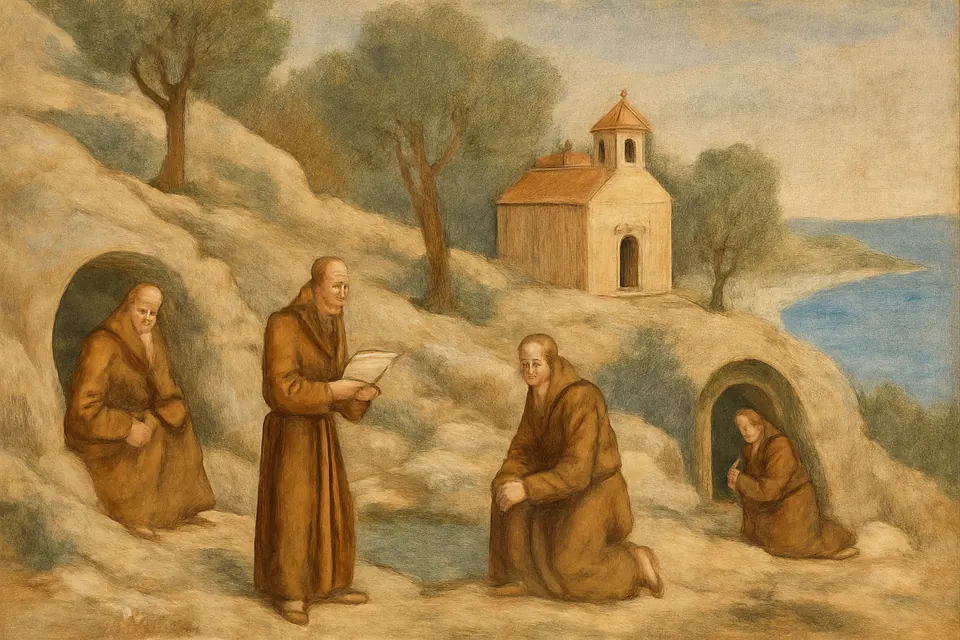
Around 1210 the patriarch of Jerusalem, St. Albert, gave them a short rule of life, and Pope Honorius III approved it in 1226. As Muslim armies retook the Crusader states, the hermits began moving to Europe, and they lost Mount Carmel itself in 1291. In Europe they became an order of friars like the Franciscans and Dominicans. The Discalced Carmelites returned to the mountain in 1631, and their Stella Maris monastery stands there today, over a cave honored as Elijah's.


The order later produced some of the Church's best-known mystics: St. Teresa of Ávila and St. John of the Cross in 16th-century Spain, and in modern times St. Thérèse of Lisieux, St. Edith Stein and the martyr St. Titus Brandsma.
St. Simon Stock and the Brown Scapular
What history can say
Simon Stock was an Englishman who became prior general of the Carmelites at a chapter held at Aylesford, in Kent, in 1247, and died at Bordeaux in 1265. The order was struggling for acceptance in Europe, and a chronicler writing shortly after 1291 says Mary told the prior to appeal to Pope Innocent IV for protection. Innocent did issue a letter protecting the Carmelites on January 13, 1252. Both facts are documented.
The vision: traditional
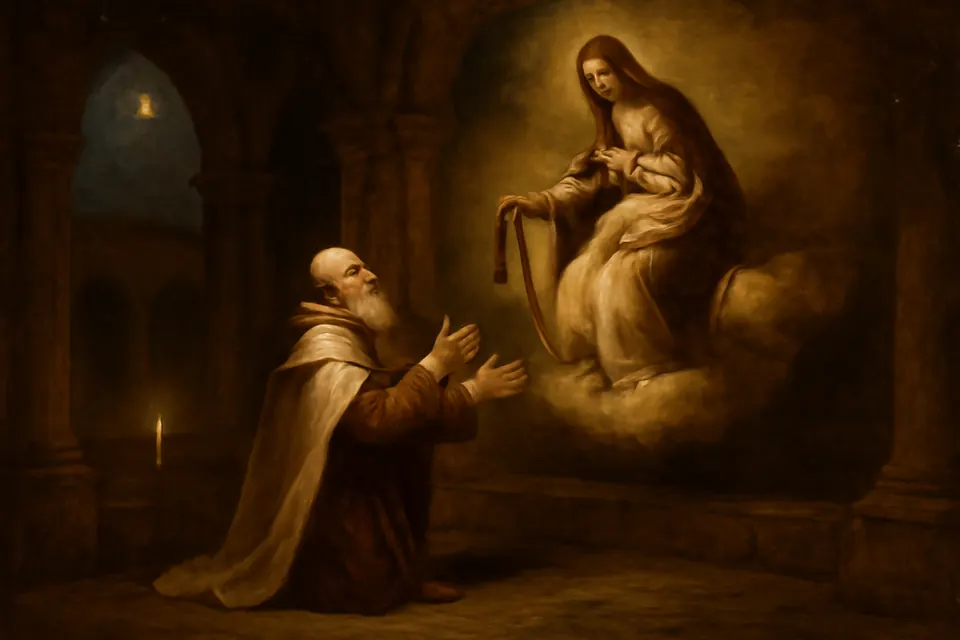
The famous scene comes later. Around 1430 the Carmelite John Grossi wrote that the Virgin appeared to Simon holding the scapular of the order and said, "This shall be the privilege for you and for all the Carmelites, that anyone dying in this habit shall be saved." The fuller version, dated to Cambridge on July 16, 1251, with the promise that "whoever dies in this garment, will not suffer everlasting fire," first appears in 1642, in a letter said to be by Simon's secretary.


The Catholic Encyclopedia (1912) admitted that this testimony "cannot be supported by historical documents," while calling the general content "a reliable pious tradition." A catechesis prepared in 2000 for the Carmelite provincials of North America is blunter: the story can't be traced earlier than the end of the 14th century, about 150 years after the vision would have taken place. This encyclopedia labels the vision traditional.
The scapular itself
A scapular was originally a work apron worn over a monk's habit. Medieval orders gave lay friends a share in their habit, and over time the Carmelite scapular shrank to two small squares of brown wool on cords. The Catholic Encyclopedia says the small scapular can't be documented before the 16th century but was widespread by 1595.


The Church approves the scapular as a sacramental. The Vatican's 2001 Directory on Popular Piety calls it "an external sign of the filial relationship" between Mary and "the faithful who entrust themselves totally to her protection," and asks that enrollment follow a period of preparation. John Paul II, writing to the Carmelites for the 750th anniversary in 2001, called it "essentially a 'habit'" and added, "I too have worn the Scapular of Carmel over my heart for a long time!"
The Carmelite order's own page puts the limits plainly. The scapular is not "a magical charm to protect you," not "an automatic guarantee of salvation," and not "an excuse for not living up to the demands of the Christian life."
The Sabbatine privilege
The second promise linked with the scapular needs more care. The Sabbatine (Saturday) privilege is the belief that Mary will free faithful scapular wearers from purgatory on the Saturday after their death. It rests on a bull said to have been issued by Pope John XXII on March 3, 1322, after Mary appeared to him.


Scholars agree that the bull is not authentic. The Catholic Encyclopedia (1912) says it is "universally regarded by scholars as inauthentic," even by the Carmelite historian Benedict Zimmerman. In 1613 the Holy Office ruled only on what the Carmelites could preach: that the faithful may "piously believe" Mary helps the souls of those who wore the scapular, kept chastity and said the Little Office of Our Lady or kept certain fasts, "especially on Saturdays." The same decree forbade paintings of Mary descending into purgatory. The Church's 1908 list of the scapular confraternity's privileges dropped any mention of the bull of John XXII. The Carmelite catechesis of 2000 goes further: it reads the 1613 ruling as an order not to preach the privilege, and admits the Carmelites "did not always comply." Catholics may piously hope for Mary's help after death, as the 1613 decree allows, but the bull's promise of release on the first Saturday is not Church teaching.
Symbols of Our Lady of Mount Carmel in art
Look for these signs:
- The Carmelite habit: Mary often wears the order's brown tunic and white cloak, the dress of her friars.
- The scapular: she or the Child Jesus holds out small brown scapulars on cords, sometimes several at once.
- St. Simon Stock: an old friar in brown and white kneeling to receive the scapular, as in the Tiepolo ceiling and Stettner's painting.
- Souls in purgatory: figures in flames reaching up for the scapular, a sign of the Sabbatine tradition.
- A star: for "Star of the Sea," a title from the Carmelite hymn Flos Carmeli.
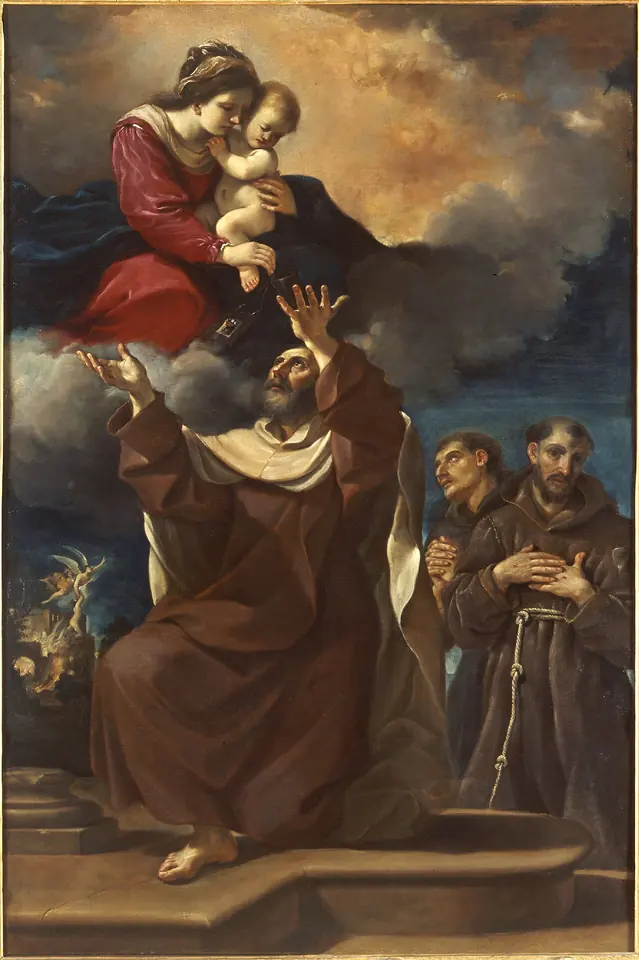
- Carmelite saints: Guercino's altarpiece puts a Carmelite saint, St. Albert, at her feet.

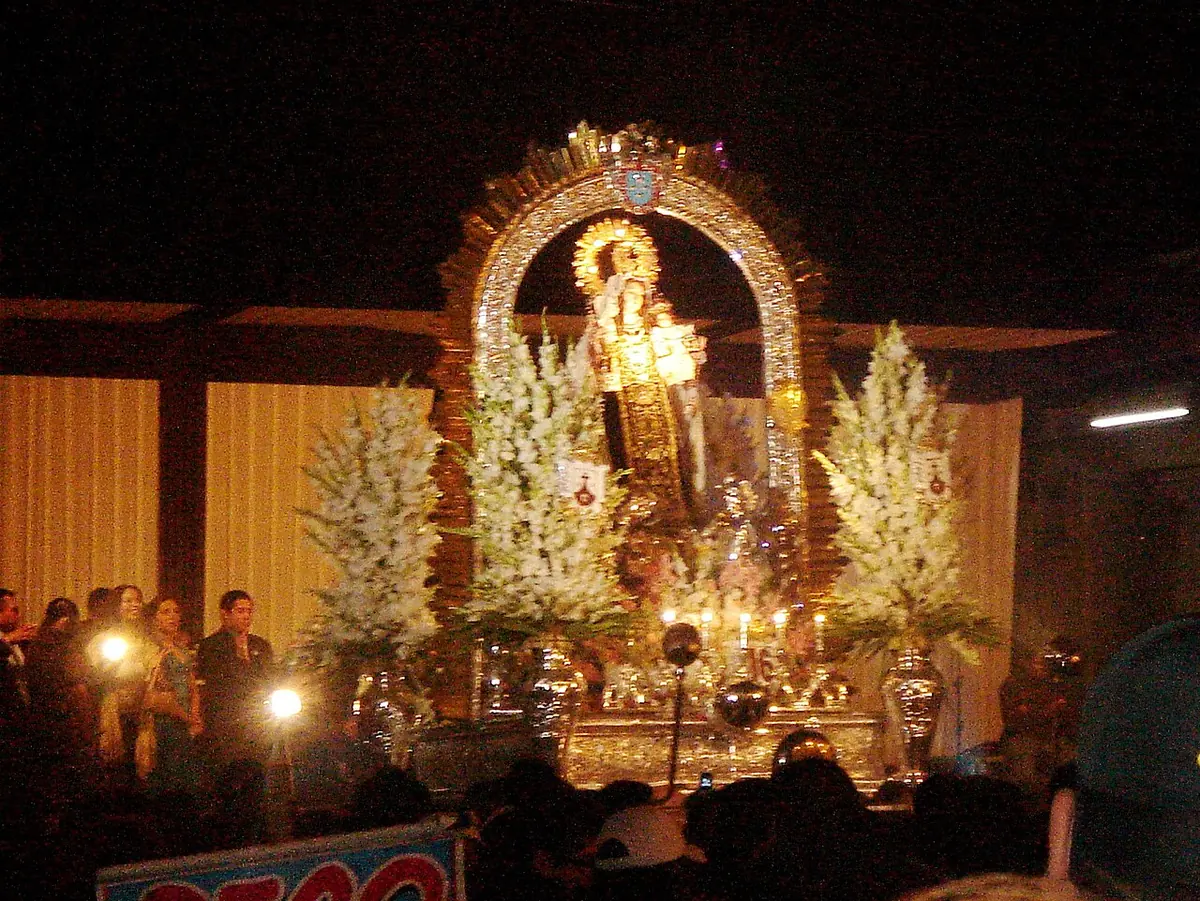
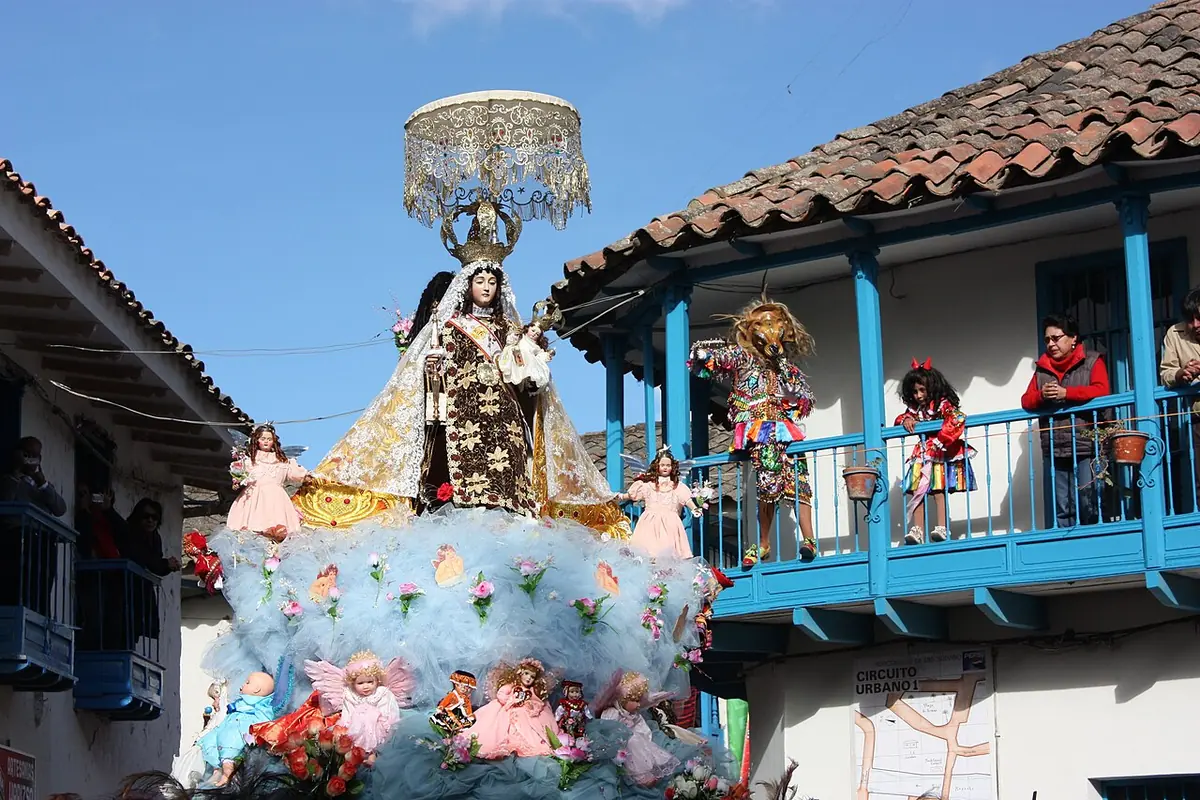
In Spain and Latin America, the Virgen del Carmen is usually a dressed statue: a crowned Mary in a brown and cream mantle holding the Child, both carrying scapulars.
Feast day and processions
The feast of July 16 began among the Carmelites between 1376 and 1386 and was tied to that date because of the Simon Stock tradition. Pope Sixtus V approved it in 1587, and Benedict XIII extended it to the whole Latin Church in 1726. It is an optional memorial on the General Roman Calendar today. Two Marian events fell on this date: St. Bernadette's last vision at Lourdes in 1858, and at Fátima in 1917 Lúcia said she saw Mary as Our Lady of Carmel during the Miracle of the Sun. See the calendar on our feast days page.
Lima and the Andes
In Lima, the Virgen del Carmen de los Barrios Altos, called the "Patroness of Criollismo" and "Perpetual Mayor of the City of Lima," leaves her sanctuary on Jirón Junín each July 16. The night before, a verbena criolla of music and fireworks fills the street. On the feast, the procession receives honors from the Congress, the Government Palace and the city government, according to Peru's national news agency, Andina. High in the Andes, the town of Paucartambo near Cusco keeps the same feast with days of costumed dances.


New York
Italian immigrants in East Harlem first kept the feast in 1881, and the Church of Our Lady of Mount Carmel on East 115th Street grew from that devotion. Its statue of Mary was crowned by pontifical decree in 1904, and the July procession through East Harlem still continues. In Williamsburg, Brooklyn, the parish of Our Lady of Mount Carmel, founded in 1887, took over the Nola immigrants' Giglio festival in the 1950s and joined it to the July 16 feast. Teams of men lift and "dance" a towering decorated giglio through the streets.


Prayer to Our Lady of Mount Carmel
The best-known Carmelite prayer to Mary is the hymn Flos Carmeli, which tradition attributes to St. Simon Stock (the attribution can't be proved). Carmelite communities sing it daily. These are its first two verses in Latin and in the English version given by the Order of Carmelites:
Flos Carmeli, vitis florigera, splendor caeli, Virgo puerpera singularis. Mater mitis, sed viri nescia, Carmelitis, esto propitia, Stella maris.
Flower of Carmel, tall vine blossoming laden; Splendor of heaven, child-bearing yet maiden. None equals thee. Mother so tender, who no man didst know, on Carmel's children thy favors bestow. Star of the Sea.
The short form the Carmelites give for enrolling someone in the scapular begins, "Receive this Scapular, a sign of your special relationship with Mary, the Mother of Jesus, whom you pledge to imitate."
Frequently asked questions
What is the Brown Scapular?
Two small pieces of brown wool joined by cords and worn over the shoulders, one piece on the chest and one on the back. It is a miniature of the scapular in the Carmelite habit. The Church's 2001 Directory on Popular Piety calls it "an external sign of the filial relationship" between Mary and those who entrust themselves to her. A person is enrolled in it once, by a priest or another authorized person.
Did Mary really give the scapular to St. Simon Stock?
It is a traditional account. Simon Stock was a real prior general of the Carmelites, elected in 1247, but the story of the vision first appears in Carmelite writings of the late 14th and 15th centuries, and its exact words only in 1642. The Catholic Encyclopedia (1912) called it a "pious tradition" that historical documents don't support. The Church approves the scapular itself, not the vision.
What is the Sabbatine privilege?
A belief that Mary helps the souls of faithful scapular wearers out of purgatory soon after death, especially on the Saturday after they die. It rests on a papal bull of 1322 that scholars agree is not authentic. In 1613 the Holy See limited what Carmelites could preach about it, and the Carmelites' own catechesis of 2000 does not promote it.
When is the feast of Our Lady of Mount Carmel?
July 16, an optional memorial for the whole Catholic Church and a solemnity for Carmelites. It is widely kept with processions, from Lima and the Andes to the Italian parishes of New York.
Can you wear a medal instead of the scapular?
Yes. Since a decree of the Holy Office in 1910, a person enrolled in the scapular may wear a blessed medal with the Sacred Heart on one side and an image of Mary on the other instead of the cloth.
Sources
- Catholic Encyclopedia (1911): Feast of Our Lady of Mount Carmel
- Catholic Encyclopedia (1908): The Carmelite Order
- Catholic Encyclopedia (1912): Scapular
- Catholic Encyclopedia (1912): St. Simon Stock
- Catholic Encyclopedia (1912): Sabbatine Privilege
- Pope John Paul II, Message to the Carmelite Order (March 26, 2001)
- Congregation for Divine Worship, Directory on Popular Piety and the Liturgy (2001), no. 205
- Order of Carmelites (O.Carm.): The Brown Scapular
- Scapular Catechesis (2000), prepared for the North American Carmelite provincials (archived)
- Order of Carmelites: Flos Carmeli, the Tapestry of Our Lady of Mount Carmel
- Andina: Con tradicional verbena criolla se inician cultos a Virgen del Carmen de Lima
- Fordham University Internet History Sourcebooks: Our Lady of Mount Carmel (East Harlem)
- Folkstreams: A History of the Giglio Feast in Williamsburg, Brooklyn, by I. Sheldon Posen and Joseph Sciorra