Our Lady of Loreto
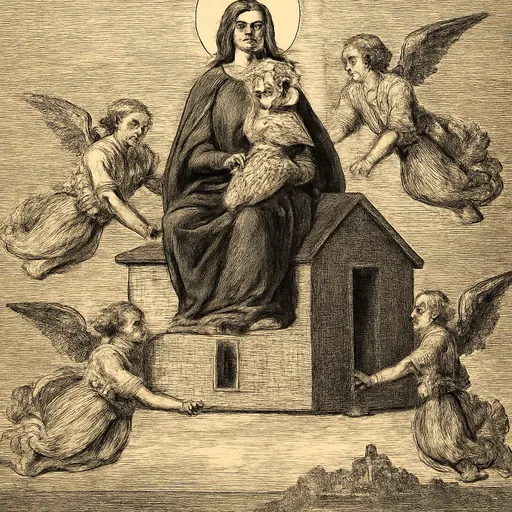
Our Lady of Loreto is the Virgin Mary as honored at the shrine of the Holy House in Loreto, Italy, a small stone room that Catholic tradition holds was Mary's home at Nazareth, where the angel Gabriel announced the birth of Jesus. Legend says angels carried it to Italy in 1294. In 1920 Pope Benedict XV named her patroness of aviators, and her feast is December 10.
Who is Our Lady of Loreto?
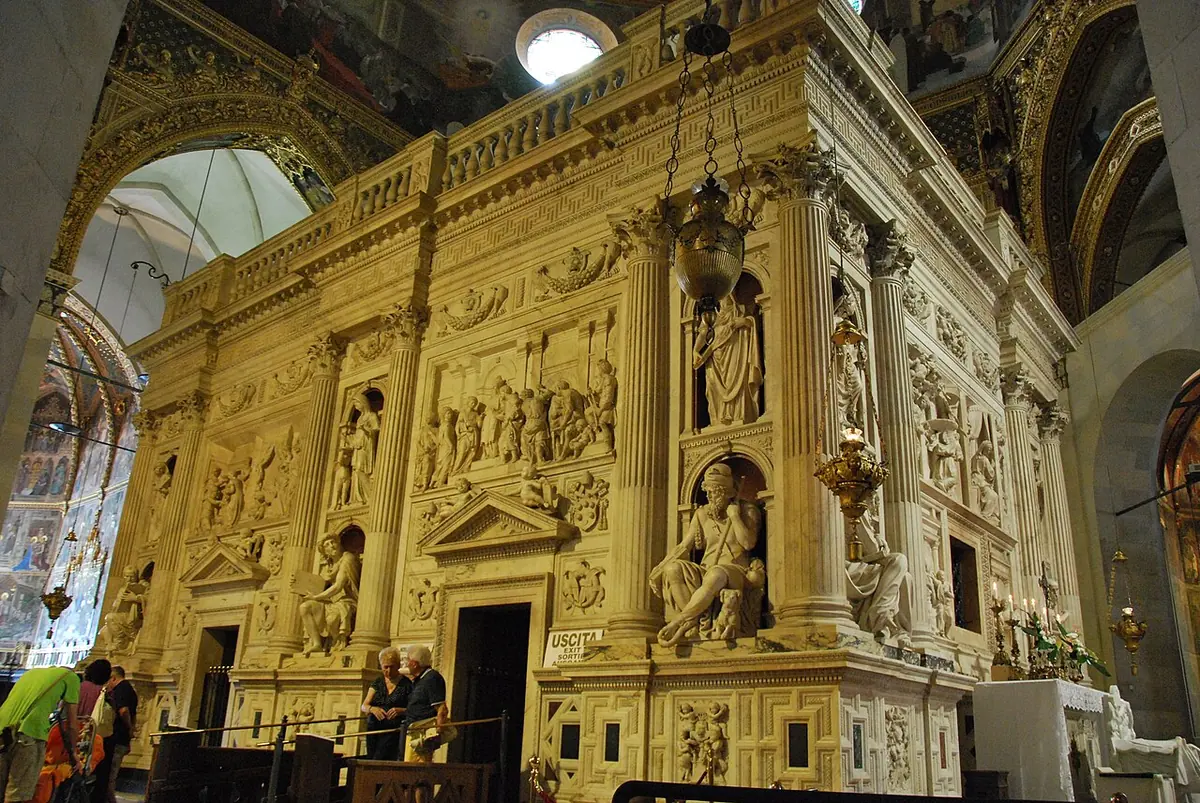
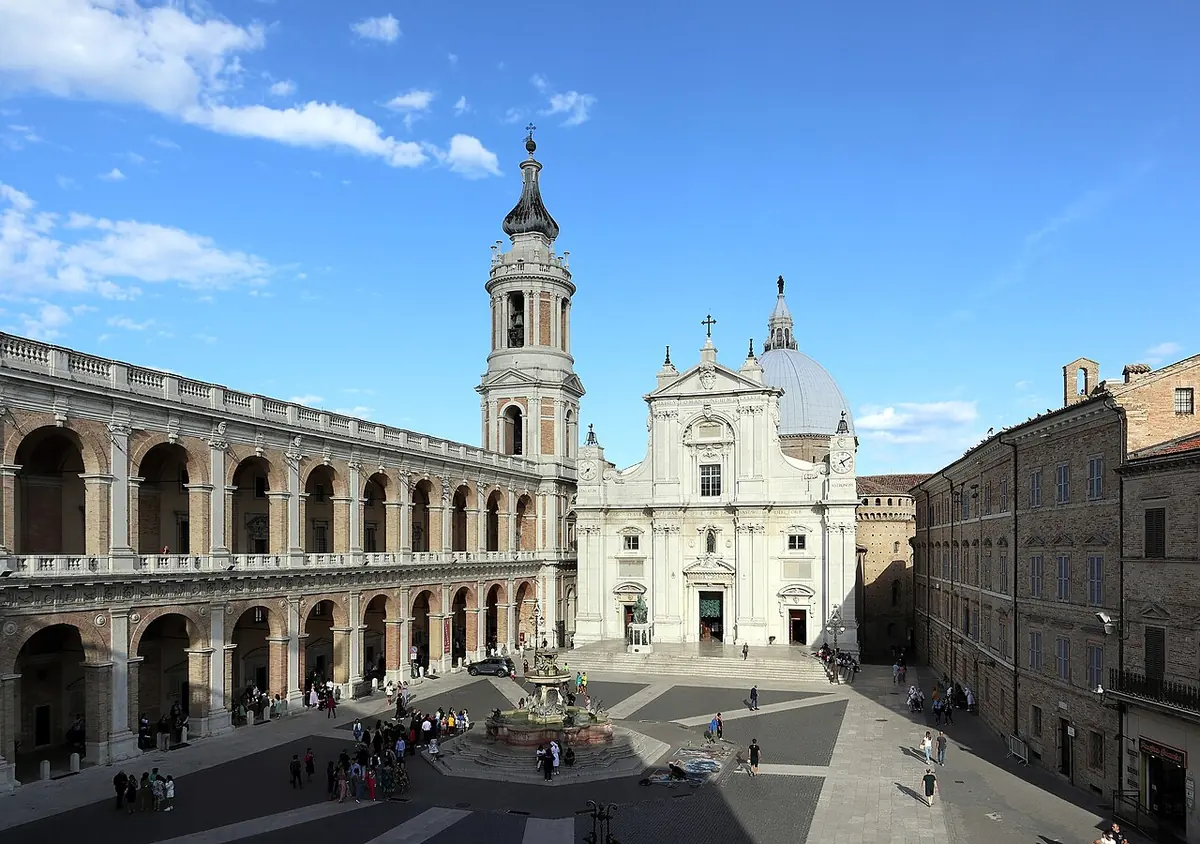
Our Lady of Loreto is a title of the Virgin Mary tied to one building: the Santa Casa, or Holy House, in the small hill town of Loreto near Ancona, on Italy's Adriatic coast. Inside a large basilica stands a plain room of rough stone and brick. The 1912 Catholic Encyclopedia gives its inside measurements as about thirty-one by thirteen feet. Catholic tradition holds that this is the house of Nazareth where the Blessed Virgin Mary was born, where the angel Gabriel greeted her, and where the Holy Family lived. An inscription over its altar reads Hic Verbum caro factum est, "Here the Word was made flesh."
Above the altar is a dark statue of the Virgin and Child dressed in a jeweled robe. The original, a 15th-century statue, burned in a fire in 1921. The cedar replacement was crowned in 1922.

The Holy House: tradition, history and the Angeli theory
The story of the angels
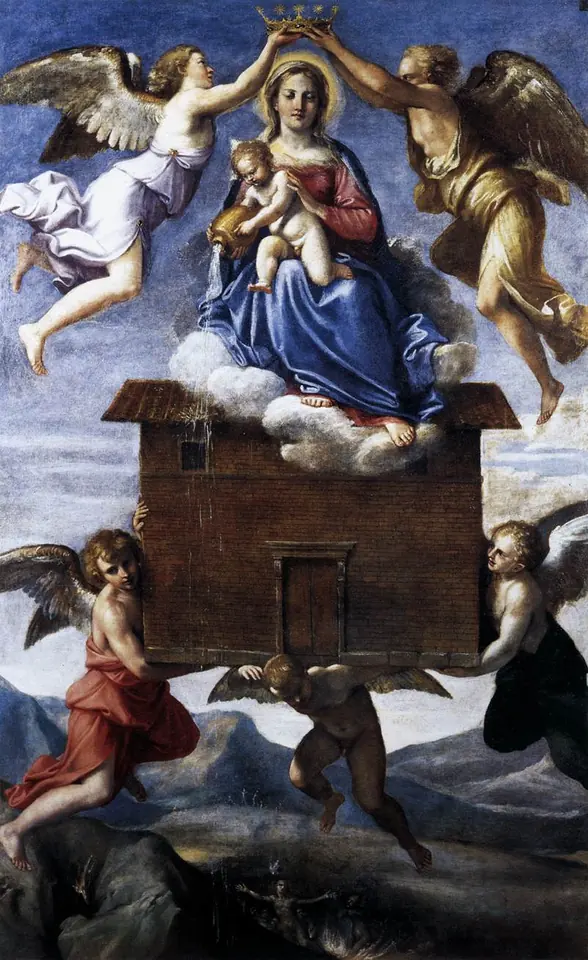
The tradition is spelled out on a 16th-century inscription on the basilica. Angels carried the house from Nazareth in 1291, when the Crusaders were losing their last strongholds in the Holy Land, and set it down at Tersatto in Illyria (today Trsat, near Rijeka in Croatia). Three years later they carried it across the Adriatic to a wood near Recanati, and after it moved three times within a year it came to rest on the hill of Loreto. The shrine dates the arrival to the night of December 9 to 10, 1294. This is a traditional account.
What historians found
The Jesuit historian Herbert Thurston, writing in the Catholic Encyclopedia in 1912, laid out the problems plainly. Pilgrims to Nazareth before 1291 describe a cave, not a cottage. Records show a church of the Virgin already at Loreto in the 12th and 13th centuries. No writer can be shown to mention the angelic flight before about 1472, nearly two centuries later. He added that no fraud need be assumed.
Popes, meanwhile, honored the shrine for centuries. Julius II's bull of 1507, the first to mention the translation, used a careful phrase: ut pie creditur et fama est, "as is piously believed and reported."

The Angeli family theory
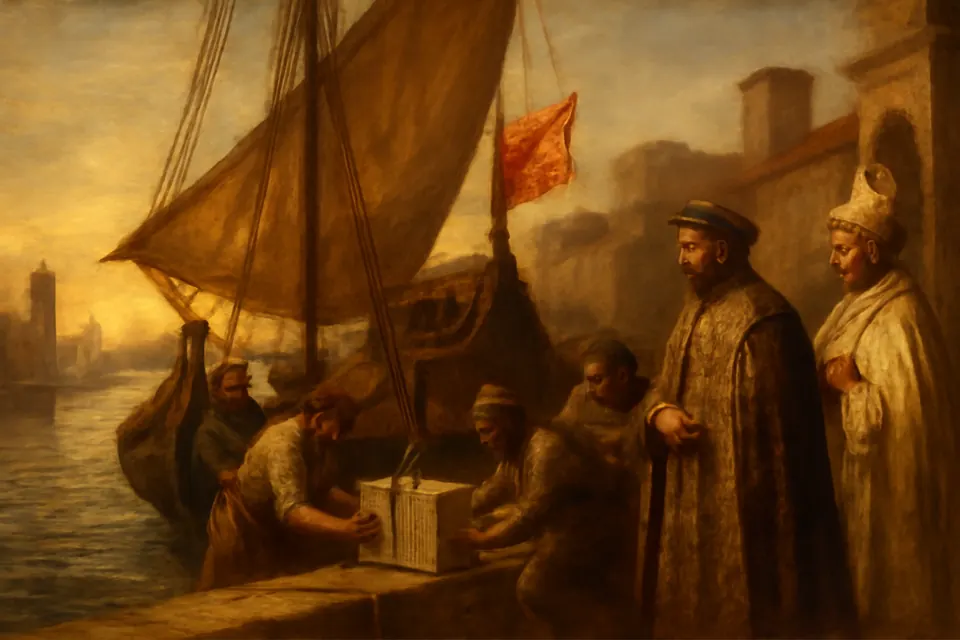
A newer explanation keeps the house and drops the flight. In 1900 the papal physician Giuseppe Lapponi reported documents in the Vatican archives saying that the Angeli, a Byzantine noble family (Angelos in Greek), rescued materials from "Our Lady's House" and shipped them to Italy. Catholic News Agency reported in 2018 that later documents, published in 1985, list "holy stones taken away from the House of Our Lady, Mother of God" in the dowry of Ithamar Angeli when she married Philip of Anjou, son of King Charles II of Naples, in 1294. "Angeli" means "angels," which may be how a sea voyage became an airborne one.
The shrine's own website now calls this "a historical-critical hypothesis, widely accepted," in which Christians moved the stones with heaven's help, "signified by the angels." It points to excavations in 1962 to 1965 that found the house has no foundations of its own and stands on an old road. The shrine also says the lower walls are stone of a kind found at Nazareth but not at Loreto, and that about sixty stones carry early Christian graffiti. These are the shrine's claims, and Thurston noted in 1912 that even the stone was disputed.
Miracles and devotion at Loreto
Loreto has drawn reports of healings for centuries; Thurston wrote that people who prayed there "may often have been rewarded, even miraculously." None of the cures has been formally approved by the Church, so they are reported miracles. The translation by angels is traditional.

Why Our Lady of Loreto is the patroness of aviators
On March 24, 1920, Pope Benedict XV, "crowning the wish of several pioneers in aviation," proclaimed Our Lady of Loreto "Patroness of all air navigators." Pope Benedict XVI recalled this in a 2010 address to Italy's civil aviation agencies, explaining that the title refers both to the archangel Gabriel, who came down from heaven to Mary, and to "the devout tradition linked to the Holy House." St. Joseph of Cupertino shares the patronage of aviators. See more on our patron saints page.
Symbols of Our Lady of Loreto in art
Painters show Our Lady of Loreto in two main ways.
- The house in flight: angels carry a small house, often brick-red with a tiled roof, across the sea, while Mary and the Child sit on top. The Carracci workshop painting near the top of this page is a typical example.
- The statue: a stiff, dark-faced Virgin and Child, both wrapped from neck to feet in a bell-shaped, jeweled robe (a dalmatic) and crowned. Copies of this statue stand in churches across Italy and far beyond.
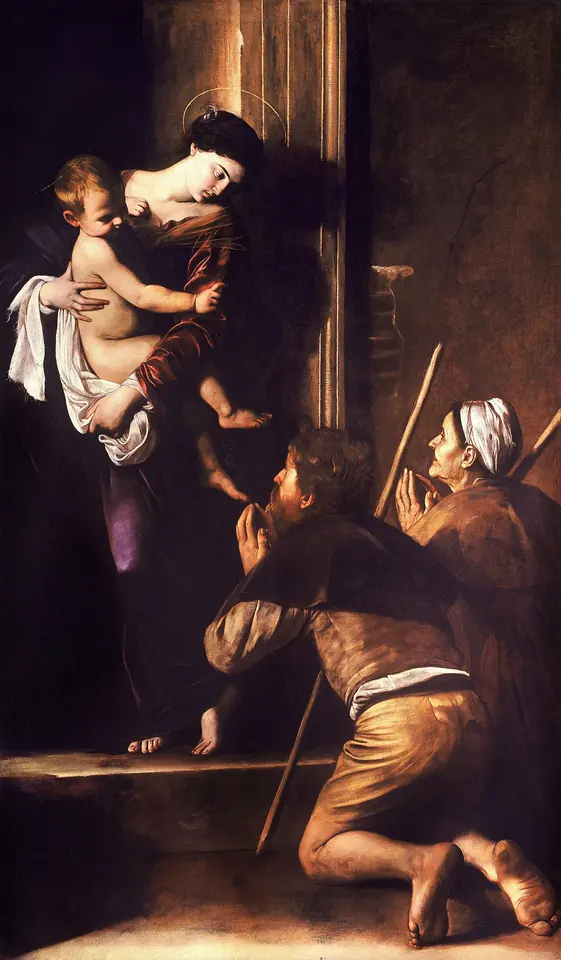
Caravaggio took a third path. His Madonna di Loreto (about 1604–1606) in the church of Sant'Agostino in Rome has no flying house at all, only a doorway and two dusty pilgrims on their knees. The doorway stands for the Holy House.

The feast of Our Lady of Loreto and the Litany
Pope Francis added the Blessed Virgin Mary of Loreto to the General Roman Calendar as an optional memorial on December 10, in a decree dated October 7, 2019. In Catholic Culture's translation from the Italian, the decree says pilgrims at the Holy House "began to praise and beg the Blessed Virgin Mary with the Litany of Loreto, known all over the world," and that "those who travel by plane have found in her their heavenly patroness." Her neighbors on the calendar are on our feast days page.
The Litany of Loreto was sung at the shrine every Saturday by the mid-1500s. The Catholic Encyclopedia traces its text to the late 15th or early 16th century; the oldest known printed copy is from Dillingen, Germany, around 1558. Pope Sixtus V approved it in 1587. Popes have added titles since, and in 2020 Pope Francis added three: "Mother of mercy," "Mother of hope" and "Solace of migrants."
Prayer to Our Lady of Loreto
The prayer most closely tied to Loreto is its litany. The Holy See's text of the Litany of Loreto opens with the Kyrie and continues through more than fifty titles, each answered "pray for us." These lines are from it:
Holy Mary, pray for us.
Holy Mother of God,
Holy Virgin of virgins,
Mother of Christ,
...
House of gold,
Ark of the covenant,
Gate of heaven,
Morning star,
Health of the sick,
Refuge of sinners.
It ends with this prayer:
Grant, we beseech thee, O Lord God, that we, your servants, may enjoy perpetual health of mind and body; and by the glorious intercession of the Blessed Mary, ever Virgin, may be delivered from present sorrow, and obtain eternal joy. Through Christ our Lord. Amen.
Frequently asked questions
Did angels really carry the Holy House to Loreto?
That is the traditional story, first written down around 1472. Historians, including the 1912 Catholic Encyclopedia, found no earlier record of it. The shrine itself now says a widely accepted theory is that Christians moved the stones by ship around 1291 to 1294, and documents point to the Byzantine Angelos (in Italian, Angeli) family, whose name means "angels." The flight through the air is best described as legend.
Why is Our Lady of Loreto the patroness of aviators?
On March 24, 1920, at the request of early aviators, Pope Benedict XV proclaimed her patroness of all who travel by air. Pope Benedict XVI explained in 2010 that the choice recalled the angel Gabriel, who came down from heaven to Mary, and the tradition of the house carried through the air.
When is the feast of Our Lady of Loreto?
December 10. Pope Francis added it to the General Roman Calendar as an optional memorial in 2019. The shrine has long kept that date as the anniversary of the house's arrival in the night of December 9 to 10, 1294.
What is the Litany of Loreto?
A litany of titles of the Virgin Mary ("Mother most pure," "Tower of ivory," "Help of Christians") with the response "pray for us." It was sung at Loreto every Saturday by the 16th century, and Pope Sixtus V approved it for the whole Church in 1587. Catholics often pray it at the end of the Rosary.
Sources
- Catholic Encyclopedia (1912): Santa Casa di Loreto
- Catholic Encyclopedia (1910): Litany of Loreto
- Santuario Pontificio della Santa Casa di Loreto: La Santa Casa da Nazareth a Loreto
- Benedict XVI: Address to ENAC and ENAV, February 20, 2010 (Vatican)
- Catholic Culture: The New Advent Feast, Our Lady of Loreto
- Catholic News Agency: Did angels really carry the Holy House of Mary to Loreto, Italy?
- Holy See Press Office: Letter on the invocations to be inserted into the Litany of Loreto (2020)
- The Holy See: The Litany of Loreto