St. Peter Canisius
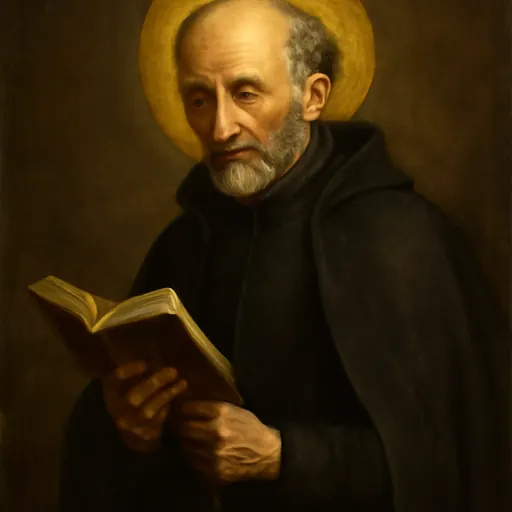
St. Peter Canisius (1521–1597) was a Dutch Jesuit priest who led the Catholic revival in Germany, Austria and Switzerland during the Reformation. His catechisms went through more than 200 editions in his lifetime, and Pope Leo XIII called him the Second Apostle of Germany. He is a Doctor of the Church, and his feast day is December 21.
Who was St. Peter Canisius?
Peter Canisius was a Jesuit priest from the Low Countries who spent almost fifty years rebuilding Catholic life in the German-speaking lands after the Reformation. He preached, founded colleges, advised emperors and popes, and wrote the catechisms that taught German Catholics their faith for three hundred years. In 1897 Pope Leo XIII called him "the second apostle of Germany," after St. Boniface.
He was born Pieter Kanis in Nijmegen on May 8, 1521. His father was the town's burgomaster. At the University of Cologne he came to know the Carthusian monks of St. Barbara and the practical spirituality of the Devotio Moderna, and in 1540, against his father's hopes for a good marriage, he promised to remain celibate.


The life of St. Peter Canisius
A Jesuit in Cologne and Rome
In 1543 Canisius made the Spiritual Exercises under Peter Faber, one of the first companions of St. Ignatius of Loyola, and entered the Society of Jesus at Mainz on his 22nd birthday. He later called it his second birthday. He helped found the first Jesuit house in Germany, at Cologne, was ordained in 1546 and went to the Council of Trent the next year as theologian for the Cardinal of Augsburg.
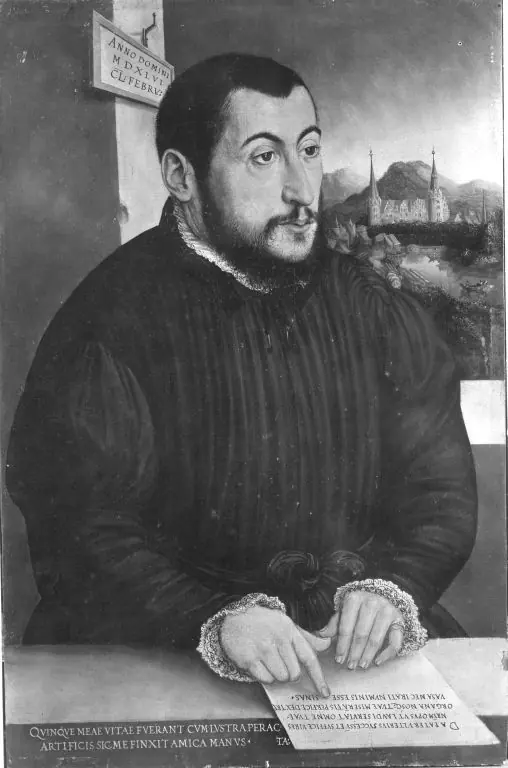

Sent to Germany
In September 1549, just before leaving for Germany, Canisius prayed at the tomb of the apostles in St. Peter's. He wrote in his journal that he felt Peter and Paul "confirmed my mission in Germany," and added: "You know, Lord, in how many ways and how often on that same day you entrusted Germany to me."

For the next thirty years he hardly stopped moving. He was rector of the University of Ingolstadt, preached at the court of Vienna and visited its hospitals and prisons, and three times refused the bishopric of Vienna. As the first Jesuit provincial of Upper Germany (1556–1569) he opened colleges at Prague, Munich, Innsbruck, Dillingen and elsewhere. He debated Philip Melanchthon at Worms in 1557 and returned to Trent in 1562. From the pulpit of Augsburg Cathedral he brought back, by the cathedral clergy's count in 1560, nine hundred people to the Church. At Dillingen in 1567 he received the young Stanislaus Kostka and sent him on to the Jesuits in Rome.
Fribourg
In 1580 his superiors sent him to Fribourg, in Catholic Switzerland, to found a college. The Collège Saint-Michel opened in 1582 and still has about 1,300 students. Canisius preached until 1589, set up Marian sodalities and wrote prayer books and lives of Swiss saints. In 1591 a stroke weakened him. He died in Fribourg on December 21, 1597.


The Canisius catechisms
In 1551 King Ferdinand I asked for a clear summary of Catholic teaching, and Canisius wrote three. The Summa doctrinae christianae (Vienna, 1555), for students and educated readers, set out the faith in about two hundred questions and answers. A shorter catechism for young children followed in 1556, and a middle one for schoolboys in 1558. Benedict XVI noted that Canisius explained doctrine "concisely, in biblical terms, with great clarity and with no polemical overtones." The names of Luther and Melanchthon never appear in it. The books went through more than 200 editions in at least twelve languages in his lifetime, and Benedict XVI recalled that his father's generation in Germany still called the catechism simply "the Canisius."


Canisius and the Hail Mary
Through the Middle Ages the Hail Mary ended with the words of Elizabeth, "blessed is the fruit of thy womb, Jesus." People often added petitions of their own, and the Catholic Encyclopedia notes a form almost identical to today's printed in a work of Savonarola in 1495.
Canisius is credited with putting the line "Holy Mary, Mother of God, pray for us sinners" (Sancta Maria, mater Dei, ora pro nobis peccatoribus) into his 1555 catechism. The attribution rests on Friedrich Streicher's critical edition of the catechisms (1933). Because the book reached so many people, it did much to make the petition standard. The words "now and at the hour of our death" came later: the full prayer became official in the Roman Breviary of Pius V in 1568.
He also issued the first known printing of the Litany of Loreto (1558) and a long defense of Catholic teaching on the Blessed Virgin Mary (1577).
Miracles and graces
- Reported: In his journal Canisius described a vision in 1549 in which Christ seemed to open his heart and invite him to drink from it. The Catholic Encyclopedia counts him among the forerunners of devotion to the Sacred Heart.
- Reported: By his own account, while on pilgrimage to Einsiedeln in 1584, he understood that St. Nicholas, patron of Fribourg, wanted him never to leave the town again. He stayed until his death.
- Approved: Reports of healings through his intercession spread soon after he died. On April 17, 1864, Pius IX approved four miracles for his beatification.
Why St. Peter Canisius is a patron
He is honored as a patron of Germany because of Leo XIII's title. Patron lists also name him for the Catholic press, since he persuaded Fribourg to set up a printing house and begged Pius V to support Catholic printers, and for catechists. These come from custom, not a formal decree. See all the patron saints.
Symbols of St. Peter Canisius in art
Canisius appears as a thin, gray-bearded Jesuit in a black cassock. Look for:
- A book or catechism: his writings, above all the Summa.
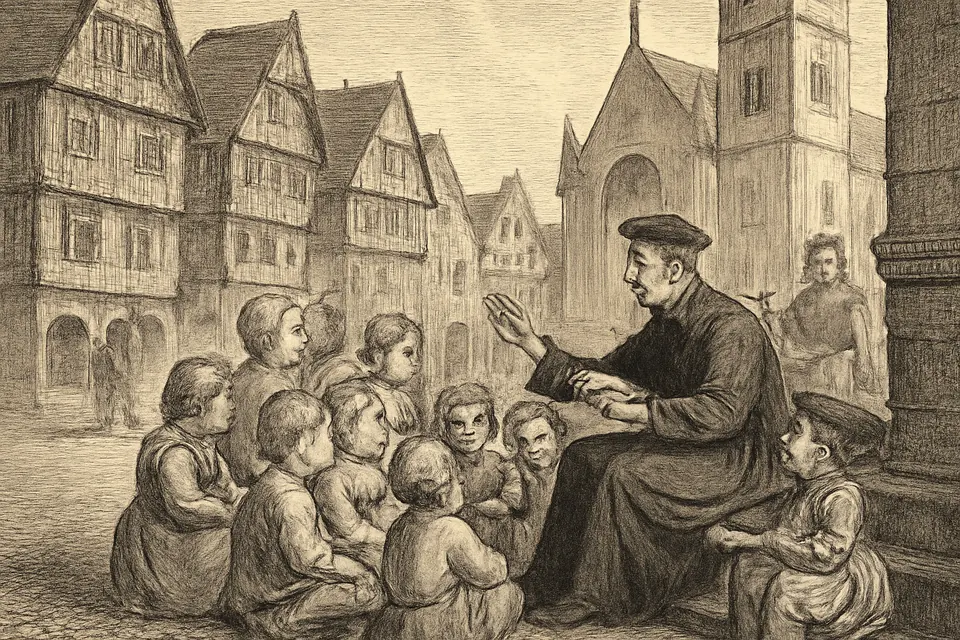
- Children gathered around him: his catechizing. The Catholic Encyclopedia says most old portraits show him with books or with children.
- A crucifix or rosary: his preaching and his love of the Rosary and its sodalities.
- The Virgin Mary: in Fribourg's stained glass he looks up from his desk to Mary, a nod to his writings in her defense.


Feast day, tomb and shrines
His feast is December 21 in the General Roman Calendar, an optional memorial. Before 1969 it was April 27. See the feast day calendar.
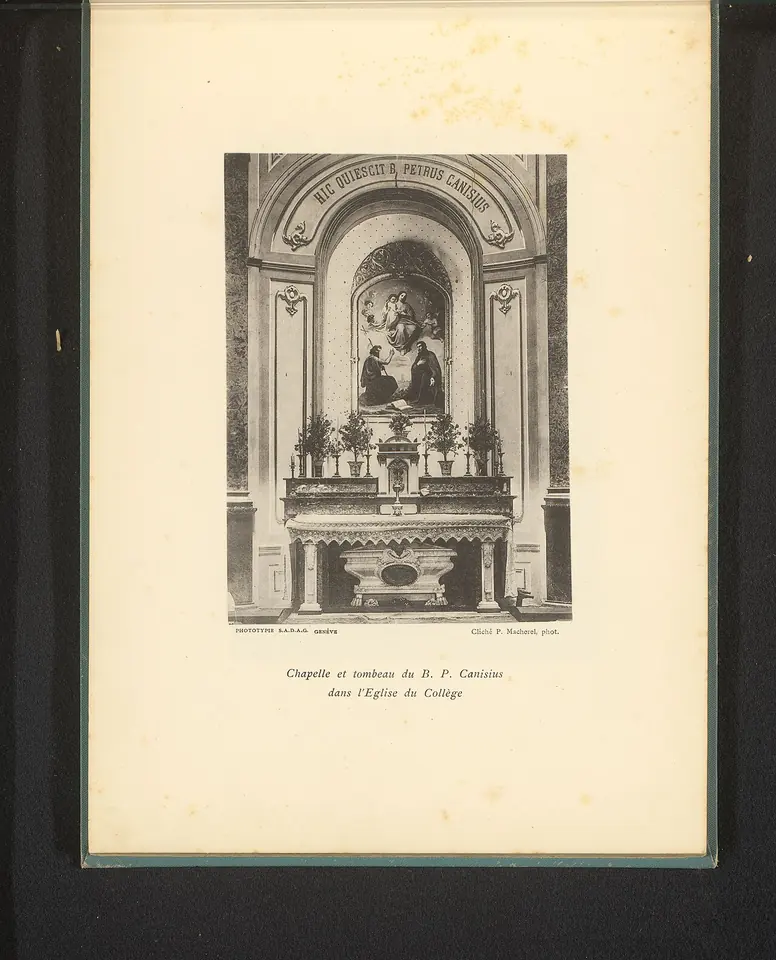
Fribourg buried him before the high altar of St. Nicholas, now the cathedral. In 1625 his remains were moved to the college church of St. Michael, built in 1604–1610 on the plan of the Gesù in Rome. The room where he died is a chapel. Pius XI canonized him and named him a Doctor of the Church in 1925.

In Nijmegen, a plaque in the Broerstraat marks the house where he was born, and a bronze statue by Toon Dupuis stands in the Hunnerpark. Canisius College in Buffalo, New York, and many Jesuit schools carry his name.


Prayer and words of St. Peter Canisius
No widely used traditional prayer to St. Peter Canisius exists outside the liturgy of his feast. Catholics ask him to pray for teachers, catechists, students and the faith of their families.
Of his opponents, who wrote pamphlets against him and once threw stones into a church where he was saying Mass, he said, as the Catholic Encyclopedia records: "the more our opponents calumniate us, the more we must love them."
Frequently asked questions
When is the feast of St. Peter Canisius?
December 21, the day he died in 1597. It has been on the General Roman Calendar on that date since the 1969 reform. Before that, his feast was kept on April 27.
Did St. Peter Canisius write the second half of the Hail Mary?
Not exactly. Prayers asking Mary to "pray for us sinners" were already in use and in print before him. Canisius is credited with putting "Holy Mary, Mother of God, pray for us sinners" into his 1555 catechism, which spread it widely. The full ending, "now and at the hour of our death," became official in the Roman Breviary of 1568.
Why is St. Peter Canisius called the Second Apostle of Germany?
Pope Leo XIII gave him that title in his 1897 encyclical Militantis Ecclesiae, comparing his work to that of St. Boniface, the 8th-century "Apostle of Germany." Canisius preached, founded Jesuit colleges and wrote the catechisms German Catholics used for three centuries.
Where is St. Peter Canisius buried?
In the church of the Collège Saint-Michel in Fribourg, Switzerland, the school he founded. He was first buried in the Church of St. Nicholas, and his remains were moved to St. Michael's in 1625.
Sources
- Catholic Encyclopedia (1911): St. Peter Canisius
- Benedict XVI, General Audience of 9 February 2011: Saint Peter Canisius
- Leo XIII, Militantis Ecclesiae (August 1, 1897), on St. Peter Canisius
- Historical Dictionary of Switzerland: Canisius, Pierre
- Fribourg Region: Collège Saint-Michel
- Catholic Encyclopedia (1910): Hail Mary
- Friedrich Streicher (ed.), S. Petri Canisii Catechismi Latini et Germanici, vol. I (Rome and Munich, 1933)
- Roman Martyrology, December 21