St. Louis-Marie Grignion de Montfort
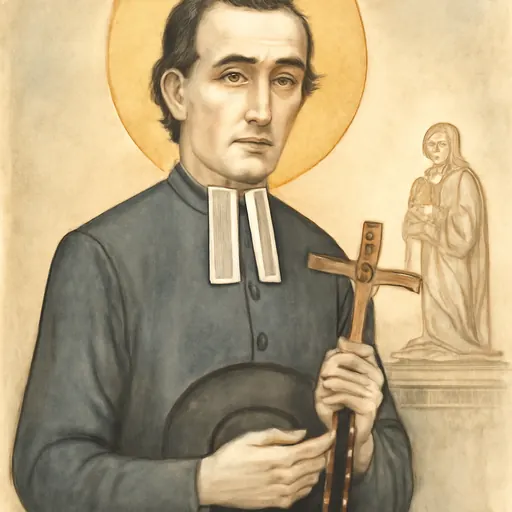
St. Louis de Montfort (1673–1716), in full Louis-Marie Grignion de Montfort, was a French priest who preached missions to the poor of Brittany and western France and wrote True Devotion to the Blessed Virgin, the classic guide to total consecration to Jesus through Mary. He founded the Company of Mary and the Daughters of Wisdom. His feast day is April 28.
Who was St. Louis de Montfort?
Louis-Marie Grignion de Montfort was a French parish missionary of the early 1700s who walked from village to village in Brittany, Poitou and the Vendée, preaching to the poor and building calvaries. He died at forty-three, worn out, with two tiny religious communities to show for his life's work. A century later his forgotten manuscript on devotion to Mary was found in a house of his order, and it became one of the most widely read Catholic books in the world.
That book, True Devotion to the Blessed Virgin, teaches a "total consecration" to Jesus through Mary that millions of Catholics have made, among them the young Karol Wojtyła, later Pope John Paul II, who took his motto Totus tuus from it.
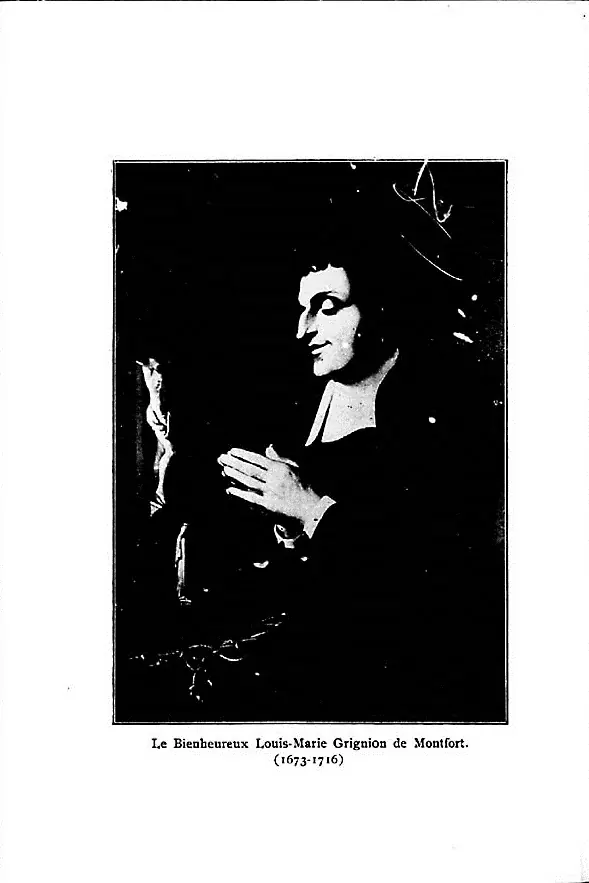

He was born on January 31, 1673, at Montfort in Brittany, and died at Saint-Laurent-sur-Sèvre on April 28, 1716. Grignion was his family name. As a priest he signed himself after the town where he was baptized, which is why he is known as "de Montfort."
The life of St. Louis de Montfort
A Breton student
From the age of twelve Louis studied at the Jesuit college in Rennes. The Catholic Encyclopedia says he never failed to visit the church before and after class, and that he joined a group of young men who spent their holidays serving the poor and the incurable sick in the city's hospitals, reading to them at meals.


The walk to Paris
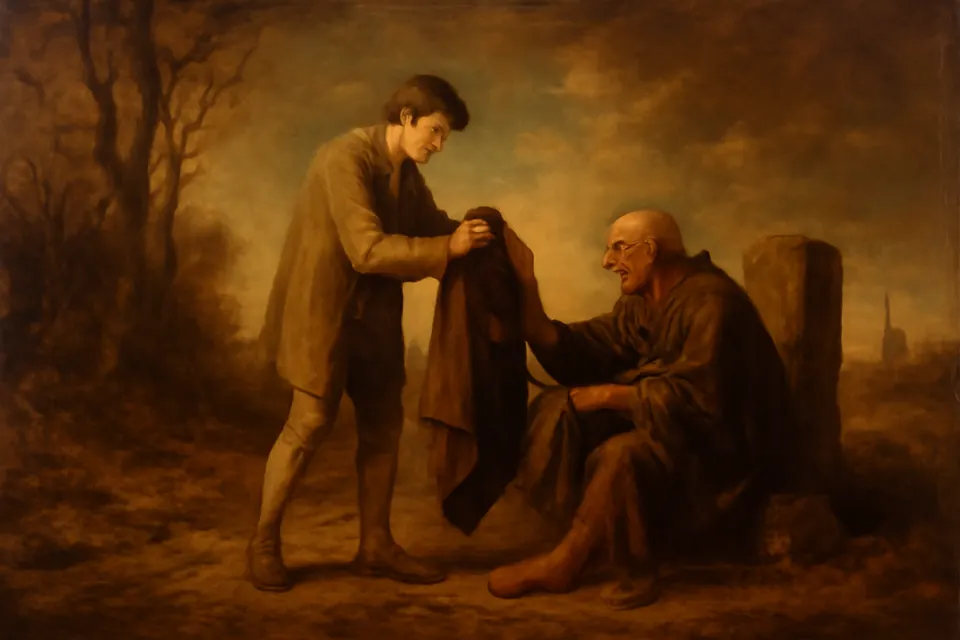
At nineteen he set out on foot for Paris to study theology. On the way, the Catholic Encyclopedia says, he gave all his money to the poor, exchanged clothes with them, and vowed to live from then on only on alms.
He studied in Paris for several years and was ordained a priest at twenty-seven, in 1700. For a time he served as a hospital chaplain.
Missionary to the poor
In 1705, at thirty-two, he found what the Catholic Encyclopedia calls his true vocation: preaching missions to the people. He went from parish to parish, preaching, hearing confessions, teaching hymns he wrote himself, and organizing processions and rosary devotions. His language was simple. The same source describes his life as one of "constant prayer, love of the poor, poverty carried to an unheard-of degree, joy in humiliations and persecutions."
Two stories show the effect he had. At La Rochelle he preached a mission to the soldiers of the garrison, who wept and cried out for forgiveness. In the closing procession an officer walked barefoot at the head carrying a banner, and the soldiers followed, also barefoot, each with a crucifix in one hand and a rosary in the other.
Between missions he sometimes withdrew to pray alone. Local tradition places one of his retreats in a small grotto in the Forest of Mervent, in the Vendée, now a chapel.


The calvary at Pontchâteau
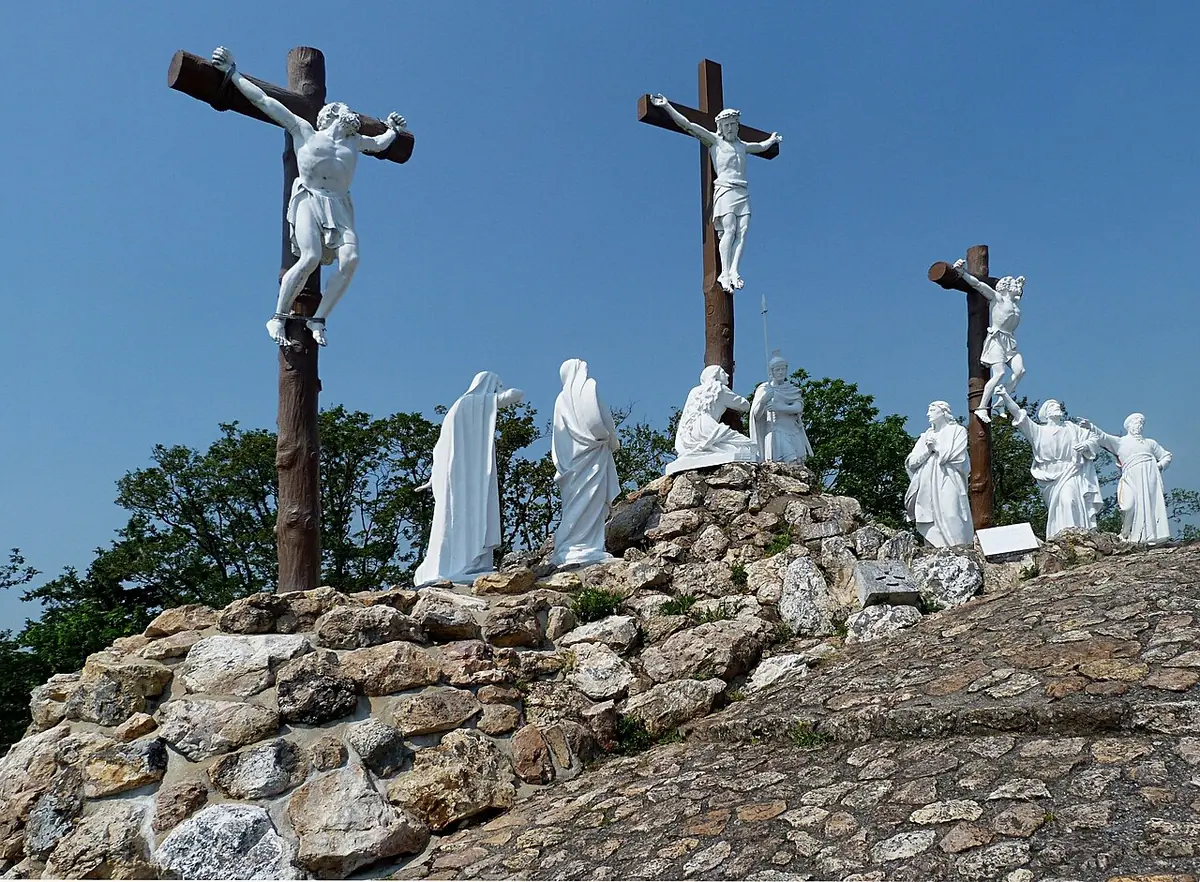
The second story is the calvary at Pontchâteau, near Nantes. Montfort decided to build a great calvary on a hill there, and the people took up the idea with enthusiasm. For fifteen months, between two and four hundred peasants worked every day without pay. It was just finished when the king ordered the whole thing torn down and the land restored. According to the Catholic Encyclopedia, Jansenists, his theological opponents, had convinced the governor of Brittany that Montfort was building a fortress for rebels. Five hundred peasants, watched by soldiers, spent months pulling it apart. When Montfort heard the news, all he said was "Blessed be God!"
The calvary was rebuilt long after his death, and Pontchâteau is still a place of pilgrimage.

Opposition and poisoning
Montfort's preaching made enemies. Jansenist clergy, who distrusted his style and his devotions, more than once had him banished from a district in the middle of a mission. At La Rochelle someone put poison in his broth. He took an antidote and survived, but the Catholic Encyclopedia says his health never recovered.
The founder and his death
A year before he died he founded two communities: the Daughters of Wisdom, for nursing in hospitals and teaching poor girls, and the Company of Mary, a society of missionary priests and brothers. At his death the sisters numbered four and the Company had two priests and a few brothers.
In April 1716 he came to Saint-Laurent-sur-Sèvre to preach a mission. He fell ill there and died on April 28, aged forty-three. He was buried in the town.
True Devotion to Mary and the 1842 rediscovery
Montfort wrote True Devotion to the Blessed Virgin in the early 1700s. It was never published in his lifetime. In the book itself he made a striking prediction. In Frederick William Faber's English translation:
I clearly foresee that raging beasts shall come in fury to tear with their diabolical teeth this little writing and him whom the Holy Ghost has made use of to write it, or at least to smother it in the silence of a coffer, that it may not appear.
The manuscript did disappear. In 1842, Faber's preface records, one of the priests of Montfort's congregation came across it by accident at Saint-Laurent-sur-Sèvre. The superior recognized the founder's handwriting, and the manuscript was sent to Rome for his cause. It was published in 1843. John Paul II wrote in 2004 that the book was "an instant success." Frederick William Faber, a priest of the London Oratory, translated it into English in the 1860s, and his version was reprinted many times.
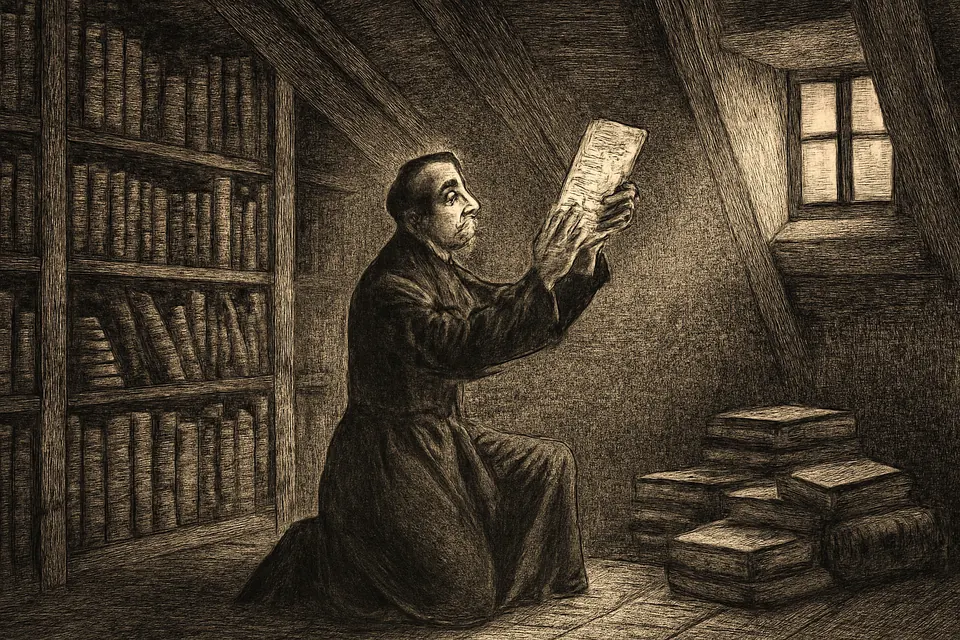
The book opens with the sentence that sums up its argument. In Faber's translation: "It is by the most holy Virgin Mary that Jesus has come into the world, and it is also by her that He has to reign in the world."
Total consecration
The practice at the center of the book is what Montfort calls the perfect consecration to Jesus by Mary. He asks his readers to spend at least twelve days emptying themselves of the spirit of the world, then three weeks asking for knowledge of themselves, of Mary and of Jesus Christ. At the end they go to confession and Communion and make an act of consecration, written out and signed. The formula, in Faber's translation, includes these words:
I deliver and consecrate to thee, as thy slave, my body and soul, my goods, both interior and exterior, and even the value of all my good actions, past, present, and future
Montfort's language of "holy slavery" can startle readers today. John Paul II explained it in 2004 as a "slavery of love" that frees the person, "a true exchange of love between God and his creature." Montfort's own reasoning, in the passage John Paul quoted in Rosarium Virginis Mariae, is that the more a soul is consecrated to Mary, the more it is consecrated to Jesus Christ.
Totus tuus and John Paul II
As a young man, Karol Wojtyła read True Devotion and found it, he wrote, "a great help." He had feared that too much devotion to Mary might crowd out the worship owed to Christ. "There I found the answers to my questions," he later wrote. As a bishop and then as pope, he took the Latin motto Totus tuus, "totally yours."
In his 2004 letter to the Montfortian religious family he spelled out where it came from: "the motto Totus tuus is inspired by the teaching of St Louis Marie Grignion de Montfort." Montfort wrote, "Tuus totus ego sum, et omnia mea tua sunt," and translated it himself: "I am all yours, and all that I have is yours, O most loving Jesus, through Mary, your most holy Mother."
Montfort's other writings include The Secret of Mary, The Secret of the Rosary, The Love of Eternal Wisdom and a large body of hymns.
The miracles of St. Louis de Montfort
- Miracles accepted for his beatification (1888) and canonization (1947): approved. Leo XIII beatified him and Pius XII canonized him after formal investigations. The individual cures aren't described in the sources used here.
- The cure of Father René Mulot: reported. Mulot, later the second head of the Company of Mary, told Montfort he was too sick to be a missionary, paralyzed on one side and barely able to breathe. According to the Catholic Encyclopedia, Montfort answered, "As soon as you begin to preach you will be completely cured," and he was. Mulot governed the Company for thirty-nine years.
- Escape from an ambush: reported. The same source says he sensed danger and avoided would-be assassins waiting in a narrow street by taking another way.
- The rediscovery of True Devotion: his followers see the 1842 discovery as the fulfillment of his prophecy. It is a documented event, not a miracle in the Church's formal sense.
Why St. Louis de Montfort is the patron saint of preachers
Catholic Culture lists him as patron of preachers, which fits a man who spent his priesthood preaching parish missions, and of the communities that trace their origin to him. Those communities have grown far beyond the handful he left. The Montfort Missionaries report just under 1,000 priests and brothers in about thirty countries. The Brothers of St. Gabriel, who grew out of the teaching brothers of his first community and were organized in the 1800s under Father Gabriel Deshayes, run schools around the world. See more patrons on our patron saints page.
Symbols of St. Louis de Montfort in art
He is usually painted as a lean priest with a long, thin face. Look for:
- A black cassock with white bands: the dress of a French secular priest of his time.
- A crucifix: often held up as if preaching, for his mission sermons and the calvaries he built.
- A rosary: he preached the rosary at every mission and wrote The Secret of the Rosary.
- A statue of the Virgin and Child: his devotion to Mary, the heart of his preaching.
- A book: True Devotion or his rule.
- A staff: the walking missionary.
His large founder statue in St. Peter's Basilica, by Giacomo Parisini (1948), stands among the statues of the great founders of religious orders.
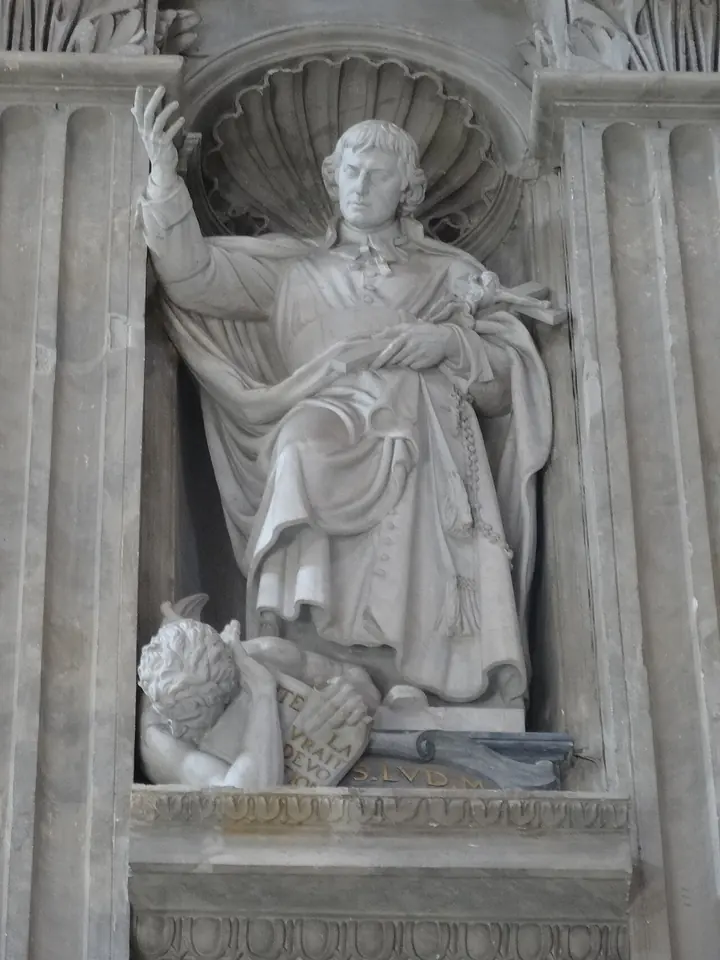

Feast day and where St. Louis de Montfort is honored
His feast is April 28, an optional memorial in the General Roman Calendar, shared with St. Peter Chanel. Find it on our feast days page.
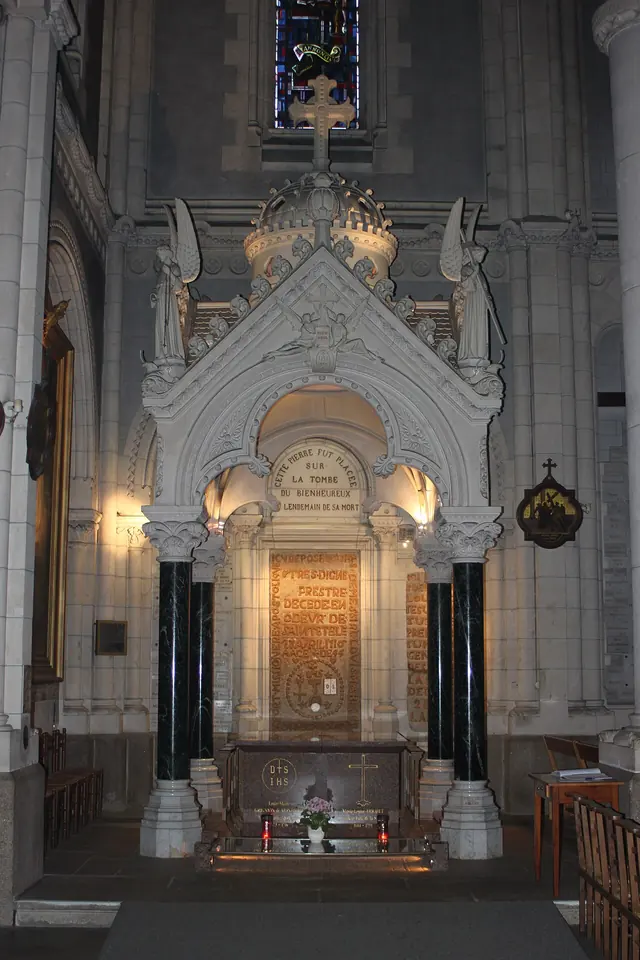
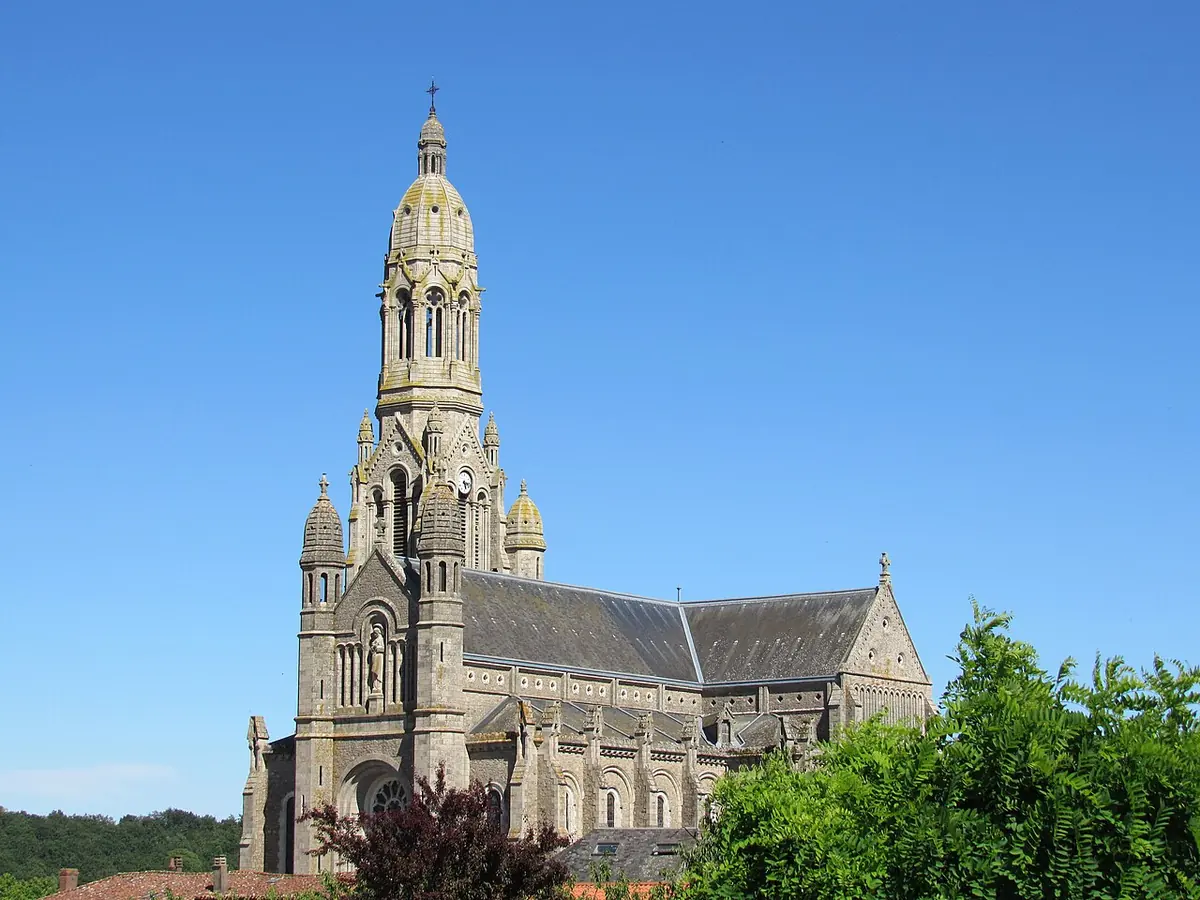
His tomb is in Saint-Laurent-sur-Sèvre, in the Vendée, where he died, in the basilica that now bears his name.


Prayer to St. Louis de Montfort
The prayer the Catholic Church uses on his feast is the collect of the Roman Missal. In the current English translation, as given by Catholic Culture:
O God, who willed to direct the steps of the Priest Saint Louis along the way of salvation and of the love of Christ, in the company of the Blessed Virgin, grant us, by his example, that, meditating on the mysteries of your love, we may strive tirelessly for the building up of your Church. Through our Lord Jesus Christ, your Son, who lives and reigns with you in the unity of the Holy Spirit, God, for ever and ever.
Many Catholics also use Montfort's own short act of consecration, which he recommended renewing even daily. In Faber's translation it reads:
Tuus totus ego sum, et omnia mea tua sunt. I am all for Thee, and all I have belongs to Thee, O my sweet Jesus, by Mary Thy holy Mother.
Frequently asked questions
What is total consecration to Jesus through Mary?
It is the practice Montfort teaches in True Devotion. After a preparation of at least twelve days, then three weeks of prayer, a person makes a written act consecrating to Mary, and through her to Jesus, "my body and soul, my goods, both interior and exterior, and even the value of all my good actions, past, present, and future" (Faber's translation). Montfort asks people to renew it at least once a year.
How did Pope John Paul II's motto come from St. Louis de Montfort?
John Paul II wrote in 2004 that his motto Totus tuus ("totally yours") "is inspired by the teaching of St Louis Marie Grignion de Montfort." It comes from Montfort's Latin formula "Tuus totus ego sum, et omnia mea tua sunt", which he rendered "I am all yours, and all that I have is yours, O most loving Jesus, through Mary, your most holy Mother."
When is St. Louis de Montfort's feast day?
April 28, the day he died in 1716. It is an optional memorial in the General Roman Calendar, shared that day with St. Peter Chanel.
Why was True Devotion lost for more than a century?
Montfort wrote it in the early 1700s, but the manuscript lay forgotten after his death. In 1842 a priest of his own congregation found it by accident at Saint-Laurent-sur-Sèvre, and it was published in 1843. Montfort had predicted in the book itself that it would be hidden "in the silence of a coffer."
What is St. Louis de Montfort the patron saint of?
Catholic Culture lists preachers, along with the religious families he founded or inspired, the Company of Mary, the Daughters of Wisdom and the Brothers of St. Gabriel. No pope has named him patron of a particular cause.
Sources
- Catholic Encyclopedia (1910): St. Louis-Marie Grignion de Montfort
- John Paul II, Letter to the Montfortian Religious Family (January 13, 2004)
- John Paul II, Rosarium Virginis Mariae (2002)
- A Treatise on the True Devotion to the Blessed Virgin, translated by Frederick William Faber (London: Burns & Oates, 1904 edition), Internet Archive
- Montfort Missionaries: History of the Company of Mary
- Catholic Culture: Liturgical Year, April 28, 2026 (Opt. Mem. of St. Louis Mary de Montfort)