St. Expedite (Expeditus)
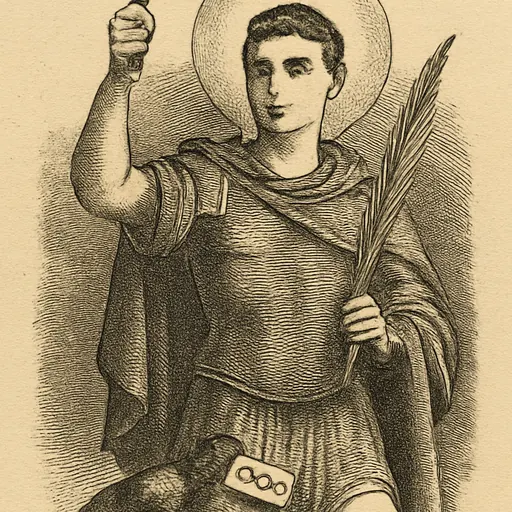
St. Expedite (Expeditus) is an early Christian martyr whose name appears in the ancient martyrologies among a group of martyrs of Melitene, in Roman Armenia, and almost nothing else is known about him for certain. Because his name sounds like "expedite," Catholics and others call on him as the patron of urgent causes and of procrastinators. His feast day is April 19.
Who was St. Expedite?
St. Expedite, or Expeditus in Latin, is one of the most popular saints in the Catholic world about whom almost nothing is known. His name appears in the Hieronymian Martyrology, a list of martyrs compiled in the 400s and wrongly credited to St. Jerome. Under April 19 it records a group of martyrs who died on a single day at Melitene, a garrison town on the upper Euphrates in Roman Armenia, now Malatya in eastern Turkey:
In Arminia Militana civitate Hermogeni, Gagi, Expediti, Aristonici, Rufi, Galatae una die coronatorum.
That is, "In the city of Melitene in Armenia, Hermogenes, Gaius, Expeditus, Aristonicus, Rufus and Galatas, crowned on one day." The Catholic Encyclopedia notes that these martyrs of Melitene are "mentioned already" in that ancient list. Vatican News sums up the rest in one line: "Expeditus is believed to have been martyred in Melitene in the 4th century; but beyond that, not much is known about him."


Even the name is uncertain. In 1906 the Bollandist scholar Hippolyte Delehaye argued in the Analecta Bollandiana that "Expeditus" may be a copyist's error for the name Elpidius. Later writers made Expedite a Roman officer of the Twelfth Legion, the "Thundering Legion," which was stationed at Melitene. That is a reasonable guess about a martyr from a garrison town, but no early source says so.
The legends of St. Expedite
Because the record is so thin, Expedite's popular image comes almost entirely from legends that grew up long after his death. They are best read as stories about his name, not his life.
The crow that said "tomorrow"
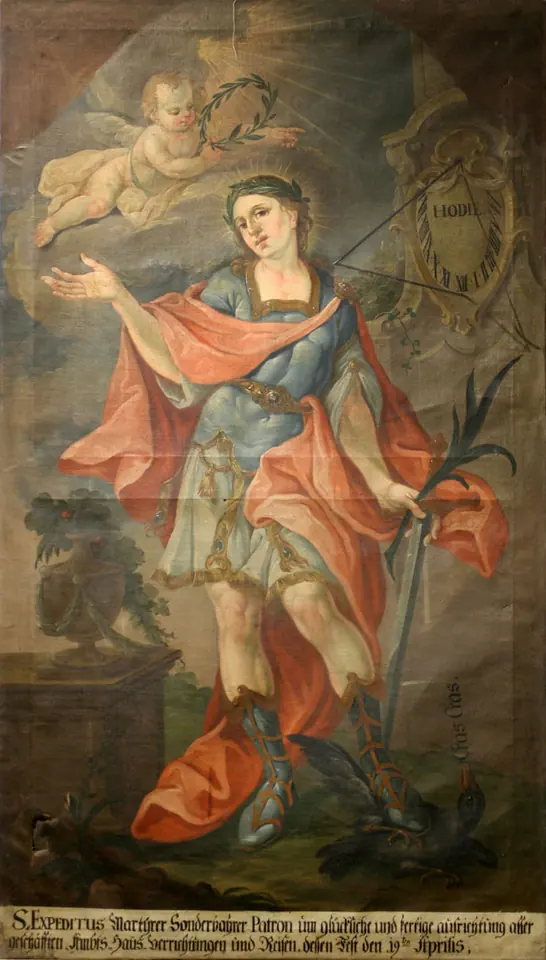
The best-known legend says that when Expedite decided to become a Christian, the devil appeared to him as a crow and croaked, "Cras, cras," Latin for "tomorrow, tomorrow," urging him to put the decision off. Expedite crushed the bird under his foot and answered, "Hodie," "today." The story is traditional, and it rests on a pun: Latin writers had long heard the caw of a crow as cras.

This picture of the saint was already in circulation in the 1700s. A late 18th-century painting now in the diocesan museum of Graz, Austria, shows the crow at his feet with "Cras Cras" painted beside it and a clock marked HODIE on the wall. Its German inscription calls him a special patron for the happy and speedy completion of all business, household tasks and journeys.

The crate marked "expedite"
A second story is told in several versions. In the usual one, a convent of nuns in Paris sent to Rome for the relics of a martyr from the catacombs. The box arrived marked spedito or "expedite," meaning "sent" or "rush," and the nuns took the word for the martyr's name. In New Orleans the same story is told about a crate of statues delivered to the old chapel on Rampart Street.
The tale is charming, but the historical record contradicts it. In November 1906 the Jesuit historian Herbert Thurston, writing in The Month, called the Paris version "a pure invention." He showed that a French reference book of 1867 already described German prints of St. Expeditus with the crow, and that the town of Acireale in Sicily had chosen "St. Expeditus, martyr of Armenia" as its patron in 1781, long before any crate could have reached Paris. One 18th-century engraving he cited calls him "S. EXPEDITUS MARTYR, NEGOTIORUM ET EXPEDITIONUM PATRONUS," patron of business and of dispatch. Thurston agreed, though, that the saint's patronage of speed came "solely from his name."

The miracles of St. Expedite
No miracle has been formally investigated for St. Expedite, and none is recorded from the early Church. Sorted by the labels this encyclopedia uses:
- The crow and the cross: traditional, a legend of the 1700s or earlier built on the pun cras and hodie.
- The relics in the crate: traditional, and shown to be later than the devotion it claims to explain.
- Answered prayers in urgent need: reported. Devotees leave thank-you plaques, flowers and candles at his altars from Réunion to Buenos Aires, and the custom of thanking him publicly is part of the devotion, but the Church has not examined these claims.
Why St. Expedite is the patron of urgent causes
The patronage comes from the word itself. Expeditus in Latin means "unencumbered" or "ready," and in Italian, French and English its relatives mean "sent off" or "done quickly." Devotees came to ask the saint with that name to hurry their requests along: a court case, a job, a sale, money for rent. Thurston found the devotion at Acireale in the 1700s and evidence that a guild of merchants from Messina brought it there, and German prints of the same period show him as a patron of business and travel. From there it moved to France and across the Catholic world.
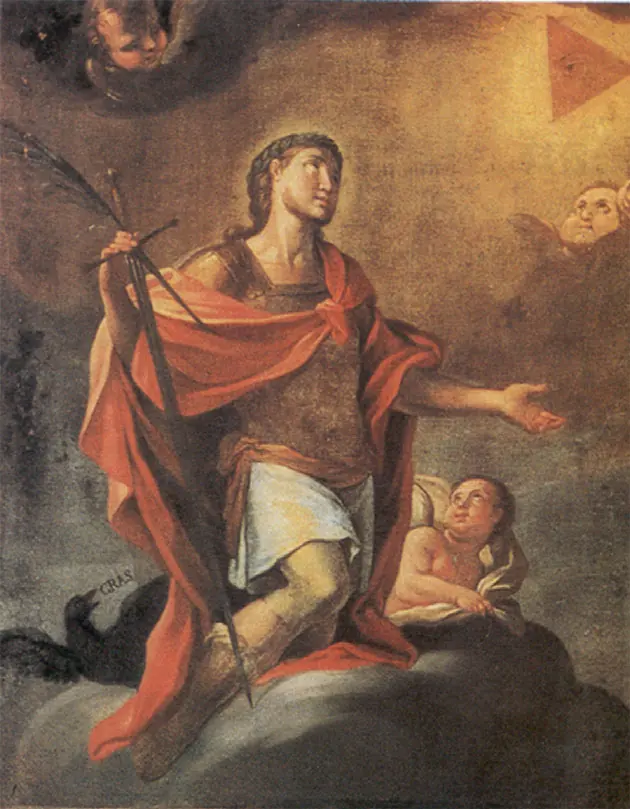

He is also the patron of procrastinators, because of the crow, and in the older Italian devotion of merchants and sailors. See our full list of patron saints. People who pray to him often pair him with St. Jude and St. Rita of Cascia, the patrons of hopeless and impossible causes.
The Church and the cult of St. Expedite
Church authorities have looked on the devotion with some caution. Popular accounts, repeated widely, say that Pope Pius X had his name struck from the list of martyrs in 1905 and tried to keep his images out of churches. This encyclopedia could not find the text of any such decree, and the story should be treated as unconfirmed. What is documented is the debate of 1905 and 1906: Delehaye's article questioning the name, Thurston's essay, and an English newspaper's claim, which Thurston quoted, that the saint had been "decanonized by the Vatican—or at least the canonization of him has been officially disapproved."
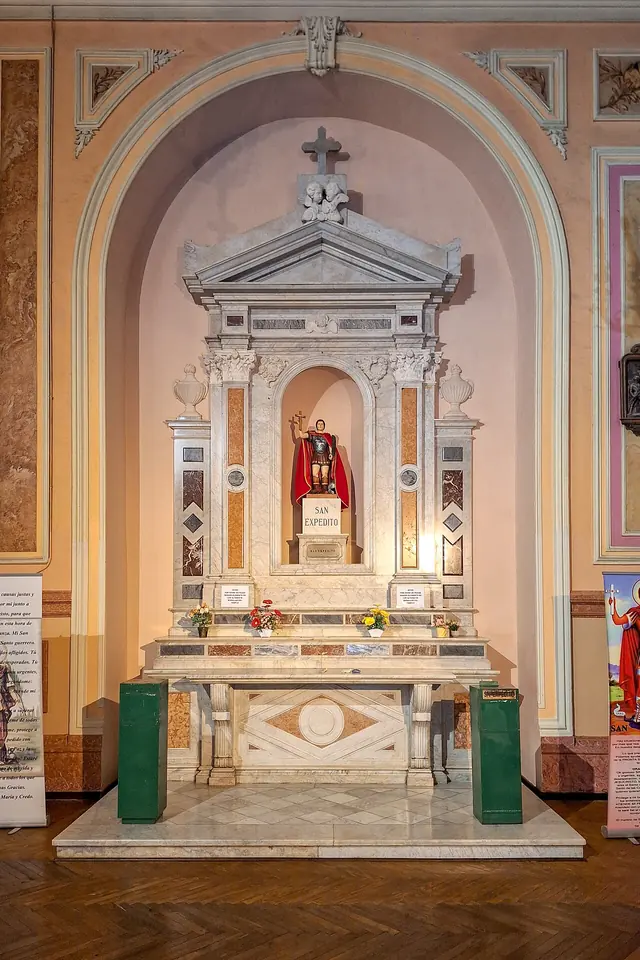
The Church has never canonized him in the modern sense, since his cult is older than the process. Statues of Expedite still stand in many Catholic churches, and Vatican News lists him among the saints of April 19. Catholic writers today usually treat him the way the Church treats other obscure early martyrs: a real name in an ancient list, honored with a devotion that has run well ahead of the facts.
Symbols of St. Expedite in art
Expedite is easy to recognize. Look for:
- A young Roman soldier: armor, a short tunic and a red cloak, usually beardless.
- A cross inscribed HODIE: "today," raised high in his right hand.
- A crow under his foot: often with a banner from its beak reading CRAS, "tomorrow."
- A clock: in older German and Austrian images, a reminder that time is short.
- A palm branch: the sign of a martyr, in his left hand.
The 1897 Italian holy card below shows the full set and adds a Roman helmet at his feet and Rome in the background. Mass-printed cards like it spread his image across South America. The Graz painting and Jahn's engraving near the top of this page show the older German type, with the clock and the trappings of trade.


Where St. Expedite is honored
Sicily and Europe
Acireale, on the east coast of Sicily, has honored him as its patron since 1781, and Thurston reported that the statue carved for him then, a soldier with a palm branch, was still kept there. In France, Germany and Austria his statue stands in many parish churches, often surrounded by small marble plaques engraved merci, "thank you."
New Orleans
In New Orleans his statue stands inside Our Lady of Guadalupe Church on North Rampart Street, the oldest surviving church building in the city, first built as a burial chapel during the yellow fever epidemics. The church is also the International Shrine of St. Jude. Karen Williams, writing in the Louisiana Folklore Miscellany in 2011, reports that the statue stands near the entrance, "palm branch in hand." In the folk religion of New Orleans, Expedite also became a figure in local Voodoo practice, where devotees leave him offerings such as pound cake in thanks for a favor granted. That practice is outside the Catholic devotion and not part of it.


Réunion
On the French island of Réunion, in the Indian Ocean, small roadside shrines to Saint Expédit are everywhere, almost always painted bright red. Some are niches cut into rock, others little huts with statues, flowers and candles. The devotion there mixes Catholic and Hindu and other island traditions, and many visitors who pray at these altars are not Catholic. The French Catholic site Aleteia calls the cult on the island "très populaire."


Brazil, Argentina and Chile
In South America he is Santo Expedito or San Expedito, and his feast is one of the busiest days of the year in some parishes. In Brazil his April 19 feast draws crowds of devotees, and a town in São Paulo state is named Santo Expedito. In Buenos Aires, long lines of pilgrims form outside the parish of Balvanera on April 19. Thomas Craughwell, writing in the Arlington Catholic Herald, notes that the devotion has also spread widely in Chile.

Prayer to St. Expedite
There is no traditional or liturgical prayer to St. Expedite with a known origin. He has no proper Mass or office in the Roman liturgy, and the prayers printed on holy cards and sold with candles were written anonymously in modern times. This encyclopedia doesn't reprint them as if they came from the Church.
Catholics who ask St. Expedite to pray for them usually do so in their own words, asking him to bring their need quickly before God. Many add an Our Father, a Hail Mary and a Glory Be, and some pray a novena, nine days of prayer ending on his feast of April 19. A common custom, from Acireale to Buenos Aires, is to thank him publicly once a prayer is answered, with flowers, a candle or a small engraved plaque. You can find other saints of the season on our feast days page.
Frequently asked questions
What is St. Expedite the patron saint of?
Urgent causes and fast solutions, procrastinators, and in the older Italian and German devotion merchants, business affairs and travelers. Acireale in Sicily chose him as its patron in 1781. Online lists sometimes add newer patronages, such as computer programmers, that come from no Church act.
When is St. Expedite's feast day?
April 19, the day the early Hieronymian Martyrology gives for the martyrs of Melitene. He is not on the General Roman Calendar, so the day is kept by local custom, with Masses and novenas in parishes in Brazil, Argentina, Chile, Réunion and southern Italy.
Was St. Expedite a real person?
A martyr named Expeditus is listed at Melitene in Armenia in the Hieronymian Martyrology, a list compiled in the 400s, so there is an old record of his name. The Bollandist Hippolyte Delehaye argued in 1906 that the name may be a copyist's slip for Elpidius. Nothing reliable survives about his life, and the stories of the crow and of the crate marked "expedite" are late legends.
Is there an official St. Expedite prayer?
No. The Church has no liturgical prayer for him, and the prayers on popular holy cards have no known author. Catholics who ask his intercession usually pray in their own words, often with an Our Father, a Hail Mary and a Glory Be, and sometimes a novena over nine days before April 19.
Why does St. Expedite step on a crow?
In Latin a crow's call was heard as "cras, cras," meaning "tomorrow." Tradition says the devil came to him as a crow urging him to put off his conversion, and he crushed it and said, "Today!" His cross is inscribed hodie, "today." The image was printed on German and Italian prints by the 1700s.
Sources
- Vatican News: Saint of the Day, April 19 (St. Expeditus)
- Herbert Thurston, "Saint 'E Spedito'", Flotsam and Jetsam, The Month, vol. 108 (November 1906), pp. 544–546
- Catholic Encyclopedia (1912): Sts. Rufus (the martyrs of Melitene, April 19)
- Daily Compass: Saint Expeditus
- Thomas J. Craughwell, A patron saint for procrastinators (Arlington Catholic Herald, 2012)
- Karen Williams, St. Expedito's Role in South Louisiana Catholicism (Louisiana Folklore Miscellany, 2011)
- Aleteia: Saint Expédit a-t-il existé ?
- Hippolyte Delehaye, Saint Expédit et le martyrologe hiéronymien, Analecta Bollandiana 25 (1906)
- Matthew Kuefler, The Convertible Saint: Expeditus through Time and Space, Journal of Religious History 42 (2018)