St. Athanasius of Alexandria

St. Athanasius (about 296–373) was the bishop of Alexandria in Egypt who defended the faith of the Council of Nicaea, that Christ is fully God, against the teaching of Arius. He was driven from his city five times and spent about seventeen years in exile, wrote On the Incarnation and the Life of Antony, and is a Doctor of the Church. His feast day is May 2.
Who was St. Athanasius?
Athanasius was bishop of Alexandria, the great Greek-speaking port of Roman Egypt, for forty-five years, from 328 until his death in 373. His whole life turned on one question: is Jesus Christ truly God, or a creature, however exalted? The Council of Nicaea answered in 325 that the Son is "of one substance" with the Father. For the next half century, powerful bishops and several emperors tried to soften or reverse that answer, and Athanasius spent his life defending it.
It cost him. Benedict XVI counted at least five expulsions from his city between 336 and 366, adding up to seventeen years of exile. Yet he outlived his opponents and died at home, in his own see. St. Gregory of Nazianzus called him "the pillar of the Church" only a few years after his death, and the Catholic, Orthodox and Coptic churches all honor him as a saint.
The Catholic Encyclopedia draws on Gregory and on Julian the Apostate's sneers to describe him: slightly below middle height, slight but strongly built, with a quick wit, an easy manner and a courage "that never falters."

The life of St. Athanasius
A boy of Alexandria
He was probably born in Alexandria between 296 and 298 and received a good Greek education in grammar and rhetoric. As a young man he became secretary to Bishop Alexander and was ordained a deacon. The Catholic Encyclopedia suggests he also spent time with the monks of the Egyptian desert, including St. Antony the Great, a friendship that shaped the rest of his life.
A charming story, told by the historian Rufinus nearly a century later, says Bishop Alexander once watched from his window as boys on the beach played at church, and saw young Athanasius, as "bishop," baptizing his friends with seawater. Alexander questioned the children, decided the baptisms were valid, and took the boy under his care. The Orthodox life of Athanasius still tells this story. The Catholic Encyclopedia doubts it, noting its chronological problems, and we label it traditional.

Nicaea and the Arian crisis
Around 318, an Alexandrian priest named Arius began teaching that the Son of God was not eternal but was created by the Father. Alexander condemned him. In 325 the emperor Constantine called the first ecumenical council at Nicaea, in present-day Turkey, and Athanasius went as Alexander's deacon and secretary. The council's creed declared the Son "true God from true God," homoousios, of the same substance as the Father.
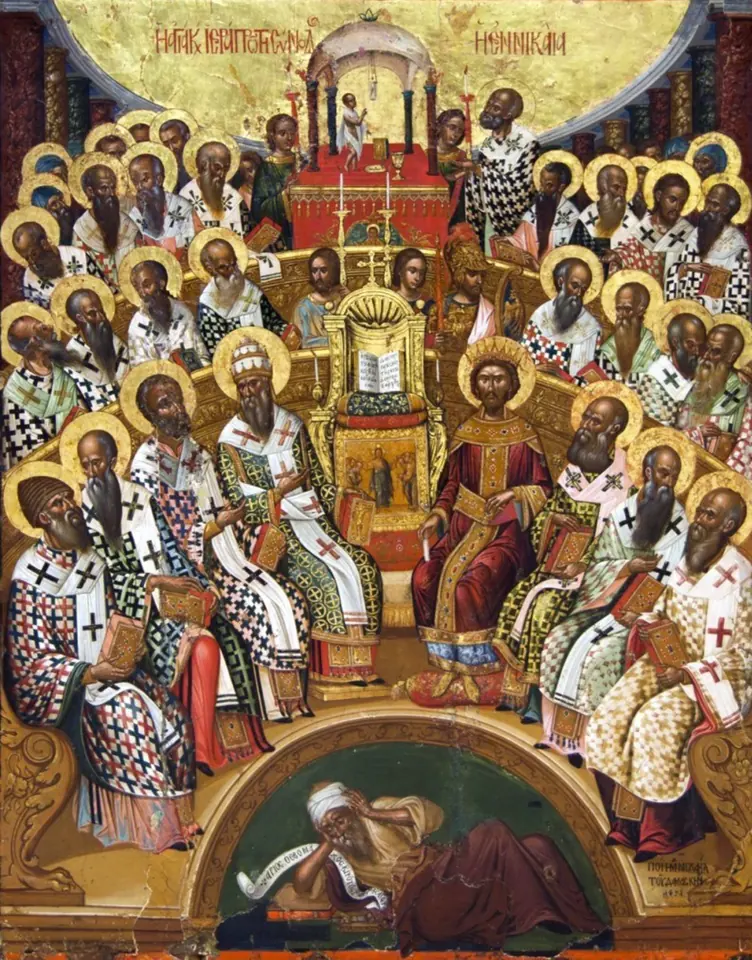

When Alexander died in 328, Athanasius, about thirty, was chosen to succeed him. His enemies later claimed he had been too young to be consecrated, and the charge followed him for years. In his early years as bishop he consecrated St. Frumentius as the first bishop of Ethiopia.
Five exiles
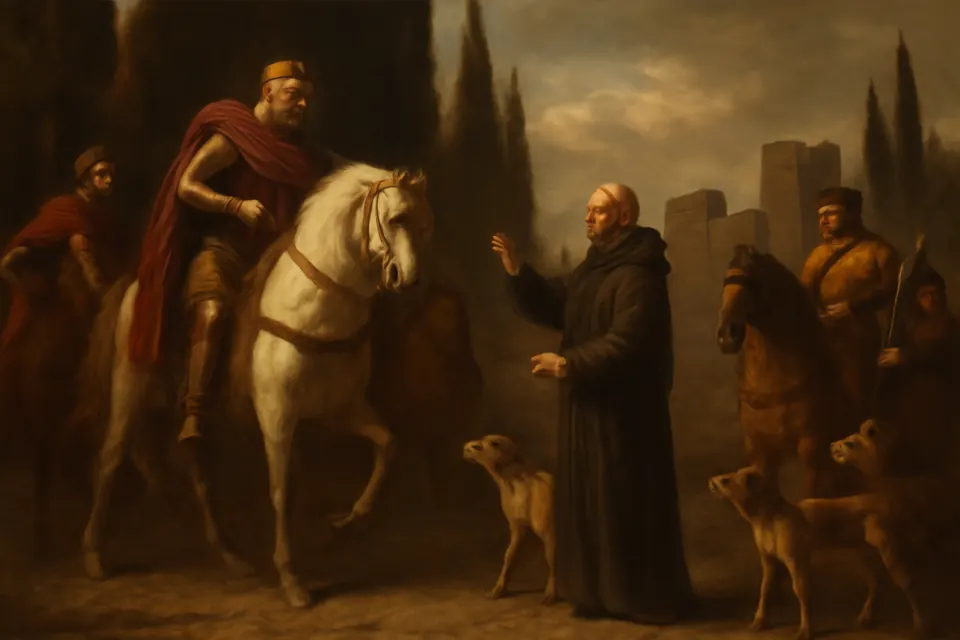
Arius's allies, led by Eusebius of Nicomedia, persuaded Constantine to readmit Arius, and they turned on Athanasius with charges of violence, extortion and even murder. A council at Tyre in 335 was so stacked against him that he slipped away by boat to Constantinople. There, the Catholic Encyclopedia says, he stepped into the road in front of the emperor, who was returning from a hunt, and demanded "a just tribunal." Constantine heard both sides and then banished him anyway.
His exiles, in outline:
- 336 to 337, Trier on the Moselle, under Constantine, where the local bishop welcomed him.
- 339 or 340 to 346, Rome, after the emperor Constantius installed a rival bishop. Pope Julius I and a Roman synod declared him innocent, and the Council of Serdica in 343 cleared him again.
- 356 to 362, the desert. Soldiers burst into his church during a night service on February 8, 356. He escaped and lived for six years hidden among the monks of Upper Egypt, writing some of his most important works.
- 362 to 363, under Julian the Apostate, who ordered him out of Egypt. Athanasius told his weeping people his absence would be short. Julian died in battle the next June.
- About 365 to 366, under the Arian emperor Valens. Socrates and Sozomen report that he hid for four months in his father's tomb before Valens let him return.
He spent his last seven years in peace in Alexandria and died there on May 2, 373.

Writings: On the Incarnation, the Life of Antony and the New Testament
Athanasius was a pastor writing in the middle of a fight, but some of his books outlasted the fight. On the Incarnation, probably written before the Arian crisis, explains why God became man. Its most famous sentence, in the Nicene and Post-Nicene Fathers translation, reads: "For He was made man that we might be made God; and He manifested Himself by a body that we might receive the idea of the unseen Father."
The Life of Antony, written soon after the hermit's death while Athanasius was hiding among the monks, was, in Benedict XVI's words, "the bestseller of early Christian literature." It was quickly translated into Latin and spread monastic life across East and West. Augustine tells in his Confessions how the story of two officials who read it at Trier moved him toward his own conversion. Antony left Athanasius one of his two sheepskins, and the cloak Athanasius had once given him.
Every year the bishop of Alexandria sent a festal letter announcing the date of Easter. In his 39th, in 367, Athanasius listed the books of the New Testament: exactly the 27 that Catholics, Orthodox and Protestants use today, the earliest surviving list with that content. "These are fountains of salvation," he wrote, "that they who thirst may be satisfied with the living words they contain."

Miracles and legends of St. Athanasius
Athanasius is honored for his teaching and endurance, not for wonders, and his own writings claim none. Later tradition adds a few stories:
- The boy bishop on the beach: traditional, from Rufinus, and doubted by the Catholic Encyclopedia.
- His prediction under Julian that his exile would be brief: traditional. The Catholic Encyclopedia calls it a prophecy "curiously fulfilled," but the sources tell it after the fact.
- Narrow escapes in the desert: the Life of Pachomius and other monastic texts tell many; the Catholic Encyclopedia treats them as legend. Traditional.
No healing or other miracle connected with him has been formally investigated by the Church.
Why St. Athanasius is a patron of theologians
Athanasius is not tied to a trade or an illness. He is invoked by theologians, teachers of the faith and those who defend Christian doctrine, because he spent his life explaining what the Church believes about Christ and why it matters. The Roman Missal's prayer for his feast calls him "an outstanding champion of your Son's divinity." See our patron saints page for more.
Symbols of St. Athanasius in art
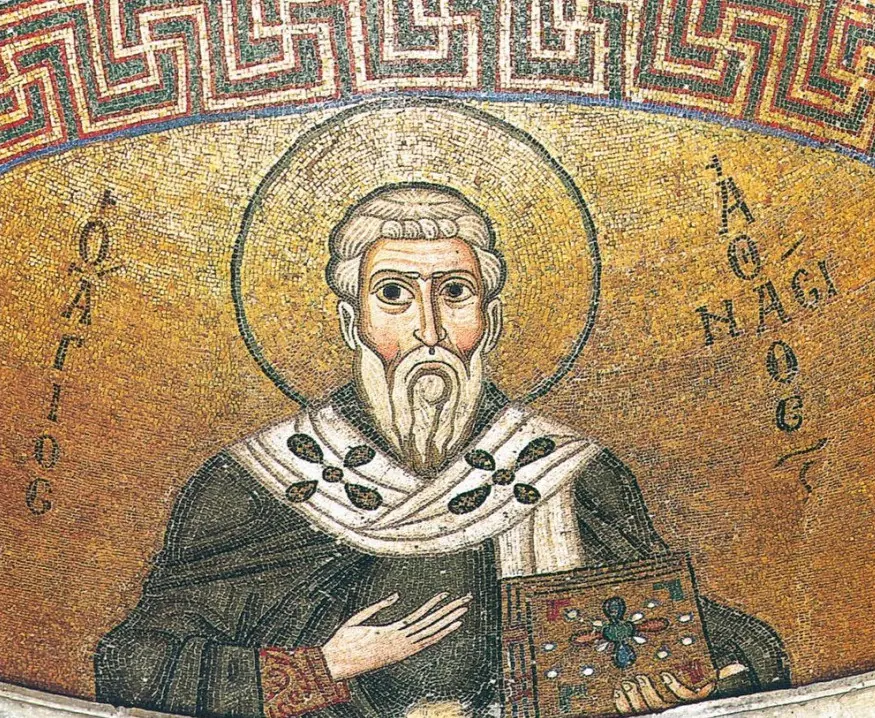
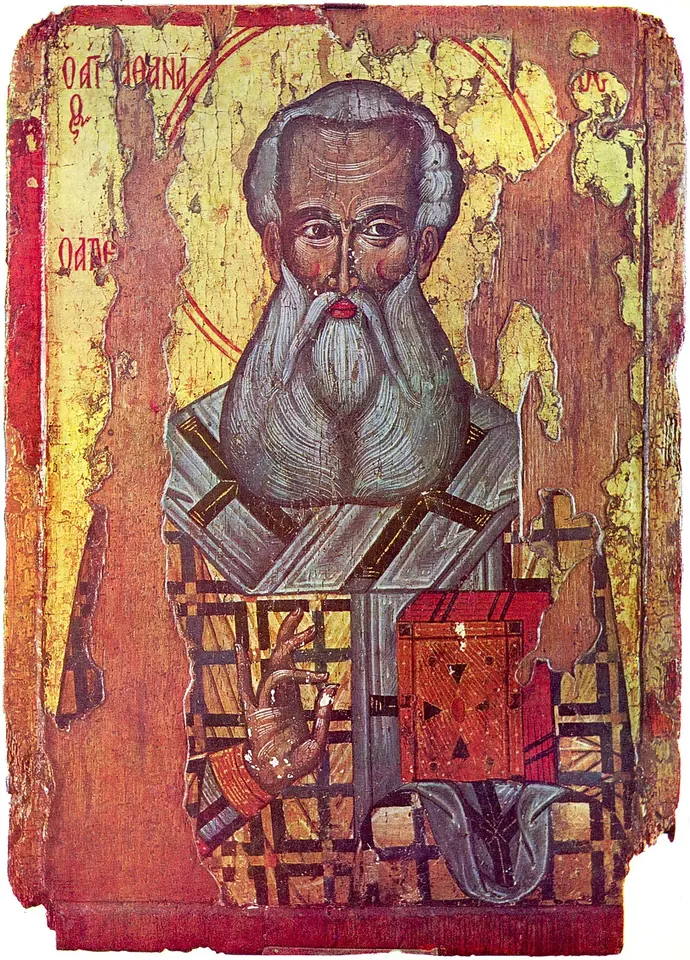
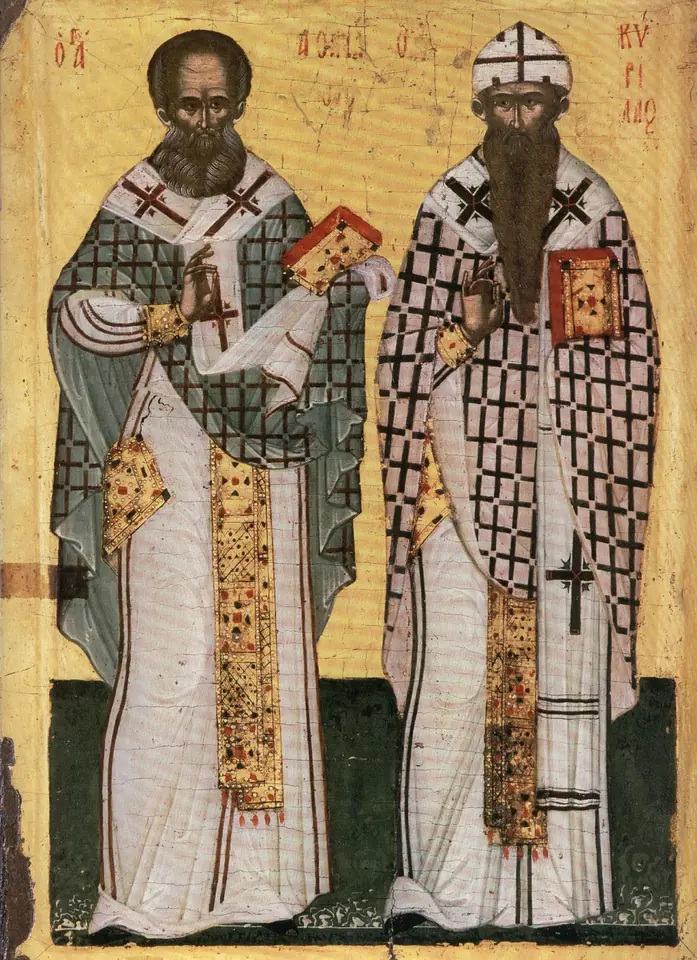
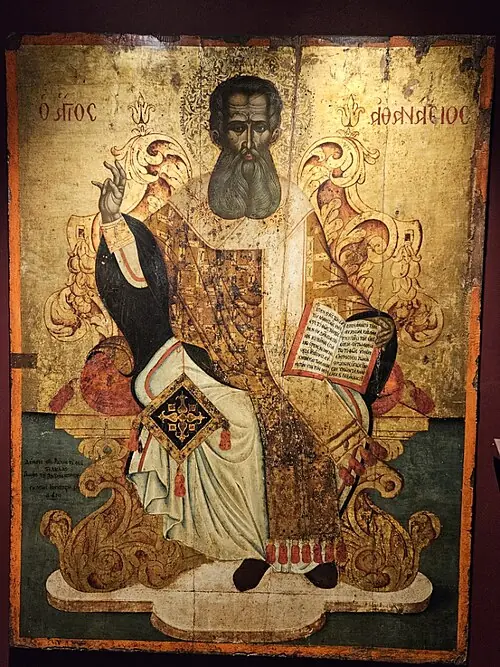
In Eastern icons, Athanasius looks much the same across a thousand years: an elderly bishop with a high, balding forehead and a short or medium white beard, in a white omophorion (the bishop's stole) marked with black crosses, holding a Gospel book and often blessing. Inscriptions name him "O Agios Athanasios," sometimes with "the Great." He often stands beside other bishops: St. Cyril of Alexandria, or the Three Holy Hierarchs St. Basil, St. Gregory of Nazianzus and St. John Chrysostom.
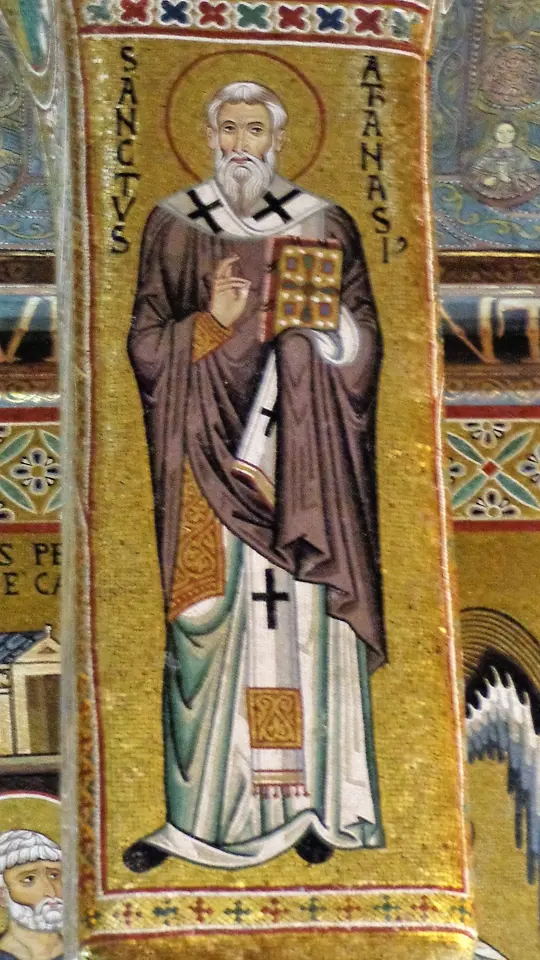

Western art shows him less often, usually as a bishop in miter and cope with a book. Look for him also in scenes of the Council of Nicaea. His best-known Western image is a bronze giant: in Bernini's Chair of St. Peter in St. Peter's Basilica, four Doctors of the Church hold up the throne, Ambrose and Augustine for the West and Athanasius and John Chrysostom for the East. Benedict XVI pointed to this as a sign of how both halves of the Church honor him.


Feast day and relics
The Catholic Church keeps his memorial on May 2, the day of his death. The Orthodox Church keeps May 2 as well and honors him again on January 18, together with St. Cyril of Alexandria. Find his neighbors on our feast days page.
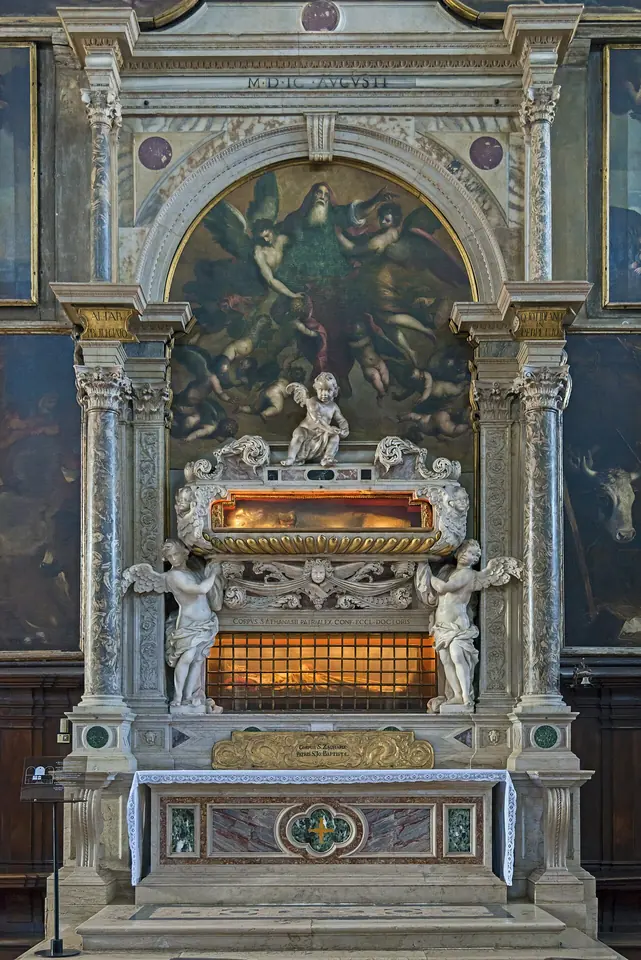
He was buried in Alexandria. His remains were later carried to Venice, where the church of San Zaccaria keeps what it venerates as his body. In May 1973, during the 1,600th anniversary of his death, Pope Paul VI received the Coptic Pope Shenouda III in Rome, and in his farewell address he hoped their shared commitment would "always be that of the great Saint Athanasius." Paul VI gave the Coptic Church a relic of the saint, now kept in St. Mark's Coptic Orthodox Cathedral in Cairo.

Prayer to St. Athanasius
The Catholic Church prays this collect on his memorial, from the Roman Missal (English translation, 2011):
Almighty ever-living God, who raised up the Bishop Saint Athanasius as an outstanding champion of your Son's divinity, mercifully grant, that, rejoicing in his teaching and his protection, we may never cease to grow in knowledge and love of you. Through our Lord Jesus Christ, your Son, who lives and reigns with you in the unity of the Holy Spirit, God, for ever and ever.
Orthodox Christians sing the troparion and kontakion of his feasts on January 18 and May 2. Many also pray with his own words, especially the line from On the Incarnation that Benedict XVI called "rightly famous."

Frequently asked questions
What is St. Athanasius known for?
For defending the Nicene Creed's teaching that the Son of God is "of one substance" (homoousios) with the Father. Arius, an Alexandrian priest, taught that the Son was a created being, and for fifty years emperors and councils swung back and forth. Athanasius did not. He is also known for On the Incarnation, the Life of Antony, and his Easter letter of 367, the first known list of exactly the 27 books of today's New Testament.
What does \"Athanasius contra mundum\" mean?
"Athanasius against the world." It is a Latin saying from later centuries, not something Athanasius wrote, and it sums up how later Christians remembered him: one bishop who refused to give way when, for a time, most of the Church's bishops and the emperor himself were on the other side.
How many times was Athanasius exiled?
Five. Benedict XVI summarized it: "At least five times - during the 30 years between 336 and 366 A.D. - Athanasius was obliged to abandon his city, spending 17 years in exile." He was banished to Trier under Constantine, fled to Rome under Constantius, hid with the desert monks for six years, was expelled by Julian the Apostate, and withdrew briefly again under Valens.
Did St. Athanasius write the Athanasian Creed?
No. The creed that begins "Whosoever will be saved" (Quicunque vult) bears his name, but the Catholic Encyclopedia explains that since the 17th century most scholars have agreed he was not its author: no early writer attributes it to him, and its language points to a Western, Latin origin. It reflects his teaching on the Trinity and the Incarnation.
When is St. Athanasius's feast day?
May 2, the day he died in 373, in both the Catholic and Orthodox calendars. The Orthodox Church honors him a second time on January 18, together with St. Cyril of Alexandria.
Sources
- Catholic Encyclopedia (1907): St. Athanasius
- Benedict XVI, General Audience of 20 June 2007: Saint Athanasius of Alexandria
- Athanasius, On the Incarnation of the Word (New Advent)
- Athanasius, Life of St. Anthony (New Advent)
- Athanasius, Festal Letter 39 (New Advent)
- Catholic Encyclopedia (1907): The Athanasian Creed
- Orthodox Church in America: Saint Athanasius the Great, Patriarch of Alexandria
- Paul VI, Farewell address to Patriarch Shenouda III (May 10, 1973)
- Catholic Culture: Memorial of St. Athanasius (May 2)
- Wikipedia: Athanasius of Alexandria (veneration and relics)