St. George the Great Martyr
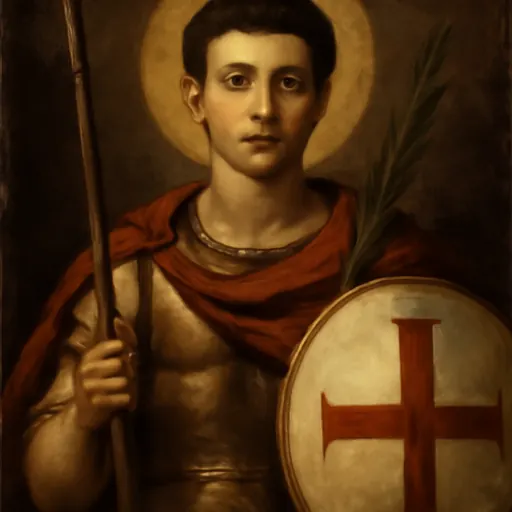
St. George was a Christian soldier martyred at Lydda in Palestine (today Lod, Israel), probably around 303 under the emperor Diocletian. Almost nothing about his life is certain, but his tomb was a place of pilgrimage by the 6th century, and the Eastern churches call him the Great Martyr. His feast day is April 23. He is the patron saint of England, Georgia, Ethiopia and Catalonia, and of soldiers and Scouts. The famous story of George killing a dragon is a medieval legend.
Who was St. George?
St. George is one of the most famous saints in the world and one of the least known. Millions of people know him as the knight who killed a dragon. Very few could say anything else about him, and that is not their fault: the historical record holds almost nothing.
What can be said with confidence is short. A Christian named George died as a martyr at or near Lydda, also called Diospolis, in Roman Palestine, probably during the great persecution under Diocletian that began in 303. Herbert Thurston, writing the Catholic Encyclopedia article in 1909 on the strength of the Bollandist scholar Hippolyte Delehaye's research, concluded that this statement "sums up all that can safely be affirmed about St. George, despite his early cultus and pre-eminent renown both in East and West."


That early cult is the strongest evidence that he was a real person. Pilgrims of the 6th to 8th centuries all describe Lydda as the place where his body rested and where Christians came to honor him. Churches in Syria, Mesopotamia and Egypt were dedicated to him early, and the Eastern churches have always ranked him among the greatest of the martyrs. Today the town is Lod, in Israel, and the Greek Orthodox Church of St. George still keeps his tomb.
The life of St. George, as tradition tells it
A soldier from Cappadocia
The story Christians tell about George's life comes from his Acts, a legendary account first written in Greek in the 5th century and copied, translated and reworked in many languages. The Orthodox Church in America gives the version most widely told in the East today. George was born in Cappadocia, in present-day Turkey, to a Christian family. His father died a martyr when George was a child, and his mother, who owned land in Palestine, took him there and raised him. He joined the Roman army, distinguished himself in battle and rose to command in the imperial guard of Diocletian.
Confession before the emperor
When Diocletian gave his governors a free hand against the Christians, George gave away his wealth to the poor, freed his servants and went before the emperor's council. In the Orthodox life he declares, "I am a servant of Christ, my God, and trusting in Him, I have come among you voluntarily, to bear witness concerning the Truth." When an official asked, "What is Truth?", echoing Pilate, George answered, "Christ Himself, Whom you persecuted, is Truth."

The emperor, who had favored him, tried to win him back with promises and then with torture. The Acts describe a long series of torments: the wheel lined with blades, a pit of quicklime, iron shoes with red-hot nails, poison. In each, George is healed or unharmed. A sorcerer named Athanasius and the empress Alexandra are converted by what they see. In the end George is beheaded, on April 23, 303, according to the Orthodox life.
What the historians say about the Acts
Here history and legend part ways, and it is worth saying plainly. The Catholic Encyclopedia calls the earliest known narrative "full beyond belief of extravagances and of quite incredible marvels." In it George is killed three times and raised three times, dead men rise to be baptized, timber bursts into leaf and milk flows instead of blood from his head. The later "mitigated" versions, Thurston wrote, were made from the wilder one by trimming it, so they do not get us closer to the facts. The persecutor's name in the oldest text is Dadianus, and only later versions turned him into Diocletian.
None of this means George never lived. It means, in Thurston's words, that "no faith can be placed in the attempts that have been made to fill up any of the details of his history." The Orthodox Church keeps the traditional life in its services, and Catholic and Orthodox Christians alike honor him as a true martyr whose story has been told and retold with love.
The Gelasian decree
An early sign of caution comes from Rome itself. A list of approved and rejected books, traditionally credited to Pope Gelasius I around 495, names "the Passion of Georgius" among writings not read in the Roman Church. The decree says such accounts "appear to have been composed by heretics" or are of unknown authorship, but it adds that the Church venerates "all the martyrs and their glorious sufferings, which are better known to God than to men." The Catholic Encyclopedia sums this up by saying Gelasius counted George among those saints "whose names are justly reverenced among men, but whose actions are only known to God." Modern scholars usually date the decree a little later than Gelasius, but its judgment on George has held.


The early cult at Lydda
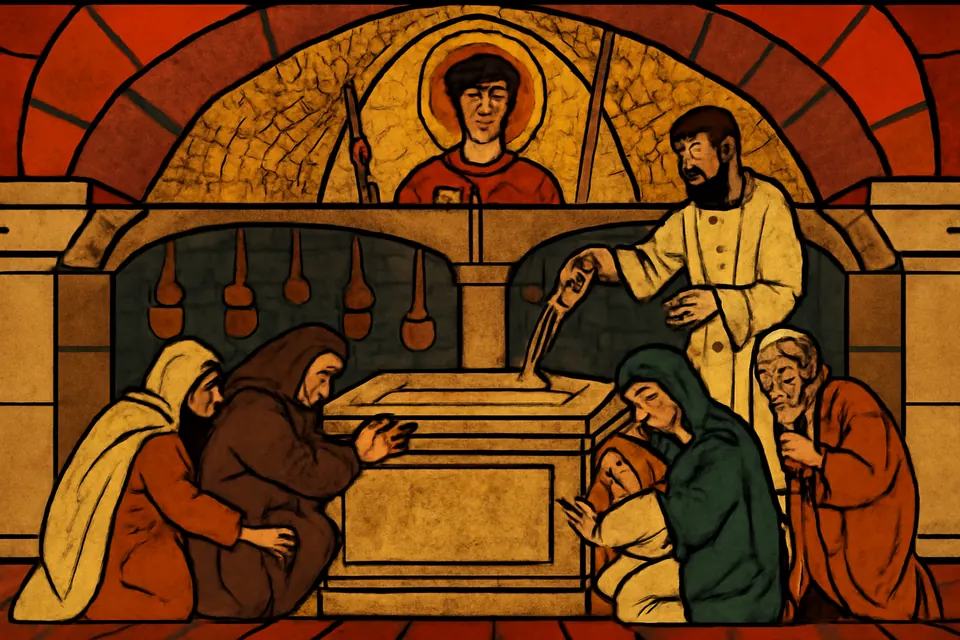
The first Christian pilgrims to describe Lydda, Theodosius around 530 and the travelers who followed him, speak of the church built over George's grave. The Crusaders rebuilt it in the 12th century. After it was destroyed, the Mamluks built a mosque on part of the site in the 13th century, and the present Greek Orthodox church was rebuilt beside the mosque from 1870. Its crypt holds a marble sarcophagus dated 1871, venerated as his tomb.
St. George and the dragon
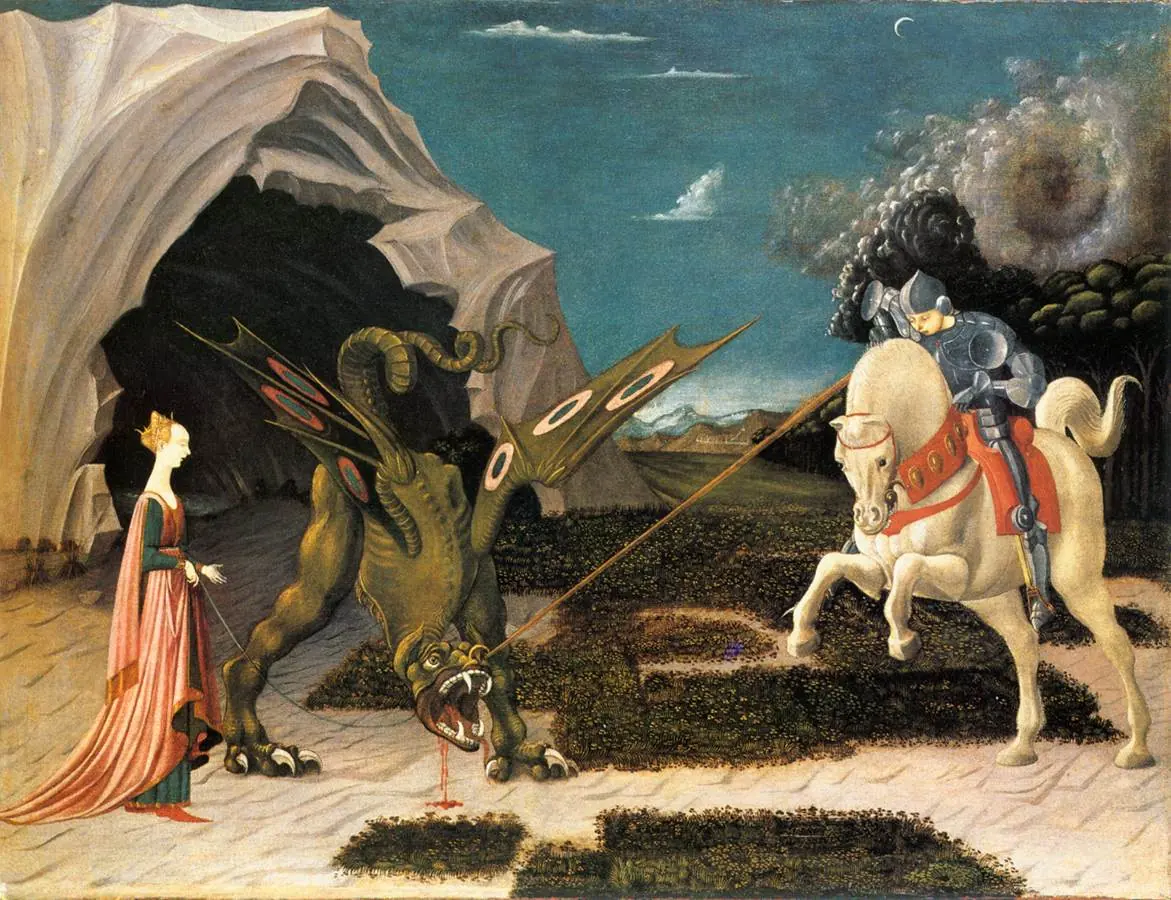
The best-known story about St. George is the latest. The dragon does not appear in any of the early Acts. The Catholic Encyclopedia says the episode "cannot be traced further back than the twelfth or thirteenth century," and Christian Iconography notes that it came to Europe with crusaders returning from Syria. It reached nearly everyone through the Golden Legend, the collection of saints' lives compiled by the Dominican Jacobus de Voragine around 1260 and printed in English by William Caxton in 1483. The story is traditional.
The story in the Golden Legend
In Caxton's English, a dragon lived in a lake near "a city which is said Silene" in Libya and "envenomed all the country" with its breath. The townspeople fed it two sheep a day, then a sheep and a person chosen by lot, until the lot fell on the king's daughter. Dressed as a bride, she was led out to the lake. George rode by, and when she begged him to leave, he said, "Fair daughter, doubt ye no thing hereof for I shall help thee in the name of Jesu Christ."
He armed himself "with the sign of the cross," charged the dragon and drove his spear into it. Then he told the princess to tie her belt around its neck, and she led it into the city "as it had been a meek beast and debonair." George promised to kill it if the people would believe in Christ and be baptized. The king and fifteen thousand men were baptized, "without women and children," and George cut off the dragon's head. He refused the king's reward and asked only that he care for the churches, honor the priests and "have pity on the poor people."


Where did the dragon come from?
No one knows. The Catholic Encyclopedia suggests the dragon may have grown out of the old Acts, where the persecuting emperor is sometimes called a dragon. Because the story appears so late, it is unlikely to be a Christianized pagan myth such as Perseus and Andromeda, though the two tales look alike. The Orthodox life sets the same story near Beirut and Mount Lebanon instead of Libya. Either way, Christians have long read the dragon as the devil and the rescued princess as the Church or the human soul.

The miracles of St. George
Every wonder in the life and legend of St. George falls into this encyclopedia's traditional category. He died long before the Church began formally investigating miracles.
- Traditional: surviving the wheel, the quicklime, the poison and the other torments of the Acts; the conversion of the sorcerer Athanasius and the empress Alexandra; raising a dead man and the farmer Glycerius's ox, as the Orthodox life tells it.
- Traditional: the killing of the dragon at Silene and the baptism of the city, from the Golden Legend.
- Traditional: appearances in battle. William of Malmesbury wrote that George and St. Demetrius, "the martyr knights," were seen helping the crusaders at the battle of Antioch in 1098, and the Golden Legend says the crusaders saw him in white armor with a red cross at the walls of Jerusalem.
- Reported: healings and help that pilgrims attribute to his prayers at his tomb in Lod and at his shrines in the East. These have not been formally examined.

Why St. George is the patron saint of England and other places
England
George was honored in England long before he became its patron. The Catholic Encyclopedia notes that English churches were dedicated to him before the Norman Conquest and that his Acts were translated into Anglo-Saxon. The Crusades made him more popular still. By the 14th century "St. George's arms," a red cross on white, had become a uniform for English soldiers and sailors. Richard II ordered every man in his army invading Scotland to wear "a signe of the arms of St. George" front and back.
The national synod of Oxford made April 23 a lesser holiday in 1222. In 1415, the year of Agincourt, Archbishop Henry Chichele raised it to one of the greatest feasts of the year, to be kept like Christmas. The red cross on white is still the flag of England and part of the Union Jack.

The Order of the Garter
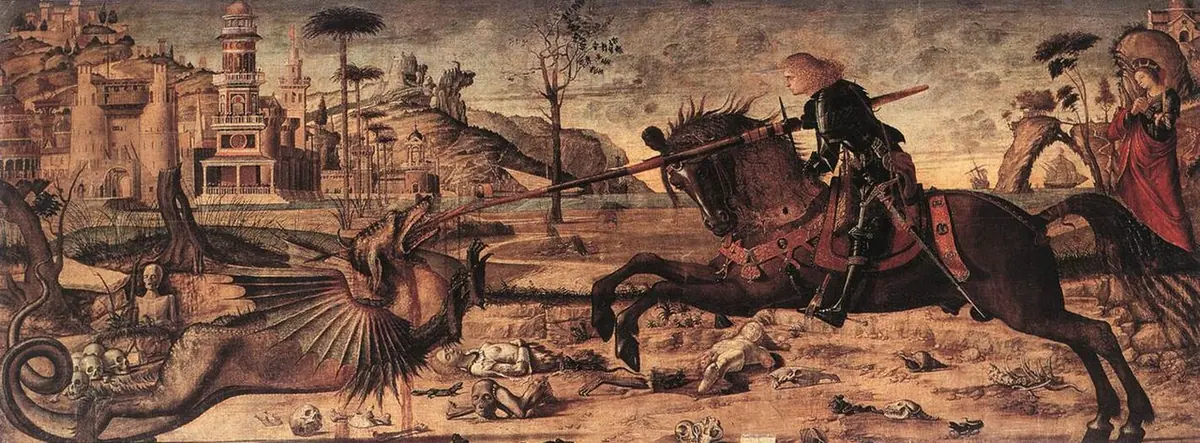
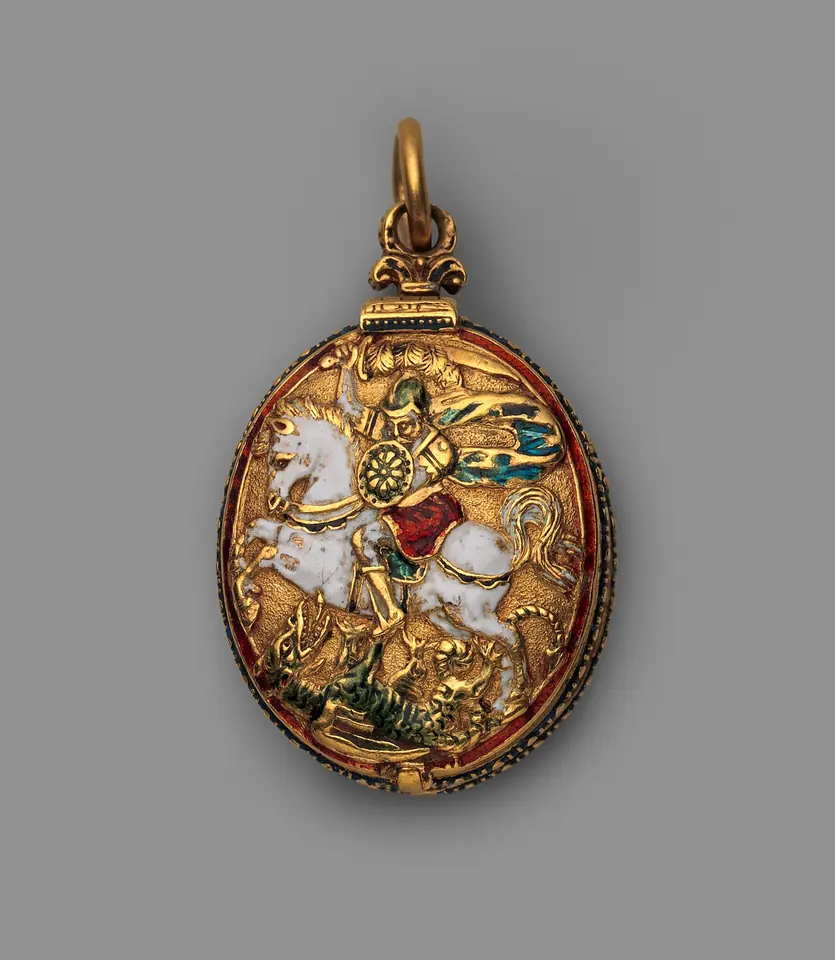
On August 6, 1348, Edward III founded the College of St. George at Windsor Castle, and the castle chapel was rededicated to the Virgin Mary, St. George, "England's patron saint, to whom the king had personal devotion," and St. Edward the Confessor. The chapel became the spiritual home of the Order of the Garter, England's highest order of knighthood, which Edward founded in the same years. The College of St. George explains the choice by Edward's war for the French throne after Crécy and his love of knightly virtue. The order's badge shows George killing the dragon, and a small version worn on a ribbon is called the "Lesser George."

Georgia, Russia and Ethiopia
In the East, George is the "Victory-bearer." Russian princes took him as their protector. The Orthodox life tells how Yaroslav the Wise, baptized George, built a church to him in Kyiv, consecrated on November 26, 1051, still kept as an "autumn feast of St. George." From the 14th century, the horseman killing the serpent appeared on the coat of arms of Moscow. The same Orthodox life calls Georgia, "the Land of Saint George," one of the Christian nations closest to his cult. Georgians have honored him as their patron for many centuries, and the Georgian flag is a red St. George's cross on white with four smaller crosses.
Ethiopian Christians call him Giyorgis. The Horniman Museum in London points out that the finest of the rock-cut churches of Lalibela, Bete Giyorgis, is his, and that Addis Ababa's cathedral is dedicated to him. Ethiopian paintings of the victory over Italy at Adwa in 1896 show St. George in the sky above the army of Emperor Menelik II and Empress Taytu.


Soldiers, Scouts and farmers
George is the soldier's saint because the Acts make him an officer who would not give up Christ to keep his rank. Robert Baden-Powell, founder of Scouting, wrote in Scouting for Boys that George "is also the Patron Saint of Scouts everywhere," because "when he was faced by a difficulty or danger, however great it appeared, even in the shape of a dragon - he did not avoid it or fear it but went at it with all the power he could." British Scouts still renew their Promise on the Sunday nearest April 23.
His Greek name, Georgios, means "farmer" or "worker of the earth," and Orthodox hymns play on it. He is also one of the Fourteen Holy Helpers, with St. Blaise, St. Christopher and others. See all the patron saints by cause.
Symbols of St. George in art
Few saints are easier to spot. Look for:
- A young knight or soldier on a white horse: the most common image in both East and West. He is usually beardless and youthful.
- A lance driven into a dragon: the dragon is under the horse's hooves or rearing at its chest. Western painters sometimes show a broken lance and George drawing his sword, as Raphael did in his Louvre version.
- A red cross on a white shield, banner or tunic: the "arms of St. George," which Christian Iconography traces back to the crusader stories.
- A princess: praying in the background, as in Raphael's Washington painting, or leading the dragon by her belt, as in Uccello's.
- Armor and a red cloak: red for his martyrdom.
- A martyr's palm, or the wheel: in older images that show his passion instead of the dragon.
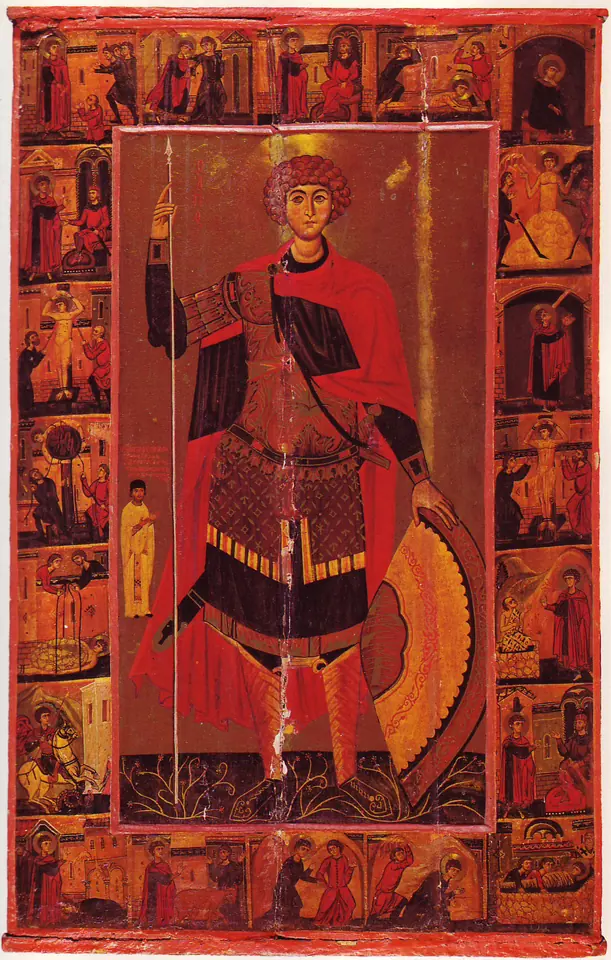
Eastern icons show him in two ways. In the "Miracle of St. George and the Serpent," a red-cloaked rider on a white horse thrusts a long, thin lance into a serpent, often with the princess and the city walls nearby; the Novgorod icon above is a famous example. Standing icons show him as a young soldier with spear and shield, often framed by small scenes from his Acts, like the 13th-century icon at Sinai. An early type, as on the Sinai panels with St. Theodore, shows him riding beside the other great soldier-martyrs.

To tell him from St. Michael the Archangel, who also slays a dragon: Michael has wings and usually stands or flies, while George is a man on horseback. Donatello's marble George, made around 1416 for the armorers' guild niche at Orsanmichele in Florence, shows him on foot with no dragon at all, a calm young soldier behind his cross-marked shield.


St. George's Day and where he is honored
The Catholic Church keeps his memorial on April 23, and the Orthodox Church keeps the same date as a great feast; churches still using the Julian calendar celebrate it on May 6. The Orthodox also keep the November 26 feast of his church in Kyiv. See the feast day calendar.
The tomb at Lod
The Church of St. George in the old town of Lod is a Greek Orthodox church built on the site of the Byzantine and Crusader churches. BibleWalks describes steps from the nave down to a crypt, where a marble sarcophagus dated 1871 is honored as his tomb. On the 15th of each month, the day tradition says his bones were brought there, oil is poured over the grooves on its lid, and pilgrims take some home.


San Giorgio in Velabro, Rome
The ancient Roman church of San Giorgio in Velabro claims relics of St. George, said to have been brought to Rome by Pope Zachary in the 8th century. They are kept under the high altar. Like many relics of early martyrs, the claim rests on tradition.
Lalibela
In Ethiopia, the cross-shaped church of Bete Giyorgis was carved down into the solid rock of Lalibela. Ethiopian tradition, the Horniman Museum notes, says King Lalibela had it made after George appeared to him in a vision.


Sant Jordi in Catalonia
In Catalonia, Sant Jordi's Day is the day of books and roses. Lovers and friends give each other roses, which recall the legend, and books. The book custom began in the early 20th century, when Barcelona's booksellers chose April 23 because Cervantes and Shakespeare both died around that date. Booksellers and flower sellers fill the streets, and UNESCO later made April 23 World Book and Copyright Day.


England
In England, St. George's Day is marked with flags, parades and church services, and Scouts gather to renew their Promise. Shakespeare gave Henry V the battle cry "God for Harry, England, and Saint George!"
Prayer to St. George
Catholics ask St. George to pray for soldiers, for courage in danger and temptation, and for their country. On his memorial the Mass uses the collect of his feast from the Roman Missal. There is no prayer from St. George himself. The Orthodox Church sings these hymns on his feast, in the translation used by the Orthodox Church in America:
Troparion (Tone 4)
As the liberator of captives and defender of the poor, / physician of the sick, and champion of kings, O Victory-bearer Great Martyr George, / intercede with Christ God to save our souls.
Kontakion (Tone 4)
You were cultivated by God, and you showed yourself as a most honorable cultivator of piety; / and you harvested for yourself the sheaves of virtue; / for having sown in tears, now you reap with joy; / and having contested unto blood, you received Christ. / By your intercessions, O Saint, you obtain the forgiveness of sins for all.
The kontakion plays on his name: the "cultivator" is the georgos, the farmer.
Frequently asked questions
Who was St. George?
A Christian soldier who died for his faith at or near Lydda in Palestine, probably before the reign of Constantine. The Catholic Encyclopedia says that is "all that can safely be affirmed" about him. His long legendary Acts make him an officer from Cappadocia who confessed Christ before the emperor Diocletian and was beheaded after many tortures.
Did St. George really kill a dragon?
No historical source says so. The dragon story cannot be traced earlier than the 12th or 13th century, more than 800 years after his death, and spread through the Golden Legend of about 1260. The Church reads it as a legend of good conquering evil, and this encyclopedia labels it traditional.
When is St. George's Day?
April 23. It is an optional memorial in the General Roman Calendar and a major feast in the Orthodox Church, where churches using the old Julian calendar keep it on May 6. England, Catalonia and Georgia celebrate it as a national day.
Why is St. George the patron saint of England?
English soldiers took up his red cross as their sign during the Crusades and the wars of the 14th century, and Edward III made him the patron of the Order of the Garter, founded in 1348. A church synod at Oxford made his day a holiday in 1222, and in 1415 Archbishop Chichele raised it to one of the greatest feasts of the year.
What is St. George the patron saint of?
England, Georgia, Ethiopia, Catalonia, Aragon, Moscow and many other countries and cities; soldiers, knights and cavalry; Scouts; and farmers, since his Greek name means "farmer." He is also one of the Fourteen Holy Helpers.
Where is St. George buried?
Tradition places his tomb at Lod (Lydda) in Israel, where the Greek Orthodox Church of St. George keeps a sarcophagus in its crypt. The church of San Giorgio in Velabro in Rome claims relics of him.
What is Sant Jordi's Day in Catalonia?
The Catalan name for St. George's Day, April 23. People give roses and books to the people they love, and booksellers and flower stalls fill the streets of Barcelona. The book custom began with Barcelona's booksellers in the early 20th century.
Sources
- Catholic Encyclopedia (1909): St. George
- Orthodox Church in America: Greatmartyr, Victory-bearer, and Wonderworker George
- Orthodox Church in America: Greatmartyr George, Troparion and Kontakion
- Decretum Gelasianum (English translation, tertullian.org)
- Jacobus de Voragine, The Golden Legend (Caxton translation): Of St. George, Martyr
- Christian Iconography: St. George, Art, Iconography, Legend
- College of St George, Windsor Castle: History
- BibleWalks: St. George, Lod (Lydda)
- Horniman Museum: Saint George, Patron Saint of Ethiopia
- Barcelona City Council: The tradition of Sant Jordi
- The Scout Association fact sheet: St. George, Patron Saint of Scouting
- Wikipedia: San Giorgio in Velabro (for the relic claim and coordinates)
- Roman Martyrology, April 23