St. Turibius of Mogrovejo
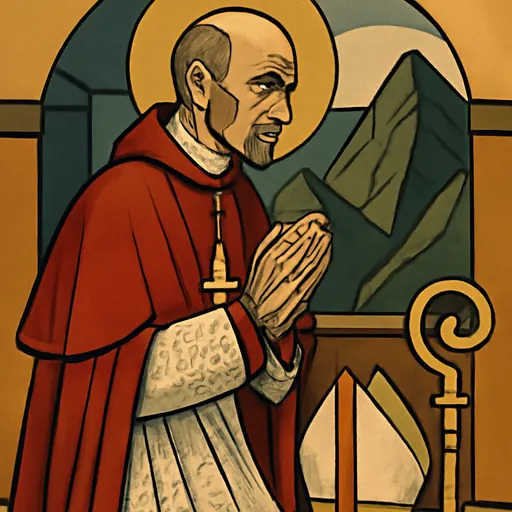
St. Turibius of Mogrovejo (1538–1606) was a Spanish law professor who was made Archbishop of Lima while still a layman. He walked his vast diocese three times, learned Quechua, defended native Peruvians and confirmed St. Rose of Lima and St. Martin de Porres. He is the patron of Latin American bishops, and his feast day is March 23.
Who was St. Turibius of Mogrovejo?
Toribio Alfonso de Mogrovejo, known in English as Turibius, was a Spanish lawyer who became Archbishop of Lima and spent twenty-five years organizing the Church in Peru. He was born in 1538 in Mayorga, in the old Kingdom of León, to a noble family, and he was named after an earlier Spanish saint, Turibius of Astorga.
His life is well documented through church records, the acts of his councils and the testimony gathered for his canonization. The miracle stories told about him are a separate matter, and are labeled below.


The life of St. Turibius
Lawyer and judge
He studied law at Valladolid, Coimbra and Salamanca and taught law at Salamanca. King Philip II made him head of the Inquisition's tribunal at Granada, an unusual post for a layman. When the see of Lima fell vacant, Philip proposed him for it. Turibius objected that he was not even a priest. He received the minor orders on successive Sundays, was ordained a priest in 1578, and was consecrated archbishop in Seville in August 1580, much as St. Ambrose had gone from governor to bishop twelve centuries earlier.
A bishop on foot
He landed at Paita in northern Peru in May 1581 and walked the roughly 600 miles to Lima, baptizing and teaching along the way. His archdiocese, Pope Francis noted, stretched from Panama toward Chile. Of his twenty-two years and more as bishop, eighteen were spent away from Lima on visitation, and he crossed his territory three times, often on foot and sometimes alone, through deserts, mountains and fevers. The Catholic Encyclopedia gives his favorite saying: "Time is not our own, and we must give a strict account of it."
On those journeys he confirmed, by the Catholic Encyclopedia's count, nearly half a million people. Among them were St. Rose of Lima, St. Francis Solano, St. Martin de Porres and St. John Macías.

The Third Council of Lima
Turibius held thirteen diocesan synods and three provincial councils. The most important, the Third Council of Lima (1582–1583), applied the reforms of the Council of Trent to South America. It ordered catechisms compiled and translated into Quechua and Aymara and told priests to learn the languages of their people. The catechism of 1584, in Spanish, Quechua and Aymara, was among the first books printed in South America. In 1591 he founded in Lima the first seminary in the Americas.
Defender of the native peoples
Turibius saw at first hand how Spanish officials and settlers abused the native peoples. In 1585 he excommunicated the corregidor (royal governor) of Cajatambo, which, in Pope Francis's words, set him against "a whole system of corruption" and earned him "the enmity of many," including the viceroy. He also clashed with the viceroy over the seminary and over the right of sanctuary.


Death at Saña
On his third visitation he fell ill with fever at Pacasmayo but kept working until he reached Saña. There, on Holy Thursday, March 23, 1606, he received Viaticum and died. Pope Francis described the scene: he died "in a hut, the midst of his people, while a native played a song on his chirimía," a kind of reed pipe.
Miracles and legends of St. Turibius
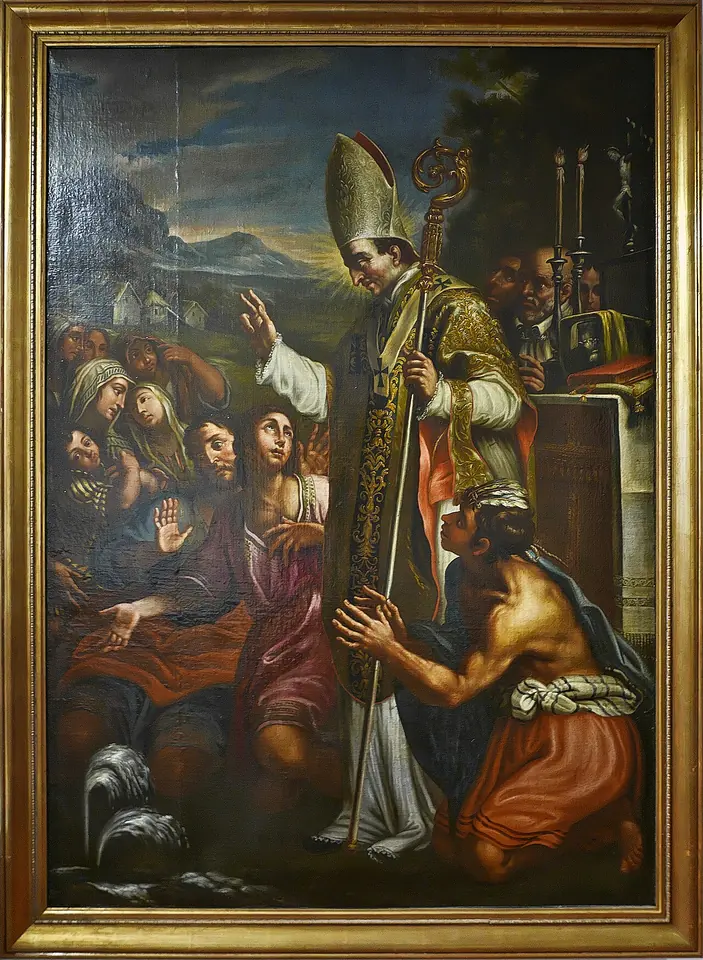
- Opening a river (traditional). Pope Francis mentioned the painting in the Vatican in which waters part before Turibius "like the Red Sea" so that he can reach people waiting on the far bank.
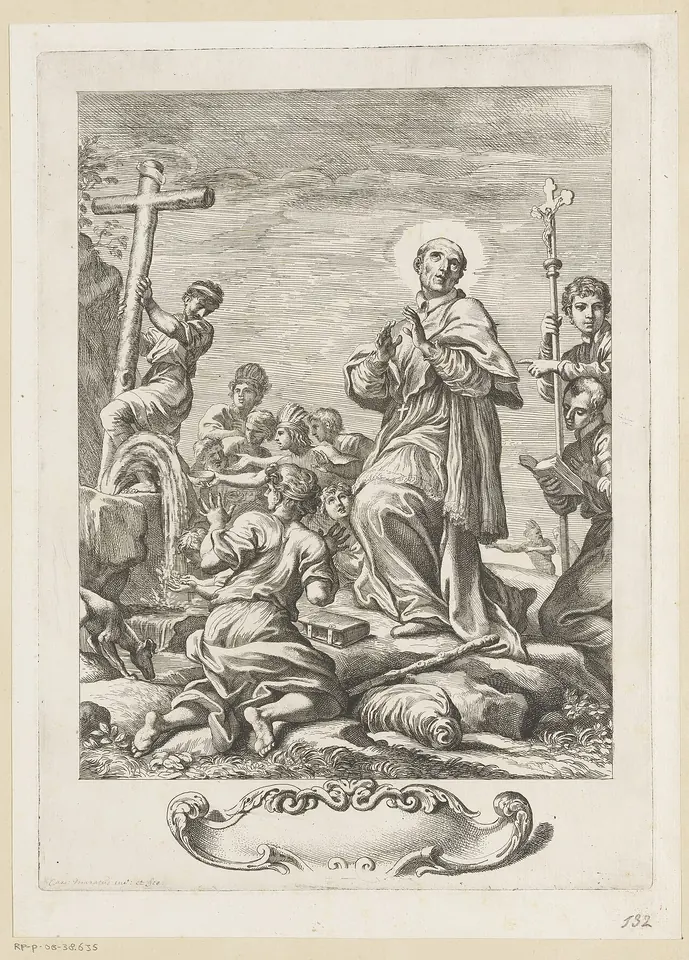
- Water from a rock (traditional). A series of prints on his life shows him drawing water from a rock for thirsty people, like Moses.
- Foretelling his death (traditional). The Catholic Encyclopedia says he "predicted the day and hour of his death" years beforehand.
- Miracles for his cause (approved). Innocent XI beatified him in 1679 and Benedict XIII canonized him in 1726, which required approved miracles. We have not found an accessible description of them.

Why St. Turibius is the patron of Latin American bishops
Pope John Paul II named him patron of the bishops of Latin America in 1983, and Francis called him a model of a bishop who goes out to "the other shore." He is also honored as a patron of Peru. Find others on our patron saints page.
Symbols of St. Turibius in art
Turibius is shown as a lean archbishop, usually balding, with a miter, crozier and processional cross. Look for:
- Native Peruvians around him, often kneeling or being blessed.
- Confirmation of a girl: the young Rose of Lima.
- A river or a rock: his traveling miracles.
- Kneeling at an altar, as in the Buenos Aires portrait.

Feast day and where he is honored
His feast is March 23, an optional memorial. See our feast days calendar. In 1604 he inaugurated the cathedral of Lima, a predecessor of the present building on the Plaza de Armas.


Prayer to St. Turibius
The collect for his memorial in the Roman Missal reads:
O God, who gave increase to your Church through the apostolic labors and zeal for truth of the Bishop Saint Turibius, grant that the people consecrated to you may always receive new growth in faith and holiness. Through our Lord Jesus Christ, your Son, who lives and reigns with you in the unity of the Holy Spirit, God, for ever and ever.
Frequently asked questions
When is the feast of St. Turibius of Mogrovejo?
March 23, the day he died in 1606, as an optional memorial in the General Roman Calendar. It used to be kept on April 27.
Why is St. Turibius the patron of Latin American bishops?
Pope John Paul II named him patron of the Latin American episcopate in 1983. Pope Francis, speaking to the bishops of Peru in 2018, held him up as a "street" bishop "with shoes worn out by walking," who learned the people's languages and denounced abuses against the native peoples.
Did St. Turibius confirm St. Rose of Lima?
Yes. The Catholic Encyclopedia lists St. Rose of Lima, St. Francis Solano and St. Martin de Porres among the people he confirmed.
Is St. Turibius the same as St. Toribio Romo?
No. St. Toribio Romo González was a Mexican priest martyred in 1928, now invoked by migrants. St. Turibius (Toribio) of Mogrovejo was a 16th-century Spanish archbishop of Lima. Both were named after a much older Spanish saint, Turibius of Astorga.
Sources
- Catholic Encyclopedia (1912): St. Toribio Alfonso Mogrovejo
- Pope Francis, Meeting with the Bishops of Peru, Lima, 21 January 2018
- Santi e Beati: San Turibio de Mogrovejo, Vescovo
- Catholic Culture: Optional Memorial of St. Turibius of Mogrovejo (March 23), with the collect
- Wikipedia: Turibius of Mogrovejo (for his birth date and beatification year)