St. Rose of Lima

St. Rose of Lima (Isabel Flores de Oliva, 1586–1617) was a laywoman of Lima, Peru, who joined the Third Order of St. Dominic, lived a hidden life of prayer and penance in her family's garden and cared for the poor and sick in her home. Canonized in 1671, she was the first saint of the Americas, and she is the patron saint of the Americas, Peru and the Philippines. Her feast day is August 23 (August 30 in Peru).
Who was St. Rose of Lima?
St. Rose of Lima was a young laywoman of colonial Peru who lived almost her whole life inside her family's house and garden in Lima, and became the first canonized saint of the Americas. Born Isabel Flores de Oliva in 1586, she supported her parents with needlework and flowers, joined the Third Order of St. Dominic at about twenty, spent long hours in prayer in a tiny hermitage her brother built for her, and took in sick and poor people to nurse them at home. She died in 1617 at thirty-one.
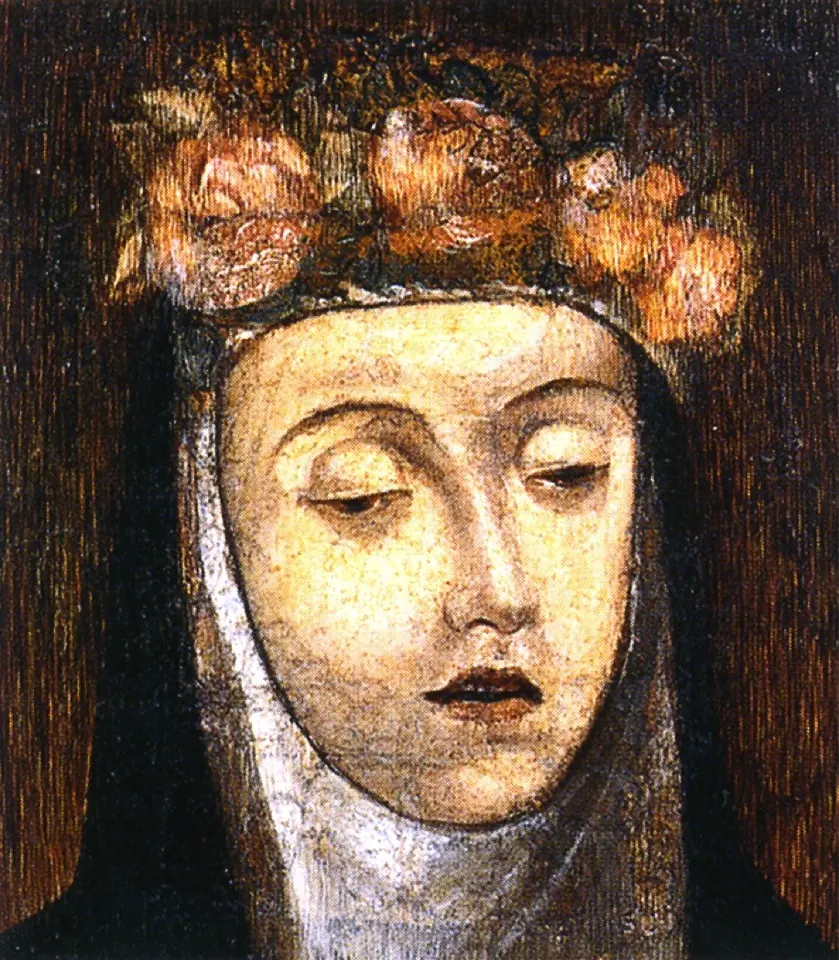

All Lima came to her funeral. Fifty-four years later Pope Clement X canonized her, and in 1670 he had already named her the patron of the Americas, the Philippines and the Indies. Her feast is August 23 in the General Roman Calendar, but Peru still keeps the older date of August 30 as a national holiday.
Rose is not an easy saint for modern readers. Her penances were severe, and the sources describe them in detail. They belong to the spirituality of her age and of her model, St. Catherine of Siena. This article reports them plainly, as the Church's own accounts do, without dwelling on them. The Church honored her for her love of God and her charity, not for the penances themselves.
Early life
Isabel becomes Rose
Rose was born in Lima on April 20, 1586, about fifty years after the Spanish founded the city. Her father, Gaspar Flores, was a Spanish soldier; her mother was María de Oliva. The family was large. According to the account in the Lives of Saints published by John J. Crawley & Co., she was one of ten children and was baptized Isabel, after her aunt and godmother, Isabel de Herrera.
The name Rose came from a family story. The Catholic Encyclopedia records that as an infant "her face had been seen transformed by a mystical rose," and her mother began calling her Rosa. Cardinal Tarcisio Bertone, preaching at her shrine in 2007, gave the simpler explanation that she was called Rose "because of the fresh rose-coloured tint of her cheeks."
For a few years around 1597 the family lived at Quives, in the Andean foothills northeast of Lima, where her father managed a mining works. There the archbishop of Lima, St. Turibius of Mogrovejo, confirmed her during one of his long pastoral journeys. ACI Prensa reports that she was eleven and was confirmed with the name Rosa de Santa María, the name she used for the rest of her life.


Needlework and flowers
Her father's fortunes did not last. The Lives of Saints says he lost money in mining ventures, and the family fell on hard times. Rose helped keep the household going. She was skilled at lace and embroidery and sold her work, and she grew flowers in the family garden to be sold at market. These two trades are the source of her later patronage of embroiderers, gardeners and florists.

She took St. Catherine of Siena, the 14th-century Dominican laywoman, as her model, fasted often and spent much of her time in prayer. She was beautiful, and she was troubled by the attention it brought her. The Lives of Saints tells how, after hearing her looks praised, she rubbed pepper into her face, and calls this "her way-a way conditioned by the time and place-of fighting a temptation to vanity."


A Dominican in her family's garden
Refusing marriage
Her parents expected her to marry, and there were suitors. Rose had privately vowed her virginity to God as a child, and the Catholic Encyclopedia says she spent ten years winning her parents' consent "through patience and prayer." For a time it seemed she would enter the convent of the Poor Clares. Cardinal Bertone told the story Lima still remembers: as she set out with her brother to enter the monastery of Santa Clara, she stopped to pray before her favorite image of Our Lady of the Rosary in the church of Santo Domingo and found she could not get up. Neither her brother nor the sacristan could lift her. Only when she promised to go home did she rise easily. She took it as a sign.
The Third Order of St. Dominic
In about 1606, at twenty, she received the habit of the Third Order of St. Dominic. A tertiary was a layperson who followed a Dominican rule of prayer and penance while living in the world, as Catherine of Siena had done. Rose wore the white tunic and black mantle of the order but stayed in her parents' house.


The hermitage in the garden
With the help of her brother Fernando, Rose built a tiny cell in a corner of the family garden. Cardinal Bertone describes it as "a cell of barely 2 square metres," and says that from about the age of twenty-three she shut herself in it and came out only for the services of the Church. With her confessor's consent she lived there almost as a recluse, praying through much of the night. A rebuilt version of the hermitage can still be visited in the garden of her sanctuary in Lima.
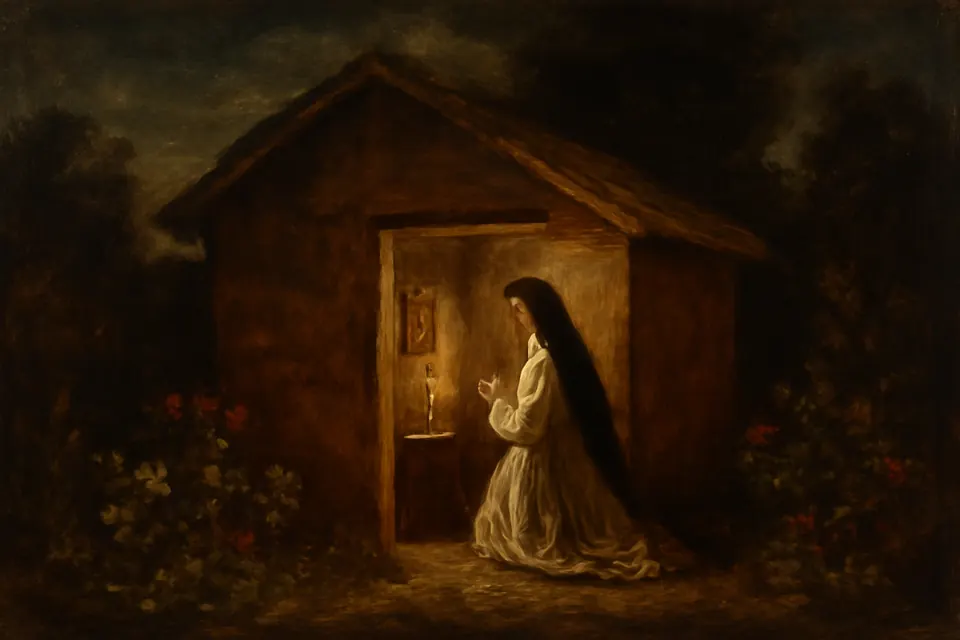
Her penances
The Catholic Encyclopedia lists the penances Rose practiced: perpetual abstinence from meat and only the coarsest food, long fasts, a silver circlet with points on the inside worn under a crown of roses for fourteen years, an iron chain around her waist and a bed of broken pottery and stones. Catholic Culture adds that during Lent she ate no bread at all. Her health suffered, and the Lives of Saints names stomach ailments, asthma, rheumatism and fevers.
The Church today does not hold up these practices for imitation, and her own confessors at times restrained her. What her biographers stress is the reason she gave: she offered her penances, the Catholic Encyclopedia says, for offenses against God, for the conversion of sinners and for the souls in purgatory. Catholic Culture quotes Pope Clement X's bull of canonization: "Since the discovery of Peru no missionary has arisen who effected a similar popular zeal for the practice of penance."
Caring for the poor and sick
Rose's life was not only inward. Cardinal Bertone said she "was devoted to caring for the poor and to the ordinary daily work in her home of any girl." The Lives of Saints says she spoke out against the exploitation of the Indigenous people of Peru, and that "sometimes she brought sick and hungry persons into her own home that she might better care for them." Lima tradition remembers a room of the family house set aside for the sick she took in.

Friends in Lima
Rose belonged to a remarkable generation in Lima. St. Martin de Porres, the son of a Spanish nobleman and a freed Black woman, was a Dominican lay brother at the convent of Santo Domingo, the church Rose attended. Another Dominican brother, St. John Macías, worked as porter at the convent of the Magdalena. Catholic Culture names both men among her friends. No letters between them survive, and the stories of their conversations come from later tradition, but all three were canonized and their relics now rest together in the Basilica of Santo Domingo.
Inner trials and mystical life
According to Cardinal Bertone, for fifteen years Rose went through "the harsh inner experience of God's absence," the spiritual darkness that St. John of the Cross called the "dark night." Her family scolded her and some people mocked her; Catholic Culture says she accepted it all serenely, "remarking that she was treated better than she deserved." When she began to speak of visions, the Lives of Saints says, priests and physicians examined her and judged her experiences to be genuine.
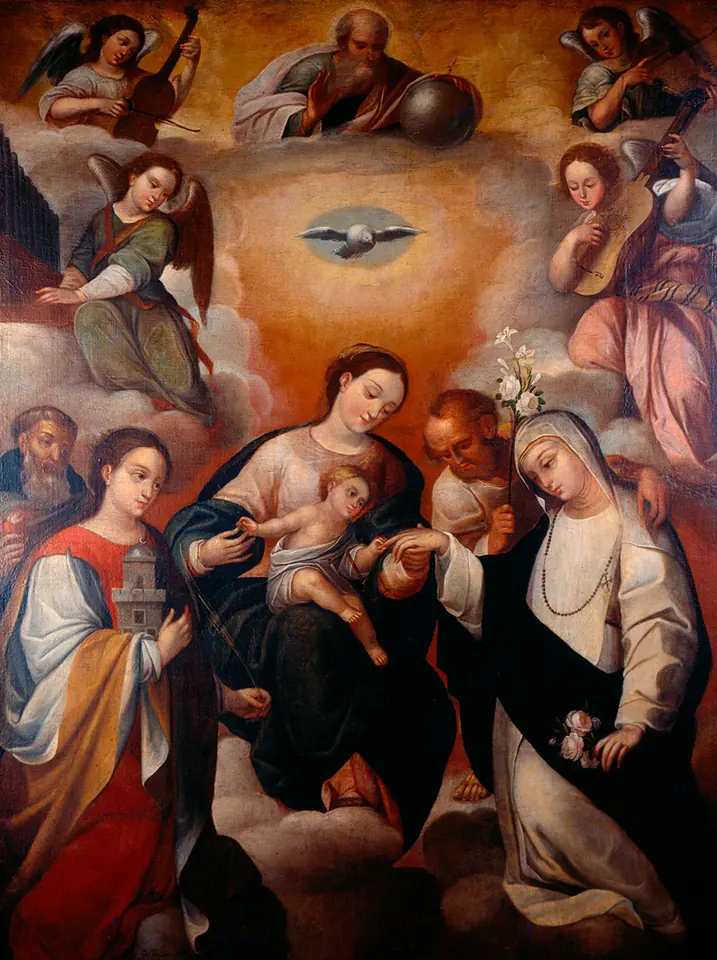
The best known of those experiences is her mystical betrothal. Tradition places it in the chapel of Our Lady of the Rosary in Santo Domingo on Palm Sunday, 1617, when she felt the Child Jesus ask her to be his bride. Painters of the colonial Americas loved the scene, and it is the subject of the Bogotá painting below.

Defending the Eucharist
In July 1615 a Dutch fleet under Joris van Spilbergen appeared off Callao, Lima's port, and the city feared an attack. Cardinal Bertone recounted that Rose went to the church of Santo Domingo and placed herself before the tabernacle to defend it with her body. The fleet sailed away without attacking Lima. The story is traditional, and colonial painters turned it into an image of Rose shielding the Eucharist.


Death and canonization
Rose spent her last years in the house of Gonzalo de la Maza, a government official, and his wife, who had become her friends and protectors. During her last illness the Lives of Saints records her prayer, "Lord, increase my sufferings, and with them increase Thy love in my heart." She died there on August 24, 1617, at thirty-one. Cardinal Bertone said the last words on her lips were "Jesus, Jesus, Jesus, be with me always."
Lima's grief surprised even those who knew her. The Lives of Saints says that when her body was carried through the streets, the crowds were so great that the burial had to be put off for several days. She was buried in the Dominican convent and later moved to the church of Santo Domingo.
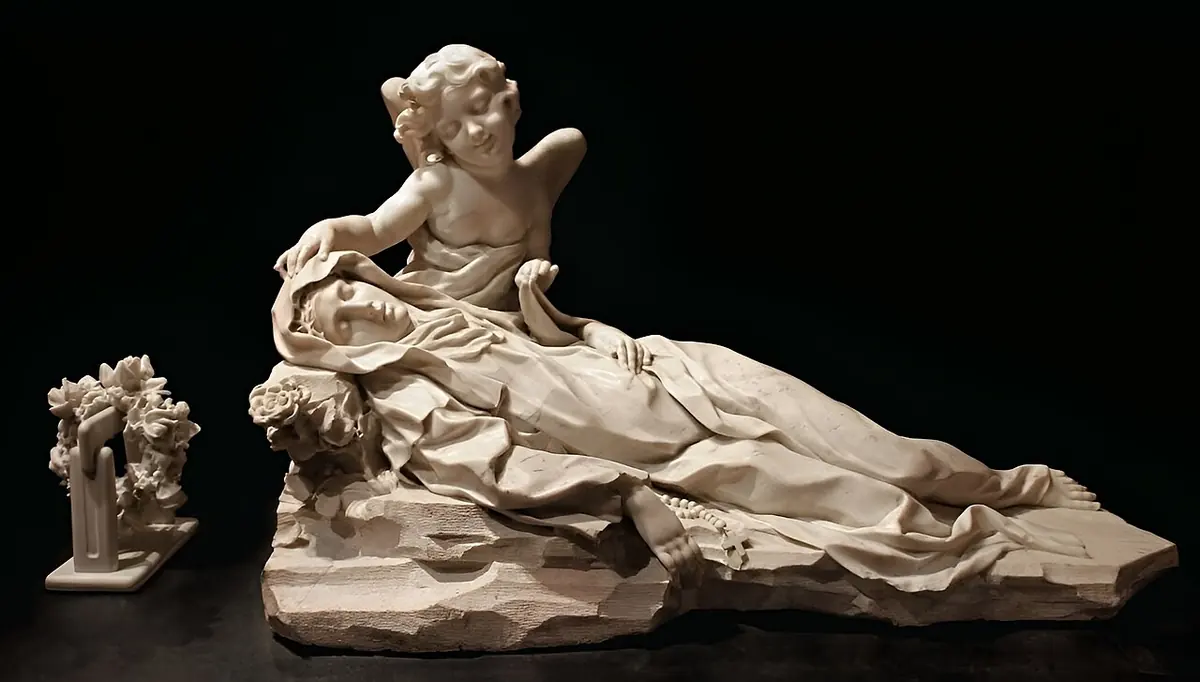

The cause moved quickly by the standards of the time. Pope Clement IX beatified her in 1668 (the Catholic Encyclopedia gives 1667) and named her patron of Lima and Peru. His successor, Clement X, named her the principal patron of the Americas, the Philippines and the Indies in 1670 and canonized her on April 12, 1671. She was the first person born in the Americas to be declared a saint. Celebrations broke out across the Spanish empire, and painters in Cuzco, Lima, Bogotá, Mexico and Seville turned out her image by the hundreds.


The miracles of St. Rose of Lima
Sorted by the labels this encyclopedia uses:
- Approved: the miracles accepted for her beatification in 1668 and her canonization in 1671. The Catholic Encyclopedia says many miracles followed her death; the specific cases examined in the cause are in the 17th-century process records, not in the sources cited here.
- Reported: cures and favors attributed to her intercession after her death, which the Lives of Saints says led to her body being moved to the church of Santo Domingo, and the petitions left at her well in Lima every year.
- Traditional: the rose seen over her face as an infant, the statue of Our Lady that held her in place when she set out for the Poor Clares, her defense of the tabernacle when the Dutch fleet threatened Lima in 1615 and the story of the key she threw into the well.
Why St. Rose of Lima is the patron saint of the Americas
Rose was the first saint born in the New World, and the Church named her patron of a whole hemisphere for that reason. Clement X's choice in 1670 covered the Americas, the Philippines (then governed from Mexico as part of the Spanish empire) and the Indies. She shares the title of patron of the Americas with Our Lady of Guadalupe.
Peru and Lima claim her as their own, and in 1669 Clement IX made her their patron. Gardeners and florists honor her because she grew and sold flowers, and because of her name. Embroiderers and needleworkers honor her because she supported her family with lace and embroidery. Catholic Culture's list also includes people ridiculed for their piety, since her family and neighbors mocked her for years. See all the patron saints.
Symbols of St. Rose of Lima in art
Rose is one of the easiest saints to recognize. Look for:
- A crown of roses: worn over her black veil. It is her name, and it also recalls the spiked circlet she hid under real roses. Medoro's death portrait at the top of this page already shows it.
- The Dominican habit: a white tunic and wimple with a black veil and mantle, the dress of a Dominican tertiary. St. Catherine of Siena wears the same habit, so check for roses and the Child Jesus; Catherine more often has a lily, a crucifix or the stigmata.
- The Child Jesus: in her arms, on a cushion, or reaching to her from the clouds. Spanish painters like Murillo and Coello loved this motif, which recalls her mystical betrothal.
- Roses and an anchor: the anchor stands for hope, and in some images she holds an anchor with a model of a city, Lima, resting on it, as its protector.
- A sewing basket: as in Murillo's painting, recalling the needlework by which she supported her family.

Rose was painted constantly in the decades after 1671. In Spain, Murillo and his workshop produced several versions of her with the Child Jesus, and Claudio Coello painted her standing under an arch with angels. In the Americas the painters of Cuzco and Lima framed her in garlands of roses and set her beside kings and popes. The marble statue by Melchiorre Caffà, a young Maltese sculptor working in Rome, was carved there in the 1660s and shipped to Lima, where it is still kept in the convent of Santo Domingo.
Feast day and where St. Rose of Lima is honored
The Church keeps her feast on August 23 in the General Roman Calendar. Before the calendar reform of 1969 it fell on August 30, and Peru still celebrates her on that day with a national holiday, processions and Masses. See the feast day calendar.
The Sanctuary of St. Rose and the well of wishes
Her family's house in central Lima, on today's Avenida Tacna, is now the Santuario de Santa Rosa. It includes a church, the garden, a rebuilt version of her hermitage and the family well.


ACI Prensa reports that the well, about 19 meters deep, once supplied water to the house. Tradition says Rose threw into it the key to the padlock of the chain she wore around her waist. The Peruvian historian José Antonio del Busto told a different version, in which she gave the key to her confessor and later broke the lock with a stone. Either way, people began dropping letters with their petitions into the well, and today thousands line up to do so in the days around August 30.


The Basilica of Santo Domingo
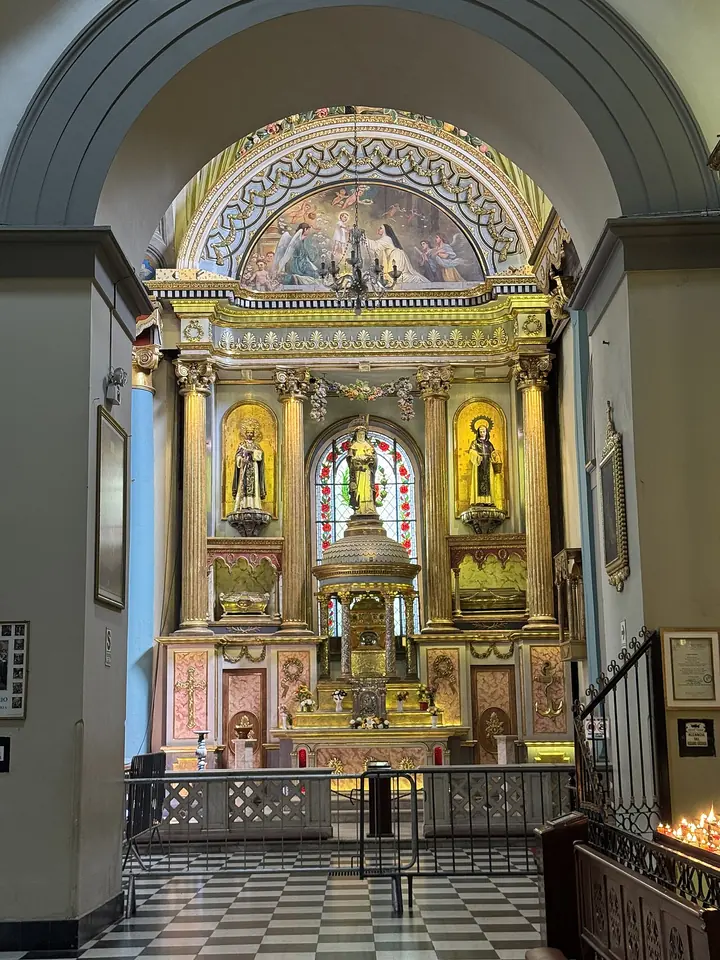
Her relics are in the Basilica and Convent of Santo Domingo in Lima, the church where she prayed, in a side altar shared with St. Martin de Porres and St. John Macías. Caffà's marble statue is in the convent. Cardinal Bertone celebrated Mass there on her feast in 2007, calling it the "beautiful church where her relics are preserved."

Quives and beyond
The village of Quives, where she was confirmed, has its own sanctuary and well. Cities, parishes and dioceses across the Americas bear her name, among them the Diocese of Santa Rosa in California, and her feast is kept with processions from Argentina to the Philippines.
Prayer to St. Rose of Lima
The Collect from the Roman Missal
This is the opening prayer (Collect) of the Mass on her memorial, in the current English translation of the Roman Missal, as given by Catholic Culture:
O God, you set Saint Rose of Lima on fire with your love, so that, secluded from the world in the austerity of a life of penance, she might give herself to you alone; grant, we pray, that through her intercession, we may tread the paths of life on earth and drink at the stream of your delights in heaven. Through our Lord Jesus Christ, your Son, who lives and reigns with you in the unity of the Holy Spirit, God, for ever and ever.
Words given to St. Rose
Rose left few writings. The best known passage, read in the Church's Office of Readings on her feast, records words she said Christ spoke to her. Cardinal Bertone quoted them at her shrine in 2007:
"Let all men know", Jesus entrusted to her, "that grace comes after tribulation. Let them know that without the burden of afflictions it is impossible to reach the height of grace. Let them know that the gifts of grace increase as the struggles increase. Let men take care not to stray or to be deceived. This is the only true ladder to paradise, and without the cross, there is no other way in which to ascend to heaven".
She added, in the same passage: "No one would complain about his cross or about the troubles that may happen to him, if he would come to know the scales on which the crosses are weighed when they are distributed to men."
Catholics ask St. Rose to pray for them in times of illness and family trouble, for the Americas and for Peru, and many write to her, as the letters in her well show. A simple form is "St. Rose of Lima, pray for us."
Frequently asked questions
What is St. Rose of Lima the patron saint of?
The Americas, Peru, Lima and the Philippines; Pope Clement X named her patron of the Americas, the Philippines and the Indies in 1670. She is also the patron of gardeners and florists, because she grew flowers to help support her family, and of embroiderers and needleworkers, because she sold her needlework.
When is St. Rose of Lima's feast day?
August 23 in the General Roman Calendar, where it is an optional memorial (a memorial in the United States). Until 1969 it was August 30, and Peru still celebrates her on August 30, a national holiday, as do several other Latin American countries.
Why is she called Rose?
She was baptized Isabel. Tradition says that when she was a baby a servant saw her face transformed into a rose, and her family began calling her Rosa. When St. Turibius of Mogrovejo confirmed her in 1597 she received the name Rosa, and she later called herself Rosa de Santa María.
Why is St. Rose of Lima the first saint of the Americas?
Pope Clement X canonized her on April 12, 1671, making her the first person born in the Americas to be declared a saint. Others who had lived and worked there, but were born in Europe, were canonized later.
What is the well of St. Rose of Lima?
A well, about 19 meters deep, in the garden of her family's old home, now the Sanctuary of St. Rose in Lima. Tradition says she threw into it the key to the padlocked chain she wore as a penance. Every August 30, thousands of people line up to drop letters with their petitions into it.
Were St. Rose of Lima and St. Martin de Porres friends?
They were contemporaries in Lima, both connected with the Dominican church of Santo Domingo, and Catholic tradition counts Martin de Porres and John Macías among her friends. Their relics now rest in the same altar of the Basilica of Santo Domingo in Lima.
What were St. Rose of Lima's last words?
According to the account Cardinal Tarcisio Bertone gave at her shrine in 2007, the last words on her lips were "Jesus, Jesus, Jesus, be with me always." She died on August 24, 1617, at thirty-one.
Sources
- Catholic Encyclopedia (1912): St. Rose of Lima
- Cardinal Tarcisio Bertone, Mass on the Feast of Saint Rose of Lima, Lima, 30 August 2007
- Catholic Culture: Optional Memorial of St. Rose of Lima, Virgin (Collect and biography)
- Lives of Saints (John J. Crawley & Co.): Saint Rose of Lima, Virgin (EWTN)
- ACI Prensa: Santa Rosa de Lima
- ACI Prensa: La historia del pozo de los deseos de Santa Rosa de Lima
- Roman Martyrology, August 23