St. Longinus
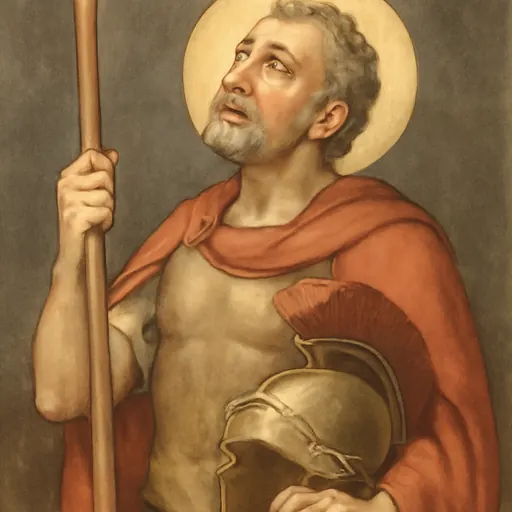
St. Longinus is the name Christian tradition gives to the Roman soldier who pierced the side of the crucified Jesus with a lance (John 19:34), and also to the centurion who said, "Truly this man was the Son of God!" (Mark 15:39). Legend says he was healed of blindness by Christ's blood, became a Christian and died a martyr. His traditional feast is March 15 (October 16 in the current Roman Martyrology and in the Orthodox Church), and he is invoked by the blind.
Who was St. Longinus?
Longinus is the name Christians have given, since at least the 6th century, to a soldier who stood at the cross. The Gospels mention two Romans there without naming either. One is the centurion in charge of the execution, who watched Jesus die and said, "Truly this man was the Son of God!" (Mark 15:39, RSV). The other is "one of the soldiers" who, finding Jesus already dead, "pierced his side with a spear, and at once there came out blood and water" (John 19:34).
Over the centuries the two men became one saint. The legend says Longinus was nearly blind, that blood from Christ's side touched his eyes and healed them, and that he believed, left the army, preached in his native Cappadocia and was beheaded for the faith. Mantua, in northern Italy, adds that he brought earth soaked in Christ's blood to the place where the city now stands.

Almost nothing in this story can be checked. The Italian reference work Santi e Beati says plainly that no biography of the soldier can be reconstructed with certainty. What can be traced is the history of his cult, which is old, wide and still alive, from St. Peter's Basilica to the Orthodox calendar.
Longinus in the Gospels and in tradition
The soldier with the lance
John's Gospel is the only one that describes the lance. The Jewish authorities asked that the legs of the crucified men be broken so the bodies could come down before the Sabbath. The soldiers broke the legs of the two thieves, but "when they came to Jesus and saw that he was already dead, they did not break his legs. But one of the soldiers pierced his side with a spear, and at once there came out blood and water. He who saw it has borne witness—his testimony is true" (John 19:33–35, RSV). The writer adds that this fulfilled two verses of Scripture, among them "They shall look on him whom they have pierced."
The centurion who confessed
Mark, Matthew and Luke all tell of the centurion. In Matthew, he and the guards see the earthquake and say, "Truly this was the Son of God!" (Matthew 27:54). In Luke he praises God and says, "Certainly this man was innocent!" (Luke 23:47).
How the two became one
The name comes from the apocryphal Gospel of Nicodemus, also called the Acts of Pilate, which survives in several versions. In one Greek form, the priests recall that "Longinus the soldier pierced his side with a spear." In another, the name belongs to the centurion: "Longinus, the centurion who stood by, said: Truly this was a son of God." Later writers put the two together.
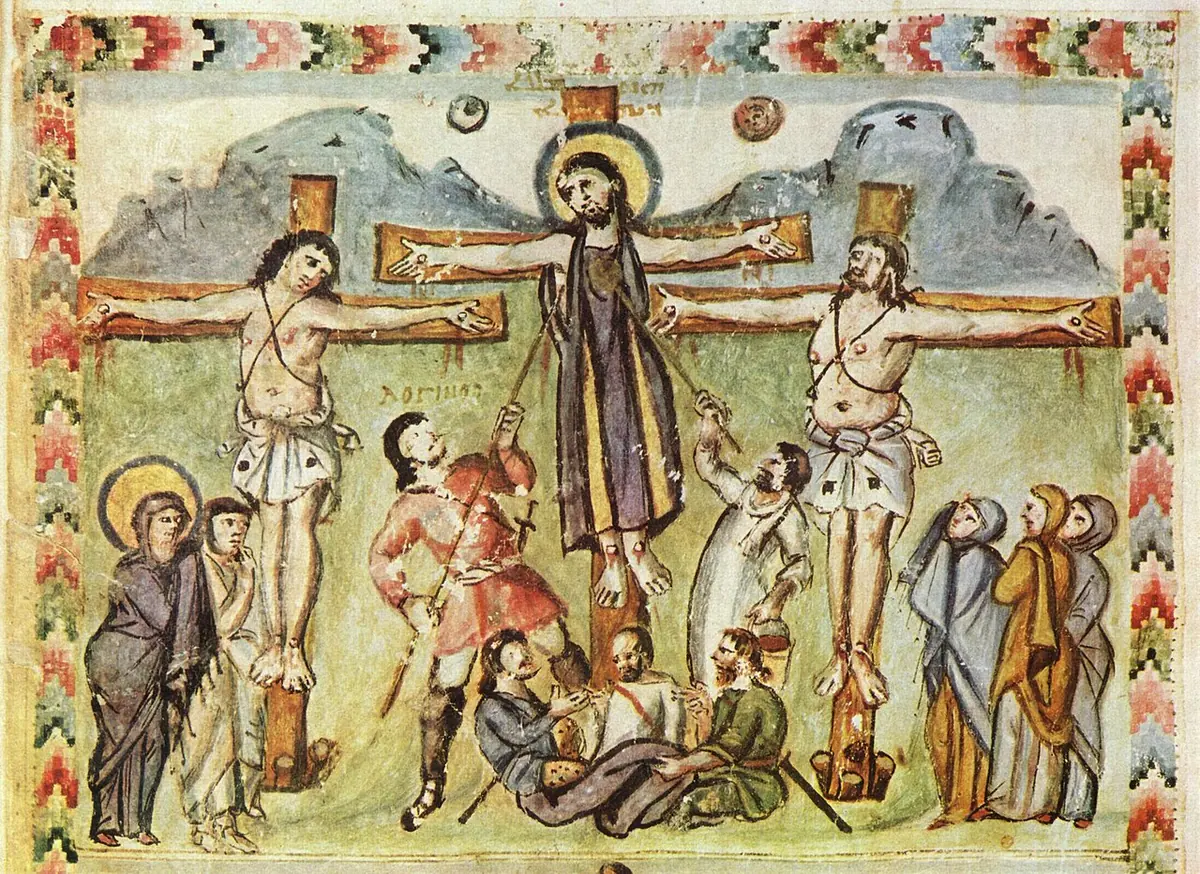
The name is probably connected with the lance itself. The Catholic Encyclopedia calls it "tempting, even if rash," to link Longinus with the Greek lonche, "lance." The oldest image to name him is in the Rabbula Gospels, a Syriac manuscript painted in 586 and now in Florence, where LOGINOS is written above the soldier with the spear.
The East and West kept different emphases. Western art usually shows Longinus thrusting the lance. The Orthodox life, kept by the Orthodox Church in America, tells the story of "Longinus the Centurion," whose detachment stood guard at the cross and later at the tomb.

The legend of St. Longinus
The stories below are all traditional.
The healing of his eyes. The Golden Legend, in the English version Caxton printed in 1483, says that when Longinus struck with the spear, "the precious blood" ran down to his eyes, and "he that had been tofore blind saw anon clearly."
The guard at the tomb. The Orthodox life says Longinus and his soldiers saw the Resurrection. When the authorities bribed the guards to say the disciples had stolen the body, Longinus and two comrades refused the money and told what they had seen.
Preaching and martyrdom. He left the army, was baptized by the apostles and went home to Cappadocia. The Golden Legend says he lived as a monk for about 38 years at Caesarea in Cappadocia. The governor had his teeth pulled out, yet he still spoke, smashed the idols with an axe and drove out the demons in them. The governor went blind, Longinus was beheaded, and the governor's sight came back when he fell weeping on the saint's body.
The blind widow. The Orthodox life adds that his head was sent to Pilate and thrown on a rubbish heap outside Jerusalem. A blind widow from Cappadocia, told in a dream where to dig, found it and was healed as soon as she touched it.
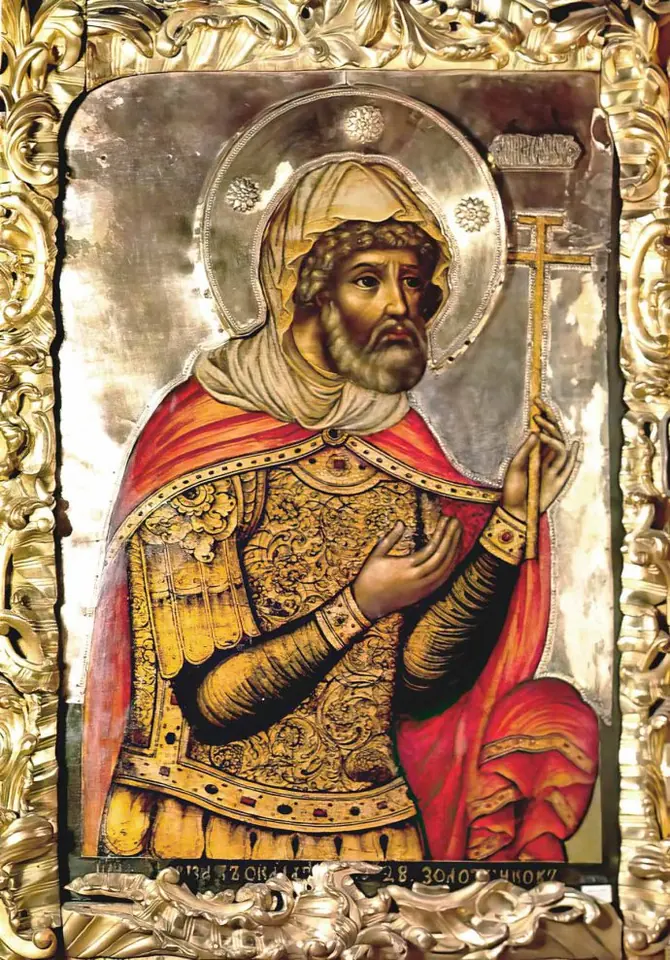

The miracles of St. Longinus
None of these miracles has been examined by the Church in the modern sense. By this encyclopedia's labels:
- The healing of his eyes at the cross: traditional.
- The miracles at his martyrdom and the finding of his head: traditional.
- The finding of the Precious Blood in Mantua in 804 and 1048: reported in Mantuan records and tradition. The Catholic Encyclopedia says Pope Leo IX recognized the relic as authentic in 1053, while Santi e Beati notes that the first document attesting the Sacred Vessels dates from 1135.
Why St. Longinus is linked with the blind
His healing is the reason. Santi e Beati notes that the story of the drop of blood that restored his sight helped tie the saint to the blind. He has no long list of patronages beyond that. See other patrons of the blind, such as St. Lucy, on our patron saints page.
The Holy Lance
The lance that pierced Christ's side became one of the great relics of Christendom, and several churches have claimed it. The Catholic Encyclopedia traces the evidence carefully:
- Jerusalem and Constantinople: a pilgrim from Piacenza saw the lance in Jerusalem around 570. After the Persians took the city in 615, its broken point went to Constantinople. In 1244 that point was given to St. Louis of France and kept in the Sainte-Chapelle in Paris, but it was lost after the French Revolution.
- Rome: the larger part stayed in Constantinople until the Turks took the city. In 1492 Sultan Bayezid II sent it to Pope Innocent VIII. The Encyclopedia notes "great doubts as to its authenticity were felt at Rome" at the time. It has been in St. Peter's ever since.
- Vienna: the lance of the Holy Roman emperors, used in coronations as early as 1273 and now in the Imperial Treasury.
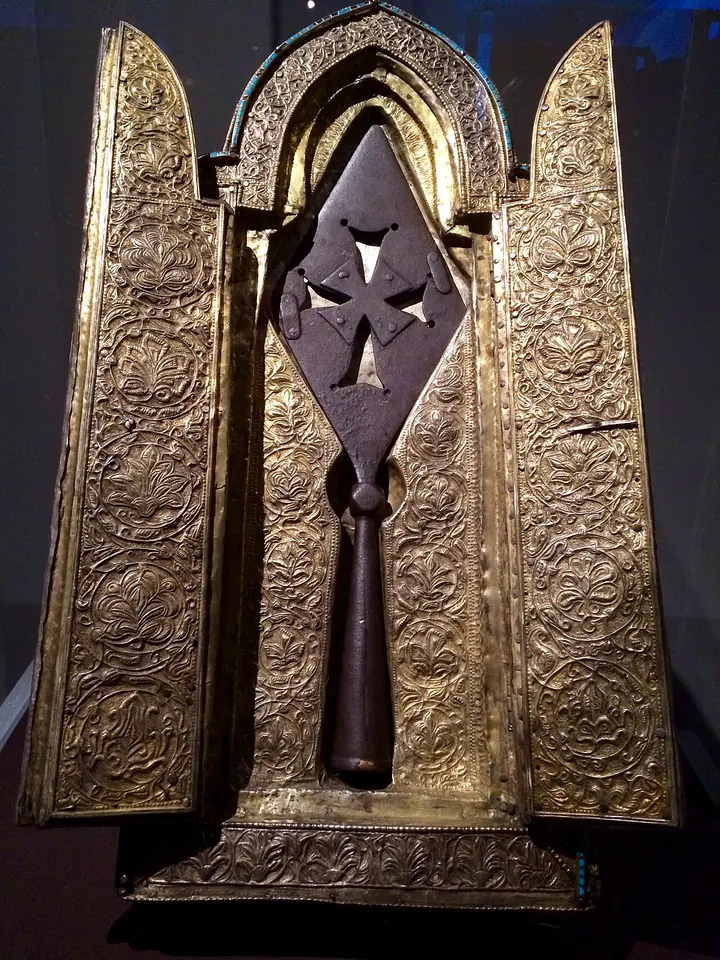
- Etchmiadzin, Armenia: the Geghard lance, which the Encyclopedia thinks is probably the lance "found" at Antioch in 1098 during the First Crusade, and "never in any proper sense a lance, but rather the head of a standard."
- Kraków: a lance whose history, the Encyclopedia says, cannot be traced.
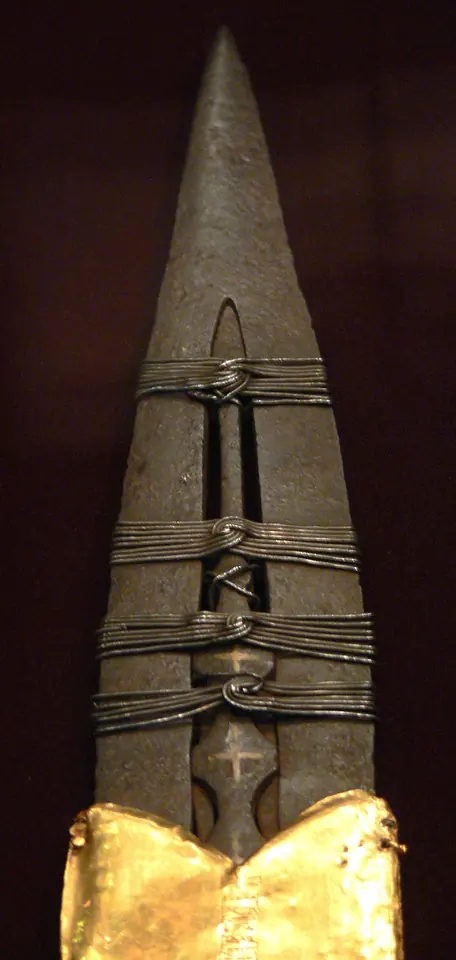

All of these are claimed relics.

Symbols of St. Longinus in art
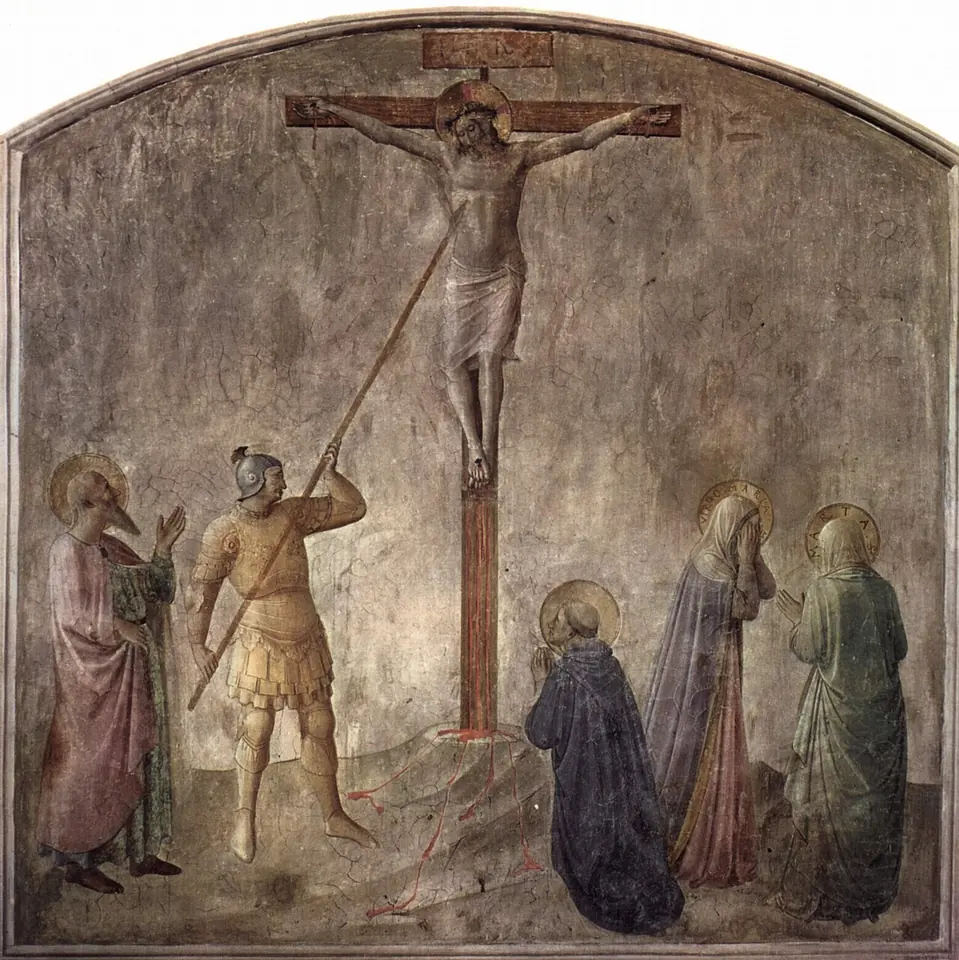
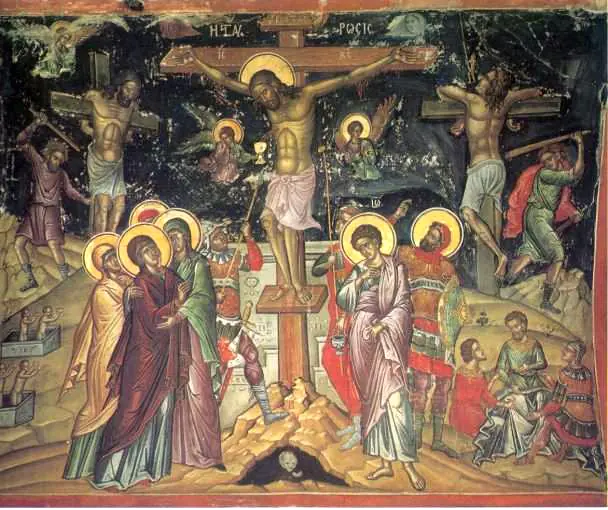
- The lance: his main attribute, held upright in portraits or driven into Christ's side in Crucifixion scenes.
- Roman armor: he is a soldier, and later painters dress him as an officer.
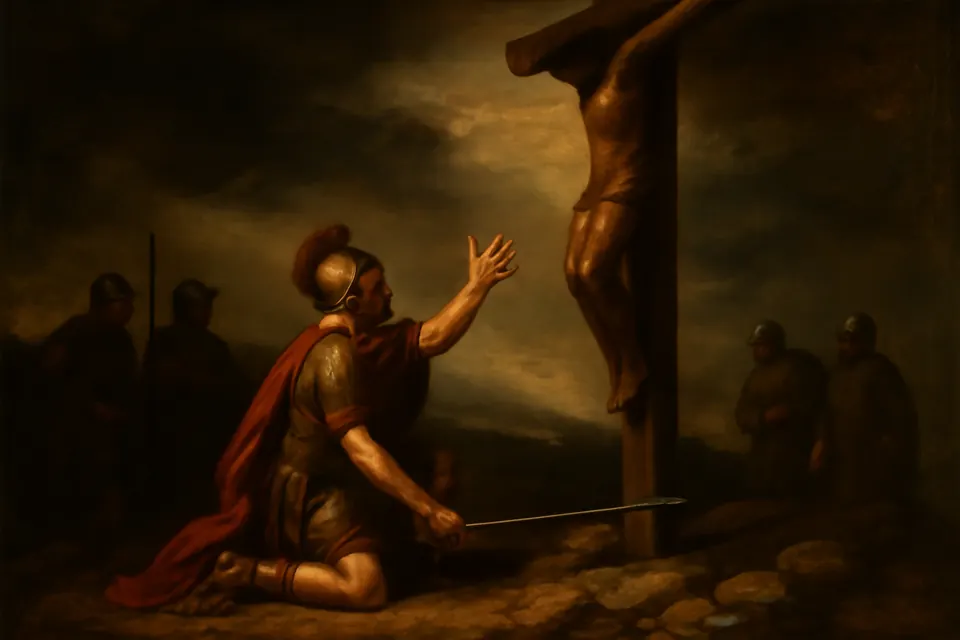
- A raised hand: the centurion's gesture of confession, as in the Aquileia fresco described by Christian Iconography.
- Blood touching his eyes: some painters, the Christian Iconography site notes, show a drop of blood falling into his eye while a companion tries to rub it out.
- A vessel of blood: in Mantua, and in a 15th-century triptych at Weingarten Abbey in Germany, which tells how he collected Christ's blood in a flask that later came to the abbey.
In a Crucifixion scene, the soldier with the lance on one side of the cross is usually Longinus. Across from him is often Stephaton, the soldier with the sponge, a pairing that goes back to the Rabbula Gospels. Orthodox icons often give the centurion a halo.

Bernini's Longinus in St. Peter's
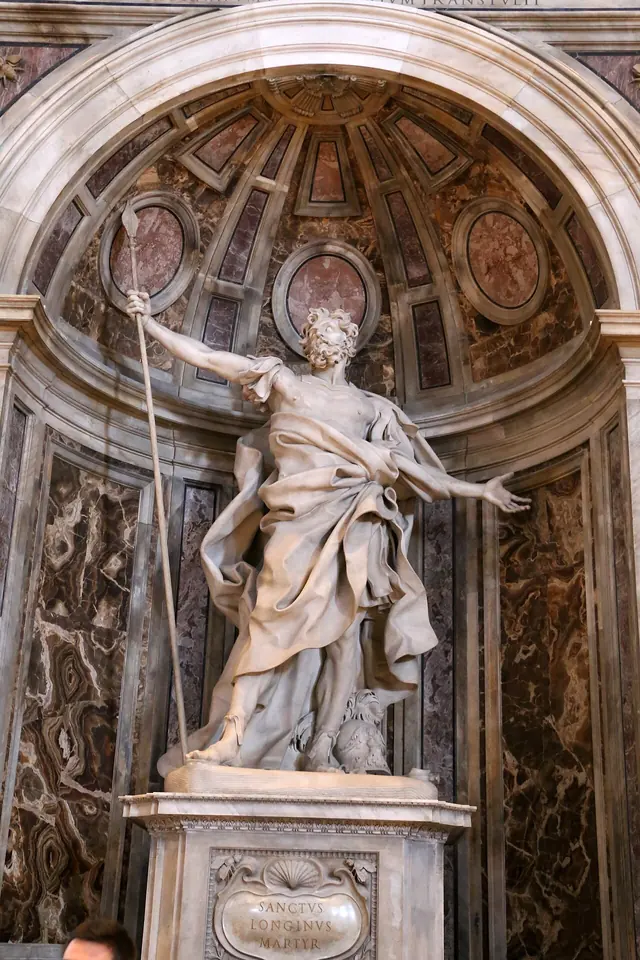
The best-known image of Longinus is Gian Lorenzo Bernini's marble statue, finished in the 1630s, in one of the four niches at the base of the piers that hold up the dome of St. Peter's. Each niche honors one of the basilica's great relics: Veronica's veil, the True Cross of St. Helena, the lance of Longinus and, until Pope Paul VI returned it to Patras in 1966, the head of St. Andrew. Bernini shows the soldier at the moment of conversion, arms thrown open, lance in hand, looking up at the cross. The relics of the Passion are now kept in the chapel above the statue of St. Veronica and shown to the faithful during Holy Week.

Feast day and Mantua's Precious Blood
The older Roman Martyrology placed Longinus on March 15, at Caesarea in Cappadocia, and Mantua still keeps that date. The current Roman Martyrology (2004) moved his commemoration to October 16, simply "at Jerusalem," without the legends. The Orthodox Church also keeps October 16. See the feast days calendar.
The Catholic Encyclopedia reports Mantua's tradition that Longinus brought the Gospel to the city along with a relic of Christ's blood. The Diocese of Mantua tells the story this way: Longinus gathered earth soaked in Christ's blood at the foot of the cross, carried it to the site of Mantua and buried it. It was found in 804, in the time of Pope Leo III and Charlemagne, hidden again during the Hungarian raids of 923 and found a second time in 1048, together with bones attributed to Longinus.
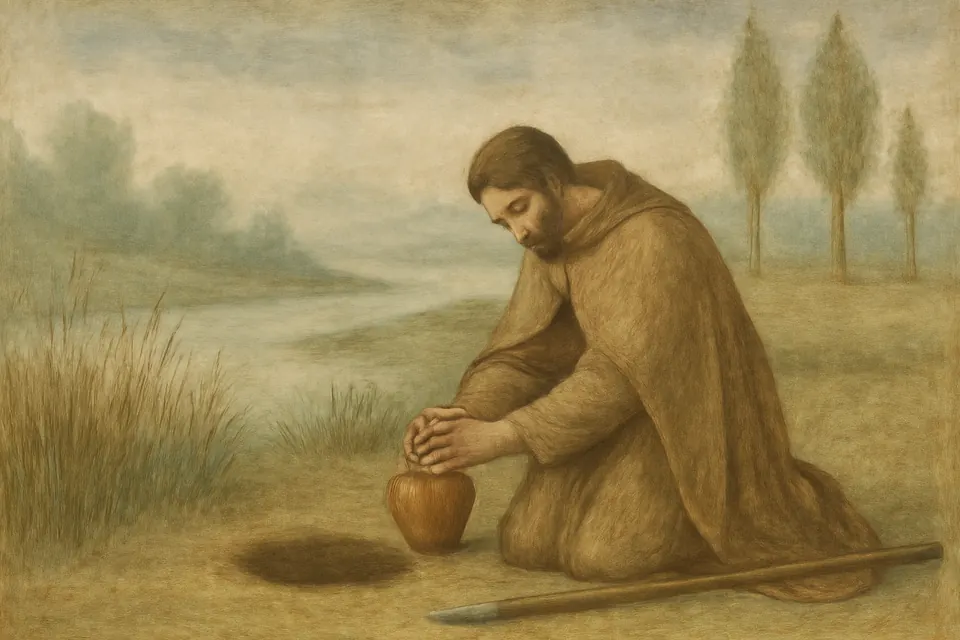
The relic is kept today in two gold reliquaries, the Sacri Vasi, in the crypt of the Basilica of Sant'Andrea. It is carried through the streets on Good Friday and shown again on March 12, the anniversary of the second finding. The safe holding it needs twelve keys, held by four different people. Andrea Mantegna, who worked for the Gonzaga court and is buried in Sant'Andrea, engraved Longinus beside the risen Christ and St. Andrew.


Prayer to St. Longinus
There is no widely used traditional prayer to St. Longinus in Catholic prayer books, and this encyclopedia won't invent one. Christians who ask his help usually pray in their own words, often before a crucifix, asking him to pray that they may see and believe as he did. In Mantua, the Company of the Most Precious Blood leads evening prayer every Friday in the crypt of Sant'Andrea, before the relic connected with his name.
Frequently asked questions
Was Longinus the centurion or the soldier with the lance?
The Gospels describe two people and name neither. Mark 15:39 tells of a centurion who said, "Truly this man was the Son of God!" John 19:34 tells of "one of the soldiers" who pierced Jesus' side with a spear. The apocryphal Gospel of Nicodemus gave the name Longinus to both, in different versions, and Western tradition merged them into one saint. The Orthodox Church honors him mainly as the centurion.
Where does the name Longinus come from?
It is not in the Bible. It first appears in the apocryphal Gospel of Nicodemus (Acts of Pilate) and above the soldier with the lance in the Syriac Rabbula Gospels of 586. Many scholars, and the Catholic Encyclopedia cautiously, connect it with the Greek word for lance, lonche.
When is St. Longinus's feast day?
March 15 in the older Roman Martyrology, and still in Mantua, Italy. The current Roman Martyrology (2004) commemorates him on October 16 at Jerusalem, as the Orthodox Church does. He is not on the General Roman Calendar.
Where is the Holy Lance today?
Several places claim it. St. Peter's Basilica has had a lance blade since 1492. Vienna's Imperial Treasury keeps the lance of the Holy Roman emperors, and the Armenian cathedral of Etchmiadzin keeps the Geghard lance. The Catholic Encyclopedia reviews each claim and treats none of them as proven.
Is St. Longinus the patron saint of anything?
His legend of being healed of blindness by a drop of Christ's blood has linked him with the blind. Mantua honors him as the man who, by tradition, brought the Gospel and the relic of Christ's blood to the city.
Sources
- Catholic Encyclopedia (1910): The Holy Lance
- Catholic Encyclopedia (1910): Mantua
- Catholic Encyclopedia (1911): Precious Blood
- Gospel of Nicodemus, Part I, First Greek Form (Ante-Nicene Fathers, Vol. 8)
- Gospel of Nicodemus, Part I, Second Greek Form (Ante-Nicene Fathers, Vol. 8)
- John 19:31–37 (Revised Standard Version), Bible Gateway
- Mark 15:39 (Revised Standard Version), Bible Gateway
- Orthodox Church in America: Martyr Longinus the Centurion, who stood at the Cross of the Lord
- The Golden Legend (Caxton translation): Life of Saint Longinus
- Christian Iconography: St. Longinus in Art
- Santi e Beati: San Longino, soldato
- Diocesi di Mantova: Preziosissimo Sangue e Sacri Vasi
- Saint Peter's Basilica guide: The Four Relics
- Roman Martyrology, October 16 (2004 edition); March 15 (earlier editions)