St. Maria Goretti
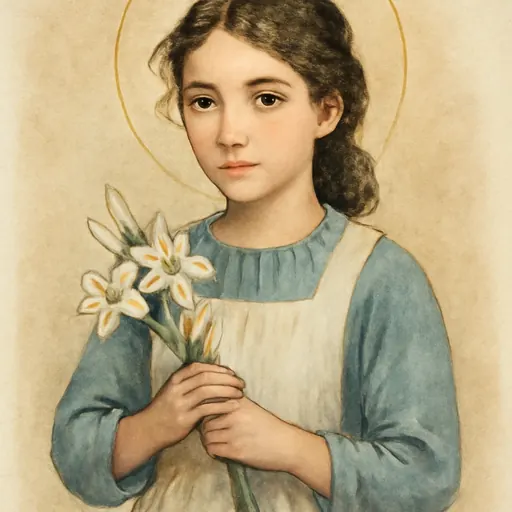
St. Maria Goretti was an Italian farm girl who died on July 6, 1902, at the age of eleven, the day after a neighbor of about twenty, Alessandro Serenelli, attacked her for refusing his sexual advances. Before she died she forgave him. He later repented and asked her mother's forgiveness. Pope Pius XII canonized her in 1950; her feast day is July 6, and she is a patron saint of young people, purity and survivors of sexual assault.
Who was St. Maria Goretti?
Maria Goretti was the daughter of poor farmworkers who moved from the Marche region of Italy to the malaria-ridden Pontine Marshes south of Rome. On July 5, 1902, when she was eleven, a neighbor of about twenty named Alessandro Serenelli tried to force her into a sexual act. She refused and resisted, and he stabbed her repeatedly. She died the next day in the hospital at Nettuno, after forgiving him.
The Catholic Church honors her as a martyr, a person who died rather than give up her faithfulness to God. Pope Pius XII beatified her in 1947 and canonized her in 1950, calling her "la piccola e dolce Martire della purezza," the sweet little martyr of purity. Her story has a second half that the Church values just as much: the man who killed her repented, asked her family's forgiveness and received it.
This entry tells the story plainly but without the details of the attack. Readers who have lived through sexual violence may still find parts of it hard.


The life of St. Maria Goretti
A poor family on the move
Maria was born on October 16, 1890, in Corinaldo, a hill town near Ancona, to Luigi Goretti and Assunta Carlini. The family lost its small farm and went south looking for work as sharecroppers. By 1899 they had settled at Le Ferriere di Conca, in the marshes near Nettuno, where they shared a farmhouse with another family of laborers, Giovanni Serenelli and his son Alessandro.
In 1900 Luigi died of malaria. Assunta took his place in the fields, and Maria, the oldest daughter, kept house, cooked and looked after the younger children. She never went to school and could not read. John Paul II, in his 2002 message for the centenary of her death, recalled the words she used to comfort her mother after her father died: "Mother, be brave, God will help us."
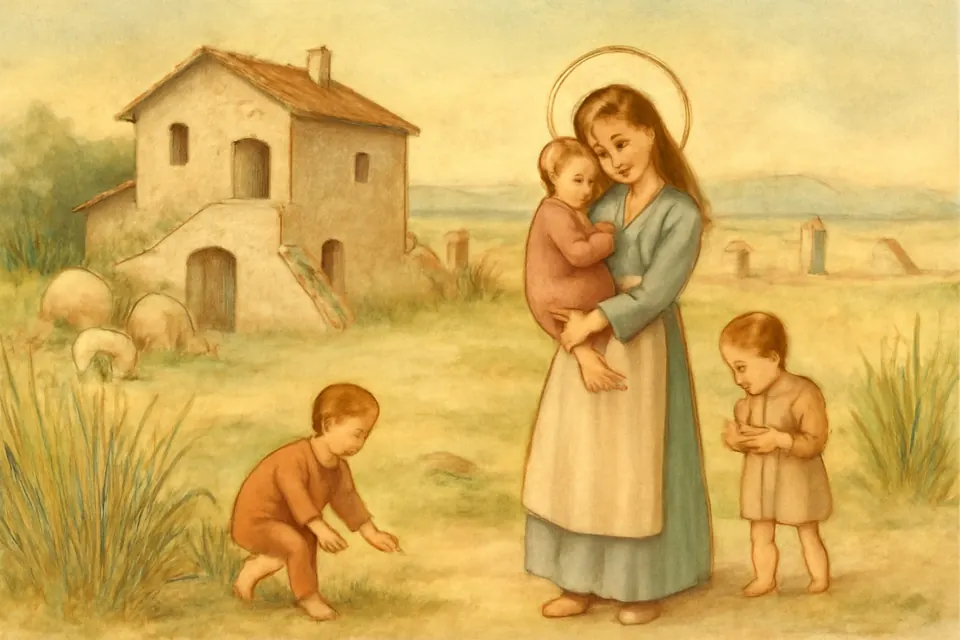
First Communion
Maria begged her mother to let her make her First Communion, and she received it on June 16, 1901, according to the Passionist fathers, who served the area and later cared for her shrine. She prayed the rosary with her family in the evenings.
July 5 and 6, 1902
Alessandro Serenelli had pressed Maria with sexual advances for some time, and she had been afraid to tell anyone. On the afternoon of July 5, 1902, while the others were threshing beans, he found her alone at the house, where she was mending one of his shirts and minding her baby sister. When she refused him and told him it was a sin, he stabbed her with a long awl. She was carried to the hospital in Nettuno. The surgeons could not save her.
She lived about a day. She received Communion as Viaticum and worried about where her mother would sleep. Before she died on the afternoon of July 6, she forgave Alessandro. The Passionists record her words: "For the love of Jesus, I forgive him, and I want him to be with me in Paradise."

John Paul II wrote that people at her funeral were already saying, "A saint has died!"
Alessandro Serenelli and forgiveness
Serenelli was arrested the same day and sentenced to 30 years in prison. For several years he was sullen and showed no remorse.
The change began, by his own account, with a dream. In the prison at Noto, in Sicily, where Bishop Giovanni Blandini visited him, he dreamed that Maria came to him gathering flowers, lilies in most tellings, and offered them to him. He served 27 years of his sentence. Accounts give his release as 1928 or 1929.
Free again, he went to Assunta Goretti and asked her forgiveness. The Passionists say she forgave him on Christmas night, and the two received Communion together. John Paul II noted that Assunta had already forgiven him "on behalf of the family in the hall of the tribunal where his trial was taking place," and he wrote: "We do not know whether it was the mother who taught her daughter to forgive or the martyr's forgiveness on her death-bed that determined her mother's conduct."

Serenelli asked to live with the Capuchin friars. He never took vows, but he worked as a porter and gardener in their friaries and died at the Capuchin house in Macerata on May 6, 1970. The Italian Catholic daily Avvenire calls his conversion the most astonishing of all the graces attributed to her.
Sources disagree on whether he attended her canonization. The Passionists' biography and Franciscan Media say he was in the crowd. Other accounts say he and the friars decided he should stay away so as not to distract from the ceremony.
Beatification, canonization and miracles
Devotion to Maria spread quickly through Italy and then abroad. Pius XII beatified her in St. Peter's Basilica on April 27, 1947, with her mother present. Three years later, on the evening of June 24, 1950, he canonized her during the Holy Year. The crowd was so large that the ceremony was held outdoors in St. Peter's Square, which the pope himself called unique in the history of the Church. Assunta, then in her eighties, was there with her surviving children. In his address Pius XII spoke of "the mother of the girl, who, having raised her for martyrdom, did not regret her death, though living in anguish."
Sorted by the labels this encyclopedia uses:
- Healings accepted for her cause: approved. Under the rules of the time, miracles attributed to her intercession were examined for both her beatification and her canonization. We have not been able to verify the details of the specific cases from a primary source, so we don't describe them here.
- Serenelli's dream of Maria with lilies: reported. It comes from his own letter and testimony.
- Serenelli's conversion: a documented change of life, which Catholics count as a grace through her prayers. It is not a miracle in the formal sense.
- Favors claimed by her brothers: reported. According to family accounts, her brother Mariano said that during World War I her voice told him to stay in his trench during an attack in which the rest of his unit died. These family accounts were never formally examined.
A note on the history
In 1985 the Italian historian Giordano Bruno Guerri published a critical study of the case that questioned parts of the traditional account. Older devotional writing sometimes told her story as if resisting an attacker were the measure of a girl's holiness. That is not what the Church teaches: a victim of sexual violence bears no guilt, and the Church honors Maria for her faith and for her forgiveness. John Paul II's 2002 message gave equal weight to "her forgiveness of the man who killed her and her desire to be able to meet him one day in heaven."
Why St. Maria Goretti is the patron saint of young people
Pius XII presented her to the youth of the world at her canonization, and John Paul II did the same in 2002, two weeks before World Youth Day in Toronto. Catholic schools, youth groups and parishes around the world bear her name. She is a patron of:
- Young people, teenagers and girls, because she died at eleven and two popes held her up to the young.
- Chastity and purity, from Pius XII's title for her.
- Forgiveness, because she forgave her killer and his life changed.
- Survivors of sexual assault, who ask the prayers of a girl who suffered violence herself.
See more on our patron saints page, and compare her with the Roman girl martyr St. Agnes, to whom she has often been likened, and with another young modern saint, St. Dominic Savio.
Symbols of St. Maria Goretti in art
Since she died in 1902, Maria has no medieval iconography. Her images come from holy cards, statues and stained glass made after her beatification. To recognize her:
- White lilies: the most common attribute, a traditional sign of purity, recalling also the lilies in Serenelli's dream.
- A martyr's palm: the ancient sign of a martyr's victory.
- A simple peasant dress or a white dress: sometimes the plain blouse and skirt of a farm girl, sometimes the white of her First Communion.
- A young face, with long dark hair: she is always shown as a girl, not a woman.
- An awl or knife: in some statues, the weapon of her death, held quietly in her hand.
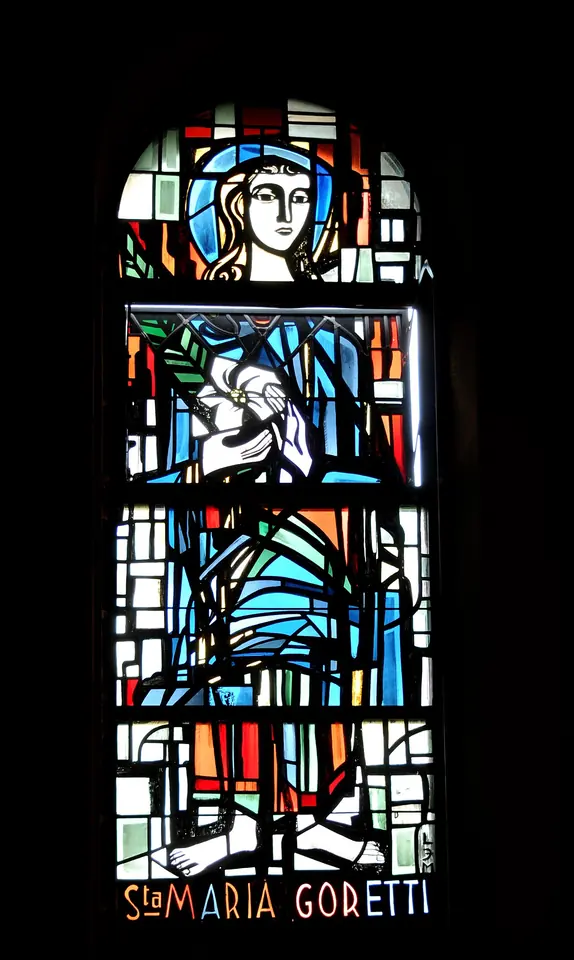

The Minnesota window below shows her in red, the color of martyrs, with her hands joined.


Painted statues in parish churches usually show her barefoot in country clothes.


Feast day and where St. Maria Goretti is honored
Her feast is July 6 in the General Roman Calendar, an optional memorial, the day she died. You can find the saints around her on our feast days page.
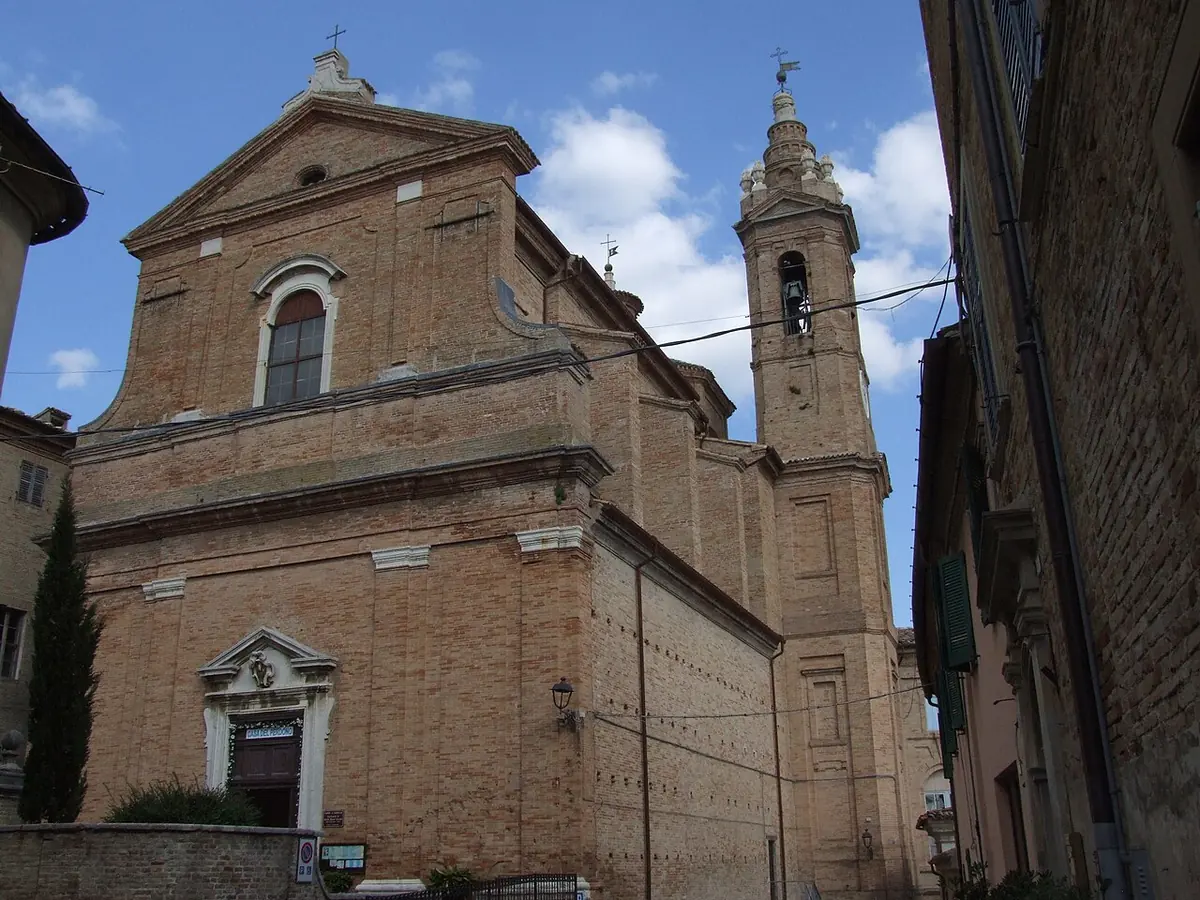
Her remains rest in the crypt of the Basilica of Our Lady of Graces and St. Maria Goretti in Nettuno, on the coast south of Rome. The Passionists have cared for the shrine since her lifetime, and the relics were moved there in 1929.


The bones lie inside a wax figure in a glass and marble casket, so she is sometimes wrongly described as incorrupt.


On her feast, pilgrims walk through the night from Nettuno and from Latina to the farmhouse at Le Ferriere, where she was attacked. Avvenire reports that the walk from Nettuno reached its 39th year in 2025. In her birthplace, Corinaldo, a torchlight procession goes to the house where she was born, and the town's sanctuary of St. Maria Goretti keeps her memory.

Prayer to St. Maria Goretti
The prayer the Church uses on her feast is the collect from the Roman Missal (English translation, 2011), which the Passionists also print on their page about her:
O God, author of innocence and lover of chastity, who bestowed the grace of martyrdom on your handmaid, the Virgin Saint Maria Goretti, in her youth, grant, we pray, through her intercession, that, as you gave her a crown for her steadfastness, so we, too, may be firm in obeying your commandments. Through our Lord Jesus Christ, your Son, who lives and reigns with you in the unity of the Holy Spirit, one God, forever and ever.
Pius XII ended his canonization address with a prayer addressed to her, in Italian. It begins, "Salve, o soave e amabile Santa!" ("Hail, gentle and lovable saint!") and asks her to protect children and young people and to help parents raise them.
Catholics also ask her prayers in their own words, especially for young people, for those who struggle to forgive and for survivors of violence.
Frequently asked questions
What is St. Maria Goretti the patron saint of?
Young people and teenagers, girls, chastity, forgiveness and the Children of Mary. Many Catholics also ask her prayers for survivors of rape and sexual assault. Pope John Paul II held her up as an example to young people in 2002.
When is St. Maria Goretti's feast day?
July 6, the anniversary of her death in 1902. It is an optional memorial in the General Roman Calendar, where it was placed in the 1969 revision.
Did St. Maria Goretti forgive her killer?
Yes. Before she died in the hospital at Nettuno she forgave Alessandro Serenelli. The Passionists record her words as "For the love of Jesus, I forgive him, and I want him to be with me in Paradise." Years later her mother forgave him too.
What happened to Alessandro Serenelli?
He served 27 years of a 30-year prison sentence. He said that Maria appeared to him in a dream in prison, and he changed. After his release he asked her mother Assunta's forgiveness, received it, and spent the rest of his life living and working with Capuchin friars. He died in Macerata in 1970.
Is St. Maria Goretti's body incorrupt?
No. Her remains in the crypt at Nettuno lie inside a wax figure in a glass casket, which is why visitors sometimes think the body is incorrupt.
Sources
- John Paul II: Message to the Bishop of Albano for the 1st centenary of St. Maria Goretti's death (2002)
- John Paul II: Angelus, 7 July 2002
- Pius XII: Address to the faithful gathered in Rome for the canonization of St. Maria Goretti (June 24, 1950, Italian)
- Passionists (Passio Christi): Saint Maria Goretti
- Avvenire: La giustizia riparativa del carnefice di santa Maria Goretti (2025)
- Franciscan Media: Saint Maria Goretti
- Roman Missal, Proper of Saints, July 6