St. Columbanus
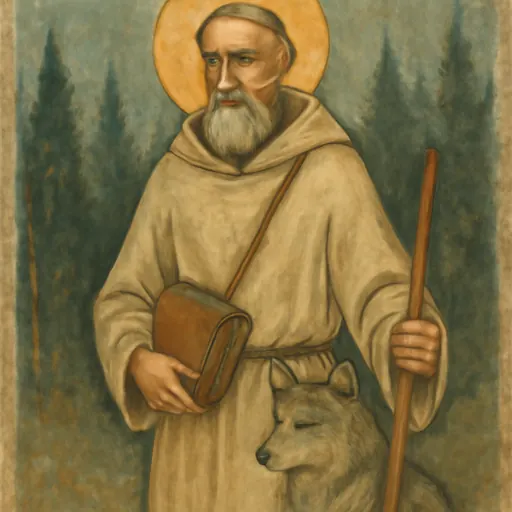
St. Columbanus (c. 543–615) was an Irish monk who left the monastery of Bangor around the age of forty and spent the rest of his life as a missionary in Europe. He founded the monasteries of Annegray, Luxeuil and Fontaines in France and Bobbio in northern Italy, wrote a strict monastic Rule, and quarreled with bishops and a royal court. His feast day is November 23, and Catholic Europe remembers him as one of its founding fathers.
Who was St. Columbanus?
Columbanus was an Irish monk who, at about forty years old, left his monastery with twelve companions and never went home. For the next quarter century he founded monasteries in the forests of eastern France, preached on the shores of Lake Constance and finished his life at Bobbio, in the Apennines of northern Italy, where he died in 615. Benedict XVI called him "the best known Irishman of the early Middle Ages" and "one of the Fathers of Europe."
He was also a difficult man. The Catholic Encyclopedia says plainly that he was "impetuous and even head-strong," and his life is a run of quarrels: with Frankish bishops over the date of Easter, with a king over his mistresses, and with a pope over a theological dispute he only half understood. He wrote letters, sermons, a penitential and a monastic Rule, and those writings survive, which is rare for anyone of his time.


Almost everything we know of his life comes from the Life of St. Columban by Jonas, a monk of Bobbio who wrote around 640, about twenty-five years after the saint's death. Jonas talked with men who had known him, which makes the outline of the story trustworthy. His many miracle stories are another matter, and this entry labels them.
The life of St. Columbanus
Leinster and Bangor
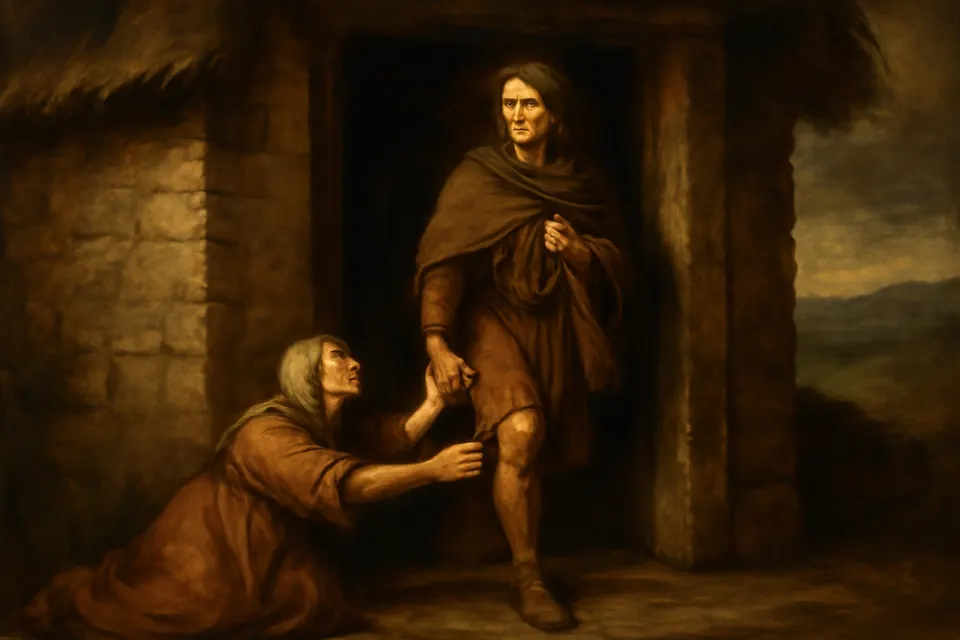
Columbanus was born around 543 in Leinster, in southeast Ireland. Jonas says he was well educated and good-looking, and that the attention he drew from women troubled him. A holy woman who had lived in a cell for twelve years told him there was no safety for him "except in flight." He decided to become a monk. His mother lay down across the doorway to stop him. Jonas writes that "leaping over both threshold and mother" he told her she would never see him again in this life.
He studied under Sinell at Cleenish, an island monastery in Lough Erne, and then entered Bangor, on Belfast Lough, under its abbot Comgall. Bangor was famous for its severity, and Columbanus spent many years there and was ordained a priest.
Pilgrim for Christ
Irish monks had an ideal they called peregrinatio pro Christo, exile for the sake of Christ. Around 590 (the Catholic Encyclopedia says 585), Columbanus asked Comgall to let him go, and sailed with twelve companions, among them Gall and Attala. They passed through Britain and landed in Brittany, then made their way to the Frankish kingdom of Burgundy.
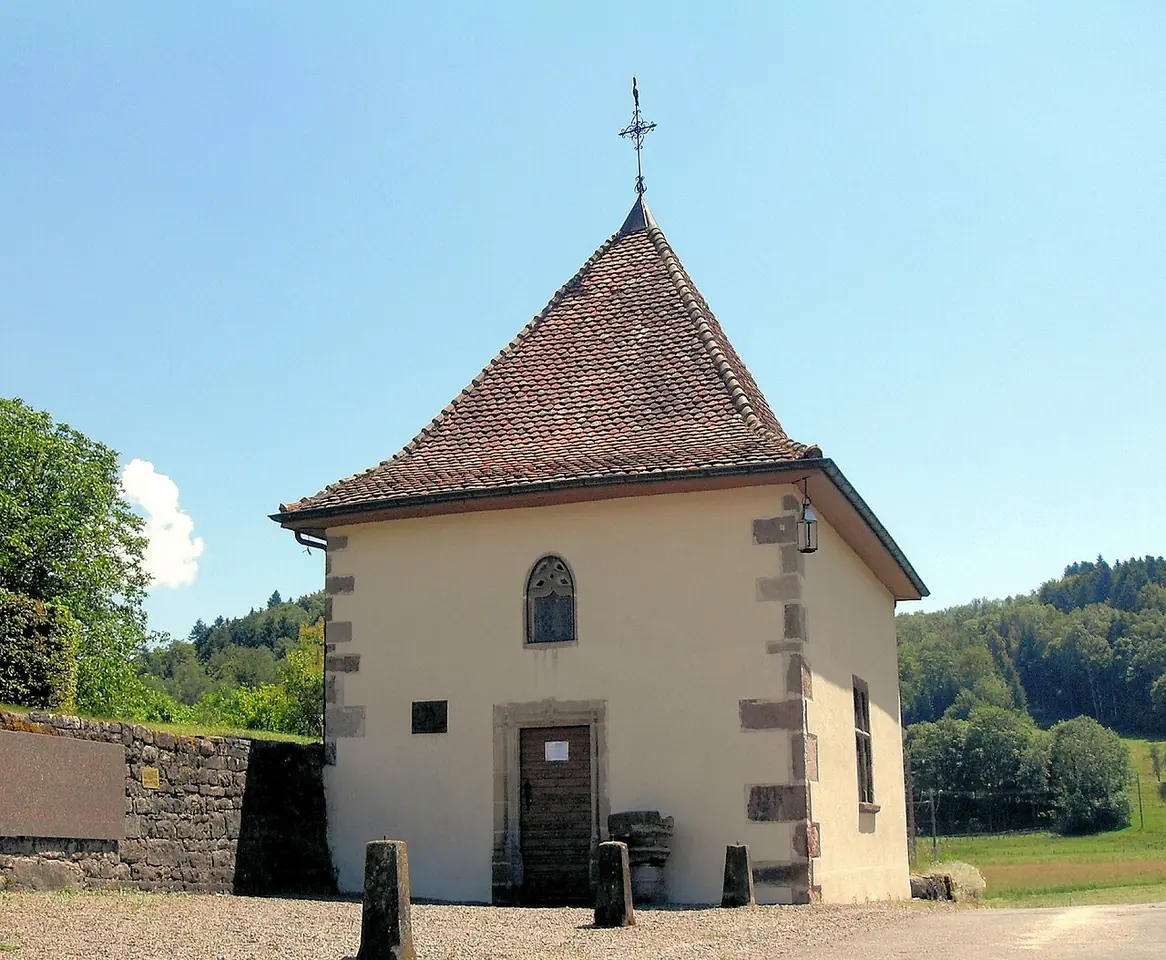
The king gave them a ruined Roman fort at Annegray in the Vosges mountains. The monks lived on herbs, berries and bark at first, but young men soon came asking to join. Columbanus founded a second monastery a few miles away at Luxeuil, on the ruins of an old Roman spa, and a third at Fontaines. Luxeuil became the center of Irish monastic life on the continent.

The Rule and private confession
For his monks Columbanus wrote the Regula monachorum. It has ten short chapters on obedience, silence, food, poverty, humility, chastity, the choir Office and correction, and it is far stricter than Benedict's Rule. His Penitential set a penance for each sin, measured to its gravity. Benedict XVI credits it with bringing private and frequent confession to the European continent.
Easter, the bishops and the king
The Frankish bishops did not like a foreign abbot who answered to no one, and they took offense at his Irish date for Easter. When a synod summoned him around 603, he sent a letter instead. "I came as a poor stranger into these parts for the cause of Christ," he wrote, as the Catholic Encyclopedia translates it, and asked only to be allowed "to live in silence in these forests." He also wrote to Pope Gregory the Great to defend the Irish custom. In that letter Columbanus called Gregory the "Flower of all Europe," and Benedict XVI notes it is the first known use of the phrase "all Europe" for the Church on the continent.
The break came over King Theuderic II of Burgundy, who kept concubines with the encouragement of his grandmother, Queen Brunhilda. Columbanus refused to bless the king's illegitimate sons and rebuked the king. In 610 the court ordered the Irish monks out of the kingdom and put them on a ship for Ireland at Nantes.
From Nantes he wrote to his monks at Luxeuil. Near the end of the letter, in G. S. M. Walker's translation:
Now as I write a messenger has reached me, saying that the ship is ready for me, in which I shall be borne unwilling to my country
But now my parchment letter is already forced to reach its end, though the greatness of my subject requires a more extensive treatment; love does not keep order, hence my missive is confused.
The ship never sailed for Ireland. It ran aground, and the captain, taking it as a sign, put the monks ashore.
Lake Constance and the Alps
Free again, Columbanus went up the Rhine to preach to the Alemanni. At Bregenz on Lake Constance the monks found a chapel where the people had set up three brass images of their gods. Gall, who knew the language, preached, and the images were destroyed. When war and local hostility made the place unsafe, around 612, Columbanus crossed the Alps. Gall stayed behind, and his hermitage became the great Abbey of St. Gall in Switzerland.

Bobbio
In Milan, King Agilulf and Queen Theodelinda of the Lombards welcomed him. At the king's request he wrote to Pope Boniface IV about the dispute over the "Three Chapters," a letter both devoted and blunt. In it he wrote:
For all we Irish, inhabitants of the world's edge, are disciples of Saints Peter and Paul and of all the disciples who wrote the sacred canon by the Holy Ghost, and we accept nothing outside the evangelical and apostolic teaching
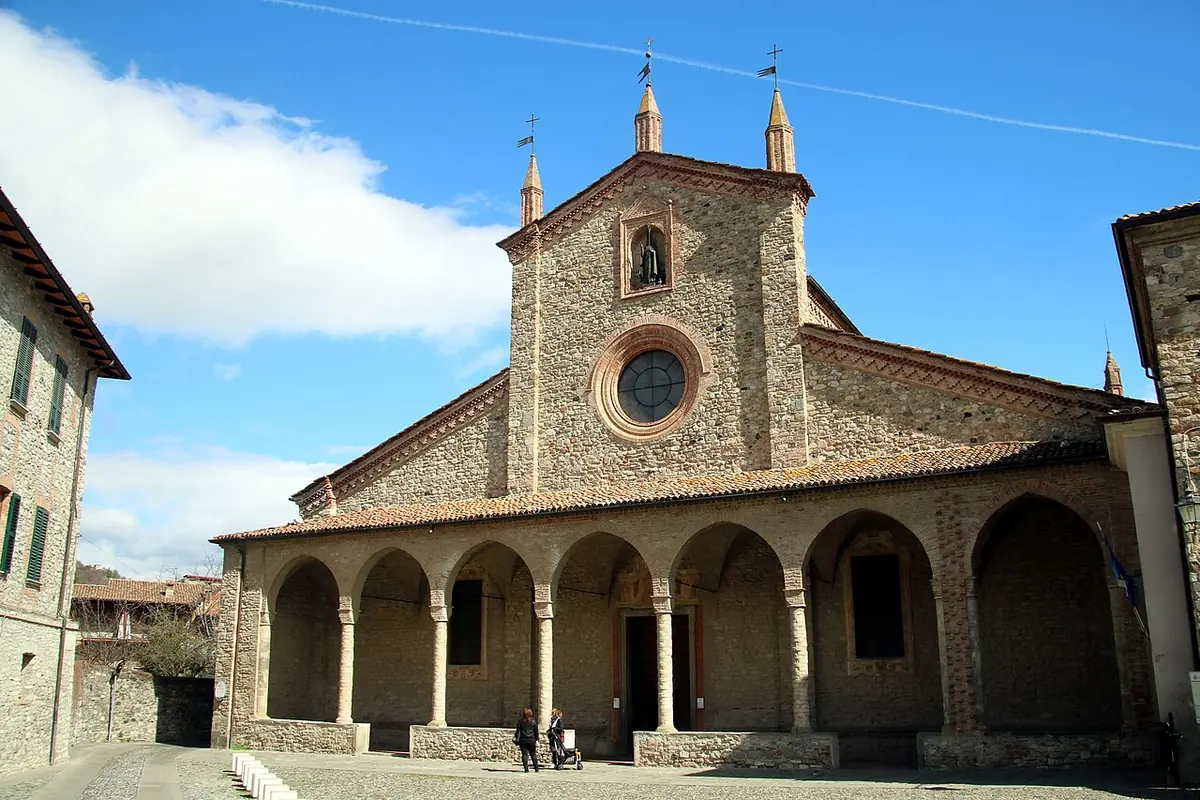
The king gave him land at Bobbio, in the Trebbia valley, with a half-ruined church of St. Peter. Columbanus rebuilt it and founded his last monastery, which became a great library and center of learning. King Chlotar II, whose rise Columbanus had predicted, asked him to come back to Francia. He declined, too old to travel, and died at Bobbio a year after its founding, in November 615.

The miracles of St. Columbanus
Jonas filled his Life with wonders, many of them about animals. None was ever formally investigated, so all are traditional by this encyclopedia's labels, though some come from eyewitnesses Jonas names.
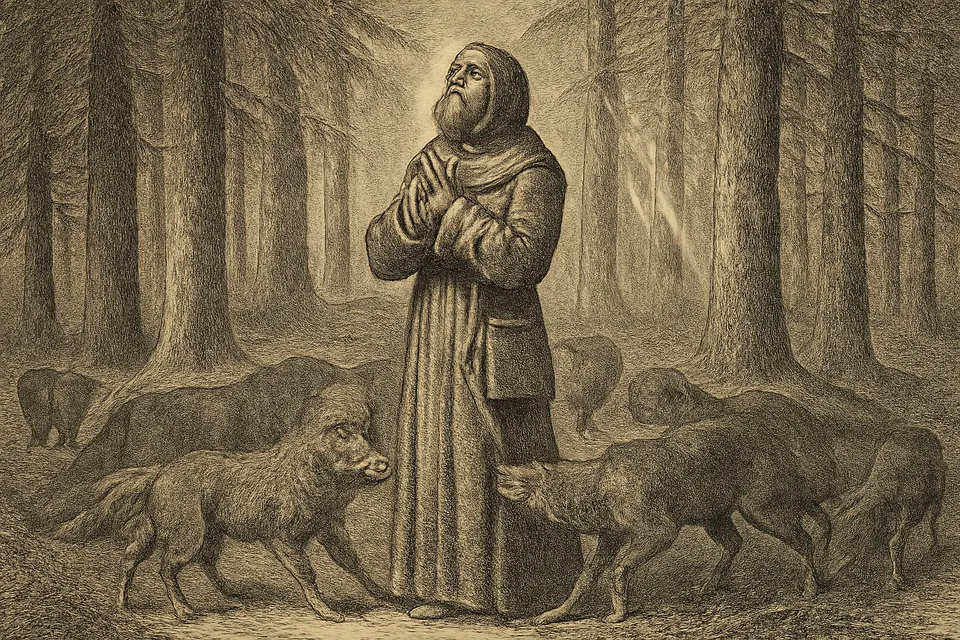
- The twelve wolves: walking in the forest, he wondered whether he would rather suffer from wild beasts or from men. Twelve wolves surrounded him and tugged at his clothes while he prayed, "Oh, God, come to my aid," then left him. Jonas adds honestly that Columbanus himself did not know whether it was a temptation of the devil or a real event.
- The bear's cave: he found a cave seven miles from Annegray, ordered the bear living there to leave, and lived in it himself.
- The cellarer's beer: a cellarer, called away by the abbot, left the tap open, yet came back to find that not a drop had spilled.
- The cask for Wodan: near Lake Zurich, he breathed on a great cask of beer prepared as an offering to the god Wodan, and it burst.
- The squirrel: Jonas cites Chamnoald, a royal chaplain who had been Columbanus's disciple, as having often seen him call a squirrel down from a tree and let it run in and out of his cowl.
- Healings at Bobbio: reported. The Catholic Encyclopedia says that many miracles have been reported at his tomb.
Why St. Columbanus is a patron saint
Bobbio, where he died and is buried, honors him as its patron. In recent decades Catholics have also named him a patron of motorcyclists, a nod to a man who crossed Europe on foot and by river. We could not find the document that made this patronage official, so we list it as a popular one. See more causes on our patron saints page.
His name lives on in two missionary orders founded in Ireland in the 20th century, the Missionary Society of St. Columban and the Missionary Sisters of St. Columban.
Symbols of St. Columbanus in art
The Catholic Encyclopedia, drawing on F. C. Husenbeth's 19th-century Emblems of Saints, lists his usual attributes. Look for:
- An old bearded monk in a cowl, without a bishop's miter, since he was an abbot, not a bishop.
- A book in a satchel: Irish monks carried their books in leather bags.
- Wolves around him, from the forest story.
- A bear, sometimes being tamed or yoked to a plow.
- Sunbeams over his head.
- A dove, a play on his name (Latin columba), as in the Bobbio window.


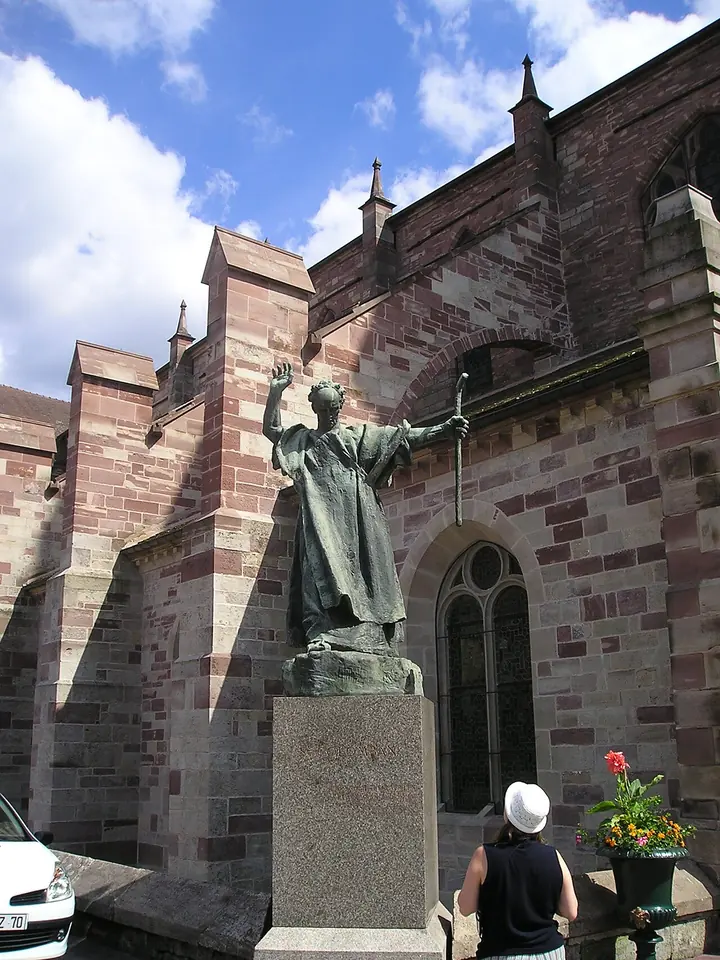
The fresco at Brugnato near the top of this page is the older Italian type, an aged abbot with crozier and blessing hand. The bronze at Luxeuil shows the other side of him: the prophet raising his arm against a king. He is easy to confuse with St. Columba of Iona, who is also an Irish monk often shown with a dove; context (Bobbio, Luxeuil, wolves) usually settles it.
Feast day and the places of St. Columbanus
His feast is November 23 on the General Roman Calendar; see his neighbors on our feast days page. Jonas dates his death to November 21, and the Catholic Encyclopedia notes that this is the date in the old Roman Martyrology.
His body lies in the crypt of the abbey church at Bobbio. The relics were moved to a new shrine beneath the crypt altar in 1482, and the sacristy keeps part of his skull, along with a knife, a wooden cup and a bell said to be his.


In France, the Basilica of St. Peter at Luxeuil-les-Bains stands on the site of his monastery. In 1950 Luxeuil held a congress for the 1,400th anniversary of his birth, attended by the French statesman Robert Schuman and by the papal nuncio Angelo Roncalli, the future Pope John XXIII.
Prayer of St. Columbanus
Columbanus left a prayer of his own at the end of his twelfth sermon, which Walker's translation gives as:
Lord, grant me, I pray Thee in the name of Jesus Christ Thy Son, my God, that love which knows no fall, so that my lamp may feel the kindling touch and know no quenching, may burn for me and for others may give light. Do Thou, Christ, deign to kindle our lamps, our Saviour most sweet to us, that they may shine continually in Thy temple, and receive perpetual light from Thee the Light perpetual, so that our darkness may be enlightened, and yet the world's darkness may be driven from us.
No traditional novena to Columbanus has come down from the early Church. Catholics who ask his intercession simply pray to God and ask the saint to pray with them, often at his tomb in Bobbio.
Frequently asked questions
When is the feast of St. Columbanus?
November 23, an optional memorial in the General Roman Calendar and his feast day in Ireland. His seventh-century biographer Jonas dates his death to November 21, 615, and the Benedictines have kept that day.
What is the difference between St. Columbanus and St. Columba?
They were two different Irish monks of the same century. St. Columba (died 597) founded the monastery of Iona and preached in Scotland. Columbanus (died 615) trained at Bangor and worked in France, Switzerland and Italy. Both names come from the Latin columba, "dove," and Columbanus sometimes signed his letters with the Hebrew form, Jonah.
What is St. Columbanus the patron saint of?
The town and abbey of Bobbio, where he is buried. Since the 2000s many Catholics have also called him the patron of motorcyclists because of his long journeys across Europe. We could not find the decree for this patronage, so treat it as a popular one.
What is the Rule of St. Columbanus?
A short rule for monks in ten chapters, on obedience, silence, food, poverty, humility, chastity, the choir Office and penance. Benedict XVI called it the only ancient Irish monastic rule that survives. It was stricter than the Rule of St. Benedict, which replaced it in his monasteries before the year 700.
Where is St. Columbanus buried?
In the crypt of the abbey church of San Colombano at Bobbio, in the Trebbia valley of northern Italy, where his relics were placed in a new shrine in 1482.
Sources
- Catholic Encyclopedia (1908): St. Columbanus
- Benedict XVI, General Audience of 11 June 2008: Saint Columban
- Jonas of Bobbio, Life of St. Columban (trans. Dana C. Munro, 1895), Internet Medieval Sourcebook
- Letters of Columbanus, English translation by G. S. M. Walker (CELT, University College Cork)
- Letters of Columbanus, Letter V to Pope Boniface IV (CELT)
- Sermons of Columbanus, Sermon XII (CELT)