St. Elizabeth of Hungary

St. Elizabeth of Hungary (1207–1231) was a Hungarian princess who married the ruler of Thuringia, spent her fortune on the poor and sick, and after her husband's death became a Franciscan tertiary and nursed the sick in a hospital she built at Marburg. She is the patron saint of charities, hospitals, bakers and the homeless, and the legend of bread turned to roses is told of her. Her feast day is November 17.
Who was St. Elizabeth of Hungary?
Elizabeth was a king's daughter who chose to live and die as a servant of the poor. Born in 1207, the daughter of King Andrew II of Hungary, she was sent as a small child to the court of Thuringia in central Germany, married its ruler, and became one of the most loved women of the Middle Ages. After her husband died she gave away her wealth, joined the Third Order of St. Francis, and spent her last years nursing the sick in a hospital she founded at Marburg. She died there at 24 and was canonized four years later.


Her life is better documented than most medieval saints'. The Catholic Encyclopedia (1909) names the two oldest sources: the letter her confessor, Conrad of Marburg, sent to Pope Gregory IX in 1232, and the sworn statements of four women who served her, taken for the canonization in 1235 and known as the Sayings of the Four Maids. Later lives, including the Golden Legend and Dietrich of Apolda's life of about 1290, added legends to the record.
Her family was full of saints. Her mother's sister was St. Hedwig of Silesia, and St. Elizabeth of Portugal was her great-niece.
The life of St. Elizabeth
A princess sent to the Wartburg
The Catholic Encyclopedia says she was born "probably at Pressburg," today Bratislava; Pope Benedict XVI, in a 2010 audience on her life, noted that "historians dispute her birthplace." In 1211 an embassy from Landgrave Hermann I of Thuringia came to arrange her marriage to his eldest son, as part of a political alliance. Elizabeth, four years old, was taken to the Thuringian court to be raised with her future husband.


Her childhood at the Wartburg, the court's castle above Eisenach, was marked by loss. Her mother was murdered by Hungarian nobles in 1213. The intended bridegroom, Hermann, died in 1216, and she was betrothed to his younger brother Ludwig.
Wife of Ludwig
Ludwig became landgrave in 1217, and the two married in 1221, when he was 21 and she was 14. The marriage was a happy one. They had three children: Hermann, Sophia and Gertrude, the last born weeks after her father's death, who became abbess of Altenberg.
Elizabeth did not fit court life. Benedict XVI tells how she once entered a church on the Feast of the Assumption, took off her crown and laid it before the crucifix. When her mother-in-law scolded her, she answered: "How can I, a wretched creature, continue to wear a crown of earthly dignity, when I see my King Jesus Christ crowned with thorns?" According to the Sayings of the Four Maids, she would not eat food that did not come from her husband's lawful property. When courtiers complained about her gifts to the poor, Ludwig answered, "So long as she does not sell the castle, I am happy with her!"
Franciscan friars reached Thuringia in the early 1220s, and one of them, Brother Rodeger, became her spiritual guide and taught her about Francis of Assisi, who was still alive. Later her director was Master Conrad of Marburg, a stern preacher whom the Catholic Encyclopedia calls "very ascetic" and "very severe." He imposed hard penances, and the Golden Legend says he had her beaten for visiting a convent without his leave.
The famine of 1226
In the spring of 1226, while Ludwig was in Italy on the emperor's business, floods, famine and plague struck Thuringia. Elizabeth took charge. She gave away grain, money and even her state robes, and built a hospital with 28 beds below the Wartburg, which she visited every day. The Catholic Encyclopedia says she fed 900 poor people a day. When Ludwig came home, he approved all she had done.

Widowhood and exile
In June 1227 Ludwig left on crusade with the emperor Frederick II. Benedict XVI quotes her farewell: "Far be it from me to detain you. I have given my whole self to God and now I must also give you." He died of fever at Otranto in September, before he could sail. When the news reached her, weeks after the birth of their third child, she cried out, "The world with all its joys is now dead to me."
That winter she left the Wartburg. Whether she was driven out by her brother-in-law Heinrich Raspe, who ruled for her young son, or left of her own will has been argued since the 1880s; the Catholic Encyclopedia sets out both views. Her uncle, the Bishop of Bamberg, took her in and tried to arrange a second marriage. She refused. The Golden Legend has her say she would cut off her own nose before she let it happen.
The hospital at Marburg
On Good Friday 1228, in the Franciscan chapel at Eisenach, Elizabeth laid her hands on the altar and renounced the world. Conrad wrote to the pope that she wanted to give up all her possessions, "but I dissuaded her out of love for the poor." At Marburg she and her companions put on the gray habit of the Third Order of St. Francis, among the first Franciscan tertiaries in Germany. With her widow's settlement she built a hospital in Marburg in the summer of 1228 and served there herself, choosing the most repellent tasks. When Conrad rebuked her for serving the sick at her own table, she answered that she received from the poor "special grace and humility."
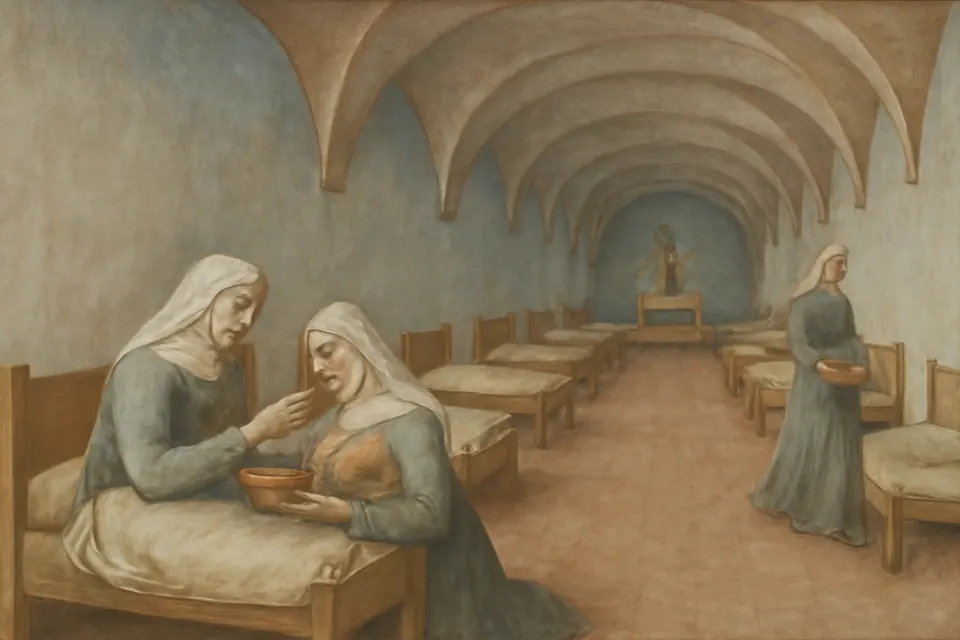
She fell ill with a high fever in November 1231 and died on the night of November 17, at 24.


The miracles of St. Elizabeth
- Cures at her grave: approved. Healings began at her tomb in the hospital chapel soon after her death, and three papal inquiries took sworn testimony from people who had been healed, in 1232, 1233 and 1235. These cures were the grounds for her canonization; the Elisabethkirche counts 106 miracle accounts in the records.
- The roses: traditional. See the next section.
- Stories in the Golden Legend: traditional. It tells of a poor woman who fainted from joy at Elizabeth's gift and revived at her prayer, a granary that did not run low however much she gave away, a hanged man restored to life after his friends prayed to her, and a drowned four-year-old revived.
The miracle of the roses
The best-known story about Elizabeth is told in many forms. In the version Benedict XVI gives, she was carrying bread to the poor in her apron when she met her husband, who asked what she had. She opened the apron and it was full of roses. The story is traditional and does not come from the people who knew her. The Catholic Encyclopedia notes that the legend "is, however, related of other saints as well," and the Christian Iconography site, citing the historian Kenneth Baxter Wolf, says hagiographers of the later 13th century borrowed it from a story told of the Spanish saint Casilda.


Mary Reed Newland's The Year and Our Children (1956) drew a family custom from it: baking bread on St. Elizabeth's Day and carrying it to the neighbors.
Why St. Elizabeth is the patron saint of charities and hospitals
- Hospitals, nurses and charitable workers: from the hospitals she built below the Wartburg and at Marburg and her own work in them.
- Bakers and the hungry: from the bread she gave in the famine of 1226 and the bread of the roses story.
- The homeless and the falsely accused: from her winter without a home and the criticism she met at court.
- Widows: she was widowed at 20 and refused to remarry.
- Secular Franciscans: Benedict XVI calls her patroness of the Third Order Regular of St. Francis and of the Secular Franciscan Order.
See all her patronages on our patron saints page.
Symbols of St. Elizabeth of Hungary in art
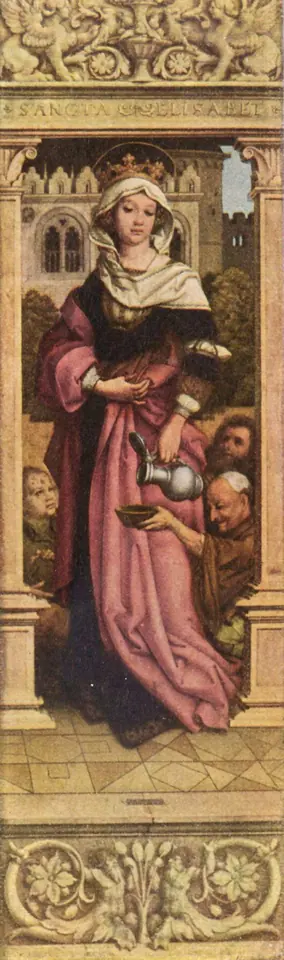
Elizabeth is almost always a young woman in a crown, often with a widow's veil or a Franciscan habit beneath it. Look for:
- Roses in her apron, lap or cloak, as in Lorenzetti's panel.
- Bread, in a basket or her cloak, sometimes together with the roses.
- A flask or jug, from giving drink to the thirsty.
- Beggars, cripples or lepers at her feet.
- Three crowns, for virgin, wife and widow.
- A model of a hospital or church.

In her own church at Marburg, a Gothic stone figure from the old choir screen stands in the north aisle; in the photograph below, visitors have left roses at its base.
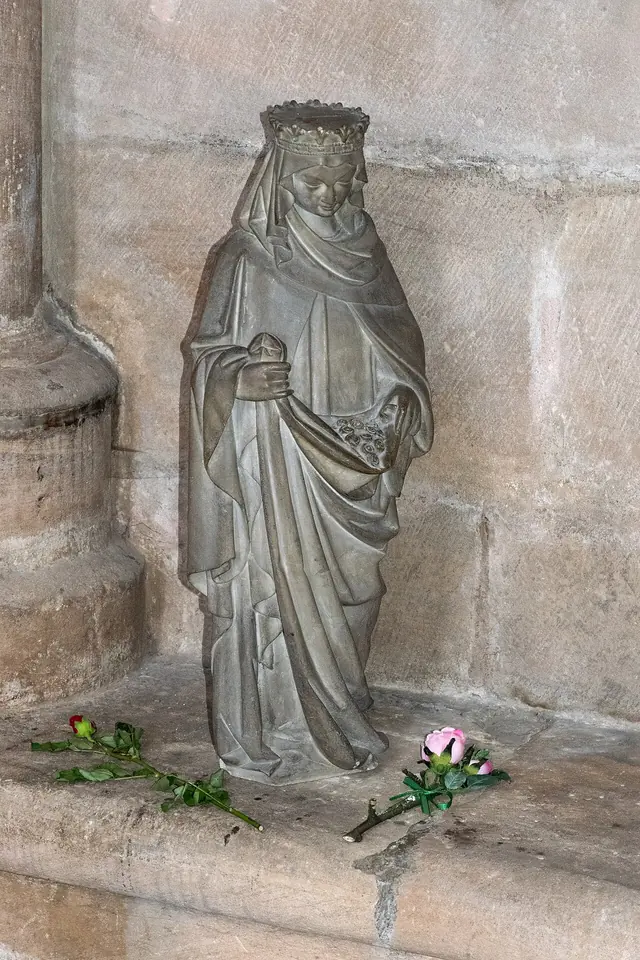

St. Elizabeth's Church in Marburg
The Teutonic Knights settled at Marburg in 1233, and her brother-in-law Conrad joined them the next year. In August 1235, months after her canonization, the cornerstone of a great Gothic church was laid over her grave; it belonged to the order. On May 1, 1236, in the presence of Emperor Frederick II, her body was raised from the grave. The church was consecrated in 1283. The Catholic Encyclopedia compares the pilgrimages to those of Santiago de Compostela.


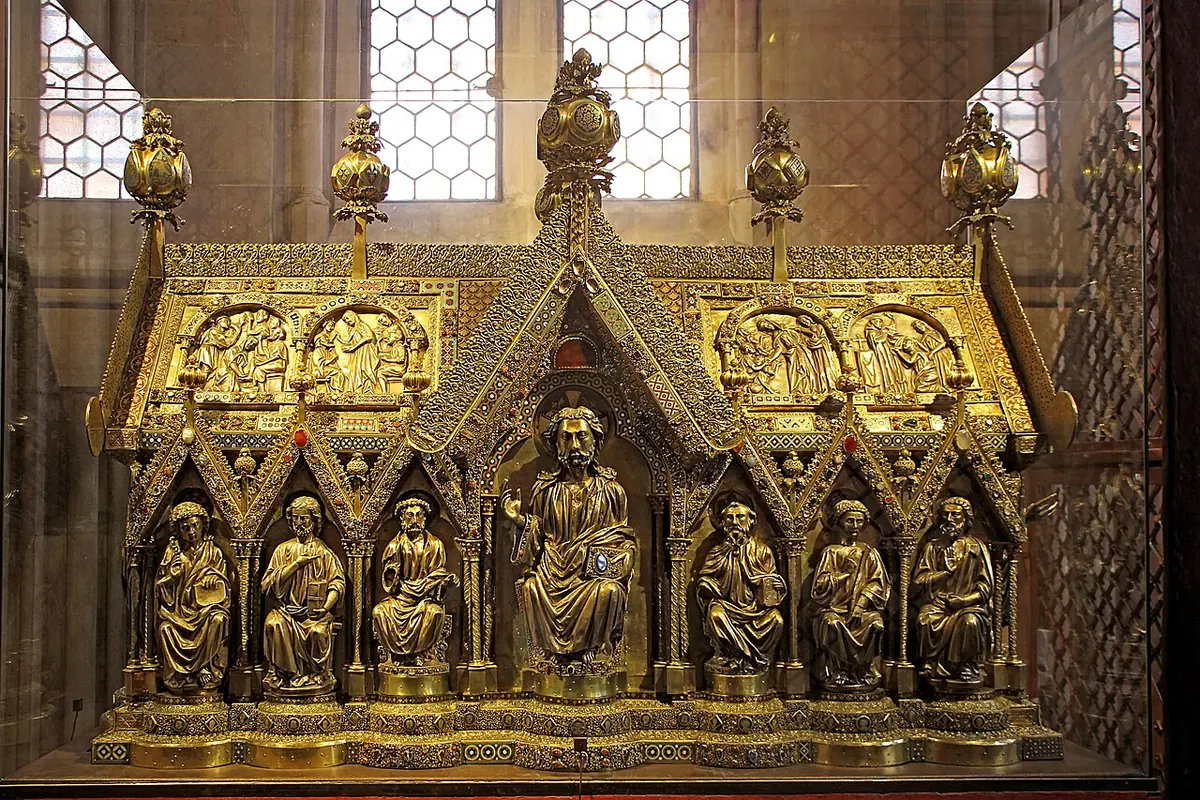
The choir still has its 13th-century Elizabeth window, showing her works of mercy in small medallions. Her bones were kept in a gilded shrine of copper over an oak core, made around 1240 in the shape of a church; its roof reliefs show her receiving the Franciscan habit, giving alms, feeding the old and washing feet.


In 1539 Landgrave Philip of Hesse, who had become a Protestant, removed her relics to end the pilgrimages, and the church later became Protestant, as it is today. The empty shrine and her tomb are still there.

Her skull and leg bones were later kept by the Poor Clares in Vienna. Since the 1780s they have been with the Elisabethine sisters there, who show them for veneration on November 19. A 1931 examination found on the skull the mark of a gold band she had worn since childhood.
St. Elizabeth of Hungary's feast day
Her feast is November 17, the day of her death, a memorial in the General Roman Calendar. Before the calendar reform of 1969 it was kept on November 19, the day of her burial, and the Viennese relics are still shown on that day. Her aunt St. Hedwig is remembered on October 16. See her neighbors on our feast days page.
Prayer to St. Elizabeth of Hungary
The collect for her memorial in the Roman Missal, as printed by Catholic Culture:
O God, by whose gift Saint Elizabeth of Hungary recognized and revered Christ in the poor, grant, through her intercession, that we may serve with unfailing charity the needy and those afflicted. Through our Lord Jesus Christ, your Son, who lives and reigns with you in the unity of the Holy Spirit, God, for ever and ever.
There is also a traditional Litany of Saint Elizabeth for private use, found in Benjamin Francis Musser's Kyrie Eleison: Two Hundred Litanies (1944). It closes:
Let us pray. Enlighten, O God of compassion, the hearts of Thy faithful servants, and through the glorious prayers of blessed Elizabeth, make us to despise the pleasing things of this world, and ever to delight in the consolations of heaven. Through Christ our Lord. R. Amen.
Catholics ask St. Elizabeth's prayers for the sick, the hungry and those who care for them.
Frequently asked questions
What is the miracle of the roses?
The story says Elizabeth was carrying bread to the poor in her cloak when she met her husband, who asked what she had; when she opened the cloak, it was full of roses. It is a traditional legend that entered her story later in the 13th century; a similar story was told of other saints.
What is St. Elizabeth of Hungary the patron saint of?
Charitable works and those who carry them out, hospitals and nurses, bakers, beggars and the homeless, widows, brides, the falsely accused and lacemakers. Pope Benedict XVI noted that she is patroness of the Third Order Regular of St. Francis and of the Secular Franciscan Order.
When is St. Elizabeth of Hungary's feast day?
November 17, the day she died in 1231, kept as a memorial in the General Roman Calendar. Older calendars kept November 19, the day of her burial.
How old was St. Elizabeth of Hungary when she died?
She was 24. She was married at 14, widowed at 20, and spent her last three years serving in her hospital at Marburg, where she died on the night of November 17, 1231.
Where are St. Elizabeth's relics?
Her grave is in St. Elizabeth's Church in Marburg, but a Protestant landgrave removed her remains in 1539. Her skull and leg bones are kept by the Elisabethine sisters in Vienna, Austria.
Sources
- Catholic Encyclopedia (1909): St. Elizabeth of Hungary
- Benedict XVI, General Audience of 20 October 2010: Saint Elizabeth of Hungary
- The Golden Legend, Life of St. Elizabeth of Hungary (Caxton translation, 1483)
- Christian Iconography: Saint Elizabeth of Hungary
- Catholic Culture: Memorial of St. Elizabeth of Hungary, November 17
- Catholic Culture: Litany of Saint Elizabeth of Hungary
- Catholic Culture: St. Elizabeth's Bread (from Mary Reed Newland, The Year and Our Children, 1956)
- Elisabethkirche Marburg: Elisabeth-Schrein
- Elisabethkirche Marburg: Mausoleum
- Elisabethkirche Marburg: Elisabeth
- Wien Geschichte Wiki: Elisabethinenkirche
- Conrad of Marburg, letter to Pope Gregory IX (1232), and the Libellus de dictis quatuor ancillarum (1235)