St. Casimir of Poland and Lithuania
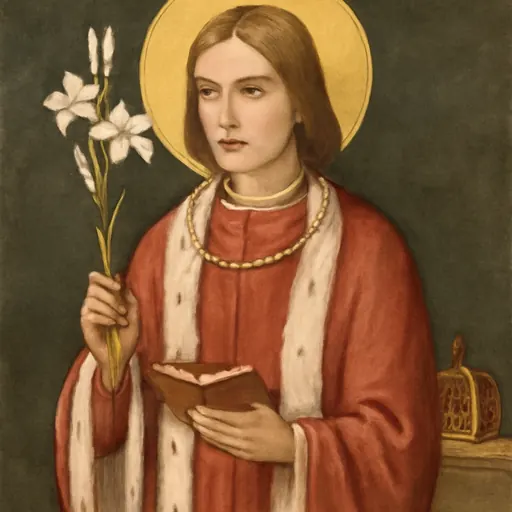
St. Casimir (1458–1484) was a prince of the Jagiellonian dynasty, the second son of King Casimir IV of Poland, who was also Grand Duke of Lithuania. Remembered for his prayer, purity and care for the poor, he died of tuberculosis at 25 and is buried in Vilnius Cathedral. His feast day is March 4, and he is the patron saint of Lithuania and Poland and of Lithuanian youth.
Who was St. Casimir?
Casimir was born in the royal castle of Wawel in Kraków on October 3, 1458, the second son of Casimir IV Jagiellon, King of Poland and Grand Duke of Lithuania, and Queen Elizabeth of Austria. Through his grandfather Jogaila, the Lithuanian grand duke who became King of Poland, he belonged to both nations. He lived only twenty-five years and never held a throne of his own, yet Lithuanians and Poles have honored him as their patron for five centuries.
From the age of nine he and his older brother Władysław were taught by Jan Długosz, the canon of Kraków and historian. The papal legate Zacharias Ferreri, who wrote the first Life of Casimir in 1521, said he also knew Lithuanian and Polish.

The life of St. Casimir
The Hungarian campaign
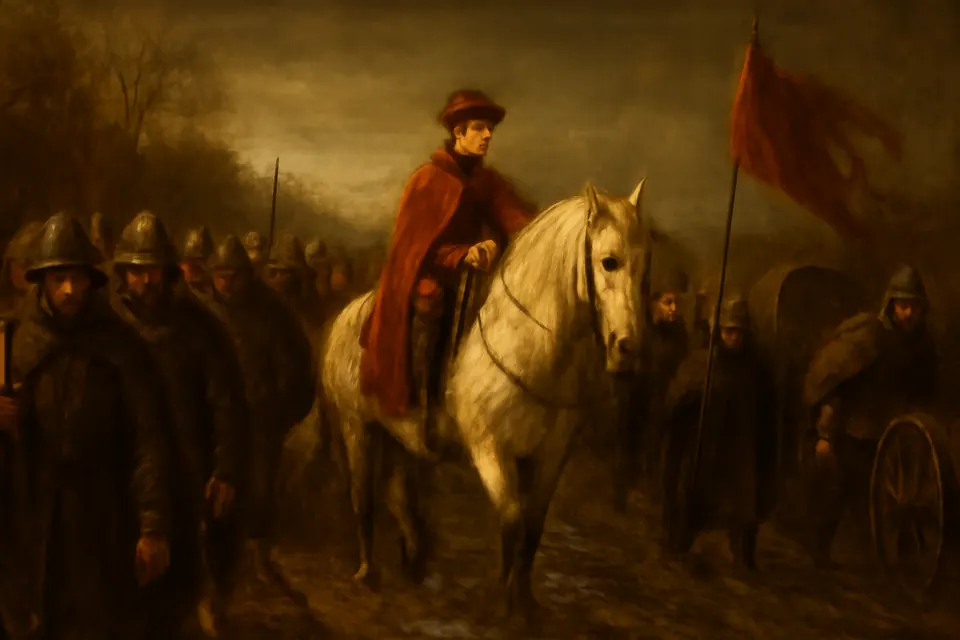
In 1471, when Casimir was thirteen, a party of Hungarian nobles turned against their king, Matthias Corvinus, and invited the Polish king to put his son on the throne. Casimir's mother was the daughter of an earlier Hungarian king, so the claim seemed good. A Polish army of about 12,000 men crossed into Hungary in October with the boy prince. The Catholic Encyclopedia tells the outcome in one line: he "was unsuccessful, and returned a fugitive." Most of the Hungarian lords went over to Matthias, and the unpaid army melted away. By 1472 Casimir was back at his studies in Kraków.
Długosz wrote that the prince felt great sorrow and shame over the failure. The cathedral of Vilnius counts it among the things that turned the young man toward God. Later tellings say he refused afterward to take up the war again, but that is traditional.
Prince and regent
In his late teens and early twenties Casimir worked beside his father. When the king spent long periods in Lithuania, Casimir governed Poland in his place, and the Catholic Encyclopedia says he ran the state from 1481 to 1483.
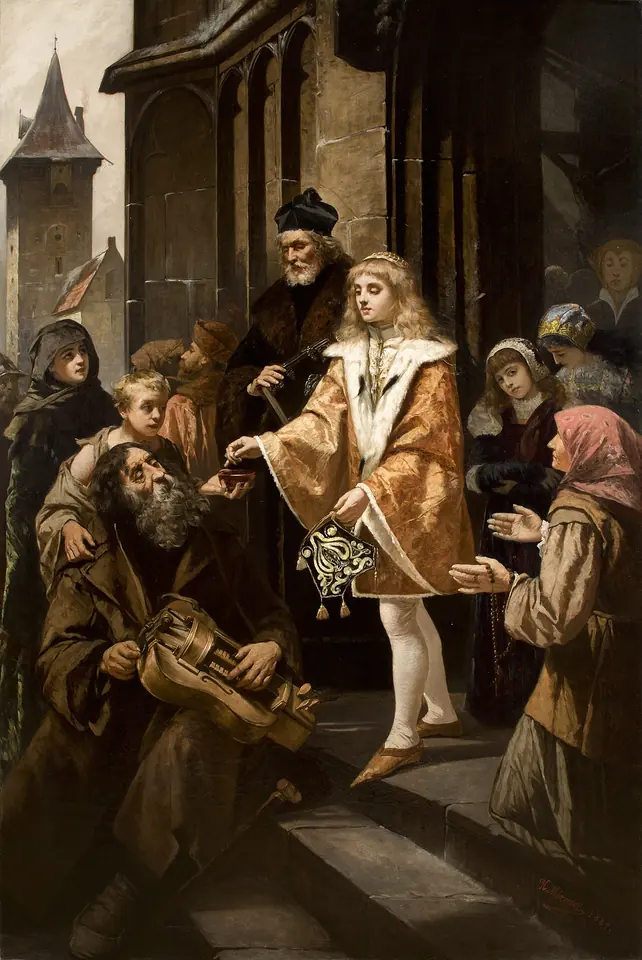
At the same time he was becoming known for his prayer. The early sources say he wore a hair shirt, fasted and gave generously to the poor and the sick, and that he would go to church before dawn and kneel at the closed doors until they opened. His father tried to arrange his marriage to Kunigunde, a daughter of Emperor Frederick III. Casimir is said to have refused, wanting to remain unmarried.


Death at Grodno
In 1483 Casimir was in Lithuania with his father and was found to have tuberculosis. According to the tradition the Vilnius cathedral repeats, his doctors advised him to take a woman as a cure, and he answered that he would rather die than sin. He died at Grodno on March 4, 1484, at the age of 25. His body was brought to Vilnius that July and buried in the cathedral's royal chapel.
The miracles of St. Casimir
Sorted by the labels this encyclopedia uses:
- Healings at his tomb: reported. By 1513 a poem by Andrzej Krzycki described wax and silver votive offerings hanging around his coffin, and Ferreri gathered accounts of cures for the papal inquiry of 1520.
- Help in battle against Moscow: traditional. The Catholic Encyclopedia tells of a victory over the Russians on the river Dvina near Polotsk, when, the story goes, Casimir appeared and showed the Lithuanian army where to cross. It is usually dated to 1518.
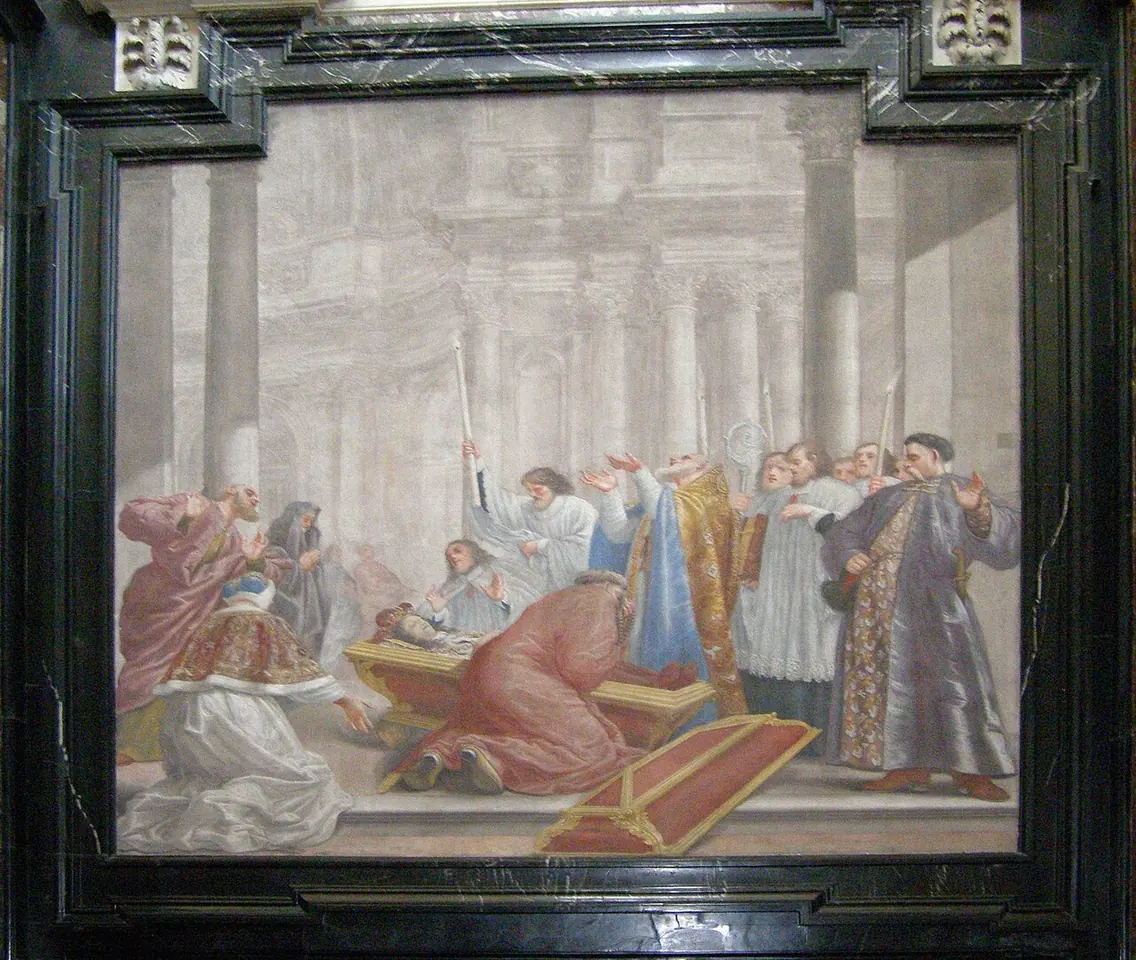
- Ursula raised from the dead: traditional. One of Michelangelo Palloni's frescoes in his chapel shows the revival of a dead girl named Ursula through his intercession.
- The incorrupt body: reported. When the coffin was opened in 1604, a witness testified that the body was intact and that a sweet scent filled the cathedral. By 1667 only bones remained.

The hymn "Omni die dic Mariae"
When Casimir's coffin was opened in 1604, the cathedral says a Latin hymn to Mary was found by his head. It begins:
Omni die dic Mariae,
mea laudes anima.
For centuries he was thought to have written it, and it became known as the Hymn of St. Casimir. In fact it is a section of the Mariale, a long 12th-century poem. The New Catholic Encyclopedia notes that it has been credited to Bernard of Clairvaux, Anselm and Casimir himself, but no manuscript is older than the time of Bernard of Cluny, the likeliest author. The Vilnius cathedral agrees. Casimir did not write the hymn, but tradition says he prayed it every day and asked for it to be buried with him. The English hymn "Daily, daily sing to Mary" is a loose version of it.
Why St. Casimir is the patron of Lithuania and Poland
He was a prince of both nations, and his cult grew up at the royal court and in Vilnius. In 1636 Pope Urban VIII named him patron of Lithuania, and in 1948 Pope Pius XII proclaimed him the special patron of all Lithuanian youth. Dozens of churches in both countries and in North America bear his name. Find other national patrons on our patron saints page.
Symbols of St. Casimir in art
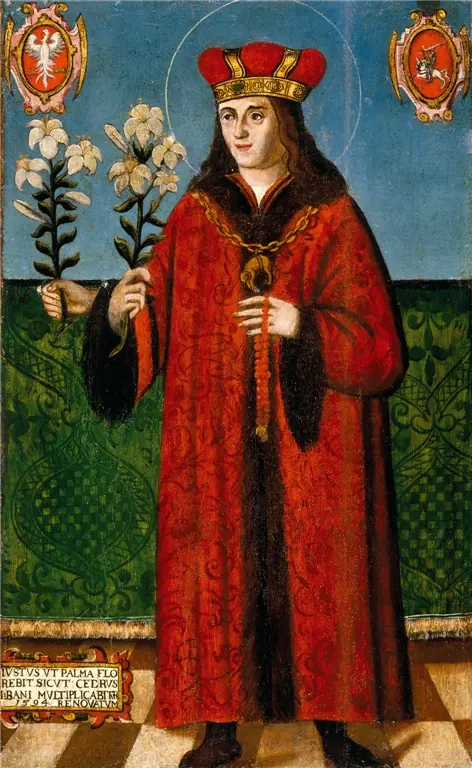
Casimir is almost always a young, beardless prince in a long red robe lined with ermine. He holds a lily for purity, and his crown or ducal cap is often set aside to show that he preferred heaven to rank. He may also hold a cross, a rosary or a book with the words of "Omni die dic Mariae." The famous painting in Vilnius Cathedral, from about 1520, gives him three hands, two of them right hands. Legend says the painter tried to paint over one, but it kept coming back.

Feast day, relics and the Vilnius chapel
His feast is March 4 in the General Roman Calendar; see the other March saints on our feast days page. Pope Clement VIII confirmed the feast for Poland and Lithuania in a brief of November 7, 1602, and Vilnius received it with three days of celebration in May 1604.
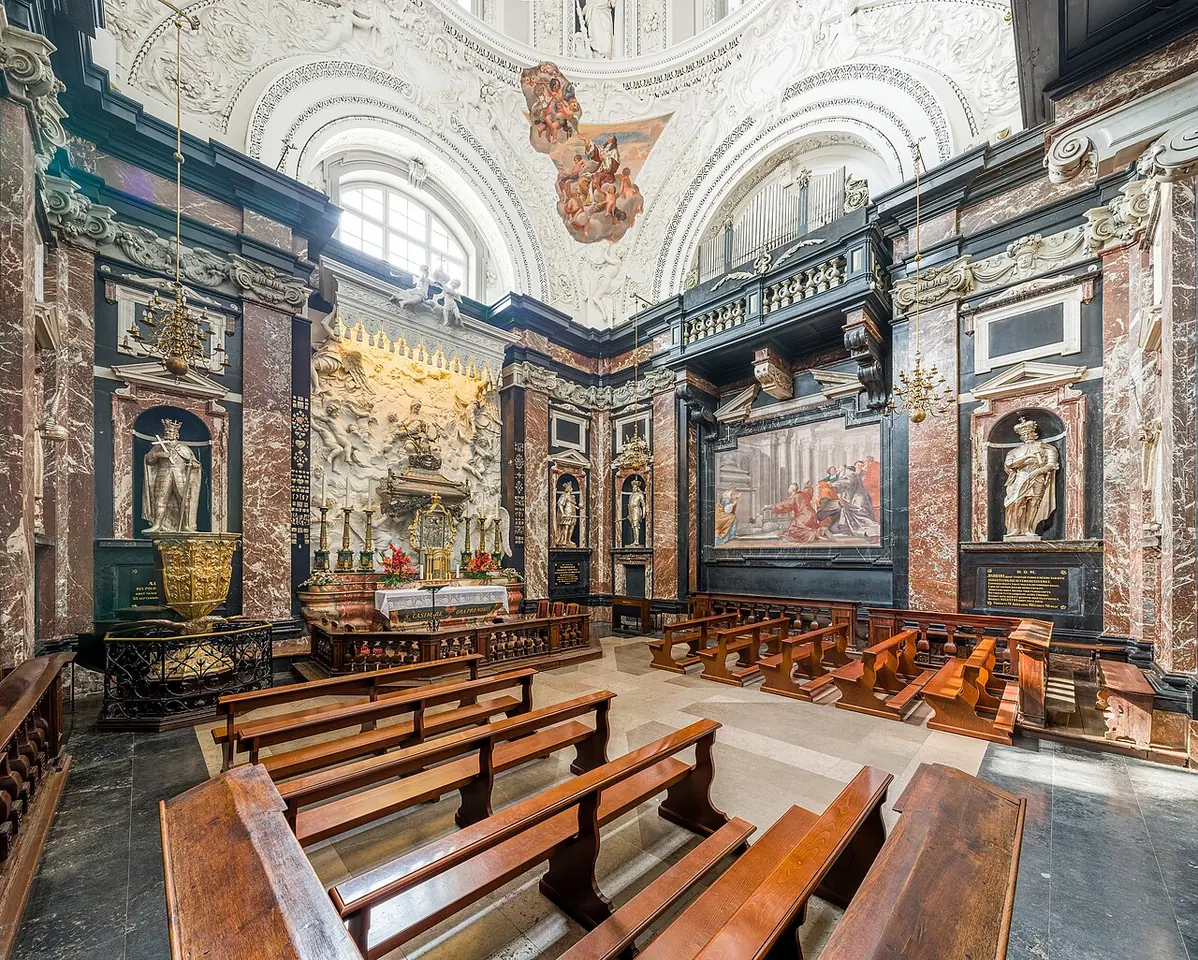
In 1636 his remains were moved into a new Baroque chapel in Vilnius Cathedral. Since 1747 they have rested on its altar in a sarcophagus of wood covered in silver. In 1952 the Soviet authorities closed the cathedral, and the relics were quietly moved to the Church of Sts. Peter and Paul. They came home on March 4, 1989, when the cathedral was given back to the Church.

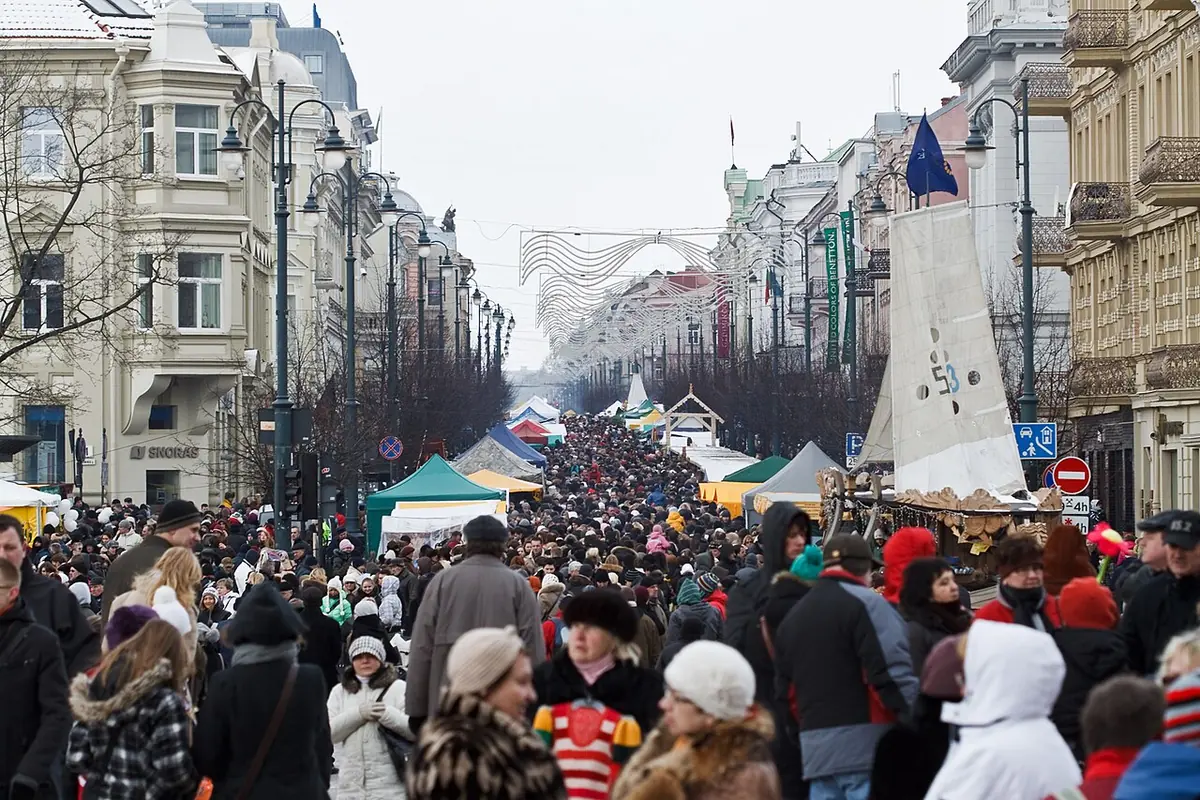
Every year around his feast, Vilnius holds Kaziuko mugė, the St. Casimir's Fair, a crafts market that fills the streets of the old town.

Prayer to St. Casimir
No prayer of Casimir's own survives. Catholics who honor him pray the hymn he loved, "Omni die dic Mariae," and the Mass of his feast. The Vilnius cathedral publishes a litany of St. Casimir and prayers for use at his relics, in Lithuanian.
Frequently asked questions
Did St. Casimir write the hymn "Omni die dic Mariae"?
No. A copy of the Latin hymn was found by his head when his coffin was opened in 1604, and for a long time he was thought to be its author. It is part of a much longer 12th-century Marian poem, the Mariale, usually credited to Bernard of Cluny (Bernard of Morlaix). The Catholic Encyclopedia of 1908 gave it to St. Bernard of Clairvaux instead. Casimir loved and prayed it, which is why it is often called the Hymn of St. Casimir.
What is St. Casimir the patron saint of?
Lithuania and Poland. Pope Urban VIII named him patron of Lithuania in 1636, and Pope Pius XII proclaimed him the special patron of all Lithuanian youth in 1948.
When is St. Casimir's feast day?
March 4, the day he died in 1484. It is an optional memorial in the General Roman Calendar and a solemnity in Lithuania. Vilnius celebrates with Kaziuko mugė, a big crafts fair held on the weekend nearest the feast.
Why is St. Casimir painted with three hands?
The old painting of him in Vilnius Cathedral shows two right hands. Legend says the painter tried to move one hand and paint over the first, but the old hand kept reappearing. Others think it was meant to show his generosity, or that the first hand simply bled through the paint.
Sources
- Catholic Encyclopedia (1908): St. Casimir
- Vilnius Cathedral: Šventojo Kazimiero gyvenimo istorija (Life of St. Casimir)
- Vilnius Cathedral: Šventojo Kazimiero relikvijos (Relics of St. Casimir)
- Vilnius Cathedral: Šv. Kazimiero sarkofagas (Sarcophagus of St. Casimir)
- Vilnius Cathedral: Omni die dic Mariae
- New Catholic Encyclopedia: Omni die dic Mariae (Encyclopedia.com)
- Vilnius Cathedral: Šv. Kazimiero gerbimo tradicijos (Devotion to St. Casimir)
- Roman Martyrology, March 4