St. David of Wales

St. David (Dewi Sant) was a 6th-century Welsh monk and bishop who founded a strict monastery at Mynyw, the place now called St Davids in Pembrokeshire, and died there around 589. He is the patron saint of Wales. His feast day is March 1, St. David's Day, when the Welsh wear leeks and daffodils.
Who was St. David?
David, or Dewi in Welsh, was a monk and bishop in southwest Wales in the 6th century. He founded a monastery at Mynyw (Menevia in Latin) on the far western tip of Pembrokeshire, at a place now called St Davids, and he died there on March 1, probably around 589. The Welsh Annals, the oldest source to mention him, give the year 601, which the Catholic Encyclopedia preferred. He is the patron saint of Wales, and he is the only patron saint of the four nations of Britain and Ireland who was born in the country he protects.
Very little about him can be checked against records from his own time. Almost everything people tell about David comes from a Latin Life written about 1090 by Rhygyfarch, son of Bishop Sulien of St Davids, five centuries after David's death. Rhygyfarch wrote partly to defend the independence of the Welsh church from the archbishops of Canterbury, and the Catholic Encyclopedia calls his work "chiefly a tissue of inventions." Historians still take a few things from it seriously: David's monastery, his strict rule, his part in church councils and the date of his death. The rest is legend, and the sections below say which is which.


The life of St. David
Birth on the cliffs
Rhygyfarch names David's father as Sant, a king of Ceredigion, and his mother as Non (Nonnita), a nun whom Sant raped. Non lived on bread and water from then on and is honored as a saint in her own right. The Life says she gave birth in a violent storm, yet the spot where she lay shone as if in sunlight, and the stone she gripped in her labor kept the marks of her hands. Tradition places the birth on the clifftop south of St Davids, where the ruins of St Non's Chapel and a holy well still draw pilgrims. All of this is traditional.
The young monk
David grew up at Hen Fynyw (Vetus Rubus) in Ceredigion, where, Rhygyfarch says, his fellow students saw "a pigeon with a gold beak playing at his lips." He studied for years under a teacher named Paulinus and is said to have cured his master's blindness with a touch. Rhygyfarch credits him with founding twelve monasteries, including Glastonbury and Leominster in England; later historians doubt most of the list.
The monastery at Mynyw
David finally settled with his disciples Aeddan, Eiludd and Ysfael in a valley the Welsh called Hodnant and the Latin writers Vallis Rosina, beside the little River Alun. Rhygyfarch tells how a local chieftain named Boia saw the smoke of their first fire and tried to drive them out, without success.
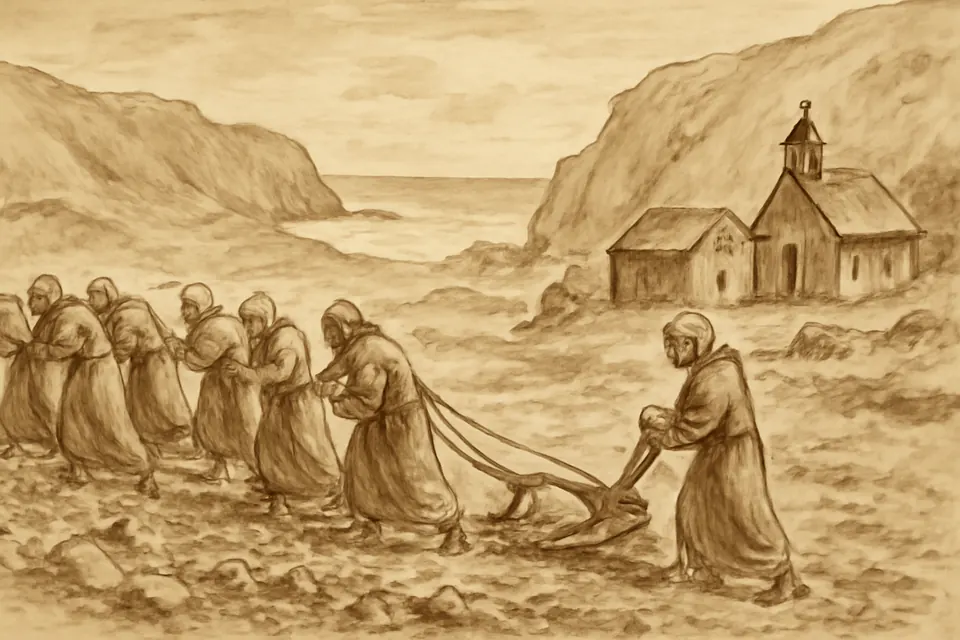
His rule was hard even by the standards of Celtic monks. The monks pulled the plough themselves: "No care of oxen is introduced for ploughing. Each to himself and the brethren is riches, each too an ox." They ate bread, vegetables and salt, drank only water, owned nothing and spoke only when they had to. That habit of water-drinking earned David his Welsh nickname, Dewi Ddyfrwr, "David the Waterman."
Pilgrimage to Jerusalem
The Life adds a journey to Jerusalem with two other Welsh saints, Teilo and Padarn, in which the Patriarch of Jerusalem consecrated David a bishop. The story is traditional, and it served Rhygyfarch's purpose: a bishop consecrated in Jerusalem owed nothing to Canterbury.
The miracles and legends of St. David
No miracle of David's was ever formally investigated. Sorted by the labels this encyclopedia uses:
- The ground rising at Llanddewi Brefi: traditional. Rhygyfarch says that at the Synod of Brefi, called to answer the Pelagian heresy, David refused to stand on a heap of garments. Instead he stood on a cloth spread on the level ground, and as he preached "the ground beneath him swells upwards and is raised into a hill." The church of Llanddewi Brefi stands on that mound today.
- The dove: traditional. At the same synod, "a snow-white pigeon, sent from heaven, settled on his shoulders, which remained as long as he preached." The bishops then chose him as their leader.
- Raising a widow's son: traditional. On his way to Brefi, the Life says, David brought a dead boy back to life and took him along to the synod.
- Healing springs: traditional. Rhygyfarch tells of springs that rose where David was baptized and where he prayed, and Wales still has many wells named for him.
- Healings at his shrine: reported. Pilgrims came to St Davids for centuries asking for cures, but none was examined in the modern way.

"Do the little things": his last sermon
Rhygyfarch says an angel told David the day of his death a week ahead. On the Sunday before, he preached to a great crowd, celebrated Mass and then, already in pain, said goodbye. In Wade-Evans's 1923 translation of the Latin Life:
My brethren, persevere in these things which ye have learnt from me and which ye have seen with me. I on the third day of the week on the first of March shall go the way of my fathers. Fare ye well in the Lord. I shall depart. Never shall we be seen on this earth again.
The famous wording comes from the medieval Welsh Life of St. David, a shorter version of Rhygyfarch's work copied in 1346 by the anchorite of Llanddewi Brefi. There David begins, "Arglwyddi, brodyr, a chwiorydd, Byddwch lawen a chadwch eich ffyd a'ch credd, a gwnewch y petheu bychain a glywsoch ac y welsoch gennyf i." In D. Simon Evans's English: "Lords, brothers and sisters, Be joyful, and keep your faith and your creed, and do the little things that you have seen me do and heard about." The phrase "gwnewch y pethau bychain," do the little things, is still one of the best-known sayings in Wales.

On Tuesday, March 1, the Life says, Christ came to him at the hour of matins, and David said, "Take me after thee." He was buried in his own monastery.
Why St. David is the patron saint of Wales
David was the great monastic founder of south Wales, and his monastery became the seat of the most important Welsh bishopric. Before the Reformation more than fifty churches in south Wales were dedicated to him, and his name is everywhere in Welsh place names beginning with Llanddewi, "church of David." Rhygyfarch's claim that the synod made him archbishop of all Wales helped turn a local founder into a national patron. In 1398 his feast was ordered kept in every church of the Province of Canterbury. You can find other national patrons, from St. Patrick of Ireland to St. George of England and St. Andrew of Scotland, on our patron saints page.
Some modern lists also make him patron of poets and of vegetarians, the second because of the meatless diet of his monks.
Symbols of St. David in art
David is a bishop in miter and vestments, usually with a long beard. To recognize him:
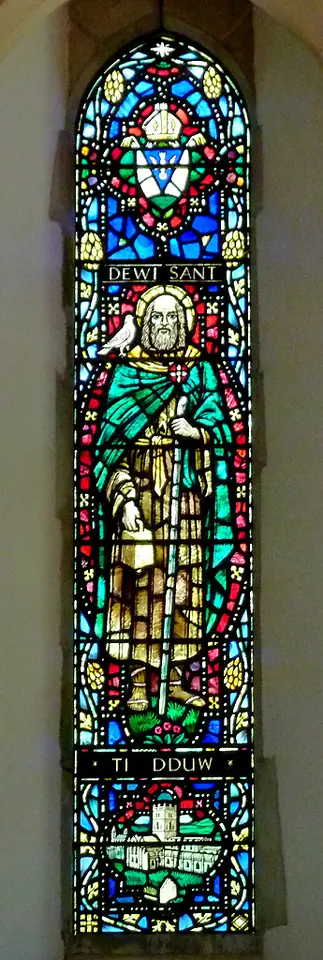
- A dove on his shoulder: the dove of the Brefi synod and his most common attribute, as in the window from St Non's Chapel near the top of this page.
- A small hill or mound under his feet: the ground that rose at Brefi.
- A book: the Gospels, which Rhygyfarch says he always carried on his breast.
- A leek or daffodils: in modern Welsh images, from the customs of his feast.
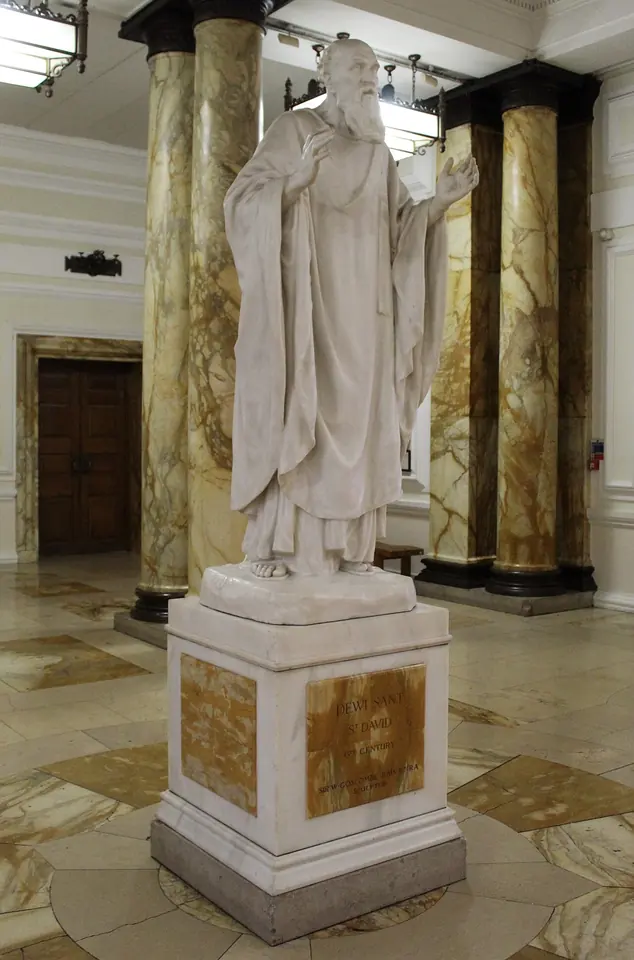
Medieval images of David are rare because the Reformation destroyed most of them, so the pictures you'll meet are mostly Victorian and later stained glass and sculpture in Welsh churches. Orthodox iconographers have painted him in recent decades as a monk-bishop holding a Gospel book, sometimes with the dove.

St Davids Cathedral and the shrine
David's monastery became St Davids Cathedral, in Britain's smallest city. The present building was begun in 1181, on a site raided many times by Vikings between the 7th and 11th centuries. Pilgrims came in large numbers after a papal privilege of the 1120s, usually credited to Pope Callixtus II, declared that two pilgrimages to St Davids were worth one to Rome, and three worth one to Jerusalem. The same pope is said to have approved David's cult; the Catholic Encyclopedia puts the canonization in 1120.


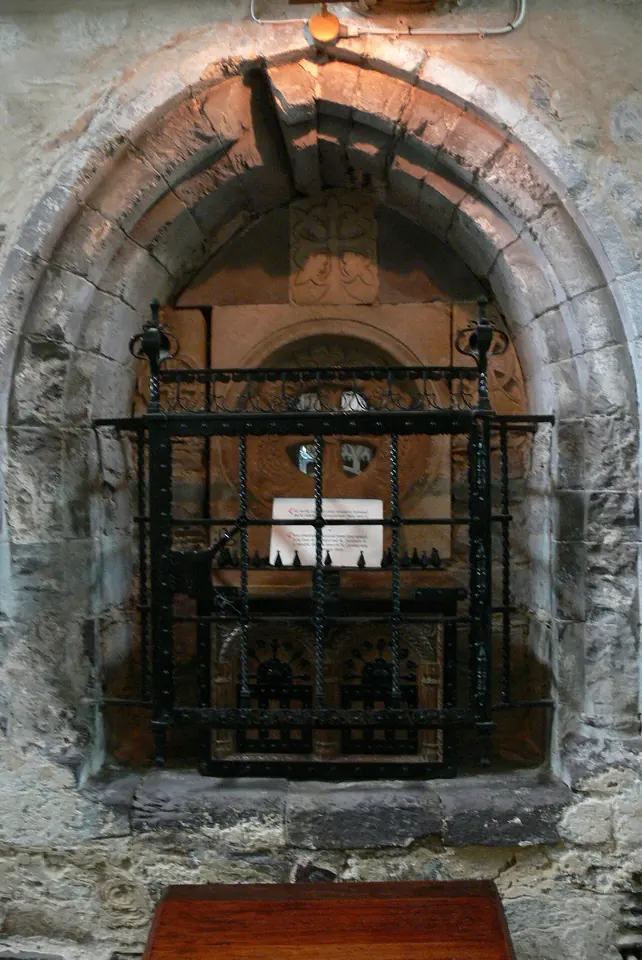
According to the cathedral, Bishop Richard de Carew built a new shrine for David in 1275. Bishop William Barlow stripped it in 1538 and seized the relics, which he described as "two heads of silver plate enclosing two rotten skulls, two arm bones and a worm-eaten book covered with silver plate." The shrine was restored and dedicated again on St. David's Day 2012, with five icons by Sarah Crisp: St. Patrick, St. David and St. Andrew on the front, and David's mother, St. Non, and his contemporary St. Justinian on the back. Its niches hold two reliquaries, reputed to contain the remains of St. David and St. Justinian.


The cathedral is frank about the bones. A casket in the Holy Trinity Chapel has long held bones venerated as David's and Justinian's, but radiocarbon dating in the 1990s placed them in the 12th and 14th centuries, so they cannot be his. Some may belong to St. Caradog, a hermit who died in 1124 and was buried at St Davids.

St. David's Day: leeks, daffodils and customs
St. David's Day falls on March 1. It is not on the General Roman Calendar, but the Catholic Church in Wales and the Church in Wales keep it as a major feast, and the Roman Martyrology lists him on that day. See his neighbors on our feast days page.
The leek has been his emblem for centuries. Legend says David told Welsh soldiers to wear leeks in their caps in a battle against the Saxons; another story ties the custom to Welsh archers at Crécy in 1346. Amgueddfa Cymru (Museum Wales) points out that the leek was already linked to March 1 by 1536, when Henry VIII gave one to his daughter. Shakespeare has the Welsh captain Fluellen tell Henry V, "I do believe your majesty takes no scorn to wear the leek upon Saint Tavy's day," and the king answers, "I wear it for a memorable honour."
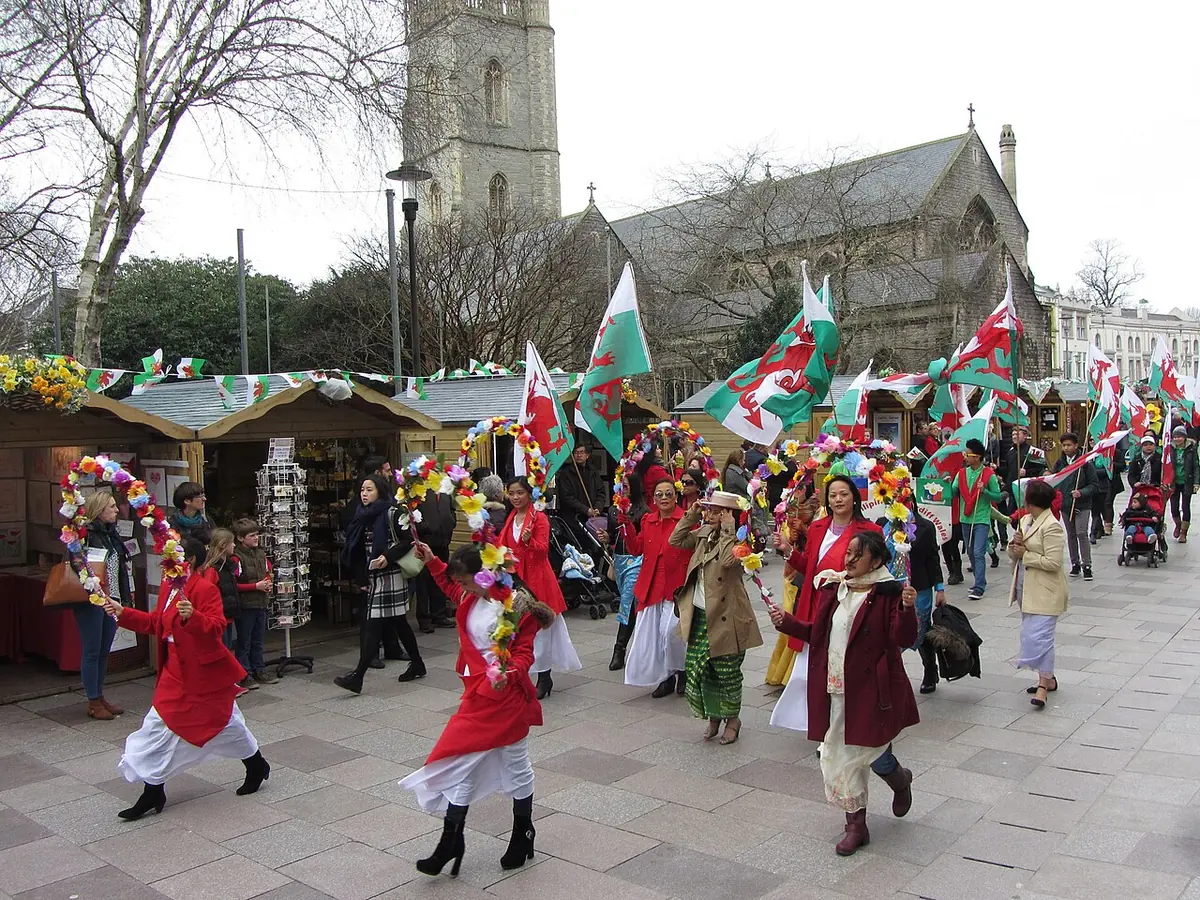
The daffodil came later. It became popular in the 19th century, especially among women, and David Lloyd George wore it and used it at the investiture of the Prince of Wales in 1911. Today children go to school in traditional Welsh costume, schools hold small eisteddfodau of songs and poems, and towns like Cardiff hold parades.

Prayer to St. David
No prayer written by St. David survives, and this encyclopedia knows of no traditional prayer that can be traced to him. On March 1, Catholic and Anglican churches in Wales use the collect and readings of his feast from their own liturgical books. Catholics and other Christians who honor him simply ask St. David to pray for them and for Wales, and many take his farewell as a rule of life: be joyful, keep the faith and do the little things.
Frequently asked questions
What did St. David say about "the little things"?
The medieval Welsh Life of St. David, copied in 1346, reports that in his last sermon he told his people to be joyful, keep their faith and do the little things they had seen and heard from him. In Welsh, "gwnewch y pethau bychain" ("do the little things") is still a well-known saying. Rhygyfarch's earlier Latin Life gives the same farewell in different words.
When is St. David's Day?
March 1, the day tradition says he died. It is the national day of Wales, though not a public holiday there. Catholic and Anglican churches in Wales keep it as a major feast, and Welsh people around the world mark it with leeks, daffodils, parades and concerts.
Why do the Welsh wear leeks and daffodils on St. David's Day?
Legend says David told Welsh soldiers to wear leeks in their caps to tell friend from foe in a battle against the Saxons. Amgueddfa Cymru (Museum Wales) notes that the leek was already tied to March 1 by 1536 and appears in Shakespeare's Henry V. The daffodil is newer; it became popular in the 19th century and was promoted by David Lloyd George.
Where is St. David buried?
Rhygyfarch says he was buried in his own monastery, which is now St Davids Cathedral in Pembrokeshire. A restored medieval shrine stands near the high altar, and a casket in the Holy Trinity Chapel holds bones long venerated as his, though radiocarbon tests have dated them to the 12th and 14th centuries.
Why is St. David shown with a dove?
Rhygyfarch's Life says that when David preached at the Synod of Brefi, a snow-white dove came down from heaven and settled on his shoulder for as long as he spoke, and the ground rose into a hill beneath him. Both details became his standard attributes in art.
Sources
- Rhygyfarch, Life of St. David, trans. A. W. Wade-Evans (1923, Internet Archive)
- Catholic Encyclopedia (1908): St. David
- St Davids Cathedral: St David's Shrine
- St Davids Cathedral: The Medieval Cult of St David
- Amgueddfa Cymru (Museum Wales): St David's Day in Wales
- Shakespeare, Henry V, Act 4, Scene 7 (MIT Shakespeare)
- Wales.com: Happy St David's Day
- D. Simon Evans, ed., The Welsh Life of St David (University of Wales Press, 1988)
- Roman Martyrology, March 1