St. Martin of Tours
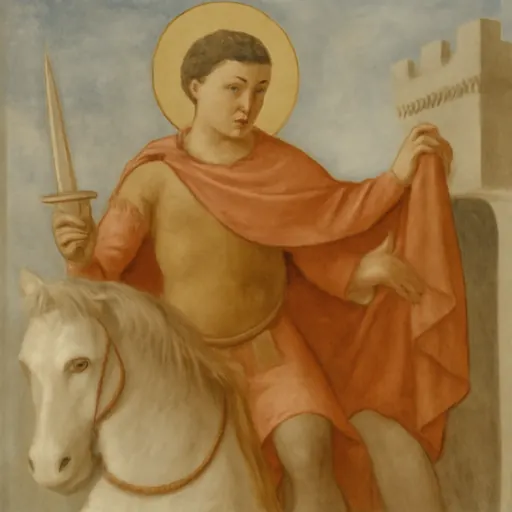
St. Martin of Tours (about 316–397) was a Roman soldier who cut his military cloak in half with his sword to clothe a freezing beggar at Amiens, then left the army, became a monk and served as bishop of Tours in Gaul. He is the patron saint of soldiers, the poor and France. His feast day is November 11, known in Europe as Martinmas.
Who was St. Martin of Tours?
Martin was a Roman soldier who became a monk and then bishop of Tours, in the Loire valley of Gaul, in the late 4th century. He is the saint of the divided cloak: as a young cavalryman he cut his military cloak in two with his sword and gave half to a freezing beggar at the gate of Amiens. Benedict XVI, speaking on his feast in 2007, called him "one of the most celebrated and venerated Saints of Europe."
Unusually for a saint of his age, Martin had a biographer who knew him. Sulpicius Severus traveled to Tours to meet him, questioned Martin and the men who lived with him, and wrote his Life of St. Martin while Martin was still alive. He added letters and dialogues after Martin's death. Sulpicius admired him without reserve and tells many miracles, so historians read him carefully, but he gives far more personal detail than most early lives. Gregory of Tours, bishop of the same city two centuries later, added the story of Martin's burial and his cult.

He was among the first saints honored in the West who did not die as martyrs. His tomb at Tours became one of the great pilgrimage shrines of medieval Europe.
The life of St. Martin
A soldier's son
The Catholic Encyclopedia puts his birth around 316 at Sabaria in Pannonia, today Szombathely in Hungary. He grew up at Ticinum (Pavia) in Italy. His parents were pagans and his father an officer, a military tribune. Sulpicius says that at ten Martin went to the church against his parents' wishes and asked to become a catechumen. When a law required veterans' sons to serve, his father reported him, and at fifteen he was put in chains and made to take the military oath.
In the army he kept a single servant and, Sulpicius says, often cleaned the man's boots himself. He gave away most of his pay.
The cloak at Amiens
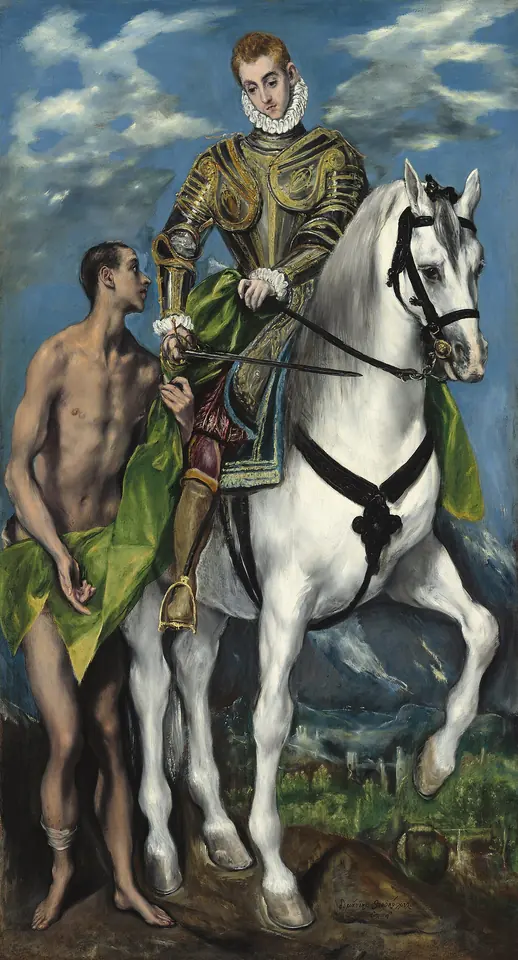
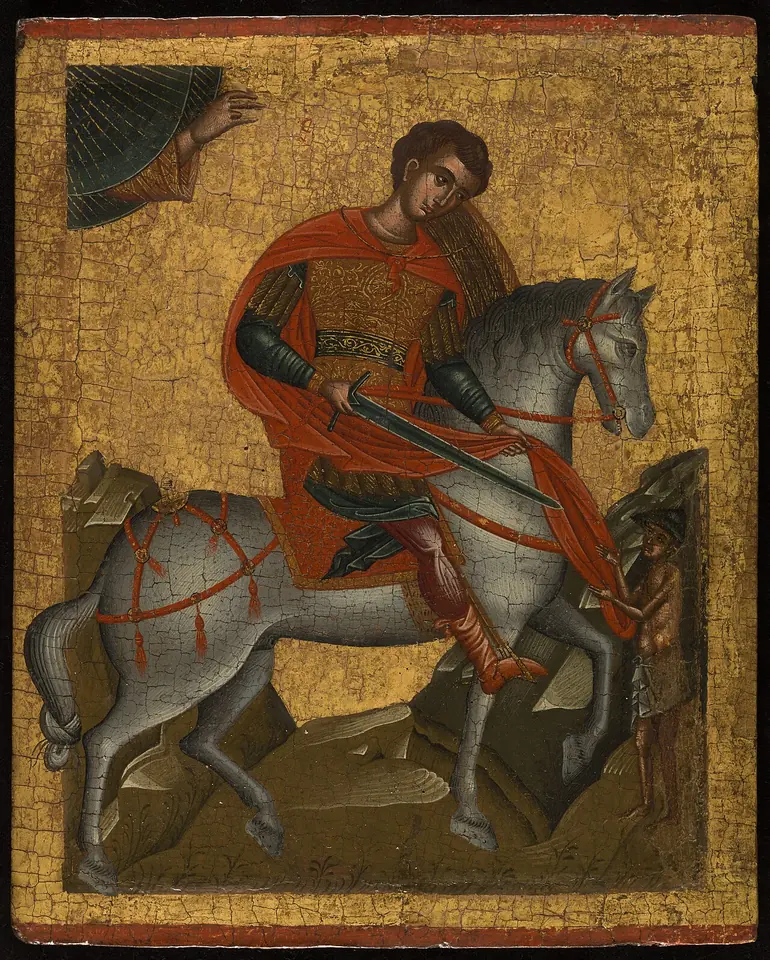
The story everyone knows comes from chapter 3 of the Life. In an unusually hard winter, Martin met a poor man "destitute of clothing" at the gate of Amiens. Others passed him by. Martin had already given away his other garments, so he took his sword, cut his cloak "into two equal parts," gave one to the beggar and put the rest back on. Some bystanders laughed at how he looked.
That night, Sulpicius writes, Martin saw Christ wearing the half he had given away and heard him tell the angels around him, "Martin, who is still but a catechumen, clothed me with this robe." Sulpicius links the vision to the words of Jesus in Matthew 25:40, "Inasmuch as you have done these things to one of the least of these, you have done them unto me." Martin was baptized soon after, at about twenty.


"I am the soldier of Christ"
Martin stayed in the army about two more years. When the barbarians crossed into Gaul and Julian Caesar handed out a bonus to his troops before a battle near Worms, Martin refused it and asked to leave: "I am the soldier of Christ: it is not lawful for me to fight." Julian called him a coward. Martin answered that he would stand unarmed in front of the line the next day, protected only by the sign of the cross. He was held in custody, but the next morning the enemy sent envoys and surrendered, and the battle never happened. Sulpicius sees God's hand in sparing him the sight of bloodshed.


Hilary, Ligugé and the robbers in the Alps
Free of the army, Martin went to Poitiers to learn from its bishop, St. Hilary, who made him an exorcist. On a journey to visit his parents he was seized by robbers in the Alps. One lifted an axe over his head. Instead, Martin talked with his guard about the Gospel, and the robber let him go and later, Sulpicius says, lived a religious life. Martin won his mother to the faith, though not his father. He was beaten and driven out by the Arian party in Illyria and again at Milan, and lived for a while as a hermit on the island of Gallinaria off the Italian coast.
When Hilary came back from exile in 361, Martin settled near Poitiers at Ligugé, where disciples gathered around him. Benedict XVI called it "the oldest monastery known in Europe," and Benedictine monks still live there.
Bishop of Tours
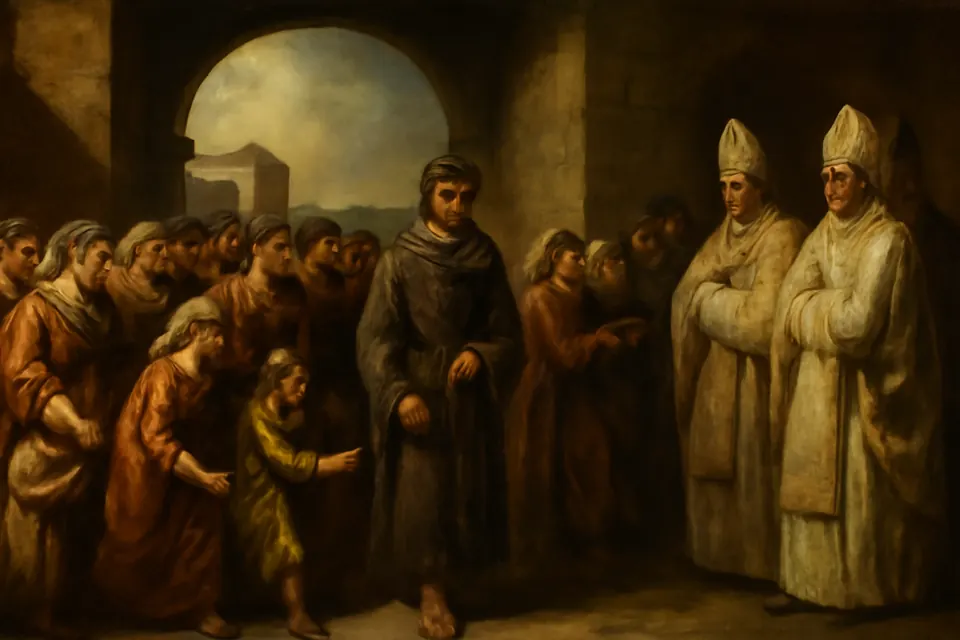
Around 371 the Christians of Tours wanted Martin as their bishop. He would not come, so a citizen named Ruricius begged him to visit his sick wife, and crowds lined the road and escorted him into the city. Some of the bishops present objected that his face was "contemptible," his clothing mean and his hair a mess. The people overruled them.
As bishop he kept living like a monk. He built a monastery about two miles from the city, later called Marmoutier, where some eighty monks lived in wooden cells and caves in the cliff. He traveled the countryside preaching, tearing down pagan temples and founding churches. More than once he went to the imperial court at Trier. In the case of Priscillian, a Spanish bishop accused of heresy, Martin argued that the emperor should not judge a church matter; after he left, Maximus had Priscillian executed, and Martin refused communion with Ithacius, the bishop who had pressed the charge.
Death at Candes
Martin died at Candes, a village of his diocese, where he had gone to make peace among the clergy. Sulpicius, in a letter to his mother-in-law Bassula, gives his prayer when his disciples begged him not to leave them: "if you command me still to persevere in the same toil for the defense of your flock, I do not refuse." Gregory of Tours dates the death to 397, at midnight on a Sunday, "in the eighty-first year of his life and the twenty-sixth of his episcopate." People from Poitiers and Tours both claimed the body. Gregory says the men of Tours passed it out through a window while the Poitiers party slept and took it by boat down the Vienne and the Loire to Tours.
The miracles of St. Martin
The 1916 English Roman Martyrology describes Martin as a bishop "whose life was so renowned for miracles that he received the power to raise three persons from the dead." His miracles come from Sulpicius and Gregory and are traditional; none was investigated in the modern way.
- Raising a catechumen who had died unbaptized near Ligugé, and a slave who had hanged himself (Life, chapters 7–8). Sulpicius says the catechumen lived for years and told his story himself.
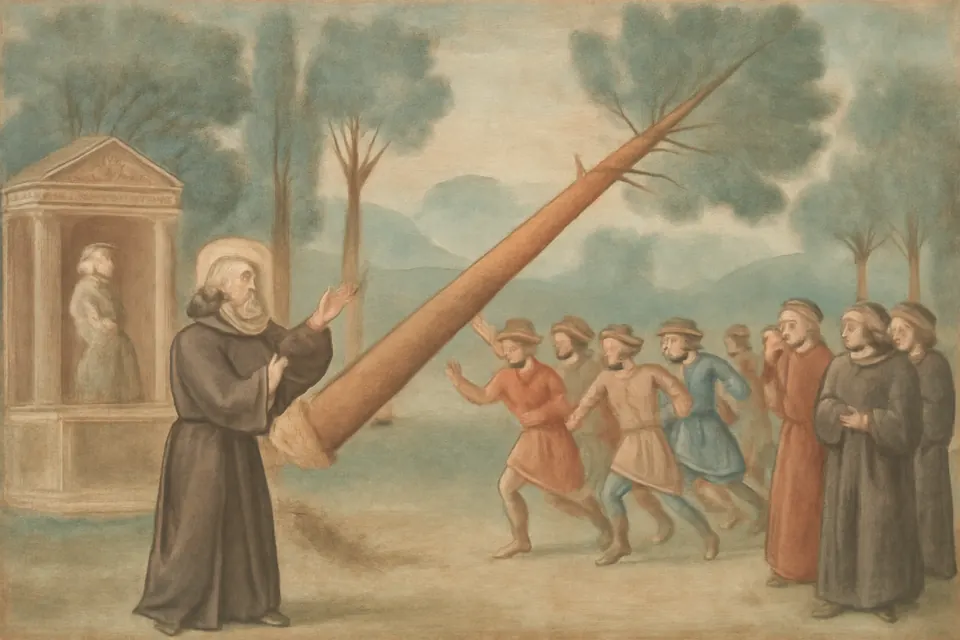
- The falling pine. Pagans agreed to cut down their sacred pine if Martin would stand where it fell. Bound in its path, he made the sign of the cross and the tree swung the other way, nearly crushing them (chapter 13).
- The false martyr. Martin doubted a local shrine, prayed at the grave and saw the ghost of a robber who confessed he was no martyr. Martin had the altar removed (chapter 11).
- Fire held back from a house next to a burning temple (chapter 14).
Sulpicius also writes that Martin saw through the devil when he appeared in royal robes claiming to be Christ, and the many healings at his tomb reported by Gregory of Tours are also traditional.
Why St. Martin is the patron saint of soldiers, the poor and France
He served as a Roman soldier, and soldiers have claimed him ever since, even though he left the army because he would not fight. The cloak made him the saint of beggars and the poor, and of tailors. Horsemen and cavalry count him as theirs because artists show him mounted. The Frankish kings carried his cloak, or what they believed was part of it, as a relic into battle, which helps explain why he became a patron of France.
That cloak gave English a word. The Catholic Encyclopedia explains that the relic was called the cappa or capella, the tent that sheltered it became a capella, the priests who served it capellani, and from them come "chapel" and "chaplain."
His feast falls at the wine harvest, so winemakers and innkeepers chose him too. See more on our patron saints page.
Symbols of St. Martin in art
Look for these:
- A soldier on horseback cutting his cloak with a sword, often with the beggar beside the horse. This is by far the most common image, from medieval manuscripts to El Greco.
- A bishop with miter and crozier, sometimes with the beggar at his feet to tell him apart from other bishops.
- A goose, linked to the Martinmas meal.
- Fire or a toppled idol, for his campaign against the temples.
Italian Gothic painters told his whole life in cycles. Simone Martini frescoed the St. Martin Chapel in the Lower Church of San Francesco in Assisi in the 1310s, from the knighting and the dream to the death and burial. Icon painters on Crete around 1500 put the cloak scene on a gold ground, in the manner of a warrior-saint icon, and the Orthodox call him Martin the Merciful.

Martinmas: St. Martin's Day customs
The feast on November 11 is a memorial on the Catholic calendar and, in the United States, also Veterans Day; the armistice that ended the First World War was signed on that date in 1918. Catholic Culture notes that in medieval France an Advent fast of forty days, the Forty Days' Fast of St. Martin, began the next day, so Martinmas was the last great feast before it. People ate goose and tasted the new wine. A spell of mild autumn weather around the date is still called St. Martin's summer in parts of Europe.
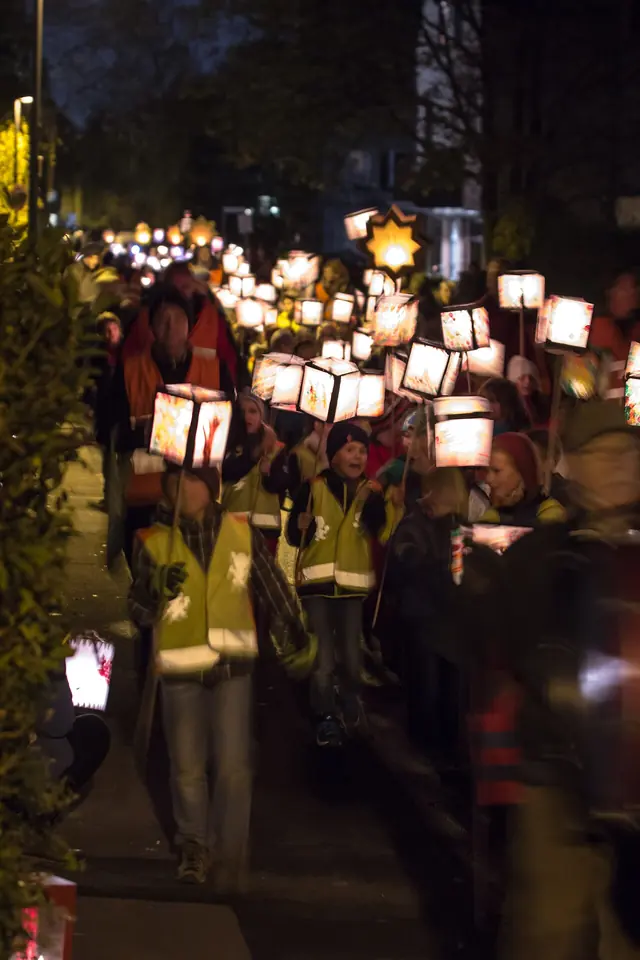
In Germany and the Netherlands children walk through the streets with paper lanterns around St. Martin's Day, and in many towns they go from door to door for sweets.

Find the saints around his date on our feast days page, including St. Martin de Porres on November 3, a different saint with the same name.
The tomb and Basilica of St. Martin in Tours
Martin's body was laid in a stone sarcophagus outside Tours. His successors built a chapel over it, then a basilica around 470, and larger churches later. In 1562 Huguenot soldiers sacked the basilica and destroyed the tomb and relics, and in 1793 the revolutionaries demolished the church and ran two streets across the site. Only two towers survived. In December 1860 excavations found the tomb's location and some fragments. The present basilica, begun under Archbishop Meignan of Tours, stands over the spot. Each year on November 11 the feast is kept there with a solemn celebration.
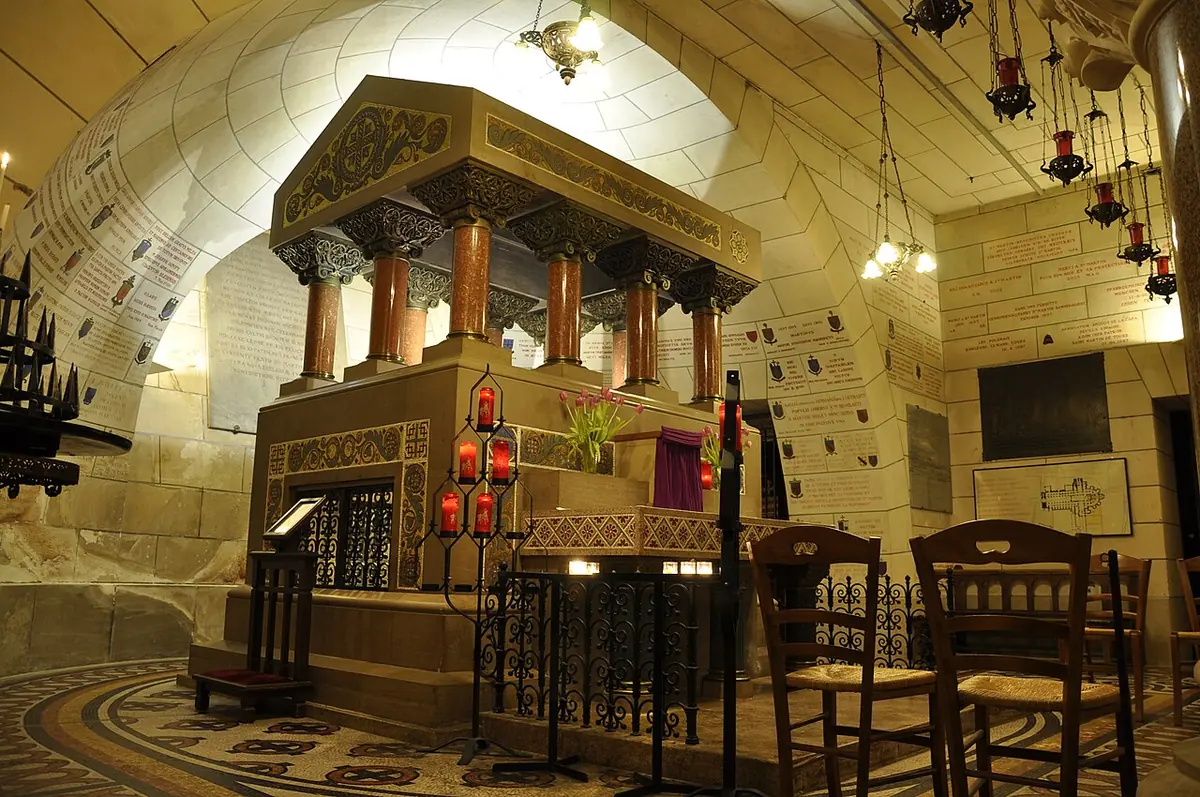

Other places tied to him are Ligugé Abbey near Poitiers, Marmoutier across the Loire from Tours, and Candes-Saint-Martin, where he died.
Prayer to St. Martin of Tours
The Catholic Church prays this collect from the Roman Missal on his memorial:
O God, who are glorified in the Bishop Saint Martin both by his life and death, make new, we pray, the wonders of your grace in our hearts, that neither death nor life may separate us from your love. Through our Lord Jesus Christ, your Son, who lives and reigns with you in the unity of the Holy Spirit, God, for ever and ever.
Many Christians also take Martin's own words at Candes as a model of prayer, as Sulpicius recorded them: "if you command me still to persevere in the same toil for the defense of your flock, I do not refuse." Catholics ask his intercession for soldiers and veterans, for the poor, and for anyone without enough to keep warm.
Frequently asked questions
What is St. Martin of Tours the patron saint of?
Soldiers, beggars and the poor, France, horses and riders, tailors (because of the cloak), winemakers and innkeepers (his feast falls at the time of the new wine), and the city of Mainz, among others.
When is St. Martin's Day?
November 11. It is a memorial on the Catholic Church's General Roman Calendar and is often called Martinmas. The Orthodox Church in America lists him on October 12 and also on November 11.
What happened with St. Martin's cloak?
According to his friend and biographer Sulpicius Severus, the young soldier Martin met a nearly naked beggar at the gate of Amiens in a bitter winter, cut his cloak in two with his sword and gave half away. That night he dreamed that Christ was wearing the half he had given and heard him say that Martin, still a catechumen, had clothed him.
What did St. Martin of Tours say when he left the army?
Sulpicius reports that he told Julian Caesar, "I am the soldier of Christ: it is not lawful for me to fight." When he was accused of cowardice, he offered to stand unarmed in front of the battle line the next day.
Is St. Martin of Tours the same as St. Martin de Porres?
No. Martin of Tours was a 4th-century soldier and bishop in Gaul. Martin de Porres was a Dominican lay brother in Lima, Peru, who died in 1639 and is honored on November 3.
Sources
- Catholic Encyclopedia (1910): St. Martin of Tours
- Sulpicius Severus, On the Life of St. Martin (New Advent)
- Sulpicius Severus, Genuine Letters, including Letter 3 on Martin's death (New Advent)
- Gregory of Tours, History of the Franks (Medieval Sourcebook)
- Benedict XVI, Angelus, 11 November 2007
- Catholic Culture: Memorial of St. Martin of Tours, Bishop (November 11)
- Catholic Culture: Martinmas Traditions
- Catholic Encyclopedia (1908): Chapel
- Orthodox Church in America: Saint Martin the Merciful, Bishop of Tours
- The Roman Martyrology (1916 English edition), November 11