St. Timothy
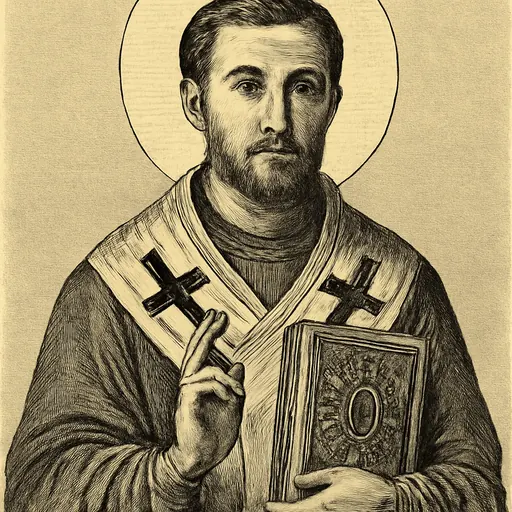
St. Timothy was the young disciple from Lystra whom St. Paul chose as his traveling companion and called his "beloved child." Two letters of the New Testament are addressed to him, and tradition holds that he was the first bishop of Ephesus and died a martyr there around the year 97. His feast day is January 26, shared with St. Titus, and he is invoked by people with stomach ailments.
Who was St. Timothy?
Timothy was a young man from Lystra, a small town in the hill country of what is now south-central Turkey, who became the closest companion of St. Paul. Paul called him "my beloved child," trusted him with hard errands to the churches he had founded, and named him as co-sender of six of his letters. Two more letters of the New Testament, 1 and 2 Timothy, are addressed to him. Benedict XVI counted his name in Paul's letters "at least 17 times" and said Paul saw him "almost as an alter ego."
His name is Greek and means "one who honors God." Tradition, starting with the historian Eusebius, makes him the first bishop of Ephesus. A later Greek text, the Acts of Timothy, says he died a martyr there under the emperor Nerva. The Catholic Church remembers him with his fellow disciple St. Titus on January 26, right after the feast of Paul's conversion.

Life of St. Timothy
A family of faith in Lystra
Acts introduces him in a single verse: "A disciple was there, named Timothy, the son of a Jewish woman who was a believer; but his father was a Greek" (Acts 16:1, RSV). Paul's second letter names the women who raised him in the faith:
I am reminded of your sincere faith, a faith that dwelt first in your grandmother Lois and your mother Eunice and now, I am sure, dwells in you. (2 Timothy 1:5, RSV)
The same letter says that "from childhood you have been acquainted with the sacred writings" (2 Timothy 3:15). Benedict XVI noted that since his mother had married a Gentile and had not had him circumcised, the family was probably not strictly observant, but Timothy still grew up knowing the Scriptures.
How the family came to faith in Jesus is not recorded. The Orthodox life of St. Timothy says they believed when Paul and Barnabas first preached in Lystra, where Paul healed a man "who could not use his feet" (Acts 14:8).


Chosen by Paul
When Paul came back through Lystra at the start of his second missionary journey, Timothy "was well spoken of by the brethren at Lystra and Iconium. Paul wanted Timothy to accompany him" (Acts 16:2–3). Paul had him circumcised "because of the Jews that were in those places, for they all knew that his father was a Greek." Paul refused the same for Titus, a full Gentile; Timothy, as the son of a Jewish mother, was a different case.

Paul's messenger
From then on Timothy shows up wherever Paul's churches needed help. He traveled with Paul and Silas into Macedonia. When Paul had to flee to Athens, he sent Timothy back to Thessalonica to strengthen the new Christians there (1 Thessalonians 3:1–2). Later he went to Corinth with a letter, and Paul asked the Corinthians to make sure he had nothing to fear among them (1 Corinthians 16:10). He joined Paul in sending 2 Corinthians, Philippians, Colossians, 1 and 2 Thessalonians and Philemon.
Paul's warmest words about him are in the Letter to the Philippians: "I have no one like him, who will be genuinely anxious for your welfare... how as a son with a father he has served with me in the gospel" (Philippians 2:20, 22, RSV). The Letter to the Hebrews mentions that "our brother Timothy has been released" (Hebrews 13:23), so at some point he was in prison for the faith.
Bishop of Ephesus
The First Letter to Timothy finds him at Ephesus, the great port city of Asia, with Paul's instructions to stop false teachers, to choose good bishops and deacons, to care for widows and to lead by example: "Let no one despise your youth, but set the believers an example in speech and conduct, in love, in faith, in purity" (1 Timothy 4:12, RSV). Eusebius, writing in the early 300s, calls him the first bishop of Ephesus, and the Catholic Encyclopedia notes that the ancient Roman Martyrology says he died as bishop there.
The Second Letter is more personal. Paul writes from prison in Rome expecting to die: "I have fought the good fight, I have finished the race, I have kept the faith" (2 Timothy 4:7, RSV). He urges Timothy to "rekindle the gift of God that is within you through the laying on of my hands" and begs him to come quickly, bringing Mark and the cloak Paul left at Troas. Whether Timothy reached Rome in time is not known.
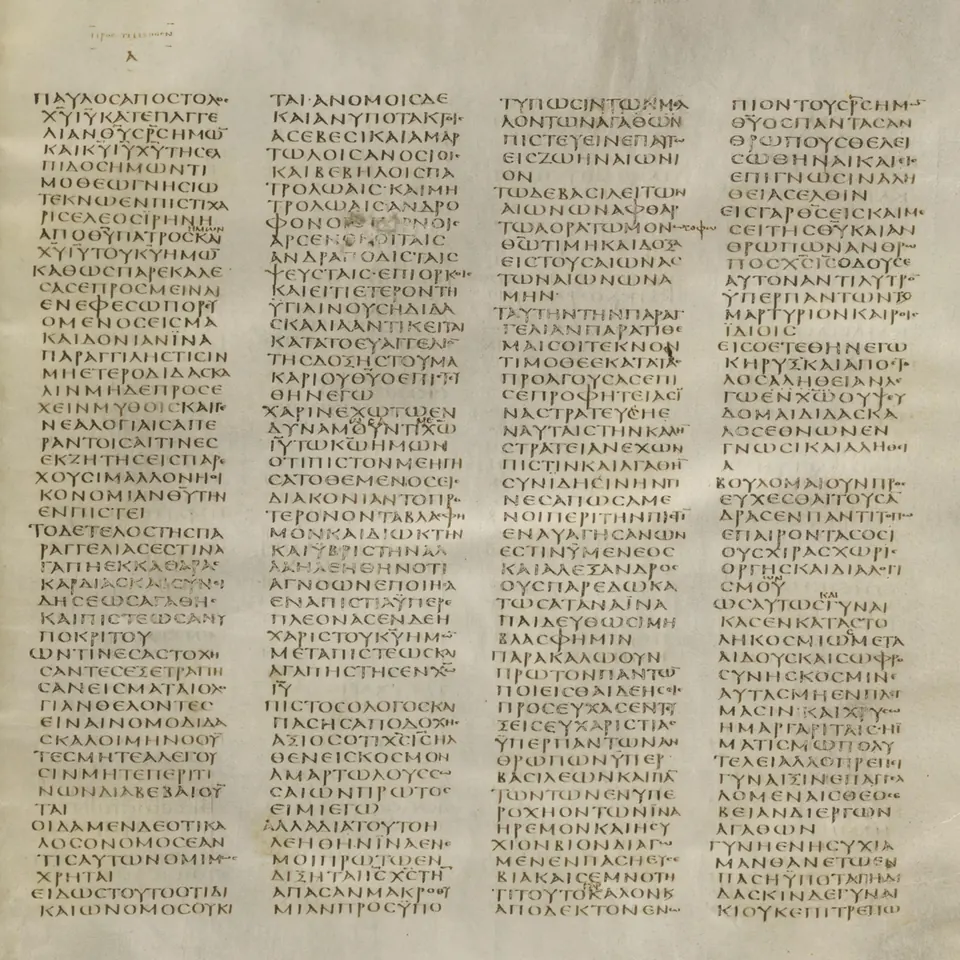

The Catholic Encyclopedia reports a tradition that St. John came to Ephesus during Nero's persecution and lived there with Timothy, and that Timothy remained unmarried. Butler adds that some writers saw Timothy as the "angel of the church of Ephesus" whom Christ addresses in the Book of Revelation (Revelation 2:1–7).
Who wrote the letters to Timothy?
The letters say they are from Paul, and the Church has always received them as his. The Catholic Encyclopedia defended that view at length in 1912. Many modern scholars think 1 and 2 Timothy and Titus, the three "Pastoral Letters," were written after Paul's death by a follower writing in his name. Catholic and Orthodox liturgy reads them as Paul's letters to his disciple.
The martyrdom of St. Timothy
The New Testament does not tell how Timothy died. The story comes from the Acts of Timothy, a Greek text that Butler dates to the 5th or 6th century and that the patriarch Photius summarized in the 9th. Butler's retelling, from the 1812 edition of his Lives, says that under the emperor Nerva, in the year 97, "St. Timothy was slain with stones and clubs, by the heathens, whilst he was endeavouring to oppose their idolatrous ceremonies on one of their festivals called Catagogia." On that day, he writes, "the idolaters walked in troops, every one carrying in one hand an idol, and in the other a club." Modern writers usually spell the festival Katagogia.

The Orthodox Church tells the same story. Its life of the saint says the pagans "beat him, dragged him along the ground, and finally, they stoned him," and gives the year as 93. This is traditional: the Church has always honored Timothy as a martyr, but the details come from a source written centuries later.


Miracles of St. Timothy
No miracle of Timothy's has been formally approved; his cult began long before canonization processes existed.
- Traditional: the healings that Butler, citing St. Paulinus of Nola, says the smallest portions of his relics worked "wherever they were distributed," and the demons St. Jerome said cried out when the relics reached Constantinople.
- Reported: answered prayers attributed to his intercession by those who ask his help in stomach illness and by the people of Termoli.
Why St. Timothy is the patron saint of stomach ailments
The patronage rests on one verse of Scripture. Timothy apparently drank only water, and Paul told him to stop:
No longer drink only water, but use a little wine for the sake of your stomach and your frequent ailments. (1 Timothy 5:23, RSV)
Butler suggests his fasting had damaged his health and comments that Paul allowed only "a little" wine, even then. Catholics have long asked St. Timothy's prayers for stomach and intestinal disorders, and the Italian town of Termoli, which keeps his relics, has him as a patron. See all the patron saints.
Symbols of St. Timothy in art
Timothy is shown in two very different ways:
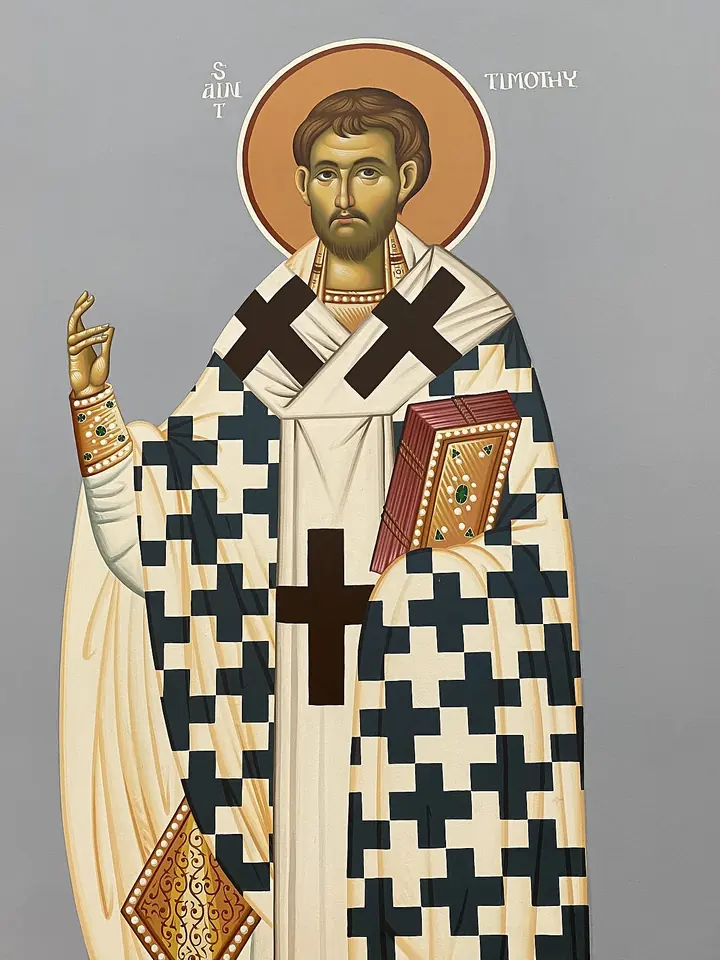
- As a bishop: in Byzantine and Orthodox icons he is a young or middle-aged man with a short dark beard, wearing a bishop's white omophorion marked with crosses and holding a Gospel book, like the modern icon on this page.
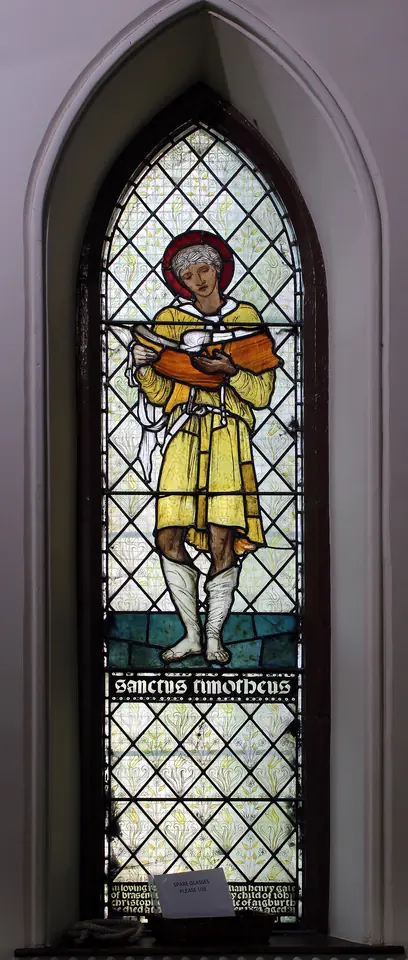
- With a book or letter: for the letters Paul wrote to him, as in the Burne-Jones window, where he is a beardless youth in a yellow tunic.
- With a club and stones: the weapons of his martyrdom in Western art. Catholic Culture also lists a broken idol, for the pagan festival he tried to stop.
- As a boy with his grandmother: Dutch painters of Rembrandt's circle painted an old woman teaching a child to read Scripture, a subject long titled "Timothy and his grandmother Lois."

In Western church art he often stands next to St. Paul, the younger of the two, sometimes holding a scroll on which Paul's letter is written.
Feast day, relics and Termoli
The General Roman Calendar keeps Sts. Timothy and Titus together on January 26, a memorial, placed the day after the Conversion of St. Paul so that the teacher and his two disciples are remembered side by side. Before 1969 Timothy's feast was January 24. The Orthodox Church honors him on January 22. See the feast day calendar.
Butler records that the emperor Constantius had Timothy's relics moved from Ephesus to Constantinople in 356 and placed under the altar of the Church of the Holy Apostles with those of St. Andrew and St. Luke. In the 13th century part of them came to Italy. Benedict XVI said they "were found in Italy in 1239 in the Cathedral of Termoli in the Molise." Catholic Culture adds that they were then forgotten and rediscovered in 1945 during restoration work, beneath a marble slab that read, "Here rests Blessed Timothy disciple of the Apostle Paul."


Prayer to St. Timothy
The Church's prayer for the feast is the collect of the Mass from the Roman Missal (English translation, 2011), which names both disciples and echoes Titus 2:12:
O God, who adorned Saints Timothy and Titus with apostolic virtues, grant through the intercession of them both, that, living justly and devoutly in this present age, we may merit to reach our heavenly homeland. Through our Lord Jesus Christ, your Son, who lives and reigns with you in the unity of the Holy Spirit, God, for ever and ever.
There is no widely used traditional prayer to St. Timothy alone. Catholics ask him to pray for them in illness of the stomach, and parents and grandparents often turn to the example of Lois and Eunice, who passed their faith on to him.
Frequently asked questions
When is the feast of St. Timothy?
January 26, a memorial in the General Roman Calendar that he shares with St. Titus, the day after the feast of the Conversion of St. Paul. Before the 1969 calendar reform his feast was January 24. The Orthodox Church honors him on January 22.
Why is St. Timothy the patron saint of stomach ailments?
Because of one verse. Paul writes to him, "No longer drink only water, but use a little wine for the sake of your stomach and your frequent ailments" (1 Timothy 5:23, RSV). So Catholics ask his prayers for stomach and intestinal illnesses.
Who were Timothy's mother and grandmother?
Eunice and Lois. Paul praises the "sincere faith" that "dwelt first in your grandmother Lois and your mother Eunice and now, I am sure, dwells in you" (2 Timothy 1:5, RSV). Acts says his mother was a Jewish believer and his father a Greek.
How did St. Timothy die?
The New Testament does not say. The Acts of Timothy, a later Greek text summarized by Photius, says he was stoned and clubbed at Ephesus around 97 when he tried to stop a pagan festival called the Katagogia. This is tradition.
Where are St. Timothy's relics?
His relics were taken from Ephesus to Constantinople in 356. Part of them came to Italy in the 13th century and lie in the cathedral of Termoli, on the Adriatic coast, where they were rediscovered in 1945.
Sources
- Benedict XVI, General Audience of 13 December 2006: Timothy and Titus
- Catholic Encyclopedia (1912): Epistles to Timothy and Titus
- Alban Butler, The Lives of the Fathers, Martyrs, and Other Principal Saints, vol. 1 (London, 1812): St. Timothy, January 24
- Orthodox Church in America: Apostle Timothy of the Seventy
- Catholic Culture: Memorial of Sts. Timothy and Titus (collect, patronage, relics)
- Bible Gateway: 2 Timothy 1:5 (Revised Standard Version)
- Bible Gateway: 1 Timothy 5:23 (Revised Standard Version)
- Bible Gateway: Acts 16:1-3 (Revised Standard Version)
- Roman Martyrology, January 26