St. Sebastian
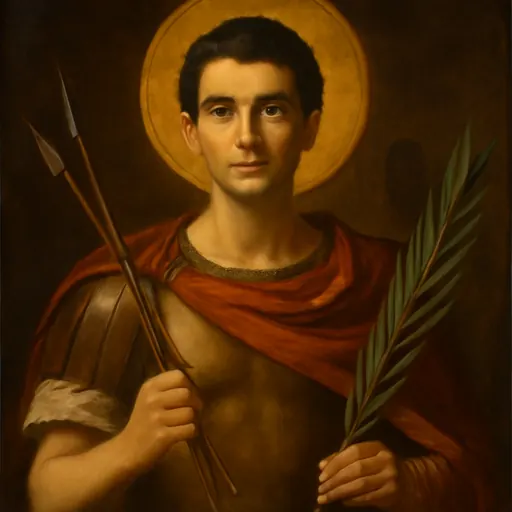
St. Sebastian was a Christian martyr in Rome under the emperor Diocletian, around 288. Tradition says he was an officer of the imperial guard who was shot with arrows, nursed back to health by St. Irene, and then beaten to death. His feast day is January 20, and he is the patron saint of soldiers, athletes and archers and a protector against plague.
Who was St. Sebastian?
St. Sebastian was a Christian martyred in Rome in the last great persecution of the Roman Empire, around 288. Very little about him can be proved. A Roman list of martyrs' burial days drawn up in 354 records him on January 20, buried on the Appian Way, and St. Ambrose, bishop of Milan, preached about him a few decades later. Everything else comes from a 5th-century Passion of St. Sebastian, once wrongly credited to Ambrose.
That Passion gave the world one of the most famous images in Christian art. In it Sebastian is an officer of the emperor's guard who secretly helps Christians, is tied up and shot with arrows, survives, and is finally beaten to death. Painters of the Renaissance turned the scene into a study of the human body, and Sebastian became the saint people called on against plague.


He is honored by Catholics, by the Orthodox and by many Anglicans and Lutherans. Soldiers, archers and athletes count him as their patron, and the city of Rio de Janeiro carries his name.
What history says
The oldest evidence is short and solid. The Depositio Martyrum, a list of Roman martyrs' burial days preserved in the Chronograph of 354, names Sebastian on January 20 and places his grave on the Via Appia, at the spot called ad catacumbas. A church was built over it in the 4th century.
St. Ambrose, preaching on Psalm 118 in Milan in the 380s, held him up as a local example. In the translation used in the Catholic Office of Readings for his feast:
Take the example of the martyr Sebastian, whose birthday in glory we celebrate today. He was a native of Milan. At a time when persecution either had ceased or had not yet begun or was of a milder kind, he realized that there was only slight, if any, opportunity for suffering. He set out for Rome, where bitter persecutions were raging because of the fervor of the Christians. There he endured suffering; there he gained his crown.
So by the late 4th century Sebastian was known as a man from Milan who went to Rome and died there for his faith, and Milan already kept his feast. The Catholic Encyclopedia concludes that beyond this, "little" can be proved.
The legend of St. Sebastian
The Passion, probably written early in the 5th century, filled in the story. The Golden Legend of Jacobus de Voragine retold it in the 13th century, and William Caxton printed it in English in 1483. All of what follows is traditional.
The captain who comforted martyrs
In the legend Sebastian was born at Narbonne in Gaul and raised in Milan. The emperors Diocletian and Maximian liked him so much that they made him captain of their guard, and he went about in an officer's cloak "girded with a girdle of gold." He kept his faith hidden, the Golden Legend says, not out of fear, but to be in a position to strengthen Christians who were about to deny Christ under torture.
Two brothers, Marcus and Marcellian, had been arrested and given thirty days to sacrifice to the gods. Their parents, their wives and their small children came to the prison and begged them to give in, and the brothers began to waver. Sebastian stepped in and spoke to them: "lose ye not the everlasting life for the blandishing words of women, be ye example to other Christian men for to be strong in the faith."
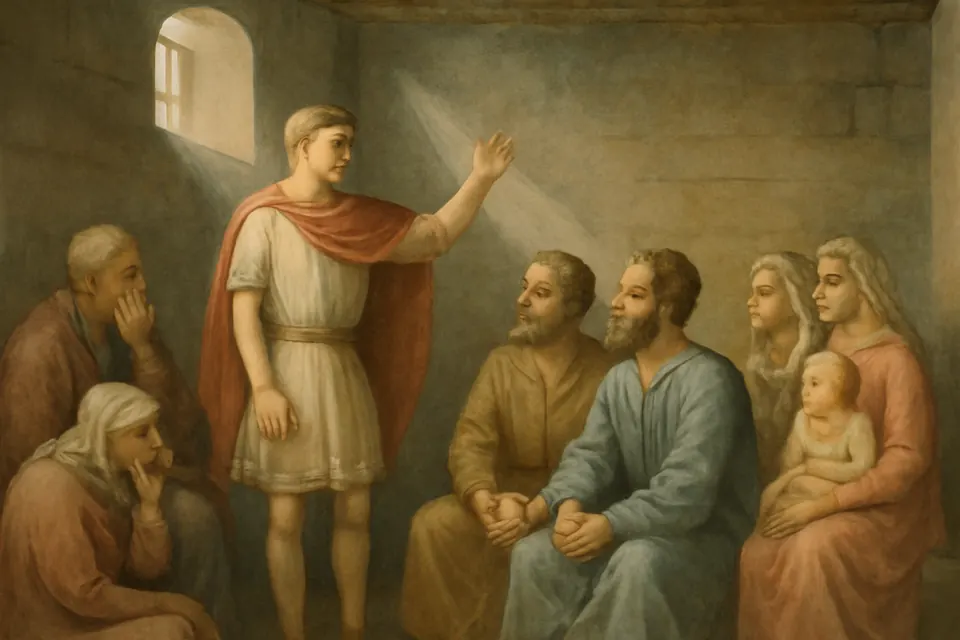
As he spoke, the legend says, a light shone around him. Zoe, the wife of the jailer Nicostratus, who had been unable to speak for six years, fell at his feet. Sebastian prayed for her and she spoke again. Her husband, the brothers' parents and many others were baptized, and the brothers went to their deaths firm in the faith.
The prefect Chromatius
The brothers' father, Tranquillinus, had suffered from gout for years and was healed at his baptism. When the prefect of Rome, Chromatius, heard about it, he asked to be cured too. Sebastian told him he would first have to destroy his idols. The legend says Sebastian and the priest Polycarp broke more than two hundred of them, and Chromatius, his son Tiburtius and their household became Christians.
The arrows
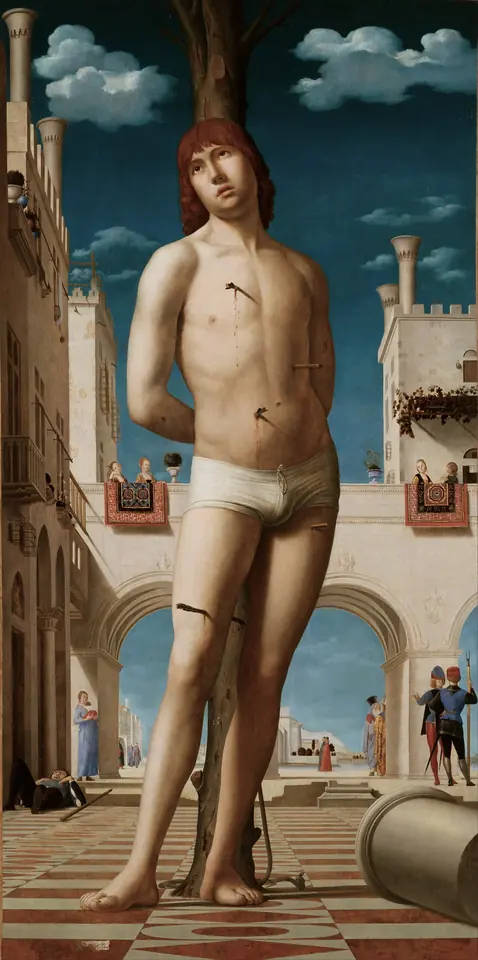
At last someone denounced Sebastian to Diocletian. The emperor reproached him: "I have always loved thee well, and have made thee master of my palace; how then hast thou been Christian privily against my health, and in despite of our gods?" Sebastian answered that he had always prayed to Christ for the emperor and for Rome. Diocletian had him tied to a stake in a field and shot by archers, and in Caxton's English, they shot "till he was as full of arrows as an urchin is full of pricks" (an "urchin" is a hedgehog). They left him for dead.

Irene's care
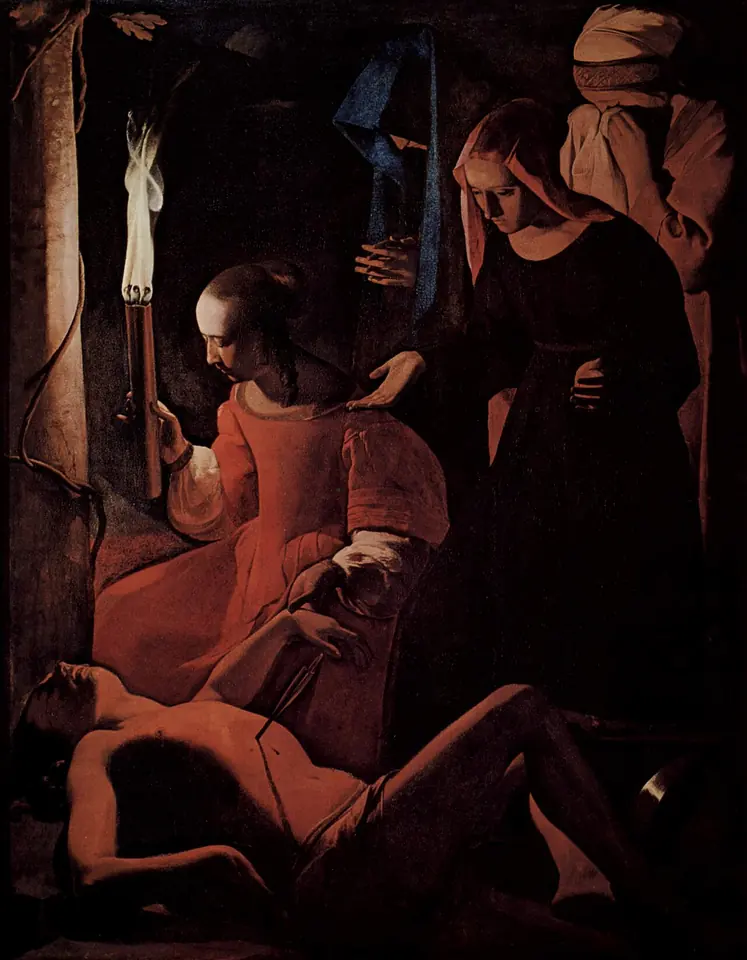
That night a Christian woman came to take his body for burial and found him alive. The Passion names her Irene, the widow of a martyr named Castulus. She took him home and nursed him until he recovered. Painters loved this quiet scene, and Georges de La Tour painted it by candlelight several times in the 1630s and 1640s.

Death by clubbing
Friends urged Sebastian to leave Rome. Instead he stood on a step where the emperor would pass and spoke to him. In the Golden Legend, Diocletian recognized him as the man "whom we commanded to be shot to death," and Sebastian said God had given him back his life "to the end that I should tell you that evilly and cruelly ye do persecutions unto Christian men."
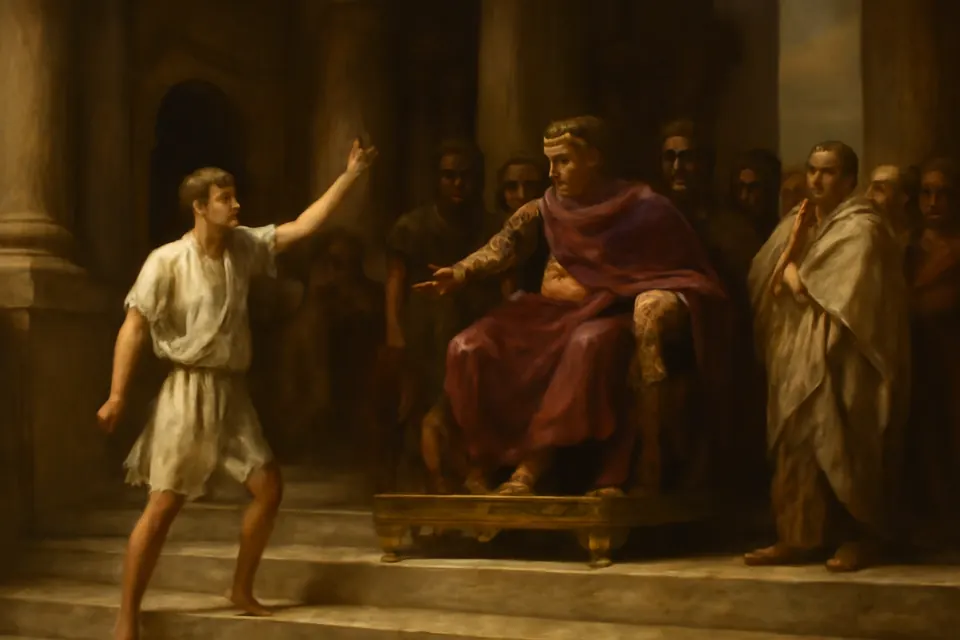
This time the emperor had him beaten to death and his body thrown into the Cloaca Maxima, the great sewer of Rome, so that Christians could not honor it. Sebastian then appeared in a dream to a Roman widow, Lucina (Caxton's English calls her Lucy), told her where his body lay, and asked to be buried in the catacombs "by the apostles." She found the body and buried it there the same night. The Golden Legend dates his death to 287; the Catholic Encyclopedia summary of the Passion places his discovery in 286.

The miracles of St. Sebastian
None of Sebastian's miracles has been approved through a modern canonical process; his cult is far older than that process. The stories fall into the other two groups.
- Traditional: the healing of Zoe's speech, the cure of Tranquillinus's gout and of the prefect Chromatius, and his survival of the arrows, all from the 5th-century Passion.
- Traditional: the end of the plague of the 680s in Rome and Pavia after an altar was raised to him, told by Paul the Deacon and repeated in the Golden Legend.
- Traditional: a story in the Dialogues of St. Gregory the Great, in which a woman who entered his church in an unworthy state was seized by a demon until a holy man named Fortunatus prayed over her.
- Reported: the end of plagues in Milan in 1575 and Lisbon in 1599 after public prayers to Sebastian, which the Catholic Encyclopedia lists, and countless personal favors that his devotees report. The Church has not formally examined these.
Why St. Sebastian is the patron saint against plague
The Golden Legend, drawing on Paul the Deacon's 8th-century History of the Lombards, tells of a plague around 680, in the time of a Lombard king Caxton calls "Gumbert," that struck all Italy, worst of all Rome and Pavia. People saw a good angel and an evil angel walking the streets, and every time the evil angel struck a door with his staff, someone in that house died. Then it was revealed that the plague would not stop until an altar was built to St. Sebastian in Pavia. The altar was built in a church of St. Peter, relics were brought from Rome, and the plague ended.


The other reason is the arrows. Long before Christianity, arrows stood for sudden disease. In Homer's Iliad, Apollo brings plague on the Greek camp by shooting arrows into it. Psalm 91, prayed for centuries in times of epidemic, promises that the believer "will not fear the terror of the night, nor the arrow that flies by day, nor the pestilence that stalks in darkness" (Psalm 91:5–6, RSV). A saint who had been shot full of arrows and lived seemed the right protector when plague came. After the Black Death of 1347–1351, towns across Europe built chapels to him and paired him with St. Roch, the pilgrim who caught the plague nursing its victims.
During the plagues of the 15th to 17th centuries, painters, confraternities and town councils turned to Sebastian again and again, which is one reason there are so many paintings of him from those centuries. Today Catholics still ask his prayers in epidemics.
Why St. Sebastian is the patron saint of soldiers, archers and athletes
Soldiers. The Passion makes him an officer of the imperial guard, and the old Roman Martyrology calls him "captain of the first cohort." He has been a patron of soldiers since the Middle Ages, and military chapels and regiments in several countries carry his name.
Archers. Medieval and early modern guilds of archers and crossbowmen, especially in Flanders and the Netherlands, chose Sebastian as their patron because of the arrows of his martyrdom. Many of those guilds, often called St. Sebastian guilds, still exist.
Athletes. This patronage is newer and has no formal decree behind it. It grew out of his legend of physical endurance and from Renaissance art, which painted him as a young man with an athlete's build. Catholic sports clubs and athletes adopted him in the 20th century.
See all the patron saints by cause.
Symbols of St. Sebastian in art
How Sebastian looks depends on when the image was made.
- A bearded man in court dress: the oldest images, like the mosaic of about 680 in San Pietro in Vincoli at the top of this page, show a dignified, gray-bearded Roman with a martyr's crown and no arrows. The Catholic Encyclopedia notes that the youthful, arrow-pierced Sebastian is an invention of Renaissance art.
- Arrows: his chief sign. Sometimes they are in his body, sometimes he simply holds them in his hand, which is common in statues and on holy cards.
- Bound to a tree or a column: the legend says a stake; painters usually chose a tree or, in classical settings, a Roman column.
- A young man, nearly unclothed: from the 15th century on, he is usually shown as a young man in a loincloth, which let painters study the human figure on a religious subject.
- Armor, a cloak or a soldier's helmet: in some Northern European and Baroque images, he wears the armor of a Roman officer and holds an arrow, without wounds.
- A palm and crown: the general signs of a martyr.
- With St. Roch, or with Irene: next to a pilgrim showing a sore on his thigh, he is almost always one of the "plague saints"; with a woman drawing out the arrows, the scene is Irene's care.
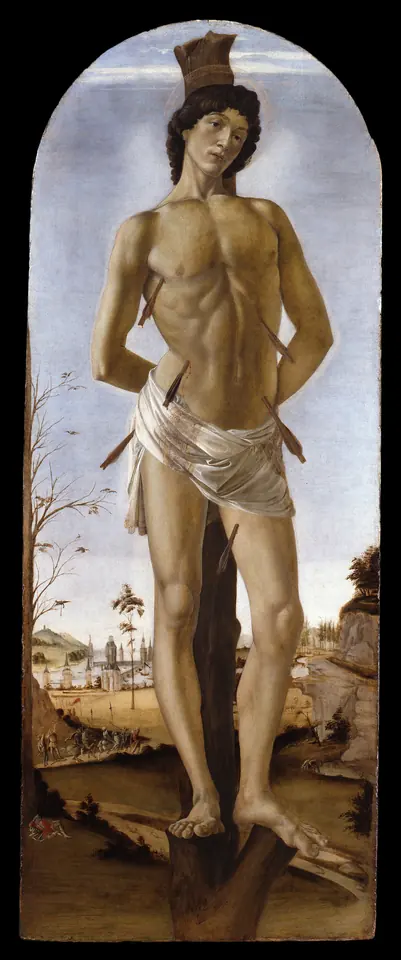

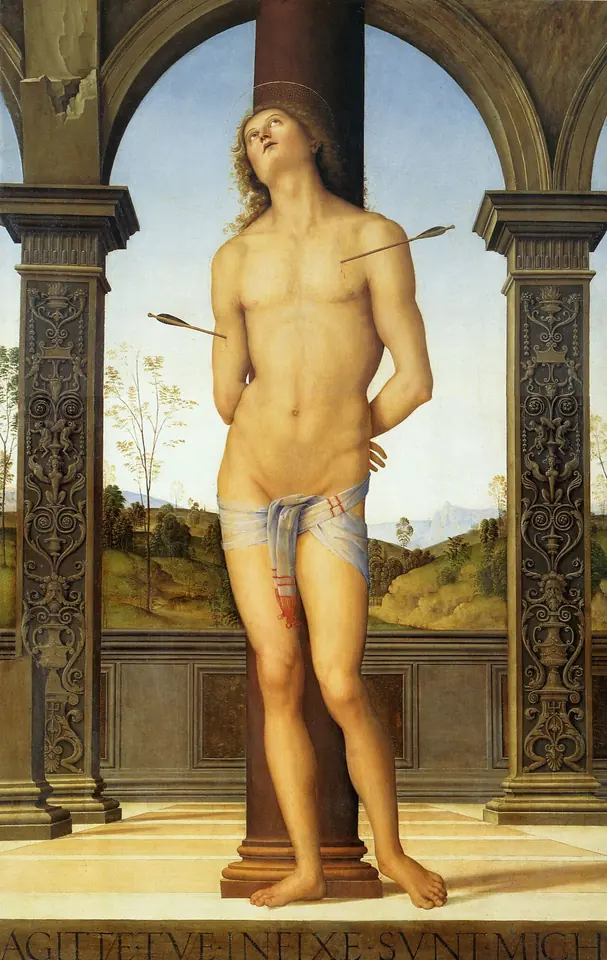
The Renaissance painters who made him famous each gave him a different mood. Antonello da Messina set him in an Italian piazza on a sunny day, as if nothing were happening. Botticelli made him slim and still, high above the landscape. Perugino painted him several times, calm and looking up to heaven between columns. His Louvre version carries a Latin line from Psalm 38 at the base, Sagittae tuae infixae sunt mihi, "your arrows have sunk into me." Andrea Mantegna painted him three times, among broken Roman ruins. Later, Guido Reni's versions in the 17th century turned him into a figure of quiet suffering, and Georges de La Tour moved the story into the dark, with Irene's lantern or torch.

Orthodox icons follow the older tradition: Sebastian appears as a young or middle-aged martyr in a soldier's or nobleman's cloak, holding a cross, with no arrows in his body.
Feast day and where St. Sebastian is honored
St. Sebastian's feast is January 20, an optional memorial in the General Roman Calendar, shared with Pope St. Fabian, who was martyred in 250. The date comes straight from the Roman list of 354, which makes it one of the oldest saints' days in the calendar. The Orthodox Church keeps his memory on December 18. The next day, January 21, is the feast of another Roman martyr, St. Agnes. See the feast day calendar.
The Roman Missal gives this collect (opening prayer) for his feast:
Grant us, we pray, O Lord, a spirit of fortitude, so that, taught by the glorious example of your Martyr Saint Sebastian, we may learn to obey you rather than men. Through our Lord Jesus Christ, your Son, who lives and reigns with you in the unity of the Holy Spirit, God, for ever and ever. Amen.
The Basilica of San Sebastiano and the catacombs, Rome
The Basilica of San Sebastiano fuori le mura ("outside the walls") stands on the old Appian Way, outside the walls of Rome. It was first built in the 4th century as a basilica of the apostles, because Christians believed the remains of St. Peter and St. Paul had rested there for a time. That is why Lucina, in the legend, buries Sebastian "by the apostles." It became one of the seven pilgrim churches of Rome. Cardinal Scipione Borghese rebuilt it, and the present church was finished in 1611.


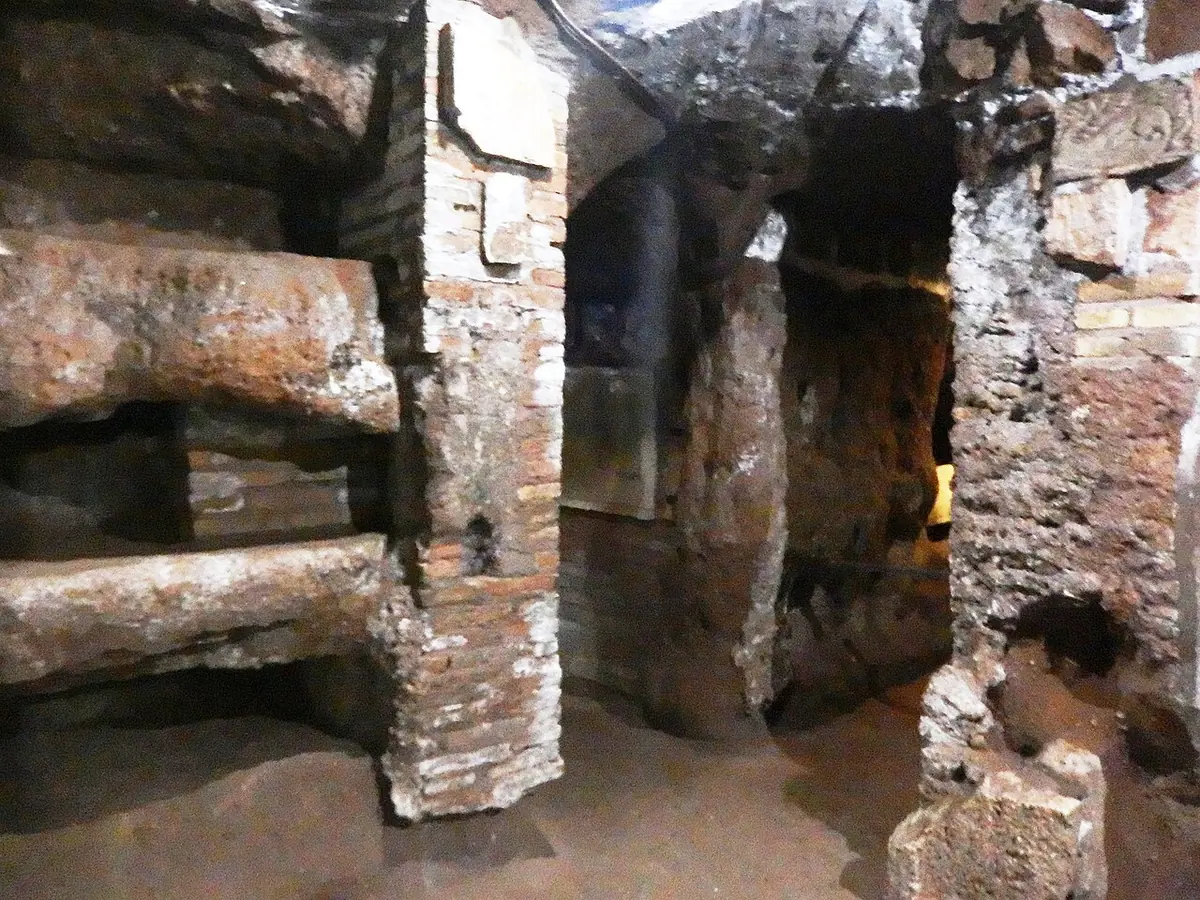
Under the basilica runs the catacomb where Sebastian was buried. The place was originally called ad catacumbas, "by the hollows," after a dip in the ground, and the word "catacomb" for every underground Christian cemetery comes from this one spot. Visitors can walk its galleries and see the 3rd-century graffiti in which pilgrims called on Peter and Paul.

In 826, part of Sebastian's relics was taken to the abbey of Saint-Médard at Soissons in France, which became a pilgrimage site of its own.
Rio de Janeiro
The Portuguese founded Rio de Janeiro on March 1, 1565, with the name São Sebastião do Rio de Janeiro. According to the city government, the name honored the boy king of Portugal, Sebastian, and the saint who shares his name was chosen as the city's patron. Two years later, on January 20, 1567, the Portuguese and their Temiminó allies won the decisive battle against the French and their Tamoio allies at Uruçumirim, by today's Glória hill. Local tradition says the saint himself appeared in the fighting. The founder, Estácio de Sá, was struck in the face by an arrow and died of the wound a month later.
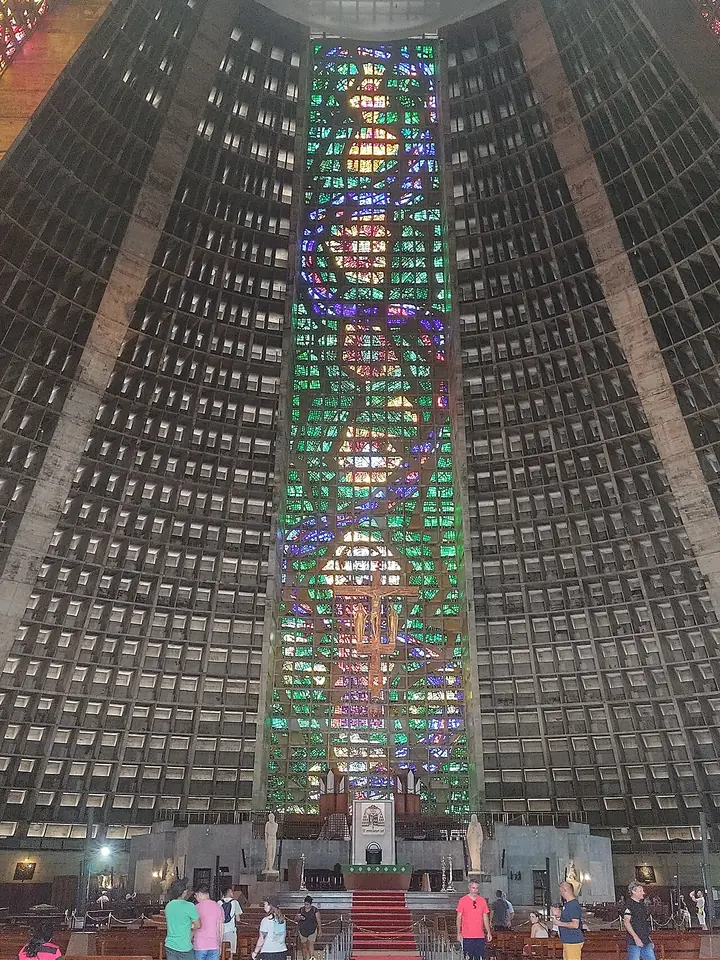
January 20 is a city holiday in Rio, with Masses and processions. The modern cone-shaped Metropolitan Cathedral of São Sebastião in the city center is dedicated to him.

Other places
The Basque city of San Sebastián (Donostia) in Spain takes its name from an old monastery dedicated to him, and on January 20 it holds the Tamborrada, a day and night of drumming through the streets. Countless towns in Italy, Spain, Portugal, Latin America and the Philippines keep his feast with processions, and in many villages of the Alps and southern Germany small plague chapels to Sebastian and Roch still stand at the edge of town.
Prayer to St. Sebastian
The best-known prayer for his feast is the collect from the Roman Missal, quoted above. It asks for the "spirit of fortitude" to "obey you rather than men," words that echo Peter and the apostles before the council in Jerusalem (Acts 5:29).
The Golden Legend closes its life of Sebastian by quoting the preface of his Mass, which it attributes to St. Ambrose, and then adds a prayer of its own. In Caxton's English:
O Lord, the blood of thy blessed martyr St. Sebastian was shed for the confession of thy name, he hath showed thy marvels that they profit in infirmity virtue, and giveth to our studies profit, and to them not steadfast to thee it giveth aid and help. Then let us pray to this holy martyr St. Sebastian that he pray unto our Lord that we may be delivered from all pestilence and from sudden death, and so depart advisedly hence, that we may come to everlasting joy and glory in heaven.
Many prayer cards print other prayers to St. Sebastian, for soldiers, for athletes or for protection in epidemics. Most are modern and of unknown authorship. Catholics also ask simply, "St. Sebastian, pray for us," above all when sickness spreads, and the Orthodox sing the troparion of the holy martyr Sebastian and his companions on December 18.
Frequently asked questions
What is St. Sebastian the patron saint of?
Soldiers, because tradition makes him an officer of the emperor's guard; archers, because of the arrows of his martyrdom; athletes; and people facing plague and epidemics. He is also the patron of Rio de Janeiro, whose full name is São Sebastião do Rio de Janeiro.
When is St. Sebastian's feast day?
January 20 in the Catholic Church, an optional memorial shared with Pope St. Fabian. The date goes back to the Roman calendar of 354, which lists his burial on the Appian Way on that day. The Orthodox Church remembers him on December 18.
Did St. Sebastian die from the arrows?
No. According to his legend, the archers left him for dead, but a Christian widow, Irene, found him alive and nursed him. When he recovered, he confronted the emperor and was beaten to death. The arrows are his symbol even though they did not kill him.
Why is St. Sebastian the patron saint against plague?
Arrows were an old image of sudden disease, and a man who survived arrows seemed a natural protector. The 8th-century historian Paul the Deacon tells how a plague in Rome and Pavia ended after an altar was built to Sebastian. The Catholic Encyclopedia also records answered prayers in Milan in 1575 and Lisbon in 1599.
Why is St. Sebastian the patron saint of athletes?
No decree made him so. The patronage grew from his legend of endurance, surviving the arrows and returning to face the emperor, and from Renaissance art, which painted him as a strong young man. Catholic athletes and sports clubs adopted him in modern times.
Is the story of St. Sebastian true?
His martyrdom in Rome and his burial on the Appian Way are historical, recorded in the 4th century. The detailed story of the arrows, Irene and his death by clubbing comes from a 5th-century Passion that the Catholic Encyclopedia judges legendary.
Where are St. Sebastian's relics?
In the Basilica of San Sebastiano on the Via Appia in Rome, built over his grave in the catacombs. Part of his relics went to the Abbey of Saint-Médard in Soissons, France, in 826, and many other churches claim smaller relics.
Sources
- Catholic Encyclopedia (1912): St. Sebastian
- Ambrose, Exposition of Psalm 118 (Office of Readings, January 20): Persecution and Martyrdom of St. Sebastian (Crossroads Initiative)
- The Golden Legend, Life of Saint Sebastian (Caxton translation, 1483)
- Christian Iconography: St. Sebastian in Art
- The Roman Missal, Collect for St. Sebastian (Aleteia: Saint of the Day)
- IstoÉ: Entenda a origem do Dia de São Sebastião, feriado no Rio e em outras cidades (2025)
- Roman Martyrology, January 20