St. John Nepomucene Neumann
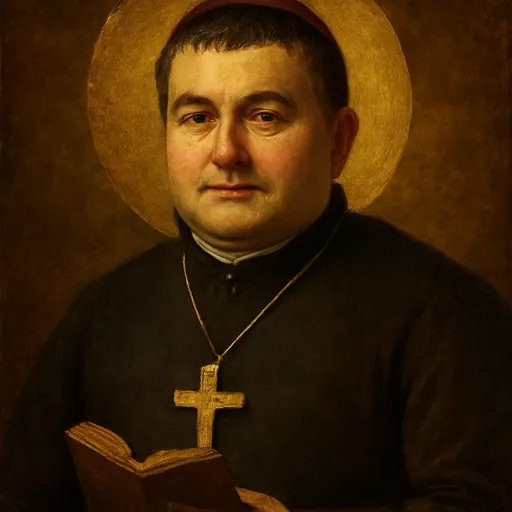
St. John Neumann (1811–1860) was a Bohemian-born priest who came to New York penniless in 1836, joined the Redemptorists, and became the fourth bishop of Philadelphia. He organized the first diocesan system of Catholic schools in the United States, spread the Forty Hours devotion, and died suddenly on a Philadelphia street. Canonized in 1977, he was the first American bishop declared a saint. His feast day is January 5, and Catholics honor him as a patron of Catholic schools and immigrants.
Who was St. John Neumann?
John Nepomucene Neumann was born in the small Bohemian town of Prachatitz, now Prachatice in the Czech Republic, on March 28, 1811. He crossed the Atlantic alone at twenty-five with no promise of a diocese, was ordained in New York within a month of landing, and spent the next twenty-four years among German-speaking immigrants in the forests of western New York, in Pittsburgh and Baltimore, and finally as bishop of Philadelphia. He died there on January 5, 1860, after collapsing on an icy sidewalk. He was forty-eight.
He was a small man, five feet two inches tall, and never a grand one. His English was accented, his clothes were shabby, and some of his fellow bishops doubted he could govern a big American diocese. Yet in less than eight years in Philadelphia he organized the first diocesan Catholic school system in the country, saw about eighty churches built, brought in teaching sisters and brothers, and introduced the Forty Hours devotion across his diocese.


Pope Paul VI, who beatified him in 1963 and canonized him in 1977, summed up his life in his canonization homily: "He was close to the sick; he was at home with the poor; he was a friend to sinners. And today he is the honor of all immigrants." He was the first American bishop, and the first American man, to be declared a saint.
The life of St. John Neumann
A bookish boy in Bohemia
His father, Philip, was a stocking knitter who had come to Prachatitz from Bavaria; his mother, Agnes, was the daughter of a Czech harness maker. John was the third of their six children, and German was spoken at home. His mother called him her "little bibliomaniac," according to his biographer Michael Curley, because he read everything he could find.


He studied with the Piarist Fathers in Budweis (České Budějovice), then philosophy, and in 1831 entered the diocesan seminary there. He loved botany and astronomy and nearly became a doctor. In the seminary he read the reports of the Leopoldine Society of Vienna, which described German Catholics in America with no priests, and he made up his mind to be a missionary. He moved to the seminary in Prague in part because he hoped to learn English there. The university didn't teach it, so he learned it from a book and by talking with English workmen at a nearby factory. As a seminarian he studied the catechism of St. Peter Canisius, a model he would later follow.
By 1835 he had finished his studies, but the bishop of Budweis had more priests than he needed and postponed all ordinations. Neumann decided to go to America anyway.
Alone to New York, 1836
He left home on February 8, 1836, telling only his sister Veronica that he was going overseas. He made his way across Germany and France, waited a month in Paris for letters that never came, and sailed from Le Havre in April on the three-masted Europa. The crossing took forty days. Curley says he landed in lower Manhattan on the feast of Corpus Christi "with only a dollar in his pocket and his clothes and shoes in tatters."
Bishop John Dubois of New York needed German-speaking priests badly. He accepted him at once and ordained him a priest on June 25, 1836, in St. Patrick's Old Cathedral. The next morning Neumann sang his first Mass at St. Nicholas Church, and he wrote in his journal:
"Oh Jesus, You poured out the fullness of your grace over me yesterday. You made me a priest and gave me the power to offer You up to God. Ah! God! This is too much for my soul! Angels of God, all you saints of heaven, come down and adore my Jesus, because what my heart says is only the imperfect echo of what Holy Church tells me to say."
The missions near Niagara Falls
Dubois sent him to the Buffalo area. For four years he served scattered German settlements around Williamsville, Lancaster and North Bush, and later outposts up to twelve hours away. He walked most of it with his vestments in a pack. When his people bought him a horse, he had to learn to ride; his feet barely reached the stirrups, and for a while he led the horse by the bridle. He built a log cabin, taught school himself when there was no teacher, and lived for weeks on bread. After his first baptism he wrote that if the child died in the grace of the sacrament, "then my journey to America has been repaid a million times, even though I do nothing for the rest of my life."

By 1840 he was worn out, sick and painfully lonely. He decided he needed to live in community.
The first Redemptorist professed in America
In the fall of 1840 he asked to join the Redemptorists, the missionary congregation founded by St. Alphonsus Liguori, who were working among German Catholics in Pittsburgh and Baltimore. He was received in Pittsburgh and made his vows in Baltimore on January 16, 1842, the first Redemptorist to profess vows in America. His brother Wenzel, who had followed him from Bohemia, joined as a lay brother.
He served as rector in Pittsburgh, as superior of all the Redemptorists in the United States in the late 1840s, and as pastor of St. Alphonsus Church in Baltimore. He became a U.S. citizen in Baltimore in 1848. Among the people who went to him for confession was Archbishop Francis Kenrick of Baltimore, formerly bishop of Philadelphia.
Bishop of Philadelphia, 1852
Kenrick put Neumann's name forward for Philadelphia. The Redemptorists begged Rome not to take him, and he tried to refuse, but Pope Pius IX named him bishop on February 1, 1852, under obedience. Curley tells how Kenrick walked to St. Alphonsus' rectory, left his own episcopal ring and pectoral cross on Neumann's table without a word, and went home. Neumann's brothers found him on his knees in prayer the next morning. He was consecrated on March 28, 1852, his forty-first birthday, and took as his motto Passio Christi conforta me: "Passion of Christ, strengthen me."
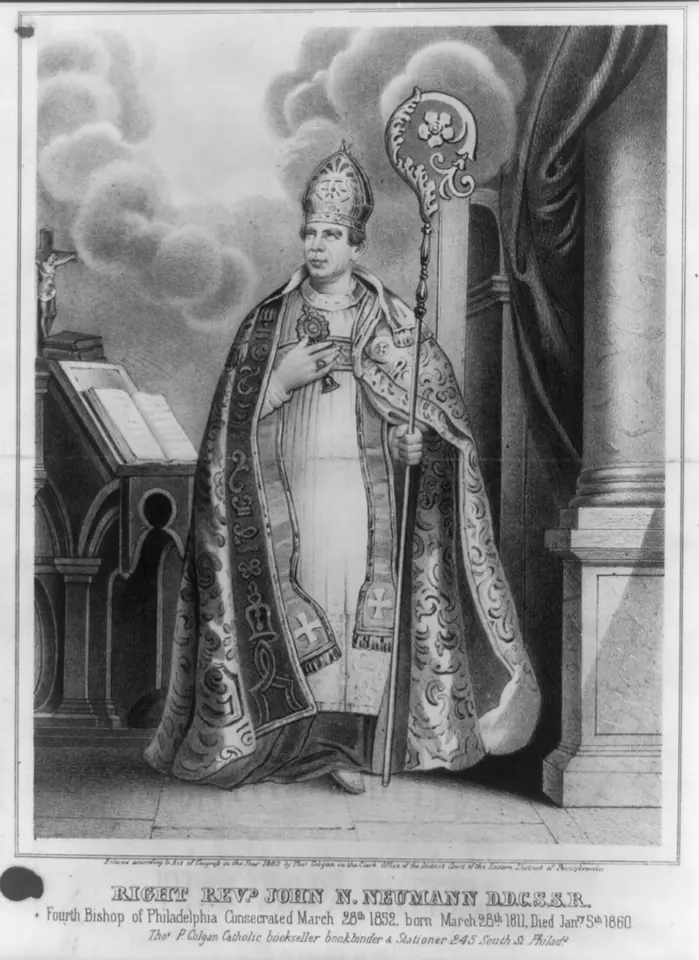

The Diocese of Philadelphia then took in all of eastern Pennsylvania and Delaware. Irish, German and soon Italian immigrants were pouring in, and the anti-Catholic riots of 1844 were a recent memory. Neumann spent months every year on horseback and in coaches visiting remote parishes. Curley says he already spoke German, French, Italian, Czech, Spanish and English, and learned enough Irish to hear the confessions of Irish miners at Trevorton in 1857. He bought a property for the first Italian parish in the diocese, St. Mary Magdalen de Pazzi, and worked to settle the bitter disputes with lay trustees at Holy Trinity Church.
He also founded or brought in religious communities. He helped the Sisters of the Immaculate Heart of Mary come to his diocese, and in 1855 he invested three women at St. Peter's Church as the first members of a Third Order of St. Francis, which became the Sisters of St. Francis of Philadelphia. He wrote their rule himself.
Schools and the catechism
Schools were his first concern. In April and May of 1852, weeks after his consecration, he called meetings at his house that set up a Central Board of Education for the diocese, made up of each pastor and two laymen from every parish. Curley calls it "the genesis of the present diocesan system of parochial schools prevalent today throughout the United States." Within three years the number of children in his parish schools had multiplied eighteen times.
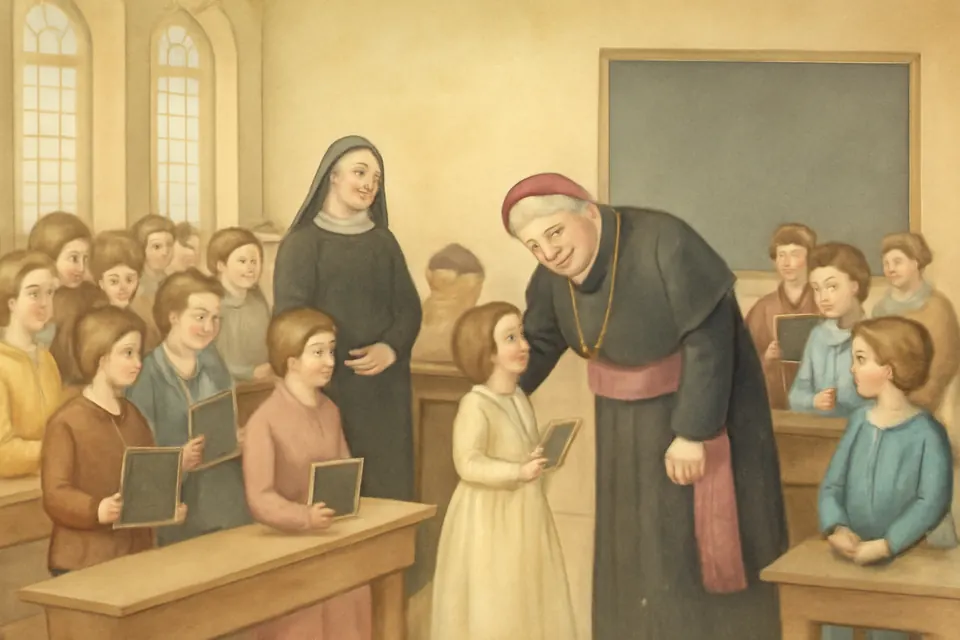
He had already published two German catechisms in his Redemptorist years, a small sixteen-page one and a larger Katholischer Katechismus. The First Plenary Council of Baltimore in 1852 asked him to prepare a German catechism for the whole country, and the larger one appeared with the council's approval in 1853. Paul VI singled out "a celebrated catechism, many times republished" in his canonization homily.
Not everything went well. Neumann disliked handling money, and several priests and bishops thought him too gentle to discipline his clergy. In 1857 Rome gave him a coadjutor, Bishop James Frederick Wood, a former banker, to manage the finances. Neumann wrote that he would gladly resign in Wood's favor and offered to move to a smaller diocese.
Death on Vine Street
On January 5, 1860, after lunch, he told a fellow Redemptorist, "I have a strange feeling today. I feel as I never felt before. I have to go out on a little business and the fresh air will do me good." He went to a lawyer about property deeds and was on his way to the express office about a lost chalice for a poor country priest. Curley writes that on Vine Street near Thirteenth he began to stagger and fell on the icy sidewalk. Two men carried him into a nearby house, and he died within minutes.

Huge crowds followed his funeral procession through the city on January 9. He had often said he wanted to be buried with his Redemptorist brothers, and Archbishop Kenrick agreed: "I'll consent to Bishop Neumann's finding a resting place in death where he could not find it in life." He was buried in the lower church of St. Peter the Apostle.
The Forty Hours devotion
The Forty Hours is a period of continuous prayer before the Blessed Sacrament exposed on the altar, in memory of the hours Christ's body lay in the tomb. It was common in Europe but rare in America. Neumann wanted it in every larger church of his diocese, so that the Blessed Sacrament would be exposed somewhere every week of the year. Some of the priests he consulted told him the time wasn't right, fearing irreverence or anti-Catholic violence.
His first biographer, the Redemptorist John Berger, writing in 1884, tells what changed his mind. Working past midnight, Neumann propped a burning candle stub among his papers and fell asleep. He woke to find the candle gone and the papers charred, "though the writing they contained remained untouched and legible." As he knelt to thank God, Berger writes, "it seemed to him that he heard an interior voice saying":
"As the flames are here burning without consuming or even injuring the writing, so shall I pour out My grace in the Blessed Sacrament without prejudice to My honor. Fear not profanation, therefore; hesitate no longer to carry out your designs for My glory."
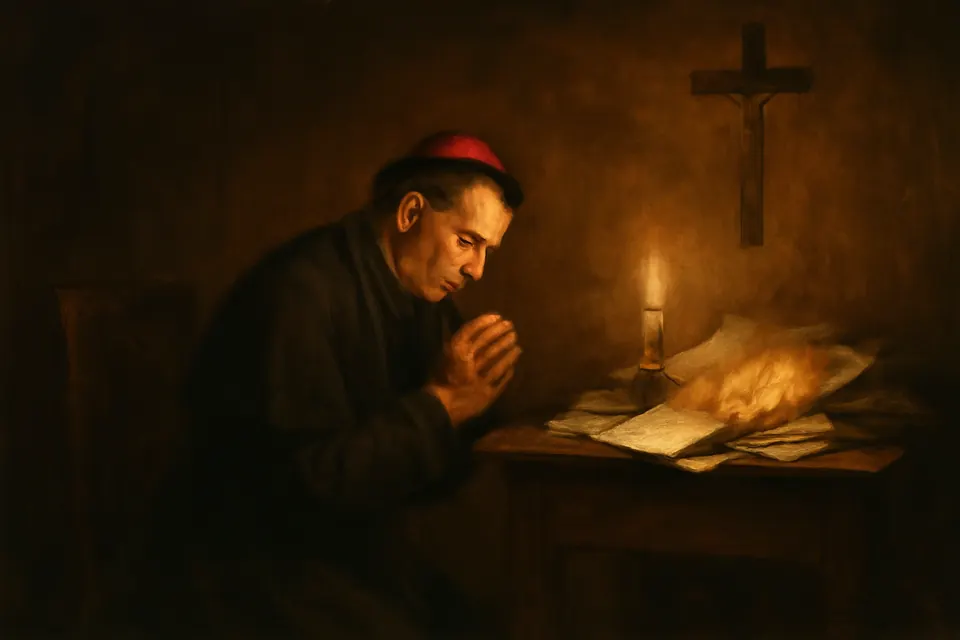
The first diocesan Forty Hours opened at St. Philip Neri Church in Philadelphia in 1853. Berger says the bishop "scarcely left the church during the three days," and that other American dioceses soon followed. The story of the candle is traditional, told by his biographer; the Church has never examined it.
The miracles of St. John Neumann
Neumann's cause opened in Philadelphia and Budweis in 1886, and Pope Benedict XV declared his virtues heroic in 1921. The Redemptorist postulator Nicola Ferrante published the history of the cause in 1976, and the account below follows his article and the archdiocesan archives.
- Approved: Eva Benassi, Sassuolo, Italy, 1923. An eleven-year-old pupil at a convent school in Sassuolo, near Modena, she fell ill with high fever, vomiting and a swollen abdomen. Her doctor suspected peritonitis and expected her to die that night. The nursing sister laid a picture of the Venerable Neumann on the painful spot and prayed the Glory Be with her. The girl slept, woke, and was well by morning. Ferrante records the doctor's words: "It wasn't me; it was the Lord God."
- Approved: Kent Lenahan, Philadelphia, 1949. On July 8, 1949, the young man was riding on the running board of a friend's car when it hit a utility pole near Philadelphia. He was taken to Bryn Mawr Hospital with a fractured skull, a broken collarbone and broken ribs, and four days later doctors gave him only hours to live. His mother applied a Neumann relic, his fever fell that night, and he recovered. The case was first doubted, then investigated in Philadelphia in 1959.
- Vatican medical experts declared both cures "not due to natural causes" on December 13, 1961, which opened the way to the beatification on October 13, 1963, during the Second Vatican Council.
- Approved: Michael Flanigan, Philadelphia, 1963–1964. He was diagnosed with Ewing's sarcoma, a bone cancer, in his right shin, which spread to both lungs. His family began asking Neumann's help in the fall of 1963, and by January 1964 he was considered cured. He stayed healthy. A medical panel at first judged that his radiation and chemotherapy might explain the cure, but after more evidence and testimony it was declared medically unexplainable in December 1975. Paul VI approved it as a miracle on November 13, 1976, and canonized Neumann on June 19, 1977.
Many other favors are reported. The Catholic Standard and Times in 2010 told of Janice Bender, whose terminal cancer went into remission after the shrine's pastor applied a relic. Visitors to his shrine still leave notes of thanks. These accounts have not been examined by the Church.
Why St. John Neumann is the patron of Catholic schools and immigrants
Neumann has no formal patronage from Rome, but American Catholics have long turned to him in two areas.
- Catholic schools: he organized the first diocesan school system in the United States, recruited teaching orders, and wrote catechisms. Paul VI praised him for "promoting, with relentless energy, the Catholic school system in the United States." The U.S. collect for his feast asks that "fostering the Christian education of youth" the Church may grow (see the prayer below). Schools, a university and a high school in Philadelphia carry his name.
- Immigrants: he arrived penniless and alone, spent his priesthood among German, Irish and Italian newcomers, and learned their languages to hear their confessions. The Roman Martyrology describes him as a bishop who helped poor immigrants with advice and charity.
- Philadelphia: he was its fourth bishop and is its first canonized saint, followed by St. Katharine Drexel in 2000.
See all patron saints by cause.
Symbols of St. John Neumann in art
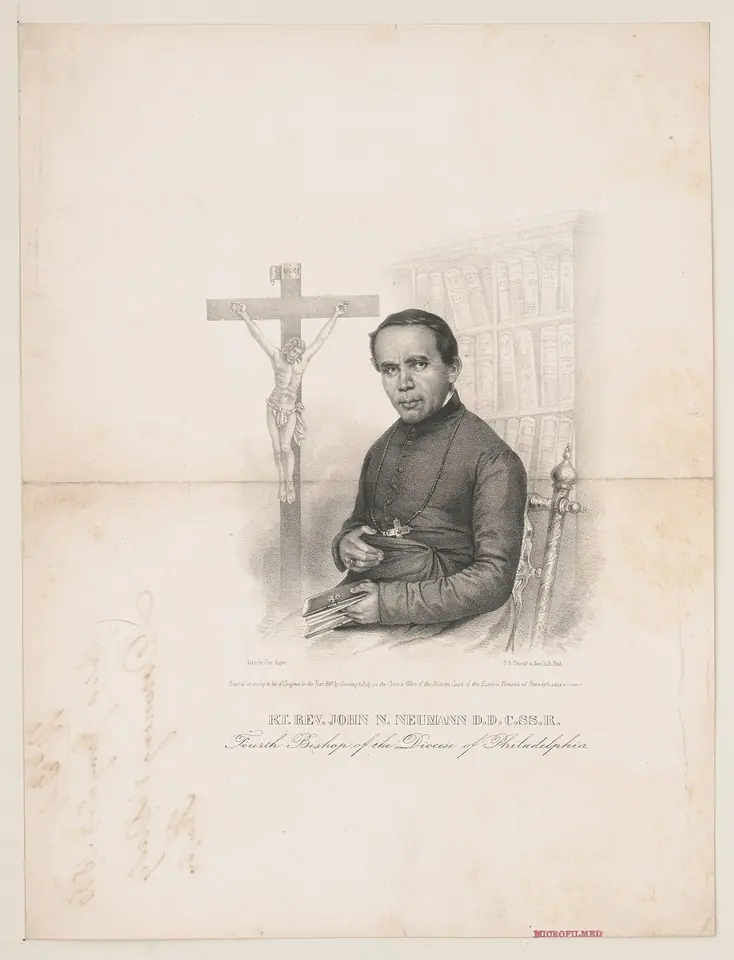
Neumann lived in the age of lithographs and early photographs, so his face is known, and artists keep close to it: a short man with a round, clean-shaven face, dark hair combed forward and a broad forehead. You can recognize him by:
- Bishop's vestments, miter and crozier, as in the 1860 lithograph on this page. In simpler images he wears a black cassock or Redemptorist habit with a pectoral cross.
- A book or catechism, for his catechisms and his schools.
- His motto, Passio Christi conforta me, often shown on a banner or with his coat of arms.
- Children around him, in school and parish art.
- A crucifix, which he holds in the mosaic at his shrine and in the bronze statue at Prachatice.
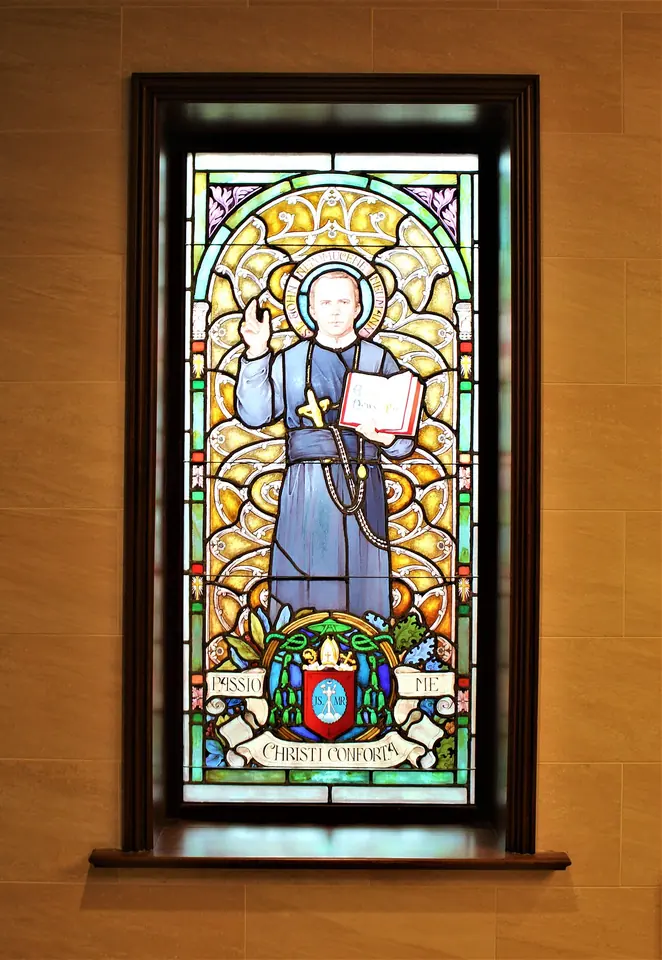

Unlike medieval saints, he has no set of legendary attributes. In a church, a short bishop in 19th-century dress with a book or with children, often near a statue of the Redemptorist St. Gerard Majella or an icon of Our Lady of Perpetual Help, is almost always John Neumann.
Feast day and the National Shrine
His feast is January 5 in the United States, an obligatory memorial the day after St. Elizabeth Ann Seton. The archbishop of Philadelphia often celebrates the feast at St. Peter the Apostle Church. See the feast day calendar.
St. Peter the Apostle Church, Philadelphia
The Redemptorists have run St. Peter the Apostle, at Fifth Street and Girard Avenue, since its founding in the 1840s, and Neumann was buried in its lower church in 1860. People began praying at his grave at once. During the canonization process his remains were exhumed in 1962, and the lower church became the National Shrine of St. John Neumann.
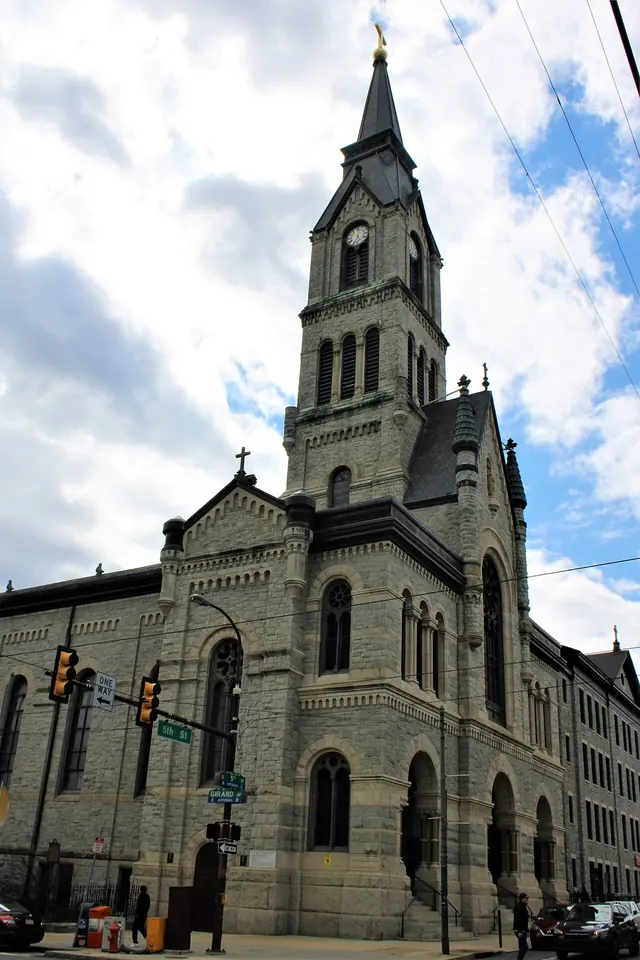

His remains now lie in a glass reliquary beneath the shrine altar, inside a lifelike effigy dressed in bishop's vestments. The face is a mask made by the Philadelphia forensic sculptor Frank Bender. Visitors sometimes take the figure for an incorrupt body, but the shrine doesn't claim that; the bones are inside the effigy.


A museum opened in the parish school building in 2019 with his vestments, letters, the botany field guides he signed, and his second casket. The shrine also keeps a mosaic of the saint above a bank of votive candles, where pilgrims light candles for their intentions.


Prachatice
His hometown keeps the house where he was born, the font in St. James Church where he was baptized, and a bronze statue in a park named for him. In 1855, on his only trip home, the town gave him a hero's welcome that he had tried to avoid.


Prayer to St. John Neumann
The approved liturgical prayer for his feast is the collect of the Mass for January 5 in the United States. The official Latin, as published by the U.S. bishops, reads:
Deus, qui beatum Ioannem episcopum pastorali servitio et caritate insignem, ad regendum populum tuum in Americæ terris vocasti, eius intercessione concede, ut christianam iuvenum educationem foventes et fraternæ dilectionis testimonio roborati, familiam Ecclesiæ tuæ iugiter augeamus.
In plain English (our translation, not the missal's wording), it asks: God, you called the bishop St. John, outstanding in pastoral service and charity, to guide your people in the lands of America; through his prayers, grant that as we foster the Christian education of the young and are strengthened by the witness of brotherly love, we may keep the family of your Church growing.
Paul VI closed his canonization homily with a short invocation that anyone can use: "Saint John Neumann, by the living power of your example and by the intercession of your prayers, help us today and for ever."
Neumann's own prayers survive in his journals. On the day after his ordination he wrote: "I will pray to You that You may give to me holiness, and to all the living and the dead, pardon, that some day we may all be together with You, our dearest God!" The words "Dearest God, give me holiness!" are written on the wall of his shrine. Catholics who visit his shrine ask his help above all for the sick, for children and for their families.
Frequently asked questions
When is St. John Neumann's feast day?
January 5, the day he died in 1860. It is an obligatory memorial on the proper calendar of the Catholic Church in the United States, the day after St. Elizabeth Ann Seton. He is not on the General Roman Calendar, so outside the United States his day is kept mainly by the Redemptorists, in Philadelphia and in his Czech homeland.
What is St. John Neumann the patron saint of?
He has no single official patronage. Catholics in America think of him above all as a patron of Catholic schools, because he organized the first diocesan school system in the country, and of immigrants, since he was one himself and spent his life serving them. Pope Paul VI called him "the honor of all immigrants" at his canonization.
What miracles are attributed to St. John Neumann?
The Church approved three. Eva Benassi, an eleven-year-old schoolgirl in Sassuolo, Italy, recovered overnight in 1923 from what doctors took to be fatal peritonitis. Kent Lenahan, a young man critically injured in a 1949 car crash near Philadelphia, recovered after his mother applied a Neumann relic. Michael Flanigan of Philadelphia was cured of Ewing's sarcoma that had spread to his lungs in 1963 and 1964. The first two led to his beatification, the third to his canonization.
Is St. John Neumann's body incorrupt?
The shrine does not claim that it is. His remains were exhumed in 1962 during the canonization process and placed inside a lifelike effigy, with a face mask, in a glass case under the shrine altar. What visitors see is the effigy in bishop's vestments; the bones are within it.
Where is St. John Neumann buried?
In the National Shrine of St. John Neumann, in the lower church of St. Peter the Apostle at 1019 North Fifth Street in Philadelphia. He had asked to be buried with his fellow Redemptorists there rather than in the cathedral crypt with the other bishops.
Was St. John Neumann the first American saint?
He was the first American man canonized and the first American bishop. St. Frances Xavier Cabrini (canonized 1946) and St. Elizabeth Ann Seton (1975) came before him. Neumann became a U.S. citizen in Baltimore in 1848.
What did St. John Neumann do for Catholic schools?
In 1852, weeks after becoming bishop, he set up a Central Board of Education for the Diocese of Philadelphia, which historians count as the start of the diocesan Catholic school system in the United States. Within three years the number of children in his parish schools had multiplied eighteen times. He also wrote two German catechisms that were used in American parishes for decades.
Sources
- Paul VI, Homily at the Canonization of John Nepomucene Neumann, 19 June 1977
- Catholic Historical Research Center of the Archdiocese of Philadelphia: Canonization of Saint John Neumann
- Nicola Ferrante, C.SS.R., La causa di beatificazione e canonizzazione di S. Giovanni Nepomuceno Neumann (1886-1976), Spicilegium Historicum C.SS.R. 24 (1976)
- Michael J. Curley, C.SS.R., Venerable John Neumann, C.SS.R., Fourth Bishop of Philadelphia (1952)
- John A. Berger, C.SS.R., Life of Right Rev. John N. Neumann, D.D. (1884)
- Catholic Encyclopedia (1911): Philadelphia
- Catholic Encyclopedia (1911): Redemptorists
- USCCB: Proper Formularies for the United States in their Original Languages (January 5)
- CatholicPhilly: Blessings by St. John Neumann continue today (2010)
- CatholicPhilly: New museum for St. John Neumann opens at his shrine (2019)
- CatholicPhilly: Archbishop Chaput celebrates Mass on saintly predecessor's feast (2016)
- Roman Martyrology, January 5