St. Gregory of Nazianzus
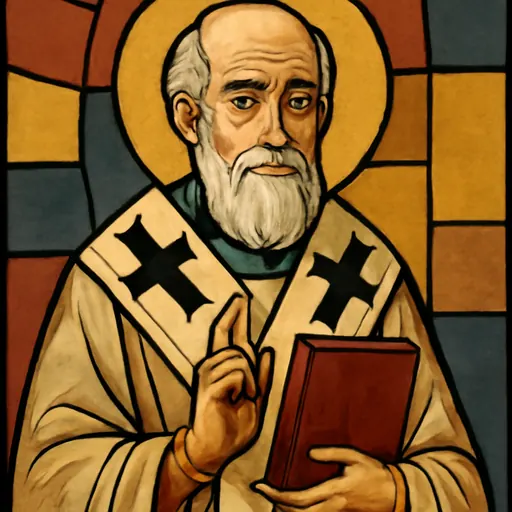
St. Gregory of Nazianzus (about 330–390) was a bishop from Cappadocia, in present-day Turkey, whose five sermons on the Trinity, preached in Constantinople in 380, earned him the title "the Theologian." He presided for a time over the Council of Constantinople in 381 and was the lifelong friend of St. Basil the Great. His feast is January 2 in the Catholic Church, shared with Basil, and January 25 in the Orthodox Church.
Who was St. Gregory of Nazianzus?
Gregory was a bishop, preacher and poet of the 4th century from Cappadocia, in central Turkey. He is the friend of St. Basil the Great who shares Basil's feast day, and one of the three "Cappadocian Fathers." The Eastern Church calls him simply "the Theologian," a title it gives to almost no one else, because of five sermons on the Trinity he preached in Constantinople in 380. Benedict XVI described him as a man of "refined and sensitive soul" who was carried, again and again, "where he did not wish to go."

The life of St. Gregory
Student and friend
Gregory was born about 330 at Arianzus, near the small town of Nazianzus. His father, also Gregory, was bishop of Nazianzus, converted by his wife, St. Nonna, who had dedicated her son to God before his birth. Gregory studied at Caesarea, where he first met Basil, then in Palestine, Alexandria and Athens. On the voyage to Athens his ship was caught in a storm for many days. The Orthodox life says Gregory, still unbaptized, lay in the stern praying and vowed himself to God.

In Athens he and Basil were inseparable. "We seemed to have one soul, inhabiting two bodies," he wrote later. Among their fellow students was the future emperor Julian the Apostate.
The unwilling priest and bishop
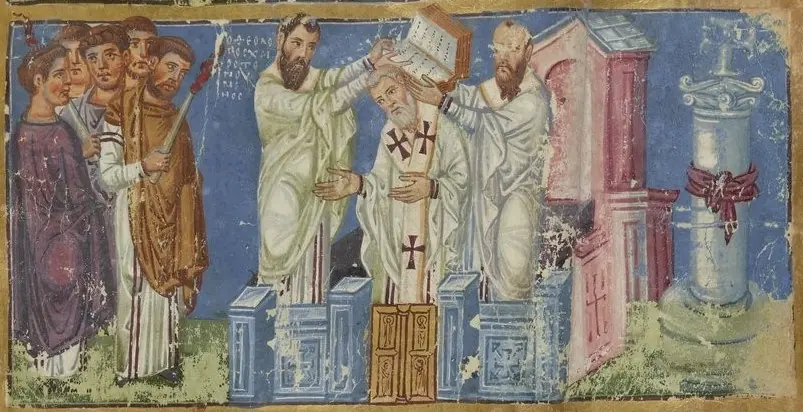
Gregory wanted a life of prayer and study. His father ordained him a priest by force, probably at Christmas 361, and Gregory fled to Basil's monastery in Pontus before returning to preach at Easter. The oration he wrote to explain his flight is a treatise on the priesthood that the Catholic Encyclopedia calls the foundation of St. John Chrysostom's On the Priesthood and of St. Gregory the Great's Pastoral Rule.
Basil, needing allies against a rival bishop, had him consecrated bishop of Sasima, a small town between Caesarea and Tyana. Gregory never took possession of it. The episode strained the friendship, and no letters between them survive from after it.

Constantinople and the Five Theological Orations
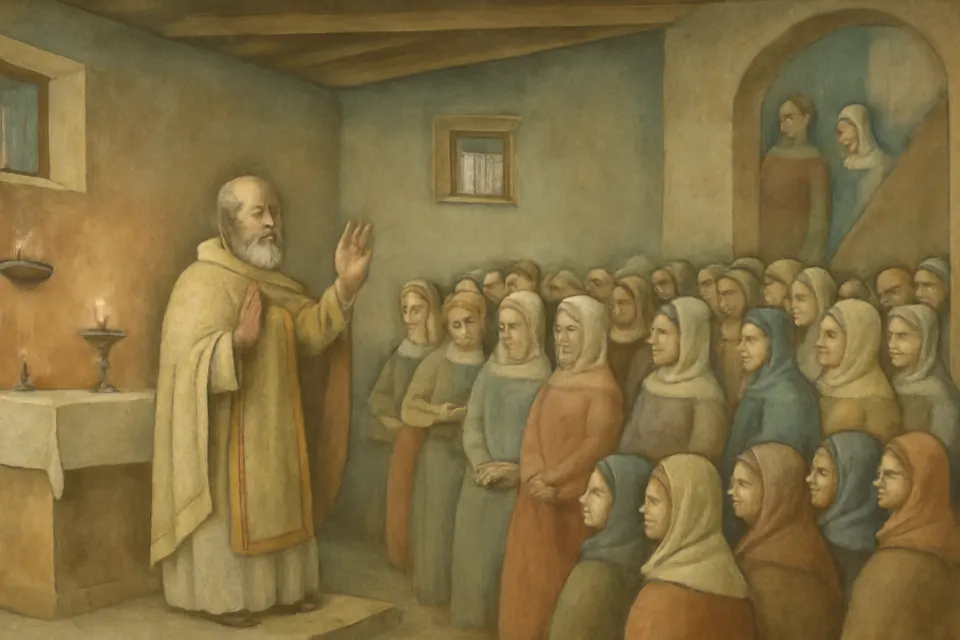
In 379, after Basil's death, the small Nicene community of Constantinople asked Gregory to lead them. The city's churches were in Arian hands, so he preached in a private house he named the Anastasia, the place of "resurrection." Arians attacked the chapel during the Easter baptisms. There, in 380, he preached the five Theological Orations. In the last, on the Holy Spirit, he wrote:
The Father was the True Light which lightens every man coming into the world. The Son was the True Light which lightens every man coming into the world. The Other Comforter was the True Light which lightens every man coming into the world. Was and Was and Was, but Was One Thing. Light thrice repeated; but One Light and One God. (Oration 31)
The third oration sets Christ's humanity and divinity side by side: "He was baptized as Man — but He remitted sins as God... He hungered — but He fed thousands" (Oration 29). St. Jerome was among his students in these years.
The Council of 381 and retirement
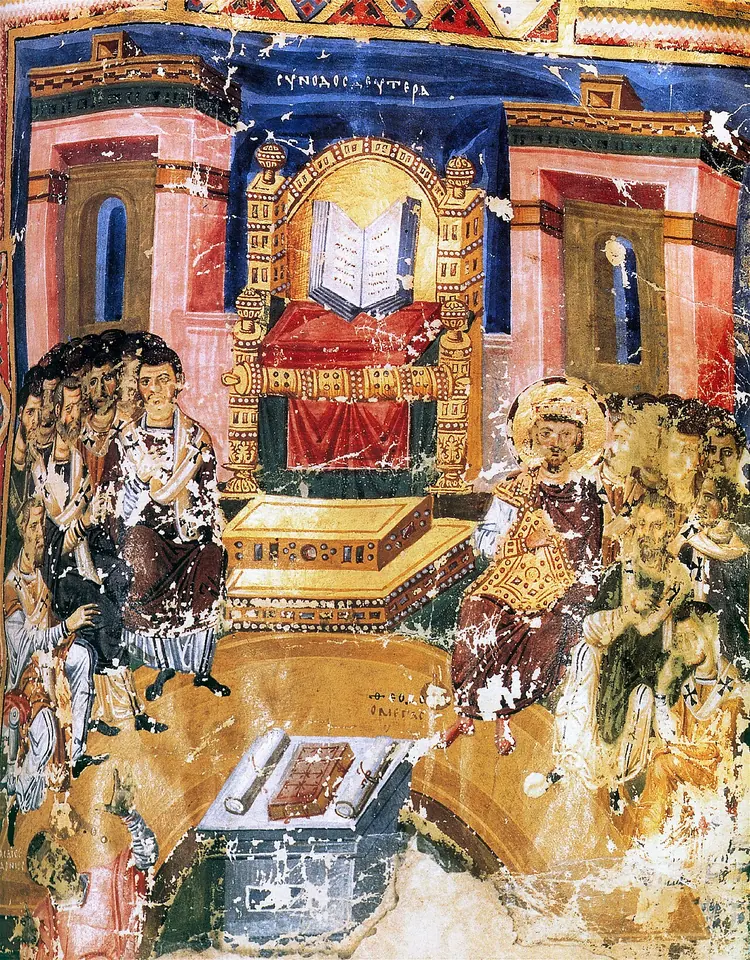
In November 380 the new emperor Theodosius gave the churches back to the Nicenes and enthroned Gregory in the cathedral. In 381 Gregory presided over the Council of Constantinople after the death of Meletius of Antioch. Bishops arriving late disputed his right to the see, and Gregory, ill and tired of the quarrels, offered to be thrown overboard like Jonah to calm the storm. He resigned, preached a farewell sermon and went home.

He spent his last years at Arianzus, writing poetry. Benedict XVI counted almost 18,000 surviving verses, including a long autobiography. He died in 389 or 390.
Miracles of St. Gregory
Gregory is honored for his teaching, not for wonders, and none of his miracles has been formally approved. The Orthodox life tells two stories, both traditional: his rescue from the storm on the way to Athens after his vow, and an assassin sent against him in Constantinople who came instead to his feet in tears of repentance.
Symbols of St. Gregory in art
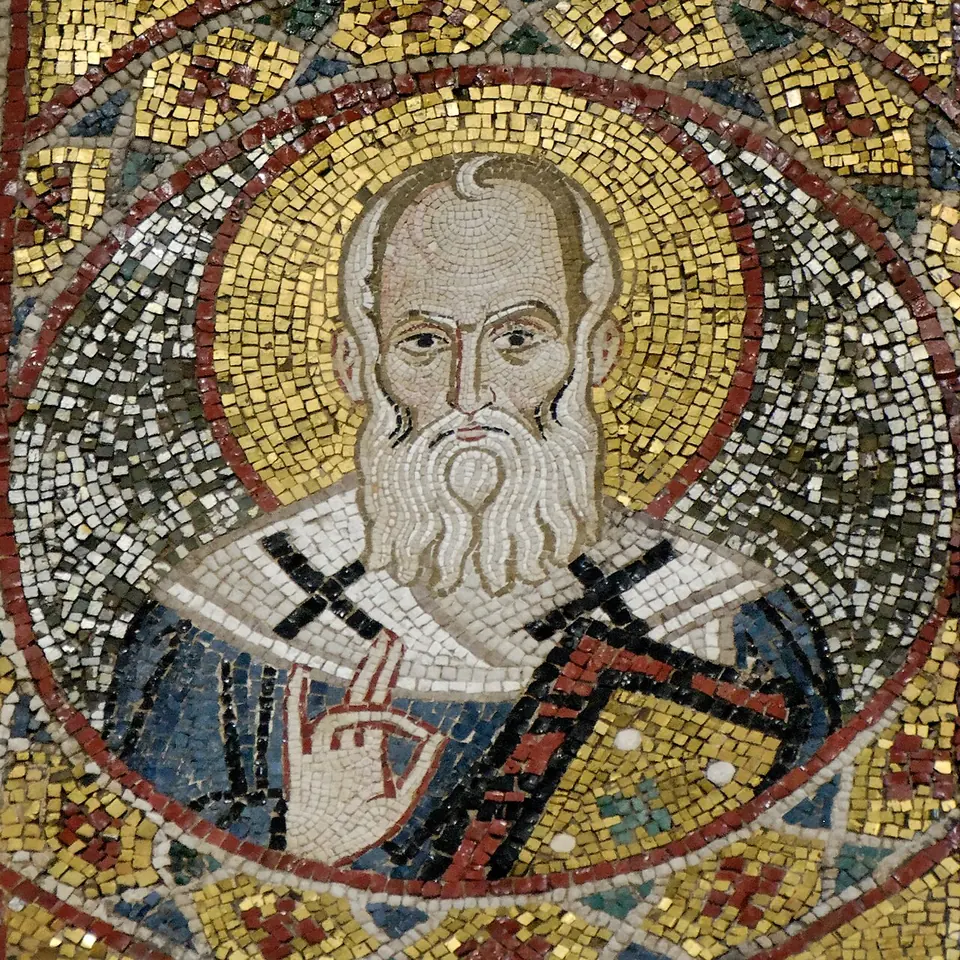
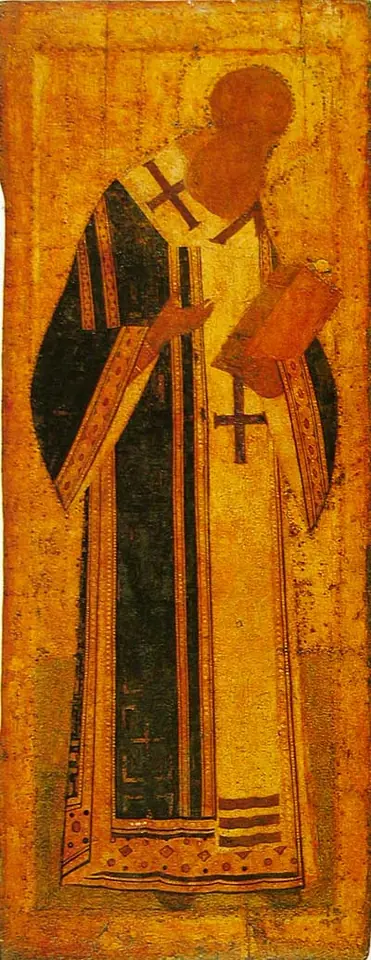
Icons make Gregory easy to recognize. Catholic Culture's notes on his feast describe the type: a balding head with a bushy white beard, which sets him apart from the dark, pointed beard of Basil. Like other Eastern bishops he wears a white omophorion with black crosses and holds a book or scroll. The Martorana mosaic and the Rublev workshop icon on this page both follow the type. In the Three Holy Hierarchs icon of January 30 he stands beside Basil and John Chrysostom.
Western images show him writing, sometimes with a dove or the hand of God above him to show that his teaching was inspired.

Feast day and relics
Catholics celebrate Gregory with Basil on January 2. The Orthodox Church keeps January 25 and the Three Holy Hierarchs on January 30. See the feast day calendar. Gregory has no traditional patronage beyond his title; this encyclopedia lists him among the patron saints of theologians for that reason.
Gregory was buried at Nazianzus. In 950 his relics were taken to the Church of the Holy Apostles in Constantinople, and part of them later reached Rome. On November 27, 2004, at St. Peter's, Pope John Paul II returned relics of Gregory and St. John Chrysostom to Ecumenical Patriarch Bartholomew I, ending what the Patriarch called their "involuntary age-old separation" from Constantinople.
Prayer to St. Gregory
Catholics pray the collect of January 2, which asks God, who gave light to the Church "by the example and teaching of the Bishops Saints Basil and Gregory," that "in humility we may learn your truth and practice it faithfully in charity." The Orthodox troparion of his feast, in the translation of the Orthodox Church in America:
The sweet-sounding shepherd's pipe of your theology / overpowered the trumpeting of the orators; / for having searched the depths of the Spirit / eloquence was also bestowed upon you. / Pray to Christ God, Father Gregory, / that our souls may be saved.
Gregory's own counsel on prayer comes from the first Theological Oration: "we ought to think of God even more often than we draw our breath."
Frequently asked questions
Why is St. Gregory of Nazianzus called "the Theologian"?
For his Five Theological Orations on the Trinity, preached in Constantinople in 380. The Catholic Encyclopedia notes that among Christian teachers only the Apostle St. John shares the title.
When is St. Gregory Nazianzen's feast day?
January 2 in the Roman Catholic calendar, together with St. Basil the Great. The Orthodox Church celebrates him on January 25 and again on January 30 with Basil and St. John Chrysostom as the Three Holy Hierarchs.
What was the friendship between Gregory and Basil like?
They met as students in Caesarea and again in Athens. In his funeral oration for Basil, Gregory wrote, "We seemed to have one soul, inhabiting two bodies." The friendship cooled when Basil made him bishop of the tiny town of Sasima against his will, but Gregory's oration for him remains one of the great tributes of ancient literature.
Where are St. Gregory of Nazianzus's relics?
His body was moved from Nazianzus to the Church of the Holy Apostles in Constantinople in 950, and part of the relics later went to Rome. On November 27, 2004, Pope John Paul II gave relics of Gregory and John Chrysostom back to the Ecumenical Patriarch Bartholomew I for the Church of Constantinople.
Sources
- Catholic Encyclopedia (1910): St. Gregory of Nazianzus
- Catholic Encyclopedia (1908): First Council of Constantinople
- Gregory Nazianzen, First Theological Oration (Oration 27), NPNF translation
- Gregory Nazianzen, Third Theological Oration (Oration 29), NPNF translation
- Gregory Nazianzen, Fifth Theological Oration (Oration 31), NPNF translation
- Gregory Nazianzen, Oration 43, Funeral Oration on the Great St. Basil (NPNF translation)
- Benedict XVI, General Audience of 8 August 2007: Saint Gregory Nazianzus (1)
- Benedict XVI, General Audience of 22 August 2007: Saint Gregory Nazianzus (2)
- John Paul II, Letter to the Ecumenical Patriarch on the return of the relics of St. Gregory Nazianzen and St. John Chrysostom (November 27, 2004)
- Orthodox Church in America: Saint Gregory the Theologian, Archbishop of Constantinople
- Orthodox Church in America: Saint Gregory the Theologian, Troparion and Kontakion
- Catholic Culture: Memorial of St. Basil the Great and St. Gregory Nazianzen