St. Genevieve, Patroness of Paris
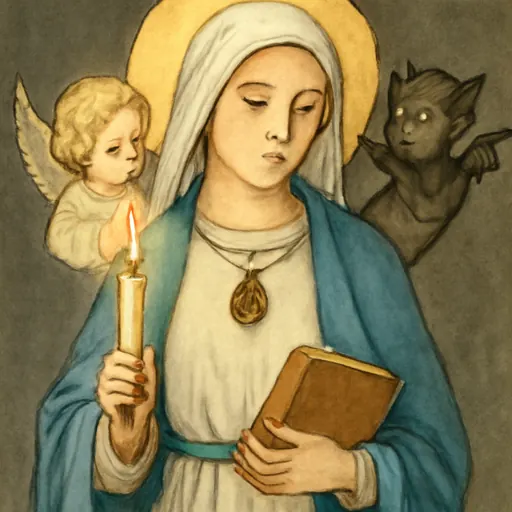
St. Genevieve (c. 420–c. 510) was a consecrated virgin of Paris who, according to the Life written soon after her death, kept the city from panic when Attila's Huns approached in 451 and later ran grain boats through a Frankish blockade to feed it. She is the patron saint of Paris. Her feast day is January 3.
Who was St. Genevieve?
Genevieve (Genovefa in Latin, Geneviève in French) was a woman of Nanterre, west of Paris, who gave her life to God as a child and spent most of her long life in Paris as a consecrated virgin. She lived through the end of Roman rule in Gaul and the rise of the Frankish kings. When Attila's Huns approached in 451, and again when the Franks blockaded the city, Parisians turned to her, and the city has called her its protector ever since.
Nearly everything known about her comes from one text, the Latin Life of St. Genovefa. Its anonymous author says he wrote 18 years after her death, around 530. The Dictionary of Christian Biography (1911) was doubtful about how much of it is history, while the Archdiocese of Paris today treats it as a reliable historical basis. What follows tells the story as the Life gives it.

The life of St. Genevieve
A child at Nanterre
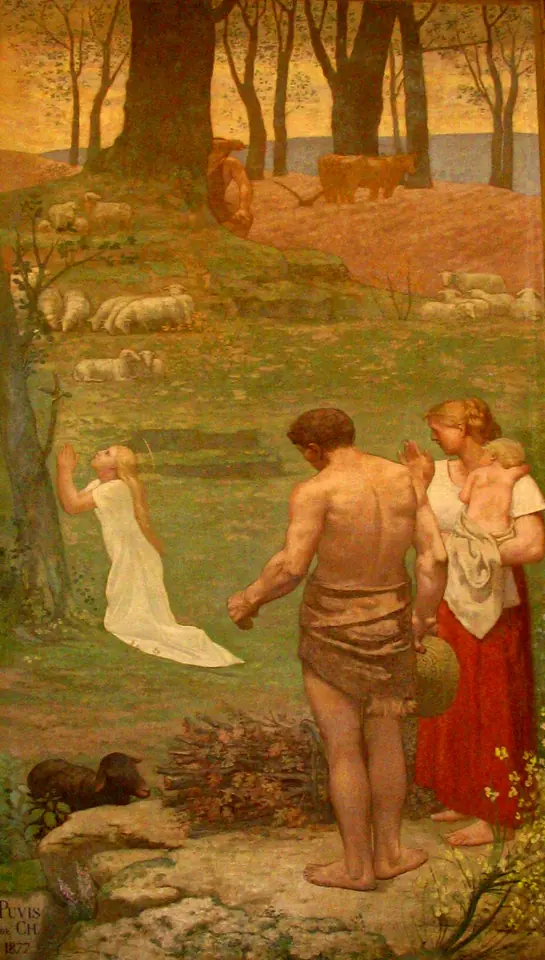
She was born about 419 or 422, the daughter of Severus and Gerontia. Legend later made her a poor shepherd girl, but the Catholic Encyclopedia thought her parents more likely well-off townspeople.
In 429, two bishops, St. Germanus of Auxerre and St. Lupus of Troyes, stopped at Nanterre on their way to Britain, where they were going to preach against the Pelagian heresy. Germanus noticed a girl of about seven in the crowd that came out to meet them. He told her parents she would lead a holy life and bring many others to God, and asked the child whether she wanted to give herself to Christ. She said she did.
The next morning, the Life says, Germanus picked up a bronze coin marked with a cross and gave it to her, telling her to wear it around her neck in place of any gold or pearls.

A consecrated virgin in Paris
There were no convents near Nanterre. Genevieve stayed at home and lived a life of prayer. At about fifteen, with two other girls, she received the veil of a consecrated virgin from the bishop of Paris. After her parents died she moved into the city to live with her godmother.
The Life says that from fifteen to fifty she ate only twice a week, barley bread or beans, until her bishops ordered her to add a little fish and milk. She kept vigil every Saturday night and stayed shut in her cell from Epiphany to Easter.
Neighbors called her a fraud, and the Catholic Encyclopedia says some plotted to drown her. On a second journey to Britain, Germanus came to her home and greeted her with respect in front of the crowd. The bishop of Paris later put her in charge of the city's consecrated virgins.

Attila and the Huns, 451
In 451 news came that Attila and his Huns were marching across Gaul. The people of Paris began to load their goods to flee. Genevieve gathered the married women of the city and urged them to save Paris with prayer and fasting rather than flight. According to the Life, the women kept vigil with her for days, and she told the men not to carry their goods away, because the city would be spared and the places they fled to would not.
The men turned on her as a false prophet, and there was talk of killing her. But the Huns never came. Attila's army "turned off towards Orléans, leaving Paris untouched," in the words of the Catholic Encyclopedia, and was defeated that summer at the Catalaunian Plains. The Dictionary of Christian Biography puts it carefully: the Huns turned away "through the efficacy of her prayers, as after-ages believed." The story is traditional.

The blockade and the grain boats
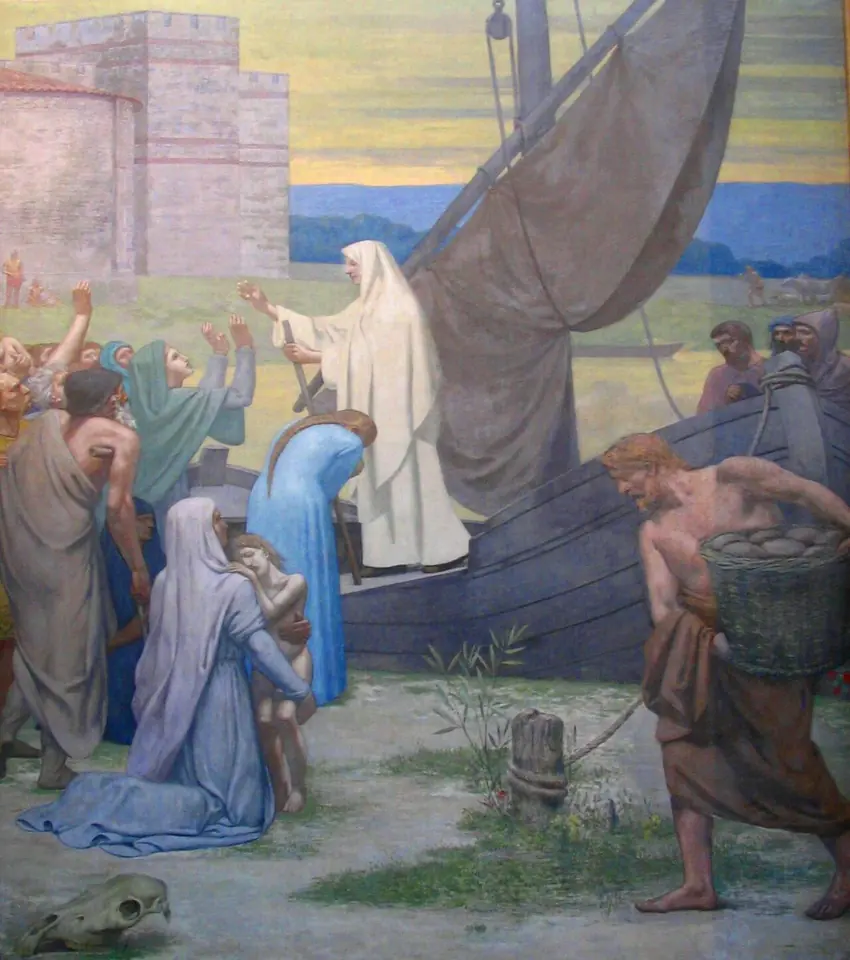
Some years later the Frankish king Childeric besieged Paris, and the city began to starve. The Diocese of Paris tells how Genevieve took a small fleet of boats up the Seine and the Aube to Arcis, and came back with eleven boats of grain, which she gave to the poor first. The Life says a storm nearly sank them on the way home and her prayers saved the boats.
The Catholic Encyclopedia credits her influence with the unusual mercy that Childeric and his son Clovis showed the people of Paris, and the Life says Clovis often freed prisoners at her request.

Builder of churches
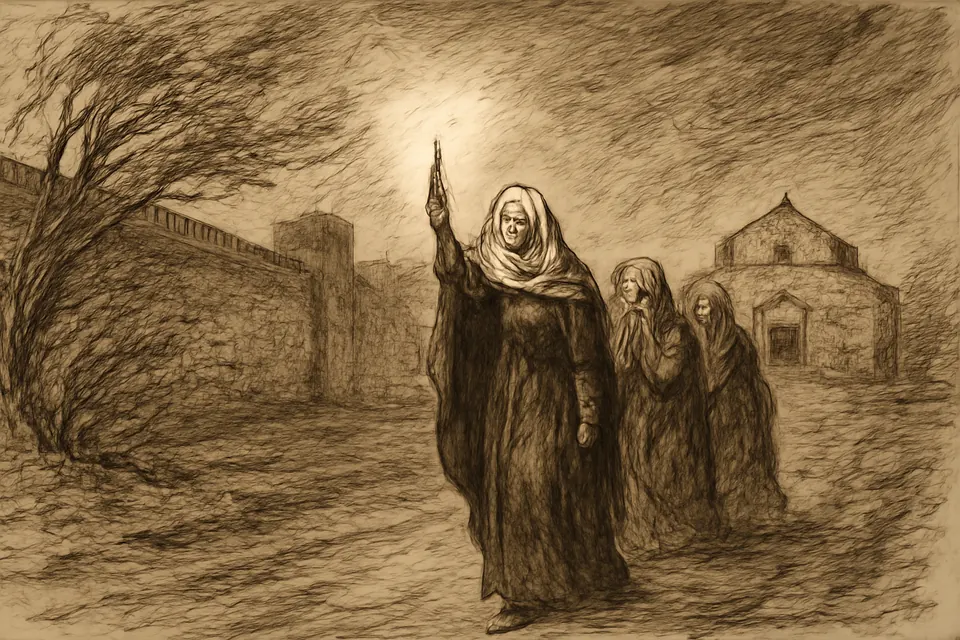
Genevieve had a basilica built over the tomb of St. Denis, the martyred first bishop of Paris, and often walked there to pray at night. Once, the Life says, the wind blew out the candle that lit her way; she took it in her hand and it lit again.
Late in her life she urged Clovis, by then a Christian, to build a church on the hill on the Left Bank. Clovis began the Church of the Holy Apostles, St. Peter and St. Paul, and his queen, St. Clotilde, finished it after his death in 511. Genevieve died on January 3, probably in 512 (some historians prefer about 502), at an advanced age. She was buried in the new church beside the king.


The miracles of St. Genevieve
The Life is full of healings: the blind given sight, a drowned boy brought back to life, the possessed set free. Later miracles were credited to her relics, carried in procession whenever Paris was in danger. None was investigated in the modern way, which did not yet exist.
- Traditional: the miracles of the Life, including the candle that relit and the sparing of Paris in 451, and the city's rescue from a flood in 834.
- Reported: the miracle des Ardents in 1129. An epidemic of mal des ardents (burning sickness), now thought to be ergot poisoning from moldy rye, killed more than 14,000 people. The Catholic Encyclopedia says it "ceased suddenly during a procession in her honour," and that Pope Innocent II examined the cure himself in 1130 and ordered a feast on November 26 to remember it.
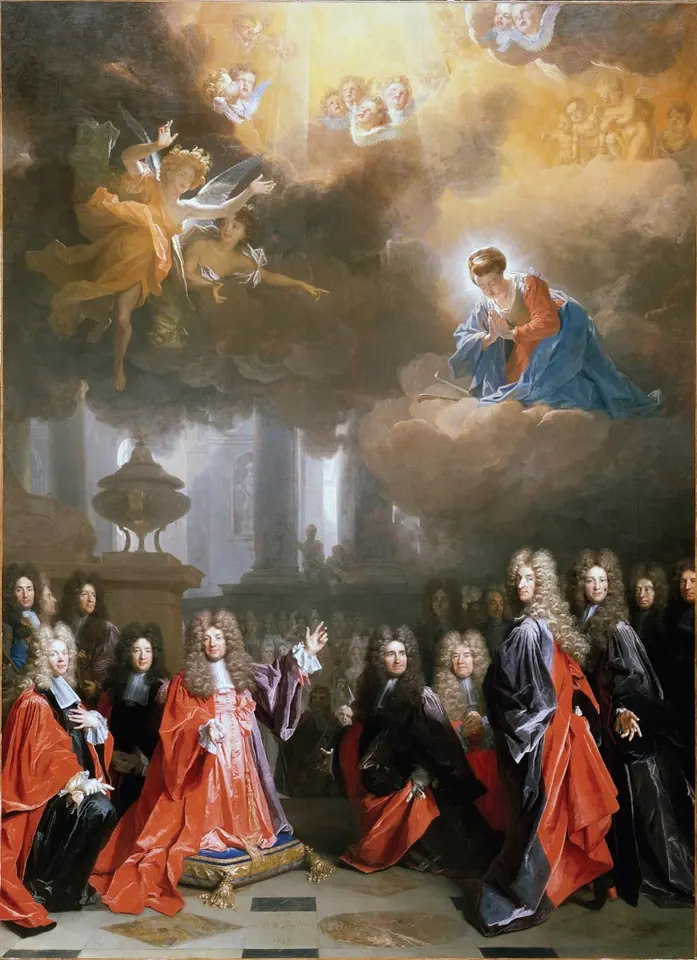
- Reported: the end of a drought in 1694 and of weeks of flooding rain in 1725, each after a procession of her shrine. The magistrates of Paris gave thanks with large painted ex-votos.

Why St. Genevieve is the patron saint of Paris
Her patronage grew out of what she did in life: she kept Paris from panic in 451 and fed it during the blockade. After her death her tomb on the hill, now the Montagne Sainte-Geneviève, became the place Parisians went for help, and her relics were carried down to Notre-Dame for floods, droughts, epidemics and wars.
Her cult spread across France, and she is often called a patroness of the whole country, though the Church's named secondary patronesses of France are St. Joan of Arc and St. Thérèse of Lisieux. The French Gendarmerie keeps her as its patroness and marks her day on November 26. See all the patron saints by cause.
Symbols of St. Genevieve in art
Genevieve is usually a young woman in a long veil and mantle. Look for these attributes:
- A candle: the most common one, from the story of the candle that relit on the way to St. Denis's tomb. In medieval art an angel at one shoulder relights it while a small devil at the other tries to blow it out, often with a pair of bellows.
- A coin or medal with a cross: the gift of St. Germanus, worn on a cord at her neck.
- A shepherd's crook and sheep: from the 16th century on, painters showed her as a shepherdess at Nanterre, an image of her watching over Paris like a flock. Historians doubt she was ever a shepherd.
- A book: her life of prayer.
- Keys: sometimes, the keys of the city or of the prisons she opened.
- Paris itself: boats, the walls of the city or the Seine behind her.
The richest place to see her is the Panthéon, where a cycle of murals on her life was begun in 1874. Pierre Puvis de Chavannes painted her childhood and, near the end of his life, the grain boats and the old saint keeping watch over the city. Jean-Paul Laurens painted her death.
Feast day, relics and where she is honored
St. Genevieve's feast is January 3, the anniversary of her death. It is in the Roman Martyrology and is kept with special solemnity in Paris and Nanterre. See the feast day calendar for her neighbors in early January, including St. Elizabeth Ann Seton on January 4.
The Panthéon
Her church on the hill became one of the great abbeys of Paris. In 1744 Louis XV fell gravely ill at Metz, prayed to St. Genevieve, recovered and promised the canons a new church. Jacques-Germain Soufflot designed it, the king laid the first stone on September 6, 1764, and it was finished in 1790.


The Revolution claimed it at once. After the death of Mirabeau in 1791 it became a national burial place for great men, and Voltaire was brought there that year. It changed between church and Panthéon six times before the funeral of Victor Hugo in 1885 settled it as a secular monument. The old abbey church beside it was pulled down in 1804; only its bell tower survives, inside the Lycée Henri-IV.
Saint-Étienne-du-Mont and her relics
In 1793 the revolutionary authorities melted down her reliquary and burned her bones on the Place de Grève; by most accounts the ashes were thrown into the Seine. The parish church of Saint-Étienne-du-Mont, next door, inherited her cult. Since the early 19th century it has kept relics that other churches had held since the 9th century, and its gilded shrine holds the surviving stones of her first sarcophagus.


Her chapel there dates from 1853, with windows of 1869 that tell her story, and the parish holds a novena from January 3 to 11 every year. In 2020 the Archdiocese of Paris kept a Year of St. Genevieve for the 1,600th anniversary of her birth.
Prayer to St. Genevieve
No single prayer to St. Genevieve is used throughout the Church. In Paris the best known is the diocesan prayer for the Year of St. Genevieve, which Archbishop Michel Aupetit asked Catholics to say daily from March 13, 2020, until the COVID-19 epidemic ended. It begins:
Sainte Geneviève, écoute favorablement nos prières. En nous tournant vers toi, nous nous souvenons de tous les bienfaits que depuis seize siècles, tu n'as cessé d'obtenir de Dieu en faveur de ceux qui t'implorent. Aujourd'hui, de nouveau, nous en appelons à ta puissante intercession. Veille sur notre Ville Capitale, et tous ses habitants.
In English: "St. Genevieve, hear our prayers with favor. As we turn to you, we remember all the blessings that for sixteen centuries you have never ceased to obtain from God for those who call on you. Today, once again, we appeal to your powerful intercession. Watch over our capital city and all who live in it." It goes on to ask her help for public officials, the sick, the hungry, exiles and students, and ends, "Sainte Geneviève, nous t'en supplions, Prie Dieu pour nous" ("St. Genevieve, we beg you, pray to God for us").
Elsewhere Catholics usually ask her help simply, "St. Genevieve, pray for us," for their city, for rain or relief from floods, or for those who keep public order.


Frequently asked questions
What is St. Genevieve the patron saint of?
Paris above all, and by extension France. Parisians carried her relics through the streets in times of drought, flood, epidemic and war for more than a thousand years. She is also the patroness of the French Gendarmerie, which honors her on November 26.
When is St. Genevieve's feast day?
January 3, the day of her death. It is in the Roman Martyrology and is kept with special solemnity in Paris, where the Church of Saint-Étienne-du-Mont holds a novena in her honor from January 3 to 11. She is not on the General Roman Calendar, so most parishes outside France don't mark the day.
Did St. Genevieve really stop Attila?
Her Life says she persuaded the people of Paris not to flee and urged the women to pray and fast, and that Attila's army passed by. The Huns did turn toward Orléans in 451. Whether her prayers caused that is a matter of faith; the story is classed here as traditional.
Where are St. Genevieve's relics?
Most of her relics were burned in 1793 during the French Revolution. The Church of Saint-Étienne-du-Mont, next to the Panthéon, keeps the surviving stones of her original sarcophagus in a gilded shrine, along with relics that had been kept in other churches since the 9th century.
Is the Panthéon a church of St. Genevieve?
It was built as one. Louis XV vowed a new church for her abbey after recovering from an illness in 1744, and it was finished in 1790. The Revolution turned it into a burial place for great French men and women in 1791. It changed back and forth between church and Panthéon several times before 1885, and murals of her life still line its walls.
Sources
- Catholic Encyclopedia (1909): St. Genevieve
- Dictionary of Christian Biography and Literature (1911): Genovefa, patron saint of Paris and France
- Diocèse de Paris: Portrait de sainte Geneviève
- Diocèse de Paris: Prière à sainte Geneviève (Année sainte Geneviève 2020)
- Paroisse Saint-Étienne-du-Mont: Histoire et architecture
- Centre des monuments nationaux: Histoire du Panthéon
- Patrimoine-histoire.fr: Église Saint-Étienne-du-Mont, 5e arrondissement (the ex-votos to St. Genevieve)
- 20 Minutes (2016): A day off for the gendarmes on the feast of St. Genevieve
- Vita sanctae Genovefae (anonymous, early 6th century), in Acta Sanctorum, January vol. 1
- Jo Ann McNamara and John E. Halborg, Sainted Women of the Dark Ages (Duke University Press, 1992), Life of Genovefa
- Roman Martyrology, January 3