St. Ursula and the Eleven Thousand Virgins
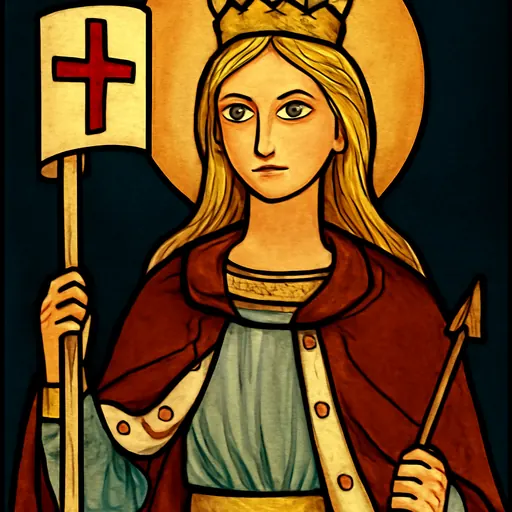
St. Ursula is the legendary leader of the virgin martyrs of Cologne, Germany. History knows only that virgins were martyred there at an unknown date and that a senator named Clematius rebuilt a church in their honor, probably in the 4th century; the famous story of Ursula as a British princess with 11,000 companions grew up in the 9th and 10th centuries. Her feast day is October 21, and the Ursuline sisters, founded to educate girls, are named for her.
Who was St. Ursula?
St. Ursula is the name at the head of one of the most popular legends of the Middle Ages: a British princess who sailed to Rome with eleven thousand virgin companions and died with them as a martyr at Cologne, on the Rhine. Behind the legend there is a small, real core. Christian virgins were put to death at Cologne at some unknown date, and by the 4th or 5th century a church stood over the place where they were believed to have died.
Everything else, including Ursula's name as their leader, her royal birth, the voyage and the number eleven thousand, came later. The Catholic Encyclopedia of 1912 sums it up: "The history of these celebrated virgins of Cologne rests on ten lines, and these are open to question." Catholic Culture's calendar, quoting John Delaney's Dictionary of Saints, calls the medieval versions "pious fictions," while affirming that the martyrs of Cologne were real.
This entry tells both stories, the history and the legend, and explains how one grew out of the other.

What history knows: the Clematius inscription
The oldest evidence is a stone slab set into the south wall of the choir of the Basilica of St. Ursula in Cologne. Its Latin says that a man of senatorial rank named Clematius, "frequently admonished by divine flaming visions," rebuilt from its foundations, on his own land and at his own cost, a basilica on the spot where holy virgins had shed their blood for the name of Christ. It ends with a warning that anyone buried there, other than the virgins, would be punished in the fires of hell.
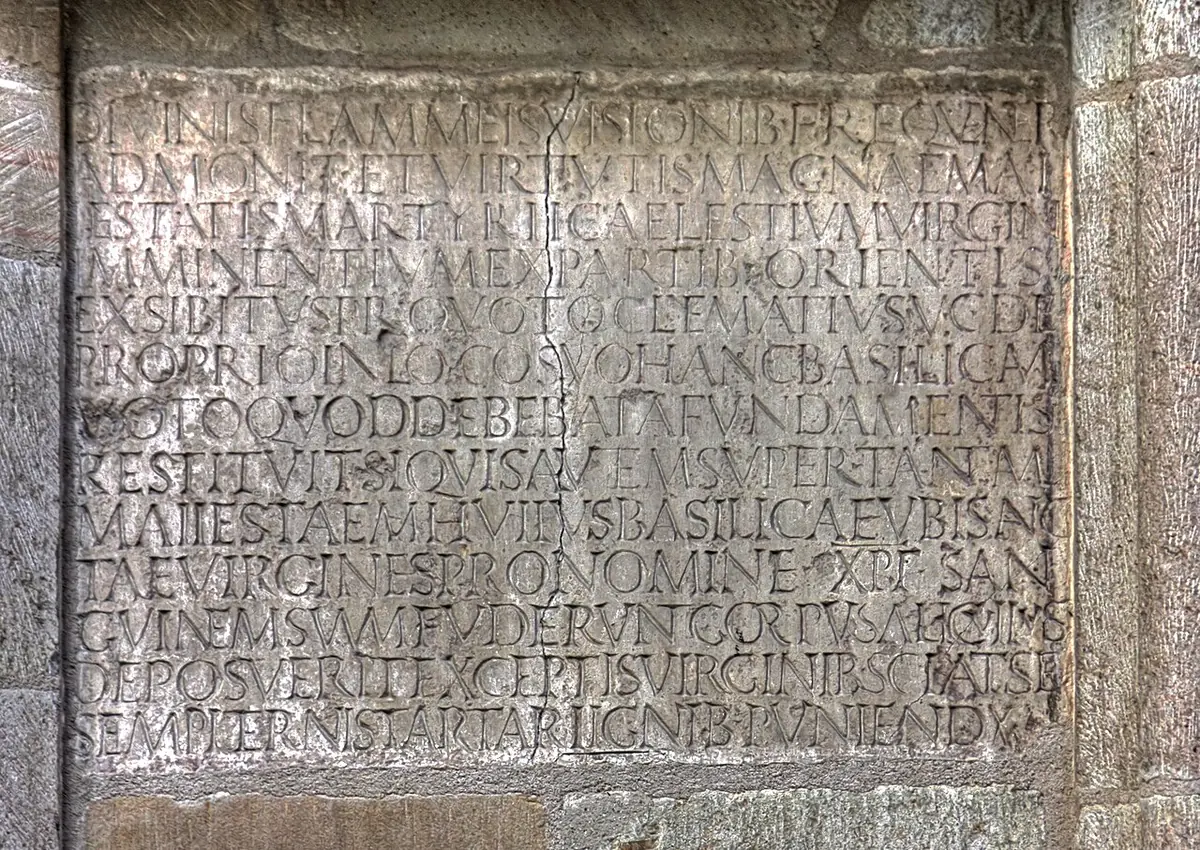

The date of the stone is debated. The Catholic Encyclopedia placed it in the 5th century at the latest and probably the 4th, and the Cologne society that cares for the city's Romanesque churches says recent research dates it to the 4th century. Some scholars have argued for a much later date. Either way, the inscription gives no number, no names and no date for the martyrdom. It also implies that an even older church had stood there before Clematius rebuilt it.
How the legend grew
For almost five hundred years after the inscription, the record is silent. Then, in the 9th century, the virgins of Cologne reappear:
- Church calendars and litanies list them on October 21, naming five, eight or eleven virgins, among them Ursula, Sencia, Gregoria, Pinnosa, Martha and Saula. In only one of these lists does Ursula come first.
- A sermon for their feast from the 9th century says there were several thousand of them, martyred under Diocletian and Maximian, and names only one, Pinnosa, then seen as their leader.
- Wandalbert of Prüm, writing his martyrology about 850, also speaks of several thousand; Usuard, about 875, mentions only "Martha and Saula with several others."
By about the year 900, "the eleven thousand virgins" was accepted without dispute, and Ursula had taken Pinnosa's place at their head. How the number arose is unknown. The theory most often repeated, and the one Catholic Culture favors, is that an abbreviation such as "XI M V," meaning eleven martyred virgins, was misread as eleven thousand (millia) virgins. Others proposed that a name like Undecimilla was mistaken for a number. The Catholic Encyclopedia called these readings "rather gratuitous" and thought it less arbitrary that the eleven names in the old liturgical books were combined with Wandalbert's "several thousand." Nobody can prove any of them.
The legend of St. Ursula
The full story took shape in two Latin Passions written at Cologne in the 9th and 10th centuries and was later retold in Jacobus de Voragine's Golden Legend (about 1260). All of it is traditional.
Ursula was the daughter of a Christian king in Britain. A powerful pagan king asked for her hand for his son. She wished to stay a virgin, and won a delay of three years. Ten noble young women were given to her as companions, and each of the eleven had a thousand maidens with her. They sailed in eleven ships, came up the Rhine to Cologne and on to Basel, and went on foot to Rome. In some versions her betrothed, Aetherius, was baptized and joined them. On the way home they reached Cologne while the Huns were besieging it. The Huns killed the virgins, and when Ursula refused to marry their leader, he shot her with an arrow.
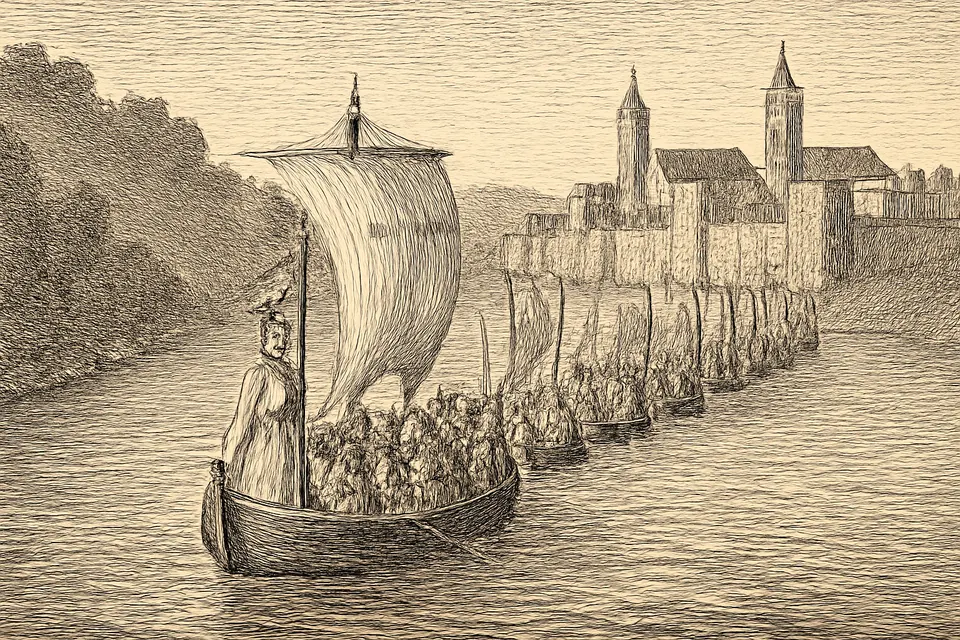
In 1136 Geoffrey of Monmouth told a different version in his History of the Kings of Britain. There, Ursula is a Cornish princess sent with eleven thousand noblewomen to marry settlers in Brittany, and a storm drives the fleet to its doom. Medieval readers added more: the 12th-century visions of St. Elisabeth of Schönau supplied names for many companions, including a "Pope Cyriacus" who supposedly abdicated to follow them. No pope of that name exists, and the Catholic Encyclopedia rejects these additions outright.


The bones of Cologne
The legend had a physical side. St. Ursula's church stands on a Roman cemetery. When Cologne extended its walls early in the 12th century, workers uncovered a large burial ground. It held the bones of women, men and children, which the city took as the remains of Ursula's company, and they were sent as relics all over Europe. The Catholic Encyclopedia calls the inscriptions found with them in the 12th century "gross forgeries."
Ursula became, with St. Gereon, a patron of Cologne in the 12th century, and since the 16th century the city's coat of arms has carried eleven flames for the eleven martyrs.
Miracles and legends of St. Ursula
No miracle has ever been formally investigated in her cause. By this encyclopedia's labels:
- The angel's announcement of her martyrdom in a dream: traditional, from the late medieval legend as Carpaccio painted it.
- The voyage of the eleven thousand and their martyrdom by the Huns: traditional.
- The visions of Clematius that moved him to rebuild the church: reported, by the inscription itself.
- Visions of the martyrs' names in the 12th century: reported by their visionaries, but the Church never accepted them as history.
Why St. Ursula is a patron saint
Catholic Culture's calendar names her patron of Cologne, of Catholic education (especially of girls), educators, teachers, students and schoolchildren, of the Ursuline order, and of a holy death. The teaching patronages come from the Ursulines. In 1535 St. Angela Merici gathered a group of women in Brescia called the Company of St. Ursula, chosen for a virgin saint who led other young women. In 1572 St. Charles Borromeo obtained for the Ursulines of Milan the status of an enclosed religious order; the Catholic Encyclopedia calls them the first teaching order of women in the Church. See the full list on our patron saints page.
The Ursulines carried her name across the Atlantic. In 1639 St. Marie of the Incarnation and Madame de la Peltrie founded a monastery at Quebec, the oldest institution of learning for women in North America, where the nuns taught First Nations and French girls. In 1727 Ursulines from France reached New Orleans and opened the first Ursuline foundation in what became the United States.

Symbols of St. Ursula in art
Ursula is easy to spot once you know her signs:
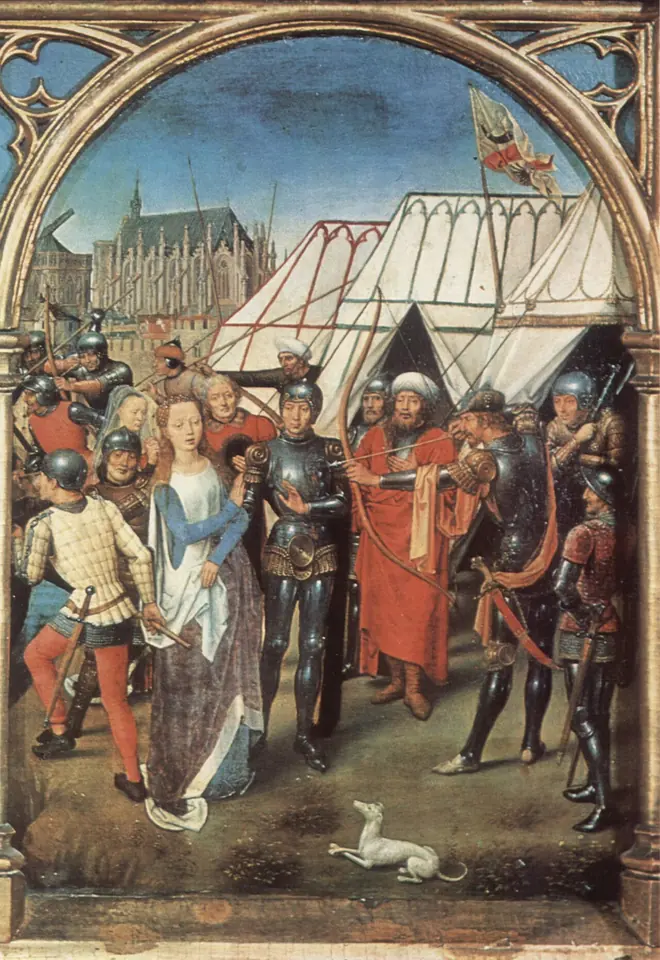
- An arrow: the weapon the Hun leader used to kill her.
- A white banner with a red cross: a sign of victory over death, often said to recall St. George and England.
- A crown: for a king's daughter.
- A wide cloak sheltering many small maidens: a German and Flemish image of her as protector of her companions.
- Ships: for the voyage, especially in story cycles.
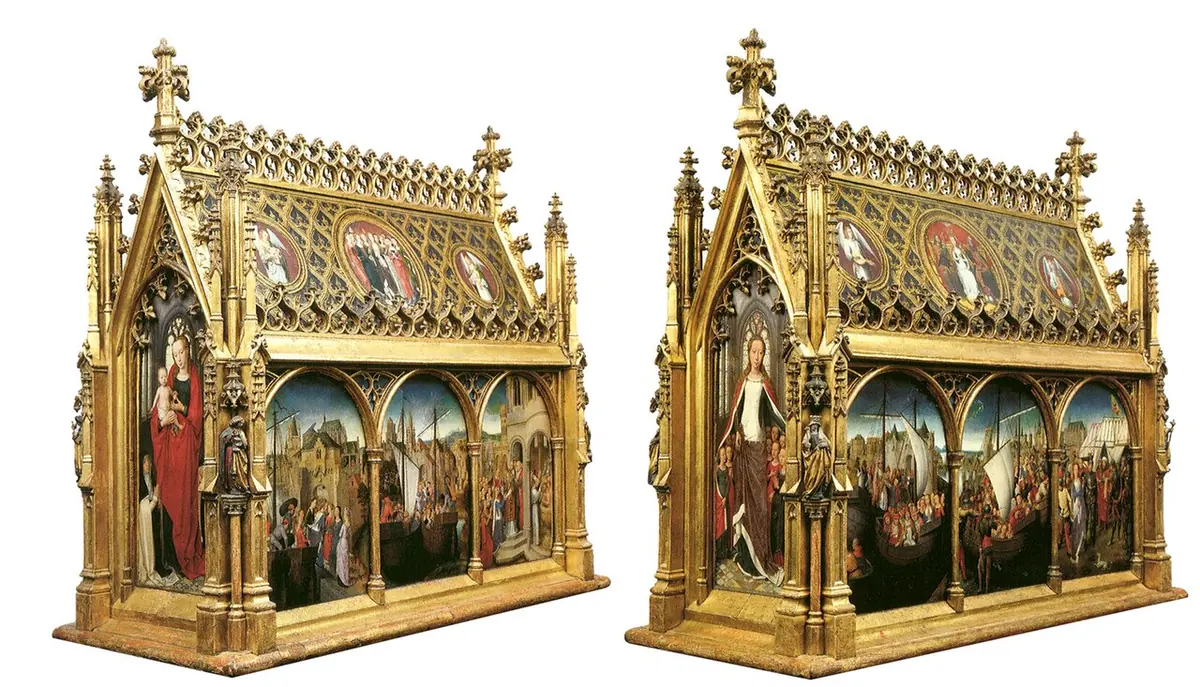
Painters loved her story. Memling's reliquary in Bruges tells it in six arched panels, ending with Ursula standing calm among soldiers as an archer takes aim, with the towers of Cologne behind her. Carpaccio painted a nine-canvas cycle for a confraternity in Venice in the 1490s, now in the Gallerie dell'Accademia. The choir of St. Ursula in Cologne has its own cycle of 30 scenes, painted in 1456 by a Cologne master close to Stefan Lochner's workshop.

The Basilica of St. Ursula and the Golden Chamber
The Romanesque basilica that stands today was built in the 12th century on the site of earlier churches, with a tall Gothic choir added about 1260–1270. Pope Benedict XV made it a minor basilica in 1920. It was badly damaged in the bombing of 1942 and rebuilt after the war. In the choir, skulls wrapped in embroidered red cloth line the walls, and among them is the head venerated as Ursula's.


The Golden Chamber, a relic chapel at the southwest corner of the church, was begun in 1642 when the old one overflowed with bones. It was paid for by the imperial councilor Johann Crane and his wife, Verena Hegenmüller, and its altar was consecrated on September 16, 1644. The golden tracery that gives the chamber its name was installed shortly before 1700. More than a hundred reliquary busts, dating from the late 13th to the 18th century, fill its shelves, and the walls above are covered with flowers, scrolls and whole inscriptions laid out in bone. A ceiling of blue with eleven-pointed golden stars was restored recently.


The feast of St. Ursula
Ursula's feast is October 21. In the 1969 reform of the Roman calendar, the commemoration of Ursula and her companions was removed from the General Roman Calendar because so little is known about them. The Roman Martyrology still lists the virgin martyrs of Cologne on October 21, and Cologne and the Ursulines continue to keep the day. See her neighbors on our feast days page.
In the 12th century, St. Hildegard of Bingen wrote thirteen chants for Ursula and her companions, among them the sequence O Ecclesia.


Prayer to St. Ursula
The Mass for Ursula and her companions was in the Roman Missal before 1969. Its collect, as printed by Catholic Culture, reads:
O God, Who hast granted to the virgins worthily consecrated to Thee, the courage to face, with Ursula as their leader, a wonderful fight whereby through the palm of martyrdom they reached the glory of Heavenly contemplation, we beseech Thee grant that we may be aided by the prayer of those who in this day after passing through the gates of death, Thou has made to triumph in Heaven. Through our Lord Jesus Christ, Who liveth and reigneth with God the Father, in the unity of the Holy Ghost, God, world without end. Amen.
Ursuline schools and communities pray to her on her feast in their own words, often for students and teachers. Catholics who ask her help commonly pray for young people, for those who teach them and for a holy death.
Frequently asked questions
Were there really 11,000 virgins?
Almost certainly not. The oldest evidence, the Clematius inscription in Cologne, gives no number at all. Ninth-century church calendars name between five and eleven virgins, and the figure of "eleven thousand" first appears around the year 900. Several explanations have been suggested, including a misreading of an abbreviation like "XI M V" (eleven virgin martyrs) as eleven thousand virgins. The Catholic Encyclopedia thinks the likelier source is the eleven names in old liturgical books combined with an earlier writer's claim of "several thousand."
When is St. Ursula's feast day?
October 21. Her commemoration was dropped from the General Roman Calendar in 1969 because almost nothing about the martyrs is known, but the Roman Martyrology still commemorates the virgin martyrs of Cologne on that day, and she remains much honored in Cologne.
What is St. Ursula the patron saint of?
Cologne, Catholic education (especially of girls), teachers, students and schoolchildren, the Ursuline order, and a holy death, according to Catholic Culture's calendar. The Ursulines, founded by St. Angela Merici in 1535, spread her name to schools around the world.
What is the Golden Chamber in Cologne?
A relic chapel in the Basilica of St. Ursula, built from 1642 and consecrated in 1644, whose walls are covered with patterns and lettering made of human bones and lined with more than a hundred reliquary busts. The bones come from the Roman cemetery around the church, which medieval Cologne took to be the burial ground of Ursula's companions.
Why is St. Ursula shown with an arrow?
In the Golden Legend, the Huns killed her companions at Cologne, but their leader wanted to marry Ursula. When she refused, he shot her with an arrow. The arrow, a crown and a white banner with a red cross are her usual signs in art.
Sources
- Catholic Encyclopedia (1912): St. Ursula and the Eleven Thousand Virgins
- Catholic Encyclopedia (1912): The Ursulines
- Catholic Encyclopedia (1912): Ursulines of Quebec
- Catholic Culture: October 21 (Roman Martyrology note, patronages and symbols of Sts. Ursula and Companions)
- Catholic Culture: Collect for Saint Ursula and Companions
- Förderverein Romanische Kirchen Köln: St. Ursula, Chor (choir, Clematius inscription, relics)
- Förderverein Romanische Kirchen Köln: St. Ursula, Goldene Kammer
- Christian Iconography: St. Ursula in Art and Legend
- Medievalists.net: Cologne's Eleven Thousand Virgins and Hildegard of Bingen