St. Simeon Stylites
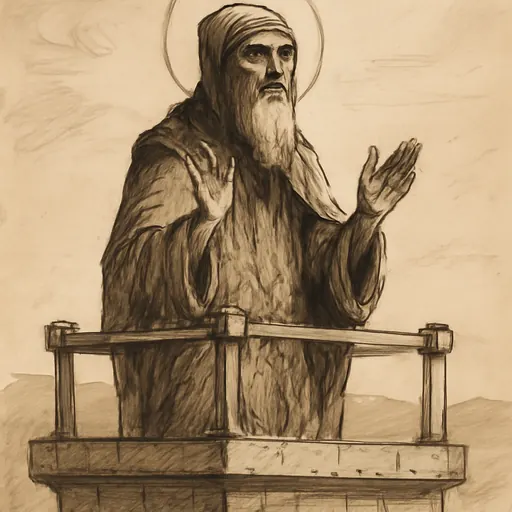
St. Simeon Stylites (about 389 to 459) was a Syrian monk who spent more than 36 years living on top of a pillar near Antioch, praying, fasting and preaching to the crowds who came from across the known world. He was the first of the stylites, or pillar saints. His feast is January 5 in the Roman Martyrology and September 1 in the Orthodox Church.
Who was St. Simeon Stylites?
Simeon was a Syrian monk of the 5th century who did something no Christian had done before: he went up a pillar and stayed there for the rest of his life. For more than thirty-six years he stood on a small platform near Antioch, in heat and frost, praying through the night, fasting through Lent and preaching every afternoon to the crowds below. People called him a stylite, from the Greek stylos, "pillar," and hundreds of later monks copied him.


His story could sound like legend, but it rests on unusually good evidence. Theodoret, bishop of Cyrrhus, knew him well and wrote about him while Simeon was still alive. A disciple named Antony wrote a second life, and a third survives in Syriac. The Catholic Encyclopedia notes that "no modern critic now ventures to dispute the reality of the feats of endurance attributed to these ascetics."
The life of St. Simeon
Shepherd boy and monk
Simeon was born around 389 in Sisan, a village in northern Syria. He tended his father's sheep. Theodoret says that one snowy day he went to church with his parents and heard the Gospel blessing those who mourn, and an older man explained to him the solitary life. Theodoret adds that he heard this "from the saint's own tongue."
He joined a monastery before he was sixteen, but his fasting and penances were so extreme that the community asked him to leave. He then shut himself in a small hut at Telanissos for three years and spent his first Lent there with no food or water. He kept that fast every Lent for the rest of his life. Next he chained himself within a small circle on a rocky hilltop, until Meletius, who then had charge of the church of Antioch, told him that the will could bind the body without iron. He had a smith strike it off.
Up the pillar
Crowds found him even there. They came to be healed, to ask advice, to touch him and take scraps of his clothing. Around 423 he had a pillar built to get away from them. Theodoret, writing in the 440s, records how it grew: "first of six cubits, then of twelve, next of twenty-two, and now of thirty-six." The last was about fifty feet high. A railing ran around the platform, and visitors climbed up by ladder.
Theodoret describes the pilgrims who came in this famous passage:
"So, as all are coming up from every quarter, and the road is like a river, one may see gathered in that place an ocean of men, which receives streams from every side; not only of those who live in our region, but Ishmaelites, and Persians, and the Armenians who are subject to them, and Iberi, and Homerites, and those who dwell beyond them. Many have come also from the extreme west, Spaniards, and Britons, and Gauls who live between the two." (Religious History 26, in Charles Kingsley's translation)
He adds that in Rome, little images of Simeon were placed in the porches of shops for protection.
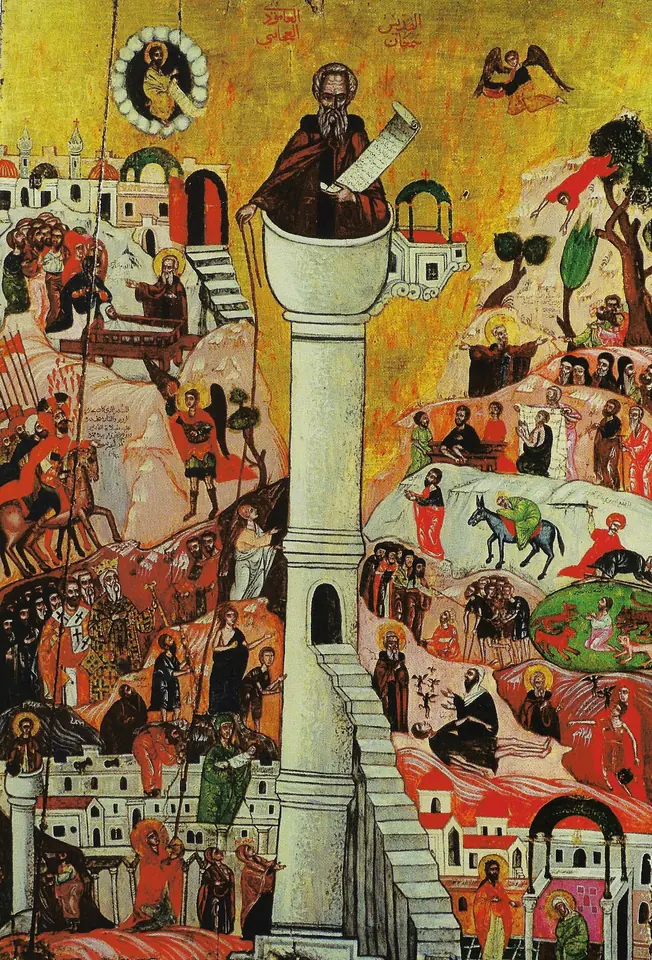

Simeon was not cut off from the world. Every afternoon he preached, settled quarrels and heard petitions. He wrote to bishops and emperors. Theodosius II and the empress Eudocia asked his advice, and he wrote to the emperor Leo in support of the Council of Chalcedon. He died on his pillar in 459, after some thirty-six years there. His body was taken to Antioch.

What Theodoret saw
Theodoret insists again and again that he is reporting what he saw. He watched whole tribes of Bedouin Arabs come to the pillar, smash their idols and ask for baptism: "And this I have seen with my own eyes, and have heard them renouncing the impiety of their fathers, and assenting to the Evangelic doctrine." Once, when Simeon sent a crowd of them to Theodoret for a blessing, they mobbed him so eagerly that they pulled at his beard and clothes, and he would have been crushed if Simeon had not shouted them away.
He also saw how Simeon prayed. A man with him once counted 1,244 deep bows in a row before he lost count.
The miracles of St. Simeon
None of Simeon's miracles were approved through a formal process, which did not exist in his time. The stories are of two kinds.
- Reported: cures and prophecies recorded by Theodoret as an eyewitness. He describes a paralyzed Arab who was told to believe in the Father, Son and Holy Spirit and to rise, and who then carried his chief on his shoulders to his tent. Theodoret also says Simeon foretold a drought and famine two years ahead and a plague of locusts that would spare the crops.
- Traditional: later stories in the lives by Antony and the Syriac monks, including visions and his struggles with the devil.
Symbols of St. Simeon Stylites in art
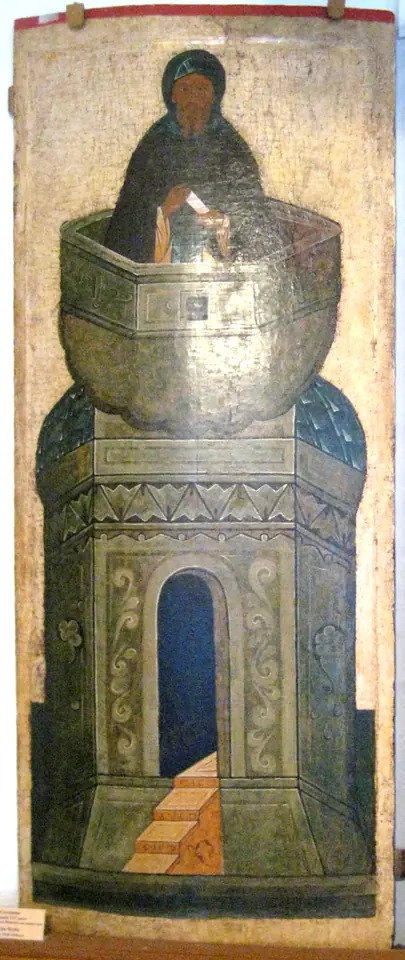
Simeon is one of the easiest saints to recognize. He is shown as a bearded monk in a dark hood, standing in the top of a pillar that often has a small door at its base. A ladder may lean against it, and sometimes a basket or jar hangs on a rope for food. In Greek and Russian icons he holds a scroll with words of his teaching and often prayer beads.


Several stylites share this image, so check the name written on the icon. Simeon the Younger lived on a pillar on the Wonderful Mountain near Antioch and died in 596. St. Daniel the Stylite, a disciple of the elder Simeon, stood on a pillar near Constantinople and was visited by the emperors Leo and Zeno. The Catholic Encyclopedia says pillar saints were found in the East until the 12th century, and in Russia until 1461.

Qal'at Sim'an: the church around the pillar
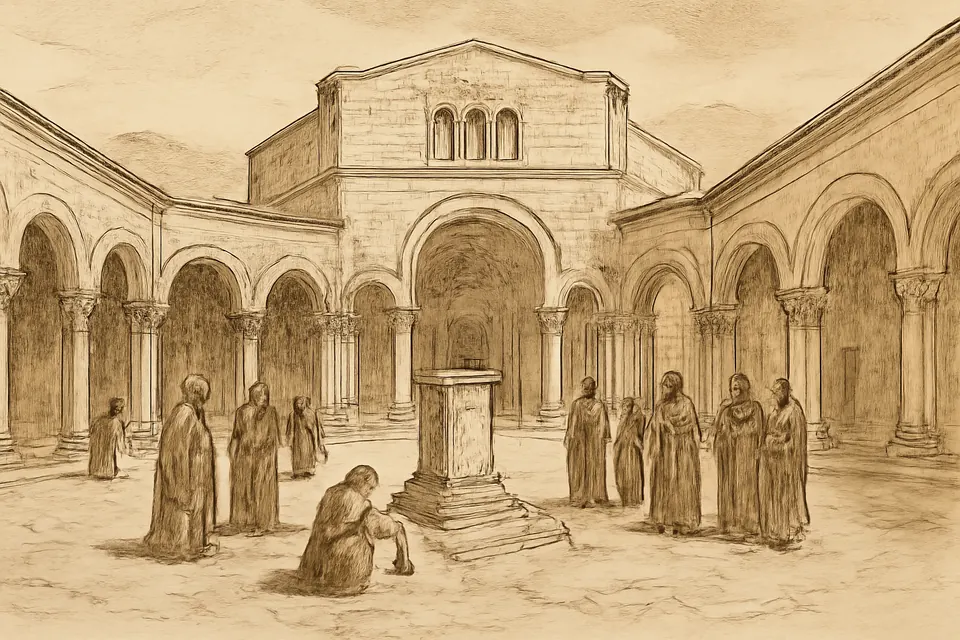
Within a few decades of Simeon's death, an enormous church rose on the hilltop where the pillar stood. Finished around 490, it had four basilicas laid out in a cross around an open octagon, with the pillar in the center. Pilgrims came for centuries. Later the site became a fortress, and the Arabic name Qal'at Sim'an means "fortress of Simeon."
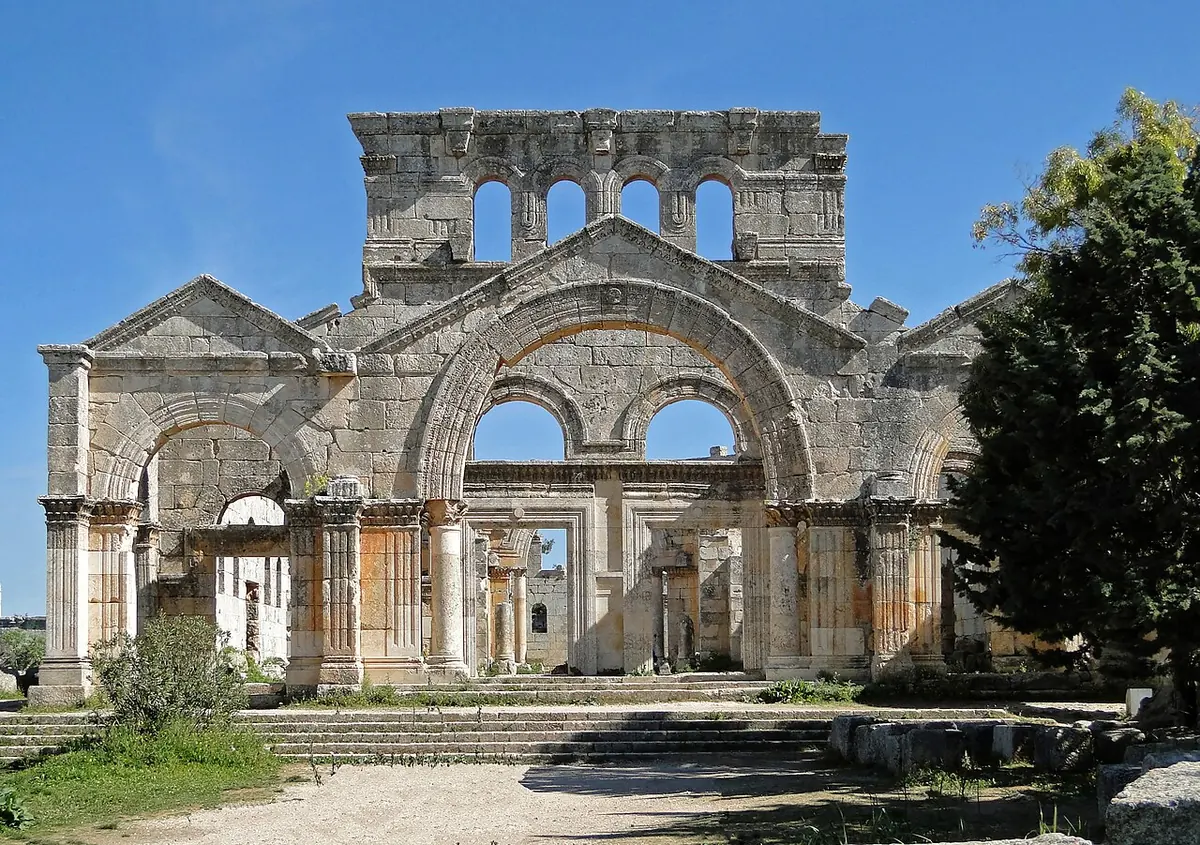

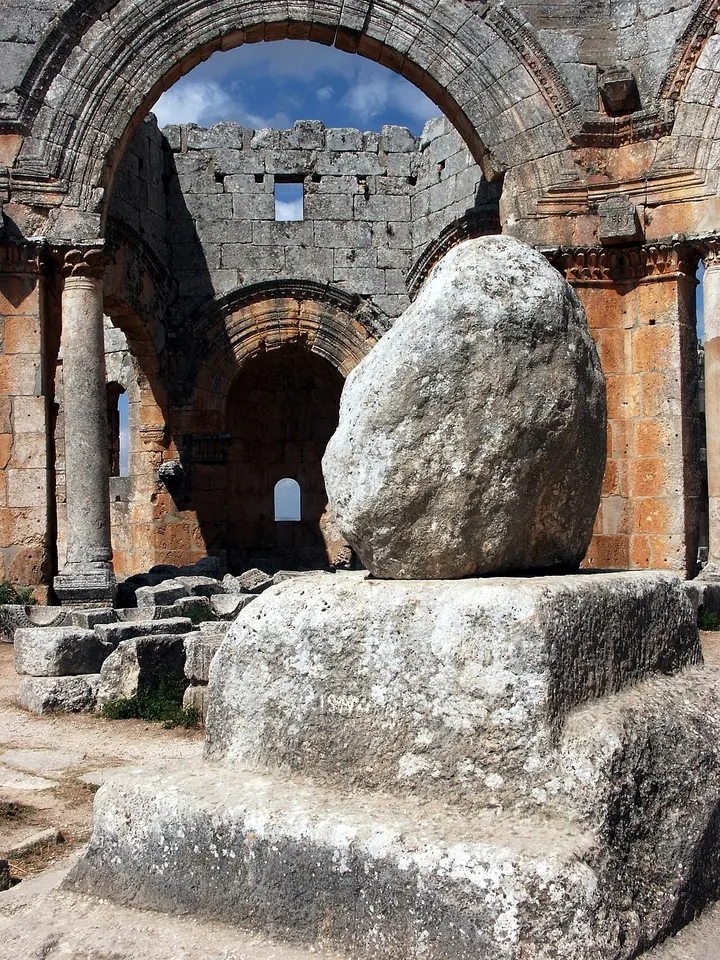
Pilgrims chipped off pieces of the pillar as relics for over a thousand years, and by the 20th century only a worn boulder on a stone base remained. In 2011 UNESCO listed the site as part of the Ancient Villages of Northern Syria, a World Heritage property placed on its List of World Heritage in Danger in 2013. During the Syrian war the site was hit by an airstrike on May 12, 2016. The Day After Heritage Protection Initiative, a Syrian monitoring group, attributed the strike to the Russian air force and reported serious damage to the ruins, including the remains of the pillar. The director-general of UNESCO issued a statement deploring the severe damage to the church.

Feast day and prayer
The Roman Martyrology remembers Simeon on January 5. The Orthodox Church keeps his feast on September 1, the start of the church year, and remembers his mother, Martha, on the same day. See our feast days calendar.
No prayer written by Simeon survives. Orthodox Christians sing the troparion of his feast, here in the translation of the Orthodox Church in America:
You were a pillar of patient endurance, having imitated the forefathers, O Venerable One: Job in suffering, and Joseph in temptations. You lived like the bodiless ones while yet in the flesh, O Simeon, our Father. Beseech Christ God that our souls may be saved.
Frequently asked questions
Why did St. Simeon Stylites live on a pillar?
To escape the crowds. Pilgrims pressed so close to touch him and take pieces of his skin garments that he climbed onto a pillar to pray in peace. His friend Theodoret saw it differently, as a "new and admirable spectacle" God used to draw people to the faith.
How long did Simeon live on the pillar?
About 36 to 37 years, from around 423 until his death in 459, according to the Catholic Encyclopedia. The pillar was raised in stages, from about nine feet to more than fifty.
When is the feast of St. Simeon Stylites?
January 5 in the Roman Martyrology and September 1 in the Orthodox Church, which honors his mother, St. Martha, on the same day.
Can you still visit the pillar of St. Simeon?
Its base still stands in the ruins of the great church built around it, called Qal'at Sim'an, northwest of Aleppo. The site is part of a UNESCO World Heritage property and was damaged in the Syrian war, including in an airstrike in May 2016.
Sources
- Catholic Encyclopedia (1912): St. Simeon Stylites the Elder
- Catholic Encyclopedia (1912): Stylites
- Theodoret of Cyrrhus, Religious History 26, translated in Charles Kingsley, The Hermits (1868), Project Gutenberg
- Orthodox Church in America: Saint Simeon Stylites, the Elder
- Orthodox Church in America: Saint Simeon Stylites, the Elder, Troparion and Kontakion
- UNESCO World Heritage Centre: Ancient Villages of Northern Syria
- The Day After Heritage Protection Initiative: Damage Report St. Simeon Russian Airstrike May 12, 2016
- Roman Martyrology, January 5