St. Paul Miki and Companions

St. Paul Miki was a Japanese Jesuit and a gifted preacher who was crucified with twenty-five other Catholics on a hill above Nagasaki on February 5, 1597, by order of the ruler Toyotomi Hideyoshi. From his cross he preached a last sermon forgiving his executioners. The 26 Martyrs of Japan, Japanese and European, priests, catechists, laymen and three boys, were canonized in 1862. Their feast day is February 6.
Who was St. Paul Miki?
Paul Miki was a Japanese Jesuit, the son of a soldier, trained from boyhood in the Jesuit schools of Japan and known as the finest preacher in the country. On February 5, 1597, he and twenty-five other Christians were crucified on Nishizaka Hill, outside Nagasaki, on the orders of Toyotomi Hideyoshi, the warlord who then ruled Japan. Paul Miki was in his early thirties and close to ordination as a priest.
The Church honors all twenty-six together as St. Paul Miki and Companions, the first martyrs of East Asia to be canonized. Their feast day is February 6.
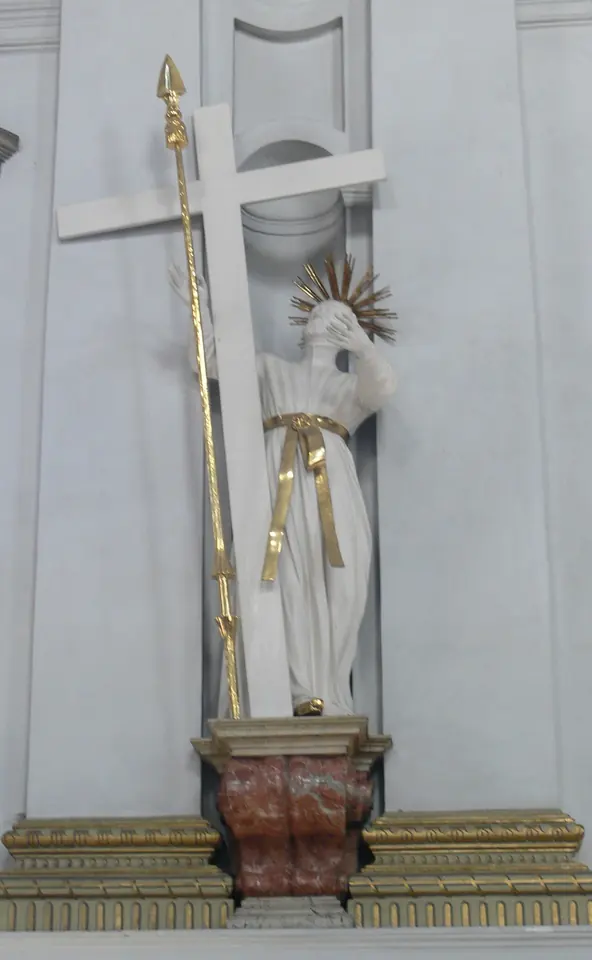

The life of St. Paul Miki
A Christian Japan
St. Francis Xavier brought the faith to Japan in 1549, and by 1587, the Catholic Encyclopedia says, the country had about 200,000 Christians. Paul Miki grew up in this first Christian generation. The Twenty-Six Martyrs Museum in Nagasaki records that he was born in the Tsunokuni district, near Osaka, the son of a brave soldier, Miki Handayu, and that he was educated as a boy at the Jesuit schools of Azuchi and Takatsuki.
He joined the Society of Jesus and gave his life to preaching and teaching, and the museum calls him "the best preacher in the country." Many Japanese were baptized after hearing him.
Persecution
In 1587 Hideyoshi ordered the missionaries out of Japan, though at first the order was loosely enforced, and the Jesuits kept working quietly. In 1596 a Spanish galleon, the San Felipe, was wrecked on the Japanese coast. Hideyoshi came to suspect that missionaries were preparing the way for Spanish conquest, and late in 1596 he ordered the Christians of Kyoto and Osaka arrested. Paul Miki was taken with them.
The road to Nagasaki
Twenty-four prisoners were paraded through Kyoto, and each had part of an ear cut off. Then, in the depth of winter, they were marched about six hundred miles to Nagasaki, where the sentence was to be carried out as a warning to the Christian city. Two men who tended them on the road were arrested too, which made twenty-six. Accounts of the march say the prisoners sang the Te Deum as they walked. The museum records that twelve-year-old Louis Ibaraki "kept singing and laughing" all the way.
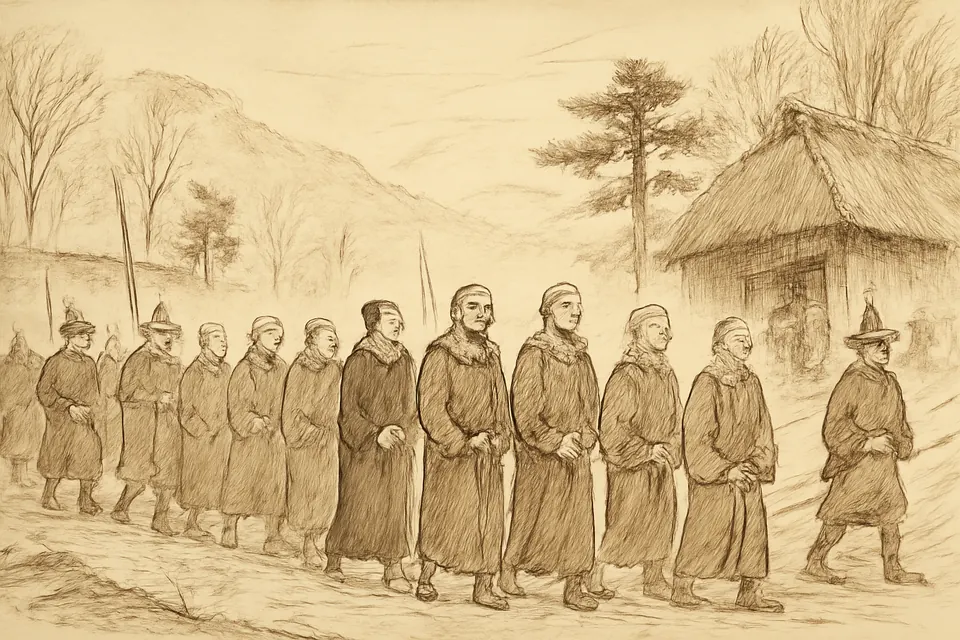
Nishizaka Hill
On the morning of February 5, 1597, the twenty-six were led to a hill outside Nagasaki overlooking the harbor. Each was bound to a cross, and the crosses were raised in a row. A crowd of Christians from the city had gathered. The martyrs sang and prayed; Anthony, a boy of thirteen, could see his mother weeping near his cross. At a signal, soldiers ended their lives with lances.
Paul Miki used his cross as a pulpit. The account of a contemporary writer, which the Church reads in the Office of Readings on his feast, gives his last sermon:
The sentence of judgment says these men came to Japan from the Philippines, but I did not come from any other country. I am a true Japanese. The only reason for my being killed is that I have taught the doctrine of Christ. I certainly did teach the doctrine of Christ. I thank God it is for this reason I die. I believe that I am telling only the truth before I die. I know you believe me and I want to say to you all once again: Ask Christ to help you to become happy. I obey Christ. After Christ's example I forgive my persecutors. I do not hate them. I ask God to have pity on all, and I hope my blood will fall on my fellow men as a fruitful rain.
A Jesuit missionary wrote afterward, in a letter the Catholic Encyclopedia quotes, that even "the very pagans who assisted at the martyrdom were struck at seeing the joy of the blessed ones as they suffered on their crosses."
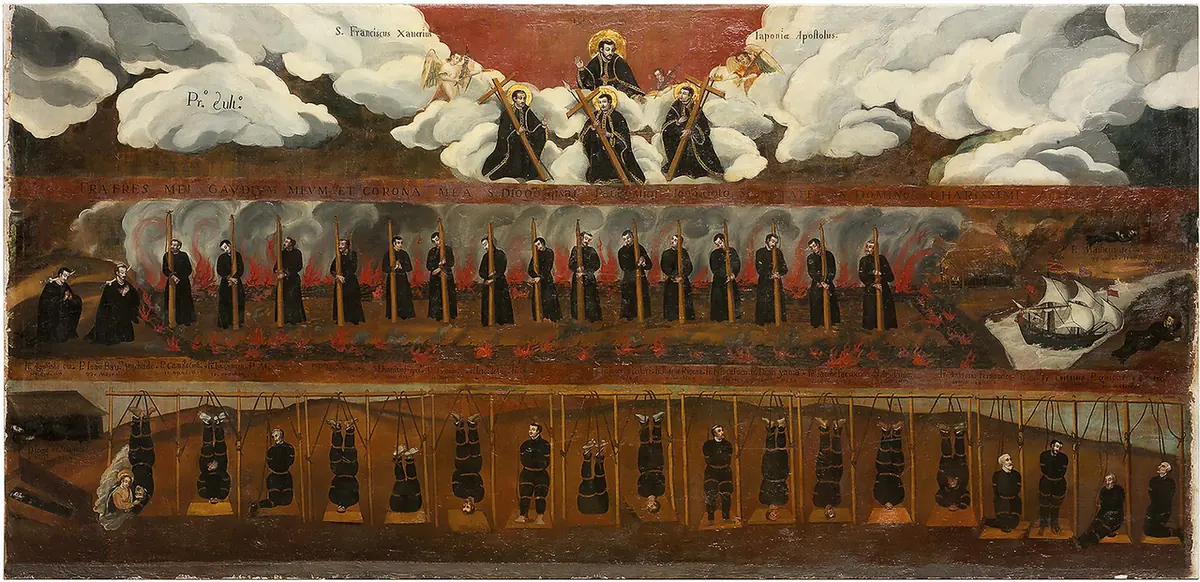

The twenty-six companions
The museum at Nishizaka lists them in the order of their crosses. They were:
- Six Franciscan friars: Peter Baptist, the superior of the mission and a former Spanish ambassador; Martin of the Ascension; Francis Blanco; Francis of St. Michael; Philip of Jesus, a young Mexican; and Gonzalo Garcia, born in India of a Portuguese father and an Indian mother.
- Three Japanese Jesuits: Paul Miki; John de Goto, nineteen; and James Kisai, a lay brother of sixty-four.
- Seventeen Japanese laymen, most of them catechists and helpers of the Franciscans: a sword maker, a bow maker, a physician, a silk weaver, a druggist, a sake brewer and others, with three boys, Louis Ibaraki (twelve), Anthony (thirteen) and Thomas Kozaki (fourteen), who helped the friars.
Miracles and witness
The cause of the twenty-six rested on martyrdom, the free acceptance of death for the faith, and no single miracle story stands at the center of their cult. What the sources record is the reported witness of the crowd: the singing on the road, the sermon from the cross and the courage of the boys. Twenty-three were beatified in 1627 under Pope Urban VIII and the three Jesuits were added in 1629; Pope Pius IX canonized the group in 1862.
Persecution grew worse after 1614, and by the 1640s no priests remained in Japan. Yet when missionaries returned in the 1860s, they found, the Catholic Encyclopedia says, "20,000 Christians practising their religion in secret" around Nagasaki.
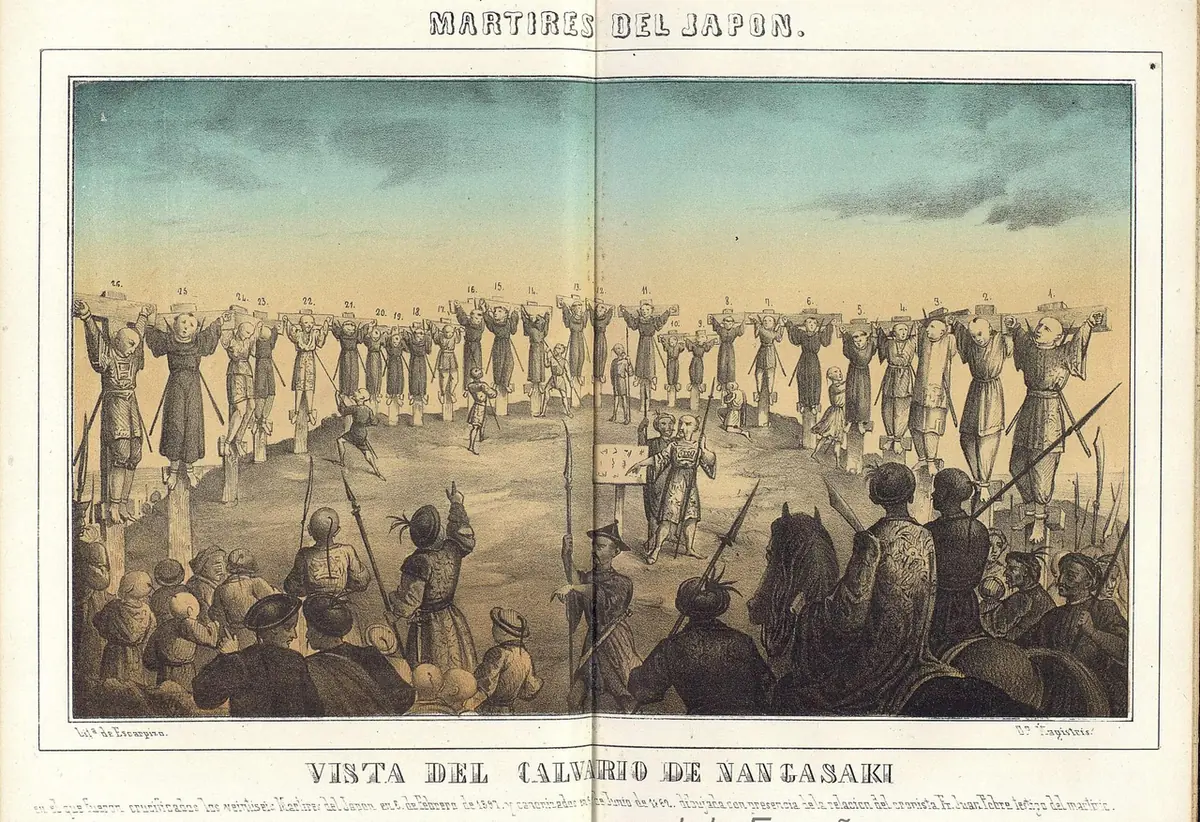

Why St. Paul Miki is a patron of Japan
The twenty-six were the first of thousands of Japanese martyrs and the first to be canonized, and Paul Miki's words "I am a true Japanese" make him the natural representative of the group. See all the patron saints by cause.
Symbols of St. Paul Miki in art
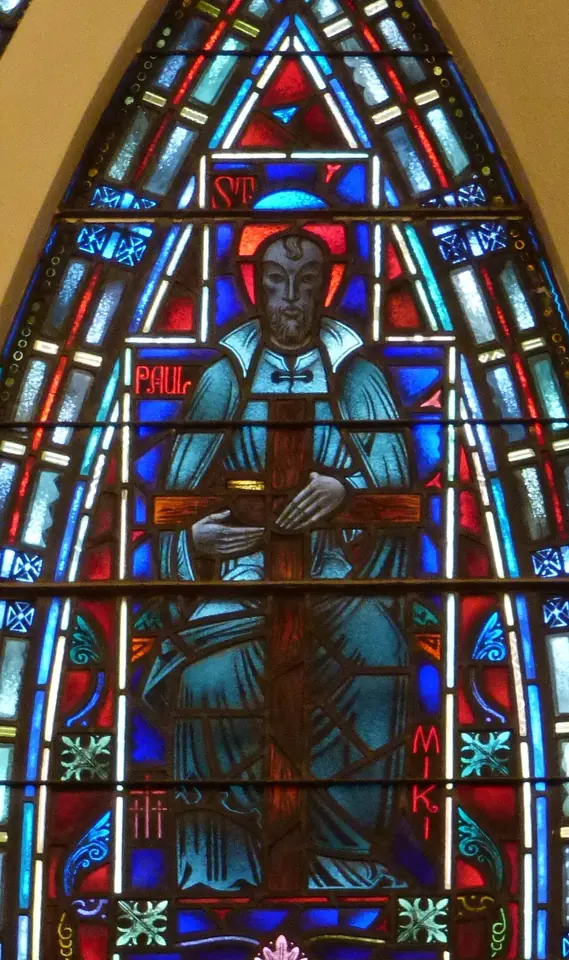
Paul Miki is shown as a young Japanese man in the black cassock of a Jesuit. His attributes:
- A cross, the instrument of his death, which he often holds or leans against.
- A lance or spear, sometimes two crossed, for the lances that ended the martyrs' lives.
- A martyr's palm.
- Companions: he often appears with the other two Jesuits, John de Goto and James Kisai, as on the altar in the Jesuit church of Saint-Ignace in Paris, or with all twenty-six in a row of crosses on a hill.
Older European prints, like Nenclares's lithograph, often gave the Japanese martyrs Chinese dress and hairstyles.


Feast day and Nishizaka Hill
The memorial of St. Paul Miki and Companions is kept on February 6 on the General Roman Calendar. The martyrs died on February 5, but in the Western Church that day was already the feast of St. Agatha, so the feast was set a day later. See our feast days calendar.
The place of execution, Nishizaka Hill, is now a park. In 1962, the centenary of the canonization, the Twenty-Six Martyrs Monument was put up there, a long stone wall with bronze figures of the martyrs by the sculptor Yasutake Funakoshi, beside a museum and the twin-spired Church of St. Philip, named for Philip of Jesus.


Pope Francis prayed there on November 24, 2019. He recalled that the shrine "bears the images and names of Christians who were martyred long ago, starting with Paul Miki and his companions on 5 February 1597," and asked the Church in Japan to hear anew "the message proclaimed by Saint Paul Miki from the cross."

Prayer to St. Paul Miki and Companions
The Church's own prayer for the feast is the Collect of the Mass in the Roman Missal, quoted here from the English translation:
O God, strength of all the Saints, who through the Cross were pleased to call the Martyrs Saint Paul Miki and companions to life, grant, we pray, that by their intercession we may hold with courage even until death to the faith that we profess. Through our Lord Jesus Christ, your Son, who lives and reigns with you in the unity of the Holy Spirit, God, for ever and ever.
Many Catholics also pray for persecuted Christians on this day.
Frequently asked questions
Who were St. Paul Miki and his companions?
Twenty-six Catholics crucified at Nagasaki on February 5, 1597. According to the Twenty-Six Martyrs Museum, they were six Franciscan friars (four Spaniards, the Mexican Philip of Jesus and Gonzalo Garcia, born in India), three Japanese Jesuits (Paul Miki, John de Goto and James Kisai) and seventeen Japanese laymen, most of them catechists and helpers of the Franciscans, among them three boys aged twelve to fourteen.
What did St. Paul Miki say on the cross?
According to a contemporary account, he told the crowd that he was a true Japanese, that he died only for teaching the doctrine of Christ, and that "After Christ's example I forgive my persecutors. I do not hate them. I ask God to have pity on all, and I hope my blood will fall on my fellow men as a fruitful rain."
Why is the feast of St. Paul Miki on February 6?
They died on February 5, 1597, but February 5 is the feast of St. Agatha in the Western Church, so their memorial was set on February 6. In Japan it has long been kept on February 5.
When were the 26 Martyrs of Japan canonized?
Pope Pius IX canonized them in 1862. Twenty-three of them were beatified in 1627 under Pope Urban VIII, and the three Jesuits were added in 1629, according to the Twenty-Six Martyrs Museum in Nagasaki.
Sources
- Catholic Encyclopedia (1910): Japanese Martyrs
- Catholic Culture: Memorial of St. Paul Miki and Companions, Martyrs (February 6)
- Twenty-Six Martyrs Museum, Nagasaki: List of the 26 Martyrs of Japan (archived)
- Pope Francis, Tribute to the Martyr Saints at the Martyrs' Monument, Nishizaka Hill, Nagasaki, 24 November 2019
- Liturgy of the Hours, Office of Readings for February 6: account of the martyrdom of St. Paul Miki and his companions by a contemporary writer
- Roman Missal, Collect for the Memorial of St. Paul Miki and Companions