St. Agatha of Sicily
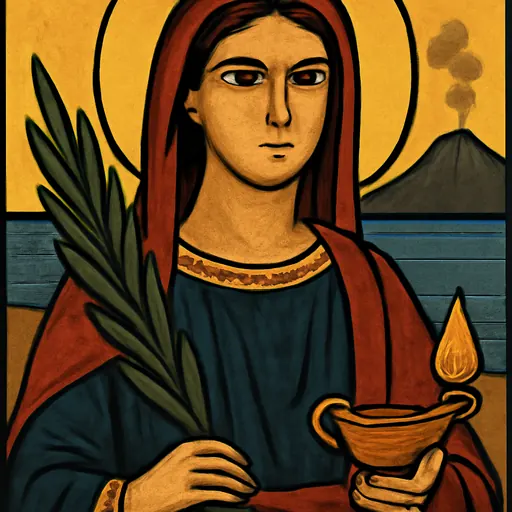
St. Agatha was a young Christian woman of Catania, Sicily, who died a martyr around 251, during the persecution of the Roman emperor Decius. Her legend says she refused the governor Quintianus and kept her faith through torture and prison. A year after her death, tradition holds, her veil stopped a lava flow from Mount Etna, so she is the patron saint of Catania and is invoked against fire and eruptions. Her feast day is February 5.
Who was St. Agatha?
Agatha was a young Christian woman of Catania, on the east coast of Sicily, who died for her faith around the year 251. Her death almost certainly fell in the persecution of the emperor Decius, who in 250 ordered every citizen of the empire to sacrifice to the gods. The Catholic Encyclopedia puts it plainly: the fact of her martyrdom and the honor paid to her from the earliest times are certain, and almost nothing else is.
The story of her trial and death comes from her Acts, which survive in Latin and Greek versions. The Latin text is no older than the 6th century, and historians treat it as a pious legend built around a real martyr. It was the legend, retold in the medieval Golden Legend, that shaped how Christians pictured her for more than a thousand years.
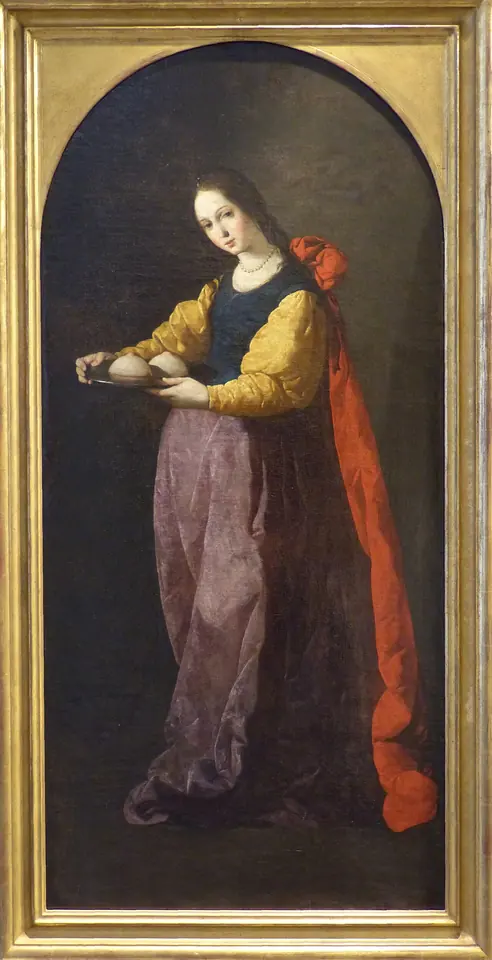

Catania and Palermo both claim her birth, but her relics lie in Catania, and every February the whole city turns out for her.
The life and martyrdom of St. Agatha
This section follows the Acts and the Golden Legend; all of it is traditional.
A noblewoman who belonged to Christ
The legend presents Agatha as rich, beautiful and of noble birth, a girl who had promised her life to Christ while still young. Quintianus, the Roman governor of Sicily, wanted her and her property. When she refused him, he had her arrested as a Christian.
The trial before Quintianus
Quintianus first handed her over to a woman named Aphrodisia, who spent a month trying to wear her down with promises and threats. Agatha's answer, in Caxton's 1483 English, was that "your words be but wind, your promises be but rain, and your menaces be as rivers that pass."

At her trial, asked why a noblewoman lived like a slave, she answered, in the Vatican News translation of the Acts: "The greatest freedom and nobility is here: to prove to be Christ's servants." She refused to sacrifice and was sent to prison.
Torture, and a visitor in the night
The next day Quintianus had her tortured. The legend says he ordered her breasts to be cut off, and Agatha rebuked him for mutilating in a woman what had nursed him as a child. She was thrown back in prison without food or medicine.
That night an old man came to her cell, a child with a light walking before him, and offered to heal her. Agatha refused any earthly medicine and said she trusted Christ, who heals with a word. The old man smiled, told her he was Christ's apostle Peter, and vanished. Her wounds were healed and the cell filled with light. The guards fled, but she would not escape.

Her death
Four days later the governor had her rolled over live coals. An earthquake shook the city, and the frightened people protested at his house. Quintianus sent Agatha back to prison, where she prayed with her arms raised and died. The Golden Legend gives her last prayer:
Lord God Jesu Christ which hast created me of nought, and sith my youth hast kept me ... and hast lent me patience among the pains, I pray thee that thou take my spirit, for it is time that thou make me to depart from this world and to come to thy mercy.
The traditional date is February 5, 251. When Christians buried her, the legend continues, a young man in white no one had seen before set a marble tablet at her head and left. It read Mentem sanctam spontaneam, honorem Deo et patriae liberationem: "a holy and willing mind, honor to God, and the deliverance of her homeland." The people took the young man for her angel, and the words are still engraved on the tablet her reliquary bust holds.
An early and widespread cult
The evidence for her cult is older than her Acts. The cathedral of Catania points to a child's epitaph of about 300 that speaks of the graves of the Christian martyrs, and to Methodius of Olympus, a bishop in Asia Minor who died in 311 and held her up as a model in his Symposium. The ancient martyrology of Carthage and the Martyrologium Hieronymianum list her on February 5.


In Rome a basilica in her honor existed by the late 5th century, and Pope Gregory the Great reconsecrated the church of Sant'Agata dei Goti, which had been used by Arian Goths. Her name stands in the Roman Canon, the oldest Eucharistic Prayer of the Mass, in its short list of women martyrs: "Felicity, Perpetua, Agatha, Lucy, Agnes, Cecilia, Anastasia."
About fifty years after her death, another Sicilian girl, St. Lucy of Syracuse, came with her sick mother to pray at Agatha's tomb. Lucy's legend says the mother was healed there and that Agatha appeared to Lucy in a dream.
The miracles of St. Agatha
None of Agatha's miracles has been examined in the modern sense, since her cult is far older than the canonization process.
- Traditional: the healing of her wounds by St. Peter in prison, and the earthquake during her last torture, both from the Acts.
- Traditional: the veil and Mount Etna. The Golden Legend says that at the beginning of February, a year after her death, fire poured from the mountain toward Catania. Townspeople, pagans among them, took the cloth from her tomb and held it up against the fire, which stopped on the day of her feast. The cathedral of Catania dates this to February 5, 252.
- Reported: protection of Catania in later eruptions, earthquakes and epidemics. The city kept a feast on June 17 for the end of the plague of 1576, and her veil has been carried in procession when lava threatened.

Why St. Agatha is the patron saint of Catania and of fire
The veil story made her Catania's protector. The Catholic Encyclopedia notes that around Etna she is invoked against eruptions, and elsewhere against fire and lightning. Today the cathedral keeps the veil in a silver reliquary made in 1926 and calls it a "powerful bulwark" against the threats of Etna.
Her other patronages grow out of her legend:
- Breast cancer patients: because of the torture she suffered and the healing she received. The cathedral of Catania publishes a prayer to St. Agatha for women who have had breast surgery.
- Nurses and wet nurses: from the same story.
- Survivors of sexual assault: Agatha was a young woman whose body was attacked by a powerful man, and many survivors find a companion in her.
- Bell-founders: no document records how this began. The explanation most often repeated is the shape of a bell, which recalls her attribute.
See all the patron saints by cause.
Symbols of St. Agatha in art
Her main symbol can surprise visitors.
- Breasts on a dish: her most common attribute in Western art from the late Middle Ages on. They stand for the torture in her legend and for Peter's healing, the way St. Lucy carries eyes on a dish and St. Apollonia a tooth in pincers. Zurbarán and Giovanni di Paolo, on this page, keep it small and discreet.
- Pincers or shears: the instruments of the torture, held in her hand or lying at her feet.
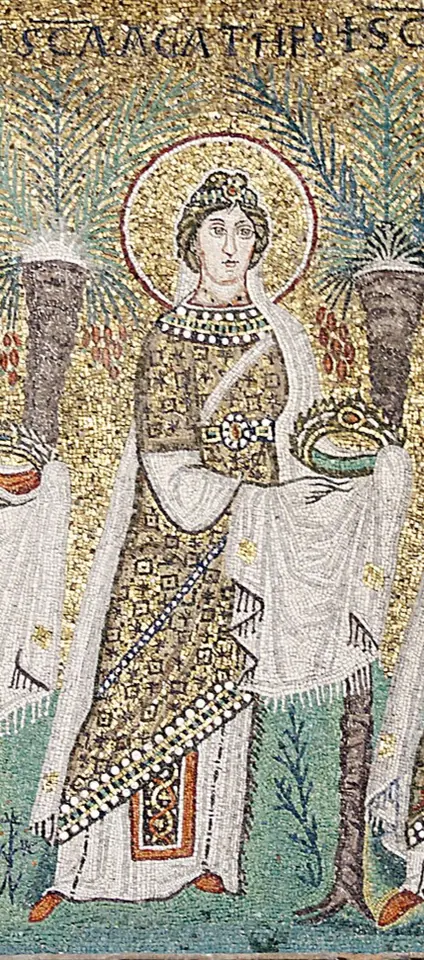
- A veil: for her consecration to Christ and for the veil that stopped the lava. Early mosaics show her as a veiled noblewoman.
- The palm of martyrdom, sometimes a crown.
- Flames, coals or a torch: her death on the coals, and her protection against fire.


The oldest images look quite different. In the 6th-century mosaics of Ravenna and Poreč she is a calm young patrician in rich robes and a white veil, carrying a crown, with nothing to recall her wounds. Eastern icons follow that older pattern and usually give her a hand cross.

Feast day and the festival in Catania
The Catholic Church keeps St. Agatha's memorial on February 5. In some places, the Catholic Encyclopedia reports, bread and water were blessed at Mass on her feast and called Agatha bread. Find her neighbors on the feast days calendar, including St. Blaise on February 3.
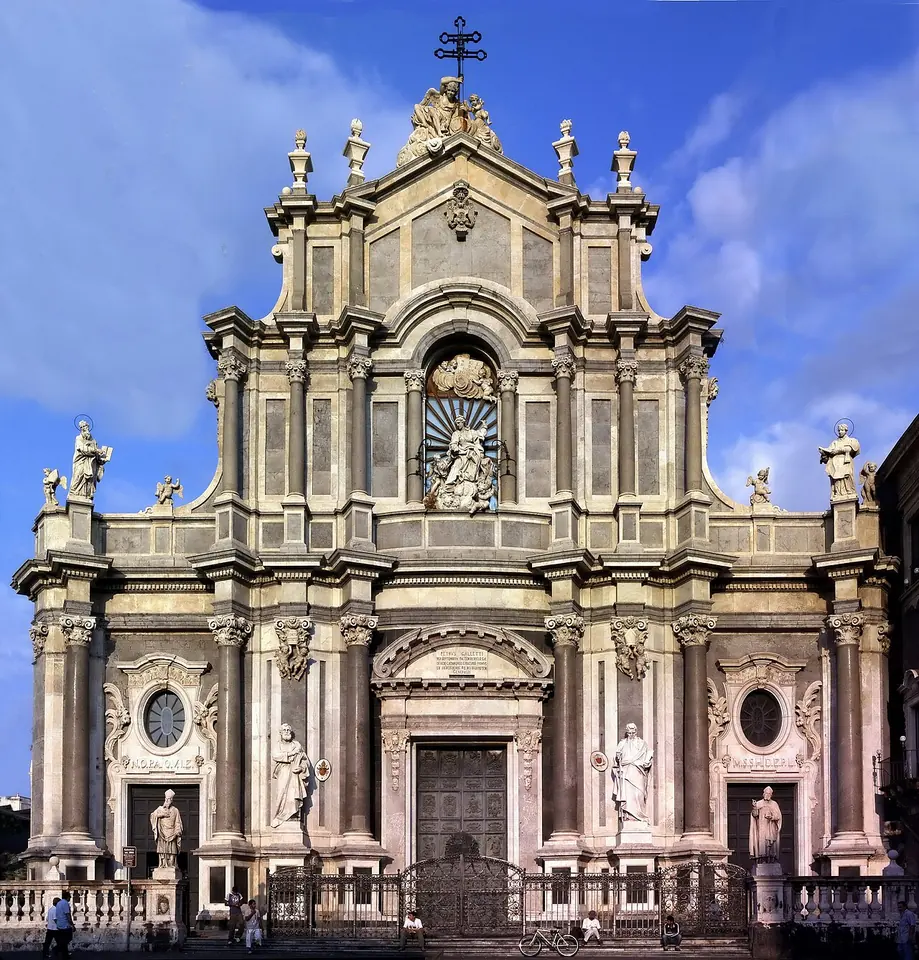

The relics
Agatha's relics left Catania once. In the 11th century they were carried off to Constantinople, and Catania celebrates their return, after 1126, every August 17. Her skull rests inside a silver reliquary bust commissioned between 1373 and 1376 from the Sienese goldsmith Giovanni di Bartolo and covered over the centuries with jewels given as offerings. A silver casket, made between 1470 and 1556, holds the reliquaries of her limbs and of the veil.
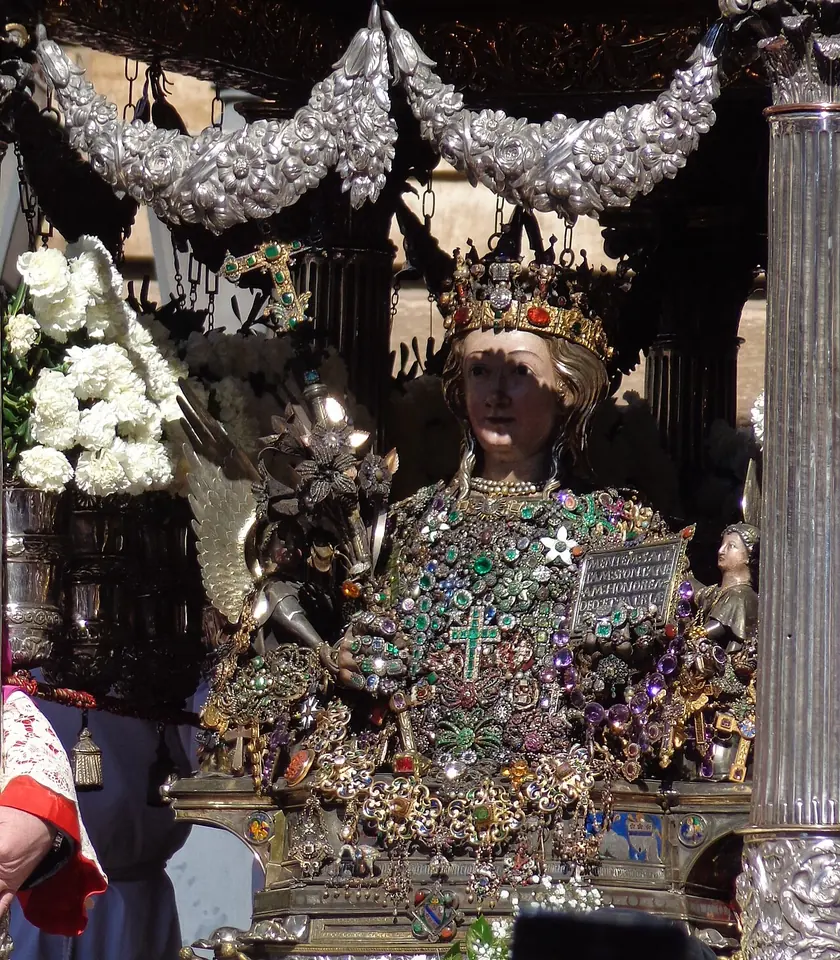

The Festa di Sant'Agata
The cathedral's history of the festival, by Mons. Gaetano Zito, traces it through descriptions from 1522 onward. Today:
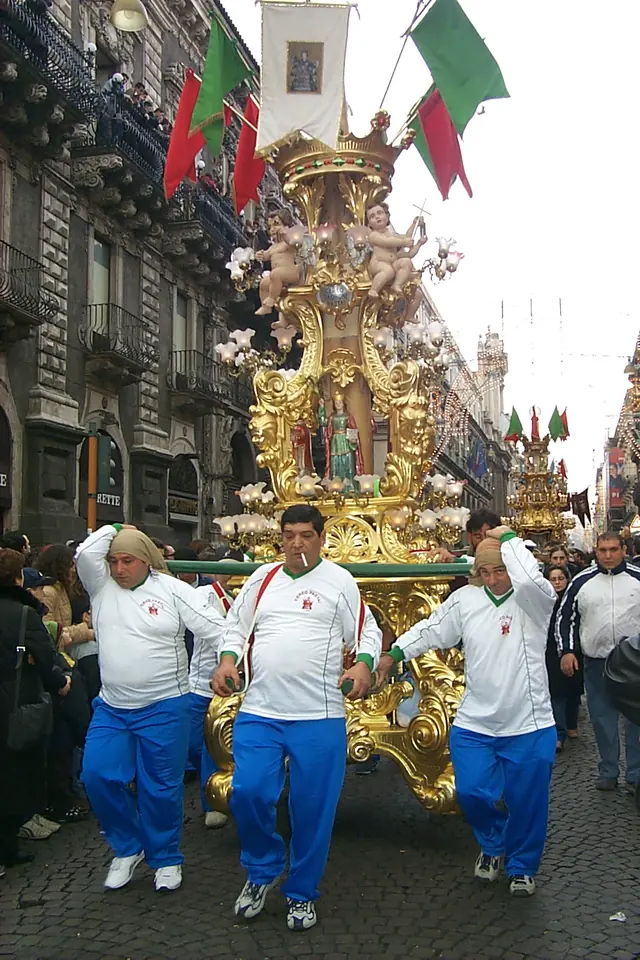
- February 3: the procession of the offering of wax, with the city's officials and the candelore, huge gilded wooden candle-stands carried by the trades of the city and carved with scenes of her martyrdom. Fireworks fill the evening.
- February 4: before dawn the bust and casket are brought out and set on the fercolo, a silver carriage begun by the goldsmith Vincenzo Archifel in 1519 and rebuilt after it was destroyed by bombing in the Second World War. Thousands of devotees pull it through the city on two long ropes, all day and into the night, on a route that follows the line of the old city walls.
- February 5: the pontifical Mass in the cathedral, then a second procession through the center of the city, a custom begun in 1846 so the cloistered nuns could see their patron pass.
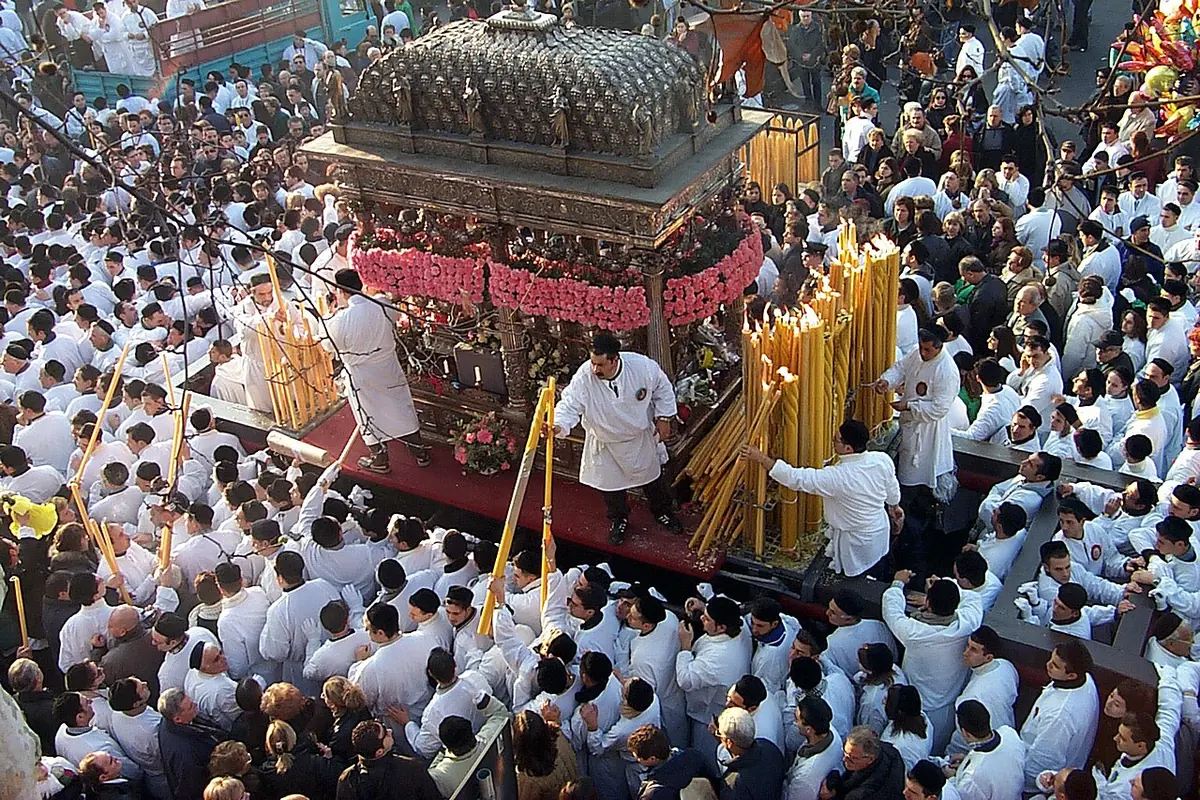

The devotees wear the sacco, a white tunic tied with a cord, with a black velvet cap and white gloves, as they have since the later 17th century.

Prayer to St. Agatha
The Church's own prayer for her feast is the Collect of the Roman Missal (English translation, 2011):
May the Virgin Martyr Saint Agatha implore your compassion for us, O Lord, we pray, for she found favor with you by the courage of her martyrdom and the merit of her chastity. Through our Lord Jesus Christ, your Son, who lives and reigns with you in the unity of the Holy Spirit, God, for ever and ever.
The cathedral of Catania publishes several prayers in Italian, including a prayer for women who have had breast surgery by Mons. Giuseppe Bruno. Its traditional prayer repeats this refrain:
O eroina del cielo, Agata bella, deh! Splendi al mio morir, propizia stella.
In English, "O heroine of heaven, fair Agatha, shine on my dying as a favoring star." Elsewhere, Catholics ask St. Agatha's prayers in illness, especially breast cancer, and for protection from fire.
Frequently asked questions
What is St. Agatha the patron saint of?
Above all, the city of Catania in Sicily. She is invoked against fire, volcanic eruptions and earthquakes, and she is the patron of breast cancer patients, nurses and wet nurses, and bell-founders. Many people who have suffered sexual violence also turn to her.
When is St. Agatha's feast day?
February 5, the traditional day of her death. It is a memorial in the General Roman Calendar. In Catania the festival runs from February 3 to 5, and the city keeps a second feast on August 17 for the return of her relics from Constantinople.
Why is St. Agatha shown holding a plate?
Her legend says the governor had her breasts cut off as a torture, and that St. Peter healed her in prison that night. Medieval and Renaissance painters showed this by placing two small breasts on a dish in her hand, the way other martyrs carry the instrument of their death. It is a sign of what she survived, not a realistic image.
Why is St. Agatha invoked against fire and volcanoes?
The year after her death, the story goes, Mount Etna erupted and lava flowed toward Catania. People took the veil from her tomb and held it before the lava, which stopped. This is a traditional account. Catania still keeps her veil in the cathedral and has carried it in procession during later eruptions.
Where are St. Agatha's relics?
In the Cathedral of St. Agatha in Catania. Her skull is inside a silver reliquary bust made in 1376, and the other relics, including her veil, are kept in reliquaries inside a silver casket. Both are carried through the city during the February festival.
Sources
- Catholic Encyclopedia (1907): St. Agatha
- The Golden Legend, Life of St. Agatha (Caxton translation, reader's version)
- Christian Iconography: St. Agatha in Art
- Vatican News: St. Agatha, Virgin and Martyr
- Basilica Cattedrale S. Agata, Catania: Il Martirio
- Basilica Cattedrale S. Agata, Catania: Origini del cristianesimo a Catania e diffusione del culto agatino
- Basilica Cattedrale S. Agata, Catania: Le reliquie
- Basilica Cattedrale S. Agata, Catania: La festa (Mons. Gaetano Zito)
- Basilica Cattedrale S. Agata, Catania: Il fercolo
- Basilica Cattedrale S. Agata, Catania: Preghiere
- Catholic Culture: Memorial of St. Agatha, Virgin and Martyr (Mass propers and collect)
- The Roman Canon (Eucharistic Prayer I), "Nobis quoque peccatoribus"
- Roman Martyrology, February 5