Our Lady of Fátima

Our Lady of Fátima is the title given to the Virgin Mary as she is believed to have appeared to three shepherd children, Lúcia dos Santos and her cousins Francisco and Jacinta Marto, at Fátima, Portugal, six times between May 13 and October 13, 1917. The Church approved the apparitions in 1930. Her message called for prayer of the Rosary, penance and devotion to the Immaculate Heart of Mary, and her feast day is May 13.
Who is Our Lady of Fátima?
Our Lady of Fátima is the Virgin Mary as Catholics believe she appeared to three shepherd children near the village of Fátima, in the hills of central Portugal, in 1917. The children were Lúcia dos Santos, who was ten, and her cousins Francisco and Jacinta Marto, nine and seven. Six times between May and October a Lady "more brilliant than the sun," as Lúcia described her, spoke to them in a rocky pasture called the Cova da Iria. In the last apparition she told them, "I am the Lady of the Rosary."


Fátima is unusual among Marian apparitions in two ways. It came with a public sign, the "Miracle of the Sun" of October 13, 1917, reported by tens of thousands of people and by the secular Lisbon press. And it left behind a "secret" in three parts, the last of which the Vatican kept sealed until 2000. Archbishop Tarcisio Bertone, introducing the Vatican's document of 2000, called Fátima "undoubtedly the most prophetic of modern apparitions."
Almost everything we know of the words spoken comes from Lúcia. Francisco and Jacinta died as children in the influenza epidemic of 1918 to 1920. Lúcia became a nun, wrote six memoirs between 1935 and 1993, and lived until 2005. The parish priest of Fátima, Manuel Marques Ferreira, also wrote down his questioning of the children after each apparition in 1917, and the sanctuary has published those notes in its critical edition of the documents.
The angel of 1916
Lúcia wrote in her fourth memoir that in 1916 an angel appeared three times to the three children while they tended their families' sheep. On the first visit, at a rocky outcrop called the Loca do Cabeço, he said, "Do not be afraid. I am the Angel of Peace. Pray with me." He knelt, bowed his forehead to the ground and taught them a prayer. In the summer he called himself "the Angel of Portugal." In the fall he came back holding a chalice and a host and gave them Communion.

The apparitions of 1917
The quotations below are from Lúcia's memoirs and the parish priest's notes, as published in English by the Shrine of Fátima.
May 13: "I am from Heaven"
On May 13, 1917, the children were playing at building a small wall in the Cova da Iria when they saw a flash of what they took for lightning. Then they saw the Lady standing above a small holm oak. "Do not be afraid. I will do you no harm," she said. Asked where she came from, she said, "I am from Heaven." She asked them to come back on the 13th of each month for six months and asked: "Are you willing to offer yourselves to God and bear all the sufferings He wills to send you?" They said they were. Her last words that day were: "Pray the Rosary every day, in order to obtain peace for the world, and the end of the war."

Jacinta could not keep quiet. That evening, Pope Francis recalled in 2017, she told her mother, "Today I saw Our Lady."
June 13: the Immaculate Heart
About 50 to 60 people came with the children in June. The Lady said she would take Jacinta and Francisco to heaven soon, but that Lúcia would stay longer: "Jesus wishes to make use of you to make me known and loved. He wants to establish in the world devotion to my Immaculate Heart." When Lúcia asked sadly if she would be left alone, the Lady answered, "I will never forsake you. My Immaculate Heart will be your refuge and the way that will lead you to God."
July 13: the secret
Several thousand people were present on July 13. The Lady promised: "In October, I will tell you who I am and what I want, and I will perform a miracle for all to see and believe." Then she showed the children the three-part vision that became known as the secret of Fátima, described below. She also taught them a prayer to add after each decade of the Rosary.
August: arrest in Ourém
On August 13, the local administrator of Vila Nova de Ourém, Artur de Oliveira Santos, took the three children away before they could reach the Cova da Iria. He later wrote that he meant to stop "the increasing clerical speculation" about them. He held them for three days, and Lúcia later wrote that they were threatened to make them reveal the secret. The Lady appeared to them on August 19 instead, at a place called Valinhos.


September 13
The roads were packed. The sanctuary estimates 20,000 to 30,000 people. The Lady repeated the request for the Rosary and promised that in October "I will perform a miracle so that all may believe."
October 13: "I am the Lady of the Rosary"
On the last day, in a cold rain, a crowd the sanctuary puts at 50,000 to 70,000 filled the Cova da Iria. The Lady said, "I want to tell you that a chapel is to be built here in my honour. I am the Lady of the Rosary." She told the children the war was going to end and said: "Do not offend the Lord our God any more, because He is already so much offended!" As she rose, Lúcia cried out, "Look at the sun!" She later had no memory of saying it. The children then saw St. Joseph with the Child Jesus blessing the world, then Our Lord with Our Lady of Sorrows, and finally Our Lady as Our Lady of Mount Carmel.
The Miracle of the Sun
What the crowd saw at about midday by the sun on October 13, 1917, is the best-documented part of Fátima, and the most debated. Because the event was announced months ahead, Lisbon's newspapers sent reporters. Several were openly hostile to the Church. Their accounts were reprinted by John De Marchi, a Consolata missionary priest who spent years interviewing witnesses, in The True Story of Fatima.
Avelino de Almeida, who had earlier lampooned the apparitions in the anticlerical daily O Século, wrote in the edition of October 15:
Before the astonished eyes of the crowd, whose aspect was biblical as they stood bareheaded, eagerly searching the sky, the sun trembled, made sudden incredible movements outside all cosmic laws—the sun "danced" according to the typical expression of the people.


The reporter for the Lisbon daily O Dia wrote on October 17:
The grey mother-of-pearl tone turned into a sheet of silver which broke up as the clouds were torn apart and the silver sun, enveloped in the same gauzy grey light, was seen to whirl and turn in the circle of broken clouds. A cry went up from every mouth and people fell on their knees on the muddy ground....
Dr. Almeida Garrett, a professor at the University of Coimbra, wrote an account for the priest-historian Manuel Formigão. He described the sun as "a disc with a clean-cut rim, luminous and shining, but which did not hurt the eyes," and added, "It looked like a glazed wheel made of mother-of-pearl."


This is a reported miracle. The testimony is abundant, but it is not uniform. De Marchi, who lived near the Cova da Iria for more than seven years gathering it, admitted that "reports do vary; impressions are in minor details confused." One witness he quotes recalled that "some saw nothing. Near us was a simple devout creature, crying bitterly because she had seen nothing." The bishop's declaration of 1930 concerned the children's visions; the Church has made no separate ruling on what happened in the sky.
The three secrets of Fátima
The "secret" was one vision with three parts, which Lúcia said the children received on July 13, 1917, and were told not to reveal. She wrote down the first two parts in her third memoir in 1941.
The first and second parts
The first part was a vision of hell: "a sea of fire" in which "demons and souls in human form" floated "like transparent burning embers." Lúcia wrote that the children would have died of fear if the Lady had not already promised to take them to heaven.
The second part explained what they had seen:
You have seen hell where the souls of poor sinners go. To save them, God wishes to establish in the world devotion to my Immaculate Heart. If what I say to you is done, many souls will be saved and there will be peace. The war is going to end: but if people do not cease offending God, a worse one will break out during the Pontificate of Pius XI.
It went on to ask "for the consecration of Russia to my Immaculate Heart, and the Communion of reparation on the First Saturdays," warning that otherwise Russia "will spread her errors throughout the world," and ended with a promise: "In the end, my Immaculate Heart will triumph."
The third part
Lúcia wrote the third part on January 3, 1944, at Tuy in Spain, on the order of her bishop. It was sealed in an envelope that she said should not be opened before 1960. In 1957 it was moved to the archives of the Holy Office in Rome. Pope John XXIII received it in 1959 and decided to return it unpublished, and Pope Paul VI read it in 1965 and also chose not to publish it. Decades of speculation followed.

On May 13, 2000, at Fátima, Cardinal Sodano announced that the text would be published, and on June 26, 2000, the Congregation for the Doctrine of the Faith released it in full. In it Lúcia describes an angel with a flaming sword crying "Penance, Penance, Penance!", and then:
a Bishop dressed in White 'we had the impression that it was the Holy Father'. Other Bishops, Priests, men and women Religious going up a steep mountain, at the top of which there was a big Cross of rough-hewn trunks as of a cork-tree with the bark; before reaching there the Holy Father passed through a big city half in ruins and half trembling with halting step, afflicted with pain and sorrow, he prayed for the souls of the corpses he met on his way; having reached the top of the mountain, on his knees at the foot of the big Cross he was killed by a group of soldiers who fired bullets and arrows at him
The Vatican's interpretation
The Vatican read the vision as a symbolic picture of the 20th century's persecution of the Church, "an interminable Way of the Cross led by the Popes of the twentieth century," culminating for John Paul II in the attempt on his life in 1981. In his theological commentary, Cardinal Joseph Ratzinger, the future Pope Benedict XVI, warned against reading it as a fixed prediction: "No great mystery is revealed; nor is the future unveiled." The purpose of the vision, he wrote, "is not to show a film of an irrevocably fixed future," and he summed up its lesson as "prayer is more powerful than bullets and faith more powerful than armies." Lúcia herself, the document reports, said that the vision was hers but its interpretation belonged to the Church.
The Vatican said it was publishing the third part "in its entirety," and that "there is only one manuscript."
The Church's approval
The Bishop of Leiria, José Alves Correia da Silva, set up a diocesan canonical commission to study the events, and Lúcia gave her official testimony to it in 1924. On October 13, 1930, in a pastoral letter on the cult of Our Lady of Fátima, he declared "worthy of belief the visions of the children in the Cova da Iria, parish of Fatima, of this Diocese, on 13 May through October 1917,".
Cardinal Ratzinger's 2000 commentary explains what such approval means. Quoting the theologian Edouard Dhanis, he wrote that approval of a private revelation says three things: "the message contains nothing contrary to faith or morals; it is lawful to make it public; and the faithful are authorized to accept it with prudence." It is "a help which is offered, but which one is not obliged to use."
The Five First Saturdays and the consecration of Russia
The Fátima story did not end in 1917. Lúcia reported later apparitions after she entered religious life.
Pontevedra, 1925. On December 10, 1925, as a postulant with the Dorothean Sisters in Pontevedra, Spain, Lúcia said Mary appeared to her with the Child Jesus and showed her a heart surrounded by thorns. The words she recorded are the foundation of the First Saturdays devotion:
Look, my daughter, at my Heart, surrounded with thorns with which ungrateful men pierce me at [e]very moment by their blasphemies and ingratitude. You at least try to console me and say that I promise to assist at the hour of death, with the graces necessary for salvation, all those who, on the first Saturday of five consecutive months, shall confess, receive Holy Communion, recite five decades of the rosary, and keep me company for 15 minutes while meditating on the 15 mysteries of the rosary, with the intention of making reparation to me.
The Shrine of Fátima keeps the devotion on the first Saturday of every month with Mass, an hour of reparation in the Chapel of the Apparitions and Eucharistic adoration.
Tuy, 1929. On June 13, 1929, in the chapel at Tuy, Lúcia saw a vision of the Holy Trinity with the words "Grace and Mercy," and Mary said: "The moment has come in which God asks the Holy Father to make, in union with all the bishops of the world, the consecration of Russia to My Immaculate Heart." John Paul II made an Act of Entrustment to the Immaculate Heart in 1981 and repeated it at Fátima in 1982. On March 25, 1984, John Paul II, in union with the world's bishops, entrusted the world to the Immaculate Heart in St. Peter's Square. In a letter of 1989, quoted by the Vatican, Lúcia wrote: "Yes it has been done just as Our Lady asked, on 25 March 1984."
Why Our Lady of Fátima is invoked for peace
Our Lady of Fátima has no formal patronage from Rome, but Catholics pray to her above all for peace. In 1917, in the middle of the First World War, the Lady's first request was "Pray the Rosary every day, in order to obtain peace for the world, and the end of the war," and in July she promised that if her requests were heeded "there will be peace." The Angel of 1916 had introduced himself as "the Angel of Peace." See more patron saints.
The miracles of Fátima
- The Miracle of the Sun (reported): October 13, 1917, described above.
- The cure of Emília Santos (approved): the miracle accepted for the beatification of Francisco and Jacinta. The sanctuary's chronology records that John Paul II promulgated the decree on June 28, 1999.
- The recovery of Lucas Baptista (approved): the miracle for their canonization. In 2013, a five-year-old Brazilian boy fell about 21 feet from a window and suffered a severe brain injury. AP reported that doctors gave him little chance of survival; his parents and a community of Carmelite nuns prayed to Francisco and Jacinta, and he recovered without lasting harm. The Vatican accepted the cure as medically unexplained.
- John Paul II's survival (reported): on May 13, 1981, the anniversary of the first apparition, the Pope was shot in St. Peter's Square. He later said that "it was a mother's hand that guided the bullet's path." Catholics see his survival as Our Lady's protection; the Church did not examine it as a formal miracle.
Francisco, Jacinta and Lúcia
Francisco Marto fell ill in the influenza epidemic in October 1918 and died at home in Aljustrel on April 4, 1919, aged ten. Jacinta, sick at the same time, died in a Lisbon hospital on February 20, 1920, aged nine. Both were beatified by John Paul II at Fátima on May 13, 2000, and canonized by Pope Francis there on May 13, 2017. The sanctuary notes that the 1989 decrees on their heroic virtues were the first ever issued for children who were not martyrs. Their feast is February 20.
Lúcia entered the Dorothean Sisters in 1925 and became a Carmelite nun in Coimbra in 1948, taking the name Sister Maria Lúcia of Jesus and the Immaculate Heart. She met several popes and died at the Carmel in Coimbra on February 13, 2005, at 97. Her cause for beatification opened in 2008.
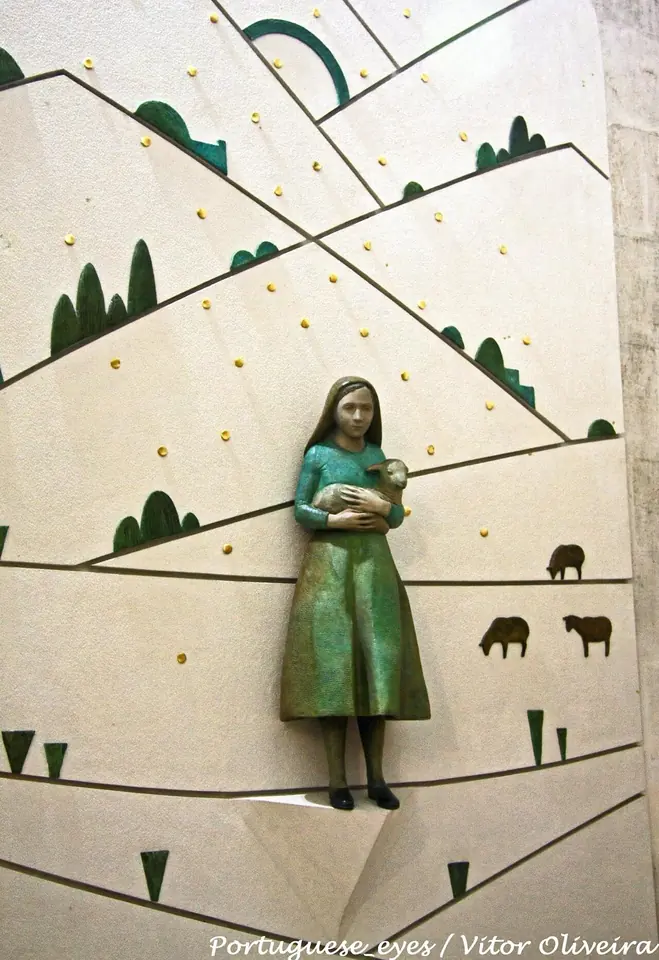

Symbols of Our Lady of Fátima in art
Almost every image of Our Lady of Fátima copies, more or less closely, the wooden statue in the Chapel of the Apparitions. Look for these features:
- White dress and mantle, covering her head and falling to her feet, with gold edging along the borders. Many statues add a small gold star near the hem.
- Hands joined in prayer at her breast, with a white rosary hanging from them, the prayer she asked for in every apparition.
- A small holm oak under her feet, often with a little cloud: the tree in the Cova da Iria over which she stood.
- The three shepherd children kneeling before her, often with a few sheep, in paintings and statue groups.
- A heart surrounded by thorns, sometimes shown on her breast, for the Immaculate Heart she revealed in June 1917 and at Pontevedra.
- A crown: since 1946 the statue at Fátima has been crowned on great feast days, and many copies wear one.
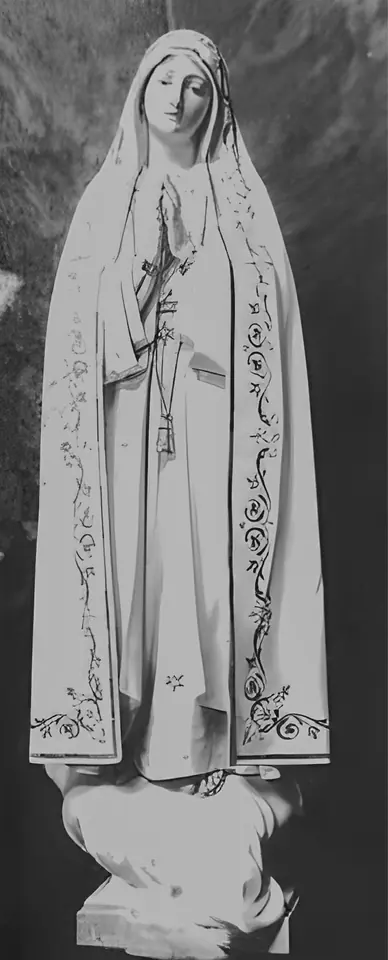

The statue was carved in Brazilian cedar by José Ferreira Thedim, a sculptor from São Mamede do Coronado, and given in 1920 by a devotee from Torres Novas. It is 1.04 meters (about 3 feet 5 inches) tall. A second statue, made according to Lúcia's instructions and crowned on May 13, 1947, became the Pilgrim Statue, which has visited 64 countries.
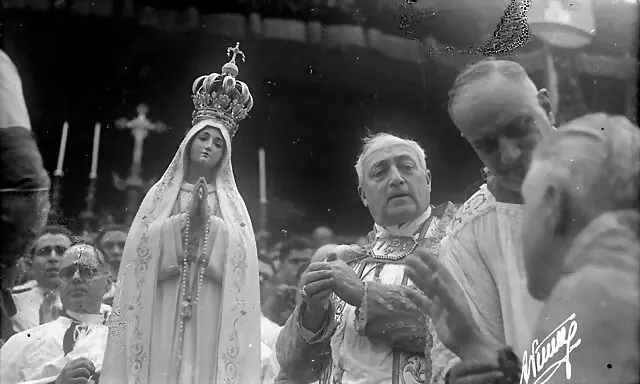

The Sanctuary of Fátima
The Chapel of the Apparitions
The little chapel the Lady asked for was built between April and June 1919 on the spot of the apparitions, with the statue's pedestal marking where the holm oak stood.
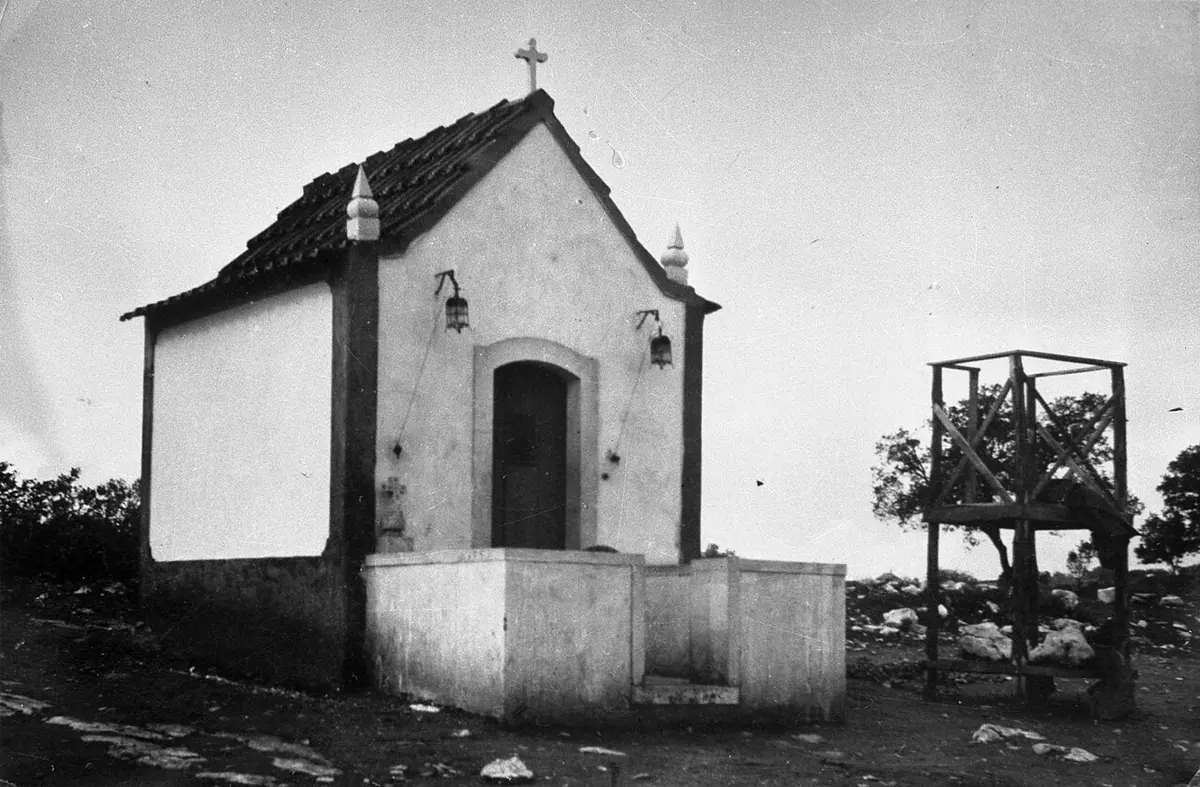

On the morning of March 6, 1922, it was blown up with dynamite. It was rebuilt and reopened on January 13, 1923.
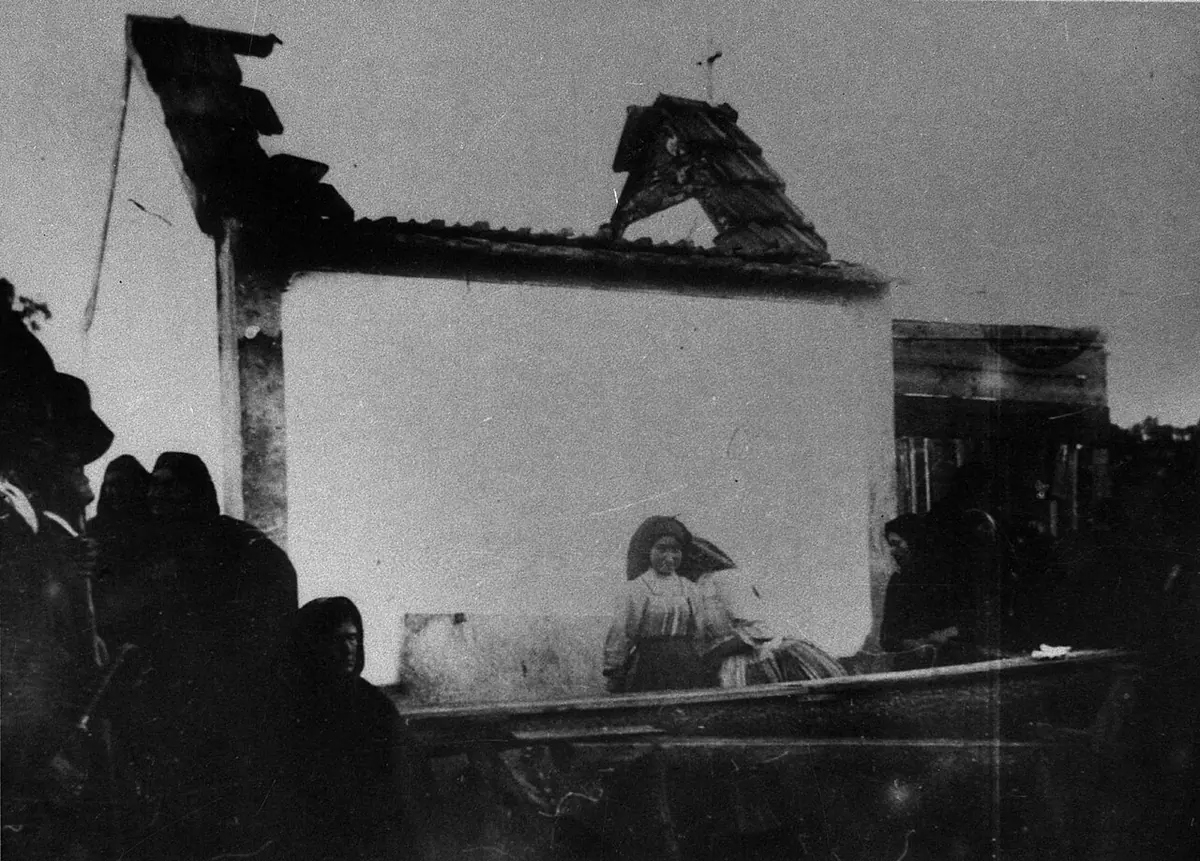

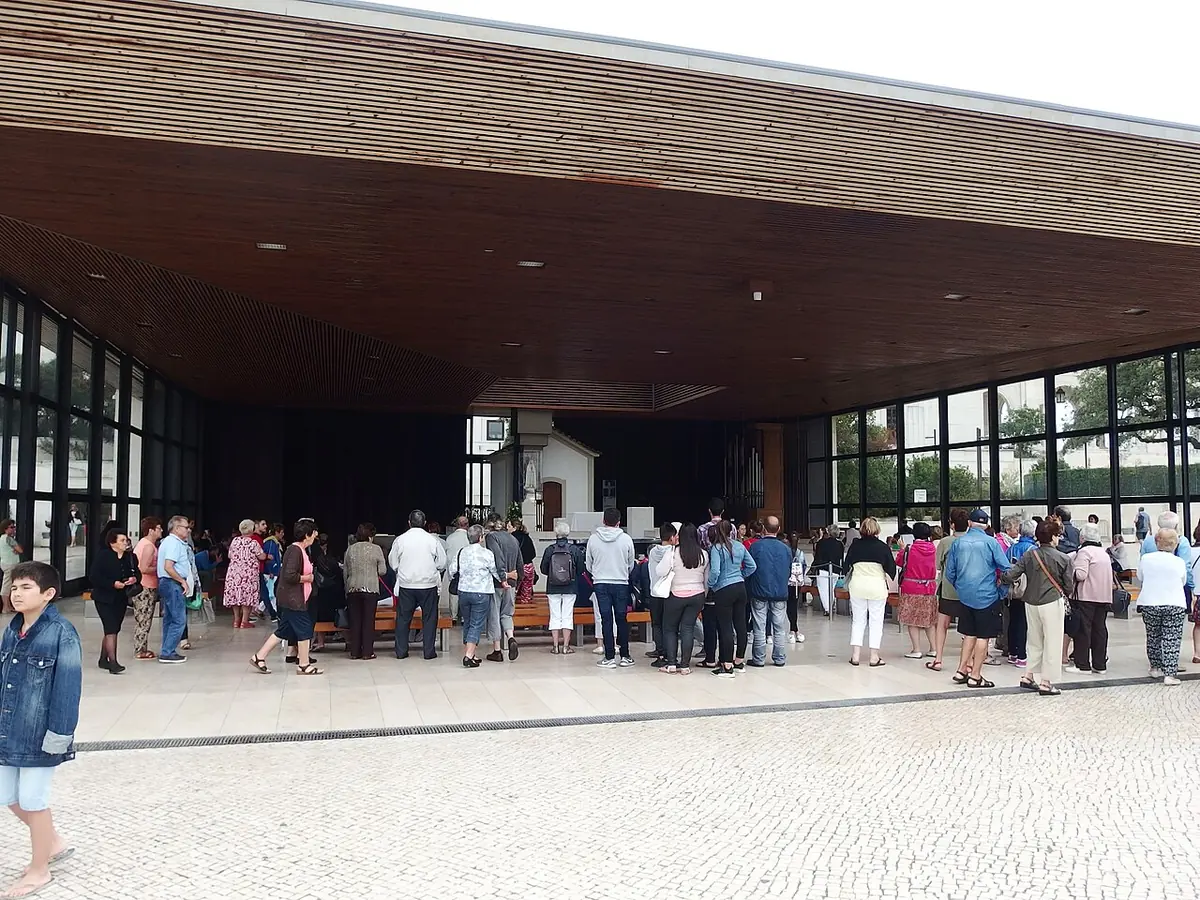
It is still a simple country chapel, now sheltered by a large open porch added for John Paul II's first visit in 1982.

The bullet in the crown
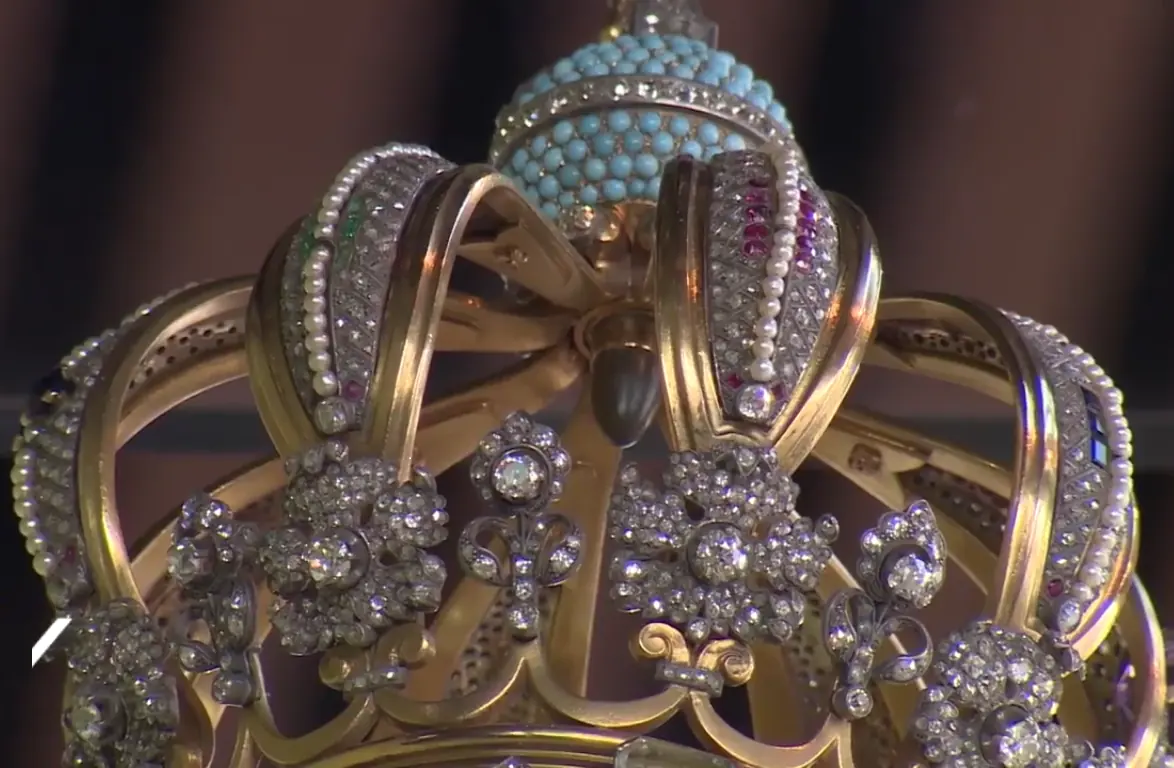
The statue's gold crown, given by the women of Portugal in 1942, weighs 1.2 kilograms and holds 313 pearls and 2,679 precious stones. According to the sanctuary, the bullet taken from John Paul II's body after the attack of May 13, 1981, which he gave to the shrine on March 26, 1984, was set into the crown in 1989. (The Vatican's 2000 statement describes it as the bullet "which had remained in the jeep.") John Paul II came to Fátima on May 13, 1982, a year after the attack, to give thanks.

The basilicas
The Basilica of Our Lady of the Rosary stands where the children were building their little wall when the first flash of light came. Its first stone was blessed on May 13, 1928, and it was dedicated on October 7, 1953, with a bell tower 65 meters tall. Francisco has rested in one arm of its transept since 1952, Jacinta in the other since 1951, and Lúcia beside Jacinta since 2006.


Across the vast prayer square, the round Basilica of the Most Holy Trinity, designed by the Greek architect Alexandros Tombazis, was dedicated on October 12, 2007, and seats 8,633 people. Near the chapel, the old large holm oak under which the children and the first pilgrims prayed the Rosary still grows; the sanctuary notes that the Lady did not appear over it.
Feast day and pilgrimages
The Church keeps May 13 as the optional memorial of Our Lady of Fátima on the General Roman Calendar. See the feast day calendar.
Paul VI came in 1967 for the fiftieth anniversary, John Paul II in 1982, 1991 and 2000, and Francis in 2017 for the centenary. See also Our Lady of Lourdes, the other great modern apparition, and Our Lady of Guadalupe.
Fátima prayers
The prayers below are published by the Shrine of Fátima as the prayers taught at the apparitions. Lúcia said the first two came from the angel in 1916.
The Pardon Prayer (taught by the Angel):
My God, I believe, I adore, I hope and I love You! I ask pardon of You for those who do not believe, do not adore, do not hope and do not love You!
The Angel's prayer to the Holy Trinity:
Most Holy Trinity, Father, Son and Holy Spirit, I adore You profoundly and I offer You the most precious Body, Blood, Soul and Divinity of Jesus Christ, present in all the tabernacles of the world, in reparation for the outrages, sacrileges and indifference with which He is offended. And through the infinite merits of the Sacred Heart and the Immaculate Heart of Mary, I beg the conversion of poor sinners.
The Fátima Prayer, said after each decade of the Rosary (taught by Our Lady, July 13, 1917):
O my Jesus, forgive us, save us from the fire of hell; lead all souls to Heaven, especially those who are most in need.
The Sacrifice Prayer (taught by Our Lady):
O Jesus, it is for love of You, and for the conversion of sinners and in reparation for the sins committed against the Immaculate Heart of Mary!
The collect for the memorial of Our Lady of Fátima, from the Roman Missal:
O God, who chose the Mother of your Son to be our Mother also, grant us that, persevering in penance and prayer for the salvation of the world, we may further more effectively each day the reign of Christ. Who lives and reigns with you in the unity of the Holy Spirit, God, for ever and ever.
Frequently asked questions
What happened at Fátima in 1917?
Three shepherd children, Lúcia (10), Francisco (9) and Jacinta (7), said that a Lady "more brilliant than the sun" appeared to them at the Cova da Iria on May 13, 1917, and on the 13th of each month through October (in August on the 19th, at Valinhos). She asked them to pray the Rosary every day for peace and the end of the war. On October 13, about 50,000 to 70,000 people gathered, and many reported seeing the sun "dance."
What are the three secrets of Fátima?
They are three parts of one message Lúcia said the Lady gave on July 13, 1917. The first was a vision of hell. The second spoke of devotion to the Immaculate Heart of Mary, another war and the consecration of Russia. The third, written down in 1944 and published by the Vatican in 2000, was a vision of a "Bishop dressed in White" killed with many others on a mountain under a cross.
What was the Miracle of the Sun?
On October 13, 1917, after a morning of rain, many in the crowd at the Cova da Iria saw the sun turn pale, spin, change color and seem to fall toward the earth. The anticlerical Lisbon daily O Século reported that "the sun trembled, made sudden incredible movements outside all cosmic laws." Not everyone saw it, and the Church has never formally defined it as a miracle; it is a reported event.
Is Fátima approved by the Catholic Church?
Yes. After a diocesan canonical inquiry, Bishop José Alves Correia da Silva of Leiria declared the visions of 1917 "worthy of belief" on October 13, 1930. Paul VI, John Paul II and Francis made pilgrimages there, and Francisco and Jacinta Marto were canonized in 2017. As with all private revelations, Catholics are not required to believe it.
When is the feast of Our Lady of Fátima?
May 13, the anniversary of the first apparition. It is an optional memorial on the General Roman Calendar.
What are the Five First Saturdays?
A devotion Lúcia said Mary asked for in Pontevedra, Spain, on December 10, 1925. On the first Saturday of five months in a row, Catholics go to confession, receive Communion, pray five decades of the Rosary and spend fifteen minutes meditating on its mysteries, all in reparation to the Immaculate Heart of Mary.
Why is a bullet in the crown of Our Lady of Fátima?
Pope John Paul II was shot in St. Peter's Square on May 13, 1981, the anniversary of the first apparition, and believed Our Lady of Fátima saved his life. He gave the sanctuary the bullet, and in 1989 it was set in the gold crown of the statue in the Chapel of the Apparitions.
Where are Lúcia, Francisco and Jacinta buried?
In the Basilica of Our Lady of the Rosary at the sanctuary of Fátima. Francisco lies on one side of the transept, and Jacinta and Lúcia on the other.
Sources
- Congregation for the Doctrine of the Faith: The Message of Fatima (June 26, 2000)
- Shrine of Fatima: Narrative of the Apparitions
- Shrine of Fatima: Chronology of the three seers
- Shrine of Fatima: Places of the apparitions
- Shrine of Fatima: Places of cult and prayer
- Shrine of Fatima: First Saturdays
- Shrine of Fatima: Fatima prayers
- Shrine of Fatima: Pilgrim Statue
- John De Marchi, The True Story of Fatima (1956), EWTN Library (archived copy)
- Pope Francis, Homily at the Canonization of Francisco and Jacinta Marto, Fátima, May 13, 2017
- CBS News (AP): Brazilian boy's survival after brain injury is Fatima "miracle," parents say (May 11, 2017)
- Catholic Culture: Optional Memorial of Our Lady of Fatima (collect)
- Liturgy Office of England and Wales: Universal Calendar, May